light RENAULT MASTER 2018 Owners Manual
[x] Cancel search | Manufacturer: RENAULT, Model Year: 2018, Model line: MASTER, Model: RENAULT MASTER 2018Pages: 290, PDF Size: 7.1 MB
Page 231 of 290
5.17
CHANGING A WHEEL: jack (2/2)
If you have a puncture, re-
place the wheel as soon as
possible.
A tyre which has been
punctured should always be inspec-
ted (and repaired, where possible)
by a specialist.
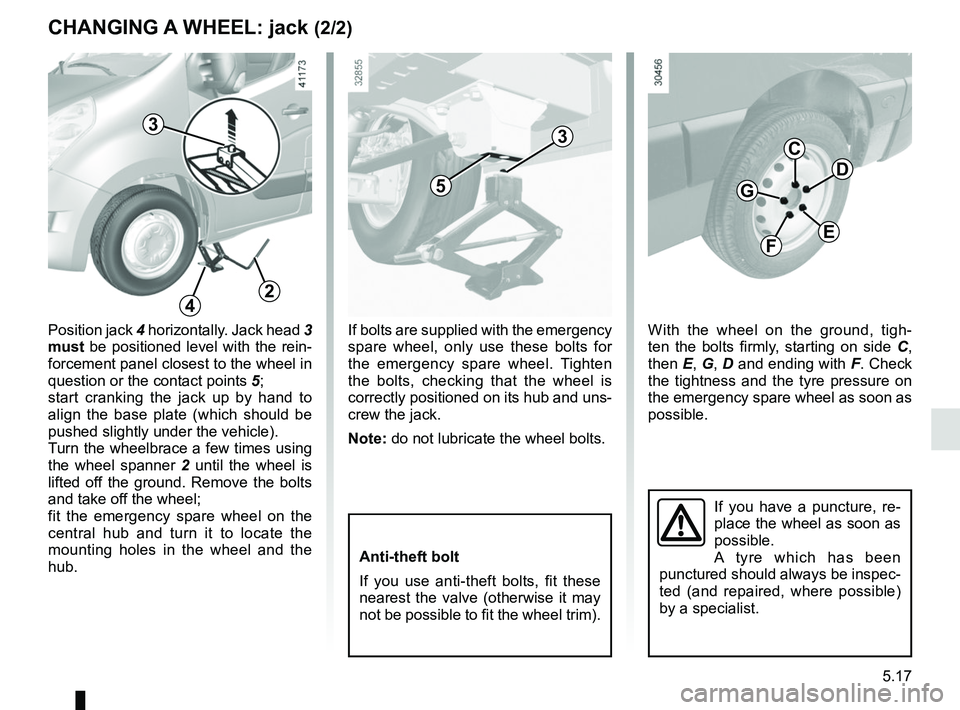
With the wheel on the ground, tigh-
ten the bolts firmly, starting on side C,
then E, G, D and ending with F. Check
the tightness and the tyre pressure on
the emergency spare wheel as soon as
possible.
C
E
G
D
F
If bolts are supplied with the emergency
spare wheel, only use these bolts for
the emergency spare wheel. Tighten
the bolts, checking that the wheel is
correctly positioned on its hub and uns-
crew the jack.
Note: do not lubricate the wheel bolts.
Anti-theft bolt
If you use anti-theft bolts, fit these
nearest the valve (otherwise it may
not be possible to fit the wheel trim).
Position jack 4 horizontally. Jack head 3
must be positioned level with the rein-
forcement panel closest to the wheel in
question or the contact points 5;
start cranking the jack up by hand to
align the base plate (which should be
pushed slightly under the vehicle).
Turn the wheelbrace a few times using
the wheel spanner 2 until the wheel is
lifted off the ground. Remove the bolts
and take off the wheel;
fit the emergency spare wheel on the
central hub and turn it to locate the
mounting holes in the wheel and the
hub.
3
5
3
24
Page 233 of 290
5.19
TYRES (2/3)
Tyre pressures
Adhere to the tyre pressures (including
the emergency spare wheel). The tyre
pressures should be checked at least
once a month and additionally before
any long journey (refer to the label af-
fixed to the edge of the driver’s door).
Incorrect tyre pressures
lead to abnormal tyre wear
and unusually hot running.
These are factors which
may seriously affect safety and lead
to:
– poor road holding,
– risk of bursting or tread separa- tion.
The pressure depends on the load
and the speed of use. Adjust the
pressure according to the condi-
tions of use (refer to the label affixed
to the edge of the driver’s door).
Please be aware that a
poorly tightened or miss-
ing valve cap can make the
tyres less airtight and lead
to pressure loss.
Always use valve caps identical to
those fitted originally and tighten
them fully.
Pressures should be checked when the
tyres are cold; ignore higher pressures
which may be reached in hot weather
or following a fast journey.
If tyre pressures cannot be checked
when the tyres are cold, the normal
pressures must be increased by 0.2 to
0.3 bar (or 3 PSI).
Never deflate a hot tyre.
Dual wheel versions
To inflate the outer wheel, it is recom-
mended that the inflation tube is passed
between the two wheels. Vehicle fitted with a tyre pressure
loss warning system
If underinflated (puncture, low pres-
sure, etc.), the warning light
on
the instrument panel comes on, see
“Tyre pressure loss warning system” in
Section 2.
Changing wheels around
This practice is not recommended.
Emergency spare wheel
Refer to the information on the
“Emergency spare wheel” and
“Changing a wheel” in Section 5.
Page 235 of 290
5.21
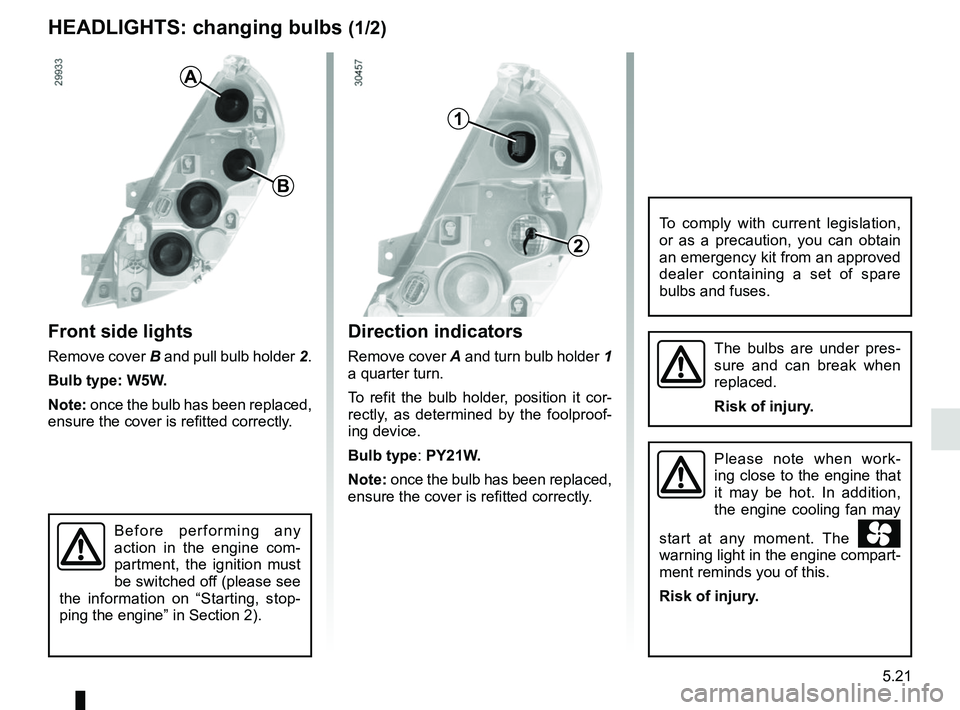
Direction indicators
Remove cover A and turn bulb holder 1
a quarter turn.
To refit the bulb holder, position it cor-
rectly, as determined by the foolproof-
ing device.
Bulb type: PY21W.
Note: once the bulb has been replaced,
ensure the cover is refitted correctly.
HEADLIGHTS: changing bulbs (1/2)
Front side lights
Remove cover B and pull bulb holder 2.
Bulb type: W5W.
Note: once the bulb has been replaced,
ensure the cover is refitted correctly.The bulbs are under pres-
sure and can break when
replaced.
Risk of injury.
To comply with current legislation,
or as a precaution, you can obtain
an emergency kit from an approved
dealer containing a set of spare
bulbs and fuses.
B
A
2
1
Please note when work-
ing close to the engine that
it may be hot. In addition,
the engine cooling fan may
start at any moment. The
warning light in the engine compart-
ment reminds you of this.
Risk of injury.Before performing any
action in the engine com-
partment, the ignition must
be switched off (please see
the information on “Starting, stop-
ping the engine” in Section 2).
Page 236 of 290
5.22
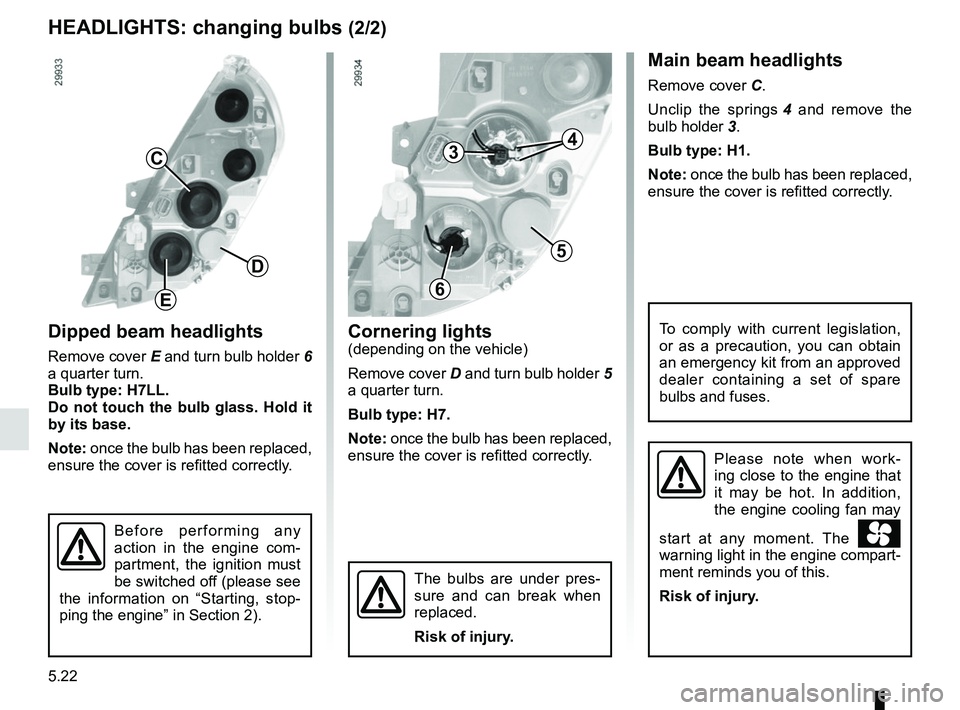
Cornering lights(depending on the vehicle)
Remove cover D and turn bulb holder 5
a quarter turn.
Bulb type: H7.
Note: once the bulb has been replaced,
ensure the cover is refitted correctly.Dipped beam headlights
Remove cover E and turn bulb holder 6
a quarter turn.
Bulb type: H7LL.
Do not touch the bulb glass. Hold it
by its base.
Note: once the bulb has been replaced,
ensure the cover is refitted correctly.
Main beam headlights
Remove cover C.
Unclip the springs 4 and remove the
bulb holder 3.
Bulb type: H1.
Note: once the bulb has been replaced,
ensure the cover is refitted correctly.
The bulbs are under pres-
sure and can break when
replaced.
Risk of injury.
To comply with current legislation,
or as a precaution, you can obtain
an emergency kit from an approved
dealer containing a set of spare
bulbs and fuses.
HEADLIGHTS: changing bulbs (2/2)
C
D
E
3
5
6
4
Please note when work-
ing close to the engine that
it may be hot. In addition,
the engine cooling fan may
start at any moment. The
warning light in the engine compart-
ment reminds you of this.
Risk of injury.Before performing any
action in the engine com-
partment, the ignition must
be switched off (please see
the information on “Starting, stop-
ping the engine” in Section 2).
Page 237 of 290
5.23
HEADLIGHTS: front fog lights
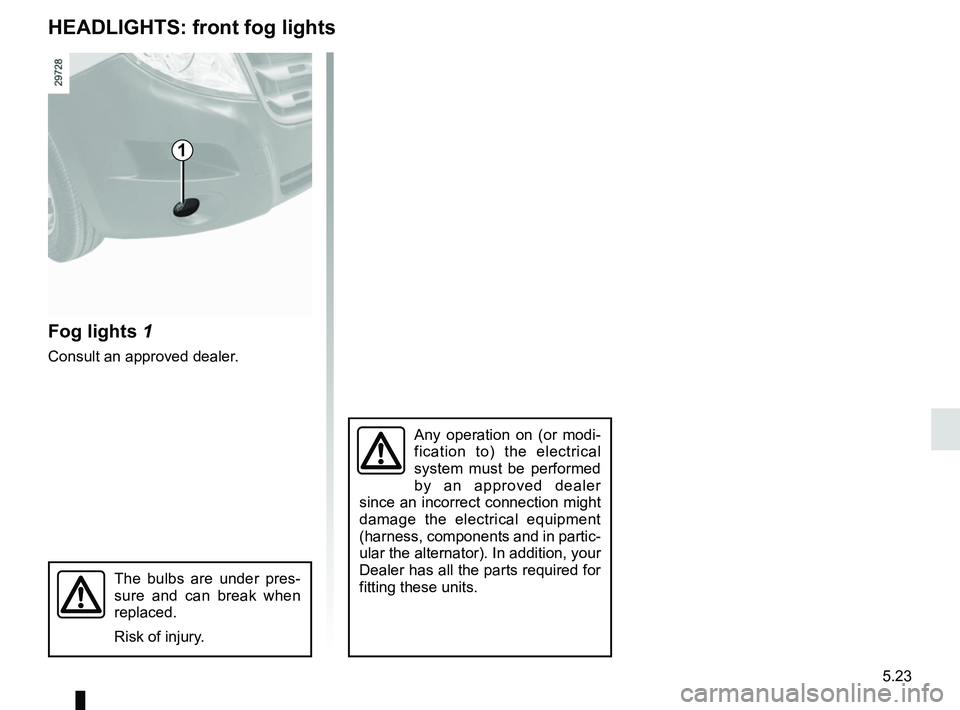
Fog lights 1
Consult an approved dealer.
Any operation on (or modi-
fication to) the electrical
system must be performed
by an approved dealer
since an incorrect connection might
damage the electrical equipment
(harness, components and in partic-
ular the alternator). In addition, your
Dealer has all the parts required for
fitting these units.
The bulbs are under pres-
sure and can break when
replaced.
Risk of injury.
1
Page 238 of 290
5.24
SIDE LIGHTS: changing bulbs
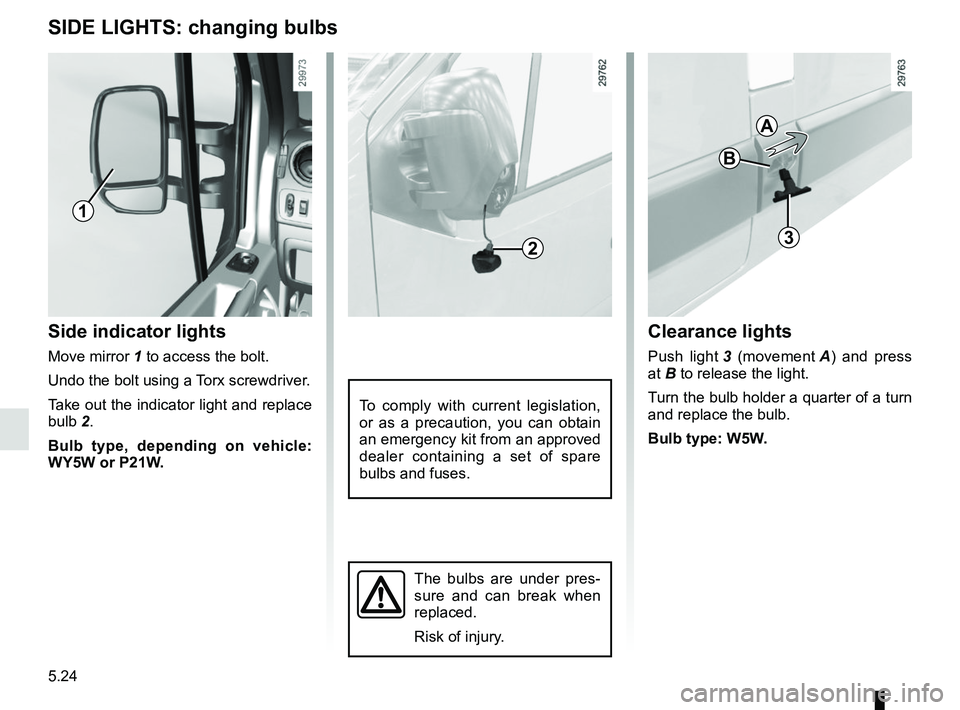
Side indicator lights
Move mirror 1 to access the bolt.
Undo the bolt using a Torx screwdriver.
Take out the indicator light and replace
bulb 2.Bulb type, depending on vehicle:
WY5W or P21W.
1
23
Clearance lights
Push light 3 (movement A) and press
at B to release the light.
Turn the bulb holder a quarter of a turn
and replace the bulb.
Bulb type: W5W.
To comply with current legislation,
or as a precaution, you can obtain
an emergency kit from an approved
dealer containing a set of spare
bulbs and fuses.
The bulbs are under pres-
sure and can break when
replaced.
Risk of injury.
B
A
Page 239 of 290
5.25
REAR LIGHTS: changing bulbs (1/2)
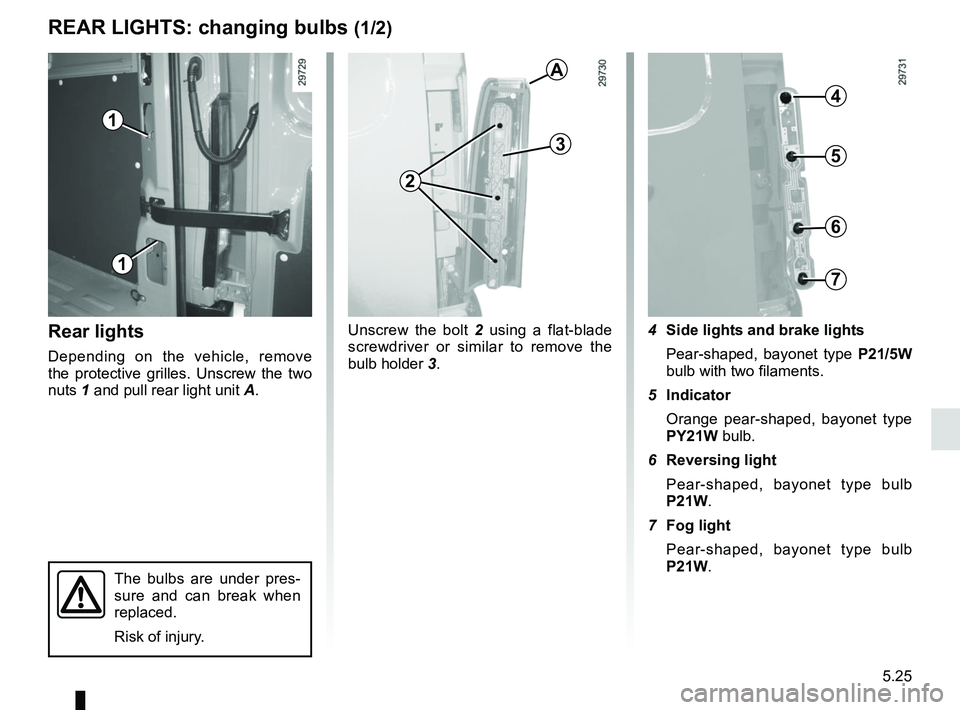
Rear lights
Depending on the vehicle, remove
the protective grilles. Unscrew the two
nuts 1 and pull rear light unit A.Unscrew the bolt
2 using a flat-blade
screwdriver or similar to remove the
bulb holder 3. 4 Side lights and brake lights
Pear-shaped, bayonet type P21/5W
bulb with two filaments.
5 Indicator Orange pear-shaped, bayonet type
PY21W bulb.
6 Reversing light
Pear-shaped, bayonet type bulb
P21W.
7 Fog light Pear-shaped, bayonet type bulb
P21W.
The bulbs are under pres-
sure and can break when
replaced.
Risk of injury.
1
1
A
2
3
4
5
6
7
Page 240 of 290
5.26
REAR LIGHTS: changing bulbs (2/2)
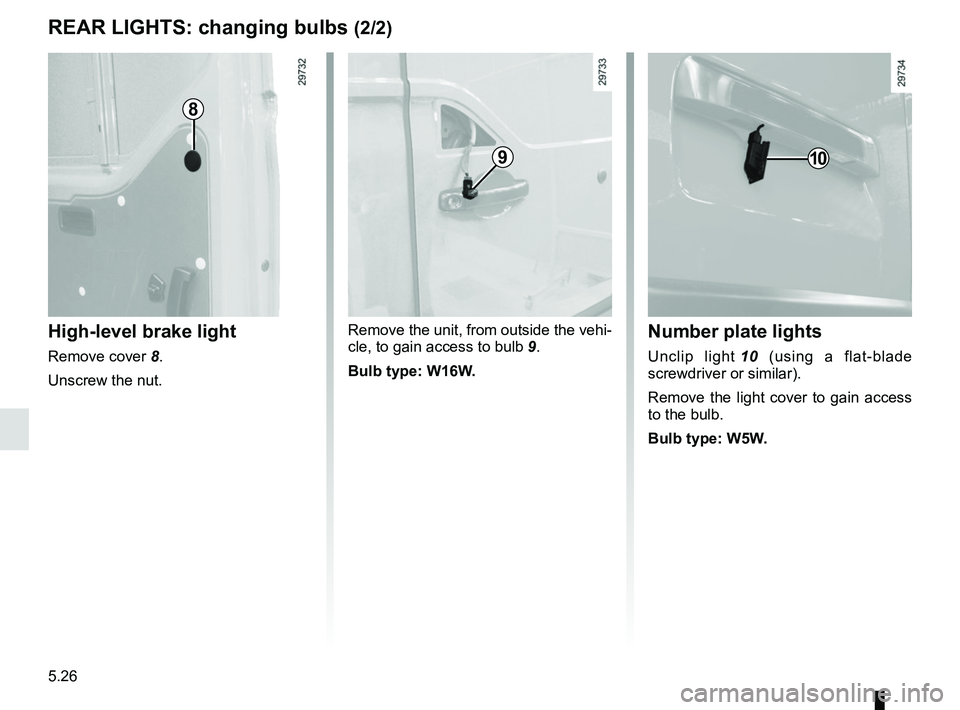
High-level brake light
Remove cover 8.
Unscrew the nut. Remove the unit, from outside the vehi-
cle, to gain access to bulb
9.
Bulb type: W16W.
Number plate lights
Unclip light 10 (using a flat-blade
screwdriver or similar).
Remove the light cover to gain access
to the bulb.
Bulb type: W5W.
8
910
Page 241 of 290

5.27
INTERIOR LIGHTING: changing bulbs
Courtesy light
Unclip the ceiling light diffuser 1 using a
flat blade screwdriver or similar.
Pull the bulb to remove it from its hous-
ing.
Bulb type: W6W
Replace the bulb and refit the lens.
Rear lights
Unclip the ceiling light diffuser using a
flat blade screwdriver or similar.
Pull the bulb to remove it from its hous-
ing.
Type of bulb 4 : W6W
Replace the bulb and refit the lens.
1
4
Special features for vehicles fitted
with a reading lamp
Type of bulb 2: festoon 10W
Type of reading lamp 3: W5W
23
Page 243 of 290
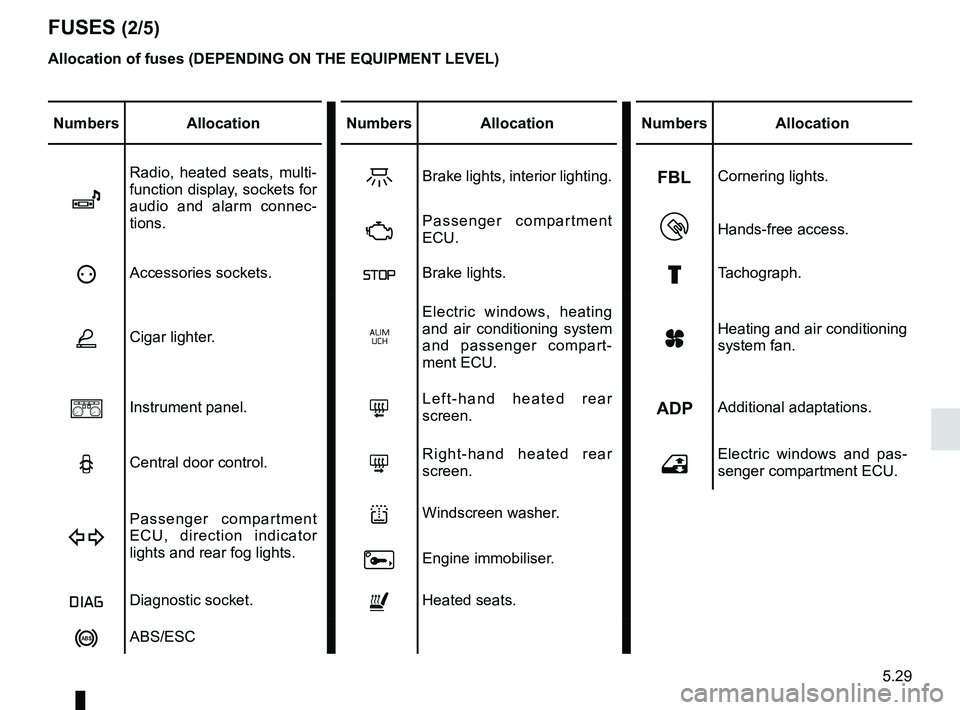
5.29
FUSES (2/5)
Allocation of fuses (DEPENDING ON THE EQUIPMENT LEVEL)
Numbers AllocationNumbers Allocation Numbers Allocation
î
Radio, heated seats, multi-
function display, sockets for
audio and alarm connec-
tions.ZBrake lights, interior lighting.Cornering lights.
ÄPassenger compartment
ECU.Hands-free access.
ëAccessories sockets.ßBrake lights.£Tachograph.
ÆCigar lighter.‚
Electric windows, heating
and air conditioning system
and passenger compart-
ment ECU.
yHeating and air conditioning
system fan.
aInstrument panel.8Left-hand heated rear
screen.Additional adaptations.
NCentral door control.7Right-hand heated rear
screen.hElectric windows and pas-
senger compartment ECU.
D
Passenger compartment
ECU, direction indicator
lights and rear fog lights.lWindscreen washer.
0Engine immobiliser.
ÎDiagnostic socket.ñHeated seats.
nABS/ESC