gearbox RENAULT MASTER 2018 User Guide
[x] Cancel search | Manufacturer: RENAULT, Model Year: 2018, Model line: MASTER, Model: RENAULT MASTER 2018Pages: 290, PDF Size: 7.1 MB
Page 161 of 290
2.45
SEQUENTIAL GEARBOX (1/5)
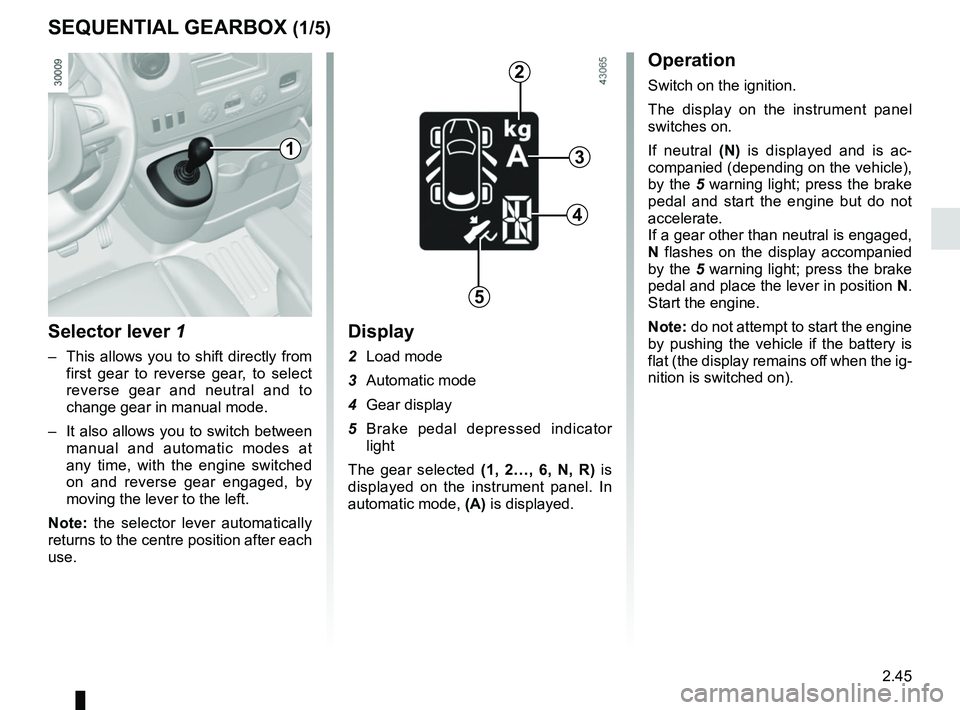
Selector lever 1
– This allows you to shift directly from first gear to reverse gear, to select
reverse gear and neutral and to
change gear in manual mode.
– It also allows you to switch between manual and automatic modes at
any time, with the engine switched
on and reverse gear engaged, by
moving the lever to the left.
Note: the selector lever automatically
returns to the centre position after each
use.
Display
2 Load mode
3 Automatic mode
4 Gear display
5 Brake pedal depressed indicator light
The gear selected (1, 2…, 6, N, R) is
displayed on the instrument panel. In
automatic mode, (A) is displayed.
Operation
Switch on the ignition.
The display on the instrument panel
switches on.
If neutral (N) is displayed and is ac-
companied (depending on the vehicle),
by the 5 warning light; press the brake
pedal and start the engine but do not
accelerate.
If a gear other than neutral is engaged,
N flashes on the display accompanied
by the 5 warning light; press the brake
pedal and place the lever in position N.
Start the engine.
Note: do not attempt to start the engine
by pushing the vehicle if the battery is
flat (the display remains off when the ig-
nition is switched on).
1
2
3
4
5
Page 162 of 290
2.46
Reverse gear (vehicle stationary)
– Brake pedal depressed. Push the
selector lever towards the right and
to the rear as shown on the base
of the lever, and then release it.
Reverse gear is engaged and the
letter R appears on the display.
– Release the brake pedal: – the engine’s idle speed is suffi-
cient for parking manoeuvres;
– accelerate gently to reverse.
You may shift from reverse gear to a
forwards gear by pushing the lever for-
wards once the vehicle is stationary.
Note: When the vehicle is stationary,
you must depress the brake pedal to
engage or disengage a gear. Otherwise,
warning light 5 will come on.
SEQUENTIAL GEARBOX (2/5)
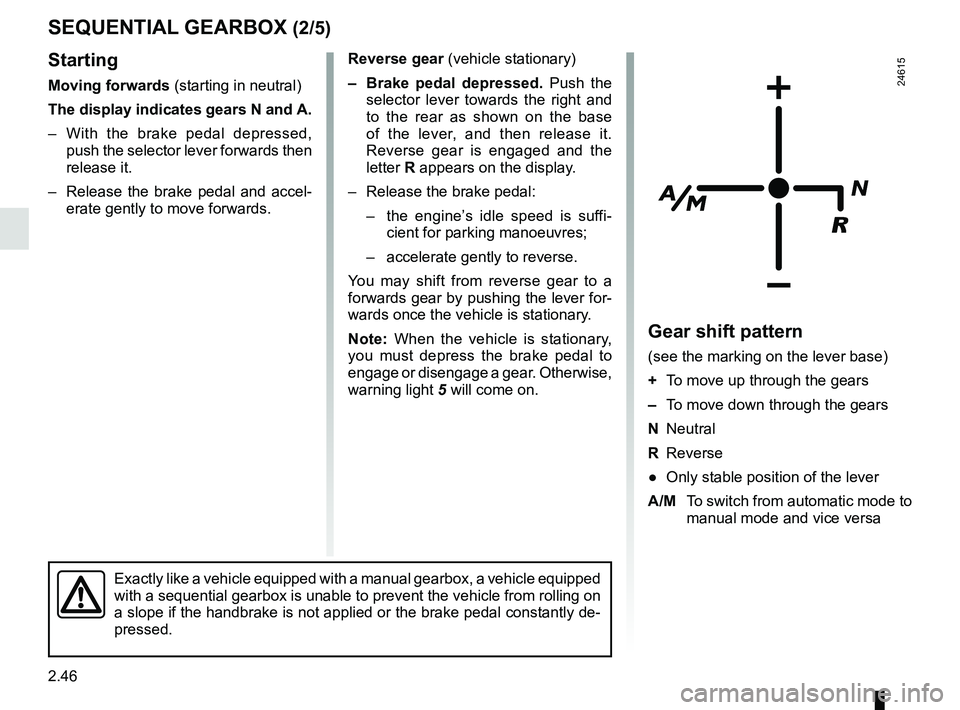
Gear shift pattern
(see the marking on the lever base)
+ To move up through the gears
– To move down through the gears
N Neutral
R Reverse
● Only stable position of the lever
A/M To switch from automatic mode to
manual mode and vice versa
24615
Exactly like a vehicle equipped with a manual gearbox, a vehicle equippe\
d
with a sequential gearbox is unable to prevent the vehicle from rolling \
on
a slope if the handbrake is not applied or the brake pedal constantly de\
-
pressed.
Starting
Moving forwards (starting in neutral)
The display indicates gears N and A.
– With the brake pedal depressed, push the selector lever forwards then
release it.
– Release the brake pedal and accel- erate gently to move forwards.
Page 163 of 290
2.47
SEQUENTIAL GEARBOX (3/5)
Operation in semiautomatic
mode (manual)
This mode can be activated at any time
when driving by pushing the lever to the
left. The mode is switched without shift-
ing up a gear.
You can initiate gear changes using the
selector lever.
To shift up a gear, push the selector
lever forwards; the accelerator pedal
does not have to be lifted.
To shift down a gear, push the selector
lever backwards; the accelerator pedal
does not have to be lifted. The system will not tolerate a series
of up or down changes that cause the
engine to underrev or overrev.
By pushing the lever forwards twice
you can move up two gears at a time
(except if underrevving). By pushing
the lever backwards twice you can
move down two gears at a time (unless
this causes overrevving).
When decelerating with the foot off
the pedal, the gears will automatically
drop to the low engine speed limit to
avoid stalling. First gear automatically
shifts below a certain speed limit. You
can stop the vehicle at red lights or
junctions etc. by depressing the brake
pedal; there is no need to change to
neutral (N).
The vehicle will move off again:
– either slowly, if you release the brake
without accelerating (e.g. when in a
traffic jam);
– or quickly, if you release the brake and accelerate.
Note: neutral may only be selected
when the vehicle is being driven or is
stationary when the brake pedal is
depressed (if you forget, warning
light 5 will come on) .
Push the gear selector lever to the right
to engage neutral.
If the engine speed is too high or too
low, the system will choose the opti-
mum gear.
Semiautomatic mode can be deacti-
vated and reactivated at any time when
the engine is running by pushing the
lever to the left.
Page 164 of 290
2.48
SEQUENTIAL GEARBOX (4/5)
Operation in automatic mode
Automatic mode is selected by default
every time the ignition is switched on.
The letter A appears on the display.
The vehicle is controlled using the ac-
celerator and the brake. Gears will
change automatically at the correct
moment and at a suitable engine speed
because the automatic mode takes the
road surface and the chosen driving
style into consideration.
Gears may be shifted manually in this
mode. Pushing the lever forwards
or backwards shifts a gear upwards
(except if there is a risk of underrev-
ving) or downwards (except if there is a
risk of overrevving).
Note: automatic mode takes account
of:
– the position and speed of depression of the accelerator pedal to assess
driving style and select the optimum
gear;
– action on the brake pedal, to com- mence engine braking in preparation
for a downshift.
You can stop the vehicle at red lights,
with the gear engaged, by depressing
the brake pedal; there is no need to
change to neutral (N).
The vehicle will move off again:
– either slowly, if you release the brake without accelerating (e.g. when in a
traffic jam);
– or quickly, if you release the brake and accelerate.
Accelerating and overtaking
– Slowly depress the accelerator pedal to accelerate gradually;
The oil level in the automatic gear-
box system reservoir varies depend-
ing on use. Adding oil is strictly
forbidden (except by qualified ap-
proved network personnel).
– to obtain maximum vehicle per-
formance regardless of the mode
selected (automatic or manual),
quickly depress the accelerator
pedal beyond the kickdown point.
The speed with which you depress the
pedal will allow you to downshift ac-
cording to the vehicle’s capabilities.
Parking the vehicle
It is possible to park in gear (for exam-
ple, on a slope):
– with the ignition on, select a gear with your foot on the brake ;
– check that a gear other than N is dis- played on the instrument panel, then
remove the ignition key;
– apply the handbrake.
To disengage the gear, switch on the
ignition without starting the engine and
shift the selector lever to neutral with
the brake pedal depressed . Check
that N is displayed on the instrument
panel.
Page 165 of 290
2.49
SEQUENTIAL GEARBOX (5/5)
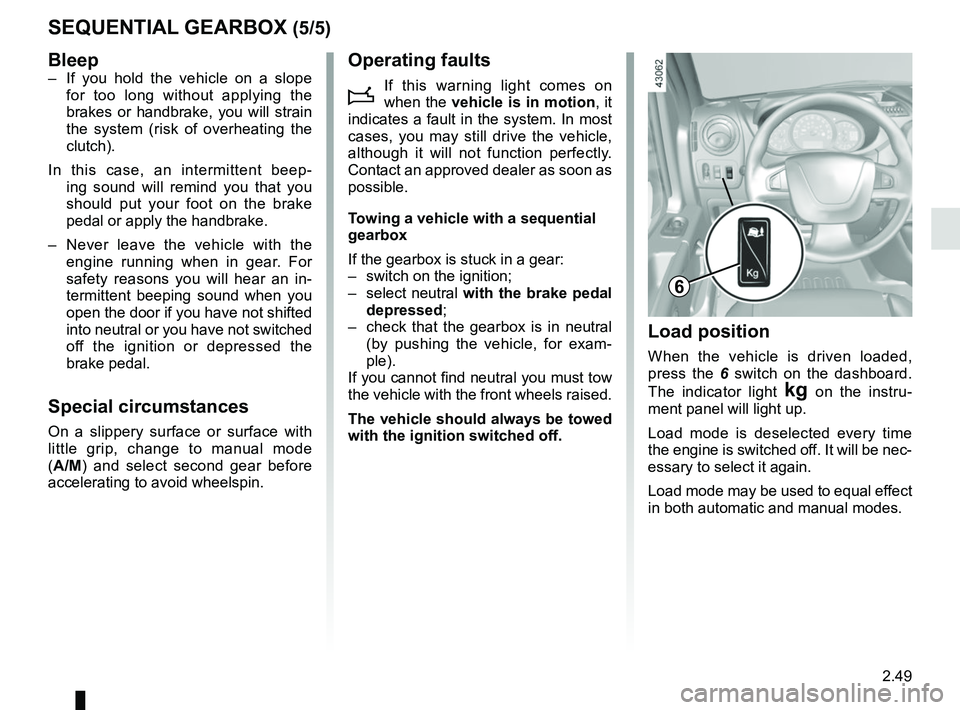
Load position
When the vehicle is driven loaded,
press the 6 switch on the dashboard.
The indicator light
§ on the instru-
ment panel will light up.
Load mode is deselected every time
the engine is switched off. It will be nec-
essary to select it again.
Load mode may be used to equal effect
in both automatic and manual modes.
6
Bleep– If you hold the vehicle on a slope for too long without applying the
brakes or handbrake, you will strain
the system (risk of overheating the
clutch).
In this case, an intermittent beep- ing sound will remind you that you
should put your foot on the brake
pedal or apply the handbrake.
– Never leave the vehicle with the engine running when in gear. For
safety reasons you will hear an in-
termittent beeping sound when you
open the door if you have not shifted
into neutral or you have not switched
off the ignition or depressed the
brake pedal.
Special circumstances
On a slippery surface or surface with
little grip, change to manual mode
(A/M) and select second gear before
accelerating to avoid wheelspin.
Operating faults
i
If this warning light comes on
when the vehicle is in motion , it
indicates a fault in the system. In most
cases, you may still drive the vehicle,
although it will not function perfectly.
Contact an approved dealer as soon as
possible.
Towing a vehicle with a sequential
gearbox
If the gearbox is stuck in a gear:
– switch on the ignition;
– select neutral with the brake pedal
depressed;
– check that the gearbox is in neutral (by pushing the vehicle, for exam-
ple).
If you cannot find neutral you must tow
the vehicle with the front wheels raised.
The vehicle should always be towed
with the ignition switched off.
Page 221 of 290
5.7
TYRE INFLATION KIT (3/6)
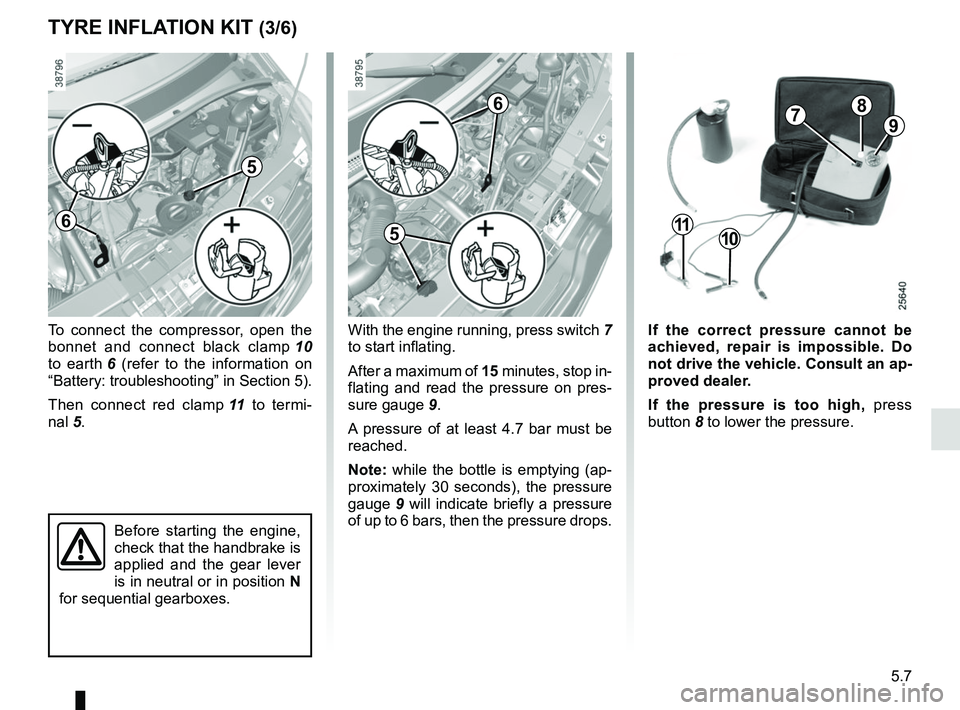
To connect the compressor, open the
bonnet and connect black clamp 10
to earth 6 (refer to the information on
“Battery: troubleshooting” in Section 5).
Then connect red clamp 11 to termi-
nal 5.
Before starting the engine,
check that the handbrake is
applied and the gear lever
is in neutral or in position N
for sequential gearboxes.
With the engine running, press switch 7
to start inflating.
After a maximum of 15 minutes, stop in-
flating and read the pressure on pres-
sure gauge 9.
A pressure of at least 4.7 bar must be
reached.
Note: while the bottle is emptying (ap-
proximately 30 seconds), the pressure
gauge 9 will indicate briefly a pressure
of up to 6 bars, then the pressure drops.
1110
7
If the correct pressure cannot be
achieved, repair is impossible. Do
not drive the vehicle. Consult an ap-
proved dealer.
If the pressure is too high, press
button 8 to lower the pressure.
8
9
5
6
6
5
Page 227 of 290
5.13
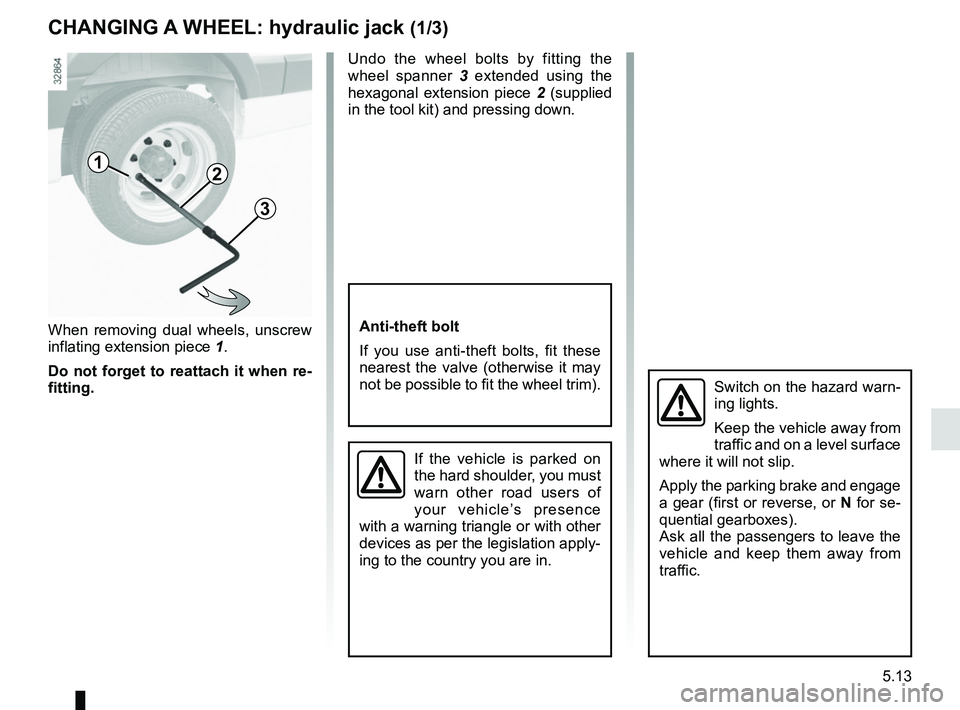
When removing dual wheels, unscrew
inflating extension piece 1.
Do not forget to reattach it when re-
fitting. Undo the wheel bolts by fitting the
wheel spanner
3 extended using the
hexagonal extension piece 2 (supplied
in the tool kit) and pressing down.
1
CHANGING A WHEEL: hydraulic jack (1/3)
Switch on the hazard warn-
ing lights.
Keep the vehicle away from
traffic and on a level surface
where it will not slip.
Apply the parking brake and engage
a gear (first or reverse, or N for se-
quential gearboxes).
Ask all the passengers to leave the
vehicle and keep them away from
traffic.
If the vehicle is parked on
the hard shoulder, you must
warn other road users of
your vehicle’s presence
with a warning triangle or with other
devices as per the legislation apply-
ing to the country you are in.
Anti-theft bolt
If you use anti-theft bolts, fit these
nearest the valve (otherwise it may
not be possible to fit the wheel trim).
2
3
Page 230 of 290
5.16
CHANGING A WHEEL: jack (1/2)
2
If the vehicle is parked on
the hard shoulder, you must
warn other road users of
your vehicle’s presence
with a warning triangle or with other
devices as per the legislation ap-
plying to the country you are in.
Switch on the hazard war-
ning lights.
Keep the vehicle away from
traffic and on a level surface
where it will not slip.
Apply the parking brake and engage
a gear (first or reverse, or N for se-
quential gearboxes).
Ask all the passengers to leave the
vehicle and keep them away from
traffic.
To prevent any risk of injury
or damage to the vehi-
cle, raise the jack until the
wheel you are replacing is
a maximum of 3 centimetres off the
ground.
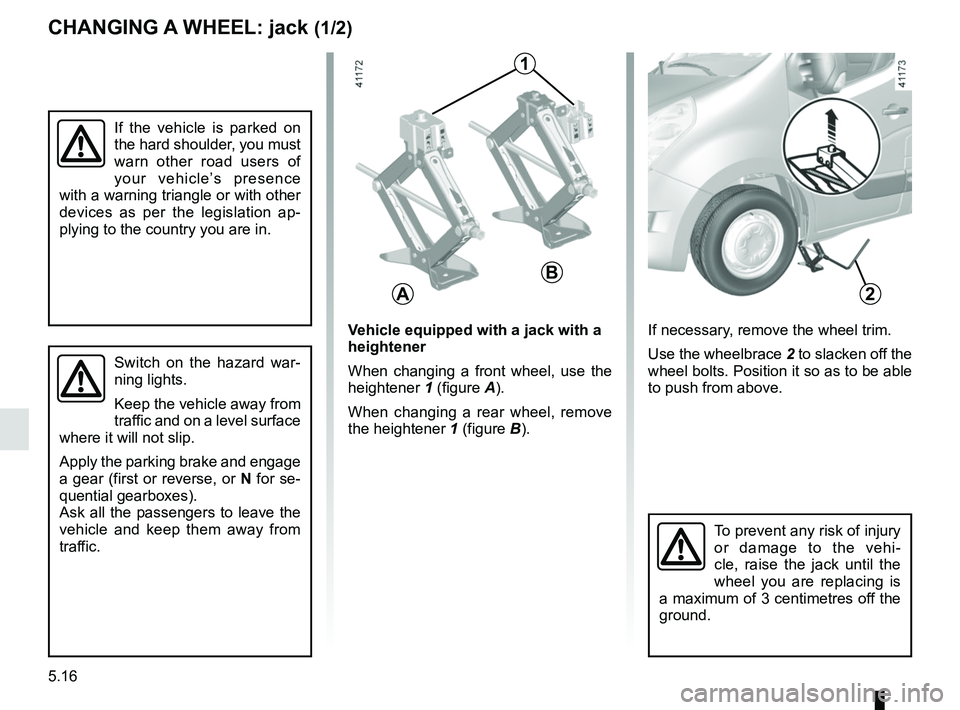
If necessary, remove the wheel trim.
Use the wheelbrace 2 to slacken off the
wheel bolts. Position it so as to be able
to push from above.Vehicle equipped with a jack with a
heightener
When changing a front wheel, use the
heightener 1 (figure A).
When changing a rear wheel, remove
the heightener 1 (figure B).
A
B
1
Page 252 of 290
5.38
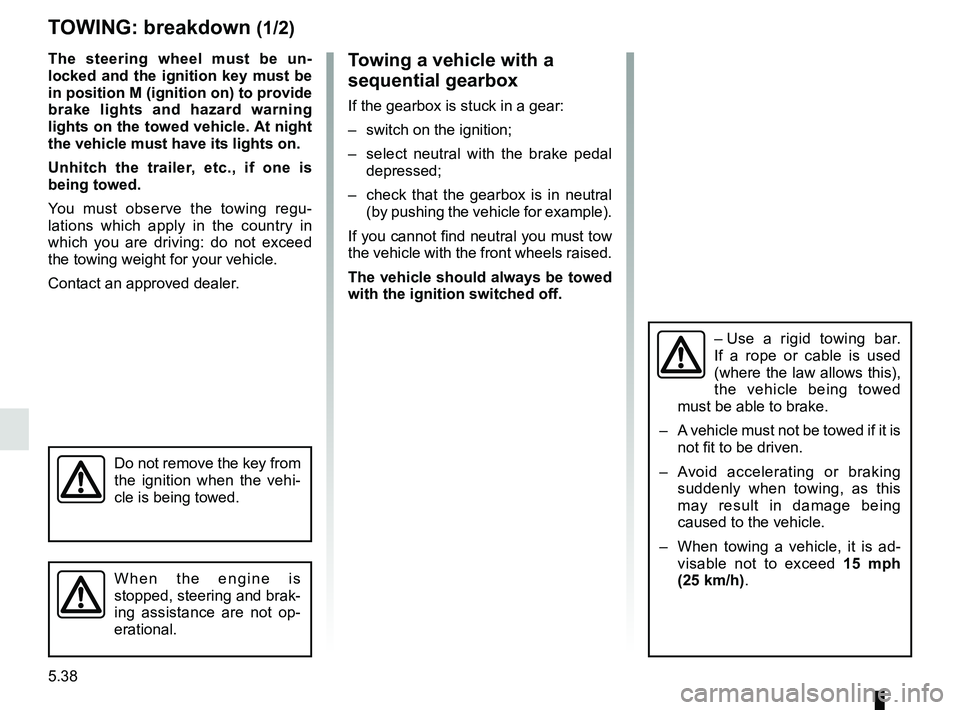
TOWING: breakdown (1/2)
The steering wheel must be un-
locked and the ignition key must be
in position M (ignition on) to provide
brake lights and hazard warning
lights on the towed vehicle. At night
the vehicle must have its lights on.
Unhitch the trailer, etc., if one is
being towed.
You must observe the towing regu-
lations which apply in the country in
which you are driving: do not exceed
the towing weight for your vehicle.
Contact an approved dealer.
– Use a rigid towing bar.
If a rope or cable is used
(where the law allows this),
the vehicle being towed
must be able to brake.
– A vehicle must not be towed if it is not fit to be driven.
– Avoid accelerating or braking suddenly when towing, as this
may result in damage being
caused to the vehicle.
– When towing a vehicle, it is ad- visable not to exceed 15 mph
(25 km/h).
When the engine is
stopped, steering and brak-
ing assistance are not op-
erational.
Do not remove the key from
the ignition when the vehi-
cle is being towed.
Towing a vehicle with a
sequential gearbox
If the gearbox is stuck in a gear:
– switch on the ignition;
– select neutral with the brake pedal depressed;
– check that the gearbox is in neutral (by pushing the vehicle for example).
If you cannot find neutral you must tow
the vehicle with the front wheels raised.
The vehicle should always be towed
with the ignition switched off.
Page 283 of 290

A
ABS ....................................................................\
...2.16 → 2.23
accessories...................................................................")
7.1
ALPHABETICAL INDEX (1/4)
A
ABS ....................................................................\
...2.16 → 2.23
accessories........................................................................\
5.41
accessories socket ............................................................ 3.19
AdBlue ...............................................................1.104 → 1.109
AdBlue additive..................................................1.104 → 1.109
additional systems to the seat belts................................... 1.31
additive (tank) ....................................................1.104 → 1.109
additive tank ......................................................1.104 → 1.109
adjusting the seats............................................................. 1.24
adjusting your driving position ........................................... 1.24
advice on antipollution ....................................................... 2.12
air bag....................................................................1.28 → 1.31
activating the front passenger air bags ............1.70 → 1.72
deactivating the front passenger air bags ........1.70 → 1.72
air conditioning ........................................................3.2 → 3.14
air vents ...................................................................... 3.2 – 3.3
anti-corrosion check ..............................................6.16 → 6.21
anti-corrosion protection .................................................... 4.14
anti-lock braking system: ABS ...............................2.16 → 2.23
antipollution advice .................................................................\
......... 2.12
ashtrays ...............................................................\
.............. 3.19
audible and visual signals................................................ 1.101
automatic gearbox selector lever...........................2.45 → 2.49
B
battery........................................................................\
........ 4.13 troubleshooting ................................................. 5.33 – 5.34
bonnet........................................................................\
.......... 4.2
brake fluid ........................................................................\
.... 4.8
bulbs changing ......................................5.21 – 5.22, 5.25 → 5.27
C
capacity of mechanical components........................4.8 → 4.10central door locking ........................... 1.2
→ 1.12, 1.15 → 1.18
changing a bulb .................................5.21 – 5.22, 5.25 → 5.27
changing a wheel........................ 5.2 → 5.4, 5.11 → 5.15, 5.17
changing gear .................................................................... 2.14
child restraint/seat 1.30, 1.33 – 1.34, 1.38 → 1.57, 1.70 → 1.72
child safety................... 1.33 – 1.34, 1.38 → 1.57, 1.70 → 1.72
child seats..........................................1.33 – 1.34, 1.38 → 1.57
children ................................................................... 1.33 – 1.34
cigar lighter ........................................................................\
3.19
cleaning: inside the vehicle .............................................. 4.17 – 4.18
clock ..................................................................\
................ 1.93
control instruments ................................................1.78 → 1.85
coolant ................................................................\
............... 1.83
courtesy light ............................................................ 3.17, 5.27
cruise control .........................................................2.33 → 2.36
cruise control-speed limiter....................................2.30 → 2.36
D
deadlocking the doors ......................................................... 1.7
demisting windscreen ..................................................3.4, 3.7 → 3.12
dimensions ................................................................. 6.6 – 6.7
dipstick................................................................\
........ 4.4 – 4.5
display .................................................................... 1.84 – 1.85
doors................................................... 1.13 – 1.14, 1.17 – 1.18
driver’s position .....................................................1.74 → 1.77
driving ...........................................2.2, 2.10, 2.16 → 2.26, 2.37
driving recommendations ........................................ 2.8 → 2.11
E
ECO driving .............................................................
2.8 → 2.11
ECO mode ........................................................................\
... 2.9
electric beam height adjustment ...................................... 1.100
electric windows ..................................................... 3.15 – 3.16
electronic stability control: ESC .............................2.16 → 2.23