spare RENAULT MASTER 2018 User Guide
[x] Cancel search | Manufacturer: RENAULT, Model Year: 2018, Model line: MASTER, Model: RENAULT MASTER 2018Pages: 290, PDF Size: 7.1 MB
Page 233 of 290
5.19
TYRES (2/3)
Tyre pressures
Adhere to the tyre pressures (including
the emergency spare wheel). The tyre
pressures should be checked at least
once a month and additionally before
any long journey (refer to the label af-
fixed to the edge of the driver’s door).
Incorrect tyre pressures
lead to abnormal tyre wear
and unusually hot running.
These are factors which
may seriously affect safety and lead
to:
– poor road holding,
– risk of bursting or tread separa- tion.
The pressure depends on the load
and the speed of use. Adjust the
pressure according to the condi-
tions of use (refer to the label affixed
to the edge of the driver’s door).
Please be aware that a
poorly tightened or miss-
ing valve cap can make the
tyres less airtight and lead
to pressure loss.
Always use valve caps identical to
those fitted originally and tighten
them fully.
Pressures should be checked when the
tyres are cold; ignore higher pressures
which may be reached in hot weather
or following a fast journey.
If tyre pressures cannot be checked
when the tyres are cold, the normal
pressures must be increased by 0.2 to
0.3 bar (or 3 PSI).
Never deflate a hot tyre.
Dual wheel versions
To inflate the outer wheel, it is recom-
mended that the inflation tube is passed
between the two wheels. Vehicle fitted with a tyre pressure
loss warning system
If underinflated (puncture, low pres-
sure, etc.), the warning light
on
the instrument panel comes on, see
“Tyre pressure loss warning system” in
Section 2.
Changing wheels around
This practice is not recommended.
Emergency spare wheel
Refer to the information on the
“Emergency spare wheel” and
“Changing a wheel” in Section 5.
Page 235 of 290
5.21
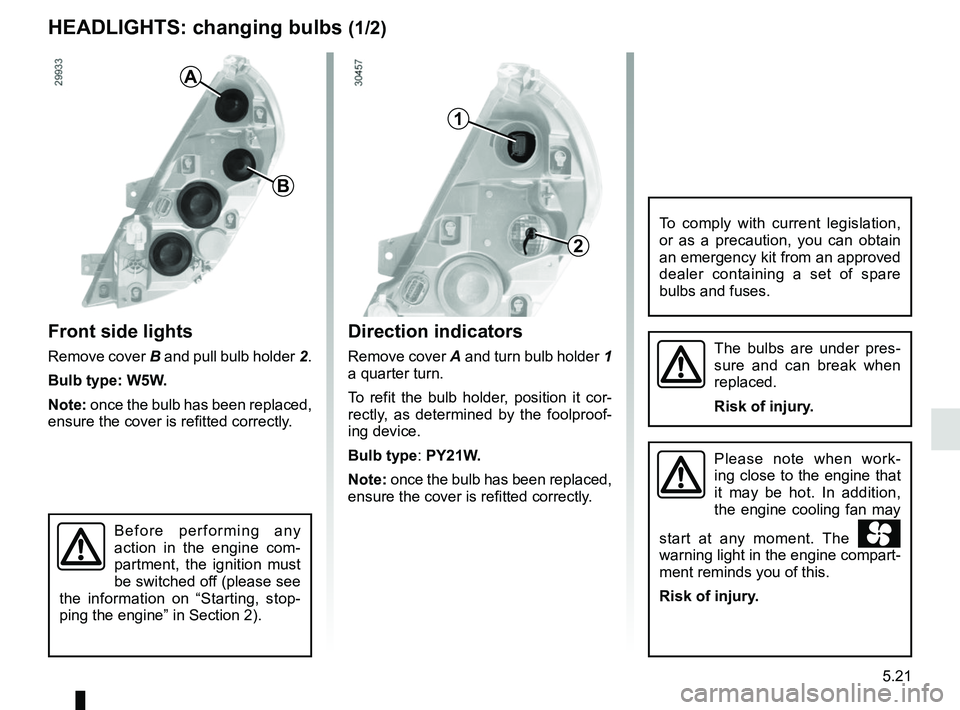
Direction indicators
Remove cover A and turn bulb holder 1
a quarter turn.
To refit the bulb holder, position it cor-
rectly, as determined by the foolproof-
ing device.
Bulb type: PY21W.
Note: once the bulb has been replaced,
ensure the cover is refitted correctly.
HEADLIGHTS: changing bulbs (1/2)
Front side lights
Remove cover B and pull bulb holder 2.
Bulb type: W5W.
Note: once the bulb has been replaced,
ensure the cover is refitted correctly.The bulbs are under pres-
sure and can break when
replaced.
Risk of injury.
To comply with current legislation,
or as a precaution, you can obtain
an emergency kit from an approved
dealer containing a set of spare
bulbs and fuses.
B
A
2
1
Please note when work-
ing close to the engine that
it may be hot. In addition,
the engine cooling fan may
start at any moment. The
warning light in the engine compart-
ment reminds you of this.
Risk of injury.Before performing any
action in the engine com-
partment, the ignition must
be switched off (please see
the information on “Starting, stop-
ping the engine” in Section 2).
Page 236 of 290
5.22
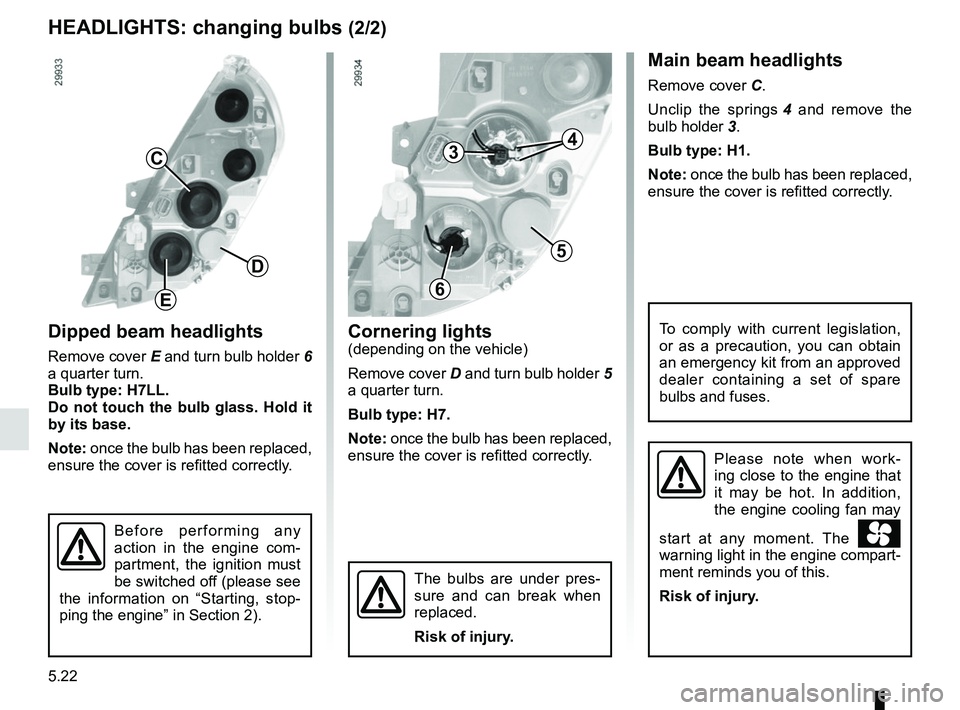
Cornering lights(depending on the vehicle)
Remove cover D and turn bulb holder 5
a quarter turn.
Bulb type: H7.
Note: once the bulb has been replaced,
ensure the cover is refitted correctly.Dipped beam headlights
Remove cover E and turn bulb holder 6
a quarter turn.
Bulb type: H7LL.
Do not touch the bulb glass. Hold it
by its base.
Note: once the bulb has been replaced,
ensure the cover is refitted correctly.
Main beam headlights
Remove cover C.
Unclip the springs 4 and remove the
bulb holder 3.
Bulb type: H1.
Note: once the bulb has been replaced,
ensure the cover is refitted correctly.
The bulbs are under pres-
sure and can break when
replaced.
Risk of injury.
To comply with current legislation,
or as a precaution, you can obtain
an emergency kit from an approved
dealer containing a set of spare
bulbs and fuses.
HEADLIGHTS: changing bulbs (2/2)
C
D
E
3
5
6
4
Please note when work-
ing close to the engine that
it may be hot. In addition,
the engine cooling fan may
start at any moment. The
warning light in the engine compart-
ment reminds you of this.
Risk of injury.Before performing any
action in the engine com-
partment, the ignition must
be switched off (please see
the information on “Starting, stop-
ping the engine” in Section 2).
Page 238 of 290
5.24
SIDE LIGHTS: changing bulbs
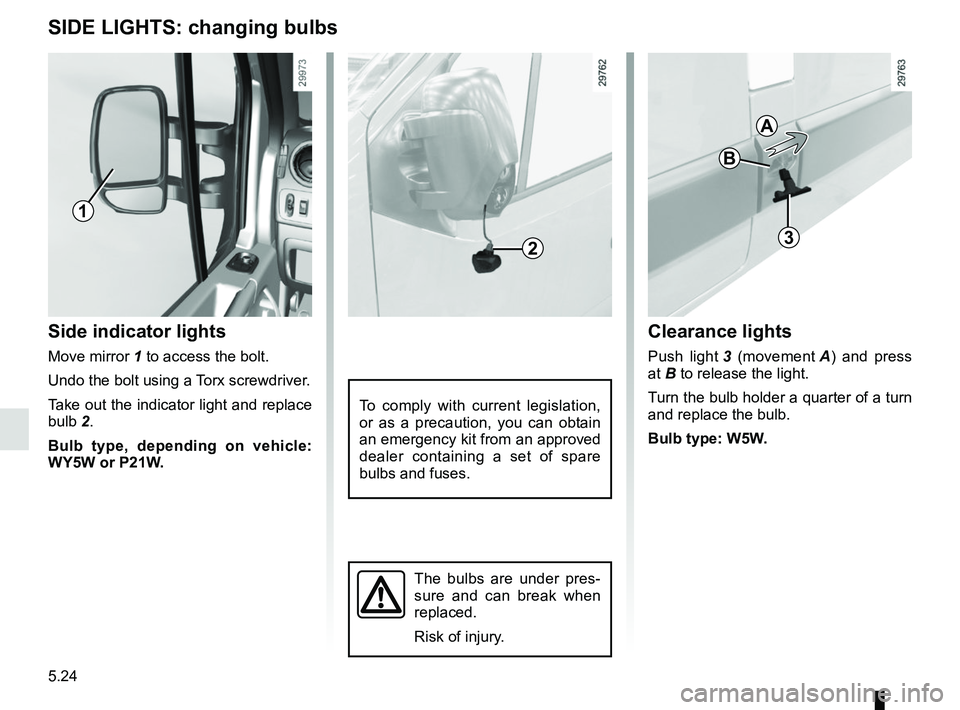
Side indicator lights
Move mirror 1 to access the bolt.
Undo the bolt using a Torx screwdriver.
Take out the indicator light and replace
bulb 2.Bulb type, depending on vehicle:
WY5W or P21W.
1
23
Clearance lights
Push light 3 (movement A) and press
at B to release the light.
Turn the bulb holder a quarter of a turn
and replace the bulb.
Bulb type: W5W.
To comply with current legislation,
or as a precaution, you can obtain
an emergency kit from an approved
dealer containing a set of spare
bulbs and fuses.
The bulbs are under pres-
sure and can break when
replaced.
Risk of injury.
B
A
Page 242 of 290
5.28
FUSES (1/5)
1
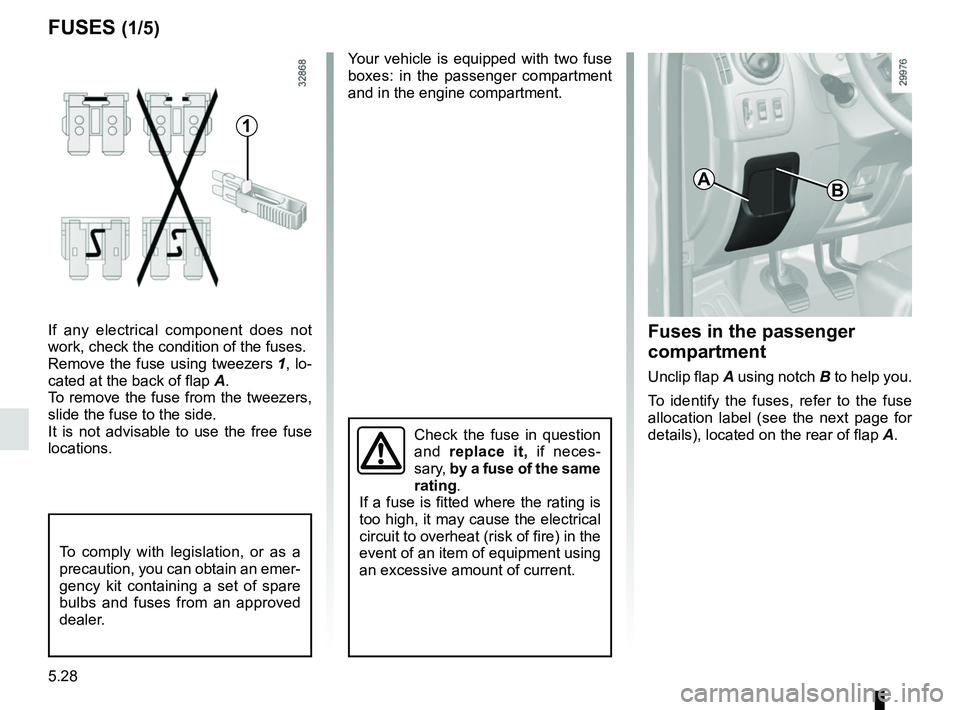
If any electrical component does not
work, check the condition of the fuses.
Remove the fuse using tweezers 1, lo-
cated at the back of flap A.
To remove the fuse from the tweezers,
slide the fuse to the side.
It is not advisable to use the free fuse
locations.
To comply with legislation, or as a
precaution, you can obtain an emer-
gency kit containing a set of spare
bulbs and fuses from an approved
dealer.
Your vehicle is equipped with two fuse
boxes: in the passenger compartment
and in the engine compartment.
A
Fuses in the passenger
compartment
Unclip flap A using notch B to help you.
To identify the fuses, refer to the fuse
allocation label (see the next page for
details), located on the rear of flap A.
B
Check the fuse in question
and replace it, if neces-
sary, by a fuse of the same
rating.
If a fuse is fitted where the rating is
too high, it may cause the electrical
circuit to overheat (risk of fire) in the
event of an item of equipment using
an excessive amount of current.
Page 284 of 290
7.2
ALPHABETICAL INDEX (2/4)
emergency active braking......................................2.16 → 2.23
emergency brake assist.........................................2.16 → 2.23
emergency braking ................................................2.16 → 2.23
emergency spare wheel ............................................. 5.2 – 5.3
engine technical specifications .................................................. 6.5
engine coolant ..................................................................... 4.9
engine oil ...................................................................4.4 → 4.7
engine oil level ..................................................1.83, 4.4 → 4.7
engine specifications ........................................................... 6.5
environment ............................................................\
........... 2.13
ESC: electronic stability control .............................2.16 → 2.23
external lights and signals ...................................1.96 → 1.100
external temperature ......................................................... 1.93
F
filter .................................................................\
................... 4.10
fitting a radio ...................................................................... 5.40
foot panel ........................................................................\
... 5.37
front passenger air bag deactivation .....................1.70 → 1.72
front seat adjustment ......................................................... 1.21
front seats ........................................................................\
.. 1.21
fuel advice on fuel economy ..................................... 2.8 → 2.11
consumption ...................................................... 2.8 → 2.11
filling .............................................................. 1.102 – 1.103
grade ..................................................................\
........ 1.102
fuel consumption ..................................................... 2.8 → 2.11
fuel filler cap ....................................................... 1.102 – 1.103
fuel grade........................................................................\
. 1.103
fuel level ........................................................................\
.... 1.83
fuel repriming ...................................................... 1.102 – 1.103
fuel tank .............................................................. 1.102 – 1.103
fuel tank capacity ............................................................. 1.102
fuses ..................................................................\
....5.28 → 5.32G
gear lever......................................................2.14, 2.45
→ 2.49
grab handle........................................................................\
3.18
grip control ........................................................................\
. 2.22
ground clearance ........................................................ 6.6 – 6.7
H
handbrake........................................................................\
.. 2.15
handsfree.................................................................... 1.8 – 1.9
hazard warning lights signal ............................................ 1.101
headrest........................................................................\
..... 1.20
heated seats ...................................................................... 1.21
heating and air conditioning system ........3.2 – 3.3, 3.7 → 3.13
heating system ......................................3.2 → 3.6, 3.13 – 3.14
Hill Start Assist.......................................................2.16 → 2.23
HSA: Hill Start Assistance ................................................ 2.23
hubcap tool ...................................................... 5.4, 5.11 – 5.12
I
idle speed ........................................................................\
.. 2.43
indicators .............................................................\
............ 1.101
indicators: direction indicators ..................................................... 1.101
instrument panel ..............................................1.78 → 1.83
instrument panel ....................................................1.78 → 1.85
interior lighting: changing bulbs ............................................................. 5.27
interior trim maintenance ..................................................... 4.17 – 4.18
J
jack ...................................................................\
................... 5.4
K
keys ...................................................................\
........1.2 → 1.6