Passenger door RENAULT MASTER 2018 Owners Manual
[x] Cancel search | Manufacturer: RENAULT, Model Year: 2018, Model line: MASTER, Model: RENAULT MASTER 2018Pages: 290, PDF Size: 7.1 MB
Page 7 of 290

1.1
Section 1: Getting to know your vehicle
Key, remote control . . . . . . . . . . . . . . . . . . . . . . . . . . . . . . . . . . . .\
. . . . . . . . . . . . . . . . . . . . . . . . . . 1.2
Deadlocking . . . . . . . . . . . . . . . . . . . . . . . . . . . . . . . . . . . . \
. . . . . . . . . . . . . . . . . . . . . . . . . . . . . . . . 1.7
Hands-free access transmitter/receiver . . . . . . . . . . . . . . . . . . . . . . . . . . . . . . . . . . . . \
. . . . . . . . . . . 1.8
Locking/unlocking the doors . . . . . . . . . . . . . . . . . . . . . . . . . . . . . . . . . . . .\
. . . . . . . . . . . . . . . . . . . 1.10
Doors . . . . . . . . . . . . . . . . . . . . . . . . . . . . . . . . . . . . \
. . . . . . . . . . . . . . . . . . . . . . . . . . . . . . . . . . . . . 1.13
Steering wheel/power-assisted steering . . . . . . . . . . . . . . . . . . . . . . . . . . . . . . . . . . . .\
. . . . . . . . . . 1.19
Headrests . . . . . . . . . . . . . . . . . . . . . . . . . . . . . . . . . . . .\
. . . . . . . . . . . . . . . . . . . . . . . . . . . . . . . . . 1.20
Front seats. . . . . . . . . . . . . . . . . . . . . . . . . . . . . . . . . . . . \
. . . . . . . . . . . . . . . . . . . . . . . . . . . . . . . . . 1.21
Seat belts. . . . . . . . . . . . . . . . . . . . . . . . . . . . . . . . . . . . \
. . . . . . . . . . . . . . . . . . . . . . . . . . . . . . . . . . 1.24
Methods of restraint in addition to the front seat belts . . . . . . . . . . . . . . . . . . . . . . . . . . . . . . . . . . . . 1.28
Side protection devices . . . . . . . . . . . . . . . . . . . . . . . . . . . . . . . . . . . . \
. . . . . . . . . . . . . . . . . . . . . . . 1.31
Child safety: general information . . . . . . . . . . . . . . . . . . . . . . . . . . . . . . . . . . . . \
. . . . . . . . . . . . . . . . 1.33 choosing a child seat mounting . . . . . . . . . . . . . . . . . . . . . . . . . . . . . . . . . . . .\
. . . . . . . . . . . 1.36
fitting a child seat, general information . . . . . . . . . . . . . . . . . . . . . . . . . . . . . . . . . . . . \
. . . . . . 1.38
Child seats: attachment by seat belt or by Isofix system . . . . . . . . . . . . . . . . . . . . . . . . . . . . . . . . . . 1.40 deactivating/activating the front passenger airbag . . . . . . . . . . . . . . . . . . . . . . . . . . . . . . . . . 1.70
Rear view mirrors . . . . . . . . . . . . . . . . . . . . . . . . . . . . . . . . . . . .\
. . . . . . . . . . . . . . . . . . . . . . . . . . . 1.73
Driving position: left-hand drive . . . . . . . . . . . . . . . . . . . . . . . . . . . . . . . . . . . . \
. . . . . . . . . . . . . . . . . 1.74
Driver’s position, right-hand drive . . . . . . . . . . . . . . . . . . . . . . . . . . . . . . . . . . . .\
. . . . . . . . . . . . . . . 1.76
Warning lights . . . . . . . . . . . . . . . . . . . . . . . . . . . . . . . . . . . .\
. . . . . . . . . . . . . . . . . . . . . . . . . . . . . . 1.78
Trip computer . . . . . . . . . . . . . . . . . . . . . . . . . . . . . . . . . . . .\
. . . . . . . . . . . . . . . . . . . . . . . . . . . . . . 1.84
Clock . . . . . . . . . . . . . . . . . . . . . . . . . . . . . . . . . \
. . . . . . . . . . . . . . . . . . . . . . . . . . . . . . . . . . . . . . . . 1.93
Exterior temperature . . . . . . . . . . . . . . . . . . . . . . . . . . . . . . . . . . . .\
. . . . . . . . . . . . . . . . . . . . . . . . . 1.93
Windscreen washer/wiper . . . . . . . . . . . . . . . . . . . . . . . . . . . . . . . . . . . . \
. . . . . . . . . . . . . . . . . . . . . 1.94
Exterior lighting and signals. . . . . . . . . . . . . . . . . . . . . . . . . . . . . . . . . . . . \
. . . . . . . . . . . . . . . . . . . . 1.96
Electrical adjustment of the dipped beam headlights . . . . . . . . . . . . . . . . . . . . . . . . . . . . . . . . . . . .\
1.100
Audible and visual signals . . . . . . . . . . . . . . . . . . . . . . . . . . . . . . . . . . . . \
. . . . . . . . . . . . . . . . . . . . . 1.101
Fuel tank . . . . . . . . . . . . . . . . . . . . . . . . . . . . . . . . . . . .\
. . . . . . . . . . . . . . . . . . . . . . . . . . . . . . . . . . 1.102
Additive tank . . . . . . . . . . . . . . . . . . . . . . . . . . . . . . . . . . . .\
. . . . . . . . . . . . . . . . . . . . . . . . . . . . . . . 1.104
Page 8 of 290
1.2
KEY, RADIO FREQUENCY REMOTE CONTROL: general information (1/3)
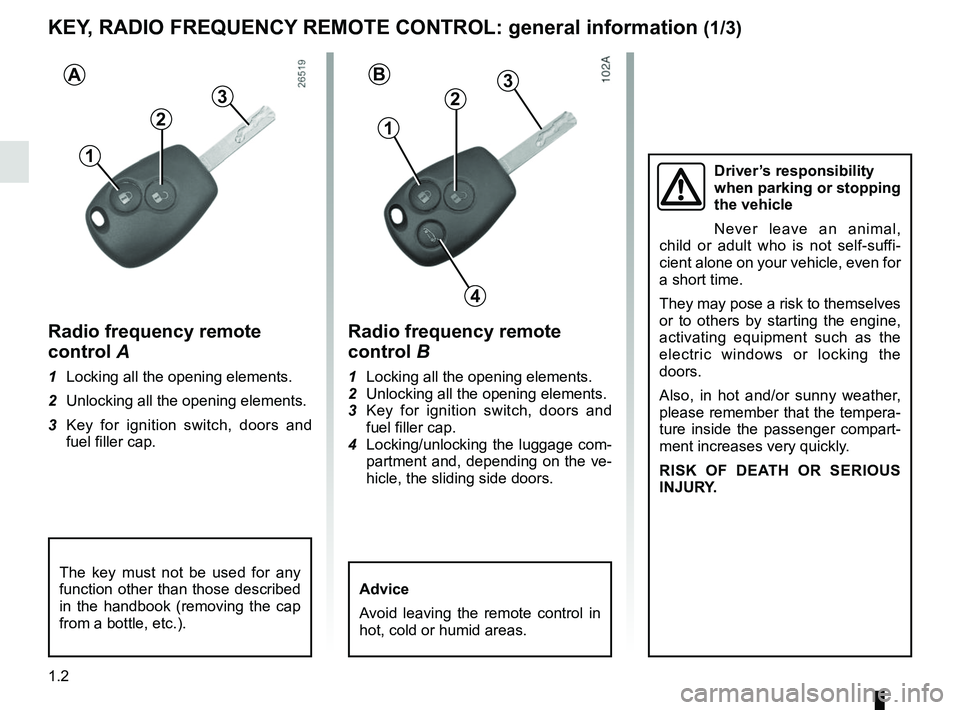
Radio frequency remote
control B
1 Locking all the opening elements.
2 Unlocking all the opening elements.
3 Key for ignition switch, doors and
fuel filler cap.
4 Locking/unlocking the luggage com- partment and, depending on the ve-
hicle, the sliding side doors.
Radio frequency remote
control A
1 Locking all the opening elements.
2 Unlocking all the opening elements.
3 Key for ignition switch, doors and
fuel filler cap.
1
2
3
The key must not be used for any
function other than those described
in the handbook (removing the cap
from a bottle, etc.).Advice
Avoid leaving the remote control in
hot, cold or humid areas.
A
1
2
3
4
B
Driver’s responsibility
when parking or stopping
the vehicle
Never leave an animal,
child or adult who is not self-suffi-
cient alone on your vehicle, even for
a short time.
They may pose a risk to themselves
or to others by starting the engine,
activating equipment such as the
electric windows or locking the
doors.
Also, in hot and/or sunny weather,
please remember that the tempera-
ture inside the passenger compart-
ment increases very quickly.
RISK OF DEATH OR SERIOUS
INJURY.
Page 10 of 290
1.4
Replacement, additional remote
control or transmitter/receiver
You must only contact an approved
Dealer.
– To replace a remote control, the vehicle must be taken to an ap-
proved Dealer as both the vehi-
cle and the remote control are
needed to initialise the system.
– Depending on the vehicle, you may use up to four remote con-
trols or two transmitter/receivers.
Remote control unit failure
Make sure that the correct battery
type is being used, and that the
battery is in good condition and in-
serted correctly. These batteries
have a service life of approximately
two years.
Refer to the information on the “Key,
radio frequency remote control: bat-
teries” in Section 5 for the battery
changing procedure.
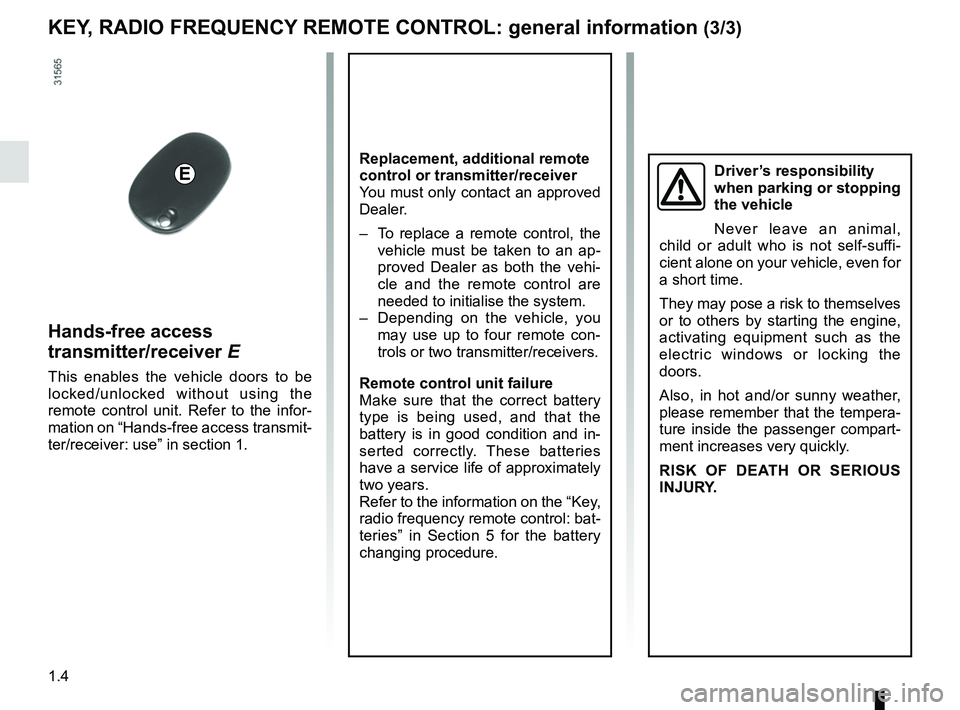
Hands-free access
transmitter/receiver E
This enables the vehicle doors to be
locked/unlocked without using the
remote control unit. Refer to the infor-
mation on “Hands-free access transmit-
ter/receiver: use” in section 1.
EDriver’s responsibility
when parking or stopping
the vehicle
Never leave an animal,
child or adult who is not self-suffi-
cient alone on your vehicle, even for
a short time.
They may pose a risk to themselves
or to others by starting the engine,
activating equipment such as the
electric windows or locking the
doors.
Also, in hot and/or sunny weather,
please remember that the tempera-
ture inside the passenger compart-
ment increases very quickly.
RISK OF DEATH OR SERIOUS
INJURY.
KEY, RADIO FREQUENCY REMOTE CONTROL: general information (3/3)
Page 11 of 290
1.5
KEY, RADIO FREQUENCY REMOTE CONTROL: use (1/2)
1
A
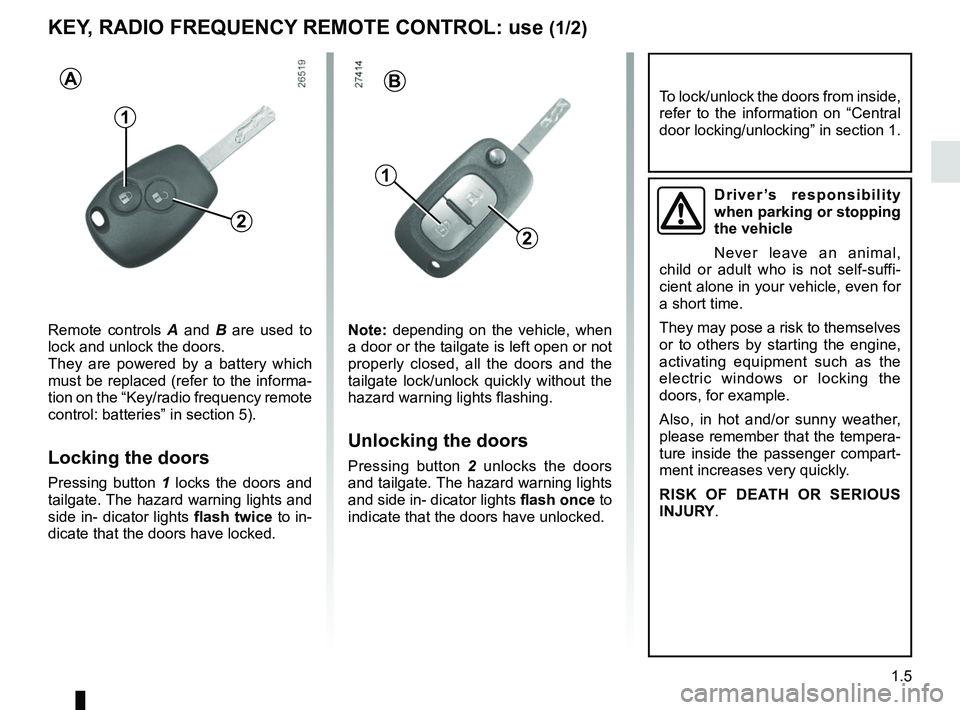
Remote controls A and B are used to
lock and unlock the doors.
They are powered by a battery which
must be replaced (refer to the informa-
tion on the “Key/radio frequency remote
control: batteries” in section 5).
Locking the doors
Pressing button 1 locks the doors and
tailgate. The hazard warning lights and
side in- dicator lights flash twice to in-
dicate that the doors have locked. Note: depending on the vehicle, when
a door or the tailgate is left open or not
properly closed, all the doors and the
tailgate lock/unlock quickly without the
hazard warning lights flashing.
Unlocking the doors
Pressing button 2
unlocks the doors
and tailgate. The hazard warning lights
and side in- dicator lights flash once to
indicate that the doors have unlocked.
2
B
1
2
Driver’s responsibility
when parking or stopping
the vehicle
Never leave an animal,
child or adult who is not self-suffi-
cient alone in your vehicle, even for
a short time.
They may pose a risk to themselves
or to others by starting the engine,
activating equipment such as the
electric windows or locking the
doors, for example.
Also, in hot and/or sunny weather,
please remember that the tempera-
ture inside the passenger compart-
ment increases very quickly.
RISK OF DEATH OR SERIOUS
INJURY.
To lock/unlock the doors from inside,
refer to the information on “Central
door locking/unlocking” in section 1.
Page 14 of 290
1.8
HANDS-FREE ACCESS TRANSMITTER/RECEIVER: use (1/2)
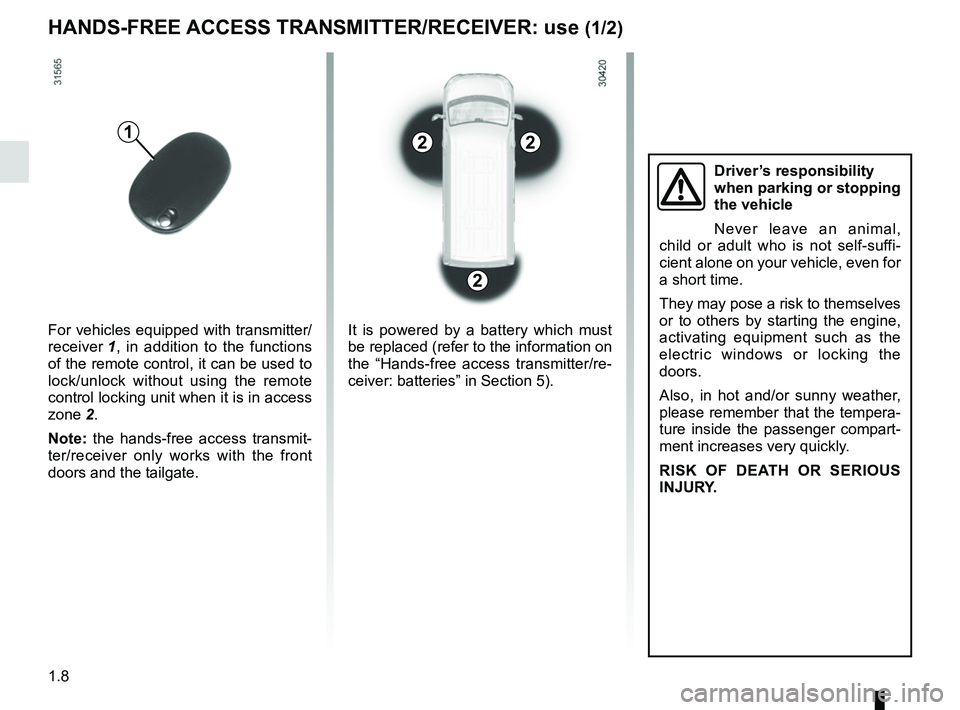
For vehicles equipped with transmitter/
receiver 1, in addition to the functions
of the remote control, it can be used to
lock/unlock without using the remote
control locking unit when it is in access
zone 2.
Note: the hands-free access transmit-
ter/receiver only works with the front
doors and the tailgate.
22
2
It is powered by a battery which must
be replaced (refer to the information on
the “Hands-free access transmitter/re-
ceiver: batteries” in Section 5).
1
Driver’s responsibility
when parking or stopping
the vehicle
Never leave an animal,
child or adult who is not self-suffi-
cient alone on your vehicle, even for
a short time.
They may pose a risk to themselves
or to others by starting the engine,
activating equipment such as the
electric windows or locking the
doors.
Also, in hot and/or sunny weather,
please remember that the tempera-
ture inside the passenger compart-
ment increases very quickly.
RISK OF DEATH OR SERIOUS
INJURY.
Page 16 of 290
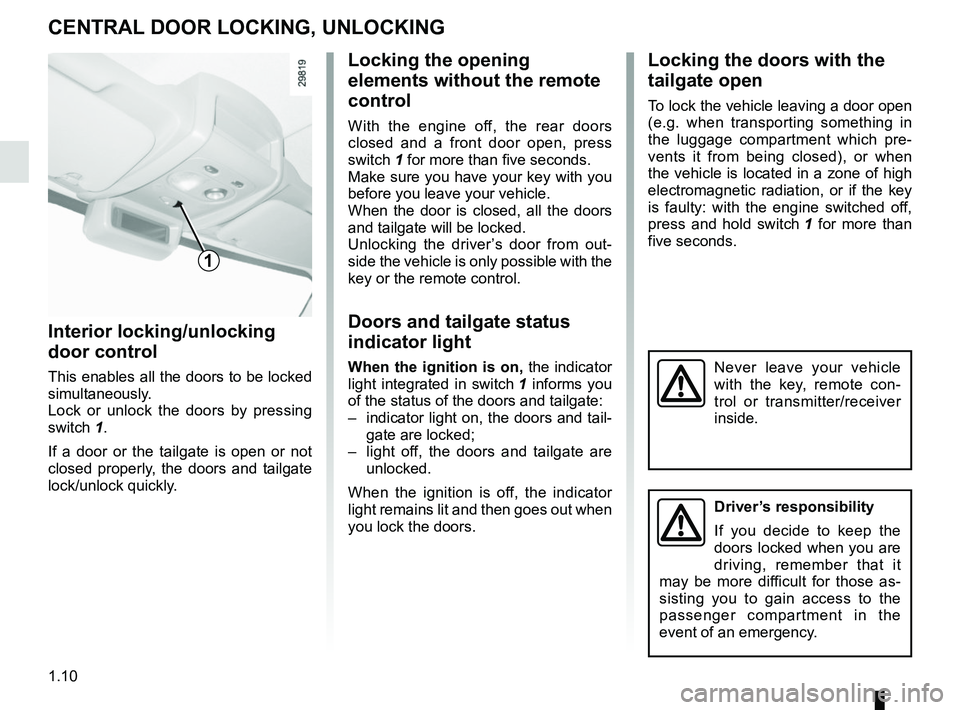
1.10
Locking the doors with the
tailgate open
To lock the vehicle leaving a door open
(e.g. when transporting something in
the luggage compartment which pre-
vents it from being closed), or when
the vehicle is located in a zone of high
electromagnetic radiation, or if the key
is faulty: with the engine switched off,
press and hold switch 1 for more than
five seconds.
Locking the opening
elements without the remote
control
With the engine off, the rear doors
closed and a front door open, press
switch 1 for more than five seconds.
Make sure you have your key with you
before you leave your vehicle.
When the door is closed, all the doors
and tailgate will be locked.
Unlocking the driver’s door from out-
side the vehicle is only possible with the
key or the remote control.
Doors and tailgate status
indicator light
When the ignition is on, the indicator
light integrated in switch 1 informs you
of the status of the doors and tailgate:
– indicator light on, the doors and tail- gate are locked;
– light off, the doors and tailgate are unlocked.
When the ignition is off, the indicator
light remains lit and then goes out when
you lock the doors.
Interior locking/unlocking
door control
This enables all the doors to be locked
simultaneously.
Lock or unlock the doors by pressing
switch 1.
If a door or the tailgate is open or not
closed properly, the doors and tailgate
lock/unlock quickly.
CENTRAL DOOR LOCKING, UNLOCKING
Never leave your vehicle
with the key, remote con-
trol or transmitter/receiver
inside.
1
Driver’s responsibility
If you decide to keep the
doors locked when you are
driving, remember that it
may be more difficult for those as-
sisting you to gain access to the
passenger compartment in the
event of an emergency.
Page 18 of 290
1.12
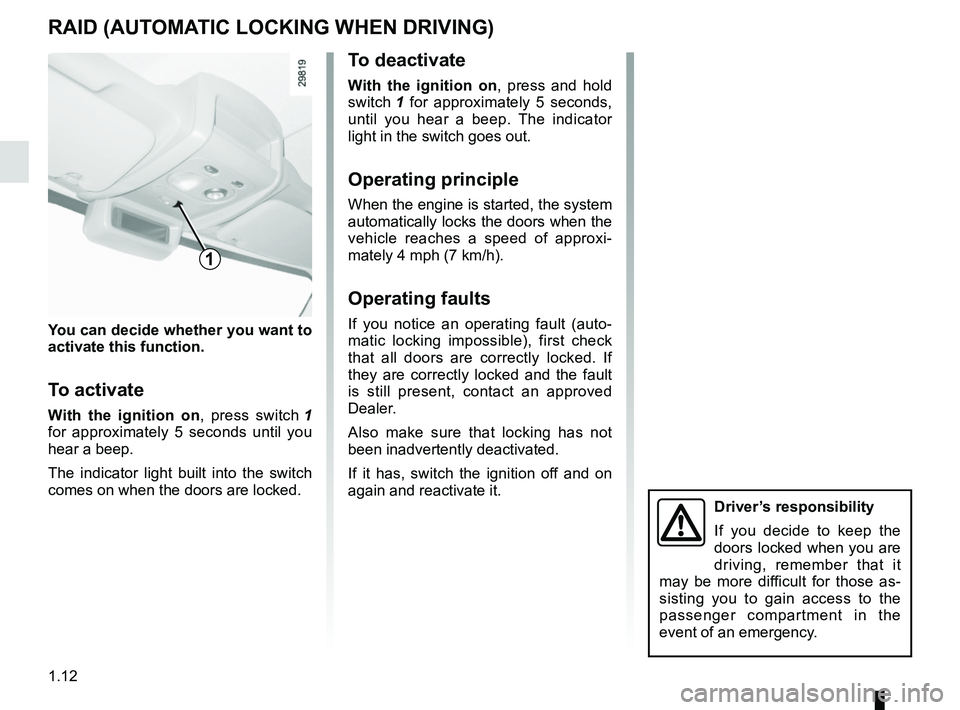
RAID (AUTOMATIC LOCKING WHEN DRIVING)
You can decide whether you want to
activate this function.
To activate
With the ignition on, press switch 1
for approximately 5 seconds until you
hear a beep.
The indicator light built into the switch
comes on when the doors are locked.
To deactivate
With the ignition on , press and hold
switch 1 for approximately 5 seconds,
until you hear a beep. The indicator
light in the switch goes out.
Operating principle
When the engine is started, the system
automatically locks the doors when the
vehicle reaches a speed of approxi-
mately 4 mph (7 km/h).
Operating faults
If you notice an operating fault (auto-
matic locking impossible), first check
that all doors are correctly locked. If
they are correctly locked and the fault
is still present, contact an approved
Dealer.
Also make sure that locking has not
been inadvertently deactivated.
If it has, switch the ignition off and on
again and reactivate it.
1
Driver’s responsibility
If you decide to keep the
doors locked when you are
driving, remember that it
may be more difficult for those as-
sisting you to gain access to the
passenger compartment in the
event of an emergency.
Page 20 of 290
1.14
FRONT DOORS (2/2)
Manual locking
With the door closed, lock the door by
pressing button 4.
Lights-on reminder buzzer
If you have switched off the ignition
and left the lights switched on, a re-
minder buzzer will sound when a door
is opened.
NOTE
The front door mechanism cannot
be locked if the door is open.Driver’s responsibility
when parking or stopping
the vehicle
Never leave an animal,
child or adult who is not self-suffi-
cient alone on your vehicle, even for
a short time.
They may pose a risk to themselves
or to others by starting the engine,
activating equipment such as the
electric windows or by locking the
doors.
Also, in hot and/or sunny weather,
please remember that the tempera-
ture inside the passenger compart-
ment increases very quickly.
RISK OF DEATH OR SERIOUS
INJURY.
Page 31 of 290
1.25
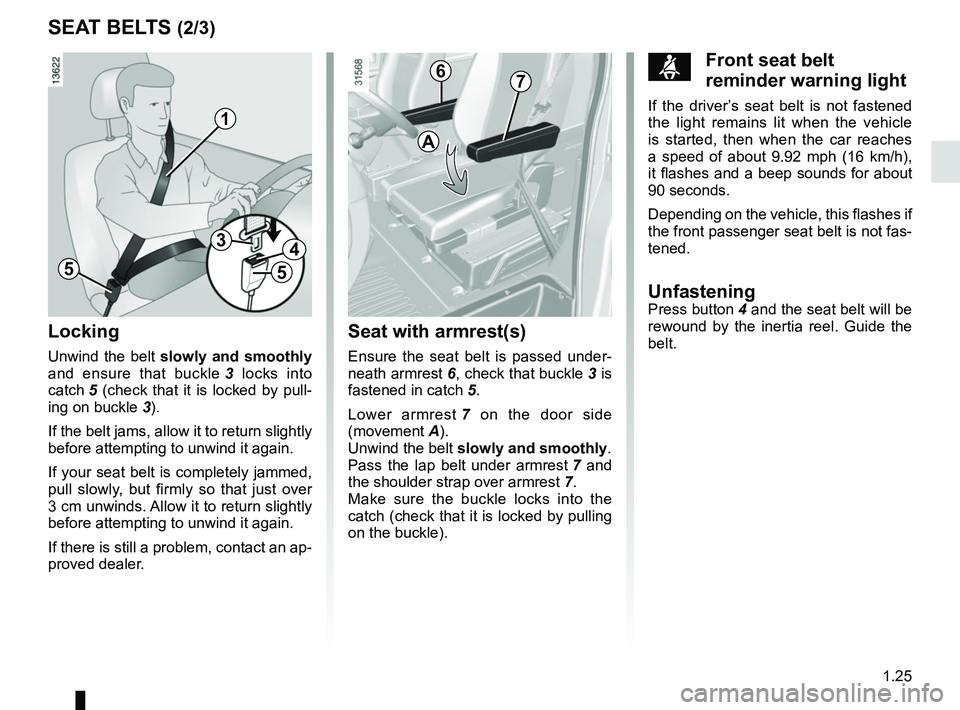
SEAT BELTS (2/3)
5
34
5
1
Locking
Unwind the belt slowly and smoothly
and ensure that buckle 3 locks into
catch 5 (check that it is locked by pull- ing on buckle 3).
If the belt jams, allow it to return slightly
before attempting to unwind it again.
If your seat belt is completely jammed,
pull slowly, but firmly so that just over
3 cm unwinds. Allow it to return slightly
before attempting to unwind it again.
If there is still a problem, contact an ap-
proved dealer.
Seat with armrest(s)
Ensure the seat belt is passed under-
neath armrest 6, check that buckle 3 is
fastened in catch 5.
Lower armrest 7 on the door side
(movement A).
Unwind the belt slowly and smoothly .
Pass the lap belt under armrest 7 and
the shoulder strap over armrest 7.
Make sure the buckle locks into the
catch (check that it is locked by pulling
on the buckle).
ßFront seat belt
reminder warning light
If the driver’s seat belt is not fastened
the light remains lit when the vehicle
is started, then when the car reaches
a speed of about 9.92 mph (16 km/h),
it flashes and a beep sounds for about
90 seconds.
Depending on the vehicle, this flashes if
the front passenger seat belt is not fas-
tened.
UnfasteningPress button 4 and the seat belt will be
rewound by the inertia reel. Guide the
belt.
A
76
Page 39 of 290
1.33
CHILD SAFETY: General information (1/2)
Carrying children
Children, and adults, must be correctly
seated and strapped in for all journeys.
The children being carried in your vehi-
cle are your responsibility.
A child is not a miniature adult. Children
are at risk of specific injuries as their
muscles and bones have not yet fin-
ished growing. The seat belt alone
would not provide suitable protection.
Use an approved child seat and ensure
you use it correctly.
A collision at 30 mph
(50 km/ h) is the same
as falling a distance of
10 metres. Transporting a
child without a restraint is the equiv-
alent of allowing him or her to play
on a fourth-floor balcony without
railings.
Never travel with a child held in your
arms. In the event of an accident,
you will not be able to keep hold of
the child, even if you yourself are
wearing a seat belt.
If your vehicle has been involved
in a road accident, replace the
child seat and have the seat belts
checked.
To prevent the doors being
opened, use the childproof
locks (please refer to the in-
formation on “Locking/un-
locking the doors” in Section 1).
Driver’s responsibility
when parking or stopping
the vehicle
Never leave an animal,
child or adult who is not self-suffi-
cient alone on your vehicle, even for
a short time.
They may pose a risk to themselves
or to others by starting the engine,
activating equipment such as the
electric windows or by locking the
doors.
Also, in hot and/or sunny weather,
please remember that the tempera-
ture inside the passenger compart-
ment increases very quickly.
RISK OF DEATH OR SERIOUS
INJURY.