oil level RENAULT MASTER 2018 Owners Manual
[x] Cancel search | Manufacturer: RENAULT, Model Year: 2018, Model line: MASTER, Model: RENAULT MASTER 2018Pages: 290, PDF Size: 7.1 MB
Page 86 of 290

The presence and operation of the warning lights DEPEND ON THE EQUIPMENT\
AND COUNTRY.
xAnti-lock braking warning
light
This light comes on when the ignition is
switched o")
1.80
WARNING LIGHTS (3/4)
The presence and operation of the warning lights DEPEND ON THE EQUIPMENT\
AND COUNTRY.
xAnti-lock braking warning
light
This light comes on when the ignition is
switched on and goes out within about
3 seconds. If it comes on when you are
driving, it indicates a fault in the anti-
lock braking system. Braking will then
occur normally, without the anti-lock
system.
Contact an approved dealer as soon as
possible.
^Water in the diesel filter
warning light
If it comes on when you are driving, it
indicates the presence of water in the
diesel. Contact your approved dealer
as soon as possible.
ÀOil pressure warning light
This light comes on when the
ignition is switched on and goes out
within about 3 seconds. If it lights up
while you are driving, stop at once and
switch off the ignition. Check the oil
level. If the level is correct, the light has
come on for another reason; contact an
approved dealer.
Traction control warning
light
Refer to the information on “Driving cor-
rection devices and aids” in Section 2.
zBrake pad wear warning
light
Depending on the vehicle, if the warn-
ing light comes on, you must have your
brake pads checked as soon as possi-
ble.
Emergency active brake
assist
Refer to the information on “Driving cor-
rection devices and aids” in Section 2.
ÉPreheating warning light
This should come on when
the ignition is switched on. It indicates
that the heater plugs are in operation. It
goes out as soon as preheating is suf-
ficient and the engine may be started.
T Digital tacograph warning light
If it comes on, there is a fault in the
system. Refer to the handbook for the
equipment.
Engine standby warning
light
Please see information about “Stop and
Start function” in Section 2.
\fUnavailability of engine
standby warning light
Please see information in the para-
graph on “Stop and Start Function” in
Section 2.
A
Page 88 of 290
1.82
Displays and indicators (1/2)
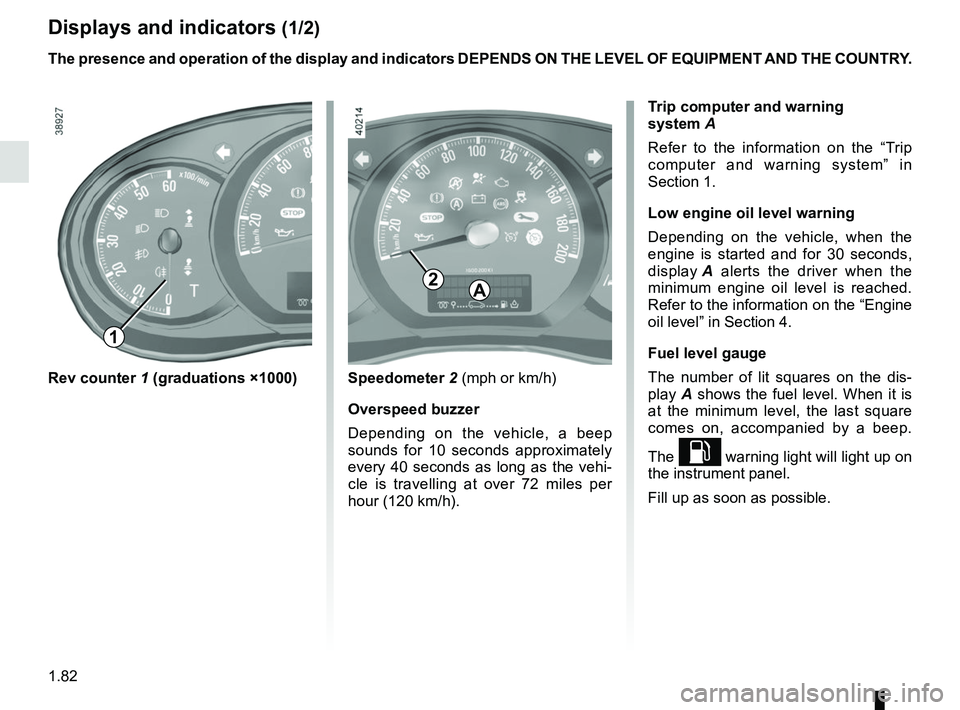
Rev counter 1 (graduations ×1000) Speedometer 2 (mph or km/h)
Overspeed buzzer
Depending on the vehicle, a beep
sounds for 10 seconds approximately
every 40 seconds as long as the vehi-
cle is travelling at over 72 miles per
hour (120 km/h).
2
1
The presence and operation of the display and indicators DEPENDS ON THE \
LEVEL OF EQUIPMENT AND THE COUNTRY.
Trip computer and warning
system A
Refer to the information on the “Trip
computer and warning system” in
Section 1.
Low engine oil level warning
Depending on the vehicle, when the
engine is started and for 30 seconds,
display A alerts the driver when the
minimum engine oil level is reached.
Refer to the information on the “Engine
oil level” in Section 4.
Fuel level gauge
The number of lit squares on the dis-
play A shows the fuel level. When it is
at the minimum level, the last square
comes on, accompanied by a beep.
The
L warning light will light up on
the instrument panel.
Fill up as soon as possible.
A
Page 96 of 290
1.90
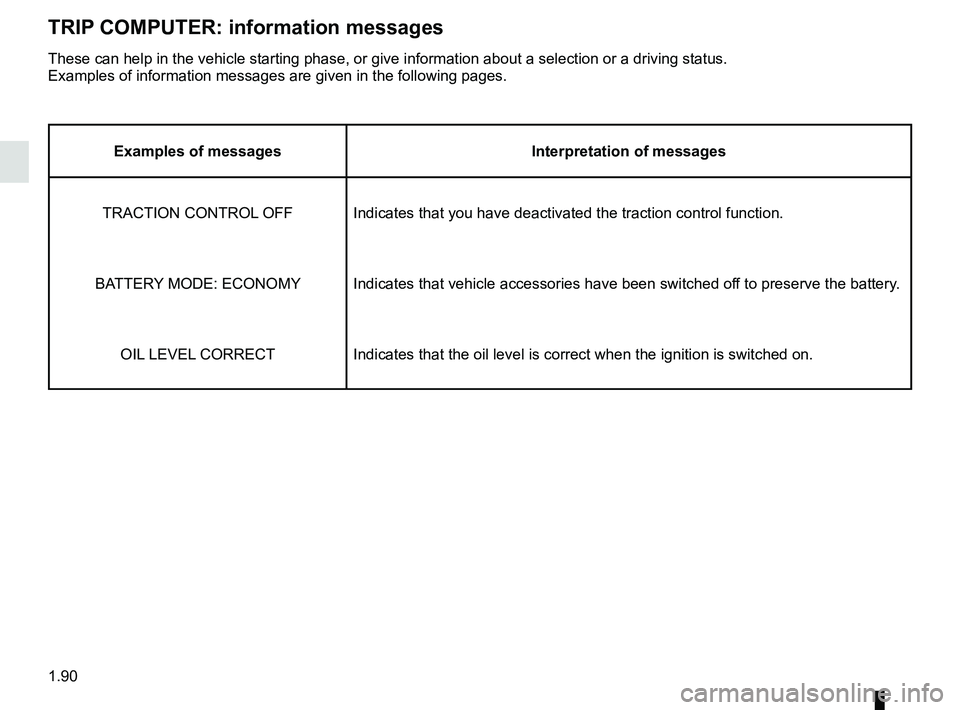
TRIP COMPUTER: information messages
Examples of messagesInterpretation of messages
TRACTION CONTROL OFF Indicates that you have deactivated the traction control function.
BATTERY MODE: ECONOMY Indicates that vehicle accessories have been switched off to preserve the battery.
OIL LEVEL CORRECT Indicates that the oil level is correct when the ignition is switched on\
.
These can help in the vehicle starting phase, or give information about \
a selection or a driving status.
Examples of information messages are given in the following pages.
Page 164 of 290
2.48
SEQUENTIAL GEARBOX (4/5)
Operation in automatic mode
Automatic mode is selected by default
every time the ignition is switched on.
The letter A appears on the display.
The vehicle is controlled using the ac-
celerator and the brake. Gears will
change automatically at the correct
moment and at a suitable engine speed
because the automatic mode takes the
road surface and the chosen driving
style into consideration.
Gears may be shifted manually in this
mode. Pushing the lever forwards
or backwards shifts a gear upwards
(except if there is a risk of underrev-
ving) or downwards (except if there is a
risk of overrevving).
Note: automatic mode takes account
of:
– the position and speed of depression of the accelerator pedal to assess
driving style and select the optimum
gear;
– action on the brake pedal, to com- mence engine braking in preparation
for a downshift.
You can stop the vehicle at red lights,
with the gear engaged, by depressing
the brake pedal; there is no need to
change to neutral (N).
The vehicle will move off again:
– either slowly, if you release the brake without accelerating (e.g. when in a
traffic jam);
– or quickly, if you release the brake and accelerate.
Accelerating and overtaking
– Slowly depress the accelerator pedal to accelerate gradually;
The oil level in the automatic gear-
box system reservoir varies depend-
ing on use. Adding oil is strictly
forbidden (except by qualified ap-
proved network personnel).
– to obtain maximum vehicle per-
formance regardless of the mode
selected (automatic or manual),
quickly depress the accelerator
pedal beyond the kickdown point.
The speed with which you depress the
pedal will allow you to downshift ac-
cording to the vehicle’s capabilities.
Parking the vehicle
It is possible to park in gear (for exam-
ple, on a slope):
– with the ignition on, select a gear with your foot on the brake ;
– check that a gear other than N is dis- played on the instrument panel, then
remove the ignition key;
– apply the handbrake.
To disengage the gear, switch on the
ignition without starting the engine and
shift the selector lever to neutral with
the brake pedal depressed . Check
that N is displayed on the instrument
panel.
Page 197 of 290

4.1
Section 4: Maintenance
Bonnet . . . . . . . . . . . . . . . . . . . . . . . . . . . . . . . . . . . . \
. . . . . . . . . . . . . . . . . . . . . . . . . . . . . . . . . . . . 4.2
Engine oil level . . . . . . . . . . . . . . . . . . . . . . . . . . . . . . . . . . . .\
. . . . . . . . . . . . . . . . . . . . . . . . . . . . . 4.4
Engine oil level: topping up/filling . . . . . . . . . . . . . . . . . . . . . . . . . . . . . . . . . . . .\
. . . . . . . . . . . . . . . 4.6
Levels . . . . . . . . . . . . . . . . . . . . . . . . . . . . . . . . . . . .\
. . . . . . . . . . . . . . . . . . . . . . . . . . . . . . . . . . . . 4.8brake fluid . . . . . . . . . . . . . . . . . . . . . . . . . . . . . . . . . . . . \
. . . . . . . . . . . . . . . . . . . . . . . . . . . . 4.8
coolant . . . . . . . . . . . . . . . . . . . . . . . . . . . . . . . . . . . .\
. . . . . . . . . . . . . . . . . . . . . . . . . . . . . . 4.9
power-assisted steering pump . . . . . . . . . . . . . . . . . . . . . . . . . . . . . . . . . . . . \
. . . . . . . . . . . . 4.10
windscreen washer reservoir . . . . . . . . . . . . . . . . . . . . . . . . . . . . . . . . . . . . \
. . . . . . . . . . . . . 4.10
Filters . . . . . . . . . . . . . . . . . . . . . . . . . . . . . . . . . . . . \
. . . . . . . . . . . . . . . . . . . . . . . . . . . . . . . . . . . . . 4.10
Tyre pressure. . . . . . . . . . . . . . . . . . . . . . . . . . . . . . . . . . . . \
. . . . . . . . . . . . . . . . . . . . . . . . . . . . . . . 4.11
Battery . . . . . . . . . . . . . . . . . . . . . . . . . . . . . . . . . . . . \
. . . . . . . . . . . . . . . . . . . . . . . . . . . . . . . . . . . . 4.13
Bodywork maintenance . . . . . . . . . . . . . . . . . . . . . . . . . . . . . . . . . . . . \
. . . . . . . . . . . . . . . . . . . . . . . 4.14
Interior trim maintenance . . . . . . . . . . . . . . . . . . . . . . . . . . . . . . . . . . . . \
. . . . . . . . . . . . . . . . . . . . . . 4.17
Page 200 of 290
4.4
ENGINE OIL LEVEL: general information (1/2)
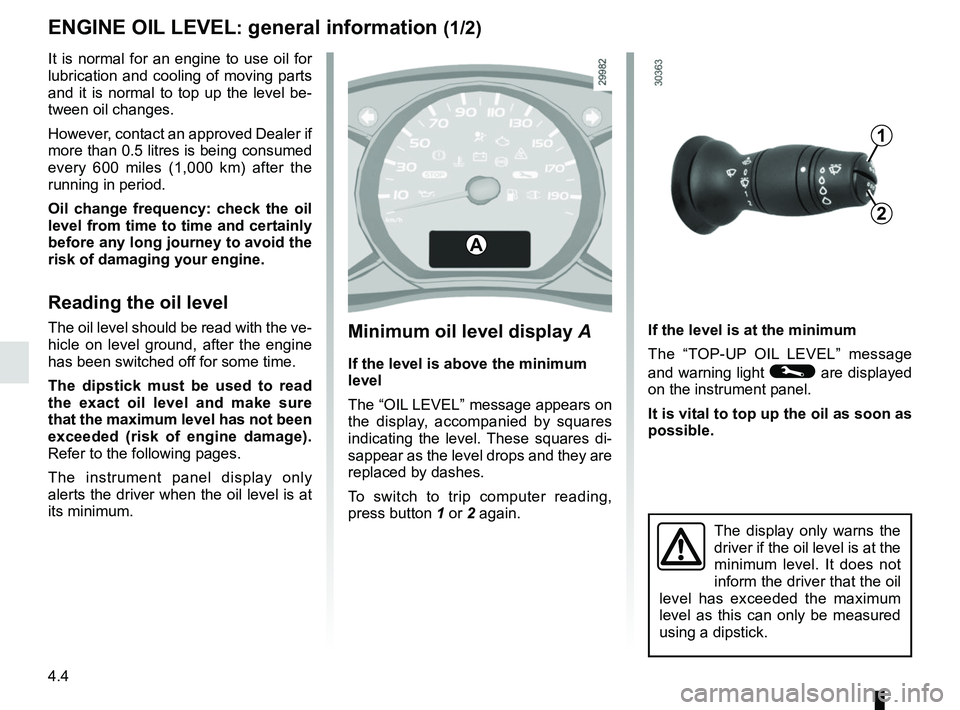
If the level is at the minimum
The “TOP-UP OIL LEVEL” message
and warning light
© are displayed
on the instrument panel.
It is vital to top up the oil as soon as
possible.
The display only warns the
driver if the oil level is at the
minimum level. It does not
inform the driver that the oil
level has exceeded the maximum
level as this can only be measured
using a dipstick.
It is normal for an engine to use oil for
lubrication and cooling of moving parts
and it is normal to top up the level be-
tween oil changes.
However, contact an approved Dealer if
more than 0.5 litres is being consumed
every 600 miles (1,000 km) after the
running in period.
Oil change frequency: check the oil
level from time to time and certainly
before any long journey to avoid the
risk of damaging your engine.
Reading the oil level
The oil level should be read with the ve-
hicle on level ground, after the engine
has been switched off for some time.
The dipstick must be used to read
the exact oil level and make sure
that the maximum level has not been
exceeded (risk of engine damage).
Refer to the following pages.
The instrument panel display only
alerts the driver when the oil level is at
its minimum.
A
1
2
Minimum oil level display A
If the level is above the minimum
level
The “OIL LEVEL” message appears on
the display, accompanied by squares
indicating the level. These squares di-
sappear as the level drops and they are
replaced by dashes.
To switch to trip computer reading,
press button 1 or 2 again.
Page 201 of 290
4.5
ENGINE OIL LEVEL: general information (2/2)
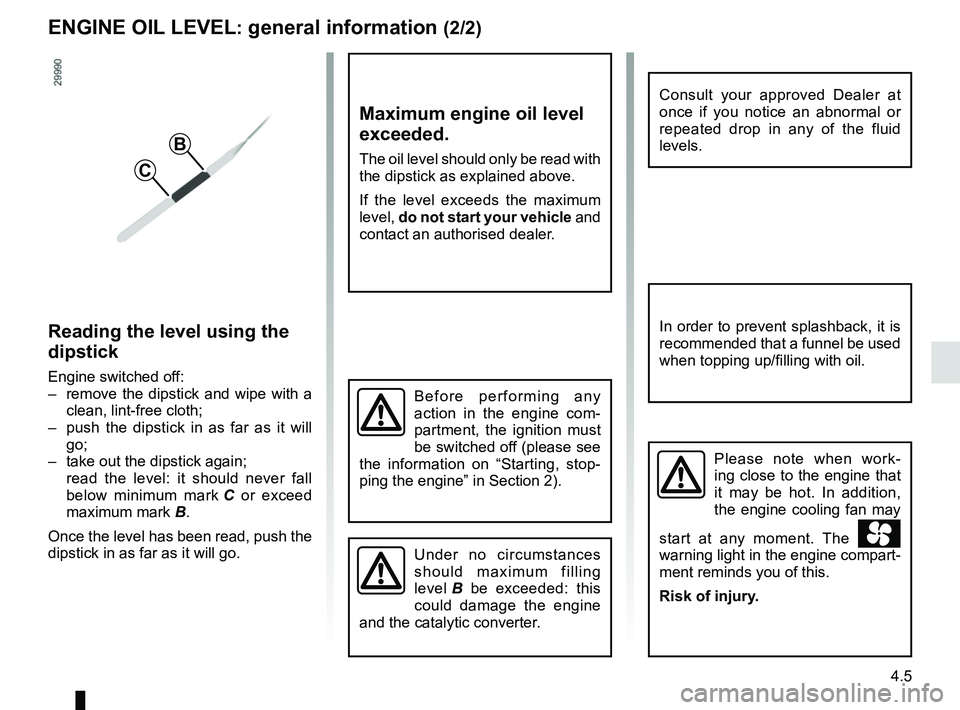
Reading the level using the
dipstick
Engine switched off:
– remove the dipstick and wipe with a clean, lint-free cloth;
– push the dipstick in as far as it will go;
– take out the dipstick again;
read the level: it should never fall below minimum mark C or exceed
maximum mark B.
Once the level has been read, push the
dipstick in as far as it will go.
Consult your approved Dealer at
once if you notice an abnormal or
repeated drop in any of the fluid
levels.
In order to prevent splashback, it is
recommended that a funnel be used
when topping up/filling with oil.
Under no circumstances
should maximum filling
level B be exceeded: this
could damage the engine
and the catalytic converter.
Maximum engine oil level
exceeded.
The oil level should only be read with
the dipstick as explained above.
If the level exceeds the maximum
level, do not start your vehicle and
contact an authorised dealer.C
B
Please note when work-
ing close to the engine that
it may be hot. In addition,
the engine cooling fan may
start at any moment. The
warning light in the engine compart-
ment reminds you of this.
Risk of injury.
Before performing any
action in the engine com-
partment, the ignition must
be switched off (please see
the information on “Starting, stop-
ping the engine” in Section 2).
Page 202 of 290
4.6
Topping up/filling
The vehicle must be parked on level
ground and the engine should be cold
(for instance, before the engine is
started up for the first time in the day).
Engine oil grade
Refer to the Maintenance Document for
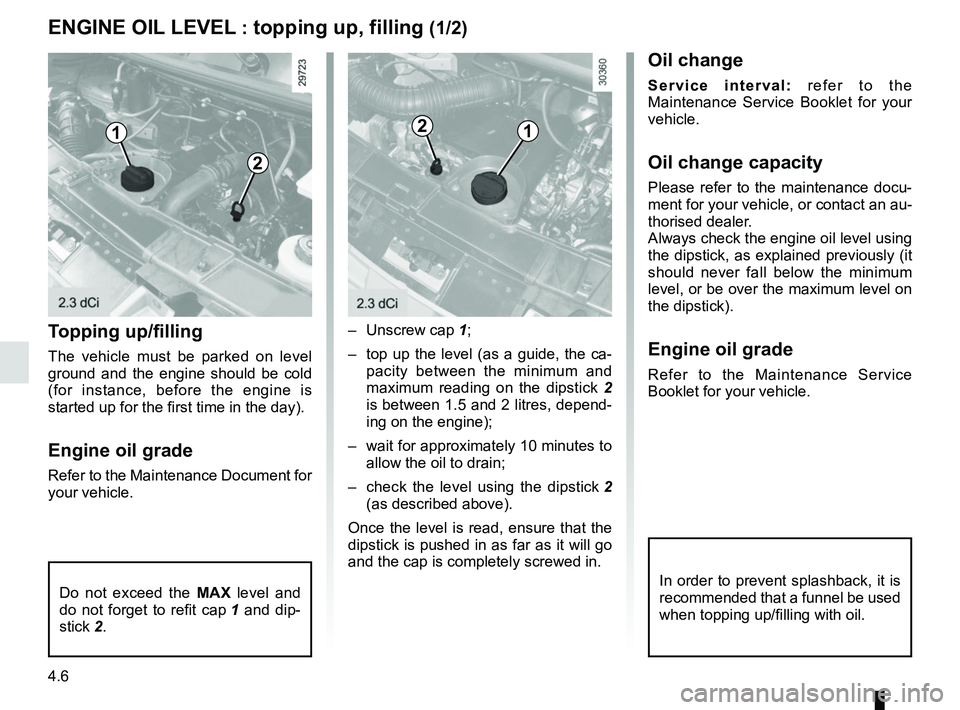
your vehicle.– Unscrew cap
1;
– top up the level (as a guide, the ca- pacity between the minimum and
maximum reading on the dipstick 2
is between 1.5 and 2 litres, depend-
ing on the engine);
– wait for approximately 10 minutes to allow the oil to drain;
– check the level using the dipstick 2
(as described above).
Once the level is read, ensure that the
dipstick is pushed in as far as it will go
and the cap is completely screwed in.
Do not exceed the MAX level and
do not forget to refit cap 1 and dip-
stick 2.
ENGINE OIL LEVEL : topping up, filling (1/2)
In order to prevent splashback, it is
recommended that a funnel be used
when topping up/filling with oil.
1
2
12
Oil change
Service interval: refer to the
Maintenance Service Booklet for your
vehicle.
Oil change capacity
Please refer to the maintenance docu-
ment for your vehicle, or contact an au-
thorised dealer.
Always check the engine oil level using
the dipstick, as explained previously (it
should never fall below the minimum
level, or be over the maximum level on
the dipstick).
Engine oil grade
Refer to the Maintenance Service
Booklet for your vehicle.
Page 203 of 290
4.7
Filling: take care when
topping up the oil that
no oil drips onto engine
components - risk of fire.
Remember to refit the cap securely
as there is a risk of fire if oil splashes
onto hot engine components.
Engine oil change: if you
are changing the oil when
the engine is hot, be careful
not to scald yourself if the
oil overflows.
Never run the engine in an
enclosed space as exhaust
gases are poisonous.
ENGINE OIL LEVEL : topping up, filling (2/2)
Please note when work-
ing close to the engine that
it may be hot. In addition,
the engine cooling fan may
start at any moment. The
warning light in the engine compart-
ment reminds you of this.
Risk of injury.
Consult your approved Dealer at
once if you notice an abnormal or
repeated drop in any of the fluid
levels.
Before performing any
action in the engine com-
partment, the ignition must
be switched off (please see
the information on “Starting, stop-
ping the engine” in Section 2).
Exceeding the maximum
engine oil level
Under no circumstances
must the maximum fill level
be exceeded: risk of damage to the
engine and catalytic converter.
If the oil level exceeds the maximum
level, do not start your vehicle and
contact an approved Dealer.
When working in the engine
compartment, ensure that
the windscreen wiper stalk
is in the park position.
Risk of injury.
Page 206 of 290
4.10
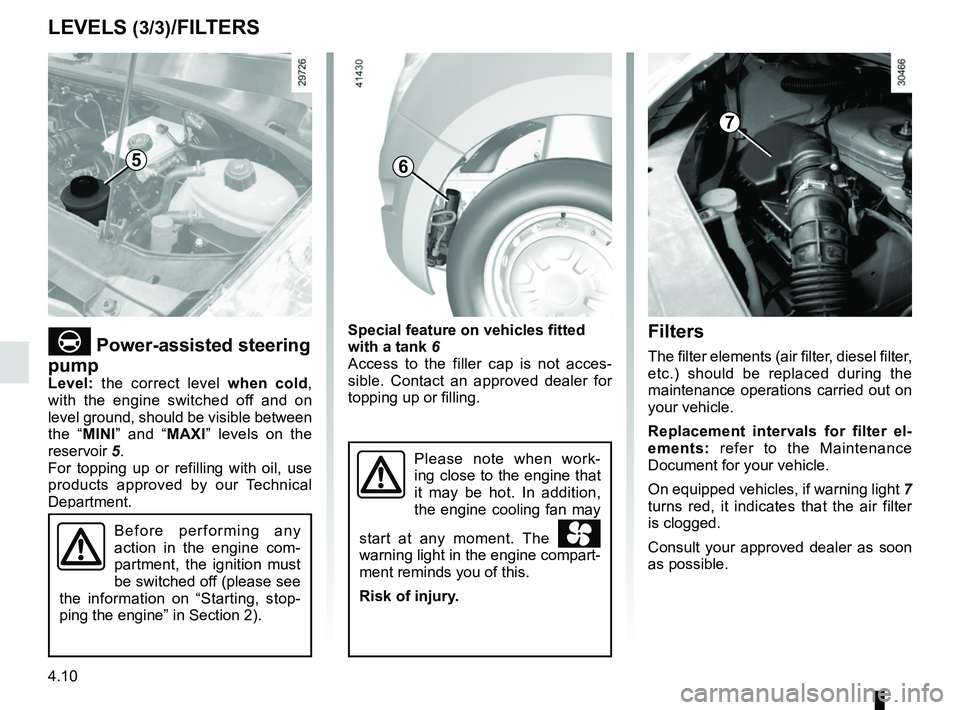
Power-assisted steering
pump
Level: the correct level when cold,
with the engine switched off and on
level ground, should be visible between
the “MINI ” and “MAXI” levels on the
reservoir 5. For topping up or refilling with oil, use
products approved by our Technical
Department. Special feature on vehicles fitted
with a tank
6
Access to the filler cap is not acces-
sible. Contact an approved dealer for
topping up or filling.
Filters
The filter elements (air filter, diesel filter,
etc.) should be replaced during the
maintenance operations carried out on
your vehicle.
Replacement intervals for filter el-
ements: refer to the Maintenance
Document for your vehicle.
On equipped vehicles, if warning light 7
turns red, it indicates that the air filter
is clogged.
Consult your approved dealer as soon
as possible.
LEVELS (3/3)/FILTERS
5
Please note when work-
ing close to the engine that
it may be hot. In addition,
the engine cooling fan may
start at any moment. The
warning light in the engine compart-
ment reminds you of this.
Risk of injury.
7
Before performing any
action in the engine com-
partment, the ignition must
be switched off (please see
the information on “Starting, stop-
ping the engine” in Section 2).
6