level RENAULT MEGANE 2005 X84 / 2.G Owner's Manual
[x] Cancel search | Manufacturer: RENAULT, Model Year: 2005, Model line: MEGANE, Model: RENAULT MEGANE 2005 X84 / 2.GPages: 250, PDF Size: 5.72 MB
Page 179 of 250
Downloaded from www.Manualslib.com manuals search engine
A
B
A
B
C
NU761_2_G4-FRA.qxd 14/11/05 10:10 Page 4.05
4.05
ENGINE OIL LEVEL (continued)
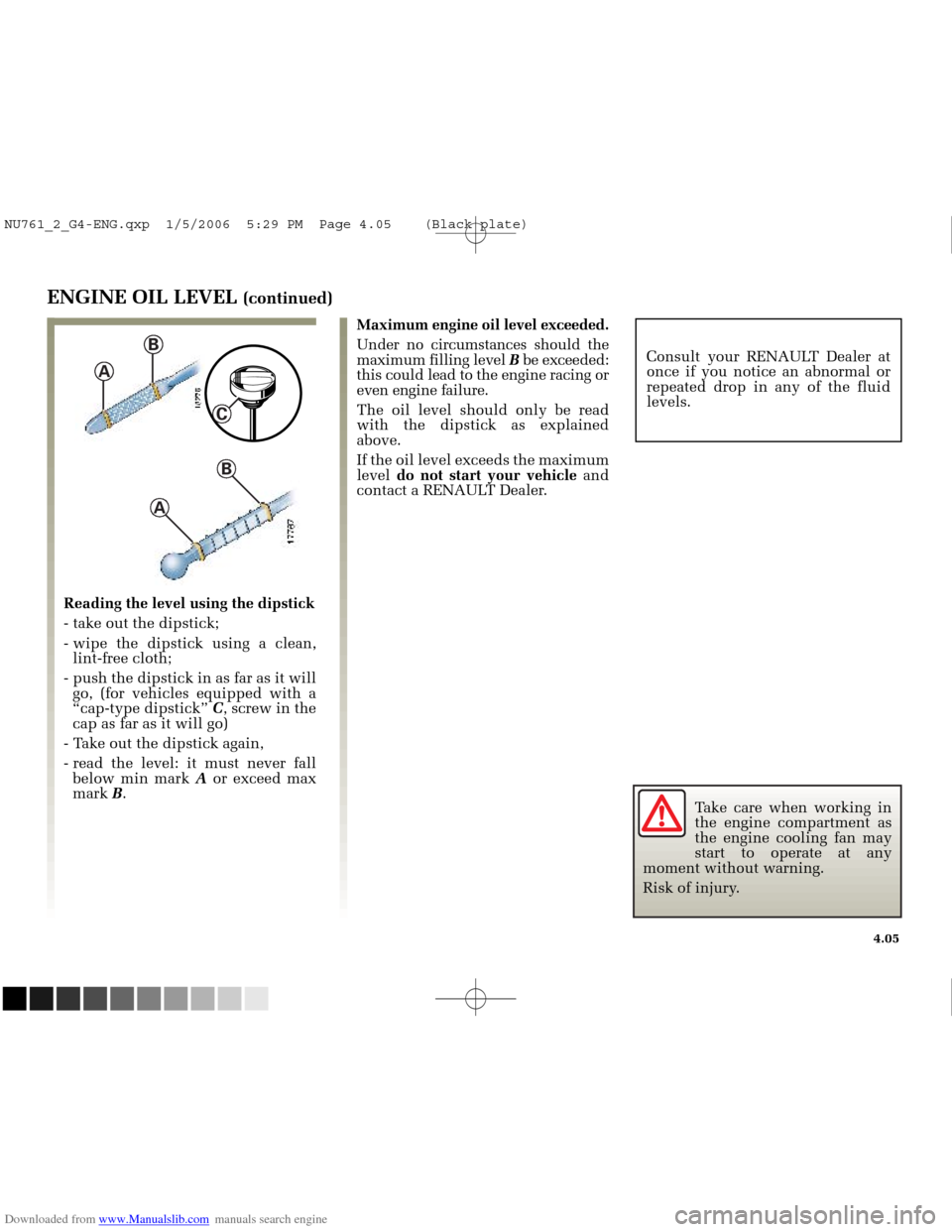
Reading the level using the dipstick
- take out the dipstick;
- wipe the dipstick using a clean,lint-free cloth;
- push the dipstick in as far as it will go, (for vehicles equipped with a
“cap-type dipstick” C, screw in the
cap as far as it will go)
- Take out the dipstick again,
- read the level: it must never fall below min mark Aor exceed max
mark B. Consult your RENAULT Dealer at
once if you notice an abnormal or
repeated drop in any of the fluid
levels.
Maximum engine oil level exceeded.
Under no circumstances should the
maximum filling level
Bbe exceeded:
this could lead to the engine racing or
even engine failure.
The oil level should only be read
with the dipstick as explained
above.
If the oil level exceeds the maximum
level do not start your vehicle and
contact a RENAULT Dealer.
Take care when working in
the engine compartment as
the engine cooling fan may
start to operate at any
moment without warning.
Risk of injury.
NU761_2_G4-ENG.qxp 1/5/2006 5:29 PM Page 4.05 (Black plate)
Page 180 of 250
Downloaded from www.Manualslib.com manuals search engine
2
2.0 T
1
2
1
2
1.4 16V - 1.6 16V
2.0 16V
1
1
2
1.5 dCi
NU761_2_G4-FRA.qxd 14/11/05 10:11 Page 4.06
4.06
ENGINE OIL LEVEL (continued)
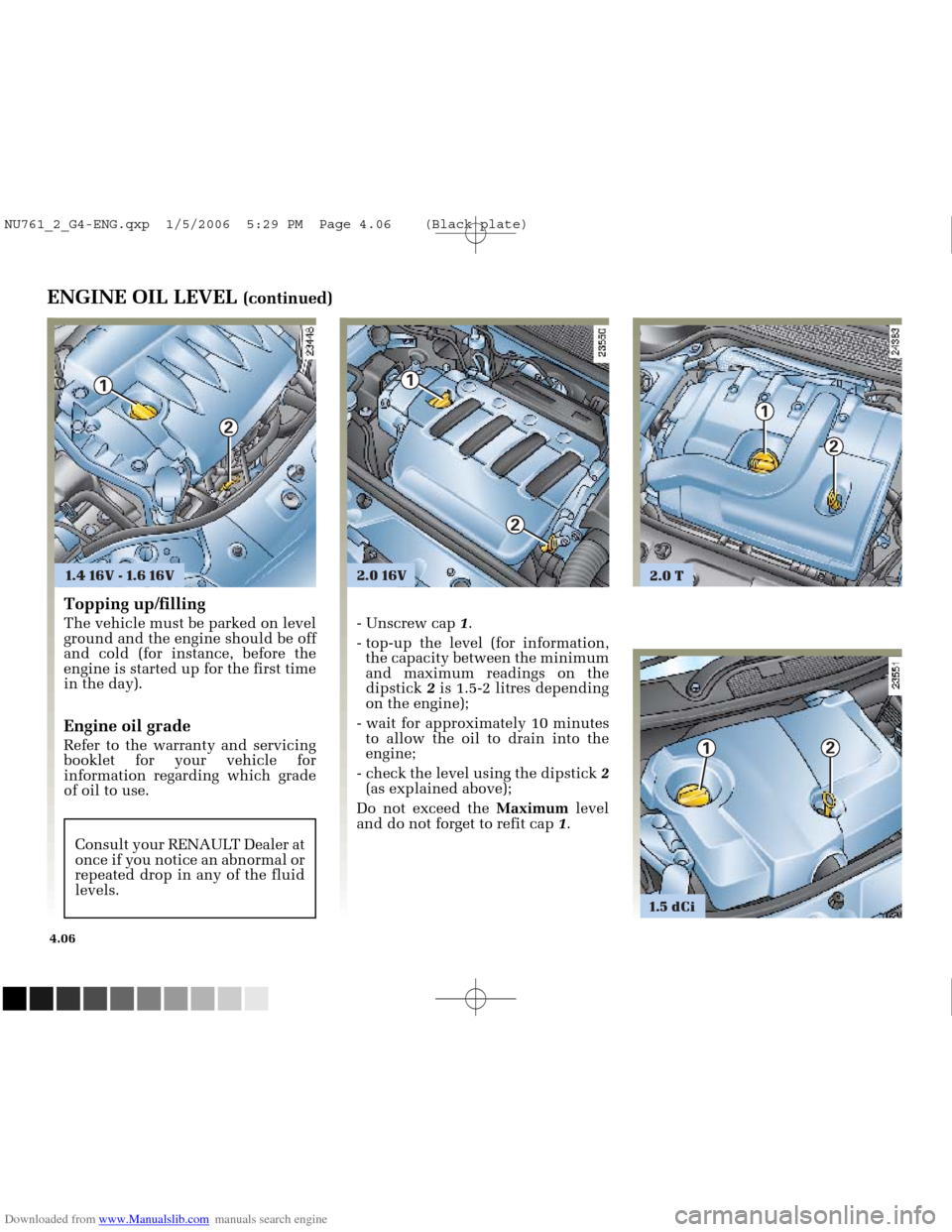
- Unscrew cap 1.
- top-up the level (for information, the capacity between the minimum
and maximum readings on the
dipstick 2is 1.5-2 litres depending
on the engine);
- wait for approximately 10 minutes to allow the oil to drain into the
engine;
- check the level using the dipstick 2
(as explained above);
Do not exceed the Maximumlevel
and do not forget to refit cap 1.
Topping up/filling
The vehicle must be parked on level
ground and the engine should be off
and cold (for instance, before the
engine is started up for the first time
in the day).
Engine oil grade
Refer to the warranty and servicing
booklet for your vehicle for
information regarding which grade
of oil to use.
Consult your RENAULT Dealer at
once if you notice an abnormal or
repeated drop in any of the fluid
levels.
NU761_2_G4-ENG.qxp 1/5/2006 5:29 PM Page 4.06 (Black plate)
Page 181 of 250
Downloaded from www.Manualslib.com manuals search engine
1
2.0 dCi
1
NU761_2_G4-FRA.qxd 14/11/05 10:11 Page 4.07
4.07
ENGINE OIL LEVEL (continued)/OIL CHANGE
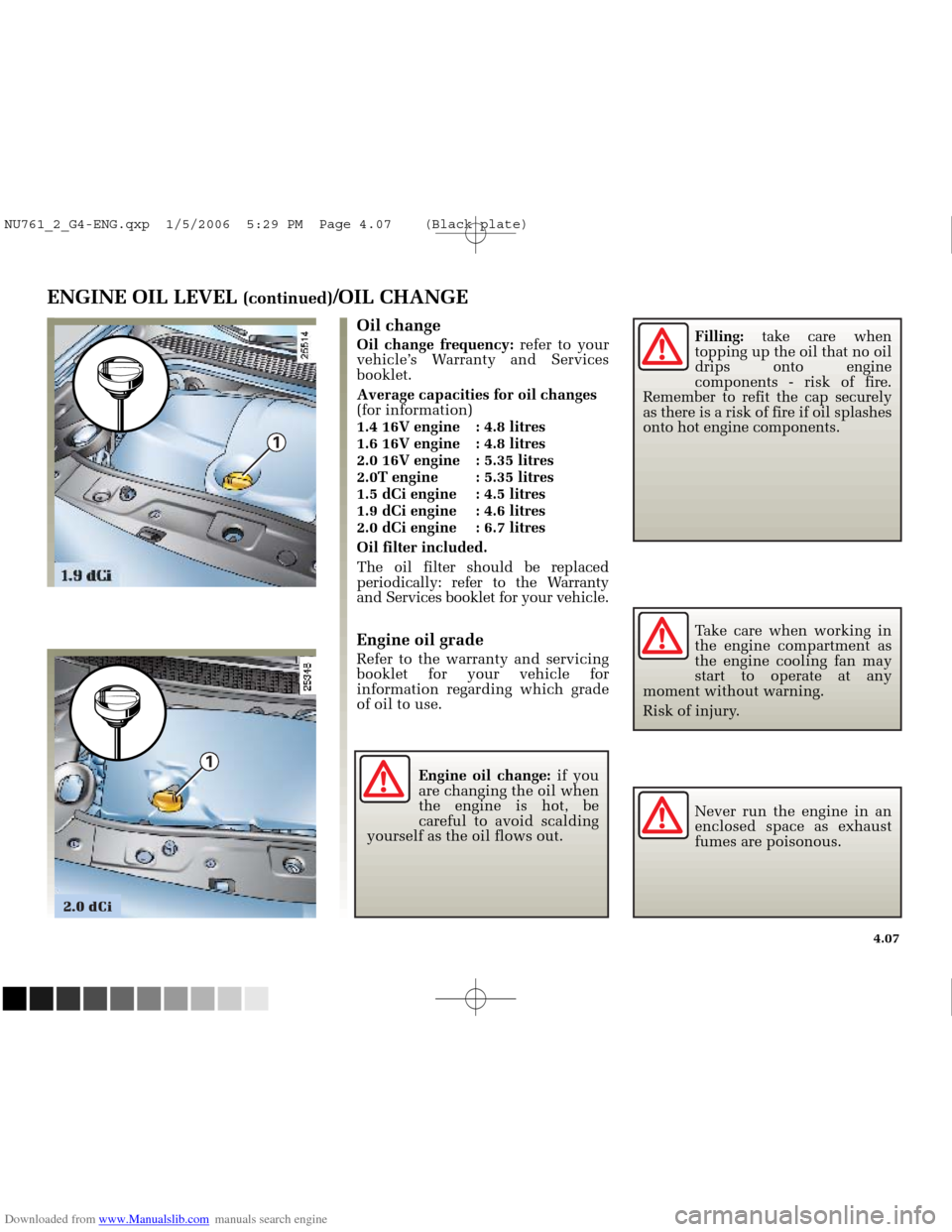
Oil change
Oil change frequency: refer to your
vehicle’s Warranty and Services
booklet.
Average capacities for oil changes
(for information)
1.4 16V engine : 4.8 litres
1.6 16V engine : 4.8 litres
2.0 16V engine : 5.35 litres
2.0T engine : 5.35 litres
1.5 dCi engine : 4.5 litres
1.9 dCi engine : 4.6 litres
2.0 dCi engine : 6.7 litres
Oil filter included.
The oil filter should be replaced
periodically: refer to the Warranty
and Services booklet for your vehicle.
Engine oil grade
Refer to the warranty and servicing
booklet for your vehicle for
information regarding which grade
of oil to use.
Engine oil change: if you
are changing the oil when
the engine is hot, be
careful to avoid scalding
yourself as the oil flows out. Never run the engine in an
enclosed space as exhaust
fumes are poisonous. Take care when working in
the engine compartment as
the engine cooling fan may
start to operate at any
moment without warning.
Risk of injury. Filling:
take care when
topping up the oil that no oil
drips onto engine
components - risk of fire.
Remember to refit the cap securely
as there is a risk of fire if oil splashes
onto hot engine components.
NU761_2_G4-ENG.qxp 1/5/2006 5:29 PM Page 4.07 (Black plate)
Page 182 of 250
Downloaded from www.Manualslib.com manuals search engine
1
NU761_2_G4-FRA.qxd 14/11/05 10:11 Page 4.08
4.08
LEVELS
Frequency for checking coolant level
Check the coolant level regularly
(very severe damage is likely to be
caused to the engine if it runs out of
coolant).
If topping up is required, only use
products approved by RENAULT’s
Technical Department:
- anti-freeze protection;
- anti-corrosion protection of thecooling system. Replacement interval
Refer to the Warranty and Services
booklet for your vehicle.
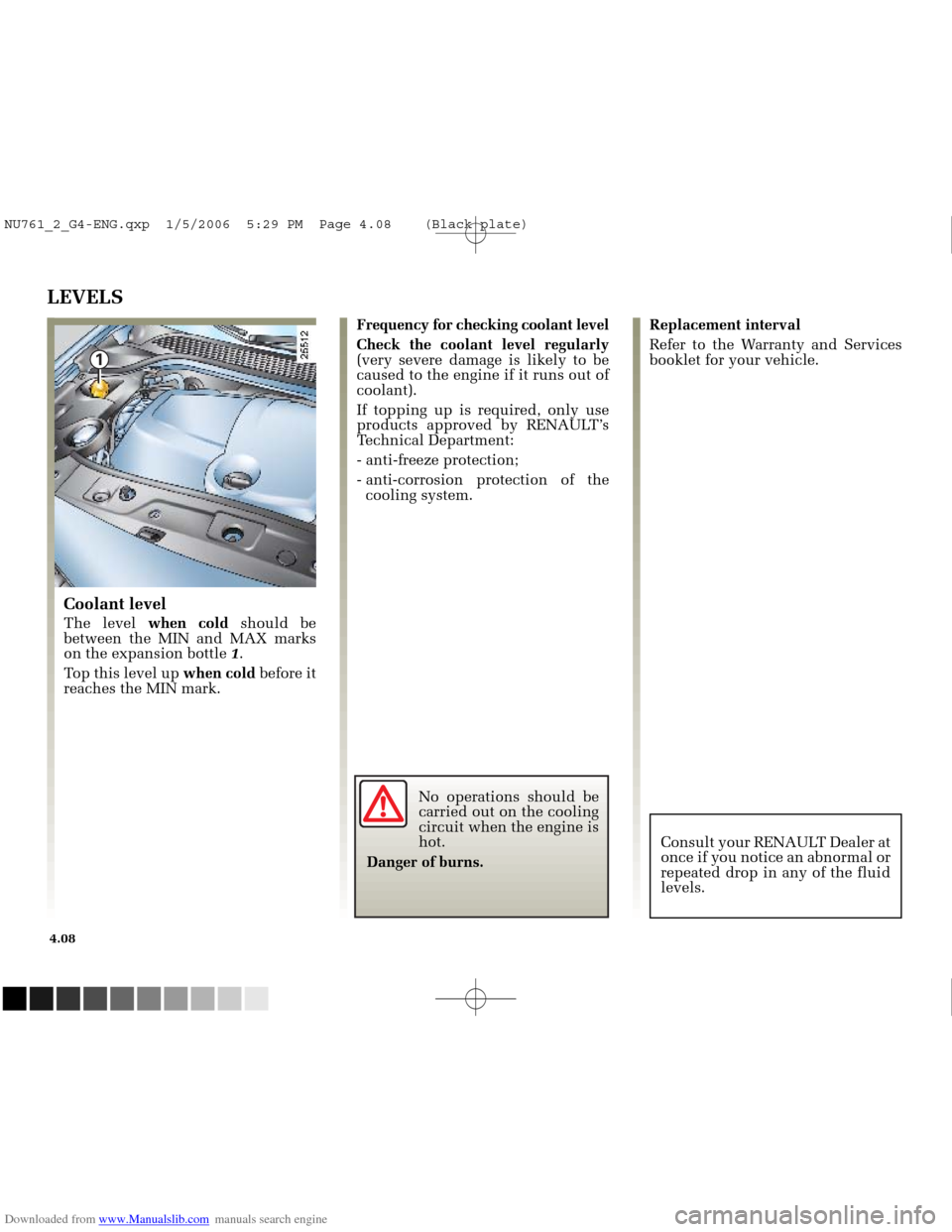
Coolant level
The level
when cold should be
between the MIN and MAX marks
on the expansion bottle 1.
Top this level up when coldbefore it
reaches the MIN mark.
Consult your RENAULT Dealer at
once if you notice an abnormal or
repeated drop in any of the fluid
levels.
No operations should be
carried out on the cooling
circuit when the engine is
hot.
Danger of burns.
NU761_2_G4-ENG.qxp 1/5/2006 5:29 PM Page 4.08 (Black plate)
Page 183 of 250
Downloaded from www.Manualslib.com manuals search engine
1
NU761_2_G4-FRA.qxd 14/11/05 10:11 Page 4.09
4.09
LEVELS (continued)
Brake fluid level
This should be checked frequently,
and immediately if you notice even
the slightest loss in braking
efficiency.
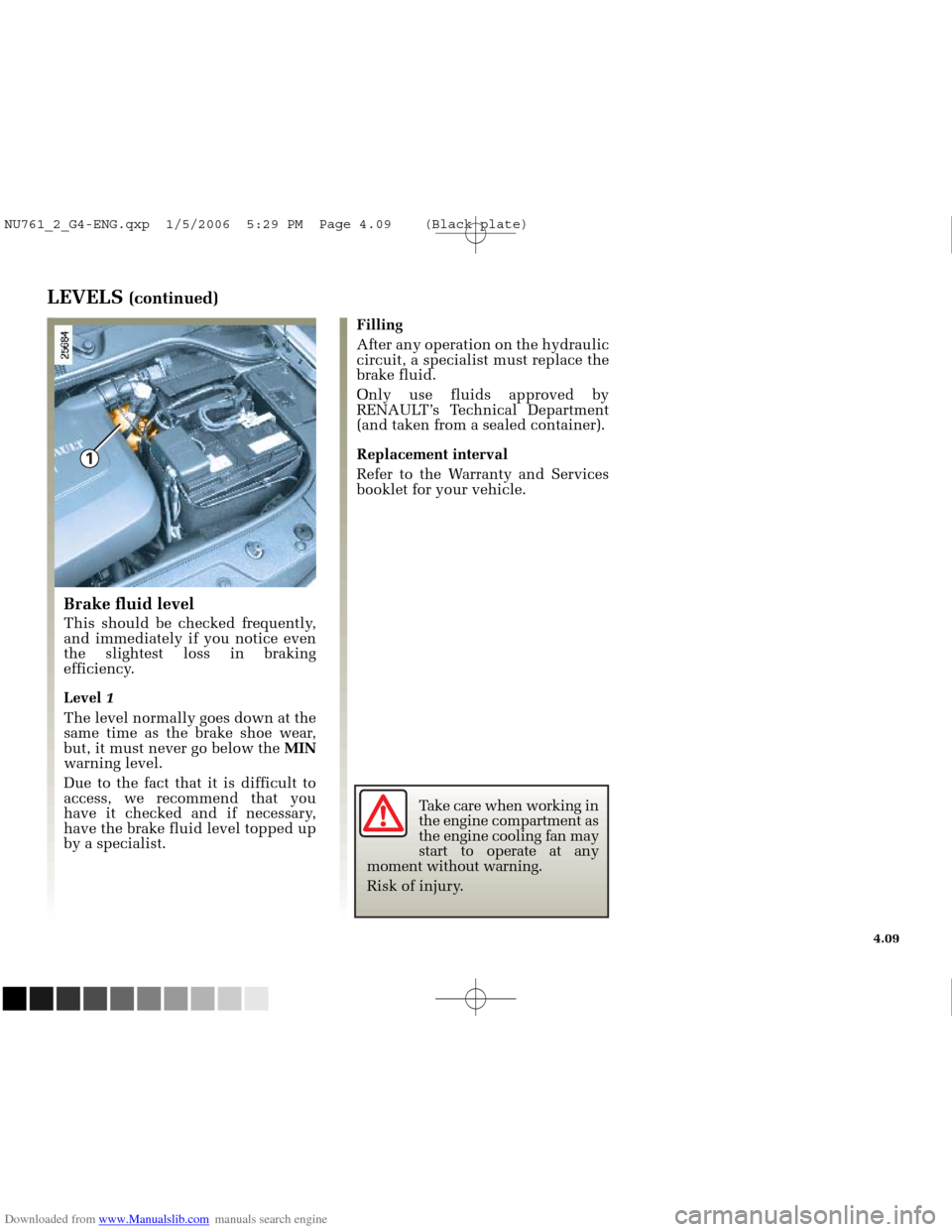
Level 1
The level normally goes down at the
same time as the brake shoe wear,
but, it must never go below the MIN
warning level.
Due to the fact that it is difficult to
access, we recommend that you
have it checked and if necessary,
have the brake fluid level topped up
by a specialist. Filling
After any operation on the hydraulic
circuit, a specialist must replace the
brake fluid.
Only use fluids approved by
RENAULT’s Technical Department
(and taken from a sealed container).
Replacement interval
Refer to the Warranty and Services
booklet for your vehicle.
Take care when working in
the engine compartment as
the engine cooling fan may
start to operate at any
moment without warning.
Risk of injury.
NU761_2_G4-ENG.qxp 1/5/2006 5:29 PM Page 4.09 (Black plate)
Page 184 of 250
Downloaded from www.Manualslib.com manuals search engine
1
NU761_2_G4-FRA.qxd 14/11/05 10:11 Page 4.10
4.10
LEVELS (continued)FILTERS
The replacement of filter elements
(air filter, passenger compartment
filter, diesel filter, etc.) is scheduled
in the servicing and maintenance
operations for your vehicle.
Frequency for replacing filter
elements: refer to the Warranty and
Services booklet for your vehicle.
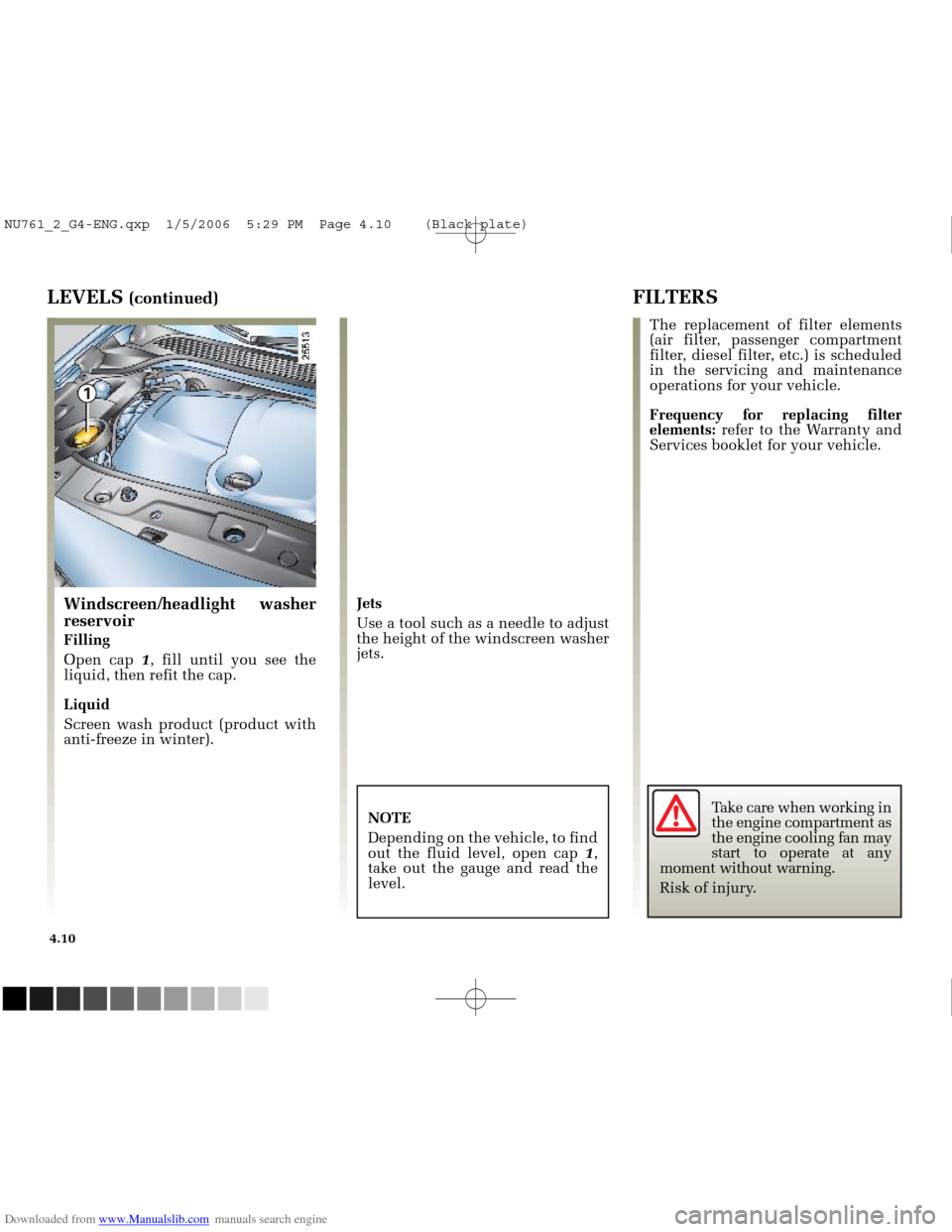
Windscreen/headlight washer
reservoir
Filling
Open cap 1, fill until you see the
liquid, then refit the cap.
Liquid
Screen wash product (product with
anti-freeze in winter). Jets
Use a tool such as a needle to adjust
the height of the windscreen washer
jets.
NOTE
Depending on the vehicle, to find
out the fluid level, open cap 1,
take out the gauge and read the
level.
Take care when working in
the engine compartment as
the engine cooling fan may
start to operate at any
moment without warning.
Risk of injury.
NU761_2_G4-ENG.qxp 1/5/2006 5:29 PM Page 4.10 (Black plate)
Page 193 of 250
Downloaded from www.Manualslib.com manuals search engine
3
4
2
1
NU761_2_G5-FRA.qxd 4/11/05 11:09 Page 5.05
5.05
CHANGING A WHEEL
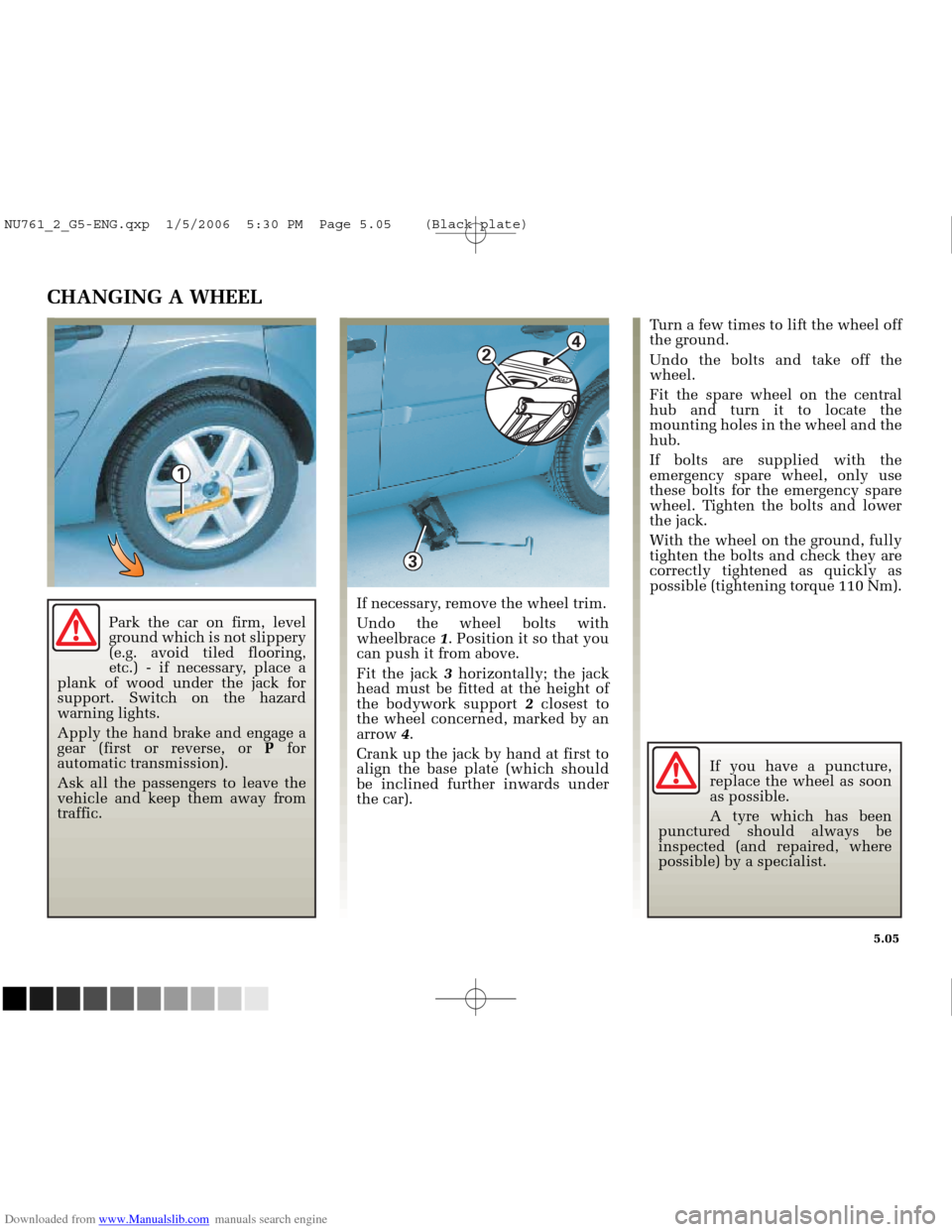
If necessary, remove the wheel trim.
Undo the wheel bolts with
wheelbrace 1. Position it so that you
can push it from above.
Fit the jack 3horizontally; the jack
head must be fitted at the height of
the bodywork support 2closest to
the wheel concerned, marked by an
arrow 4.
Crank up the jack by hand at first to
align the base plate (which should
be inclined further inwards under
the car). Turn a few times to lift the wheel off
the ground.
Undo the bolts and take off the
wheel.
Fit the spare wheel on the central
hub and turn it to locate the
mounting holes in the wheel and the
hub.
If bolts are supplied with the
emergency spare wheel, only use
these bolts for the emergency spare
wheel. Tighten the bolts and lower
the jack.
With the wheel on the ground, fully
tighten the bolts and check they are
correctly tightened as quickly as
possible (tightening torque 110 Nm).
If you have a puncture,
replace the wheel as soon
as possible.
A tyre which has been
punctured should always be
inspected (and repaired, where
possible) by a specialist.
Park the car on firm, level
ground which is not slippery
(e.g. avoid tiled flooring,
etc.) - if necessary, place a
plank of wood under the jack for
support. Switch on the hazard
warning lights.
Apply the hand brake and engage a
gear (first or reverse, or Pfor
automatic transmission).
Ask all the passengers to leave the
vehicle and keep them away from
traffic.
NU761_2_G5-ENG.qxp 1/5/2006 5:30 PM Page 5.05 (Black plate)
Page 194 of 250
Downloaded from www.Manualslib.com manuals search engine
1
2
NU761_2_G5-FRA.qxd 4/11/05 11:09 Page 5.06
5.06
TYRES
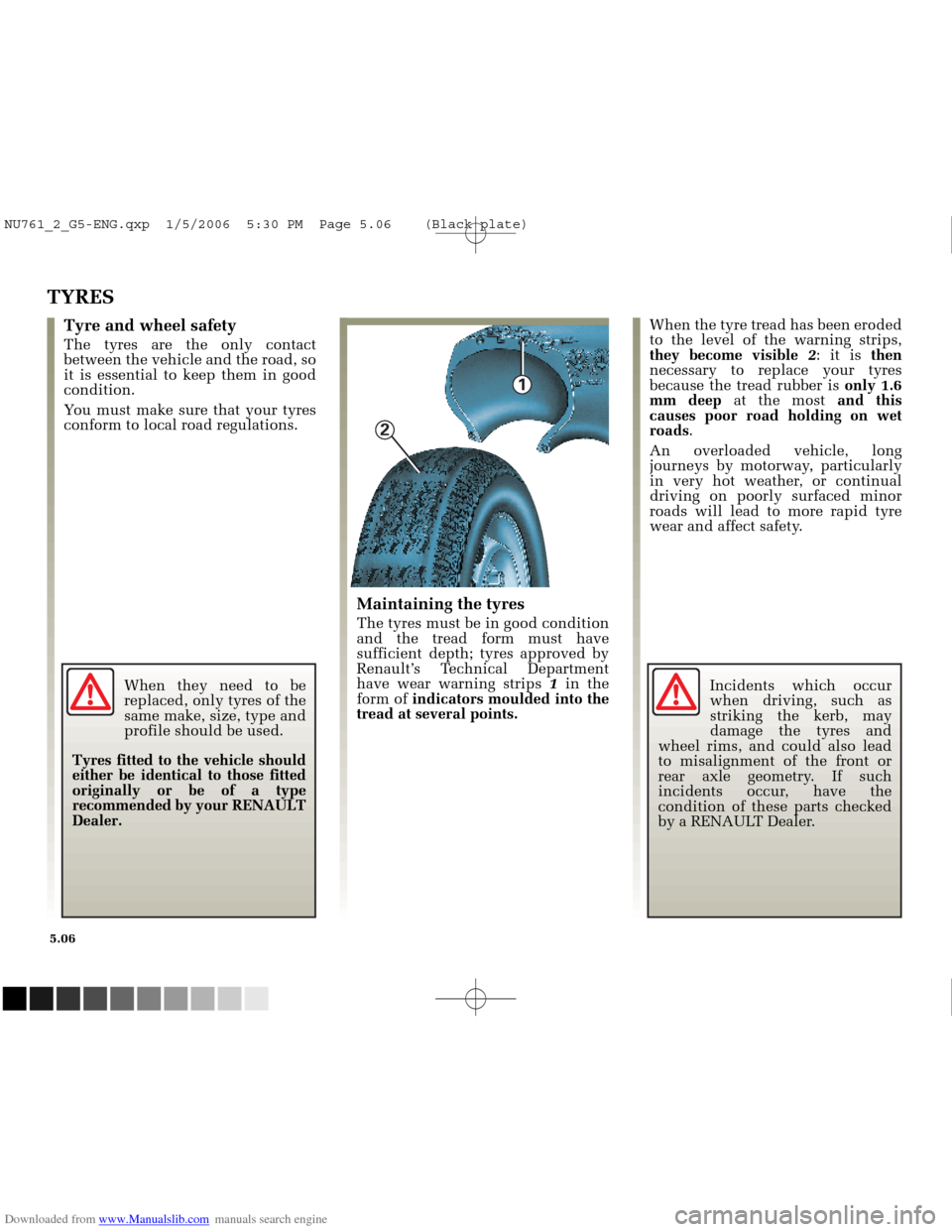
Maintaining the tyres
The tyres must be in good condition
and the tread form must have
sufficient depth; tyres approved by
Renault’s Technical Department
have wear warning strips 1in the
form of indicators moulded into the
tread at several points.
Tyre and wheel safety
The tyres are the only contact
between the vehicle and the road, so
it is essential to keep them in good
condition.
You must make sure that your tyres
conform to local road regulations. When the tyre tread has been eroded
to the level of the warning strips,
they become visible
2: it is then
necessary to replace your tyres
because the tread rubber is only 1.6
mm deep at the most and this
causes poor road holding on wet
roads .
An overloaded vehicle, long
journeys by motorway, particularly
in very hot weather, or continual
driving on poorly surfaced minor
roads will lead to more rapid tyre
wear and affect safety.
When they need to be
replaced, only tyres of the
same make, size, type and
profile should be used.
Tyres fitted to the vehicle should
either be identical to those fitted
originally or be of a type
recommended by your RENAULT
Dealer. Incidents which occur
when driving, such as
striking the kerb, may
damage the tyres and
wheel rims, and could also lead
to misalignment of the front or
rear axle geometry. If such
incidents occur, have the
condition of these parts checked
by a RENAULT Dealer.
NU761_2_G5-ENG.qxp 1/5/2006 5:30 PM Page 5.06 (Black plate)
Page 207 of 250
Downloaded from www.Manualslib.com manuals search engine
A
NU761_2_G5-FRA.qxd 4/11/05 11:09 Page 5.19
5.19
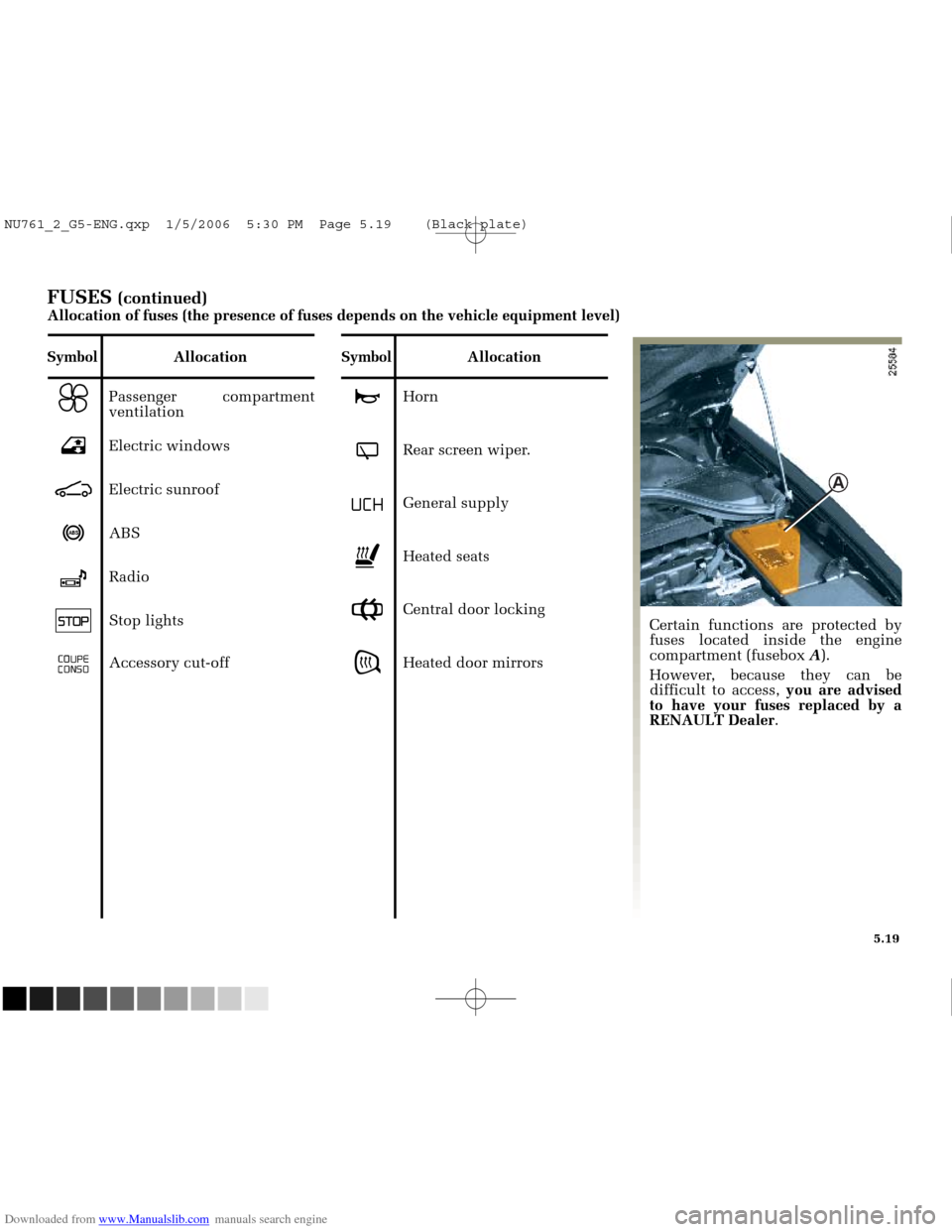
FUSES (continued)Allocation of fuses (the presence of fuses depends on the vehicle equip\
ment level)
SymbolAllocation
ZPassenger compartment
ventilation
VElectric windows
[Electric sunroof
XABS
ÎRadio
×Stop lights
ÈAccessory cut-off
SymbolAllocation
ÌHorn
ERear screen wiper.
ÔGeneral supply
ÑHeated seats
]Central door locking
SHeated door mirrors
Certain functions are protected by
fuses located inside the engine
compartment (fusebox A).
However, because they can be
difficult to access, you are advised
to have your fuses replaced by a
RENAULT Dealer .
NU761_2_G5-ENG.qxp 1/5/2006 5:30 PM Page 5.19 (Black plate)
Page 212 of 250
Downloaded from www.Manualslib.com manuals search engine
3
2
1
NU761_2_G5-FRA.qxd 4/11/05 11:10 Page 5.24
5.24
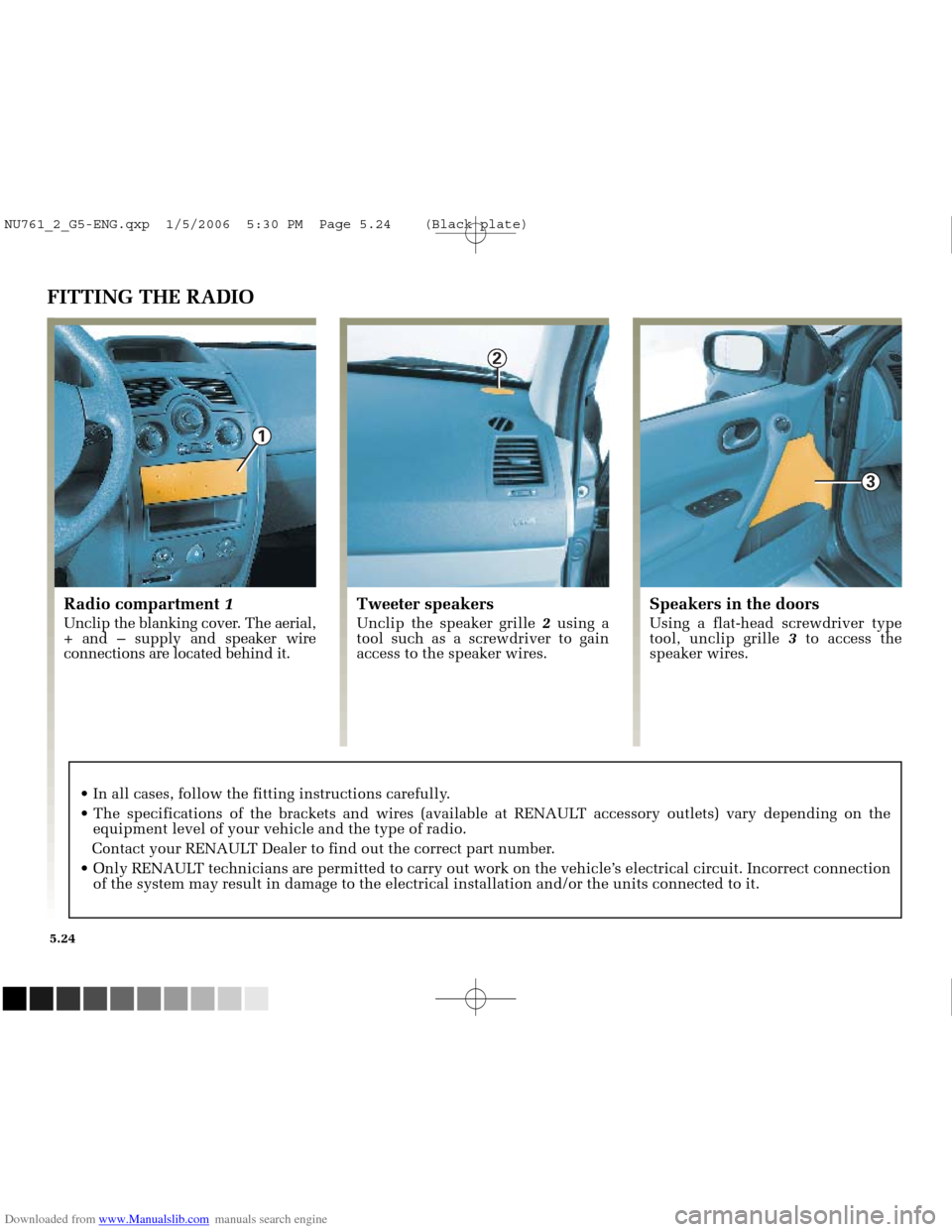
FITTING THE RADIO
Tweeter speakers
Unclip the speaker grille 2using a
tool such as a screwdriver to gain
access to the speaker wires.
Speakers in the doors
Using a flat-head screwdriver type
tool, unclip grille 3to access the
speaker wires.
Radio compartment 1
Unclip the blanking cover. The aerial,
+ and – supply and speaker wire
connections are located behind it.
In all cases, follow the fitting instructions carefully.
The specifications of the brackets and wires (available at RENAULT accessory outlets) vary depending on theequipment level of your vehicle and the type of radio.
Contact your RENAULT Dealer to find out the correct part number.
Only RENAULT technicians are permitted to carry out work on the vehicle’s electrical circuit. Incorrect connection of the system may result in damage to the electrical installation and/or\
the units connected to it.
NU761_2_G5-ENG.qxp 1/5/2006 5:30 PM Page 5.24 (Black plate)