check auto RENAULT MEGANE 2017 4.G User Guide
[x] Cancel search | Manufacturer: RENAULT, Model Year: 2017, Model line: MEGANE, Model: RENAULT MEGANE 2017 4.GPages: 346, PDF Size: 7.04 MB
Page 129 of 346
2.17
ELECTRONIC PARKING BRAKE (1/3)
Note:
To indicate that the electronic parking
brake is released, a beep sounds and
the message “Apply parking brake” ap-
pears on the instrument panel:
– with the engine running: when the driver’s door is opened;
– with the engine switched off (eg. when the engine stalls): when a front
door is opened.
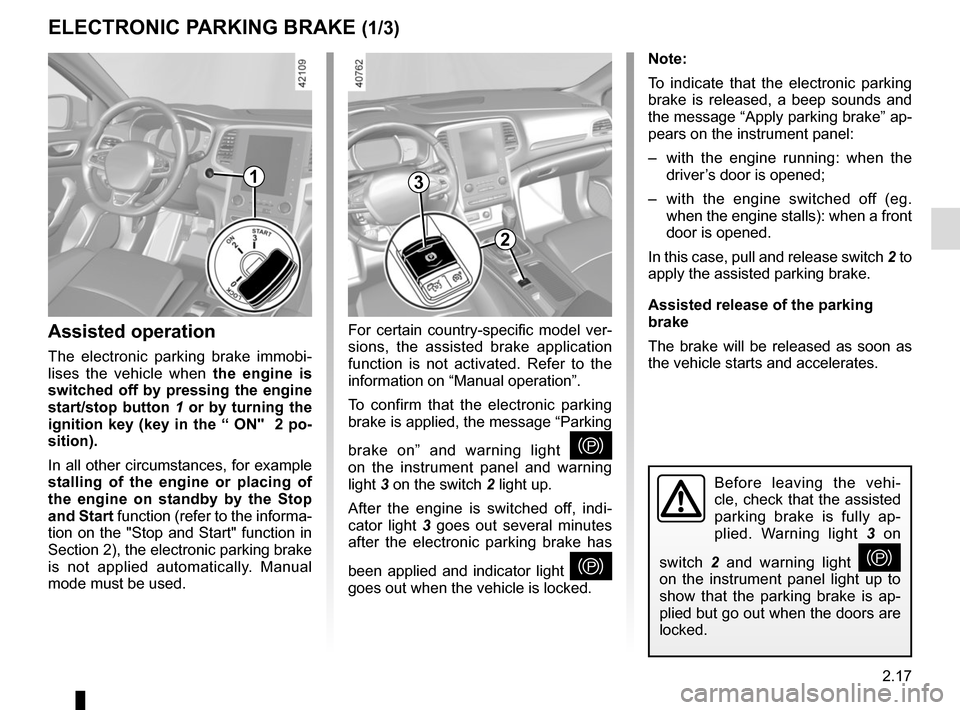
In this case, pull and release switch 2 to
apply the assisted parking brake.
Assisted release of the parking
brake
The brake will be released as soon as
the vehicle starts and accelerates.
Assisted operation
The electronic parking brake immobi-
lises the vehicle when the engine is
switched off by pressing the engine
start/stop button 1 or by turning the
ignition key (key in the “ ON" 2 po-
sition).
In all other circumstances, for example
stalling of the engine or placing of
the engine on standby by the Stop
and Start function (refer to the informa-
tion on the "Stop and Start" function in
Section 2), the electronic parking brake
is not applied automatically. Manual
mode must be used. For certain country-specific model ver-
sions, the assisted brake application
function is not activated. Refer to the
information on “Manual operation”.
To confirm that the electronic parking
brake is applied, the message “Parking
brake on” and warning light
}
on the instrument panel and warning
light 3 on the switch 2 light up.
After the engine is switched off, indi-
cator light 3 goes out several minutes
after the electronic parking brake has
been applied and indicator light
}
goes out when the vehicle is locked.
Before leaving the vehi-
cle, check that the assisted
parking brake is fully ap-
plied. Warning light 3 on
switch 2 and warning light
}
on the instrument panel light up to
show that the parking brake is ap-
plied but go out when the doors are
locked.
3
2
1
Page 131 of 346
2.19
Operating faults
– If there is a fault, the © warning
light illuminates on the instrument
panel accompanied by the “Check
parking brake” message and, in
some cases, the
} warning
light.
Please contact an authorised dealer
as soon as possible.
– If there is an assisted parking brake fault, the warning light
® comes
on, along with the message “Braking
system fault”, a beep and, in some
cases, the warning light
}.
This means that you must stop as
soon as traffic conditions allow.
Versions with an automatic
gearbox
For safety reasons, automatic release
is deactivated when the driver’s door
is open or not shut properly and the
engine is running (in order to prevent
the vehicle from moving without the
driver). The “Release parking brake
manually” message appears on the
instrument panel when the driver de-
presses the accelerator.
ELECTRONIC PARKING BRAKE (3/3)
It is therefore essential to
immobilise the vehicle by
engaging first gear (manual
gearbox) or position P (au-
tomatic gearbox). If the slope re-
quires it, chock the vehicle.
Never leave your vehicle
without moving the selec-
tor lever to position P and
switching off the engine.
This is because when the vehicle is
stationary with the engine running
and a gear engaged, the vehicle
may begin to move.
There is a risk of accidents.If no lights or sounds are ap-
parent, this indicates a fault
in the instrument panel. This
indicates that it is essential
to stop immediately (as soon as traf-
fic conditions allow). Ensure that the
vehicle is correctly immobilised and
contact an approved Dealer.
In the event of message
“Electric failure DANGER”
or “Check battery”, manu-
ally activate the electronic
parking brake by pulling switch 2 (or
position the gear lever in P for au-
tomatic gearboxes) before stopping
the engine.
Risk of loss of immobilisation of the
vehicle.
Contact an authorised dealer.
Page 184 of 346
2.72
Automatic deactivation of the
parking distance control
The system deactivates:
– when the vehicle speed is above ap-proximately 6 mph (10 km/h);
– depending on the model, when the vehicle is stationary for more than
approximately 5 seconds and an ob-
stacle is detected (such as when in a
traffic jam, etc.);
– when the vehicle is in neutral for manual gearboxes, or in position N
or P for automatic gearboxes.
PARKING DISTANCE CONTROL (5/5)
Operating faults
When the system detects an operating
fault, a beep sounds for approximately
3 seconds each time reverse gear is se-
lected and is accompanied by the mes-
sage “Check parking sensor” shown on
the instrument panel. Please consult an
authorised dealer.
Page 193 of 346
2.81
AUTOMATIC TRANSMISSION (3/3)
Parking the vehicle
When the vehicle is stopped, move the
lever to position P while keeping your
foot on the brake pedal: the gearbox is
in neutral and the drive wheels are me-
chanically locked by the driveshaft.
Apply the handbrake or, depending
on the vehicle, ensure that the elec-
tronic parking brake is applied.
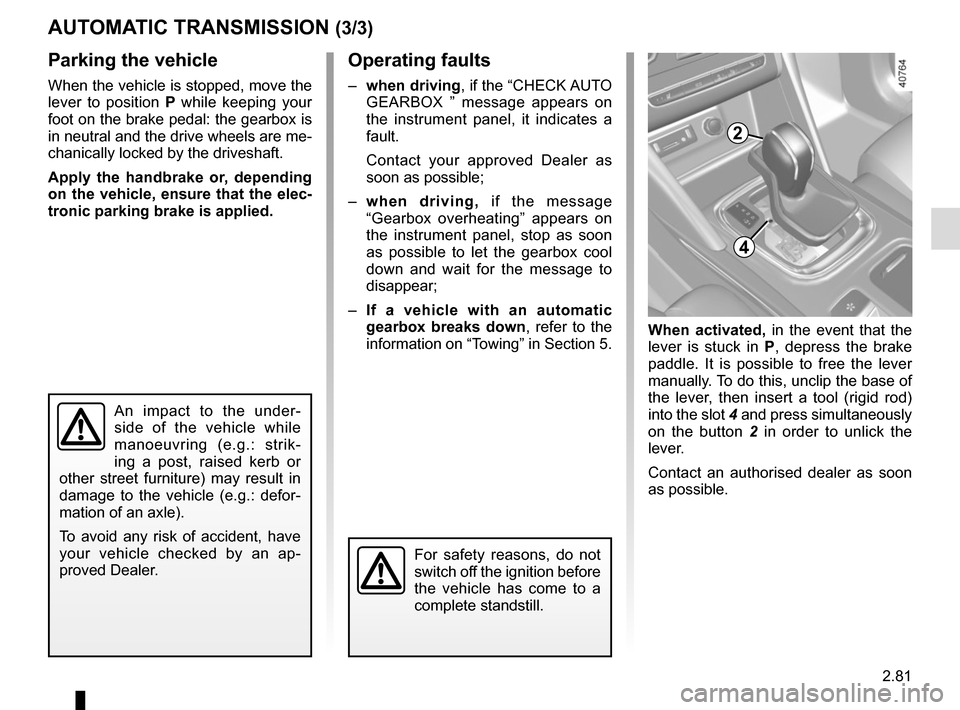
When activated, in the event that the
lever is stuck in P, depress the brake
paddle. It is possible to free the lever
manually. To do this, unclip the base of
the lever, then insert a tool (rigid rod)
into the slot 4 and press simultaneously
on the button 2 in order to unlick the
lever.
Contact an authorised dealer as soon
as possible.
Operating faults
– when driving , if the “CHECK AUTO
GEARBOX ” message appears on
the instrument panel, it indicates a
fault.
Contact your approved Dealer as
soon as possible;
– when driving, if the message
“Gearbox overheating” appears on
the instrument panel, stop as soon
as possible to let the gearbox cool
down and wait for the message to
disappear;
– If a vehicle with an automatic
gearbox breaks down, refer to the
information on “Towing” in Section 5.
For safety reasons, do not
switch off the ignition before
the vehicle has come to a
complete standstill.
An impact to the under-
side of the vehicle while
manoeuvring (e.g.: strik-
ing a post, raised kerb or
other street furniture) may result in
damage to the vehicle (e.g.: defor-
mation of an axle).
To avoid any risk of accident, have
your vehicle checked by an ap-
proved Dealer.
4
2
Page 213 of 346
3.19
Operating faults
As a general rule, contact your ap-
proved dealer in the event of an oper-
ating fault.
– Reduction in de-icing, demisting or air conditioning performance.
This may be caused by the passen-
ger compartment filter cartridge be-
coming clogged.
– No cold air is being produced .
Check that the controls are set cor-
rectly and that the fuses are sound.
Otherwise, switch off the system.
Presence of water under the
vehicle
After prolonged use of the air condi-
tioning system, it is normal for water
to be present under the vehicle. This is
caused by condensation.
AIR CONDITIONING: information and advice on use
Do not open the refriger-
ant fluid circuit. The fluid
may damage eyes or skin.
Fuel consumption
You will normally notice an increase in
fuel consumption (especially in town)
when the air conditioning is operating.
For vehicles fitted with air conditioning
with no automatic mode, switch off the
system when it is not required.
Advice for reducing consumption
and helping to preserve the environ-
ment
Drive with the air vents open and the
windows closed.
If the vehicle has been parked in the
sun, open the doors for a few moments
to let the hot air escape before starting
the engine.
Advice on use
In some situations, (air conditioning
off, air recirculation activated, ventila-
tion speed at zero or low, etc.) you may
notice that condensation starts to form
on the windows and windscreen.
If there is condensation, use the “Clear
View” function to remove it, then use
the air conditioning in automatic mode
to stop it forming again.
Maintenance
Refer to the Maintenance Document
for your vehicle for the inspection fre-
quency.
Do not add anything to the
vehicle’s ventilation circuit
(for example, to remove
bad odours).
There is a risk of damage or of
fire.
Page 218 of 346
3.24
ELECTRIC SUNROOF (2/3)
Special features
Your vehicle is fitted with an anti-pinch
facility: when the sunroof encounters
resistance whilst closing (branch of
a tree, etc.), it stops and then moves
back a few centimetres.
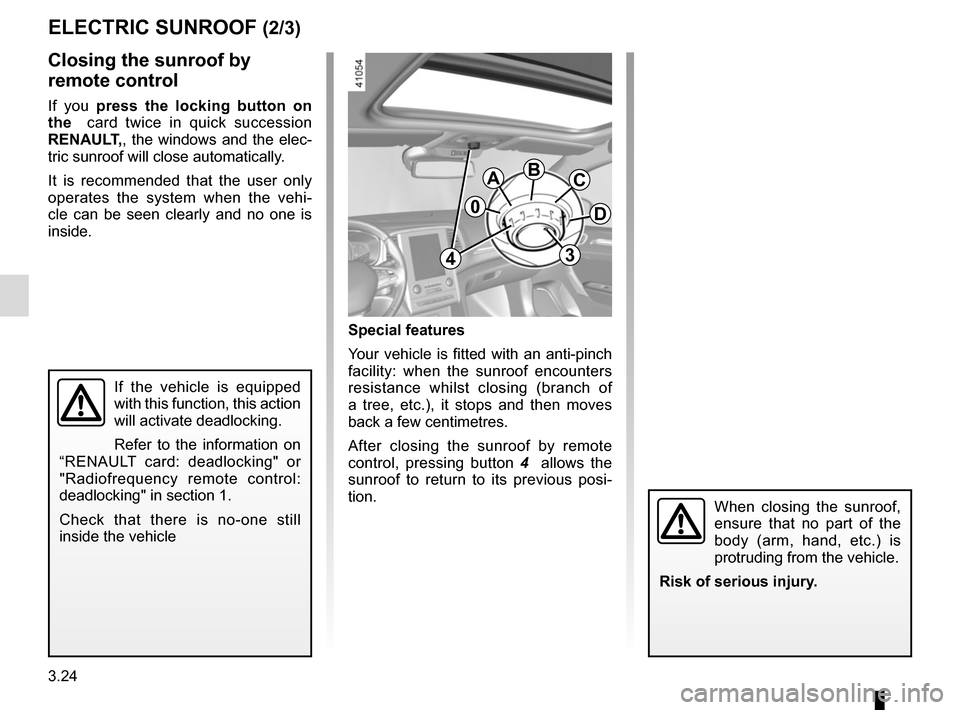
After closing the sunroof by remote
control, pressing button 4 allows the
sunroof to return to its previous posi-
tion.
Closing the sunroof by
remote control
If you press the locking button on
the card twice in quick succession
RENAULT,, the windows and the elec-
tric sunroof will close automatically.
It is recommended that the user only
operates the system when the vehi-
cle can be seen clearly and no one is
inside.
If the vehicle is equipped
with this function, this action
will activate deadlocking.
Refer to the information on
“RENAULT card: deadlocking" or
"Radiofrequency remote control:
deadlocking" in section 1.
Check that there is no-one still
inside the vehicle
0
ABC
D
34
When closing the sunroof,
ensure that no part of the
body (arm, hand, etc.) is
protruding from the vehicle.
Risk of serious injury.
Page 255 of 346
4.3
BONNET (2/2)
Closing the bonnet
Check that nothing has been left in the
engine compartment.
To close the bonnet again, hold the
bonnet in the middle and guide it down,
allowing a 30 cm gap before it is closed,
then release it. It will latch automatically
under its own weight.
Ensure that the bonnet is
properly locked.
Check that nothing is pre-
venting the catch from lock-
ing (gravel, cloth, etc.).
After carrying out any work
in the engine compart-
ment, check that nothing
has been left behind (cloth,
tools, etc.).
These may damage the engine or
cause a fire.
In the event of even a slight
impact involving the radia-
tor grille or bonnet, have the
bonnet lock checked by an
authorised dealer as soon as pos-
sible.
Page 339 of 346

A
ABS ....................................................................\
...2.30 → 2.39
accessories...................................................................")
7.1
ALPHABETICAL INDEX (1/5)
A
ABS ....................................................................\
...2.30 → 2.39
accessories........................................................................\
5.34
accessories socket ........................................ 3.33 – 3.34, 3.57
adaptive cruise control...........................................2.61 → 2.67
additional methods of restraint .....................1.28 → 1.31, 1.34
side protection ............................................................. 1.33
to the rear seat belts ........................................1.28 → 1.32
adjusting your driving position ...............................1.24 → 1.27
advice on antipollution ....................................................... 2.25
air bag....................................................................1.28 → 1.34
activating the front passenger air bags ........................ 1.52
deactivating the front passenger air bags .................... 1.50
air conditioning ........................................................3.6 → 3.19
air vents ...................................................................... 3.4 – 3.5
anti-corrosion check ..............................................6.17 → 6.21
anti-corrosion protection .................................................... 4.15
anti-lock braking system: ABS ...............................2.30 → 2.39
antipollution advice .................................................................\
......... 2.25
armrest: front ..................................................................\
............ 3.31
ashtray .................................................................... 3.33 – 3.34
assisted parking............................... 2.68 → 2.72, 2.75 → 2.78
automatic gearbox (use) ........................................2.79 → 2.81
automatic gearbox selector lever...........................2.79 → 2.81
B
battery..................................................................... 4.11 – 4.12 troubleshooting ................................................. 5.30 – 5.31
battery (remote control) ..................................................... 5.33
blind spot warning signal .......................................2.43 → 2.46
blind spot: warning signal ......................................2.43 → 2.46
bonnet........................................................................\
. 4.2 – 4.3
brake fluid ........................................................................\
.... 4.9 bulbs
changing ......................................5.14 → 5.27, 5.26 – 5.27
C
catalytic converter................................................... 2.14 – 2.15
central door locking ...............1.2 – 1.3, 1.5, 1.12 → 1.15, 1.19
changing a bulb .................................5.14 → 5.27, 5.26 – 5.27
changing a wheel...................................................... 5.9 – 5.10
changing gear ...............................................2.16, 2.79 → 2.81
child restraint/seat .............................1.35 – 1.36, 1.38 → 1.49
child safety.........1.6, 1.9, 1.18, 1.35 – 1.36, 1.38 → 1.49, 3.21
child seats..........................................1.35 – 1.36, 1.38 → 1.49
children .......................................................... 1.35 – 1.36, 1.36
children (safety) .......................................... 1.6, 1.9, 1.18, 3.21
cigar lighter ............................................................. 3.33 – 3.34
cleaning: inside the vehicle .............................................. 4.17 – 4.18
clock ..................................................................\
................ 1.84
closing the doors ...................................................1.13 → 1.18
control instruments ................................................. 1.70 – 1.71
controls ...............................................................\
...1.54 → 1.57
coolant ................................................................\
................. 4.8
courtesy light ...................................... 3.26 – 3.27, 5.25 – 5.26
courtesy mirrors ................................................................. 3.28
cruise control ................................... 2.51 → 2.53, 2.57 → 2.60
cruise control-speed limiter.............. 2.51 → 2.53, 2.57 → 2.60
customised vehicle settings ................................... 1.80 – 1.81
customising the vehicle settings ............................ 1.80 – 1.81
D
dashboard..............................................................1.54 → 1.57
deadlocking the doors ................................................ 1.5, 1.12
demisting rear screen ...........................................................3.6 →
3.8
windscreen ...........................................................3.6 → 3.8
dimensions .............................................................\
...6.5 → 6.7