mount RENAULT MEGANE 2017 4.G User Guide
[x] Cancel search | Manufacturer: RENAULT, Model Year: 2017, Model line: MEGANE, Model: RENAULT MEGANE 2017 4.GPages: 346, PDF Size: 7.04 MB
Page 209 of 346
3.15
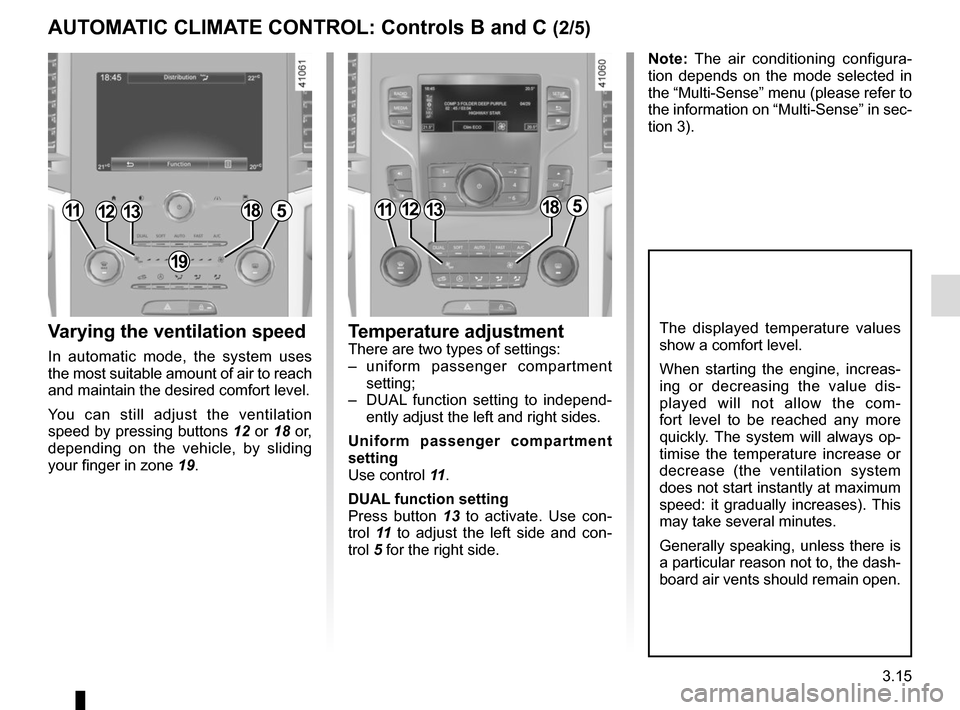
Varying the ventilation speed
In automatic mode, the system uses
the most suitable amount of air to reach
and maintain the desired comfort level.
You can still adjust the ventilation
speed by pressing buttons 12 or 18 or,
depending on the vehicle, by sliding
your finger in zone 19.
Temperature adjustmentThere are two types of settings:
– uniform passenger compartment
setting;
– DUAL function setting to independ- ently adjust the left and right sides.
Uniform passenger compartment
setting
Use control 11 .
DUAL function setting
Press button 13 to activate. Use con-
trol 11 to adjust the left side and con-
trol 5 for the right side.
The displayed temperature values
show a comfort level.
When starting the engine, increas-
ing or decreasing the value dis-
played will not allow the com-
fort level to be reached any more
quickly. The system will always op-
timise the temperature increase or
decrease (the ventilation system
does not start instantly at maximum
speed: it gradually increases). This
may take several minutes.
Generally speaking, unless there is
a particular reason not to, the dash-
board air vents should remain open.
Note: The air conditioning configura-
tion depends on the mode selected in
the “Multi-Sense” menu (please refer to
the information on “Multi-Sense” in sec-
tion 3).
111312185111312185
19
AUTOMATIC CLIMATE CONTROL: Controls B and C (2/5)
Page 238 of 346
3.44
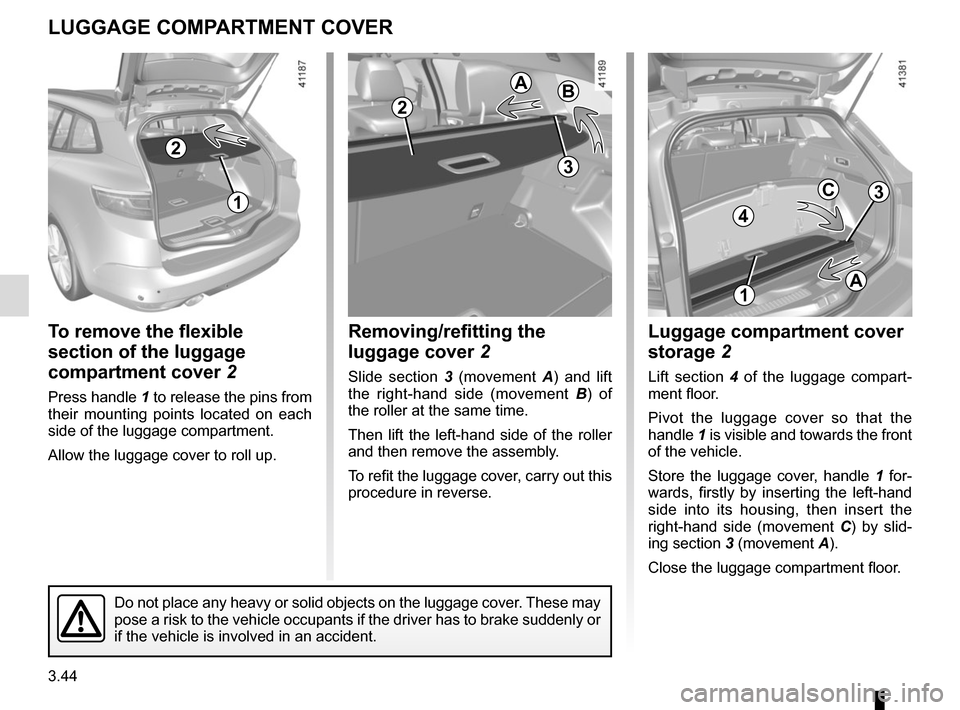
To remove the flexible
section of the luggage
compartment cover 2
Press handle 1 to release the pins from
their mounting points located on each
side of the luggage compartment.
Allow the luggage cover to roll up.
LUGGAGE COMPARTMENT COVER
Do not place any heavy or solid objects on the luggage cover. These may
pose a risk to the vehicle occupants if the driver has to brake suddenly\
or
if the vehicle is involved in an accident.
1
Removing/refitting the
luggage cover 2
Slide section 3 (movement A ) and lift
the right-hand side (movement B) of
the roller at the same time.
Then lift the left-hand side of the roller
and then remove the assembly.
To refit the luggage cover, carry out this
procedure in reverse.
B
3
2
2
4
C3
A1
A
Luggage compartment cover
storage 2
Lift section 4 of the luggage compart-
ment floor.
Pivot the luggage cover so that the
handle 1 is visible and towards the front
of the vehicle.
Store the luggage cover, handle 1 for-
wards, firstly by inserting the left-hand
side into its housing, then insert the
right-hand side (movement C) by slid-
ing section 3 (movement A).
Close the luggage compartment floor.
Page 240 of 346
3.46
LUGGAGE NET (2/2)
6
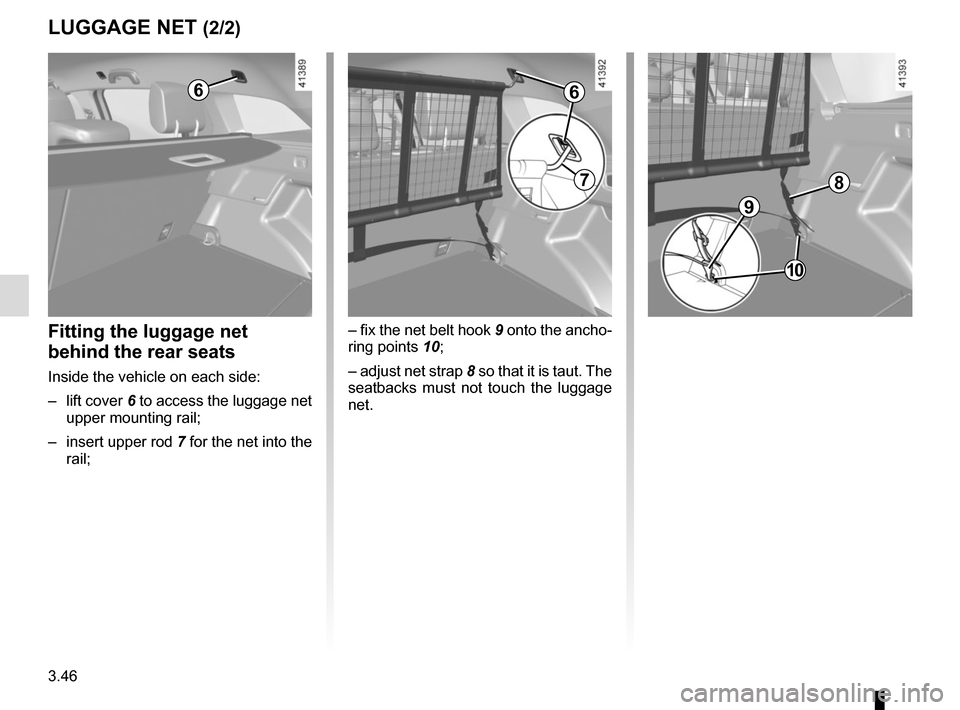
– fix the net belt hook 9 onto the ancho-
ring points 10;
– adjust net strap 8 so that it is taut. The
seatbacks must not touch the luggage
net.Fitting the luggage net
behind the rear seats
Inside the vehicle on each side:
– lift cover 6 to access the luggage net
upper mounting rail;
– insert upper rod 7 for the net into the
rail;
10
9
6
78
Page 248 of 346
3.54
ROOF BARS (1/2)
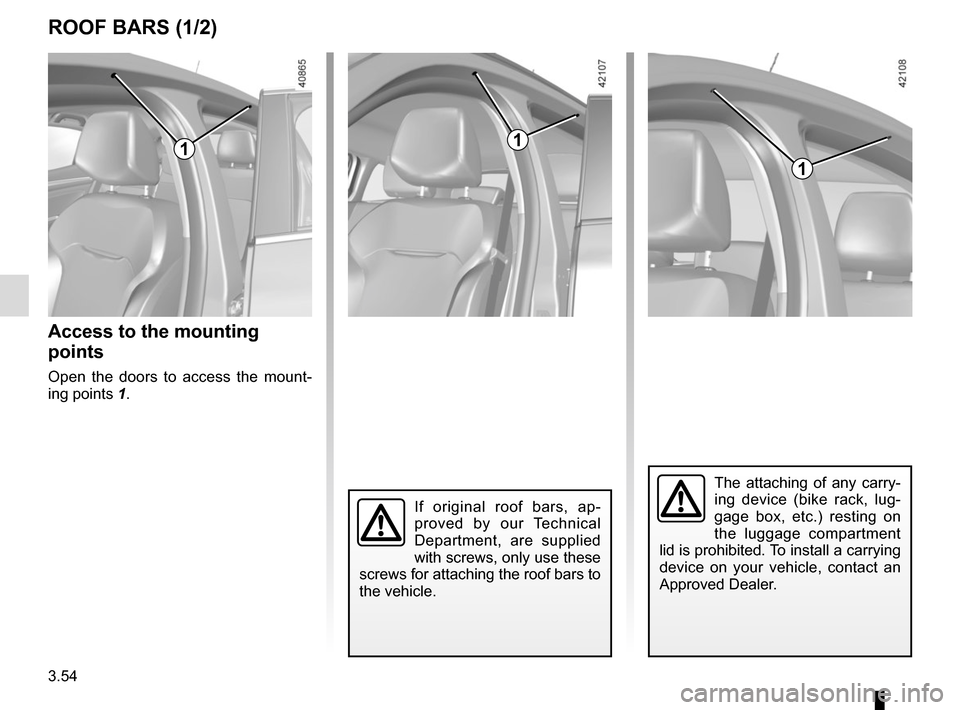
Access to the mounting
points
Open the doors to access the mount-
ing points 1.
If original roof bars, ap-
proved by our Technical
Department, are supplied
with screws, only use these
screws for attaching the roof bars to
the vehicle.
The attaching of any carry-
ing device (bike rack, lug-
gage box, etc.) resting on
the luggage compartment
lid is prohibited. To install a carrying
device on your vehicle, contact an
Approved Dealer.
11
1
Page 268 of 346
4.16
Respect local regulations about wash-
ing vehicles (e.g. do not wash your ve-
hicle on a public highway).
Observe the vehicle stopping distances
when driving on gravelled surfaces to
prevent paint damage.
Repair, or have repaired quickly, areas
where the paint has been damaged, to
prevent corrosion spreading.
Remember to visit the body shop pe-
riodically in order to maintain your
anti-corrosion warranty. Refer to the
Maintenance Document.
If it is necessary to clean mechani-
cal components, hinges, etc., spray
them with products approved by our
Technical Department to protect them
after they have been cleaned.
BODYWORK MAINTENANCE (2/2)
We have selected special products
to care for your vehicle and you can
obtain these from the manufactur-
er’s accessory outlets.
Using a roller type car wash
Return the windscreen wiper stalk to
the Park position (refer to the informa-
tion on the “Windscreen washer, wiper”
in Section 1). Check the mounting of
external accessories, additional lights
and mirrors, and ensure that the wiper
blades are secured with adhesive tape.
Remove the radio aerial mast if your
vehicle is fitted with this equipment.
Remember to remove the tape and refit
the antenna after washing.
Cleaning the headlights
As the headlights are made of plastic
“glass”, use a soft cloth or cotton wool
to clean them. If this does not clean
them properly, moisten the cloth with
soapy water, then wipe clean with a soft
damp cloth or cotton wool.
Finally, carefully dry off with a soft dry
cloth.
Cleaning products containing alco-
hol must not be used.
Do not use a scraper.
Vehicles with a matte paint
finish
This type of paint requires certain pre-
cautions.
Do not do the following
– use wax-based products (polishing);
– rub hard;
– wash the vehicle in a roller-type car
wash;
– wash the vehicle using a high-pres-
sure device;
– attach stickers to the paintwork (risk
of leaving marks).
You should do the following
Wash the vehicle by hand using plenty
of water, using a soft cloth or a gentle
sponge.
Page 270 of 346
4.18
You are strongly recom-
mended not to use high-
pressure or spray cleaning
equipment inside the pas-
senger compartment: use of such
equipment could impair the correct
functioning of the electrical or elec-
tronic components in the vehicle, or
have other detrimental effects.
INTERIOR TRIM MAINTENANCE (2/2)
You should not:
You are strongly advised not to po-
sition objects such as deodorants,
scents, etc. near air vents, as this could
damage your dashboard trim.
Removal/replacing removable
equipment originally fitted in
the vehicle
If you need to remove equipment in
order to clean the passenger com-
partment (for example, mats), always
ensure that they are correctly refitted
and are the right way around (the driv-
er’s mat should be fitted on the driver’s
side, etc.) and fit them with the compo-
nents supplied with the equipment (for
example, the driver mat should always
be fixed using the pre-fitted mounting
components).
With the vehicle stationary, always
ensure that nothing will impede driving
(anything obstructing the pedals, heel
wedged by the mat etc.).
Page 273 of 346
5.3
PUNCTURE/EMERGENCY SPARE WHEEL (2/2)
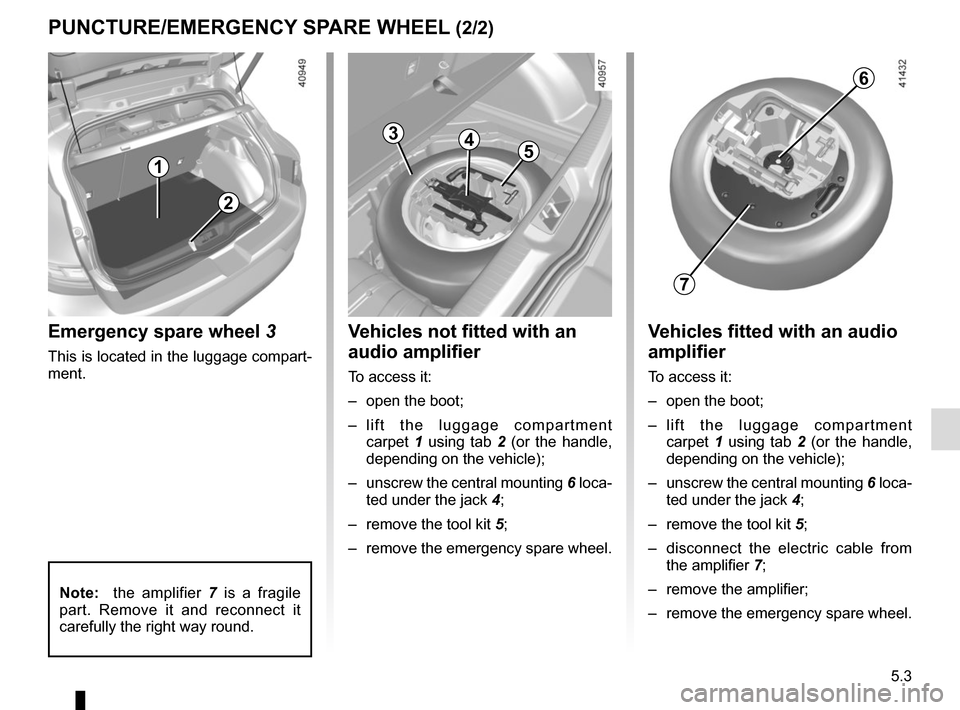
Emergency spare wheel 3
This is located in the luggage compart-
ment.
2
1
43
5
Vehicles not fitted with an
audio amplifier
To access it:
– open the boot;
– lift the luggage compartment carpet 1 using tab 2 (or the handle,
depending on the vehicle);
– unscrew the central mounting 6 loca-
ted under the jack 4;
– remove the tool kit 5;
– remove the emergency spare wheel.
Vehicles fitted with an audio
amplifier
To access it:
– open the boot;
– lift the luggage compartment carpet 1 using tab 2 (or the handle,
depending on the vehicle);
– unscrew the central mounting 6 loca-
ted under the jack 4;
– remove the tool kit 5;
– disconnect the electric cable from the amplifier 7;
– remove the amplifier;
– remove the emergency spare wheel.
6
7
Note: the amplifier 7 is a fragile
part. Remove it and reconnect it
carefully the right way round.
Page 280 of 346
5.10
Undo the bolts and take off the wheel.
Fit the emergency spare wheel onto
the hub and rotate it until the mounting
holes in the wheel coincide with those
of the hub.
If bolts are supplied with the emergency
spare wheel, only use these bolts for
the emergency spare wheel. Tighten
the bolts, checking that the wheel is
correctly positioned on its hub and un-
screw the jack.
With the wheel on the ground, tighten
the bolts fully and have the tightness of
the bolts checked and the emergency
spare wheel pressure checked as soon
as possible.
Anti-theft bolt
If you use anti-theft bolts, fit these
nearest the valve (wheel embel-
lisher may not be able to fit).
If you have a puncture, re-
place the wheel as soon as
possible.
A tyre which has been punc-
tured should always be inspected
(and repaired, where possible) by a
specialist.
CHANGING A WHEEL (2/2)
Page 298 of 346
5.28
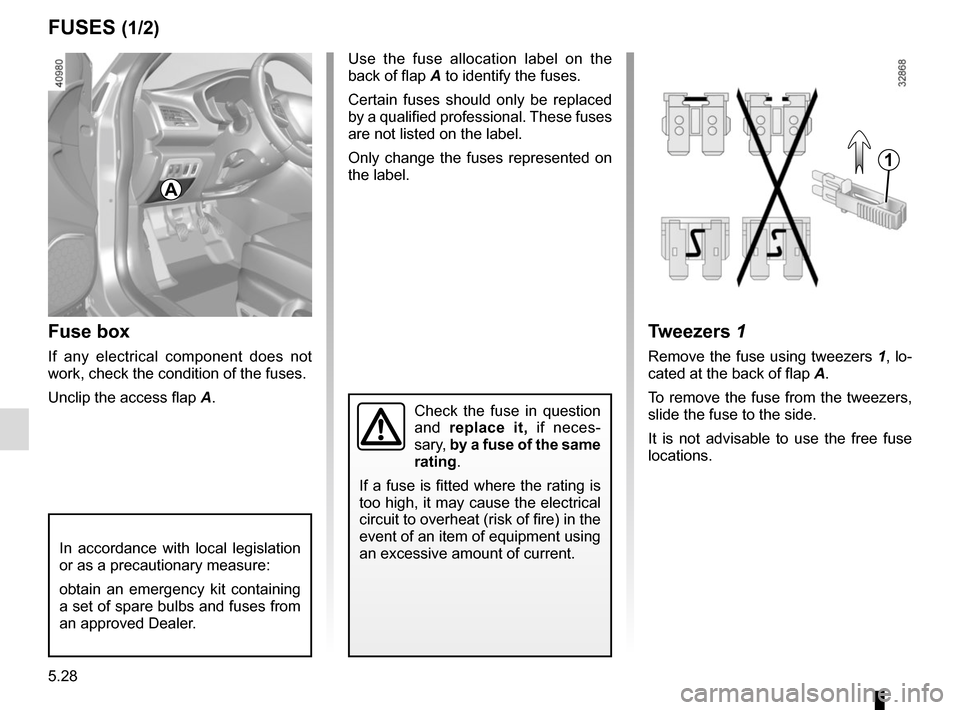
FUSES (1/2)
Fuse box
If any electrical component does not
work, check the condition of the fuses.
Unclip the access flap A.
Tweezers 1
Remove the fuse using tweezers 1, lo-
cated at the back of flap A.
To remove the fuse from the tweezers,
slide the fuse to the side.
It is not advisable to use the free fuse
locations.
Check the fuse in question
and replace it, if neces-
sary, by a fuse of the same
rating.
If a fuse is fitted where the rating is
too high, it may cause the electrical
circuit to overheat (risk of fire) in the
event of an item of equipment using
an excessive amount of current.
In accordance with local legislation
or as a precautionary measure:
obtain an emergency kit containing
a set of spare bulbs and fuses from
an approved Dealer.
A
1
Use the fuse allocation label on the
back of flap A to identify the fuses.
Certain fuses should only be replaced
by a qualified professional. These fuses
are not listed on the label.
Only change the fuses represented on
the label.