Stop lights RENAULT MEGANE 2017 4.G Owner's Manual
[x] Cancel search | Manufacturer: RENAULT, Model Year: 2017, Model line: MEGANE, Model: RENAULT MEGANE 2017 4.GPages: 346, PDF Size: 7.04 MB
Page 275 of 346
5.5
TYRE PRESSURE KIT (2/3)
In the event of a puncture, use the kit
located in the luggage compartment,
under the luggage compartment carpet
or, depending on the vehicle, under
the luggage compartment floor (please
refer to the information on “Luggage
compartment fittings” in section 3).
Before using the kit, park
the vehicle at a sufficient
distance from traffic, switch
on the hazard warning
lights, apply the parking brake, ask
all passengers to leave the vehicle
and keep them away from traffic.
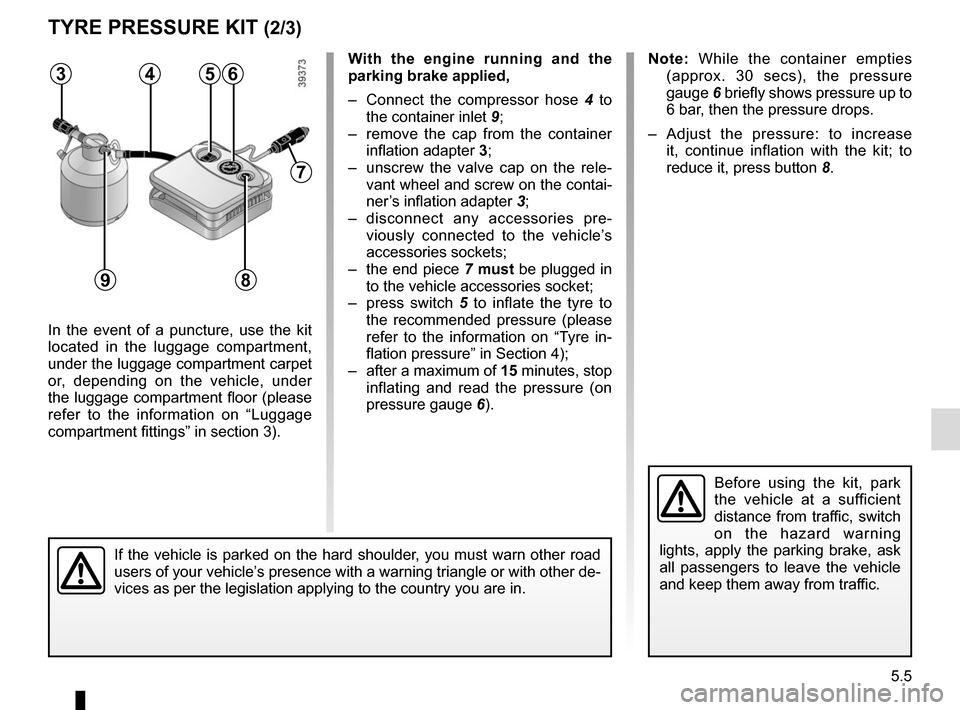
Note: While the container empties (approx. 30 secs), the pressure
gauge 6 briefly shows pressure up to
6 bar, then the pressure drops.
– Adjust the pressure: to increase it, continue inflation with the kit; to
reduce it, press button 8.
If the vehicle is parked on the hard shoulder, you must warn other road
users of your vehicle’s presence with a warning triangle or with other de-
vices as per the legislation applying to the country you are in.
With the engine running and the
parking brake applied,
– Connect the compressor hose 4 to
the container inlet 9;
– remove the cap from the container inflation adapter 3;
– unscrew the valve cap on the rele- vant wheel and screw on the contai-
ner’s inflation adapter 3;
– disconnect any accessories pre- viously connected to the vehicle’s
accessories sockets;
– the end piece 7 must be plugged in
to the vehicle accessories socket;
– press switch 5 to inflate the tyre to
the recommended pressure (please
refer to the information on “Tyre in-
flation pressure” in Section 4);
– after a maximum of 15 minutes, stop inflating and read the pressure (on
pressure gauge 6).563
9
7
4
8
Page 300 of 346
5.30
BATTERY: troubleshooting (1/2)
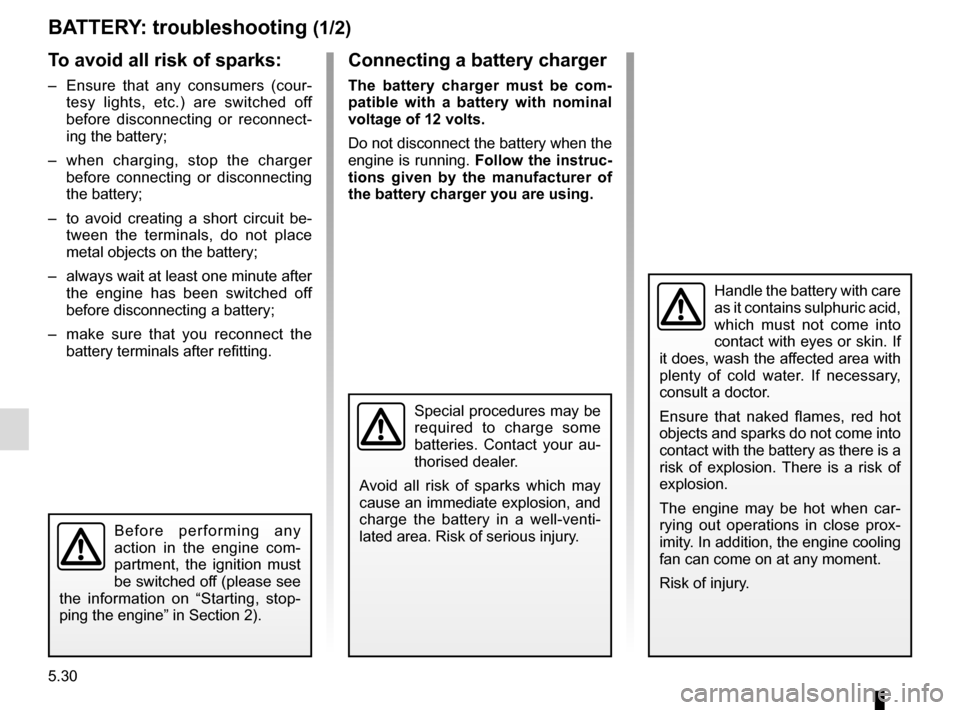
To avoid all risk of sparks:
– Ensure that any consumers (cour-tesy lights, etc.) are switched off
before disconnecting or reconnect-
ing the battery;
– when charging, stop the charger before connecting or disconnecting
the battery;
– to avoid creating a short circuit be- tween the terminals, do not place
metal objects on the battery;
– always wait at least one minute after the engine has been switched off
before disconnecting a battery;
– make sure that you reconnect the battery terminals after refitting.
Connecting a battery charger
The battery charger must be com-
patible with a battery with nominal
voltage of 12 volts.
Do not disconnect the battery when the
engine is running. Follow the instruc-
tions given by the manufacturer of
the battery charger you are using.
Special procedures may be
required to charge some
batteries. Contact your au-
thorised dealer.
Avoid all risk of sparks which may
cause an immediate explosion, and
charge the battery in a well-venti-
lated area. Risk of serious injury.
Handle the battery with care
as it contains sulphuric acid,
which must not come into
contact with eyes or skin. If
it does, wash the affected area with
plenty of cold water. If necessary,
consult a doctor.
Ensure that naked flames, red hot
objects and sparks do not come into
contact with the battery as there is a
risk of explosion. There is a risk of
explosion.
The engine may be hot when car-
rying out operations in close prox-
imity. In addition, the engine cooling
fan can come on at any moment.
Risk of injury.
Before performing any
action in the engine com-
partment, the ignition must
be switched off (please see
the information on “Starting, stop-
ping the engine” in Section 2).
Page 311 of 346
5.41
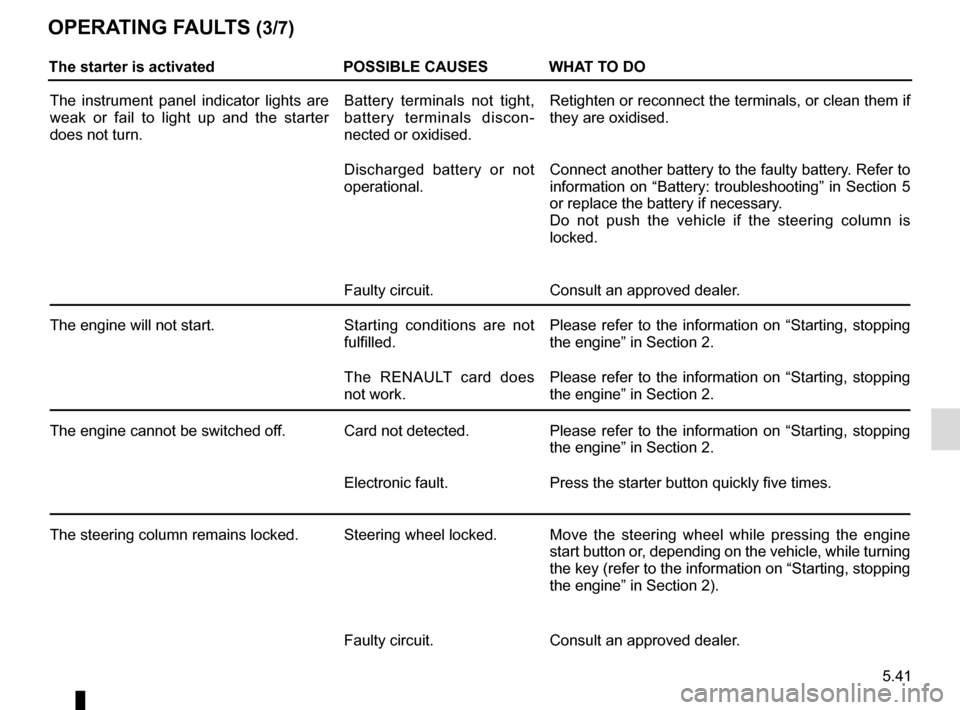
OPERATING FAULTS (3/7)
The starter is activatedPOSSIBLE CAUSES WHAT TO DO
The instrument panel indicator lights are
weak or fail to light up and the starter
does not turn. Battery terminals not tight,
battery terminals discon-
nected or oxidised.Retighten or reconnect the terminals, or clean them if
they are oxidised.
Discharged battery or not
operational. Connect another battery to the faulty battery. Refer to
information on “Battery: troubleshooting” in Section 5
or replace the battery if necessary.
Do not push the vehicle if the steering column is
locked.
Faulty circuit. Consult an approved dealer.
The engine will not start. Starting conditions are not
fulfilled.Please refer to the information on “Starting, stopping
the engine” in Section 2.
The RENAULT card does
not work. Please refer to the information on “Starting, stopping
the engine” in Section 2.
The engine cannot be switched off. Card not detected. Please refer to the information on “Starting, stopping
the engine” in Section 2.
Electronic fault. Press the starter button quickly five times.
The steering column remains locked. Steering wheel locked. Move the steering wheel while pressing the engine
start button or, depending on the vehicle, while turning
the key (refer to the information on “Starting, stopping
the engine” in Section 2).
Faulty circuit. Consult an approved dealer.
Page 314 of 346
5.44
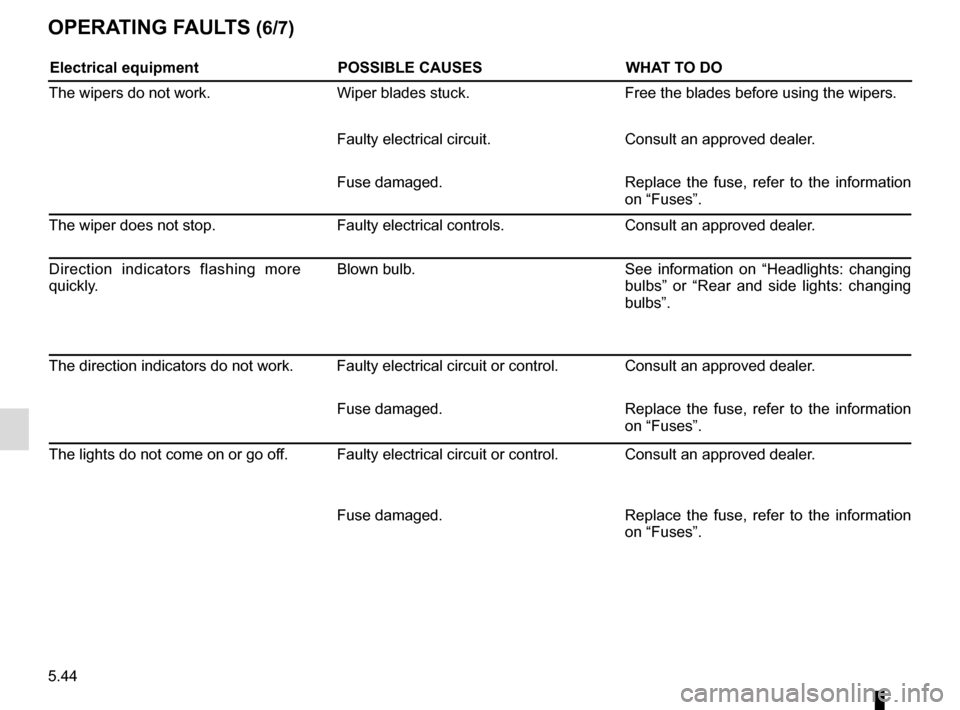
OPERATING FAULTS (6/7)
Electrical equipmentPOSSIBLE CAUSESWHAT TO DO
The wipers do not work. Wiper blades stuck. Free the blades before using the wipers.
Faulty electrical circuit. Consult an approved dealer.
Fuse damaged. Replace the fuse, refer to the information
on “Fuses”.
The wiper does not stop. Faulty electrical controls.Consult an approved dealer.
Direction indicators flashing more
quickly. Blown bulb.
See information on “Headlights: changing
bulbs” or “Rear and side lights: changing
bulbs”.
The direction indicators do not work. Faulty electrical circuit or control. Consult an approved dealer. Fuse damaged. Replace the fuse, refer to the information
on “Fuses”.
The lights do not come on or go off. Faulty electrical circuit or control. Consult an approved dealer.
Fuse damaged. Replace the fuse, refer to the information
on “Fuses”.
Page 343 of 346

steering wheeladjustment .............................................................\
...... 1.82
Stop & Start ..........................................................")
7.5
ALPHABETICAL INDEX (5/5)
steering wheeladjustment .............................................................\
...... 1.82
Stop & Start ...........................................................2.10 → 2.13
Stop & Start function..............................................2.10 → 2.13
stopping the engine ............................................................. 2.4
storage compartment.............................................3.29 → 3.32
storage compartments ..................... 3.29 → 3.32, 3.47 → 3.51
sun blinds ........................................................................\
.. 3.28
sun visor ........................................................................\
.... 3.28
sunroof...................................................................3.23 → 3.25
switching on the vehicle ignition ................................... 2.3, 2.6
T
tailgate ............................................. 3.39 → 3.43, 3.47 → 3.52
tanks and reservoirs brake fluid ...................................................................... 4.9
coolant ................................................................\
........... 4.8
tanks and reservoirs: windscreen washer ...................................................... 4.10
technical specifications ............................................6.5 → 6.10
telephone ................................................................ 3.56 – 3.57
temperature regulation ............................................3.9 → 3.19
tool kit ........................................................................\
.......... 5.7
towing breakdown ........................................................ 5.37 – 5.38
towing equipment .............................................. 3.52 – 3.53
towing a caravan ............................................. 3.52 – 3.53, 6.9
towing hitch...................................................... 5.7, 5.37 – 5.38
towing rings .............................................................. 3.46, 3.52
towing weights ..................................................................... 6.9
traction control .......................................................2.30 → 2.39
transporting children ..........................1.35 – 1.36, 1.38 → 1.49
transporting objects in the luggage compartment ........................................ 3.52
luggage net ....................................................... 3.45 – 3.46
trims ..................................................................\
................... 5.8 trip computer and warning system... 1.58
→ 1.63, 1.70 → 1.79
tyre inflation kit...........................................................5.4 → 5.6
tyre pressure.............................2.27 → 2.29, 4.13 – 4.14, 5.12
tyre pressure monitor.............................................2.27 → 2.29
tyre pressures ...........................2.27 → 2.29, 4.13 – 4.14, 4.14
tyres .................... 2.24, 2.27 → 2.29, 4.13 – 4.14, 5.11 → 5.13
U
unlocking the doors ...............................................1.13 → 1.15
V
ventilation ............................................................\
....3.6 → 3.19
W
warning buzzer ......................................................... 1.16, 1.53
warning lights................................... 1.58 → 1.63, 1.70 → 1.79
washing .................................................................. 4.15 – 4.16
weights ................................................................\
................ 6.9
wheelbrace .............................................................\
............. 5.7
wheels (safety) ...................................................... 5.11 → 5.13
windscreen de-icing/demisting ................................. 3.11, 3.16
windscreen washer .....................................1.95 → 1.100, 4.10
windscreen washer/wiper ....................................1.95 → 1.100
wiper blades ........................................................... 5.35 – 5.36
wipers .................................................................\
.1.95 → 1.100
blades ............................................................... 5.35 – 5.36