weight RENAULT MEGANE 2018 Owners Manual
[x] Cancel search | Manufacturer: RENAULT, Model Year: 2018, Model line: MEGANE, Model: RENAULT MEGANE 2018Pages: 348, PDF Size: 9.25 MB
Page 52 of 348

The table below summarises the information already shown in the diagram \
on the following pages, to ensure the appli-
cable regulations are respected.")
1.46
CHILD SEATS: attachment by seat belt (1/3)
The table below summarises the information already shown in the diagram \
on the following pages, to ensure the appli-
cable regulations are respected.
Type of child seat Weight of the childFront passenger
seat (1) Rear side seats Rear centre seat
Carrycot fitted
across the vehicle
Group 0 < 10 kg X U (2) X
Rear-facing shell
seat
Groups 0 or 0 + < 10 kg and < 13 kg U (5) U (3) U (3)
Shell seat/rear-facing
seat
Groups 0+ and 1 < 13 kg and 9 to 18 kg U (5) U (3) U (3)
Forward-facing seat
Group 1 9 to 18 kg X U (4) U (4)
Booster seat
Groups 2 and 3 15 to 25 kg and 22 to
36 kg
X U (4) X
(1) RISK OF DEATH OR SERIOUS INJURY: Before installing a child seat on the front passenger seat, check that \
the airbag has been deactivated (please refer to “Child safety: fron\
t passenger airbag deactivation and activation” in
Section 1).
Page 56 of 348

1.50
The table below summarises the information already shown on the diagram \
on the previous pages, to ensure the regula-
tions in force are respected.
CHILD SEATS: attachment using the isofix system (2/3)
Type of child seatWeight of
the child Seat size ISOFIX Front passenger
seat Rear side seats Rear centre seat
Carrycot fitted across
the vehicle
Group 0 < 10 kg
F, GXX X
Rear-facing shell
seat
Groups 0 or 0 + < 10 kg and
< 13 kg
E
XIL (1) X
Shell seat/rear-facing
seat
Groups 0+ and 1 < 13 kg and 9 to
18 kg
C, D
XIL (1) X
Forward-facing seat
Group 1 9 to 18 kg
A, B, B1XIUF - IL (2) X
Booster seat
Groups 2 and 3 15 to 25 kg and
22 to 36 kg
X
IUF - IL (2) X
Seat i-Size Xi-U X
Page 94 of 348
1.88
Halogen bulb versions
HEADLIGHT BEAM ADJUSTMENT (1/2)
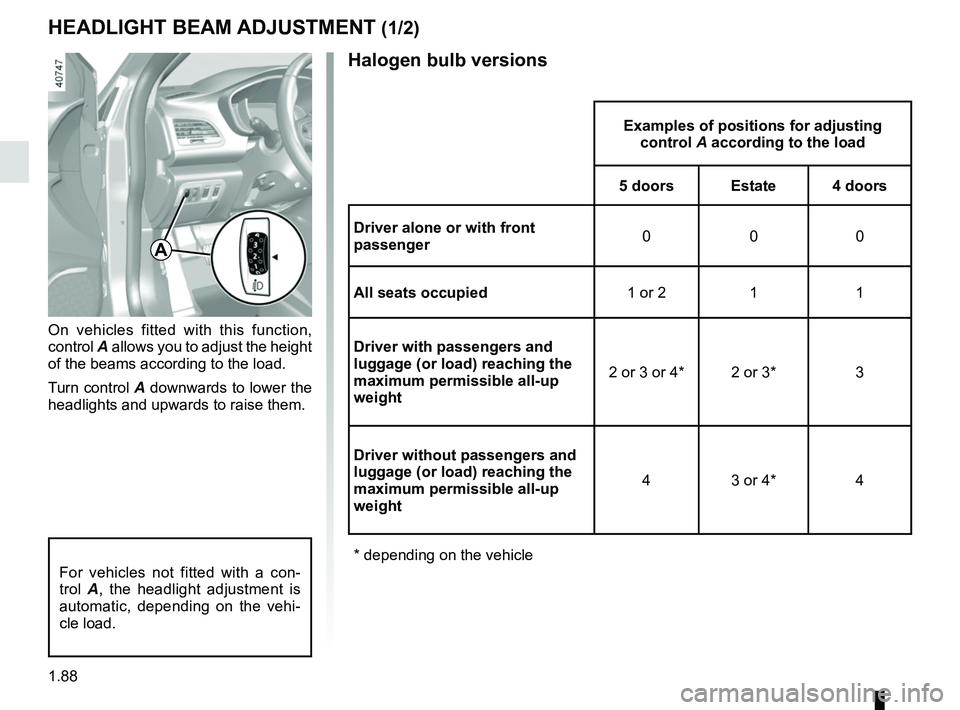
On vehicles fitted with this function,
control A allows you to adjust the height
of the beams according to the load.
Turn control A downwards to lower the
headlights and upwards to raise them.
Examples of positions for adjusting control A according to the load
5 doors Estate 4 doors
Driver alone or with front
passenger 000
All seats occupied 1 or 2 1 1
Driver with passengers and
luggage (or load) reaching the
maximum permissible all-up
weight 2 or 3 or 4* 2 or 3* 3
Driver without passengers and
luggage (or load) reaching the
maximum permissible all-up
weight 4 3 or 4* 4
* depending on the vehicle
A
For vehicles not fitted with a con-
trol A, the headlight adjustment is
automatic, depending on the vehi-
cle load.
Page 95 of 348
1.89
LED versions
HEADLIGHT BEAM ADJUSTMENT (2/2)
Examples of positions for adjusting control A according to the load
5 doors Estate 4 doors
Driver alone or with front
passenger 000
All seats occupied 111
Driver with passengers and
luggage (or load) reaching the
maximum permissible all-up
weight 2 or 3* 2 or 3* 3
Driver without passengers and
luggage (or load) reaching the
maximum permissible all-up
weight 3 or 4* 3 3 or 4*
* depending on the vehicle
Page 214 of 348
3.20
AIR CONDITIONING: information and operating instructions (2/2)
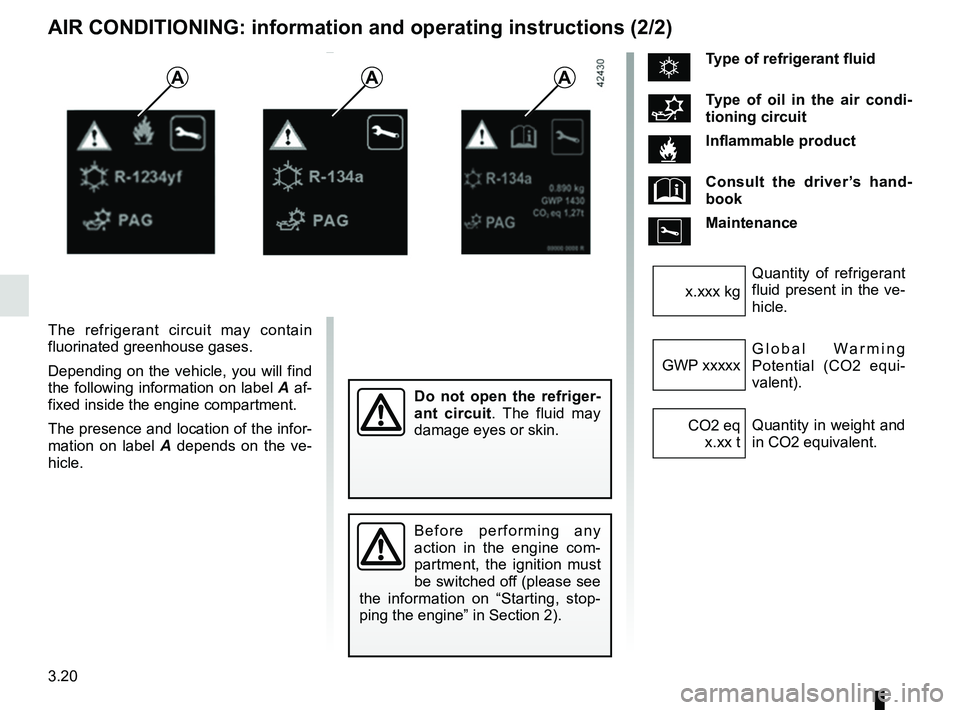
The refrigerant circuit may contain
fluorinated greenhouse gases.
Depending on the vehicle, you will find
the following information on label A af-
fixed inside the engine compartment.
The presence and location of the infor-
mation on label A depends on the ve-
hicle.
Do not open the refriger-
ant circuit . The fluid may
damage eyes or skin.
Before performing any
action in the engine com-
partment, the ignition must
be switched off (please see
the information on “Starting, stop-
ping the engine” in Section 2).
ÑType of refrigerant fluid
Type of oil in the air condi-
tioning circuit
Inflammable product
Consult the driver’s hand-
book
Maintenance
Quantity of refrigerant
fluid present in the ve-
hicle.
x.xxx kg
Global Warming
Potential (CO2 equi-
valent).
GWP xxxxx
Quantity in weight and
in CO2 equivalent.
CO2 eq
x.xx t
AAA
Page 240 of 348
3.46
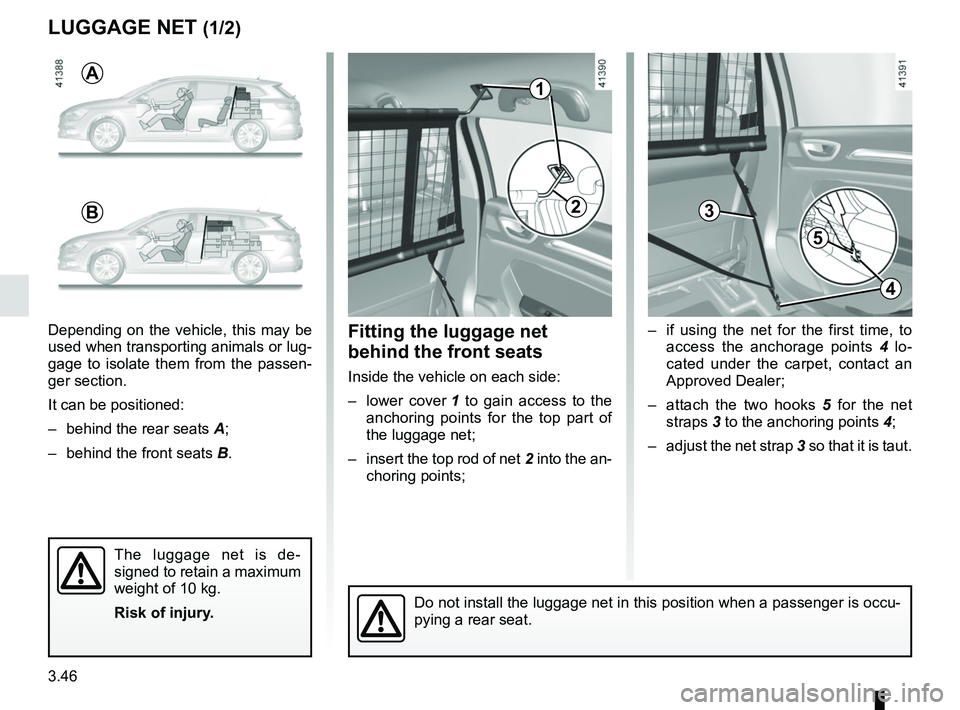
– if using the net for the first time, to access the anchorage points 4 lo-
cated under the carpet, contact an
Approved Dealer;
– attach the two hooks 5 for the net
straps 3 to the anchoring points 4;
– adjust the net strap 3 so that it is taut.
3
LUGGAGE NET (1/2)
Fitting the luggage net
behind the front seats
Inside the vehicle on each side:
– lower cover 1 to gain access to the
anchoring points for the top part of
the luggage net;
– insert the top rod of net 2 into the an-
choring points;
Depending on the vehicle, this may be
used when transporting animals or lug-
gage to isolate them from the passen-
ger section.
It can be positioned:
– behind the rear seats
A;
– behind the front seats B.
The luggage net is de-
signed to retain a maximum
weight of 10 kg.
Risk of injury.
Do not install the luggage net in this position when a passenger is occu\
-
pying a rear seat.
A
B
1
2
5
4
Page 245 of 348
3.51
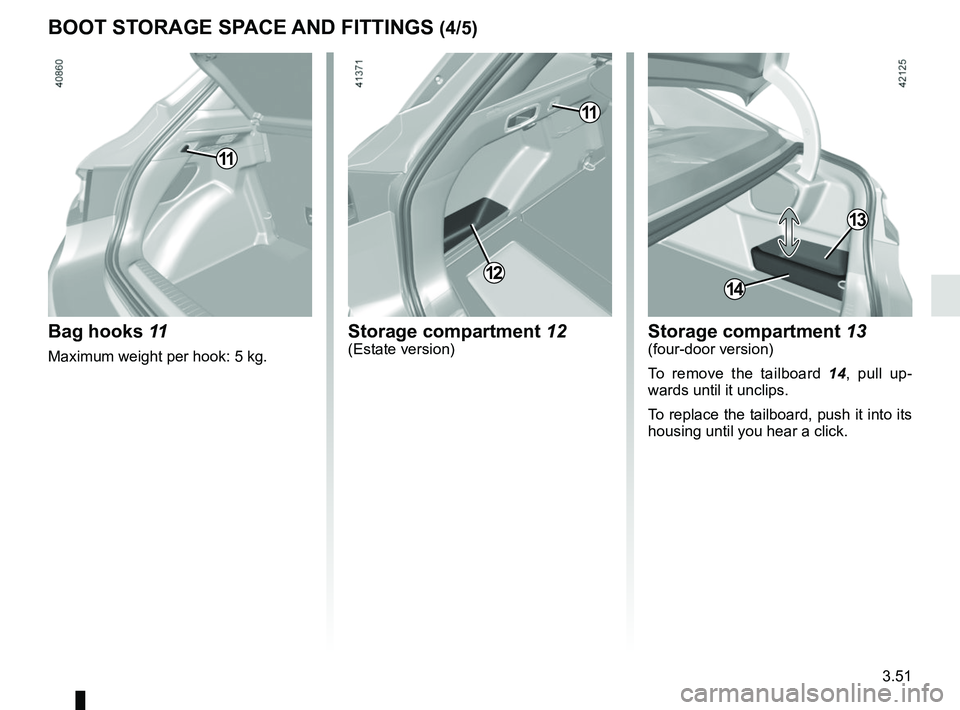
Storage compartment 12(Estate version)
12
Bag hooks 11
Maximum weight per hook: 5 kg.
BOOT STORAGE SPACE AND FITTINGS (4/5)
11
14
Storage compartment 13(four-door version)
To remove the tailboard 14, pull up-
wards until it unclips.
To replace the tailboard, push it into its
housing until you hear a click.
13
11
Page 248 of 348
3.54
Permissible nose weight, maxi-
mum permissible towing weight,
braked and unbraked: refer to
the information on “Weights” in
Section 6.
Choice and fitting of towing
equipment
Maximum weight of towing equip-
ment:
– 36 kg (5-door version);
– 37 kg (4-seater and estate ver-
sions).
For fitting and conditions of use,
refer to the equipment’s fitting in-
structions.
Please keep these instructions with
the rest of the vehicle documenta-
tion.
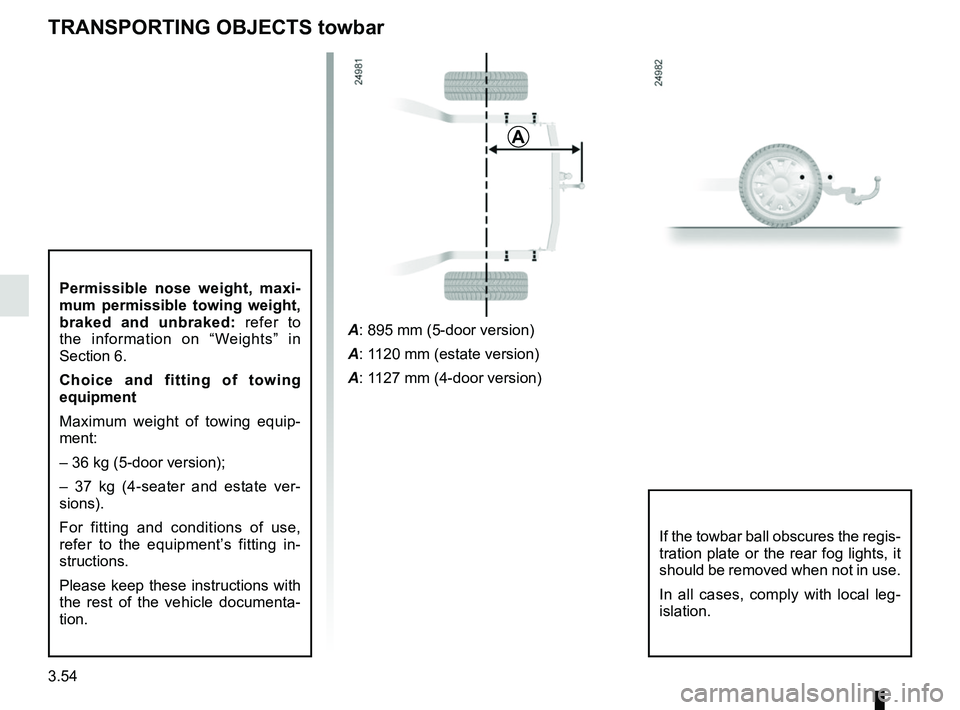
TRANSPORTING OBJECTS towbar
A
A: 895 mm (5-door version)
A: 1120 mm (estate version)
A: 1127 mm (4-door version)
If the towbar ball obscures the regis-
tration plate or the rear fog lights, it
should be removed when not in use.
In all cases, comply with local leg-
islation.
Page 249 of 348
3.55
ROOF BARS (1/2)
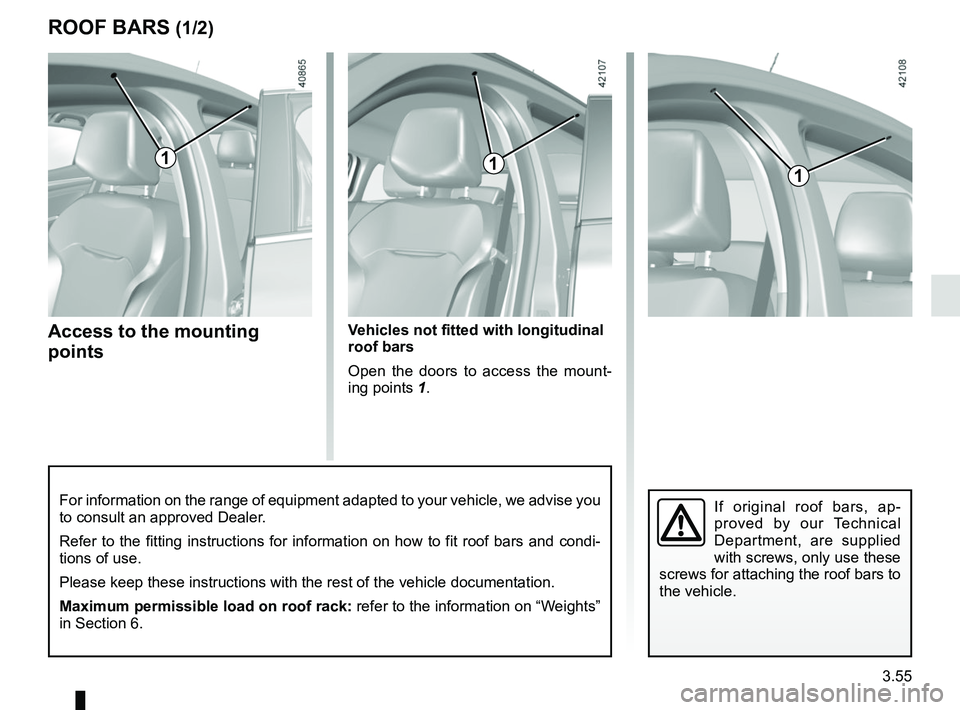
Access to the mounting
points
If original roof bars, ap-
proved by our Technical
Department, are supplied
with screws, only use these
screws for attaching the roof bars to
the vehicle.
111
Vehicles not fitted with longitudinal
roof bars
Open the doors to access the mount-
ing points 1.
For information on the range of equipment adapted to your vehicle, we ad\
vise you
to consult an approved Dealer.
Refer to the fitting instructions for information on how to fit roof bar\
s and condi-
tions of use.
Please keep these instructions with the rest of the vehicle documentatio\
n.
Maximum permissible load on roof rack: refer to the information on “Weights”
in Section 6.
Page 255 of 348
4.3
BONNET (2/2)
Closing the bonnet
Check that nothing has been left in the
engine compartment.
To close the bonnet again, hold the
bonnet in the middle and guide it down,
allowing a 30 cm gap before it is closed,
then release it. It will latch automatically
under its own weight.
Ensure that the bonnet is
properly locked.
Check that nothing is pre-
venting the catch from lock-
ing (gravel, cloth, etc.).
After carrying out any work
in the engine compart-
ment, check that nothing
has been left behind (cloth,
tools, etc.).
These may damage the engine or
cause a fire.
In the event of even a slight
impact involving the radia-
tor grille or bonnet, have the
bonnet lock checked by an
authorised dealer as soon as pos-
sible.