steering wheel RENAULT MEGANE RS 2012 X95 / 3.G User Guide
[x] Cancel search | Manufacturer: RENAULT, Model Year: 2012, Model line: MEGANE RS, Model: RENAULT MEGANE RS 2012 X95 / 3.GPages: 239, PDF Size: 9.2 MB
Page 78 of 239
lights:main beam headlights ...................................... (current page)
warning buzzer ...................................................... (current page)
see-me-home lighting ............................................ (current page)
lights mobile directional ............................................. (current page)
1.72
ENG_UD18905_2
Éclairages et signalisations extérieurs (X95 - B95 - Renault)
ENG_NU_837-6_BDK95_Renault_1
Jaune NoirNoir texte
EXTERIOR LIgHTINg ANd sIgNALs (2/3)
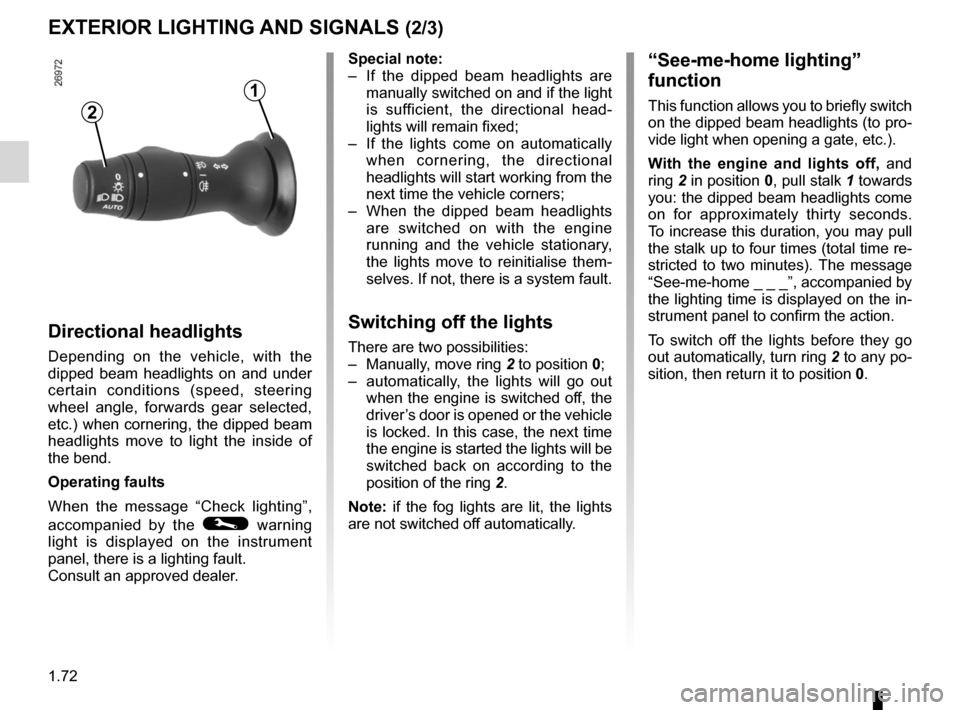
1
special note:
– If the dipped beam headlights are
manually switched on and if the light
is sufficient, the directional head -
lights will remain fixed;
– If the lights come on automatically
when cornering, the directional
headlights will start working from the
next time the vehicle corners;
– When the dipped beam headlights
are switched on with the engine
running and the vehicle stationary,
the lights move to reinitialise them -
selves. If not, there is a system fault.
switching off the lights
There are two possibilities:
– Manually, move ring 2 to position 0;
– automatically, the lights will go out
when the engine is switched off, the
driver’s door is opened or the vehicle
is locked. In this case, the next time
the engine is started the lights will be
switched back on according to the
position of the ring 2.
Note: if the fog lights are lit, the lights
are not switched off automatically.
“see-me-home lighting”
function
This function allows you to briefly switch
on the dipped beam headlights (to pro-
vide light when opening a gate, etc.).
With the engine and lights off, and
ring 2 in position 0, pull stalk 1 towards
you: the dipped beam headlights come
on for approximately thirty seconds.
To increase this duration, you may pull
the stalk up to four times (total time re-
stricted to two minutes). The message
“See-me-home _ _ _”, accompanied by
the lighting time is displayed on the in-
strument panel to confirm the action.
To switch off the lights before they go
out automatically, turn ring 2 to any po-
sition, then return it to position 0.
directional headlights
Depending on the vehicle, with the
dipped beam headlights on and under
certain conditions (speed, steering
wheel angle, forwards gear selected,
etc.) when cornering, the dipped beam
headlights move to light the inside of
the bend.
Operating faults
When the message “Check lighting”,
accompanied by the
© warning
light is displayed on the instrument
panel, there is a lighting fault.
Consult an approved dealer.
2
Page 89 of 239
starting the engine ................................ (up to the end of the DU)
engine start/stop button ........................ (up to the end of the DU)
starting the engine ................................ (up to the end of the DU)
driving ................................................... (up to the end of the DU)
2.3
ENG_UD18932_3
Démarrage / Arrêt moteur avec carte RENAULT mains libres (X95 - B95 - D95 - Renault)
ENG_NU_837-6_BDK95_Renault_2
Starting the engine
STARTING THE ENGINE (1/2)
Remote control RENAULT
card
When you get into the vehicle, insert the
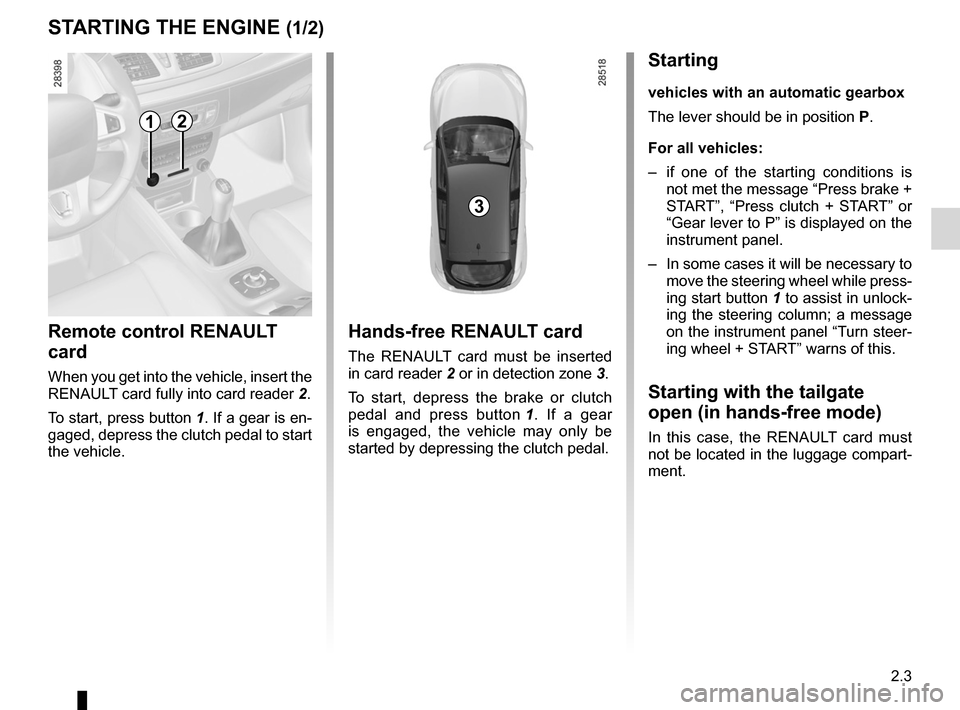
RENAULT card fully into card reader 2.
To start, press button 1. If a gear is en-
gaged, depress the clutch pedal to start
the vehicle.
Hands-free RENAULT card
The RENAULT card must be inserted
in card reader 2 or in detection zone 3.
To start, depress the brake or clutch
pedal and press button 1 . If a gear
is engaged, the vehicle may only be
started by depressing the clutch pedal.
Starting
vehicles with an automatic gearbox
The lever should be in position P.
For all vehicles:
– if one of the starting conditions is
not met the message “Press brake +
START”, “Press clutch + START” or
“Gear lever to P” is displayed on the
instrument panel.
– In some cases it will be necessary to
move the steering wheel while press-
ing start button 1 to assist in unlock-
ing the steering column; a message
on the instrument panel “Turn steer-
ing wheel + START” warns of this.
Starting with the tailgate
open (in hands-free mode)
In this case, the RENAULT card must
not be located in the luggage compart-
ment.
3
12
Page 106 of 239
2.20
ENG_UD14885_2
Dispositifs de correction de conduite (X95 - B95 - D95 - Renault)
ENG_NU_837-6_BDK95_Renault_2
Jaune NoirNoir texte
DRIVER CORRECTION DEVICES/AIDS (2/4)
Electronic stability program
(E.S.P.) with understeer
control and traction control
(A.S.R.)
Electronic stability program (E.S.P.)
This system helps you to keep control
of the vehicle in critical driving condi -
tions (avoiding an obstacle, loss of grip
on a bend, etc.).
Operating principle
A sensor in the steering wheel detects
the direction selected by the driver.
Other sensors throughout the vehicle
measure the actual direction.
The system compares driver input to
the actual trajectory of the vehicle and
corrects the trajectory if necessary by
controlling the braking of certain wheels
and/or engine power. In the event that
the system is engaged, indicator light
ù flashes on the instrument panel. Understeer control
This system optimises the action of
the E.S.P. in the case of pronounced
understeering (loss of front axle road
holding).
Traction control (A.S.R.)
This system helps to limit wheelspin of
the drive wheels and to control the ve-
hicle when pulling away accelerating or
decelerating.
Operating principle
Using the wheel sensors, the system
measures and compares the speed of
the drive wheels at all times and slows
down their over-rotation. If a wheel is
starting to slip, the system brakes au
-
tomatically until the drive supplied be -
comes compatible with the level of grip
under the wheel again.
The system also adjusts the engine
speed to the grip available under the
wheels, independently of the pressure
exerted on the accelerator pedal. Operating faults
When the system detects an operating
fault the message “Check ESP” and the
indicator light
© appears on the in-
strument panel. In this case, the E.S.P.
and A.S.R. are deactivated.
Consult an approved dealer.
Page 182 of 239
tyre pressure.......................................................... (current page)
5.10
ENG_UD10474_2
Pneumatiques (X95 - B95 - D95 - Renault)
ENG_NU_837-6_BDK95_Renault_5
Jaune NoirNoir texte
tyre pressuresAdhere to the tyre pressures (including
the emergency spare wheel). The tyre
pressures should be checked at least
once a month and additionally before
any long journey (refer to the label af -
fixed to the edge of the driver’s door). Pressures should be checked when the
tyres are cold; ignore higher pressures
which may be reached in hot weather
or following a fast journey.
If tyre pressures cannot be checked
when the tyres are
cold, the normal
pressures must be increased by 0.2 to
0.3 bar (or 3 PsI).
never deflate a hot tyre.
special note
Depending on the vehicle, there may
be an adapter which needs to be posi-
tioned on the valve before air is added.Fitting new tyres
emergency spare wheel
Refer to the information on the
“Emergency spare wheel” and in -
structions on “Changing a wheel” in
Section 5.
tyres (2/3)
Incorrect tyre pressures
lead to abnormal tyre wear
and unusually hot running.
These are factors which
may seriously affect safety and lead
to:
– poor road holding,
– risk of bursting or tread separa -
tion.
The pressure depends on the load
and the speed of use. Adjust the
pressure according to the condi -
tions of use (refer to the label affixed
to the edge of the driver’s door).
Please be aware that a
poorly tightened or miss -
ing valve cap can make the
tyres less airtight and lead
to pressure loss.
Always use valve caps identical to
those fitted originally and tighten
them fully.
For safety reasons, this op-
eration must be carried out
by a specialist.
Fitting different tyres may
change your vehicle as follows:
– It may mean that your vehicle no
longer conforms to current regu-
lations;
– It may change the way it handles
when cornering;
– It may cause the steering to be
heavy;
– It may affect the use of snow
chains.
Page 203 of 239
towingbreakdown ...................................... (up to the end of the DU)
towing hitch ........................................... (up to the end of the DU)
5.31
ENG_UD14787_2
Remorquage : dépannage (X95 - B95 - D95 - Renault)
ENG_NU_837-6_BDK95_Renault_5
Towing
tOwIng : breakdown (1/2)
Before towing, unlock the steering
column: with the clutch depressed,
engage first gear (lever in position n
or r for vehicles with automatic trans -
missions), insert the RENAULT card in
the card reader then press the engine
start button for two seconds.
Reposition the lever to neutral (posi -
tion N for vehicles fitted with an auto -
matic gearbox)
The steering column unlocks, the ve -
hicle’s accessory functions are pow -
ered, and you can use the vehicle lights
(brake lights, hazard warning lights,
etc.). At night, the vehicle must be lit.
Once you have finished towing, press
the engine start button twice (risk of
running down the battery). The speed specified by current legis
-
lation for towing must always be ob -
served. If your vehicle is the towing
vehicle, do not exceed the maximum
towing weight for your vehicle (refer to
the information on “Weights” in Section
6).
t owing a vehicle with an
automatic gearbox
With the engine switched off, the trans-
mission is no longer lubricated. It is
preferable to tow this type of vehicle on
a trailer or tow it with the front wheels
off the ground.
u nder exceptional circumstances,
you may tow the vehicle with all four
wheels on the ground, only going for -
ward, with the gear lever in the n posi-
tion, and for a distance not exceeding
50 miles (80 km).
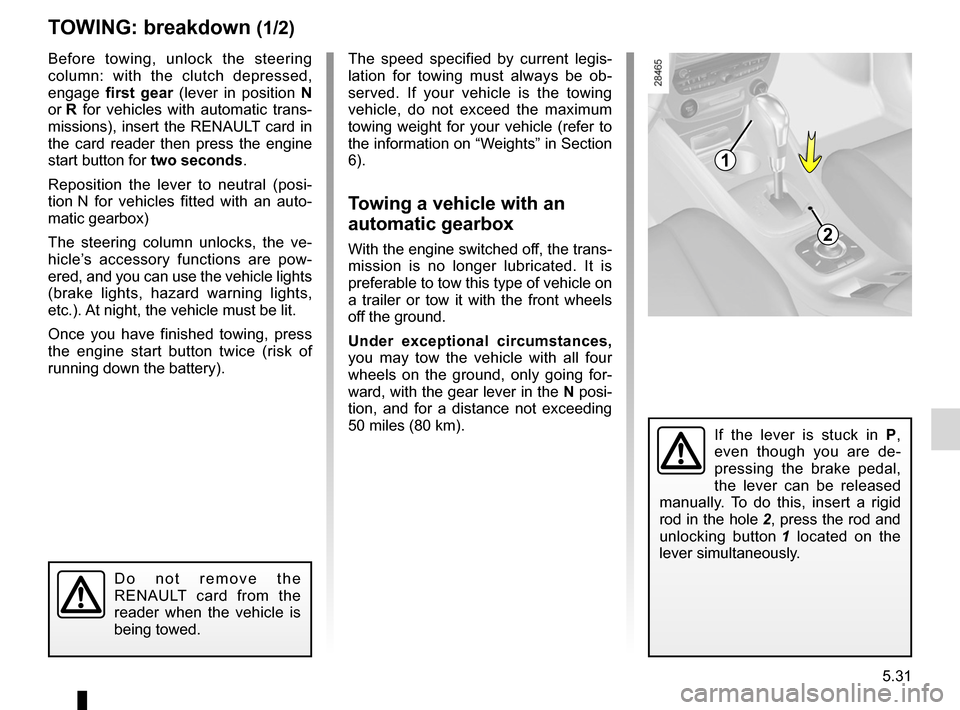
If the lever is stuck in P,
even though you are de -
pressing the brake pedal,
the lever can be released
manually. To do this, insert a rigid
rod in the hole 2, press the rod and
unlocking button 1 located on the
lever simultaneously.
1
2
D o n o t r e m o v e t h e
RENAULT card from the
reader when the vehicle is
being towed.
Page 204 of 239
5.32
ENG_UD14787_2
Remorquage : dépannage (X95 - B95 - D95 - Renault)
ENG_NU_837-6_BDK95_Renault_5
tOwIng : breakdown (2/2)
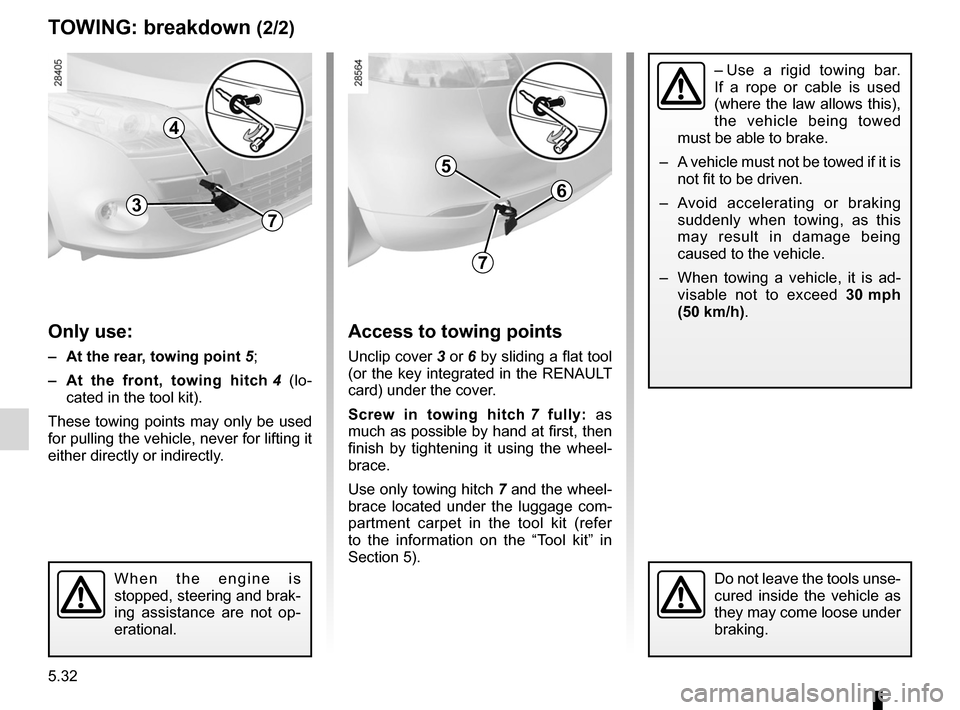
Only use:
– at the rear, towing point 5;
– a t the front, towing hitch 4 (lo -
cated in the tool kit).
These towing points may only be used
for pulling the vehicle, never for lifting it
either directly or indirectly.
access to towing points
Unclip cover 3 or 6 by sliding a flat tool
(or the key integrated in the RENAULT
card) under the cover.
s crew in towing hitch 7 fully: as
much as possible by hand at first, then
finish by tightening it using the wheel -
brace.
Use only towing hitch 7 and the wheel -
brace located under the luggage com -
partment carpet in the tool kit (refer
to the information on the “Tool kit” in
Section 5).
W h e n t h e e n g i n e i s
stopped, steering and brak-
ing assistance are not op -
erational.Do not leave the tools unse-
cured inside the vehicle as
they may come loose under
braking.
4
5
36
7
7
– Use a rigid towing bar.
If a rope or cable is used
(where the law allows this),
the vehicle being towed
must be able to brake.
– A vehicle must not be towed if it is
not fit to be driven.
– Avoid accelerating or braking
suddenly when towing, as this
may result in damage being
caused to the vehicle.
– When towing a vehicle, it is ad -
visable not to exceed 30 mph
(50 km/h).
Page 207 of 239
JauneNoirNoir texte
5.35
ENG_UD17369_3
Anomalies de fonctionnement (X95 - B95 - D95 - Renault)
ENG_NU_837-6_BDK95_Renault_5
OPeratIng F aults (3/5)
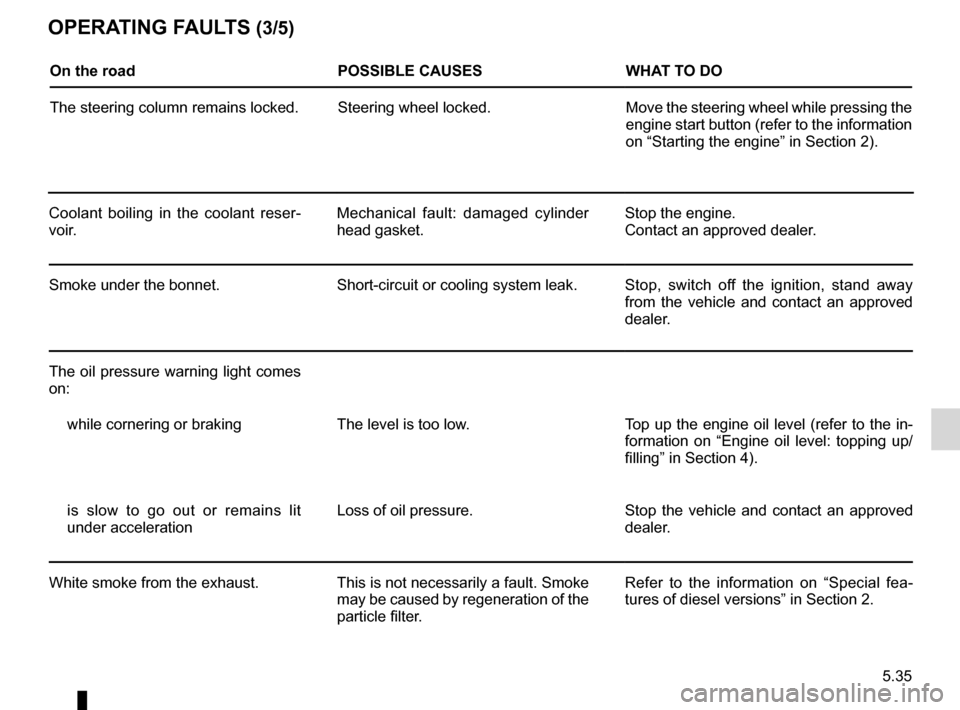
On the road POssIBle causeswhat tO DO
The steering column remains locked. Steering wheel locked.Move the steering wheel while pressing the
engine start button (refer to the information
on “Starting the engine” in Section 2).
Coolant boiling in the coolant reser -
voir. Mechanical fault: damaged cylinder
head gasket.Stop the engine.
Contact an approved dealer.
Smoke under the bonnet. Short-circuit or cooling system leak.Stop, switch off the ignition, stand away
from the vehicle and contact an approved
dealer.
The oil pressure warning light comes
on: while cornering or braking The level is too low. Top up the engine oil level (refer to the in-
formation on “Engine oil level: topping up/
filling” in Section 4).
is slow to go out or remains lit
under acceleration Loss of oil pressure.
Stop the vehicle and contact an approved
dealer.
White smoke from the exhaust. This is not necessarily a fault. Smoke
may be caused by regeneration of the
particle filter.Refer to the information on “Special fea
-
tures of diesel versions” in Section 2.
Page 236 of 239
7.4
FRA_UD19033_8
Index (X95 - B95 - D95 - Renault)
ENG_NU_837-6_BDK95_Renault_7
Jaune NoirNoir texte
AlphAbeticAl index (4/5)
p
paintwork
maintenance ..................................................... 4.12 – 4.13
parking distance control ......................................... 2.30 → 2.32
power-assisted steering ..................................................... 1.67
pretensioners ..................................................................... 1.25
puncture .............................................................. 5.2, 5.6 → 5.8
R
radio........................................................................\
........... 3.36
fitting a radio ................................................................ 5.28
rear bench seat ...................................................... 3.22 → 3.24
rear parcel shelf ..................................................... 3.26 → 3.28
rear screen de-icing/demisting ..................................... 3.5, 3.9
rear seats functions .......................................................... 3.22 → 3.24
rear view mirrors ................................................................ 1.69
RENAULT ANTI-INTRUDER DEVICE (RAID) ...................1.14
RENAULT card battery .......................................................................... 5.27
use ....................................................................... 1.2 → 1.9
RENAULT card battery ...................................................... 5.27
replacement parts .............................................................. 6.10
reverse gear selecting .................................................... 2.8, 2.33 → 2.35
reversing sensor .................................................... 2.30 → 2.32
roof bars ........................................................................\
.... 3.35
roof rack roof bars ....................................................................... 3.35
running in ........................................................................\
..... 2.2
S
screen wash/wipe .............................................................. 1.77
seat belt pretensioners .......................................... 1.25 → 1.28
front seat belt ...................................................1.25 → 1.28
seat belts .................................. 1.22 → 1.28, 1.30 – 1.31, 1.52 see-me-home lighting
............................................... 1.72, 1.74
service sheets ........................................................ 6.11 → 6.16
side indicator lights changing bulbs ............................................................. 5.20
side protection devices ...................................................... 1.30
signals and lights ................................................... 1.71 → 1.74
speakers location ........................................................................ 5.28
special features of diesel versions .......................................2.7
special features of petrol vehicles ....................................... 2.6
speed limiter ................................................. 1.51, 2.23 → 2.25
starting the engine ...................................................... 2.3 – 2.4
steering wheel adjustment ................................................................... 1.67
stopping the engine ............................................................. 2.5
storage compartment ............................................. 3.17 → 3.20
storage compartments ..................... 3.17 → 3.20, 3.29 → 3.31
storing the driver’s seat position ........................................1.20
sun visor ........................................................................\
.... 3.16
sunroof ................................................................... 3.12 → 3.14
switching on the vehicle ignition .......................................... 2.4
t
tailgate ........................... 3.25 – 3.26, 3.29 → 3.31, 3.33 – 3.34
tanks and reservoirs brake fluid ...................................................................... 4.8
coolant ........................................................................... 4.7
tanks and reservoirs: windscreen washer ........................................................ 4.9
technical specifications ............................ 6.3 → 6.7, 6.9 – 6.10
telephone ........................................................................\
... 3.36
temperature regulation ............................................ 3.6 → 3.10
tool kit ........................................................................\
.......... 5.6
towing breakdown ........................................................ 5.31 – 5.32
towing equipment ......................................................... 3.32
Page 237 of 239
JauneNoirNoir texte
7.5
FRA_UD19033_8
Index (X95 - B95 - D95 - Renault)
ENG_NU_837-6_BDK95_Renault_7
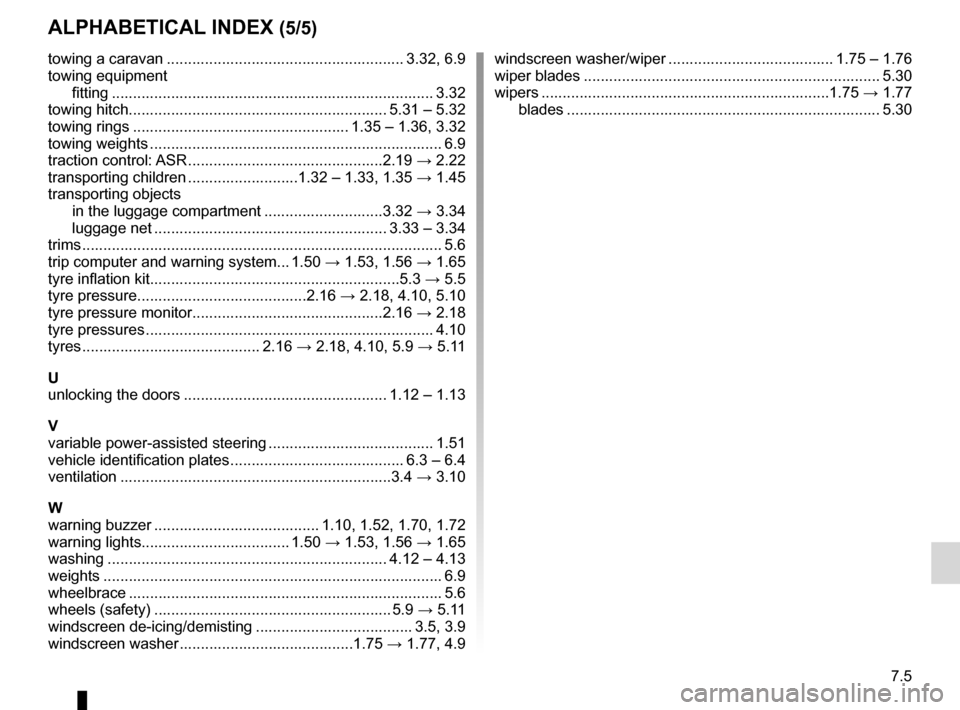
AlphAbeticAl index (5/5)
towing a caravan ........................................................ 3.32, 6.9
towing equipment fitting ............................................................................ 3.32
towing hitch ............................................................. 5.31 – 5.32
towing rings ................................................... 1.35 – 1.36, 3.32
towing weights ..................................................................... 6.9
traction control: ASR .............................................. 2.19 → 2.22
transporting children .......................... 1.32 – 1.33, 1.35 → 1.45
transporting objects in the luggage compartment ............................ 3.32 → 3.34
luggage net ....................................................... 3.33 – 3.34
trims ........................................................................\
............. 5.6
trip computer and warning system ...1.50 → 1.53, 1.56 → 1.65
tyre inflation kit ........................................................... 5.3 → 5.5
tyre pressure ........................................ 2.16 → 2.18, 4.10, 5.10
tyre pressure monitor ............................................. 2.16 → 2.18
tyre pressures .................................................................... 4.10
tyres .......................................... 2.16 → 2.18, 4.10, 5.9 → 5.11
U
unlocking the doors ................................................ 1.12 – 1.13
V
variable power-assisted steering ....................................... 1.51
vehicle identification plates ......................................... 6.3 – 6.4
ventilation ................................................................ 3.4 → 3.10
W
warning buzzer ....................................... 1.10, 1.52, 1.70, 1.72
warning lights ................................... 1.50 → 1.53, 1.56 → 1.65
washing .................................................................. 4.12 – 4.13
weights ........................................................................\
........ 6.9
wheelbrace ........................................................................\
.. 5.6
wheels (safety) ........................................................ 5.9 → 5.11
windscreen de-icing/demisting ..................................... 3.5, 3.9
windscreen washer ......................................... 1.75 → 1.77, 4.9windscreen washer/wiper
....................................... 1.75 – 1.76
wiper blades ...................................................................... 5.30
wipers .................................................................... 1.75 → 1.77
blades .......................................................................... 5.30