Pump RENAULT MEGANE RS 2012 X95 / 3.G Owners Manual
[x] Cancel search | Manufacturer: RENAULT, Model Year: 2012, Model line: MEGANE RS, Model: RENAULT MEGANE RS 2012 X95 / 3.GPages: 239, PDF Size: 9.2 MB
Page 85 of 239
JauneNoirNoir texte
1.79
ENG_UD18917_5
Réservoir à carburant (X95 - B95 - Renault)
ENG_NU_837-6_BDK95_Renault_1
filling with fuel
Insert the nozzle to open the valve A
and insert fully before turning it on to
fill the fuel tank (risk of splashing).
Keep the nozzle in this position through -
out the entire filling operation.
When the pump cuts out automatically
at the end of the filling procedure, a
maximum of two further filling attempts
may be made, as there must be suffi -
cient space in the fuel tank to allow for
expansion.
Make sure that no water enters the fuel
tank during filling. The valve A and its
surround must remain clean.
petrol versions
Using leaded petrol will damage the
antipollution system and may lead to a
loss of warranty.
To ensure that the fuel tank is not filled
with leaded petrol, the fuel tank filler
neck contains a restrictor fitted with a
foolproof system which only allows
the nozzle for unleaded petrol to be
used (at the pump).
No modifications what -
soever are permitted on
any part of the fuel supply
system (computers, wiring,
fuel circuit, injector, protection
covers, etc.) as this may be danger-
ous (such work must be undertaken
by qualified Network personnel).
fUEL TANK (2/2)
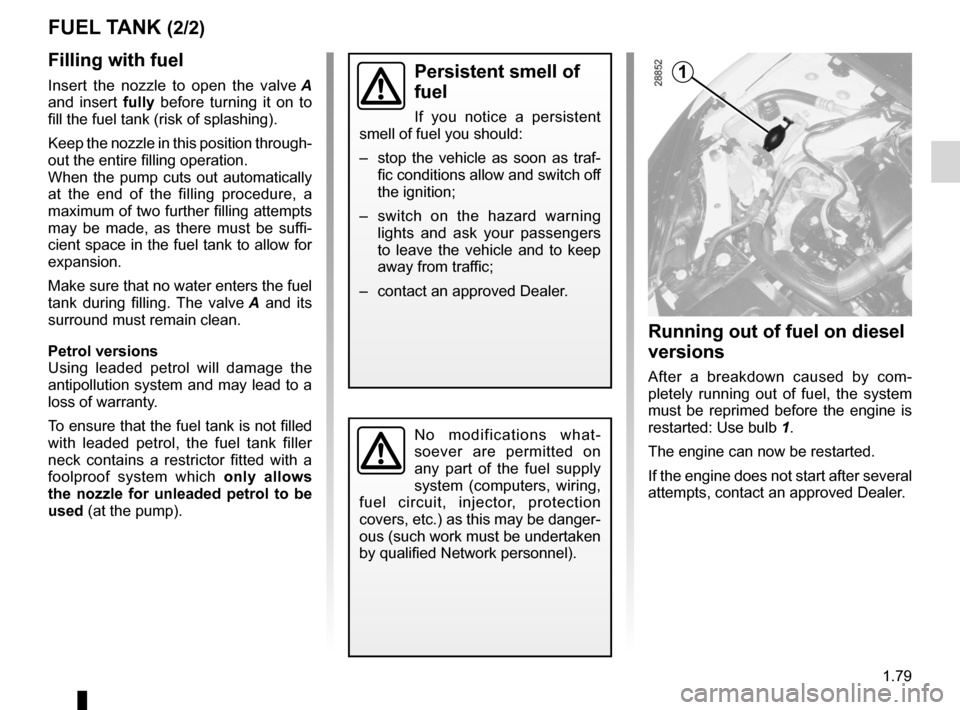
Running out of fuel on diesel
versions
After a breakdown caused by com-
pletely running out of fuel, the system
must be reprimed before the engine is
restarted: Use bulb 1.
The engine can now be restarted.
If the engine does not start after several
attempts, contact an approved Dealer.
1persistent smell of
fuel
If you notice a persistent
smell of fuel you should:
– stop the vehicle as soon as traf-
fic conditions allow and switch off
the ignition;
– switch on the hazard warning
lights and ask your passengers
to leave the vehicle and to keep
away from traffic;
– contact an approved Dealer.
Page 105 of 239
ABS ...................................................... (up to the end of the DU)
anti-lock braking system: ABS ..............(up to the end of the DU)
ESP: Electronic Stability Program ........ (up to the end of the DU)
ASR (traction control) ........................... (up to the end of the DU)
traction control: ASR .............................(up to the end of the DU)
Electronic Stability Program: ESP ........ (up to the end of the DU)
emergency brake assist ........................(up to the end of the DU)
emergency braking ............................... (up to the end of the DU)
traction control: ASR .............................................. (current page)
driving ................................................... (up to the end of the DU)
2.19
ENG_UD14885_2
Dispositifs de correction de conduite (X95 - B95 - D95 - Renault)
ENG_NU_837-6_BDK95_Renault_2
Driver correction devices/aids
DRIVER CORRECTION DEVICES/AIDS (1/4)
Depending on the vehicle, this is com-
posed of:
– t h e A bS ( a n t i - l o c k b r a k i n g
system);
– the electronic stability program
(E.S.P. ) with understeer control
and traction control (A.S.R.);
– emergency brake assist with, de -
pending on the vehicle, braking
anticipation.
In an emergency, apply firm and
continuous pressure to the brake
pedal. There is no need to pump
it repeatedly. The ABS will modu -
late the force applied in the braking
system.
These functions are an ad-
ditional aid in the event of
critical driving conditions,
enabling the vehicle behav -
iour to be adapted to suit the driving
conditions.
However, the functions do not take
the place of the driver. They do
not increase the vehicle’s limits
and should not encourage you
to drive more quickly. Therefore,
they can under no circumstances
replace the vigilance or responsibil -
ity of the driver when manoeuvring
the vehicle (the driver must always
be ready for sudden incidents which
may occur when driving).
Yo u r b r a k i n g s y s t e m s
are partially operational.
However, it is dangerous
to brake suddenly and
it is essential to stop immediately,
as soon as traffic conditions allow.
Contact an approved dealer.
Operating faults:
–
© and x lit up on the in -
strument panel along with the mes -
sages “Check ABS”, “Check braking
system” and “Check ESP”: the ABS,
E.S.P. and emergency brake assist
are deactivated. braking safety is
still guaranteed;
–
x, D, © and ®
lit on the instrument panel accom -
panied by the message “ Braking
system fault”: this indicates a fault
with the braking system.
In both cases, consult an approved
Dealer.
AbS (anti-lock braking
system)
Under heavy braking, the ABS prevents
the wheels from locking, allowing the
stopping distance to be managed and
keeping control of the vehicle.
Under these circumstances, the vehi -
cle can be steered to avoid an obstacle
whilst braking. In addition, this system
can increase stopping distances, par -
ticularly on roads with low surface grip
(wet ground etc.).
You will feel a pulsation through the
brake pedal each time the system is
activated. The ABS does not in any way
improve the vehicle’s physical perform-
ance relating to the road surface and
roadholding. It is still essential to follow
the rules of good driving practice (such
as driving at a safe distance from the
vehicle in front etc.).