wheel RENAULT SANDERO 2012 User Guide
[x] Cancel search | Manufacturer: RENAULT, Model Year: 2012, Model line: SANDERO, Model: RENAULT SANDERO 2012Pages: 183, PDF Size: 6.95 MB
Page 75 of 183
power-assisted steering......................................... (current page)
driving .................................................................... (current page)
power-assisted steering ......................................... (current page)
handbrake .............................................................. (current page)
2.11
ENG_UD18241_6
Frein à main / Direction assistée (B90 - L90 Ph2 - F90 Ph2 - R90 \
Ph2 - Dacia)
ENG_NU_817-9_B90_Dacia_2
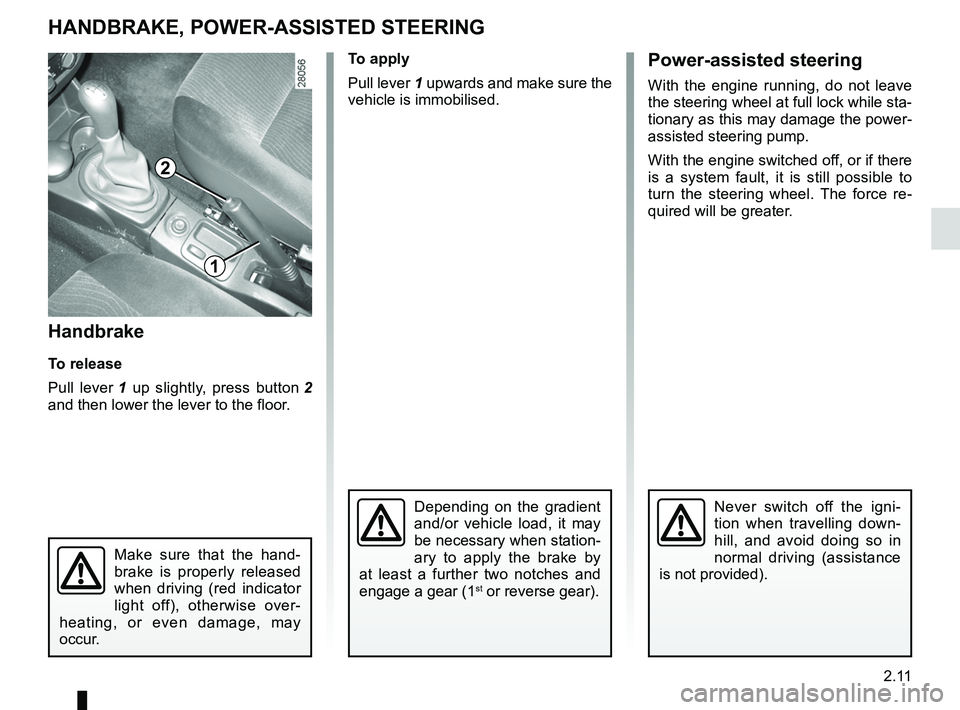
Handbrake
To release
Pull lever 1 up slightly, press button 2
and then lower the lever to the floor.
Handbrake/Power-assisted steering
HANDBRAKE, POWER-ASSISTED STEERING
To apply
Pull lever 1 upwards and make sure the
vehicle is immobilised.
Depending on the gradient
and/or vehicle load, it may
be necessary when station-
ary to apply the brake by
at least a further two notches and
engage a gear (1
st or reverse gear).
Never switch off the igni -
tion when travelling down -
hill, and avoid doing so in
normal driving (assistance
is not provided).
Make sure that the hand -
brake is properly released
when driving (red indicator
light off), otherwise over -
heating, or even damage, may
occur.
1
2
Power-assisted steering
With the engine running, do not leave
the steering wheel at full lock while sta-
tionary as this may damage the power -
assisted steering pump.
With the engine switched off, or if there
is a system fault, it is still possible to
turn the steering wheel. The force re -
quired will be greater.
Page 76 of 183
driving ................................................... (up to the end of the DU)
ABS ...................................................... (up to the end of the DU)
anti-lock braking system: ABS ..............(up to the end of the DU)
2.12
ENG_UD18242_8
Dispositifs de correction et d’assistance à la conduite (B90 - U9\
0 - L90 Ph2 - F90 Ph2 - R90 Ph2 - Dacia)
ENG_NU_817-9_B90_Dacia_2
Jaune NoirNoir texte
ABS (anti-lock braking
system)
Under heavy braking, the ABS prevents
the wheels from locking, allowing the
stopping distance to be managed and
keeping control of the vehicle.
Under these circumstances, the vehi -
cle can be steered to avoid an obstacle
whilst braking. In addition, this system
can increase stopping distances, par -
ticularly on roads with low surface grip
(wet ground etc.).
You will feel a pulsation through the
brake pedal each time the system is
activated. The ABS does not in any way
improve the vehicle's physical perform-
ance relating to the road surface and
roadholding. It is still essential to follow
the rules of good driving practice (such
as driving at a safe distance from the
vehicle in front etc.).
Driver correction devices/aids
DRIVER CORRECTION DEVICES/AIDS (1/2)
Depending on the vehicle, this is com-
posed of:
– t h e A B S ( a n t i - l o c k b r a k i n g
system);
– emergency brake assist.
These functions are an ad-
ditional aid in the event of
critical driving conditions,
enabling the vehicle behav -
iour to be adapted to suit the driving
conditions.
However, the functions do not take
the place of the driver. They do
not increase the vehicle’s limits
and should not encourage you
to drive more quickly. Therefore,
they can under no circumstances
replace the vigilance or responsibil -
ity of the driver when manoeuvring
the vehicle (the driver must always
be ready for sudden incidents which
may occur when driving).
In an emergency, apply firm and
continuous pressure to the brake
pedal. There is no need to pump
it repeatedly. The ABS will modu -
late the force applied in the braking
system.
Page 80 of 183
2.16
ENG_UD22554_10
Boîte automatique (B90 - L90 Ph2 - F90 Ph2 - R90 Ph2 - Dacia)
ENG_NU_817-9_B90_Dacia_2
Parking the vehicleWhen the vehicle is stopped, move the
lever to position P while keeping your
foot on the brake pedal: the gearbox is
in neutral and the drive wheels are me-
chanically locked by the driveshaft.
Apply the handbrake.
AUTOMATIC TRANSMISSION (3/3)
An impact to the under -
side of the vehicle while
manoeuvring (e.g.: strik -
ing a post, raised kerb or
other street furniture) may result in
damage to the vehicle (e.g.: defor -
mation of an axle).
To avoid any risk of accident, have
your vehicle checked by an ap -
proved Dealer.
2
6
Operating faults
If a vehicle with an automatic gear -
box breaks down, please refer to the
information on “Towing” in Section 5.
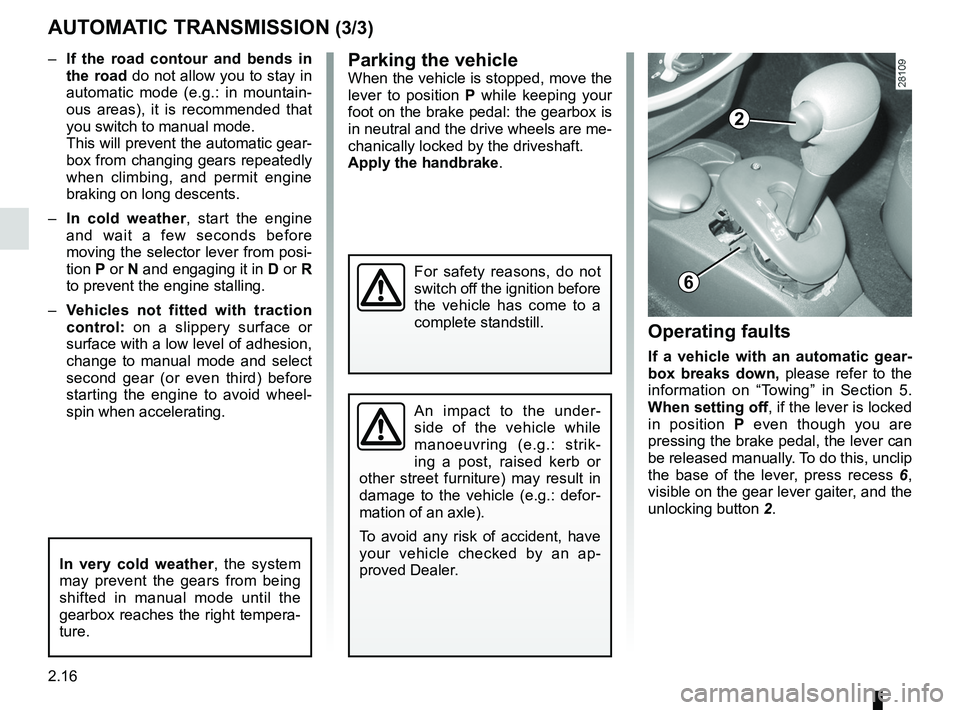
When setting off, if the lever is locked
in position P even though you are
pressing the brake pedal, the lever can
be released manually. To do this, unclip
the base of the lever, press recess 6 ,
visible on the gear lever gaiter, and the
unlocking button 2.
–
If the road contour and bends in
the road do not allow you to stay in
automatic mode (e.g.: in mountain -
ous areas), it is recommended that
you switch to manual mode.
This will prevent the automatic gear-
box from changing gears repeatedly
when climbing, and permit engine
braking on long descents.
– In cold weather , start the engine
and wait a few seconds before
moving the selector lever from posi-
tion P or N and engaging it in D or R
to prevent the engine stalling.
– Vehicles not fitted with traction
control: on a slippery surface or
surface with a low level of adhesion,
change to manual mode and select
second gear (or even third) before
starting the engine to avoid wheel -
spin when accelerating.
In very cold weather , the system
may prevent the gears from being
shifted in manual mode until the
gearbox reaches the right tempera-
ture.
For safety reasons, do not
switch off the ignition before
the vehicle has come to a
complete standstill.
Page 113 of 183
tyre pressures ....................................... (up to the end of the DU)
tyres ...................................................... (up to the end of the DU)
tyre pressure ......................................... (up to the end of the DU)
4.11
ENG_UD19741_9
Pressions de gonflage des pneumatiques à froid (B90 - U90 - L90 Ph2 \
- F90 Ph2 - R90 Ph2 - Dacia)
ENG_NU_817-9_B90_Dacia_4
Tyre pressures
TyRE PRESSURE
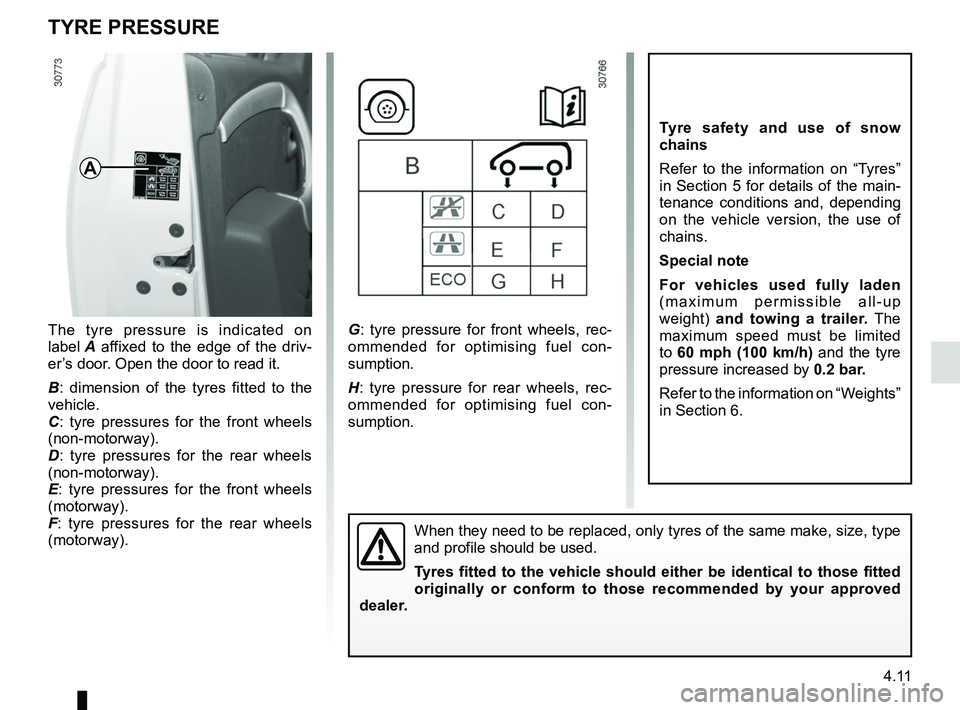
The tyre pressure is indicated on
label A affixed to the edge of the driv -
er’s door. Open the door to read it.
B : dimension of the tyres fitted to the
vehicle.
C : tyre pressures for the front wheels
(non-motorway).
D : tyre pressures for the rear wheels
(non-motorway).
E : tyre pressures for the front wheels
(motorway).
F : tyre pressures for the rear wheels
(motorway). G
: tyre pressure for front wheels, rec -
ommended for optimising fuel con -
sumption.
H : tyre pressure for rear wheels, rec -
ommended for optimising fuel con -
sumption.
Tyre safety and use of snow
chains
Refer to the information on “Tyres”
in Section 5 for details of the main-
tenance conditions and, depending
on the vehicle version, the use of
chains.
Special note
For vehicles used fully laden
( m a x i m u m p e r m i s s i b l e a l l - u p
weight) and towing a trailer. The
maximum speed must be limited
to 60 mph (100 km/h) and the tyre
pressure increased by 0.2 bar.
Refer to the information on “Weights”
in Section 6.
When they need to be replaced, only tyres of the same make, size, type
and profile should be used.
Tyres fitted to the vehicle should either be identical to those fitted
originally or conform to those recommended by your approved
dealer.
A
Page 115 of 183
bodywork (maintenance) ...................... (up to the end of the DU)
maintenance: bodywork ........................................ (up to the end of the DU)
washing ................................................ (up to the end of the DU)
paintwork maintenance .................................................... (current page)
4.13
ENG_UD20155_5
Entretien de la carrosserie (B90 - U90 - L90 Ph2 - F90 Ph2 - R90 Ph2 - \
Dacia)
ENG_NU_817-9_B90_Dacia_4
Bodywork maintenance
BODyWORK MAINTENANCE (1/3)
A well-maintained vehicle will have a
longer service life. It is therefore ad -
visable to maintain the vehicle exterior
regularly.
Protection against the effects
of corrosive agents
Although your vehicle has been treated
with very effective anti-corrosion prod -
ucts, it nevertheless remains subject to
the effects of:
– corrosives in the atmosphere
– atmospheric pollution (urban and
industrial areas);
– saline atmosphere (near the sea,
particularly in hot weather);
– seasonal and damp climatic con-
ditions, (e.g.: road salt in winter,
water from road cleaners, etc.).
– abrasives
Wind-borne dust and sand, mud,
road grit thrown up by other vehi -
cles, etc.
– minor impacts
You should take a minimum number of
precautions in order to safeguard your
vehicle against such risks and not to
lose the benefit of your vehicle’s anti -
corrosion protection.
y ou should not:
– Degrease or clean mechanical com-
ponents, underneath the body, parts
with hinges (eg. fuel filler cap, inside
the fuel flap) and painted plastic ex-
ternal fittings (eg. bumpers) using
high-pressure cleaning equipment
or by spraying on products not ap -
proved by our Technical Department.
If adequate precautions are not
taken, this could cause corrosion or
lead to operational faults.
– Aim a high pressure water jet directly
onto damaged parts of the vehicle
(eg. painted bumpers, lights, etc.).
Wash these parts carefully by hand.
– Wash the vehicle in bright sunlight or
freezing temperatures. –
Use hard brushes to clean alloy
wheels. These can scratch or
damage the wheel’s protective coat-
ing.
– Scrape off mud or dirt without
prewetting.
– Allow dirt to accumulate.
– Allow rust to form following minor im-
pacts.
– Use solvents not approved by the
Technical Department to remove
stains as this could damage the
paintwork.
– Drive when the vehicle is muddy or
covered in snow (the wheel arches,
underneath the body, radiator, etc.
must always be free from mud or
snow).
It is forbidden to wash the engine compartment using a high-pressure
water jet: this risks damaging the electrical/electronic components in the
engine compartment.
A label affixed in the engine compartment reminds you of this.
Page 116 of 183

ENG_NU_817-9_B90_Dacia_4
Jaune NoirNoir texte
BODyWORK MAINTENANCE (2/3)
y ou should
–
Respect")
4.14
ENG_UD20155_5
Entretien de la carrosserie (B90 - U90 - L90 Ph2 - F90 Ph2 - R90 Ph2 - \
Dacia)
ENG_NU_817-9_B90_Dacia_4
Jaune NoirNoir texte
BODyWORK MAINTENANCE (2/3)
y ou should
–
Respect local regulations about
washing vehicles (e.g. do not wash
your vehicle on a public highway).
– Always follow the recommenda -
tions supplied with the high-pressure
cleaning equipment (jet distance and
pressure).
– Before using a roller type car wash,
put the windscreen wiper stalk in
Park position (refer information
on the “Windscreen wash/wipe” in
Section 1), check that the external
accessories, additional lights, and
mirrors are securely fitted and that
the wiper blades and radio aerial are
taped down.
Remove the radio aerial mast if your
vehicle is fitted with this equipment.
Remember to remove the tape and
refit the antenna after washing. –
Wash your vehicle frequently with
the engine off , using shampoo ap -
proved by our Technical Department
(never use abrasive products) and
rinse thoroughly using a warm or
cold water jet (never hot):
– spots of tree resin and industrial
grime;
– the layer of dust or mud and any
insects;
– bird droppings , which contain
chemicals that rapidly discolour
paintwork and may even cause
the paint to peel off ;
Wash the vehicle immediately to
remove these marks since it is im-
possible to remove them by pol -
ishing; –
salt deposited in the wheel arches
and underneath the body after
driving in areas where the roads
are chemically treated;
– mud in the wheel arches and un-
derneath the body which form
damp patches.
– Clean mud and sand from the
wheels, in particular the inside of the
wheels and the brakes, as this can:
– reduce the braking efficiency and
damage the components of the
braking system;
– cause vibrations in the bodywork
and steering column.
We have selected special products
to care for your vehicle and you can
obtain these from approved dealer
accessory outlets.
Page 117 of 183

ENG_NU_817-9_B90_Dacia_4
BODyWORK MAINTENANCE (3/3)
– After cleaning your v")
JauneNoirNoir texte
4.15
ENG_UD20155_5
Entretien de la carrosserie (B90 - U90 - L90 Ph2 - F90 Ph2 - R90 Ph2 - \
Dacia)
ENG_NU_817-9_B90_Dacia_4
BODyWORK MAINTENANCE (3/3)
– After cleaning your vehicle, check
the brakes while driving at low speed
to ensure that the braking efficiency
has not been reduced by the water.
If it has, depress the brake pedal
gently while driving to dry the brakes.
– Check the drain holes at the bottom
of the doors to make sure they are
not blocked.
– Inspect the wheels regularly to check
for any traces of impacts or corro -
sion. These can damage the tyre or
cause it to lose pressure.
– Keep well away from the vehicle in
front when driving on gravelled sur -
faces to prevent paint damage.
– Repair or have repaired quickly
patches where the paint has been
damaged to prevent corrosion
spreading. –
Remember to visit the body shop pe-
riodically in order to maintain your
anticorrosion warranty. Refer to the
Maintenance Service Booklet.
– Spray mechanical components,
hinges, etc. with products approved
by the Technical Department to
protect them after they have been
cleaned.
Page 121 of 183
5.1
ENG_UD25175_11
Sommaire 5 (B90 - Dacia)
ENG_NU_817-9_B90_Dacia_5
Section 5: Practical advice
Tools . . . . . . . . . . . . . . . . . . . . . . . . . . . . . . . . . . . . . . . . . . . . . . . . . . . . . . . . . . . . . . . . . . . . . . . . . 5.2
Puncture . . . . . . . . . . . . . . . . . . . . . . . . . . . . . . . . . . . . . . . . . . . . . . . . . . . . . . . . . . . . . . . . . . . . . . 5.3
Tyre inflation kit . . . . . . . . . . . . . . . . . . . . . . . . . . . . . . . . . . . . . . . . . . . . . . . . . . . . . . . . . . . . . . . . . 5.4
Wheel trims/Wheels . . . . . . . . . . . . . . . . . . . . . . . . . . . . . . . . . . . . \
. . . . . . . . . . . . . . . . . . . . . . . . . . 5.7
Changing a wheel . . . . . . . . . . . . . . . . . . . . . . . . . . . . . . . . . . . . . . . . . . . . . . . . . . . . . . . . . . . . . . . 5.9
Tyres (tyre and wheel safety, use in winter) . . . . . . . . . . . . . . . . . . . . . . . . . . . . . . . . . . . . . . . . . . . 5.11
Changing bulbs . . . . . . . . . . . . . . . . . . . . . . . . . . . . . . . . . . . . . . . . . . . . . . . . . . . . . . . . . . . . . . . . . 5.14
Front lights . . . . . . . . . . . . . . . . . . . . . . . . . . . . . . . . . . . . . . . . . . . . . . . . . . . . . . . . . . . . . . . 5.14
Fog lights . . . . . . . . . . . . . . . . . . . . . . . . . . . . . . . . . . . . . . . . . . . . . . . . . . . . . . . . . . . . . . . . 5.15
Rear lights . . . . . . . . . . . . . . . . . . . . . . . . . . . . . . . . . . . . . . . . . . . . . . . . . . . . . . . . . . . . . . . 5.16
Indicator lights . . . . . . . . . . . . . . . . . . . . . . . . . . . . . . . . . . . . . . . . . . . . . . . . . . . . . . . . . . . . 5.18
Interior lights . . . . . . . . . . . . . . . . . . . . . . . . . . . . . . . . . . . . . . . . . . . . . . . . . . . . . . . . . . . . . . 5.19
Fuses . . . . . . . . . . . . . . . . . . . . . . . . . . . . . . . . . . . . . . . . . . . . . . . . . . . . . . . . . . . . . . . . . . . . . . . . . 5.22
Battery . . . . . . . . . . . . . . . . . . . . . . . . . . . . . . . . . . . . . . . . . . . . . . . . . . . . . . . . . . . . . . . . . . . . . . . . 5.25
Radio frequency remote control: battery . . . . . . . . . . . . . . . . . . . . . . . . . . . . . . . . . . . . . . . . . . . . . . 5.27
Wiper blades . . . . . . . . . . . . . . . . . . . . . . . . . . . . . . . . . . . . . . . . . . . . . . . . . . . . . . . . . . . . . . . . . . . 5.28
Towing: breakdown . . . . . . . . . . . . . . . . . . . . . . . . . . . . . . . . . . . . . . . . . . . . . . . . . . . . . . . . . . . . . . 5.29
Towing: equipment . . . . . . . . . . . . . . . . . . . . . . . . . . . . . . . . . . . . \
. . . . . . . . . . . . . . . . . . . . . . . . . . . 5.31
Fitting a radio . . . . . . . . . . . . . . . . . . . . . . . . . . . . . . . . . . . . . . . . . . . . . . . . . . . . . . . . . . . . . . . . . . . 5.32
Accessories . . . . . . . . . . . . . . . . . . . . . . . . . . . . . . . . . . . . . . . . . . . . . . . . . . . . . . . . . . . . . . . . . . . . 5.33
Operating faults . . . . . . . . . . . . . . . . . . . . . . . . . . . . . . . . . . . . . . . . . . . . . . . . . . . . . . . . . . . . . . . . . 5.34
Page 122 of 183
towing hitch........................................... (up to the end of the DU)
practical advice ..................................... (up to the end of the DU)
jack ....................................................... (up to the end of the DU)
lifting the vehicle changing a wheel ............................ (up to the end of the DU)
wheelbrace ........................................... (up to the end of the DU)
5.2
ENG_UD22588_6
Outils (B90 - Dacia)
ENG_NU_817-9_B90_Dacia_5
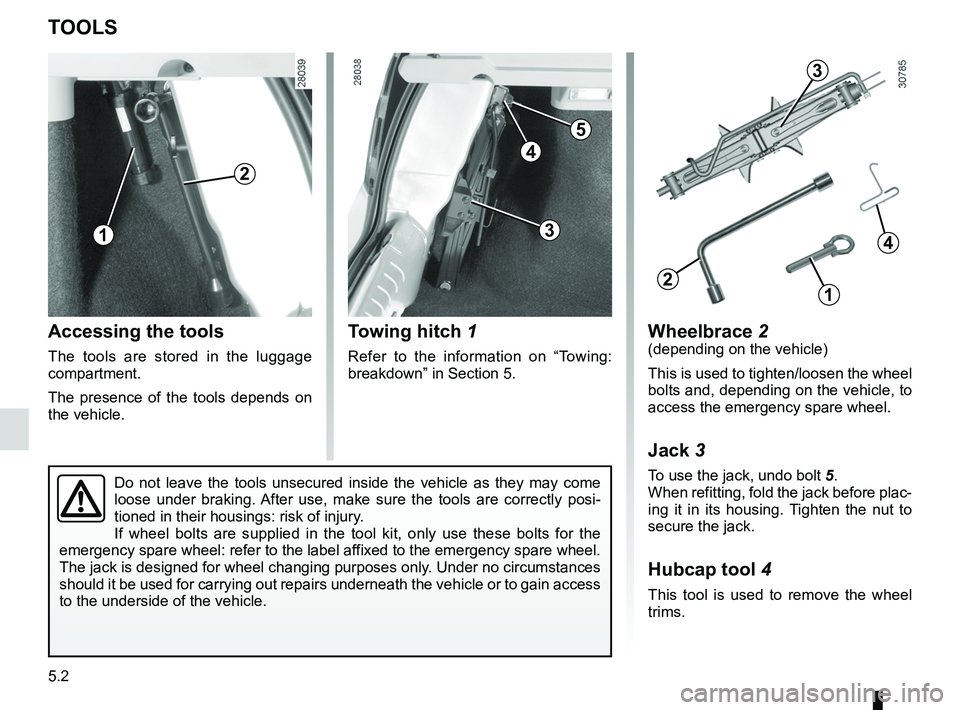
Accessing the tools
The tools are stored in the luggage
compartment.
The presence of the tools depends on
the vehicle.
Towing hitch 1
Refer to the information on “Towing:
breakdown” in Section 5.
Tools
TOOLS
Wheelbrace 2(depending on the vehicle)
This is used to tighten/loosen the wheel
bolts and, depending on the vehicle, to
access the emergency spare wheel.
Jack 3
To use the jack, undo bolt 5.
When refitting, fold the jack before plac-
ing it in its housing. Tighten the nut to
secure the jack.
Hubcap tool 4
This tool is used to remove the wheel
trims.
2
13
5
4
Do not leave the tools unsecured inside the vehicle as they may come
loose under braking. After use, make sure the tools are correctly posi -
tioned in their housings: risk of injury.
If wheel bolts are supplied in the tool kit, only use these bolts for the
emergency spare wheel: refer to the label affixed to the emergency spare wheel.
The jack is designed for wheel changing purposes only. Under no circumstances
should it be used for carrying out repairs underneath the vehicle or to gain access
to the underside of the vehicle.
3
4
21
Page 123 of 183
practical advice ..................................... (up to the end of the DU)
puncture ................................................ (up to the end of the DU)
emergency spare wheel ....................... (up to the end of the DU)
lifting the vehicle changing a wheel ............................ (up to the end of the DU)
5.3
ENG_UD25179_5
Crevaison (B90 - Dacia)
ENG_NU_817-9_B90_Dacia_5
Puncture
PUNCTURE
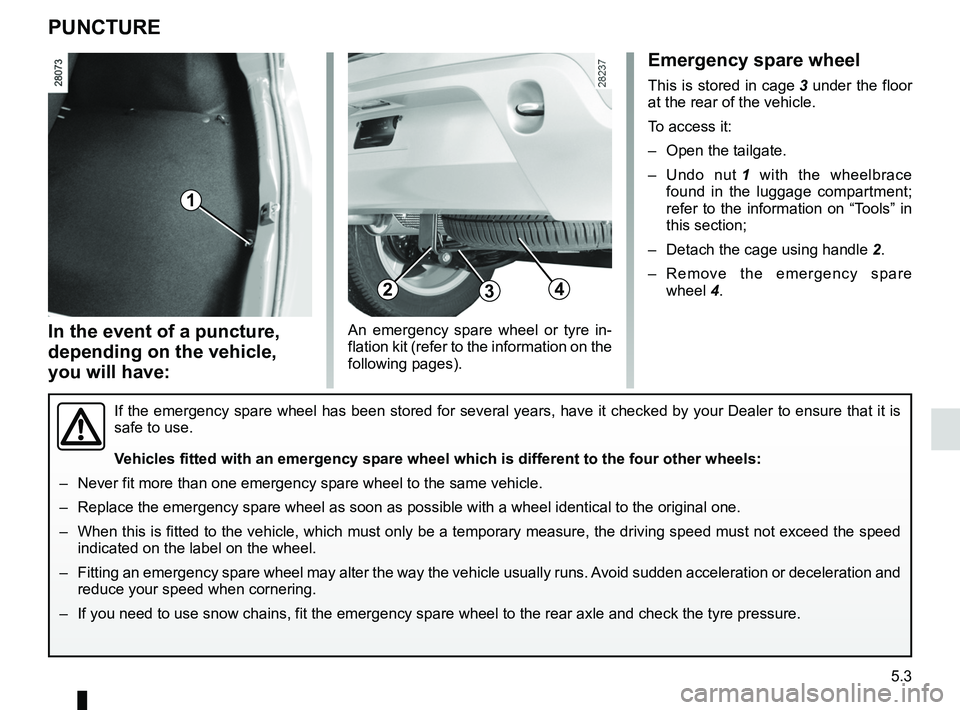
Emergency spare wheel
This is stored in cage 3 under the floor
at the rear of the vehicle.
To access it:
– Open the tailgate.
– Undo nut 1 with the wheelbrace
found in the luggage compartment;
refer to the information on “Tools” in
this section;
– Detach the cage using handle 2.
– Remove the emergency spare
wheel 4.
1
324
In the event of a puncture,
depending on the vehicle,
you will have:An emergency spare wheel or tyre in -
flation kit (refer to the information on the
following pages).
If the emergency spare wheel has been stored for several years, have it checked by your Dealer to ensure that it is
safe to use.
Vehicles fitted with an emergency spare wheel which is different to the f\
our other wheels:
– Never fit more than one emergency spare wheel to the same vehicle.
– Replace the emergency spare wheel as soon as possible with a wheel identical to the original one.
– When this is fitted to the vehicle, which must only be a temporary measure, the driving speed must not exceed the speed
indicated on the label on the wheel.
– Fitting an emergency spare wheel may alter the way the vehicle usually runs. Avoid sudden acceleration or deceleration and
reduce your speed when cornering.
– If you need to use snow chains, fit the emergency spare wheel to the rear axle and check the tyre pressure.