ECU RENAULT SANDERO 2012 Owner's Manual
[x] Cancel search | Manufacturer: RENAULT, Model Year: 2012, Model line: SANDERO, Model: RENAULT SANDERO 2012Pages: 183, PDF Size: 6.95 MB
Page 71 of 183

ENG_NU_817-9_B90_Dacia_2
On versions with")
JauneNoirNoir texte
2.7
ENG_UD22287_11
Conseils : antipollution, économies de carburant, conduite (B90 - U9\
0 - L90 Ph2 - F90 Ph2 - R90 Ph2 - H79 - Dacia)
ENG_NU_817-9_B90_Dacia_2
On versions with an automatic gear-
box, it is preferable to keep the gear
lever in position D.
– Do not try to maintain the same
speed up a hill, accelerate no more
than you would on the level. Keep
your foot in the same position on the
accelerator pedal.
– Double declutching and accelerating
before switching off are unnecessary
in modern vehicles.
– Poor weather conditions, flooded
roads. Do not drive through water if it
is higher than the lower edge of the
wheel rim.Exhaust gas monitoring
system
The exhaust gas monitoring system de-
tects operating faults in the vehicle’s
antipollution system. These faults may
cause mechanical damage or the re -
lease of harmful substances.
ÄThis warning light on the in -
strument panel will indicate if
there are any faults in the system:
This comes on when the ignition is
switched on and goes out after three
seconds.
– If it comes on continuously, consult
an approved dealer as soon as pos-
sible.
– If it flashes, reduce the engine speed
until the light stops flashing. Contact
an approved dealer as soon as pos-
sible.
Driving– Drive carefully for the first few miles
until the engine reaches its normal
operating temperature, rather than
let it warm up while the vehicle is sta-
tionary.
ADVICE: antipollution, fuel economy and driving (2/3)
Driving problems
On the driver ’s side, only
use mats specially adapted
for the vehicle and attached
to prefitted devices. Check regularly
to make sure they are secure. Do
not overlay several mats.
Risk of pedals jamming .
– Speed is expensive.
– Sporty driving uses a lot of fuel: drive
with a light right foot.
– Study the road ahead so that you are
able to brake as little as possible, it
can be sufficient just to lift off the ac-
celerator.
– Avoid sudden acceleration.
– Do not overrev the engine in the in-
termediate gears. Always use the
highest gear possible without labour-
ing the engine.
Page 100 of 183
roof bars ............................................... (up to the end of the DU)
roof rack roof bars .......................................... (up to the end of the DU)
3.20
ENG_UD18248_3
Barres de toit (B90 - Dacia)
ENG_NU_817-9_B90_Dacia_3
Roof bars
ROOF BARS
Access to the mounting
points
(depending on the vehicle)
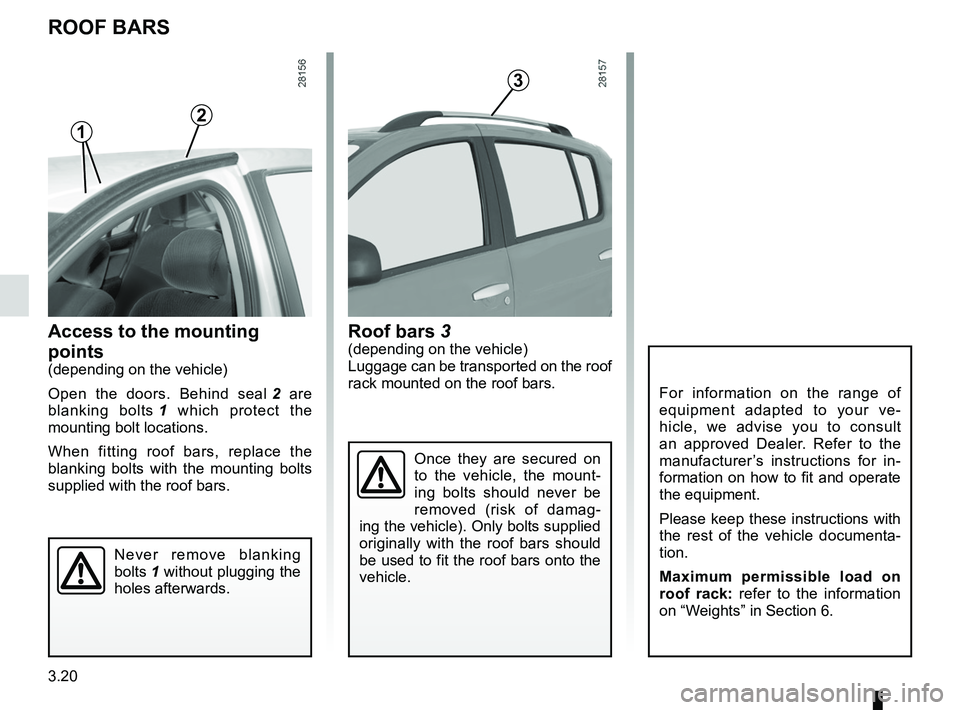
Open the doors. Behind seal 2 are
blanking bolts 1 which protect the
mounting bolt locations.
When fitting roof bars, replace the
blanking bolts with the mounting bolts
supplied with the roof bars.
Never remove blanking
bolts 1 without plugging the
holes afterwards.
Once they are secured on
to the vehicle, the mount -
ing bolts should never be
removed (risk of damag -
ing the vehicle). Only bolts supplied
originally with the roof bars should
be used to fit the roof bars onto the
vehicle.
For information on the range of
equipment adapted to your ve -
hicle, we advise you to consult
an approved Dealer. Refer to the
manufacturer ’s instructions for in -
formation on how to fit and operate
the equipment.
Please keep these instructions with
the rest of the vehicle documenta -
tion.
Maximum permissible load on
roof rack: refer to the information
on “Weights” in Section 6.
Roof bars 3(depending on the vehicle)
Luggage can be transported on the roof
rack mounted on the roof bars.
3
21
Page 108 of 183
filteroil filter ............................................................. (current page)
oil change .............................................................. (current page)
4.6
ENG_UD19757_10
Niveau huile moteur : appoint / remplissage (B90 - L90 Ph2 - Dacia)
ENG_NU_817-9_B90_Dacia_4
Engine oil change
ENGINE OIL LEVEL: topping up/filling (2/2)
Oil change
S e r v i c e i n t e r v a l : r e f e r t o t h e
Maintenance Service Booklet for your
vehicle.
Average capacities for oil change oil
filter included.
(for information)
1.2 16V engines: 4.00 litres
1.4 engines : 3.30 litres
1.6 engines : 3.30 litres
1.6 16V engines: 4.80 litres
1.5 dCi engines : 4.10 litres
Engine oil grade
Refer to the Maintenance Service
Booklet for your vehicle.
Filling: take care when
topping up the oil that
no oil drips onto engine
components - risk of fire.
Remember to refit the cap securely
as there is a risk of fire if oil splashes
onto hot engine components.
Engine oil change: if you
are changing the oil when
the engine is hot, be careful
not to scald yourself if the
oil overflows.
The engine may be hot
during operations in close
proximity. In addition, the
engine cooling fan may
come on at any moment.
Risk of injury.
Consult an approved dealer at once
if you notice an abnormal or re -
peated drop in any of the fluid levels.
Resetting the alert after an oil
change
(depending on the vehicle)
If you change the oil yourself, you will
need to reset the oil change warning.
To do this, after switching on the igni -
tion, for ten seconds you must:
– Depress the accelerator pedal fully,
– with your foot on the accelerator, de-
press the brake pedal three times in
succession.
Reinitialisation is complete when the
# indicator light goes out. If this is
not the case, repeat the operation.
Special case : if you change the oil
before the oil change interval exceeded
warning is displayed, it will also be nec-
essary to reset the display. In this case,
the
# warning light comes on for
approximately 5 seconds to confirm the
reset.
Never run the engine in an
enclosed space as exhaust
gases are poisonous.
Page 116 of 183

ENG_NU_817-9_B90_Dacia_4
Jaune NoirNoir texte
BODyWORK MAINTENANCE (2/3)
y ou should
–
Respect")
4.14
ENG_UD20155_5
Entretien de la carrosserie (B90 - U90 - L90 Ph2 - F90 Ph2 - R90 Ph2 - \
Dacia)
ENG_NU_817-9_B90_Dacia_4
Jaune NoirNoir texte
BODyWORK MAINTENANCE (2/3)
y ou should
–
Respect local regulations about
washing vehicles (e.g. do not wash
your vehicle on a public highway).
– Always follow the recommenda -
tions supplied with the high-pressure
cleaning equipment (jet distance and
pressure).
– Before using a roller type car wash,
put the windscreen wiper stalk in
Park position (refer information
on the “Windscreen wash/wipe” in
Section 1), check that the external
accessories, additional lights, and
mirrors are securely fitted and that
the wiper blades and radio aerial are
taped down.
Remove the radio aerial mast if your
vehicle is fitted with this equipment.
Remember to remove the tape and
refit the antenna after washing. –
Wash your vehicle frequently with
the engine off , using shampoo ap -
proved by our Technical Department
(never use abrasive products) and
rinse thoroughly using a warm or
cold water jet (never hot):
– spots of tree resin and industrial
grime;
– the layer of dust or mud and any
insects;
– bird droppings , which contain
chemicals that rapidly discolour
paintwork and may even cause
the paint to peel off ;
Wash the vehicle immediately to
remove these marks since it is im-
possible to remove them by pol -
ishing; –
salt deposited in the wheel arches
and underneath the body after
driving in areas where the roads
are chemically treated;
– mud in the wheel arches and un-
derneath the body which form
damp patches.
– Clean mud and sand from the
wheels, in particular the inside of the
wheels and the brakes, as this can:
– reduce the braking efficiency and
damage the components of the
braking system;
– cause vibrations in the bodywork
and steering column.
We have selected special products
to care for your vehicle and you can
obtain these from approved dealer
accessory outlets.
Page 119 of 183

ENG_NU_817-9_B90_Dacia_4
Removing/refitting factory
fitted remov")
JauneNoirNoir texte
4.17
ENG_UD22288_6
Entretien des garnitures intérieures (B90 - U90 - L90 Ph2 - F90 Ph2 \
- R90 Ph2 - H79 - Dacia)
ENG_NU_817-9_B90_Dacia_4
Removing/refitting factory
fitted removable equipment
in the vehicle
If you need to remove equipment to
clean the passenger compartment (e.g.
mats), always make you refit it properly
and on the correct side (driver’s side
mats must be fitted on the driver’s side,
etc.), using retaining components sup-
plied with the equipment (e.g. the driv-
er’s side mat must always be secured
using prefitted retaining devices).
In all cases, with the vehicle stationary,
ensure that nothing can hinder driving
(obstacle underneath the pedals, heel
trapped by the mat, etc.).
What you should not do
You are strongly advised not to place
items such as air fresheners, perfume
etc. near the air vents as these could
damage the dashboard fittings.
INTERIOR TRIM MAINTENANCE (2/2)
You are strongly recom -
mended not to use high -
pressure or spray cleaning
equipment inside the pas -
senger compartment: this equip -
ment could impair the correct func-
tioning of the electrical or electronic
components in the vehicle, or have
other detrimental effects.
Page 122 of 183
towing hitch........................................... (up to the end of the DU)
practical advice ..................................... (up to the end of the DU)
jack ....................................................... (up to the end of the DU)
lifting the vehicle changing a wheel ............................ (up to the end of the DU)
wheelbrace ........................................... (up to the end of the DU)
5.2
ENG_UD22588_6
Outils (B90 - Dacia)
ENG_NU_817-9_B90_Dacia_5
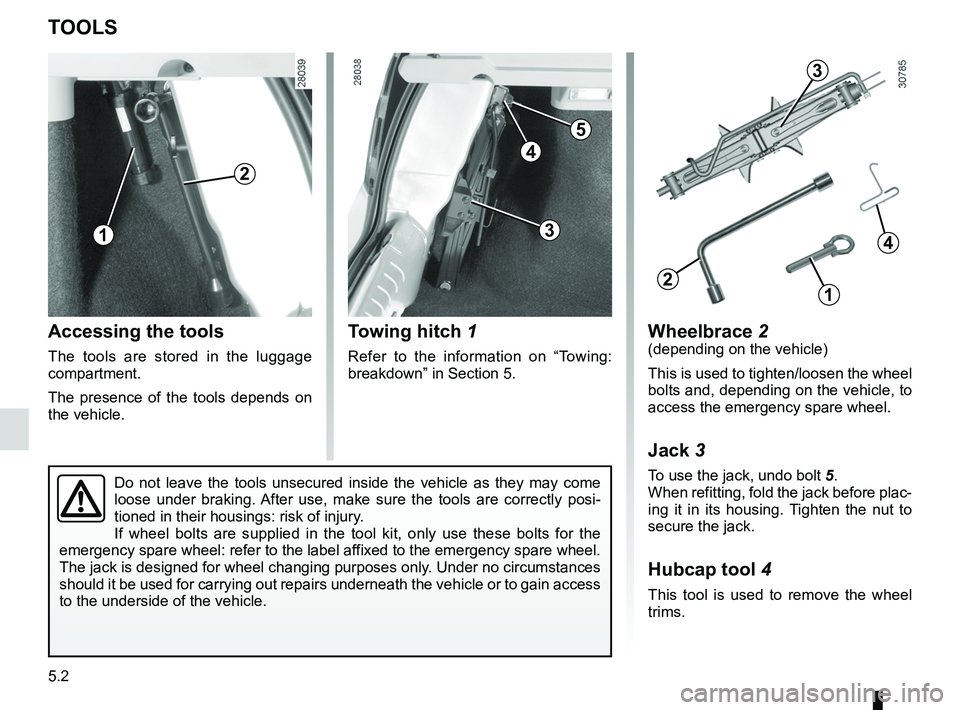
Accessing the tools
The tools are stored in the luggage
compartment.
The presence of the tools depends on
the vehicle.
Towing hitch 1
Refer to the information on “Towing:
breakdown” in Section 5.
Tools
TOOLS
Wheelbrace 2(depending on the vehicle)
This is used to tighten/loosen the wheel
bolts and, depending on the vehicle, to
access the emergency spare wheel.
Jack 3
To use the jack, undo bolt 5.
When refitting, fold the jack before plac-
ing it in its housing. Tighten the nut to
secure the jack.
Hubcap tool 4
This tool is used to remove the wheel
trims.
2
13
5
4
Do not leave the tools unsecured inside the vehicle as they may come
loose under braking. After use, make sure the tools are correctly posi -
tioned in their housings: risk of injury.
If wheel bolts are supplied in the tool kit, only use these bolts for the
emergency spare wheel: refer to the label affixed to the emergency spare wheel.
The jack is designed for wheel changing purposes only. Under no circumstances
should it be used for carrying out repairs underneath the vehicle or to gain access
to the underside of the vehicle.
3
4
21
Page 126 of 183

ENG_NU_817-9_B90_Dacia_5
TYRE INFLATION KIT (3/3)
Once the tyre is inflated correctly:
– stop using")
5.6
ENG_UD22290_8
Kit de gonflage des pneumatiques (B90 - L90 Ph2 - F90 Ph2 - R90 Ph2 - D\
acia)
ENG_NU_817-9_B90_Dacia_5
TYRE INFLATION KIT (3/3)
Once the tyre is inflated correctly:
– stop using the kit;
– close the integrated cap on the bottle
again;
– disconnect adapter 8; –
a ff i x d r i v i n g r e c o m m e n d a t i o n
label 10 to the dashboard where it
can easily be seen by the driver;
– store the kit;
– after the first inflation procedure the
tyre will still be leaking; it is vital to
drive in order to plug the hole;
– start immediately and drive at be -
tween 12 and 36 mph (20 and
60 km/h) to distribute the product
evenly throughout the tyre, stopping
after a distance of 2 miles (3 kilome-
tres) to check the pressure; –
if the pressure is above 1.3 bar but
lower than the recommended pres -
sure, readjust it (refer to the label
affixed to the edge of the driver ’s
door), otherwise contact an ap -
proved dealer: repair is not possible.
Note : after using the inflation kit, you
should visit an approved dealer to re -
place the inflation hose and the bottle
of repair product.
Precautions when using the
kit
The kit should not be operated for more
than 15 consecutive minutes.
Important: a missing or
loose valve cap may com -
promise the tyre seal and
cause a loss of pressure.
Always use valve caps which are
identical to the originals and fully
tightened.
Following repair with the kit,
do not travel further than
120 miles (200 km). In addi -
tion, reduce your speed and
under no circumstances exceed 48
mph (80 km/h). The sticker, which
you must affix in a prominent posi -
tion on the dashboard, reminds you
of this.
Depending on the country or local
legislation, a tyre repaired with the
tyre pressure kit will need to be re-
placed.
Nothing should be placed
around the driver ’s feet
as such objects may slide
under the pedals during
sudden braking manoeuvres and
obstruct their use.
8
10
Page 127 of 183
practical advice ..................................... (up to the end of the DU)
trims ...................................................... (up to the end of the DU)
lifting the vehicle changing a wheel ............................ (up to the end of the DU)
5.7
ENG_UD20461_5
Enjoliveurs - Jantes (B90 - Dacia)
ENG_NU_817-9_B90_Dacia_5
Wheel trim/Wheels
WHEEL TRIM/WHEELS (1/2)
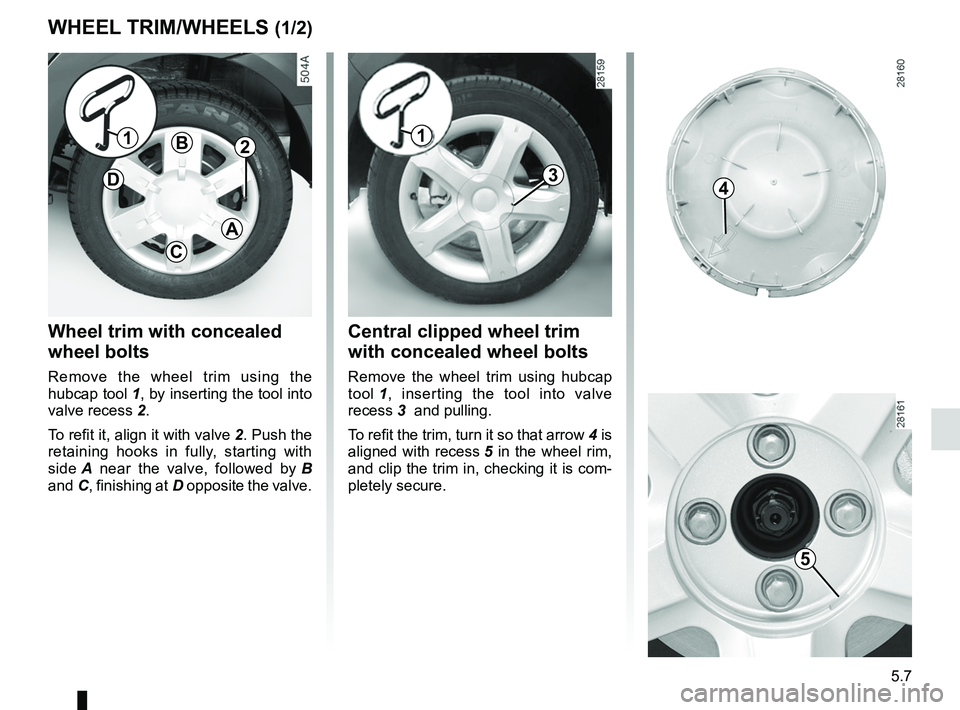
Wheel trim with concealed
wheel bolts
Remove the wheel trim using the
hubcap tool 1, by inserting the tool into
valve recess 2.
To refit it, align it with valve 2. Push the
retaining hooks in fully, starting with
side A near the valve, followed by B
and C, finishing at D opposite the valve.
B
D
C
A
121
3
Central clipped wheel trim
with concealed wheel bolts
Remove the wheel trim using hubcap
tool 1 , inserting the tool into valve
recess 3 and pulling.
To refit the trim, turn it so that arrow 4 is
aligned with recess 5 in the wheel rim,
and clip the trim in, checking it is com-
pletely secure.
5
4
Page 150 of 183
5.30
ENG_UD17944_4
Remorquage : dépannage (B90 - Dacia)
ENG_NU_817-9_B90_Dacia_5
Towing a vehicle with an
automatic gearbox
With the engine switched off, the trans-
mission is no longer lubricated. It is
preferable to tow this type of vehicle on
a trailer or tow it with the front wheels
off the ground.
Under exceptional circumstances ,
you may tow the vehicle with all four
wheels on the ground, only going for -
ward, with the gear lever in the N posi-
tion, and for a distance not exceeding
30 miles (50 km).
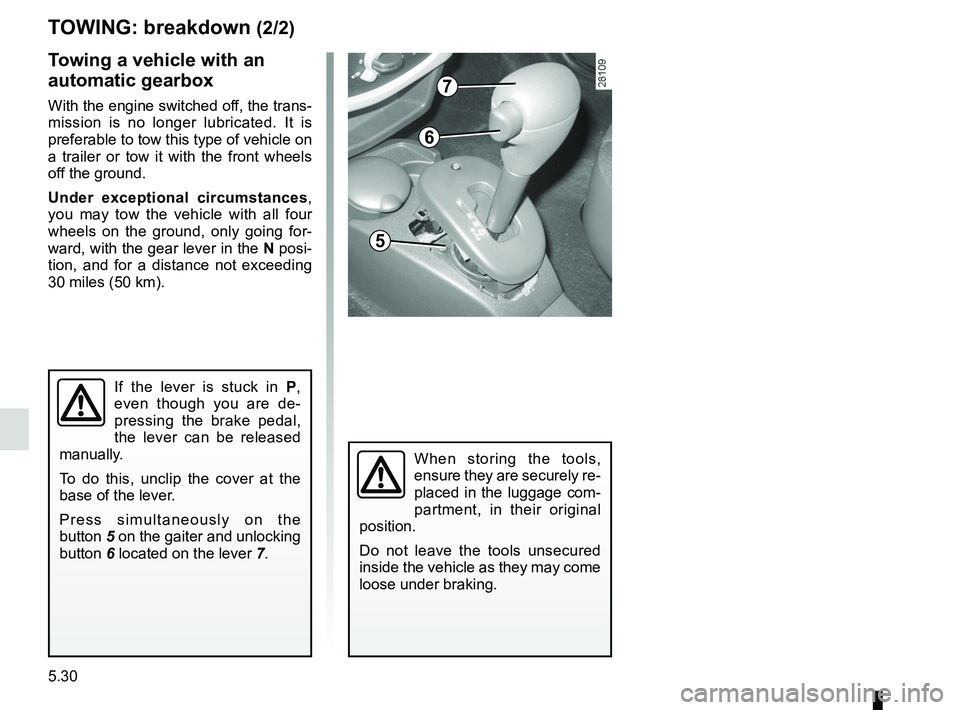
If the lever is stuck in P,
even though you are de -
pressing the brake pedal,
the lever can be released
manually.
To do this, unclip the cover at the
base of the lever.
P r e s s s i m u l t a n e o u s l y o n t h e
button 5 on the gaiter and unlocking
button 6 located on the lever 7.
When storing the tools,
ensure they are securely re-
placed in the luggage com-
partment, in their original
position.
Do not leave the tools unsecured
inside the vehicle as they may come
loose under braking.
T OWING : breakdown (2/2)
7
6
5
Page 154 of 183
operating faults ..................................... (up to the end of the DU)
practical advice ..................................... (up to the end of the DU)
faults operating faults ............................... (up to the end of the DU)
5.34
ENG_UD19739_7
Anomalies de fonctionnement (B90 - U90 - L90 Ph2 - F90 Ph2 - R90 Ph2 - \
Dacia)
ENG_NU_817-9_B90_Dacia_5
Jaune NoirNoir texte
Operating faults
OPERATING FAULTS (1/5)
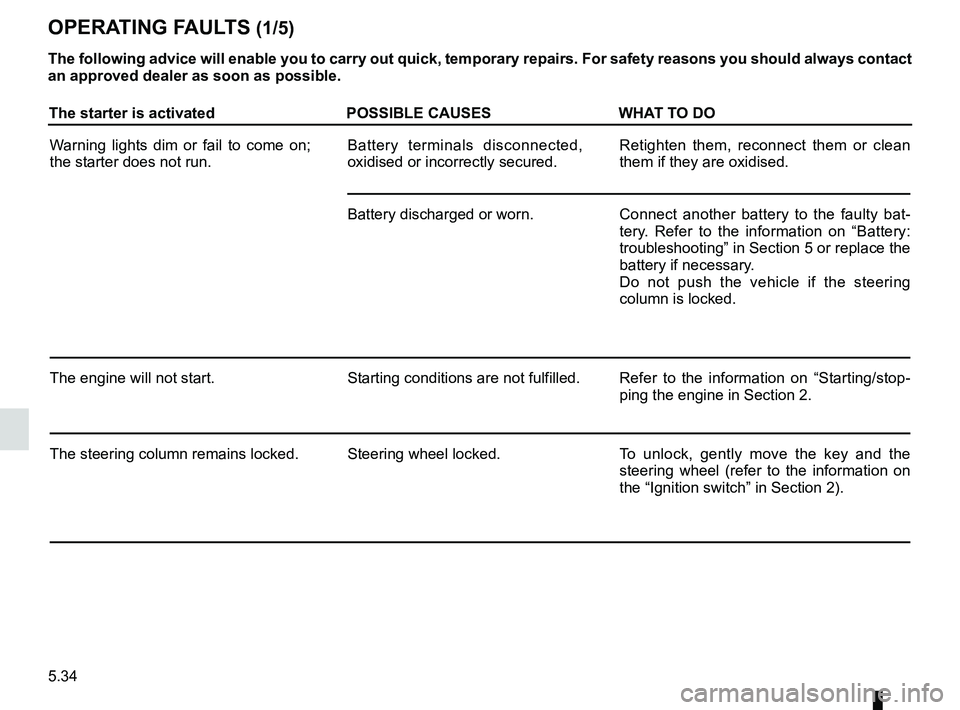
The following advice will enable you to carry out quick, temporary repairs. For safety reasons you should always contact
an approved dealer as soon as possible.
The starter is activated POSSIBLE CAUSESWHAT TO DO
Warning lights dim or fail to come on;
the starter does not run. Battery terminals disconnected,
oxidised or incorrectly secured.Retighten them, reconnect them or clean
them if they are oxidised.
Battery discharged or worn. Connect another battery to the faulty bat -
tery. Refer to the information on “Battery:
troubleshooting” in Section 5 or replace the
battery if necessary.
Do not push the vehicle if the steering
column is locked.
The engine will not start. Starting conditions are not fulfilled.Refer to the information on “Starting/stop -
ping the engine in Section 2.
The steering column remains locked. Steering wheel locked.To unlock, gently move the key and the
steering wheel (refer to the information on
the “Ignition switch” in Section 2).