isofix RENAULT SCENIC 2015 J95 / 3.G User Guide
[x] Cancel search | Manufacturer: RENAULT, Model Year: 2015, Model line: SCENIC, Model: RENAULT SCENIC 2015 J95 / 3.GPages: 270, PDF Size: 6.08 MB
Page 49 of 270

1.43
X = Seat not suitable for fitting child seats.
U = Seat which allows a child seat with “Universal” approval to be ins\
talled using a seat belt; check that it can be fitted.
IUF/IL = On equipped vehicles, seat which allows an approved “Universal/semi-u\
niversal” or “vehicle specific” child seat to be at-
tached using the ISOFIX system; check that it can be fitted.
(1) Only a rear-facing child seat can be fitted in this seat: raise the seat\
to the maximum and position it as far back as possible ,
tilting the seatback slightly (approximately 25°).
(2) A carrycot can be installed across the vehicle and will take up two seats\
. Position the child with his or her feet nearest the door.
(3) Move the front seat as far forward as possible to install a rear-facing \
child seat, then move back the seat in front as far as it will
go, although without allowing it to come into contact with the child sea\
t.
(4) Forward-facing child seat; position the seatback of the child seat in co\
ntact with the seatback of the vehicle seat. Adjust the
height of the headrest or remove it if necessary; do not push the seat i\
n front of the child more than halfway back on its runn ers
and do not recline the seatback more than 25°.
(5) Push the seat(s) in front of the child in a third row seat as far forw\
ard as possible.
(6) RISK OF DEATH OR SERIOUS INJURY: before fitting a rear-facing child seat in the front passenger seat, ch\
eck
that the air bag deactivator is in the OFF position .
CHILD SAFETY: fitting a child seat (9/11)
Page 50 of 270
1.44
CHILD SAFETY: fitting a child seat (10/11)
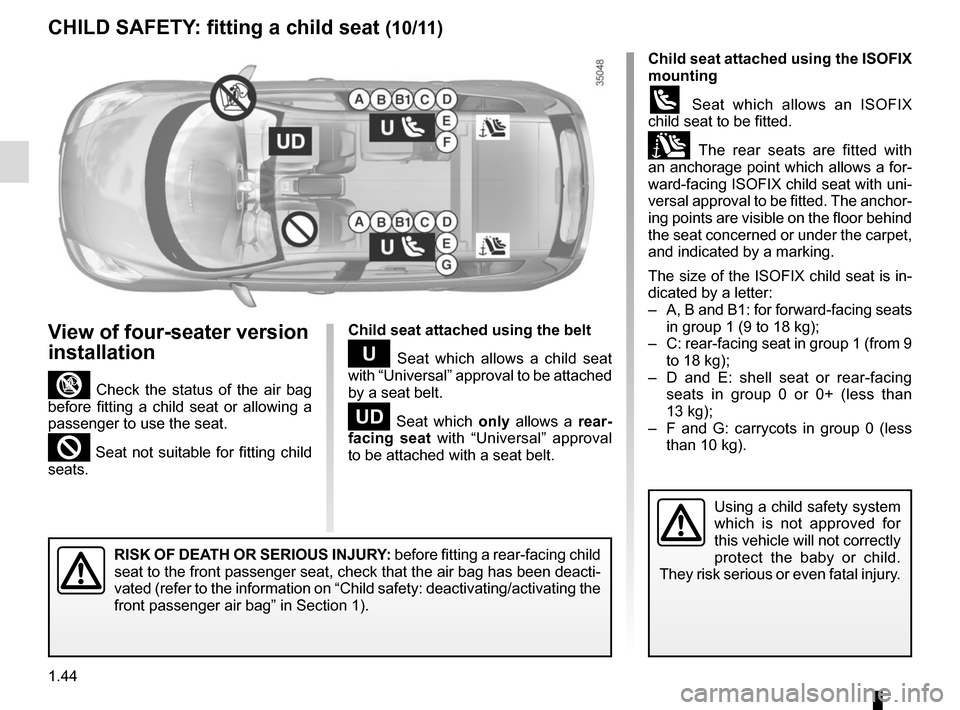
Child seat attached using the ISOFIX
mounting
ü Seat which allows an ISOFIX
child seat to be fitted.
± The rear seats are fitted with
an anchorage point which allows a for-
ward-facing ISOFIX child seat with uni-
versal approval to be fitted. The anchor-
ing points are visible on the floor behind
the seat concerned or under the carpet,
and indicated by a marking.
The size of the ISOFIX child seat is in-
dicated by a letter:
– A, B and B1: for forward-facing seats in group 1 (9 to 18 kg);
– C: rear-facing seat in group 1 (from 9 to 18 kg);
– D and E: shell seat or rear-facing seats in group 0 or 0+ (less than
13 kg);
– F and G: carrycots in group 0 (less than 10 kg).
Using a child safety system
which is not approved for
this vehicle will not correctly
protect the baby or child.
They risk serious or even fatal injury.
RISK OF DEATH OR SERIOUS INJURY: before fitting a rear-facing child
seat to the front passenger seat, check that the air bag has been deacti\
-
vated (refer to the information on “Child safety: deactivating/activ\
ating the
front passenger air bag” in Section 1).
Child seat attached using the belt
¬ Seat which allows a child seat
with “Universal” approval to be attached
by a seat belt.
− Seat which only allows a rear-
facing seat with “Universal” approval
to be attached with a seat belt.
View of four-seater version
installation
³ Check the status of the air bag
before fitting a child seat or allowing a
passenger to use the seat.
² Seat not suitable for fitting child
seats.
Page 51 of 270
1.45
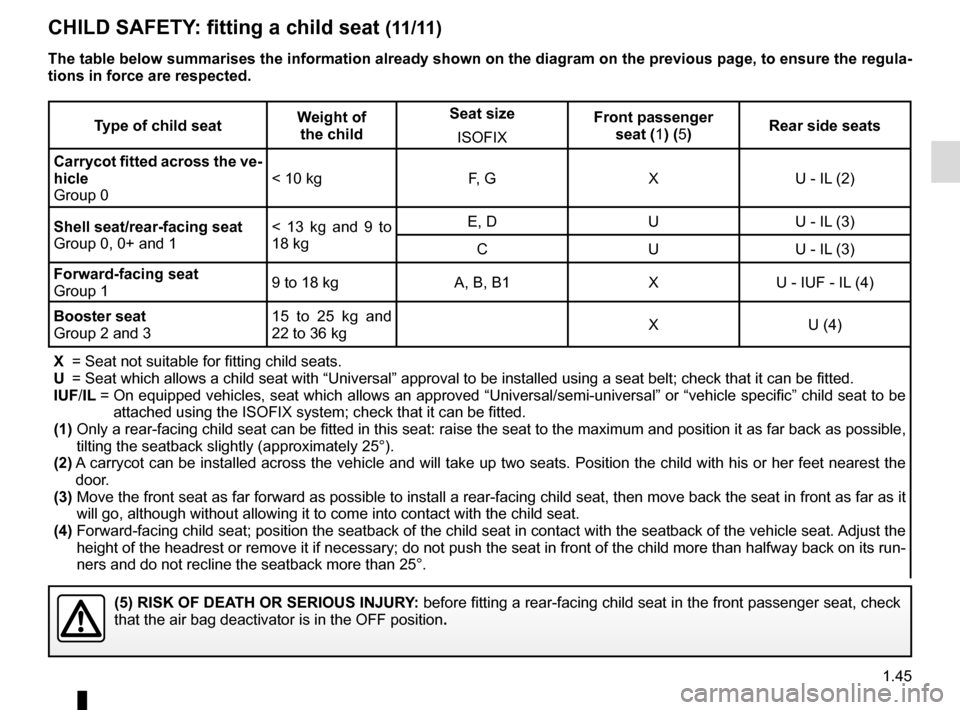
Type of child seatWeight of
the child Seat size
ISOFIX Front passenger
seat (1) (5) Rear side seats
Carrycot fitted across the ve-
hicle
Group 0 < 10 kg
F, GXU - IL (2)
Shell seat/rear-facing seat
Group 0, 0+ and 1 < 13 kg and 9 to
18 kgE, D
UU - IL (3)
C UU - IL (3)
Forward-facing seat
Group 1 9 to 18 kg
A, B, B1 XU - IUF - IL (4)
Booster seat
Group 2 and 3 15 to 25 kg and
22 to 36 kg
X
U (4)
X = Seat not suitable for fitting child seats.
U = Seat which allows a child seat with “Universal” approval to be ins\
talled using a seat belt; check that it can be fitted.
IUF/IL = On equipped vehicles, seat which allows an approved “Universal/semi-u\
niversal” or “vehicle specific” child seat to be
attached using the ISOFIX system; check that it can be fitted.
(1) Only a rear-facing child seat can be fitted in this seat: raise the seat\
to the maximum and position it as far back as possible ,
tilting the seatback slightly (approximately 25°).
(2) A carrycot can be installed across the vehicle and will take up two seats\
. Position the child with his or her feet nearest the
door.
(3) Move the front seat as far forward as possible to install a rear-facing \
child seat, then move back the seat in front as far as it
will go, although without allowing it to come into contact with the chil\
d seat.
(4) Forward-facing child seat; position the seatback of the child seat in co\
ntact with the seatback of the vehicle seat. Adjust the
height of the headrest or remove it if necessary; do not push the seat i\
n front of the child more than halfway back on its run-
ners and do not recline the seatback more than 25°.
(5) RISK OF DEATH OR SERIOUS INJURY: before fitting a rear-facing child seat in the front passenger seat, ch\
eck
that the air bag deactivator is in the OFF position .
The table below summarises the information already shown on the diagram \
on the previous page, to ensure the regula-
tions in force are respected.
CHILD SAFETY: fitting a child seat (11/11)