battery RENAULT SCENIC 2018 User Guide
[x] Cancel search | Manufacturer: RENAULT, Model Year: 2018, Model line: SCENIC, Model: RENAULT SCENIC 2018Pages: 364, PDF Size: 10.43 MB
Page 126 of 364
2.6
STARTING, STOPPING THE ENGINE: vehicle with RENAULT card (2/3)
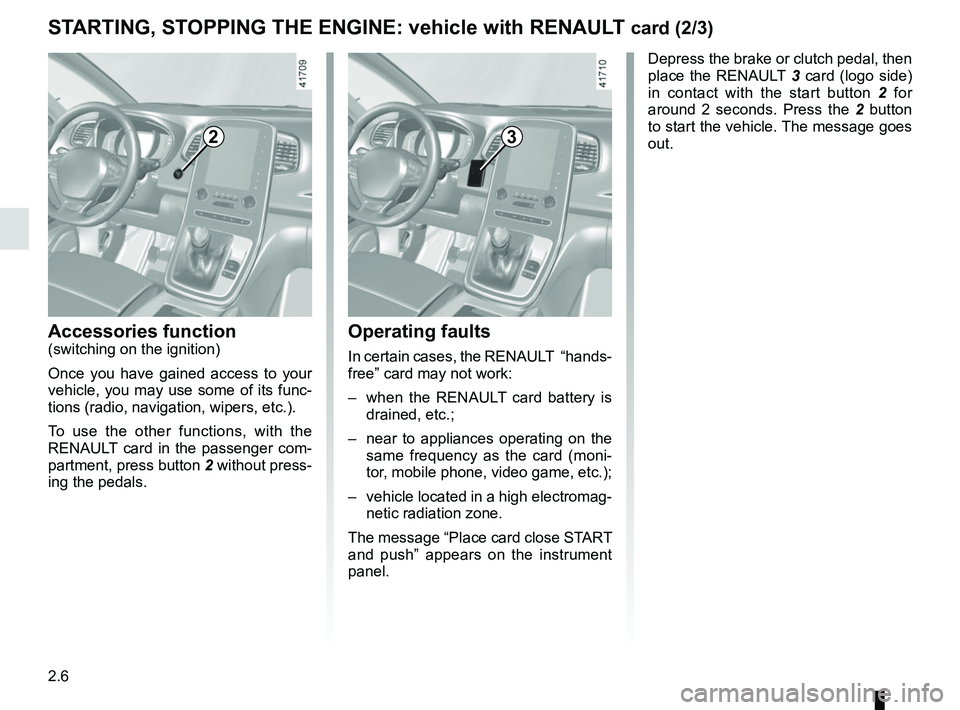
Depress the brake or clutch pedal, then
place the RENAULT 3 card (logo side)
in contact with the start button 2 for
around 2 seconds. Press the 2 button
to start the vehicle. The message goes
out.
2
Accessories function(switching on the ignition)
Once you have gained access to your
vehicle, you may use some of its func-
tions (radio, navigation, wipers, etc.).
To use the other functions, with the
RENAULT card in the passenger com-
partment, press button 2 without press-
ing the pedals.
3
Operating faults
In certain cases, the RENAULT “hands-
free” card may not work:
– when the RENAULT card battery is drained, etc.;
– near to appliances operating on the same frequency as the card (moni-
tor, mobile phone, video game, etc.);
– vehicle located in a high electromag- netic radiation zone.
The message “Place card close START
and push” appears on the instrument
panel.
Page 133 of 364
2.13
SPECIAL FEATURES OF DIESEL VERSIONS
Diesel engine speed
Diesel engines are fitted with injection
equipment which prevents the engine
speed being exceeded irrespective of
the gear selected.
If the message “Check anti- pollution
system” is displayed along with warn-
ing lights
Ä and ©, consult an
authorised dealer immediately.
When driving, depending on the fuel
grade used, it is possible that white
smoke may be emitted.
This is due to the exhaust particle filter
being cleaned automatically, and does
not affect the way the vehicle runs.
Do not park the vehicle or
run the engine in locations
where combustible sub-
stances or materials such
as grass or leaves can come into
contact with the hot exhaust system.
Precautions to be taken in
winter
To avoid any faults in icy weather:
– ensure that the battery is always fully charged,
– always keep the diesel tank rela- tively full to avoid water vapour con-
densing in it and accumulating at the
bottom of the tank.
Page 134 of 364
2.14
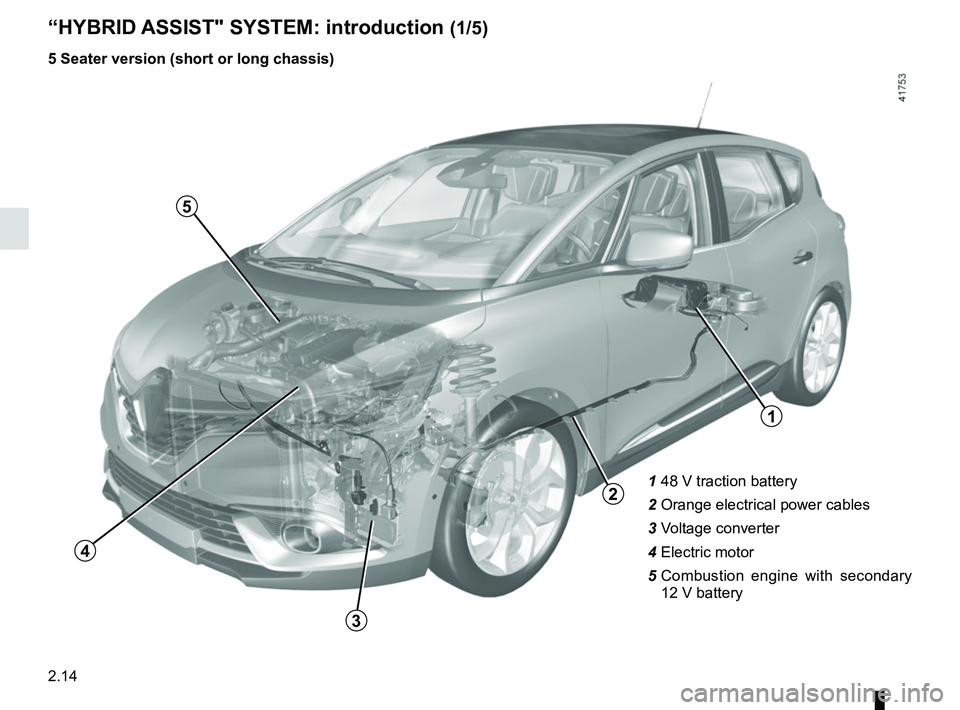
1 48 V traction battery
2 Orange electrical power cables
3 Voltage converter
4 Electric motor
5 Combustion engine with secondary
12 V battery
“HYBRID ASSIST" SYSTEM: introduction (1/5)
1
3
4
2
5
5 Seater version (short or long chassis)
Page 135 of 364
2.15
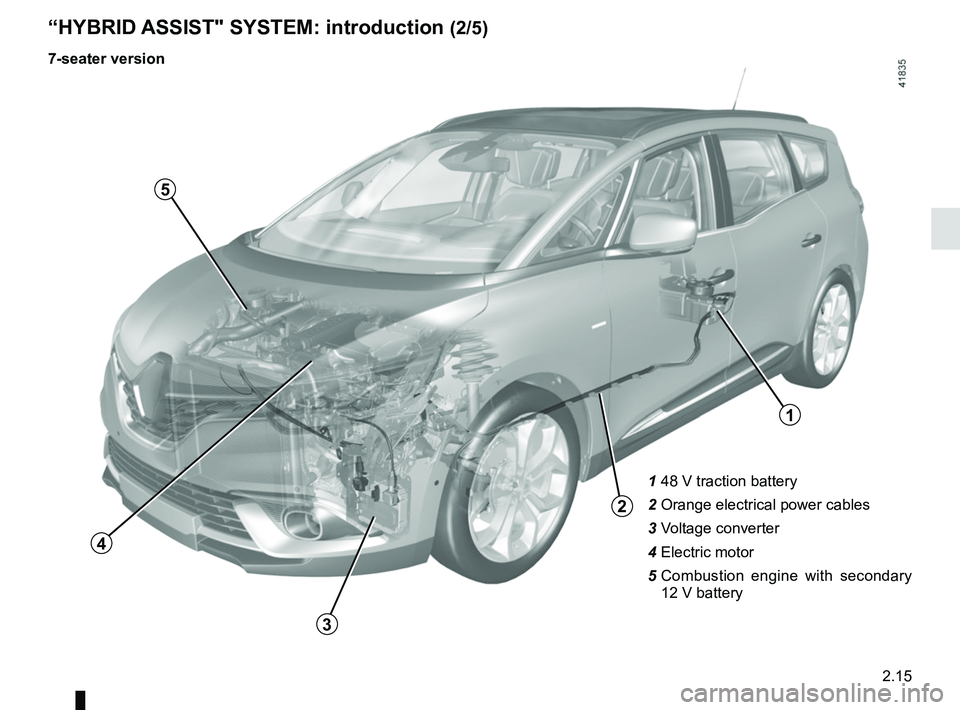
1 48 V traction battery
2 Orange electrical power cables
3 Voltage converter
4 Electric motor
5 Combustion engine with secondary
12 V battery
“HYBRID ASSIST" SYSTEM: introduction (2/5)
7-seater version
1
2
3
4
5
Page 136 of 364
2.16
The “Hybrid Assist” system uses an
electric motor to improve performance
of the combustion engine (acceleration,
starting on a slope etc.). The vehicle
has more acceleration torque available
while consuming less fuel.
BatteriesYour electric vehicle has two types of
battery:
– a 48 V traction battery;
– secondary 12 V battery.
“48 volt” traction battery
Located under the rear floor, this bat-
tery stores the energy recovered during
phases of deceleration. This energy is
used by the hybrid system to provide
additional torque to the combustion
engine.
“HYBRID ASSIST" SYSTEM: introduction (3/5)
Secondary 12V battery
The 12 V battery supplies the energy
required to operate vehicle equipment
(lights, windscreen wipers, ABS etc).
Please see the information under
“12 volt battery” in Section 4.
“48 volt” electrical circuit
The 48 V electrical circuit is denoted
by orange cables and parts bearing the
symbol
ṑ.
All interventions or modi-
fications to the vehicle’s
48 volt electrical system
(components, cables, con-
nectors, traction battery) are strictly
prohibited due to the risks this may
present to your safety. Call an ap-
proved Dealer.
Risk of electric shock.
A
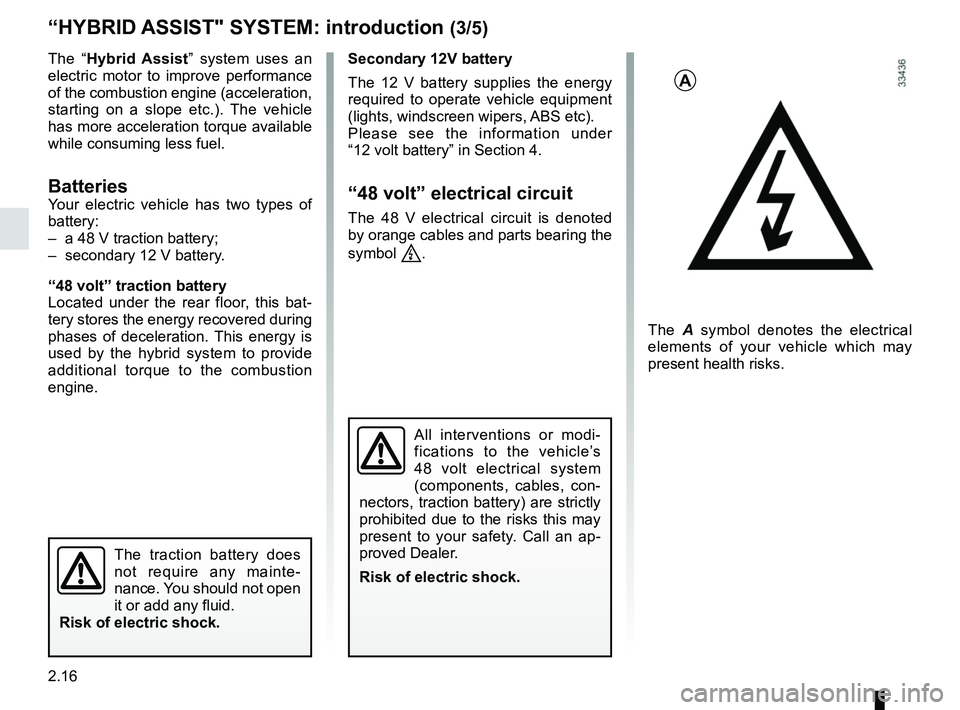
The A symbol denotes the electrical
elements of your vehicle which may
present health risks.
The traction battery does
not require any mainte-
nance. You should not open
it or add any fluid.
Risk of electric shock.
Page 137 of 364
2.17
“HYBRID ASSIST" SYSTEM: introduction (4/5)
Indicator of power
consumption/recovery
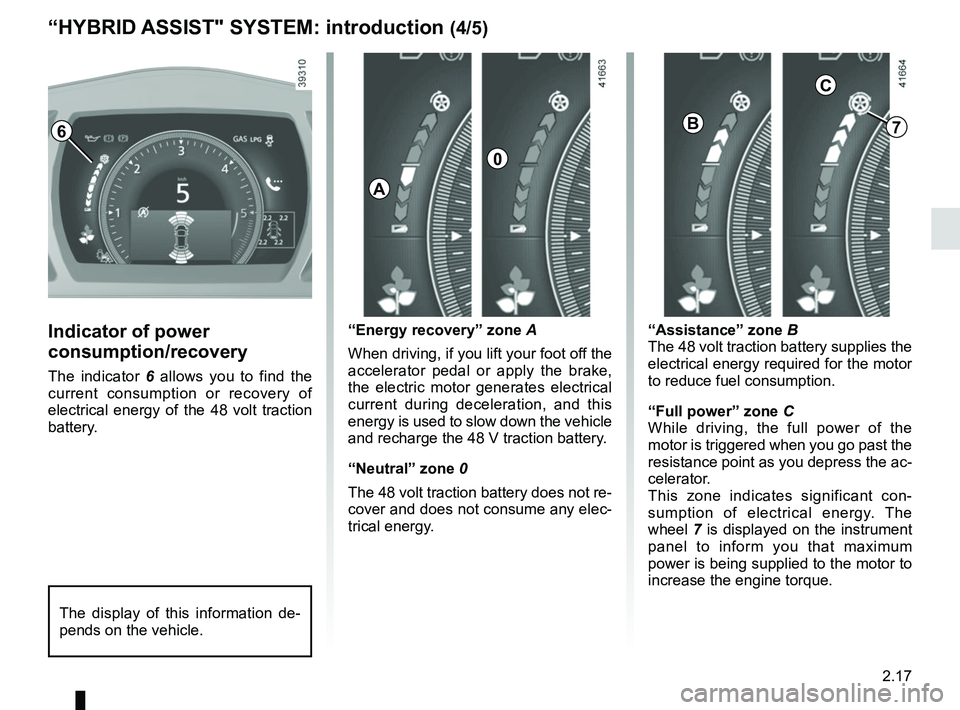
The indicator 6 allows you to find the
current consumption or recovery of
electrical energy of the 48 volt traction
battery. “Energy recovery” zone A
When driving, if you lift your foot off the
accelerator pedal or apply the brake,
the electric motor generates electrical
current during deceleration, and this
energy is used to slow down the vehicle
and recharge the 48 V traction battery.
“Neutral” zone 0
The 48 volt traction battery does not re-
cover and does not consume any elec-
trical energy.
The display of this information de-
pends on the vehicle.
“Assistance” zone B
The 48 volt traction battery supplies the
electrical energy required for the motor
to reduce fuel consumption.
“Full power” zone
C
While driving, the full power of the
motor is triggered when you go past the
resistance point as you depress the ac-
celerator.
This zone indicates significant con-
sumption of electrical energy. The
wheel 7 is displayed on the instrument
panel to inform you that maximum
power is being supplied to the motor to
increase the engine torque.
6
A
0
B
C
7
Page 139 of 364
2.19
“HYBRID ASSIST” SYSTEM: important recommendations
Please read these instructions carefully. Failure to follow these instructions may lead to a risk of fire, serious injury
or electric shocks.
In the event of an accident or impact
Never touch the “48 volt” components or orange cables which are ex\
posed and visible inside or outside the vehicle.
Risk of electric shock.
In the event of serious damage to the 48 V traction battery, leaks may occur:
– never touch any liquids (fluids etc.) coming from the 48 V traction ba\
ttery;
– in the event of contact with the body, wash the affected area with plenty of water and consult a doctor as soon as possibl\
e.
In the event of fire
In the event of fire, make everyone evacuate the vehicle immediately and\
contact the emergency services, informing them that
this is an electric vehicle.
Only use extinguishing agents ABC or BC that are permitted for use with electrical fires. Do not use w\
ater or other extinguish-
ing agents.
In the event of damage to the electrical circuit, please call an authori\
sed dealer.
Washing the vehicle
Never wash the engine compartment, the “48 volt” components and th\
e orange cables with a high pressure washer.
This risks damaging the electric circuit.
Never wash the luggage compartment or the rear bench seat with a water j\
et or high pressure washer.
This risks damaging the electric circuit.
Risk of fire if water leaks into the 48 volt traction battery.
Page 143 of 364
2.23
ELECTRONIC PARKING BRAKE (3/3)Operating faults
– If there is a fault, the © warning
light illuminates on the instrument
panel accompanied by the “Check
parking brake” message and, in
some cases, the
} warning
light.
Please contact an authorised dealer
as soon as possible.
– If there is an assisted parking brake fault, the warning light
® comes
on, along with the message “Braking
system fault”, a beep and, in some
cases, the warning light
}.
This means that you must stop as
soon as traffic conditions allow.
Versions with an automatic
gearbox
For safety reasons, automatic release
is deactivated when the driver’s door
is open or not shut properly and the
engine is running (in order to prevent
the vehicle from moving without the
driver). The “Release parking brake
manually” message appears on the
instrument panel when the driver de-
presses the accelerator.
It is therefore essential to
immobilise the vehicle by
engaging first gear (manual
gearbox) or position P (au-
tomatic gearbox). If the slope re-
quires it, chock the vehicle.
Never leave your vehicle
without moving the selec-
tor lever to position P and
switching off the engine.
This is because when the vehicle is
stationary with the engine running
and a gear engaged, the vehicle
may begin to move.
There is a risk of accidents.If no lights or sounds are ap-
parent, this indicates a fault
in the instrument panel. This
indicates that it is essential
to stop immediately (as soon as traf-
fic conditions allow). Ensure that the
vehicle is correctly immobilised and
contact an approved Dealer.
In the event of message
“Electric failure DANGER”
or “Check battery”, manu-
ally activate the electronic
parking brake by pulling switch 3 (or
position the gear lever in P for au-
tomatic gearboxes) before stopping
the engine.
Risk of loss of immobilisation of
the vehicle.
Contact an authorised dealer.
Page 151 of 364
2.31
ENVIRONMENT
Emissions
Your vehicle has been designed to emit
fewer greenhouse gases (CO2) while in
use, and therefore to consume less fuel
(eg. 140 g/km, equivalent to 5.3 l/100
km for a diesel vehicle).
Our vehicles are also equipped with a
particle filter system including a cata-
lytic converter, an oxygen sensor and
an active carbon filter (the latter pre-
vents vapour from the fuel tank being
released into the open air).
For certain diesel vehicles, this system
also has a particle filter to reduce the
volume of soot particles emitted.
Please make your own
contribution towards
protecting the environment
too
– Worn parts replaced in the course of routine vehicle maintenance (vehi-
cle battery, oil filter, air filter, batter-
ies, etc.) and oil containers (empty or
filled with used oil) must be disposed
of through specialist organisations. – At the end of the vehicle’s service
life, it should be sent to approved
centres to ensure that it is recycled.
– In all cases, comply with local legis- lation.
Recycling
Your vehicle is 85% recyclable and
95% recoverable.
To achieve these objectives, many of
the vehicle components have been de-
signed to enable them to be recycled.
The materials and structures have
been carefully designed to allow these
components to be easily removed and
reprocessed by specialist companies.
In order to preserve raw material re-
sources, this vehicle incorporates nu-
merous parts made from recycled plas-
tics or renewable materials (vegetable
or animal-derived materials such as
cotton or wool).
Your vehicle has been designed with
respect for the environment in mind for
its entire service life: during production,
use and at the end of its life.
This commitment is illustrated by the
Renault eco² signature.Manufacture
Your vehicle has been manufactured at
a factory which complies with a policy
to reduce the environmental impact
on the surrounding areas (reduction of
water and energy consumption, visual
and noise pollution, atmospheric emis-
sions and waste water; sorting and re-
using waste).
Page 273 of 364

4.1
Section 4: Maintenance
Bonnet . . . . . . . . . . . . . . . . . . . . . . . . . . . . . . . . . . . . \
. . . . . . . . . . . . . . . . . . . . . . . . . . . . . . . . . . . . 4.2
Engine oil level: general information . . . . . . . . . . . . . . . . . . . . . . . . . . . . . . . . . . . .\
. . . . . . . . . . . . . 4.4
Engine oil level: topping up/filling . . . . . . . . . . . . . . . . . . . . . . . . . . . . . . . . . . . .\
. . . . . . . . . . . . . . . 4.5
Engine oil level: topping up/filling . . . . . . . . . . . . . . . . . . . . . . . . . . . . . . . . . . . .\
. . . . . . . . . . . . . . . 4.6
Oil change . . . . . . . . . . . . . . . . . . . . . . . . . . . . . . . . . . . . \
. . . . . . . . . . . . . . . . . . . . . . . . . . . . . . . . . 4.7
Levels: . . . . . . . . . . . . . . . . . . . . . . . . . . . . . . . . . . . . \
. . . . . . . . . . . . . . . . . . . . . . . . . . . . . . . . . . . . 4.8engine coolant . . . . . . . . . . . . . . . . . . . . . . . . . . . . . . . . . . . .\
. . . . . . . . . . . . . . . . . . . . . . . . 4.8
brake fluid . . . . . . . . . . . . . . . . . . . . . . . . . . . . . . . . . . . . \
. . . . . . . . . . . . . . . . . . . . . . . . . . . . 4.9
windscreen/headlight washer reservoir . . . . . . . . . . . . . . . . . . . . . . . . . . . . . . . . . . . .\
. . . . . 4.10
Filters . . . . . . . . . . . . . . . . . . . . . . . . . . . . . . . . . . . . \
. . . . . . . . . . . . . . . . . . . . . . . . . . . . . . . . . . . . . 4.10
12 volt battery . . . . . . . . . . . . . . . . . . . . . . . . . . . . . . . . . . . .\
. . . . . . . . . . . . . . . . . . . . . . . . . . . . . . 4.11
Tyre pressure. . . . . . . . . . . . . . . . . . . . . . . . . . . . . . . . . . . . \
. . . . . . . . . . . . . . . . . . . . . . . . . . . . . . . 4.13
Bodywork maintenance . . . . . . . . . . . . . . . . . . . . . . . . . . . . . . . . . . . . \
. . . . . . . . . . . . . . . . . . . . . . . 4.15
Interior trim maintenance . . . . . . . . . . . . . . . . . . . . . . . . . . . . . . . . . . . . \
. . . . . . . . . . . . . . . . . . . . . . 4.18