boot RENAULT SCENIC 2018 User Guide
[x] Cancel search | Manufacturer: RENAULT, Model Year: 2018, Model line: SCENIC, Model: RENAULT SCENIC 2018Pages: 364, PDF Size: 10.43 MB
Page 201 of 364

Limitation of the system operation
– A vehicle travelling in the opposite direction will not trigger any alert\
or any action on the system operation.
– The rad")
2.81
ADAPTIVE CRUISE CONTROL (8/8)
Limitation of the system operation
– A vehicle travelling in the opposite direction will not trigger any alert\
or any action on the system operation.
– The radar-camera should be kept clean and free of any modifications in o\
rder to ensure the proper operation of the
system.
– Fixed obstacles (stationary vehicles, traffic jams, toll booths etc.) or objects travelling at low speed or of a \
small size ( motor-
bikes, bicycles, pedestrians etc.) may not be detected by the system.
– A vehicle entering the same lane will only be detected once it has entere\
d the detection zone. Sudden or late braking may then take place.
– When entering a bend or curve, the radar-camera may temporarily no longe\
r detect the vehicle in front, and this may lead to acceleration.
– When exiting a curve, the detection of the vehicle in front may be affected or delayed. Sudden or late braking may then take place.
– A slower vehicle travelling in an adjacent lane may be detected and cause\
a slowing down if one of the two vehicles is trav- elling too close to the lane of the other.
– A slower vehicle with a wide difference in speed may not be taken into account by the system.
– The system is deactivated below around 31 mph (50 km/h). Drivers must \
react accordingly.
– Sudden changes in situation are not instantly taken into account by the \
system. Drivers must remain vigilant at all times and
under all circumstances.
System disturbance
Some conditions can disturb or damage the operation of the system, such \
as:
– a complex environment (metal bridge, tunnel etc.) ;
– poor weather conditions (snow, hail, black ice etc.);
– poor visibility (night, fog etc.);
– poor contrast between objects;
– being dazzled (glaring sun, lights of vehicles travelling in the opposi\
te direction etc.).
Risk of unwanted braking or acceleration.
Page 208 of 364
2.88
This function is an additional
aid. It cannot, therefore,
under any circumstances
replace the vigilance or the
responsibility of the driver.
The driver should always be ready
for sudden incidents while driv-
ing: always ensure that there are
no small, narrow moving obstacles
(such as a child, animal, pushchair,
bicycle, stone, post etc.) in the blind
spot when manoeuvring.
The screen shows a reverse mirror
image.
The frames are a representation
projected on a flat surface. This in-
formation is to not be taken into ac-
count when superimposed on a
vertical object or an object on the
ground.
Objects which appear on the edge
of the screen may be deformed.
In very bright light (snow, vehicle in
sunshine etc.), the camera vision
may be adversely affected.
If the boot is open or poorly closed,
the message “Boot open” appears
and the camera display disappears.
You can also adjust the camera image
settings (brightness, contrast, etc.)
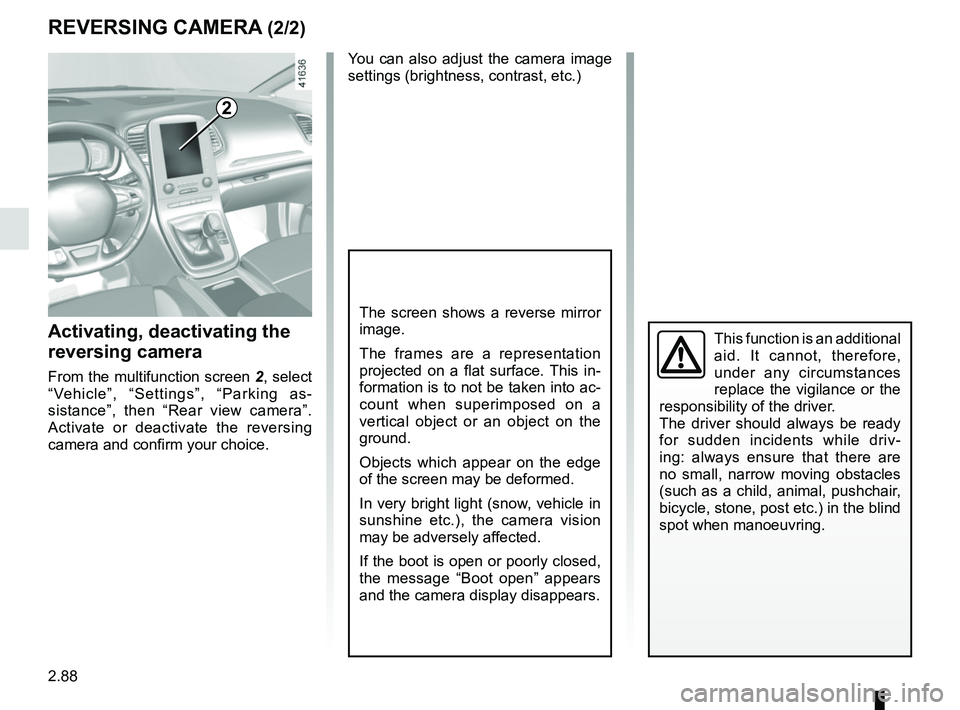
Activating, deactivating the
reversing camera
From the multifunction screen 2, select
“Vehicle”, “Settings”, “Parking as-
sistance”, then “Rear view camera”.
Activate or deactivate the reversing
camera and confirm your choice.
REVERSING CAMERA (2/2)
2
Page 211 of 364
2.91
ASSISTED PARKING (3/4)
Your speed should not exceed around
4 mph (7 km/h).
Once in position to exit the space, the
system will notify you of the end of the
manoeuvre.
Once the warning light
on the
instrument panel goes off and a beep
sounds, the manoeuvre has been com-
pleted.
Suspending the manoeuvreThe manoeuvre is suspended in the fol-
lowing circumstances:
– you take control of the wheel;
– a door or the boot is opened;
– the vehicle is at a standstill for too long;
– an obstacle in the direction of move- ment prevents the manoeuvre from
being completed;
– the engine will stop.
Once the warning light
on the
instrument panel goes off and a beep
sounds, the manoeuvre has been sus-
pended. To resume the manoeuvre,
press and hold the system activation
switch. In this case, the reason for suspending
the manoeuvre will be displayed on the
multifunction screen.
Make sure:
– you have released the steering
wheel;
and
– that all doors and the boot are closed;
and
– that no obstacles are in the way of the direction of movement;
and
– that the engine is started.
Cancelling the manoeuvre
The manoeuvre can be stopped in the
following cases:
– by pressing the system activation switch;
– the vehicle speed has exceeded 4 mph (7 km/h);
– you have performed more than ten forwards/backwards movements in
one manoeuvre;
– the parking distance control sensors are dirty or blocked;
– the vehicle wheels have skidded.
Once the warning light
on the
instrument panel goes off and a beep
sounds, the manoeuvre has been com-
pleted.
Exiting a parallel parking space
– Select “Exit parallel parking space” mode;
– activate the direction indicator on the side you wish to go out of;
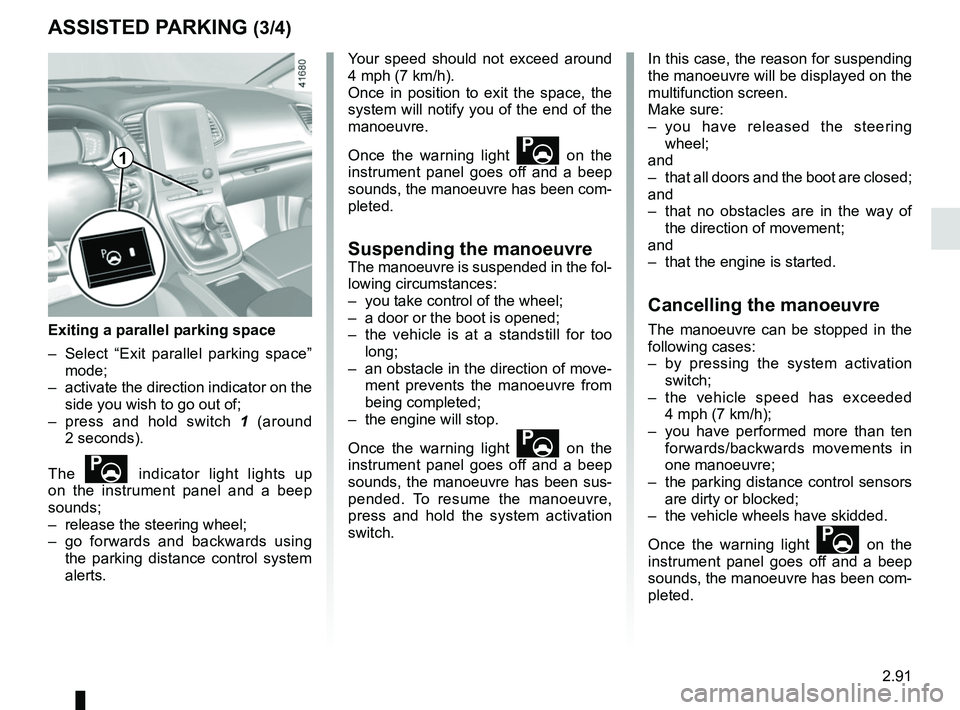
– press and hold switch 1 (around
2 seconds).
The
indicator light lights up
on the instrument panel and a beep
sounds;
– release the steering wheel;
– go forwards and backwards using the parking distance control system
alerts.
1
Page 243 of 364
3.27
When the doors or boot are un-
locked and opened, the reading and
footwell lights come on temporarily.
1
INTERIOR LIGHTING (1/2)
1
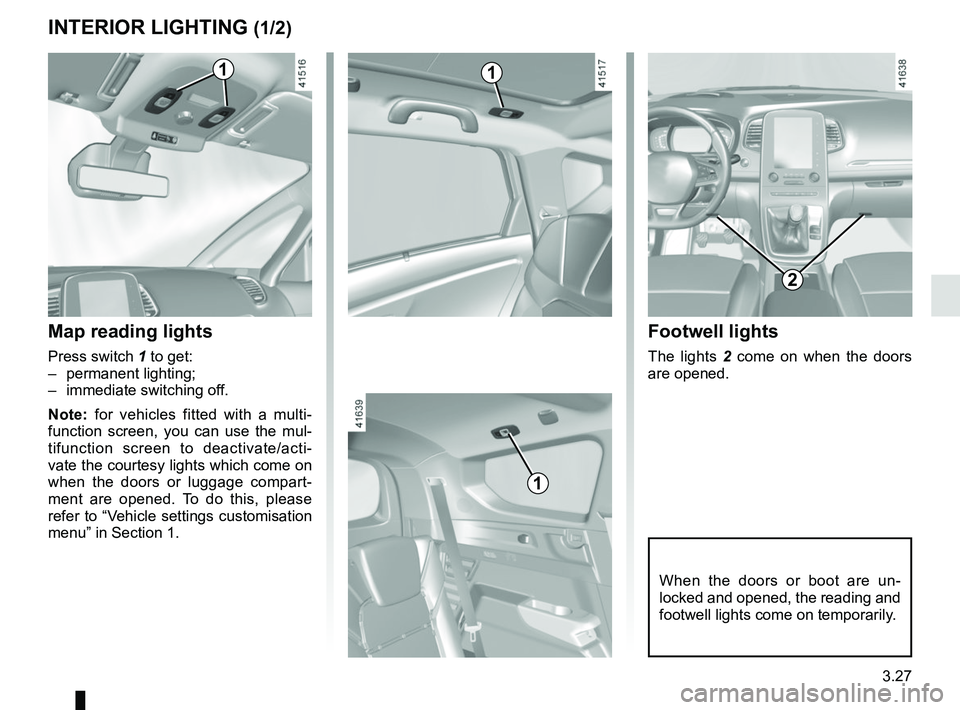
Map reading lights
Press switch 1 to get:
– permanent lighting;
– immediate switching off.
Note: for vehicles fitted with a multi-
function screen, you can use the mul-
tifunction screen to deactivate/acti-
vate the courtesy lights which come on
when the doors or luggage compart-
ment are opened. To do this, please
refer to “Vehicle settings customisation
menu” in Section 1.
1
2
Footwell lights
The lights 2 come on when the doors
are opened.
Page 244 of 364
3.28
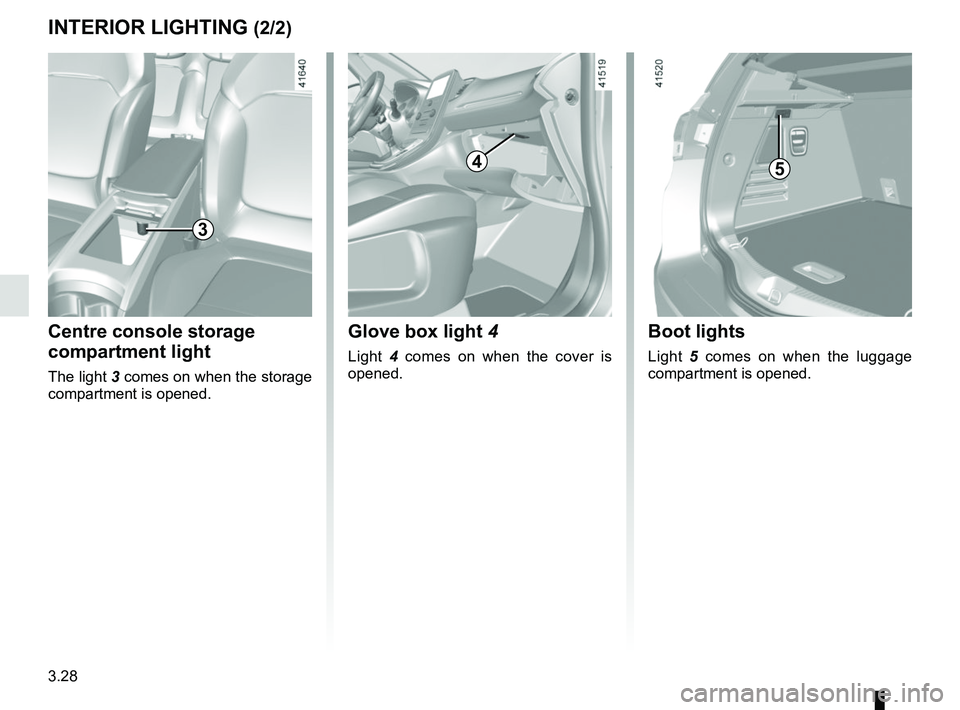
Boot lights
Light 5 comes on when the luggage
compartment is opened.
INTERIOR LIGHTING (2/2)
5
Glove box light 4
Light 4 comes on when the cover is
opened.
4
Centre console storage
compartment light
The light 3 comes on when the storage
compartment is opened.
3
Page 257 of 364
3.41
REAR SEATS (2/6)
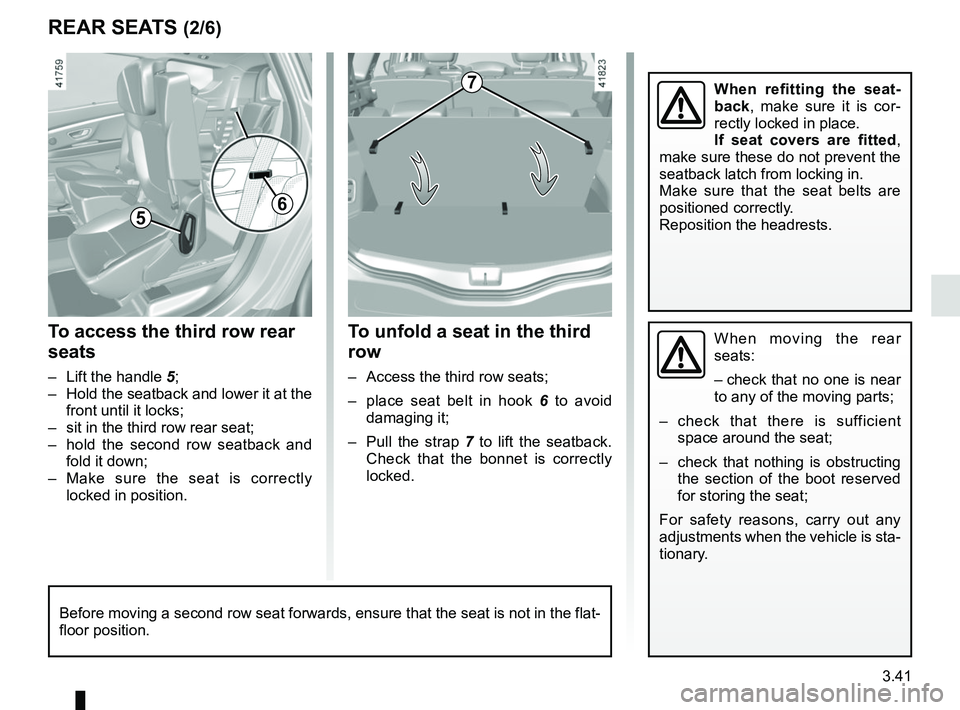
To unfold a seat in the third
row
– Access the third row seats;
– place seat belt in hook 6 to avoid
damaging it;
– Pull the strap 7 to lift the seatback.
Check that the bonnet is correctly
locked.
To access the third row rear
seats
– Lift the handle 5;
– Hold the seatback and lower it at the front until it locks;
– sit in the third row rear seat;
– hold the second row seatback and fold it down;
– Make sure the seat is correctly locked in position.
56
When moving the rear
seats:
– check that no one is near
to any of the moving parts;
– check that there is sufficient space around the seat;
– check that nothing is obstructing the section of the boot reserved
for storing the seat;
For safety reasons, carry out any
adjustments when the vehicle is sta-
tionary.
Before moving a second row seat forwards, ensure that the seat is not in\
the flat-
floor position.
7When refitting the seat-
back, make sure it is cor-
rectly locked in place.
If seat covers are fitted ,
make sure these do not prevent the
seatback latch from locking in.
Make sure that the seat belts are
positioned correctly.
Reposition the headrests.
Page 259 of 364
3.43
REAR SEATS (4/6)
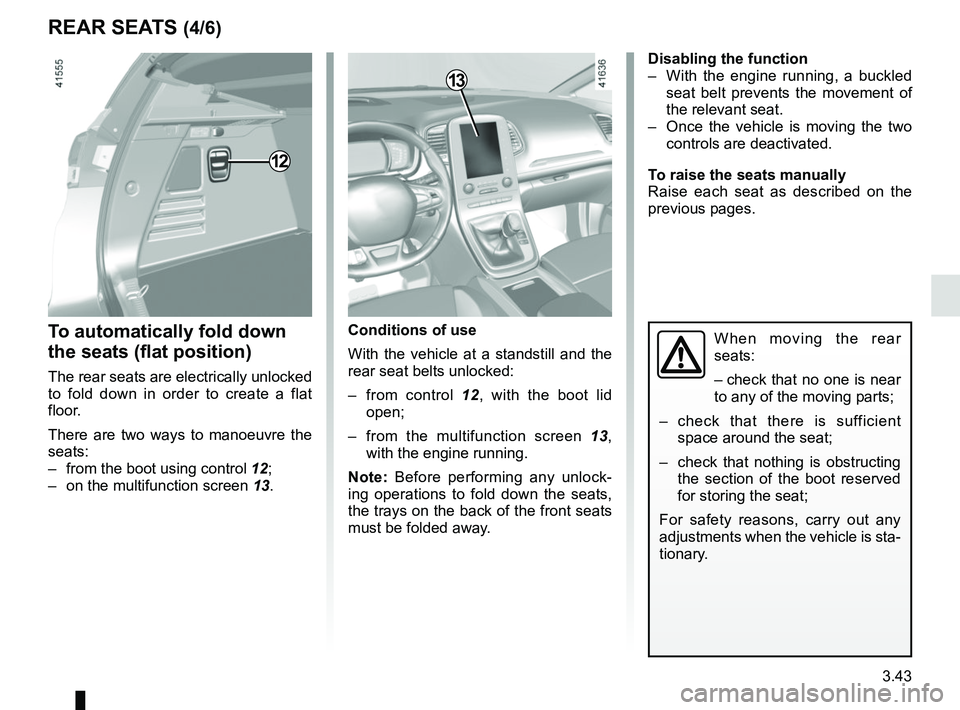
To automatically fold down
the seats (flat position)
The rear seats are electrically unlocked
to fold down in order to create a flat
floor.
There are two ways to manoeuvre the
seats:
– from the boot using control 12;
– on the multifunction screen 13. Disabling the function
– With the engine running, a buckled
seat belt prevents the movement of
the relevant seat.
– Once the vehicle is moving the two controls are deactivated.
To raise the seats manually
Raise each seat as described on the
previous pages.
13
Conditions of use
With the vehicle at a standstill and the
rear seat belts unlocked:
– from control 12, with the boot lid
open;
– from the multifunction screen 13, with the engine running.
Note: Before performing any unlock-
ing operations to fold down the seats,
the trays on the back of the front seats
must be folded away.
12
When moving the rear
seats:
– check that no one is near
to any of the moving parts;
– check that there is sufficient space around the seat;
– check that nothing is obstructing the section of the boot reserved
for storing the seat;
For safety reasons, carry out any
adjustments when the vehicle is sta-
tionary.
Page 262 of 364
3.46
TAILGATE
2
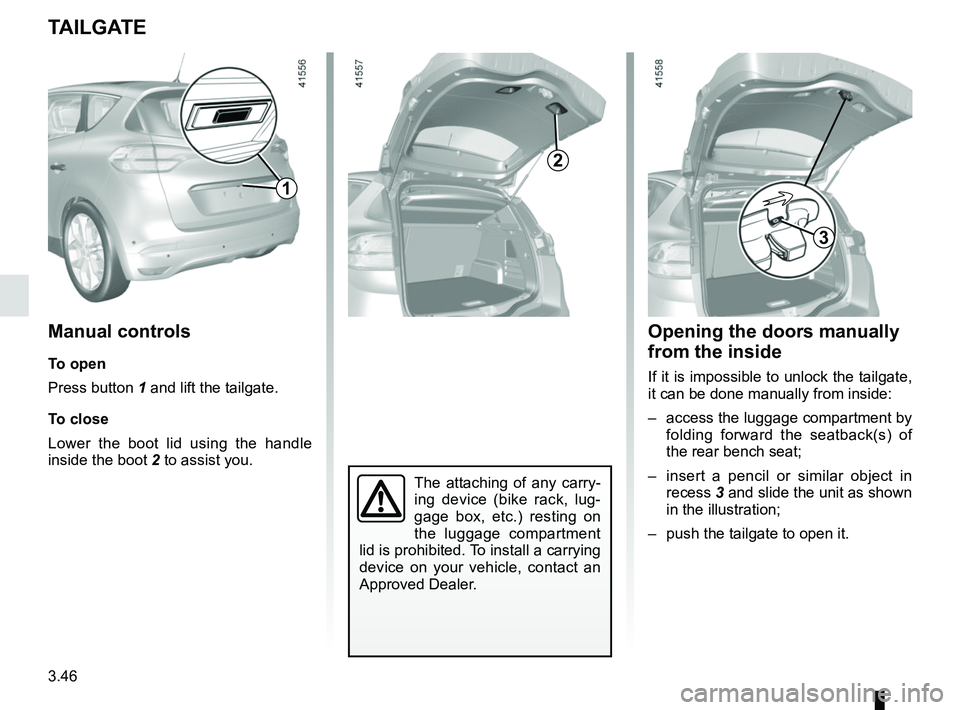
Manual controls
To open
Press button 1 and lift the tailgate.
To close
Lower the boot lid using the handle
inside the boot 2 to assist you.
Opening the doors manually
from the inside
If it is impossible to unlock the tailgate,
it can be done manually from inside:
– access the luggage compartment by
folding forward the seatback(s) of
the rear bench seat;
– insert a pencil or similar object in recess 3 and slide the unit as shown
in the illustration;
– push the tailgate to open it.
The attaching of any carry-
ing device (bike rack, lug-
gage box, etc.) resting on
the luggage compartment
lid is prohibited. To install a carrying
device on your vehicle, contact an
Approved Dealer.
1
3
Page 264 of 364
3.48
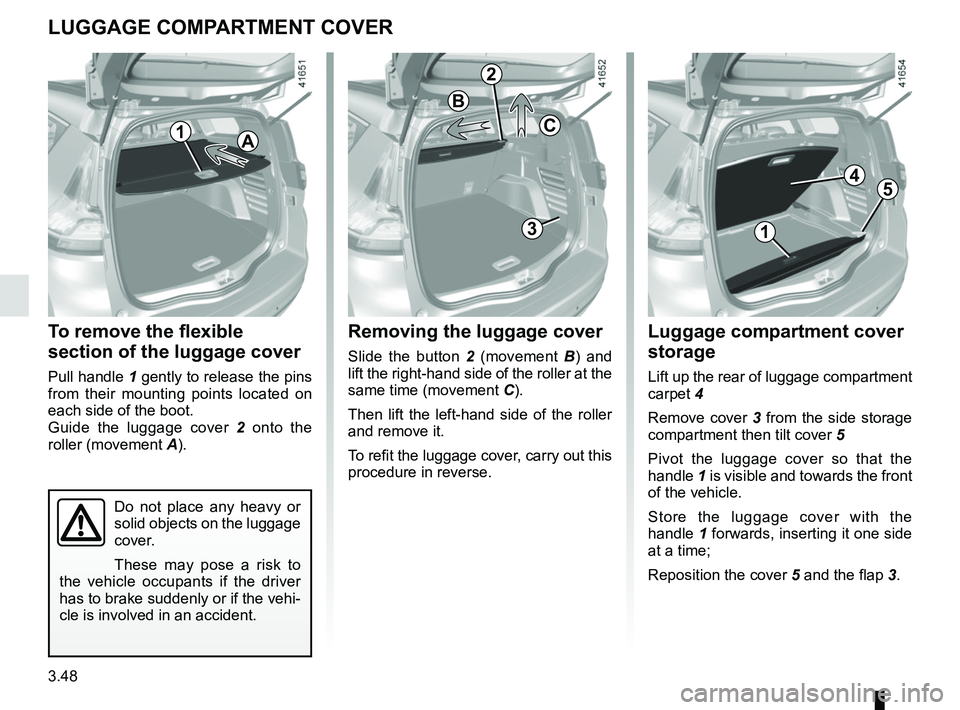
Removing the luggage cover
Slide the button 2 (movement B ) and
lift the right-hand side of the roller at the
same time (movement C).
Then lift the left-hand side of the roller
and remove it.
To refit the luggage cover, carry out this
procedure in reverse.
To remove the flexible
section of the luggage cover
Pull handle 1 gently to release the pins
from their mounting points located on
each side of the boot.
Guide the luggage cover 2 onto the
roller (movement A).
LUGGAGE COMPARTMENT COVER
1
Luggage compartment cover
storage
Lift up the rear of luggage compartment
carpet 4
Remove cover 3 from the side storage
compartment then tilt cover 5
Pivot the luggage cover so that the
handle 1 is visible and towards the front
of the vehicle.
Store the luggage cover with the
handle 1 forwards, inserting it one side
at a time;
Reposition the cover 5 and the flap 3.
2
B
A
31
C
45
Do not place any heavy or
solid objects on the luggage
cover.
These may pose a risk to
the vehicle occupants if the driver
has to brake suddenly or if the vehi-
cle is involved in an accident.
Page 265 of 364
3.49
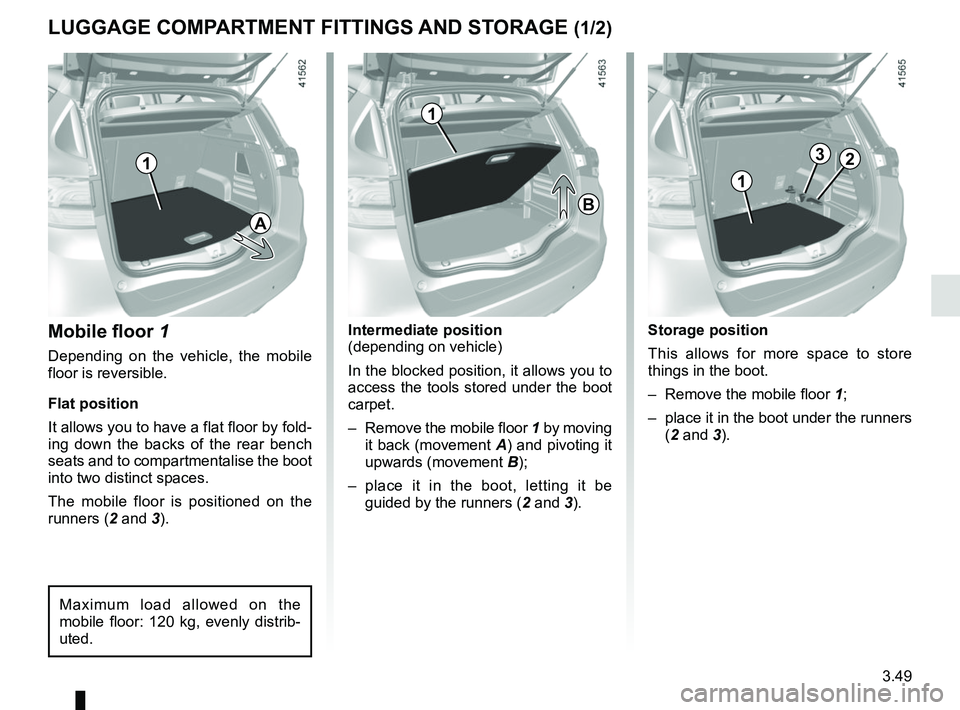
LUGGAGE COMPARTMENT FITTINGS AND STORAGE (1/2)
Mobile floor 1
Depending on the vehicle, the mobile
floor is reversible.
Flat position
It allows you to have a flat floor by fold-
ing down the backs of the rear bench
seats and to compartmentalise the boot
into two distinct spaces.
The mobile floor is positioned on the
runners (2 and 3).
Maximum load allowed on the
mobile floor: 120 kg, evenly distrib-
uted.
Storage position
This allows for more space to store
things in the boot.
– Remove the mobile floor 1;
– place it in the boot under the runners (2 and 3).
3
Intermediate position
(depending on vehicle)
In the blocked position, it allows you to
access the tools stored under the boot
carpet.
– Remove the mobile floor 1 by moving
it back (movement A) and pivoting it
upwards (movement B);
– place it in the boot, letting it be guided by the runners ( 2 and 3).
1
2
A
B
1
1