luggage RENAULT TALISMAN 2016 1.G User Guide
[x] Cancel search | Manufacturer: RENAULT, Model Year: 2016, Model line: TALISMAN, Model: RENAULT TALISMAN 2016 1.GPages: 328, PDF Size: 3.39 MB
Page 226 of 328
3.36
LUGGAGE COMPARTMENT: estate version (2/2)
3
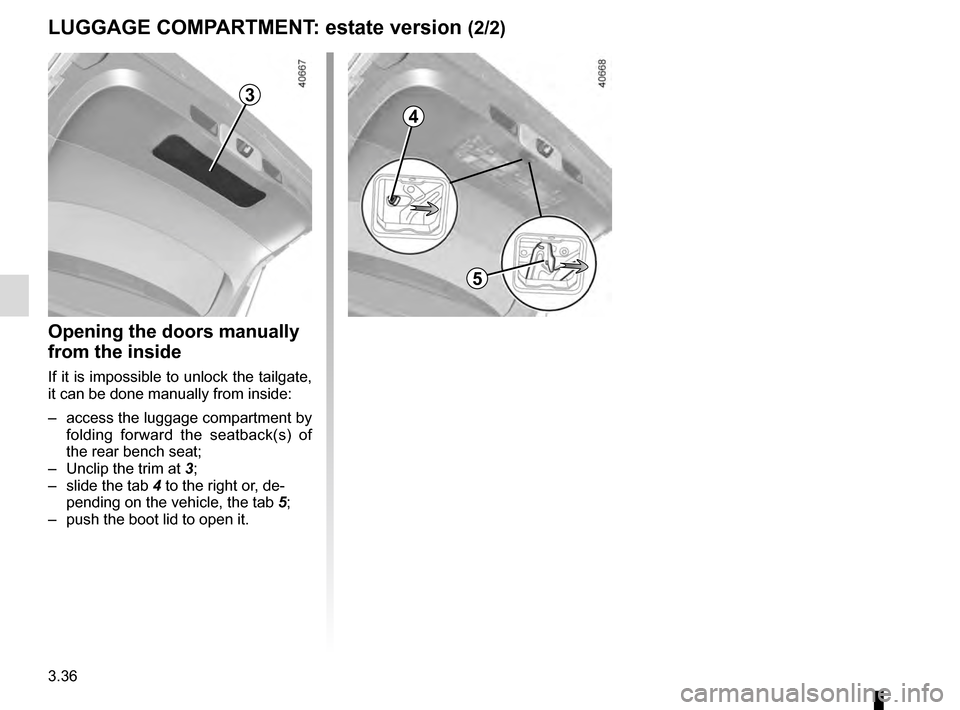
Opening the doors manually
from the inside
If it is impossible to unlock the tailgate,
it can be done manually from inside:
– access the luggage compartment by folding forward the seatback(s) of
the rear bench seat;
– Unclip the trim at 3;
– slide the tab 4 to the right or, de- pending on the vehicle, the tab 5;
– push the boot lid to open it.
4
5
Page 227 of 328
3.37
If fitted on the vehicle, the tailgate locks
and unlocks at the same time as the
doors.
Depending on the vehicle, you have se-
veral different ways to manoeuvre the
tailgate:
– using the RENAULT card remote control;
– using the controls on the tailgate;
– using the dashboard control;
– using the hands-free function.
AUTOMATIC TAILGATE (1/5)
Conditions of use
– Immobilise the vehicle.
– If there is any ice or snow prevent-ing the tailgate from opening, this ice
or snow must be removed to free the
tailgate.
– In the event that the battery is dis- charged or if it is changed, the tail-
gate should be closed (manually
if necessary) to restart the tailgate
motor.
Ensure that nobody is close
to the moving parts when
opening/closing the tail-
gate.
Risk of injury.
Opening/Closing
Activating the automatic tailgate ope-
ning or closing using the dashboard
control or using the RENAULT card
causes three beeps to sound just
before the tailgate begins to move.
When opening or closing the tail-
gate, ensure that nothing interferes
with the manoeuvre.
To avoid damaging the tailgate
system, do not manually force the
tailgate to open or close while it is
moving.
The attaching of any
carrying device (bike rack,
luggage box, etc.) resting
on the luggage compart-
ment lid is prohibited. To install a
carrying device on your vehicle,
contact an Approved Dealer.
Page 232 of 328
3.42
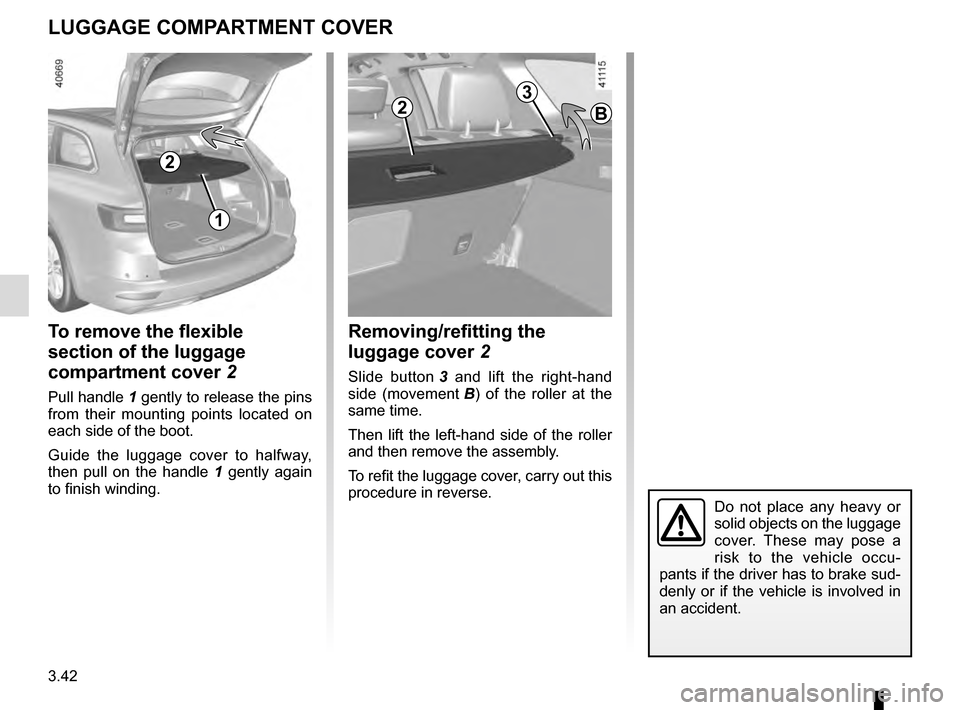
To remove the flexible
section of the luggage
compartment cover 2
Pull handle 1 gently to release the pins
from their mounting points located on
each side of the boot.
Guide the luggage cover to halfway,
then pull on the handle 1 gently again
to finish winding.
LUGGAGE COMPARTMENT COVER
Do not place any heavy or
solid objects on the luggage
cover. These may pose a
risk to the vehicle occu-
pants if the driver has to brake sud-
denly or if the vehicle is involved in
an accident.
1
Removing/refitting the
luggage cover 2
Slide button 3 and lift the right-hand
side (movement B) of the roller at the
same time.
Then lift the left-hand side of the roller
and then remove the assembly.
To refit the luggage cover, carry out this
procedure in reverse.
B
3
2
2
Page 233 of 328
3.43
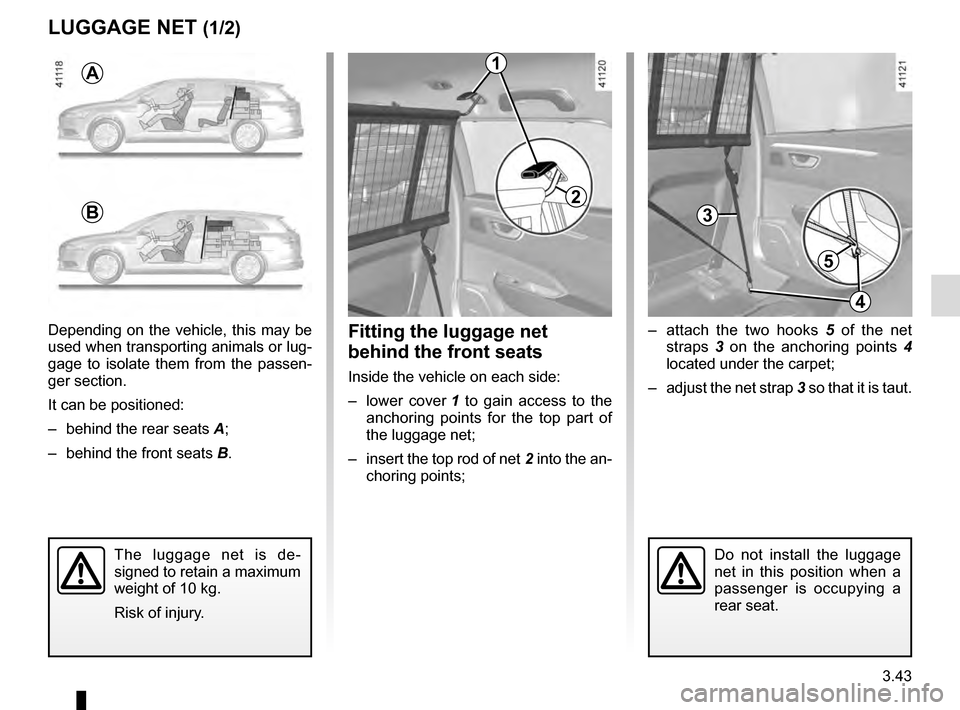
LUGGAGE NET (1/2)
– attach the two hooks 5 of the net
straps 3 on the anchoring points 4
located under the carpet;
– adjust the net strap 3 so that it is taut.Fitting the luggage net
behind the front seats
Inside the vehicle on each side:
– lower cover 1 to gain access to the
anchoring points for the top part of
the luggage net;
– insert the top rod of net 2 into the an-
choring points;
Depending on the vehicle, this may be
used when transporting animals or lug-
gage to isolate them from the passen-
ger section.
It can be positioned:
– behind the rear seats
A;
– behind the front seats B.
The luggage net is de-
signed to retain a maximum
weight of 10 kg.
Risk of injury.Do not install the luggage
net in this position when a
passenger is occupying a
rear seat.
A
B
1
2
3
5
4
Page 234 of 328
3.44
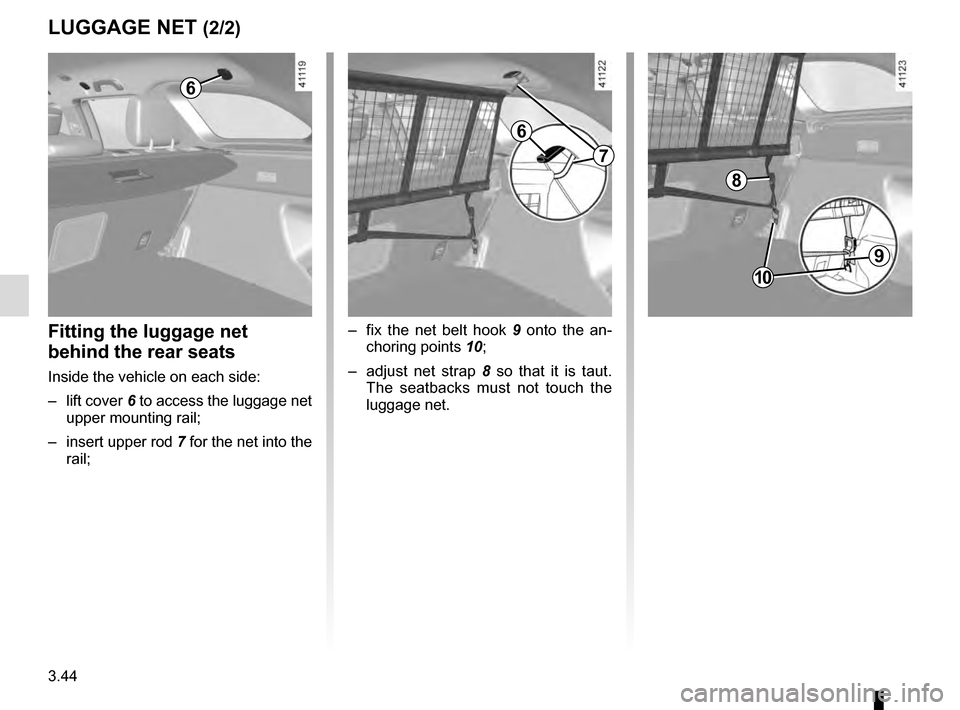
LUGGAGE NET (2/2)
6
– fix the net belt hook 9 onto the an-
choring points 10;
– adjust net strap 8 so that it is taut.
The seatbacks must not touch the
luggage net.Fitting the luggage net
behind the rear seats
Inside the vehicle on each side:
– lift cover 6 to access the luggage net
upper mounting rail;
– insert upper rod 7 for the net into the
rail;
7
6
8
10
9
Page 236 of 328
3.46
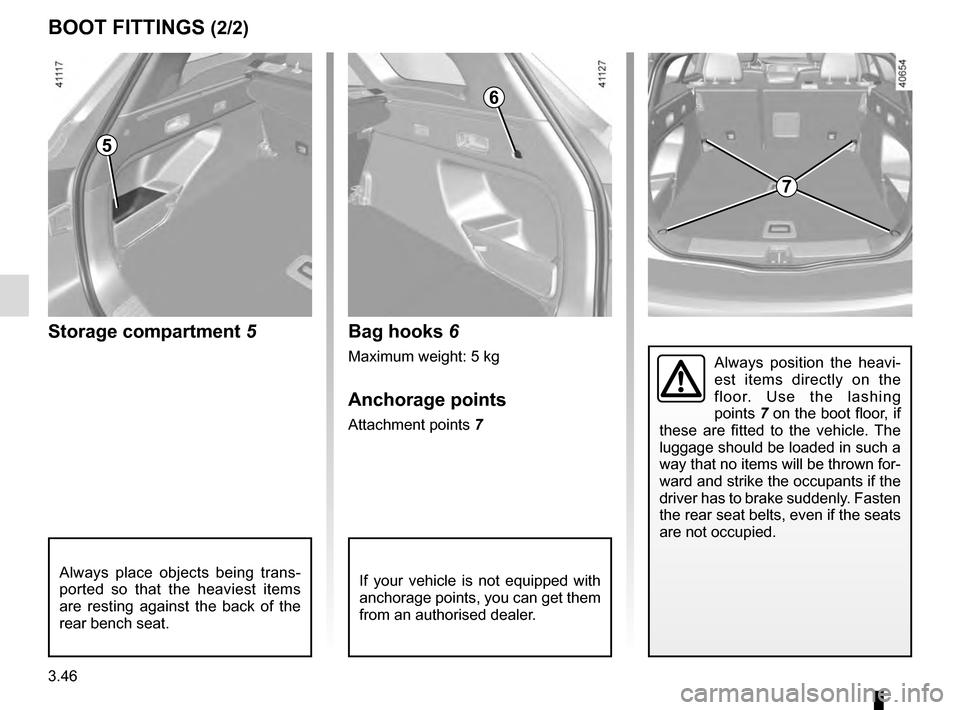
BOOT FITTINGS (2/2)
If your vehicle is not equipped with
anchorage points, you can get them
from an authorised dealer.
7
Bag hooks 6
Maximum weight: 5 kg
Anchorage points
Attachment points 7
Storage compartment 5
5
Always position the heavi-
est items directly on the
floor. Use the lashing
points 7 on the boot floor, if
these are fitted to the vehicle. The
luggage should be loaded in such a
way that no items will be thrown for-
ward and strike the occupants if the
driver has to brake suddenly. Fasten
the rear seat belts, even if the seats
are not occupied.
Always place objects being trans-
ported so that the heaviest items
are resting against the back of the
rear bench seat.
6
Page 237 of 328
3.47
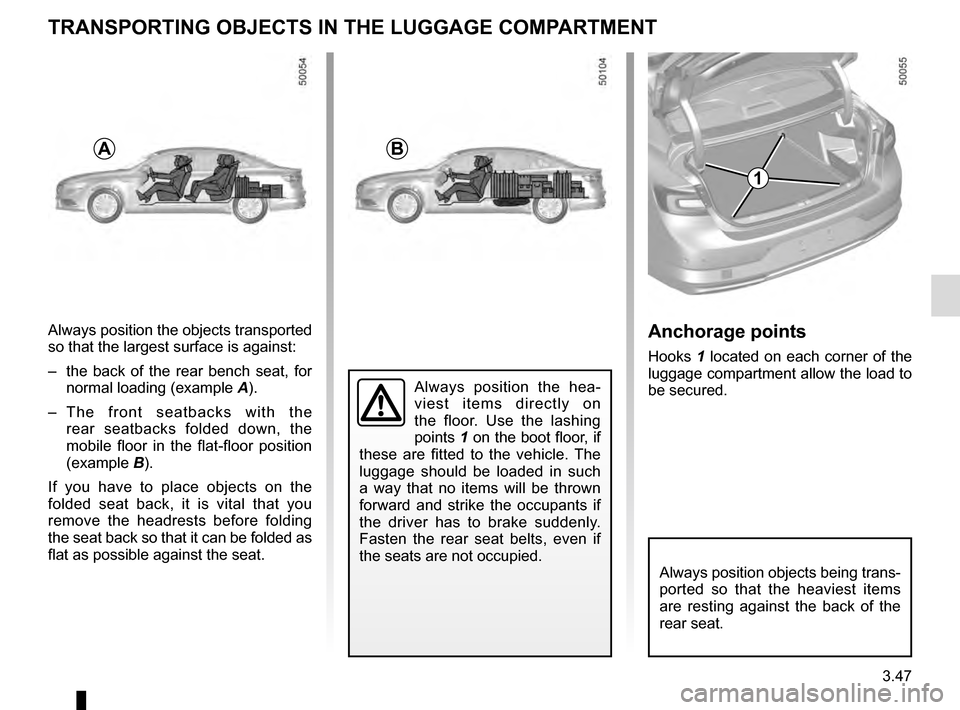
Always position the objects transported
so that the largest surface is against:
– the back of the rear bench seat, for normal loading (example A).
– The front seatbacks with the rear seatbacks folded down, the
mobile floor in the flat-floor position
(example B).
If you have to place objects on the
folded seat back, it is vital that you
remove the headrests before folding
the seat back so that it can be folded as
flat as possible against the seat.
TRANSPORTING OBJECTS IN THE LUGGAGE COMPARTMENT
A
Always position the hea-
viest items directly on
the floor. Use the lashing
points 1 on the boot floor, if
these are fitted to the vehicle. The
luggage should be loaded in such
a way that no items will be thrown
forward and strike the occupants if
the driver has to brake suddenly.
Fasten the rear seat belts, even if
the seats are not occupied.
Anchorage points
Hooks 1 located on each corner of the
luggage compartment allow the load to
be secured.
Always position objects being trans-
ported so that the heaviest items
are resting against the back of the
rear seat.
1
B
Page 239 of 328
3.49
ROOF BARS
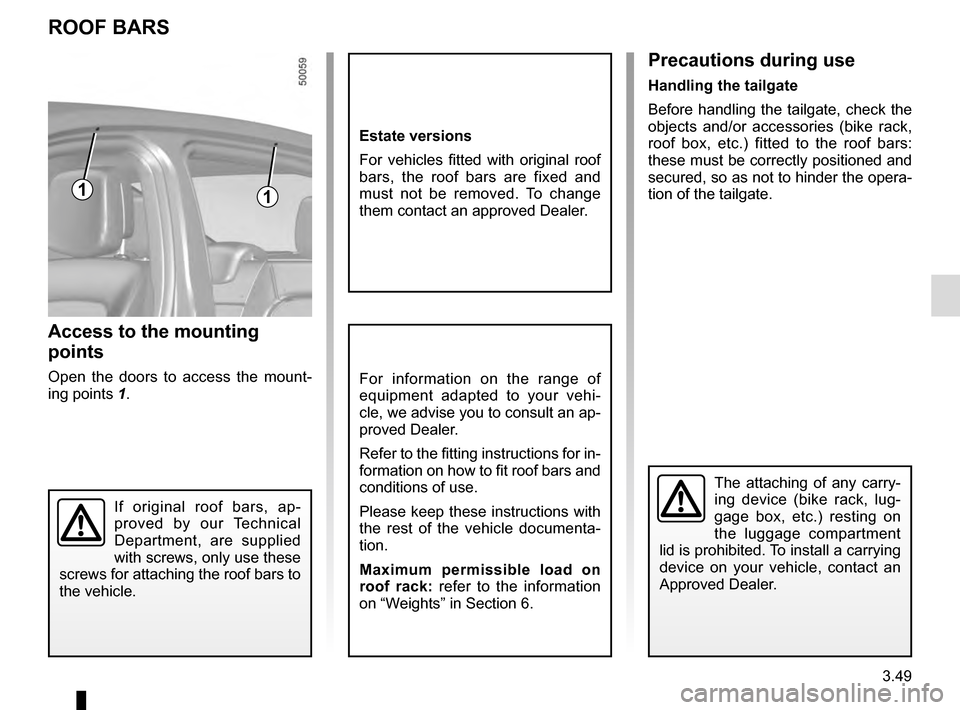
Access to the mounting
points
Open the doors to access the mount-
ing points 1.For information on the range of
equipment adapted to your vehi-
cle, we advise you to consult an ap-
proved Dealer.
Refer to the fitting instructions for in-
formation on how to fit roof bars and
conditions of use.
Please keep these instructions with
the rest of the vehicle documenta-
tion.
Maximum permissible load on
roof rack: refer to the information
on “Weights” in Section 6.
11
If original roof bars, ap-
proved by our Technical
Department, are supplied
with screws, only use these
screws for attaching the roof bars to
the vehicle.
The attaching of any carry-
ing device (bike rack, lug-
gage box, etc.) resting on
the luggage compartment
lid is prohibited. To install a carrying
device on your vehicle, contact an
Approved Dealer.
Precautions during use
Handling the tailgate
Before handling the tailgate, check the
objects and/or accessories (bike rack,
roof box, etc.) fitted to the roof bars:
these must be correctly positioned and
secured, so as not to hinder the opera-
tion of the tailgate.
Estate versions
For vehicles fitted with original roof
bars, the roof bars are fixed and
must not be removed. To change
them contact an approved Dealer.
Page 262 of 328
5.2
PUNCTURE, EMERGENCY SPARE WHEEL
If the vehicle is parked on
the hard shoulder, you must
warn other road users of
your vehicle’s presence
with a warning triangle or with other
devices as per the legislation apply-
ing to the country you are in.
Special note
The Tyre Pressure Monitor function
does not check the emergency spare
wheel (the wheel replaced by the emer-
gency spare wheel disappears from the
instrument panel display).
Refer to the information on the “Tyre
pressure monitoring system” in
Section 2.Emergency spare wheel
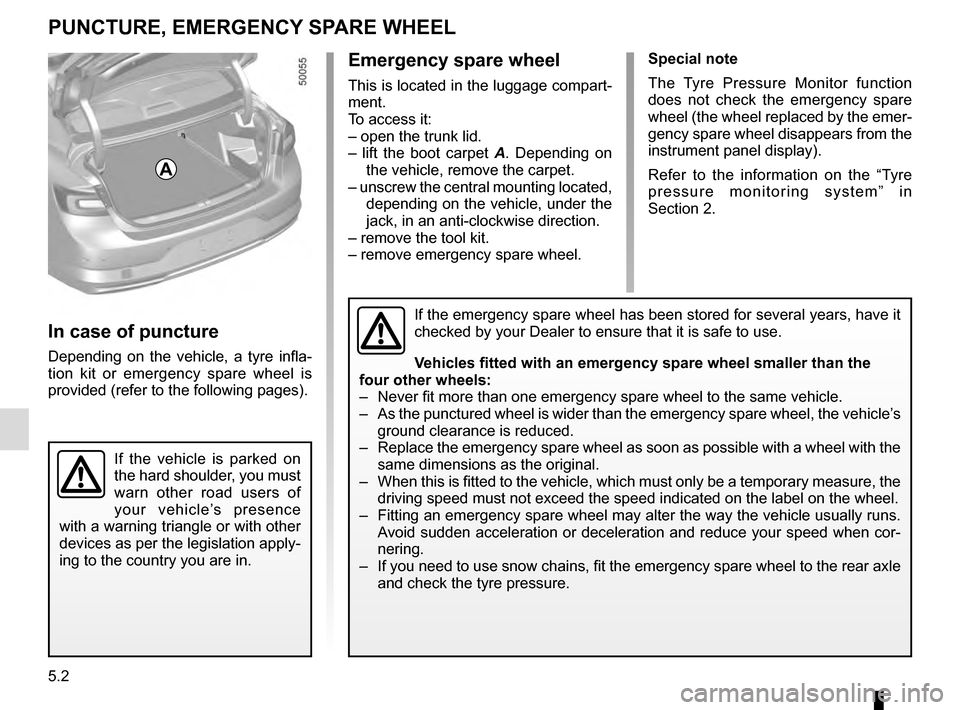
This is located in the luggage compart-
ment.
To access it:
– open the trunk lid.
– lift the boot carpet A . Depending on
the vehicle, remove the carpet.
– unscrew the central mounting located, depending on the vehicle, under the
jack, in an anti-clockwise direction.
– remove the tool kit.
– remove emergency spare wheel.
If the emergency spare wheel has been stored for several years, have it \
checked by your Dealer to ensure that it is safe to use.
Vehicles fitted with an emergency spare wheel smaller than the
four other wheels:
– Never fit more than one emergency spare wheel to the same vehicle.
– As the punctured wheel is wider than the emergency spare wheel, the vehi\
cle’s ground clearance is reduced.
– Replace the emergency spare wheel as soon as possible with a wheel with \
the same dimensions as the original.
– When this is fitted to the vehicle, which must only be a temporary measu\
re, the driving speed must not exceed the speed indicated on the label on the wh\
eel.
– Fitting an emergency spare wheel may alter the way the vehicle usually r\
uns. Avoid sudden acceleration or deceleration and reduce your speed when cor-\
nering.
– If you need to use snow chains, fit the emergency spare wheel to the rea\
r axle and check the tyre pressure.
A
In case of puncture
Depending on the vehicle, a tyre infla-
tion kit or emergency spare wheel is
provided (refer to the following pages).
Page 323 of 328

headrest................................................................\
............. 3.29
heated steering wheel .......................................................")
7.3
ALPHABETICAL INDEX (3/5)
headrest................................................................\
............. 3.29
heated steering wheel ....................................................... 1.79
heating and air conditioning system .................................. 3.16
heating system ........................................................3.6 → 3.15
Hill Start Assist..............................................2.28 → 2.39, 2.37
horn ...................................................................\
................ 1.84
horn: flash ..................................................................\
........... 1.84
sounding the horn ........................................................ 1.84
hubcap tool ................................................................. 5.7 – 5.8
I
ignition switch ...................................................................... 2.3
indicators ....................................................... 1.84, 5.14 – 5.15
indicators: direction indicators .............................................. 1.84, 5.16
exterior temperature indicator ...................................... 1.78
instrument panel ..............................................1.56 → 1.67
instrument panel ...........................................1.56 → 1.75, 1.85
instrument panel messages...................................1.68 → 1.75
interior trim maintenance ..................................................... 4.16 – 4.17
Isofix .................................................................\
.....1.48 → 1.50
J
jack ........................................................................\
..... 5.7 – 5.8
K
keys ...................................................................\
........1.2 → 1.4
L
lane departure warning ..........................................2.40 → 2.42
levels: brake fluid ...................................................................... 4.8
coolant ................................................................\
........... 4.7
engine oil ....................................................................... 4.4 windscreen washer reservoir ......................................... 4.9
lifting the vehicle changing a wheel ................................................ 5.9 – 5.10
lighting: exterior ......................................................1.6, 1.85 → 1.90
instrument panel .......................................................... 1.85
interior ..........................................3.22 – 3.23, 5.21 → 5.23
lights adjustment .............................................................\
...... 1.90
changing bulbs .................................................. 5.14 – 5.15
front ................................................................... 5.14 – 5.15
lights: adjusting ..............................................................\
........ 1.90
brake lights .................................................................. 5.16
dipped beam headlights ........................... 1.85, 5.14 – 5.15
direction indicators ..................................1.84, 5.14 → 5.16
fog lights ............................................................. 1.89, 5.16
hazard warning ............................................................ 1.84
main beam headlights ................... 1.86 – 1.87, 5.14 – 5.15
number plate lights ...................................................... 5.20
reversing lights ............................................................. 5.16
side lights ............................................................ 1.85, 5.16
locking the doors ............................... 1.2 → 1.11, 1.15 → 1.18
luggage compartment cover .............................................. 3.42
luggage retaining net .............................................. 3.43 – 3.44
M
maintenance ............................................................\
.......... 2.23
maintenance: bodywork .......................................................... 4.14 – 4.15
interior trim ........................................................ 4.16 – 4.17
mechanical .........................................4.2 – 4.3, 6.9 → 6.14
map reading lights .................................................. 3.22 – 3.23
menu for customising the vehicle settings .............. 1.76 – 1.77
methods of restraint in addition to the seat belts ...1.35 → 1.37
mobile floor ........................................................................\
3.45