Heat RENAULT TALISMAN 2016 1.G Owner's Manual
[x] Cancel search | Manufacturer: RENAULT, Model Year: 2016, Model line: TALISMAN, Model: RENAULT TALISMAN 2016 1.GPages: 328, PDF Size: 3.39 MB
Page 231 of 328
3.41
AUTOMATIC TAILGATE (5/5)Operating faults
If you activate the automatic tailgate
continuously for around a minute (se-
quence of opening and closing), it will
stop in order to avoid overheating. The
operation will return to normal after
about a minute.
The automatic tailgate will not operate
if the battery is on low charge. In this
case, operate the automatic tailgate
with the engine started.
Note
In very cold weather conditions, the au-
tomatic opening may not operate if the
trunk lid joints are frozen.
Precautions during use
Before opening/closing the tailgate,
ensure that the surrounding space is
sufficient to allow the tailgate to ope-
rate. If not, stop the tailgate movement
with the external tailgate control and
hold the tailgate in position by hand
(the tailgate may continue to open ma-
nually).
If the tailgate is moving and the engine
is started, the movement will stop for a
seconds before continuing.
Avoid multiple manual stops during the
automatic tailgate movement (risk of
damaging the tailgate system).
Make sure that the sensors are not
obscured (by dirt, mud, snow, road salt
etc.).
Driver’s responsibility
when parking or stopping
the vehicle
Never leave your vehicle
with a child, an adult who is not self-
sufficient or a pet inside or at the
rear of the tailgate, even for a short
while.
They may pose a risk to themselves
or to others by starting the engine,
activating equipment such as the
electric windows, the automatic
tailgate or by locking the doors.
RISK OF DEATH OR SERIOUS
INJURY.
Disable the «hands-free» function before washing the vehicle manua\
lly
or handling the emergency spare wheel or the towbar.
Risk of accidental opening or closing of the tailgate which may
cause injury.
Page 284 of 328
5.24
FUSES (1/2)
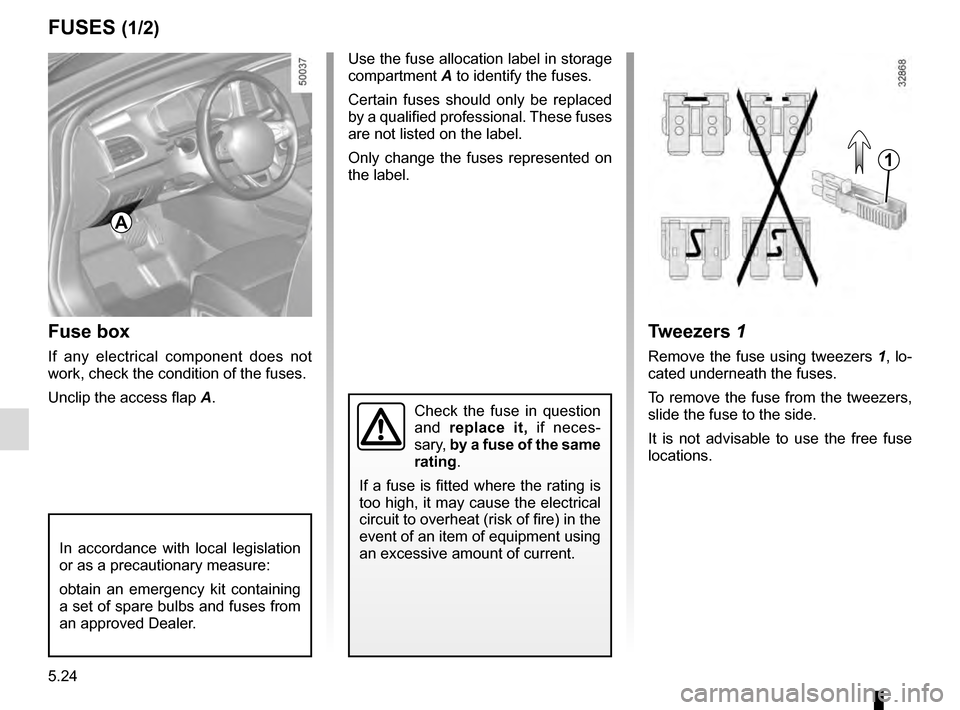
Fuse box
If any electrical component does not
work, check the condition of the fuses.
Unclip the access flap A.
Tweezers 1
Remove the fuse using tweezers 1, lo-
cated underneath the fuses.
To remove the fuse from the tweezers,
slide the fuse to the side.
It is not advisable to use the free fuse
locations.
Check the fuse in question
and replace it, if neces-
sary, by a fuse of the same
rating.
If a fuse is fitted where the rating is
too high, it may cause the electrical
circuit to overheat (risk of fire) in the
event of an item of equipment using
an excessive amount of current.
In accordance with local legislation
or as a precautionary measure:
obtain an emergency kit containing
a set of spare bulbs and fuses from
an approved Dealer.
A
1
Use the fuse allocation label in storage
compartment A to identify the fuses.
Certain fuses should only be replaced
by a qualified professional. These fuses
are not listed on the label.
Only change the fuses represented on
the label.
Page 285 of 328

Allocation of fuses
(the presence of certain fuses depends on the vehicle equipment level)\
Symbol Allocation SymbolAllocation
HWindscreen washerNot used
ëThird row accessories")
5.25
FUSES (2/2)
Allocation of fuses
(the presence of certain fuses depends on the vehicle equipment level)\
Symbol Allocation SymbolAllocation
HWindscreen washerNot used
ëThird row accessories socket, boot accessories
socketÝTowbar socket
ÆFront cigarette lighter, front and rear accessories
socketDiagnostic socket, audio alarm
Not usedÌHorn
Heated door mirrorsInstrument panel, dashboard control lighting
×Brake lights, passenger compartment central unitPiloted dampened suspension
\bParking brakefFront windscreen wiper
Additional servoDDirection indicator lights, hazard warning lights
îRadio, multifunction screen, multimedia acces-
sories sockets, parking brake controlRear USB sockets on console
Passenger compartment centre unit, rear wiper,
rear fog light\fNot used
OLocking opening elements, trunk lid opening and
closing control
Page 291 of 328
5.31
WIPER BLADES: replacement (1/2)
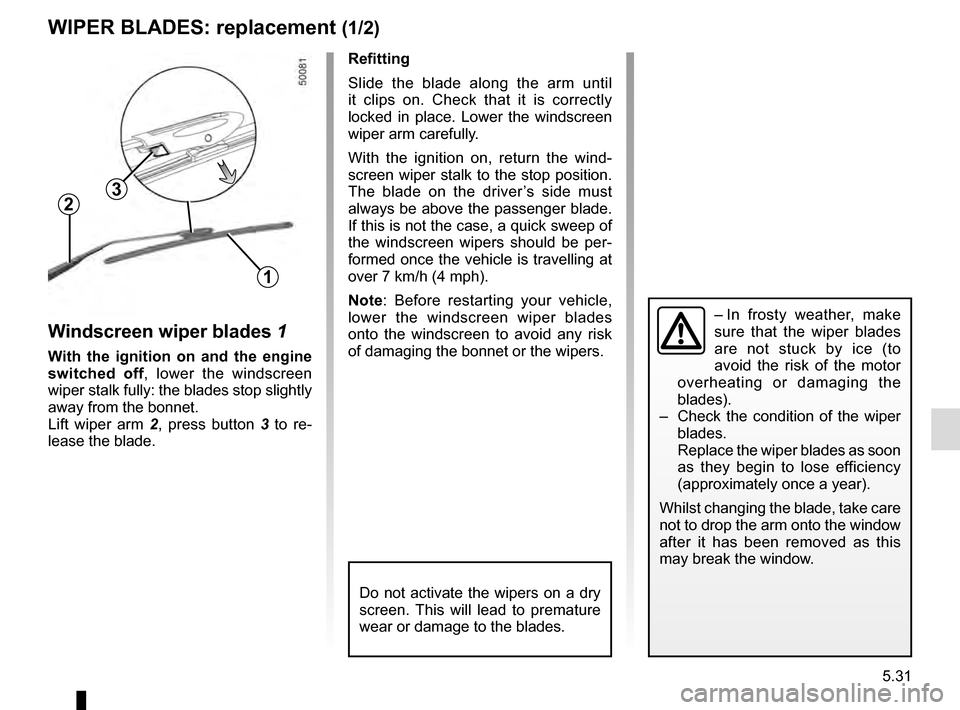
Windscreen wiper blades 1
With the ignition on and the engine
switched off, lower the windscreen
wiper stalk fully: the blades stop slightly
away from the bonnet.
Lift wiper arm 2 , press button 3 to re-
lease the blade.
1
32
Refitting
Slide the blade along the arm until
it clips on. Check that it is correctly
locked in place. Lower the windscreen
wiper arm carefully.
With the ignition on, return the wind-
screen wiper stalk to the stop position.
The blade on the driver’s side must
always be above the passenger blade.
If this is not the case, a quick sweep of
the windscreen wipers should be per-
formed once the vehicle is travelling at
over 7 km/h (4 mph).
Note: Before restarting your vehicle,
lower the windscreen wiper blades
onto the windscreen to avoid any risk
of damaging the bonnet or the wipers.
– In frosty weather, make
sure that the wiper blades
are not stuck by ice (to
avoid the risk of the motor
overheating or damaging the
blades).
– Check the condition of the wiper
blades.
Replace the wiper blades as soon
as they begin to lose efficiency
(approximately once a year).
Whilst changing the blade, take care
not to drop the arm onto the window
after it has been removed as this
may break the window.
Do not activate the wipers on a dry
screen. This will lead to premature
wear or damage to the blades.
Page 298 of 328
5.38
OPERATING FAULTS (4/6)
On the roadPOSSIBLE CAUSESWHAT TO DO
Steering becomes heavy. Assistance overheating.Consult an approved dealer.
The engine is overheating. The cool-
ant temperature indicator is in the
warning zone and warning light
® comes on. Engine cooling fan not working. Stop the vehicle, switch off the engine and
contact an approved dealer.
Coolant leaks. Check the coolant reservoir: it should con- tain fluid. If there is no coolant, consult an
authorised dealer as soon as possible.
Coolant boiling in the coolant reser-
voir. Mechanical fault: damaged cylinder
head gasket.Stop the engine.
Contact an approved dealer.
Radiator:
If there is a significant lack of coolant, remember that it must never b\
e topped up using cold coolant while
the engine is very warm. After any procedure on the vehicle which has involved even partial drain\
ing of the cooling
system, it must be refilled with a new mixture prepared in the correct p\
roportions. Reminder: only products approved
by our Technical Department may be used for this purpose.
Page 323 of 328

headrest................................................................\
............. 3.29
heated steering wheel .......................................................")
7.3
ALPHABETICAL INDEX (3/5)
headrest................................................................\
............. 3.29
heated steering wheel ....................................................... 1.79
heating and air conditioning system .................................. 3.16
heating system ........................................................3.6 → 3.15
Hill Start Assist..............................................2.28 → 2.39, 2.37
horn ...................................................................\
................ 1.84
horn: flash ..................................................................\
........... 1.84
sounding the horn ........................................................ 1.84
hubcap tool ................................................................. 5.7 – 5.8
I
ignition switch ...................................................................... 2.3
indicators ....................................................... 1.84, 5.14 – 5.15
indicators: direction indicators .............................................. 1.84, 5.16
exterior temperature indicator ...................................... 1.78
instrument panel ..............................................1.56 → 1.67
instrument panel ...........................................1.56 → 1.75, 1.85
instrument panel messages...................................1.68 → 1.75
interior trim maintenance ..................................................... 4.16 – 4.17
Isofix .................................................................\
.....1.48 → 1.50
J
jack ........................................................................\
..... 5.7 – 5.8
K
keys ...................................................................\
........1.2 → 1.4
L
lane departure warning ..........................................2.40 → 2.42
levels: brake fluid ...................................................................... 4.8
coolant ................................................................\
........... 4.7
engine oil ....................................................................... 4.4 windscreen washer reservoir ......................................... 4.9
lifting the vehicle changing a wheel ................................................ 5.9 – 5.10
lighting: exterior ......................................................1.6, 1.85 → 1.90
instrument panel .......................................................... 1.85
interior ..........................................3.22 – 3.23, 5.21 → 5.23
lights adjustment .............................................................\
...... 1.90
changing bulbs .................................................. 5.14 – 5.15
front ................................................................... 5.14 – 5.15
lights: adjusting ..............................................................\
........ 1.90
brake lights .................................................................. 5.16
dipped beam headlights ........................... 1.85, 5.14 – 5.15
direction indicators ..................................1.84, 5.14 → 5.16
fog lights ............................................................. 1.89, 5.16
hazard warning ............................................................ 1.84
main beam headlights ................... 1.86 – 1.87, 5.14 – 5.15
number plate lights ...................................................... 5.20
reversing lights ............................................................. 5.16
side lights ............................................................ 1.85, 5.16
locking the doors ............................... 1.2 → 1.11, 1.15 → 1.18
luggage compartment cover .............................................. 3.42
luggage retaining net .............................................. 3.43 – 3.44
M
maintenance ............................................................\
.......... 2.23
maintenance: bodywork .......................................................... 4.14 – 4.15
interior trim ........................................................ 4.16 – 4.17
mechanical .........................................4.2 – 4.3, 6.9 → 6.14
map reading lights .................................................. 3.22 – 3.23
menu for customising the vehicle settings .............. 1.76 – 1.77
methods of restraint in addition to the seat belts ...1.35 → 1.37
mobile floor ........................................................................\
3.45