air condition RENAULT TALISMAN 2016 1.G Owner's Manual
[x] Cancel search | Manufacturer: RENAULT, Model Year: 2016, Model line: TALISMAN, Model: RENAULT TALISMAN 2016 1.GPages: 328, PDF Size: 3.39 MB
Page 204 of 328
3.14
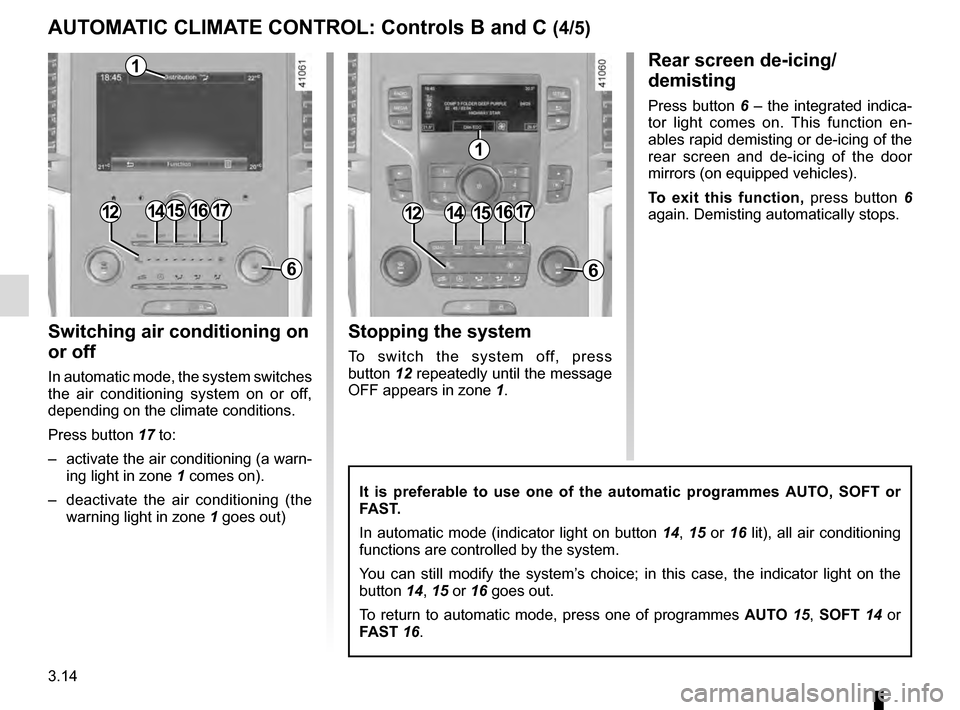
Switching air conditioning on
or off
In automatic mode, the system switches
the air conditioning system on or off,
depending on the climate conditions.
Press button 17 to:
– activate the air conditioning (a warn-ing light in zone 1 comes on).
– deactivate the air conditioning (the warning light in zone 1 goes out)
Rear screen de-icing/
demisting
Press button 6 – the integrated indica-
tor light comes on. This function en-
ables rapid demisting or de-icing of the
rear screen and de-icing of the door
mirrors (on equipped vehicles).
To exit this function, press button 6
again. Demisting automatically stops.
It is preferable to use one of the automatic programmes AUTO, SOFT or
FAST.
In automatic mode (indicator light on button 14, 15 or 16 lit), all air conditioning
functions are controlled by the system.
You can still modify the system’s choice; in this case, the indicator light on the
button 14, 15 or 16 goes out.
To return to automatic mode, press one of programmes AUTO 15, SOFT 14 or
FAST 16.
15
6
1715
6
1714161416
1
1
Stopping the system
To switch the system off, press
button 12 repeatedly until the message
OFF appears in zone 1.
1212
AUTOMATIC CLIMATE CONTROL: Controls B and C (4/5)
Page 206 of 328
3.16
AIR CONDITIONING: information and advice on use
Do not add anything to the
vehicle’s ventilation circuit
(for example, to remove
bad odours).
There is a risk of damage or of
fire.
Do not open the refriger-
ant fluid circuit. The fluid
may damage eyes or skin.
Fuel consumption
You will normally notice an increase in
fuel consumption (especially in town)
when the air conditioning is operating.
For vehicles fitted with air conditioning
with no automatic mode, switch off the
system when it is not required.
Advice for reducing consumption
and helping to preserve the environ-
ment
Drive with the air vents open and the
windows closed.
If the vehicle has been parked in the
sun, open the doors for a few moments
to let the hot air escape before starting
the engine.
Maintenance
Refer to the Maintenance Document
for your vehicle for the inspection fre-
quency.
Operating faults
As a general rule, contact your ap-
proved dealer in the event of an oper-
ating fault.
– Reduction in de-icing, demisting or air conditioning performance.
This may be caused by the passen-
ger compartment filter cartridge be-
coming clogged.
– No cold air is being produced .
Check that the controls are set cor-
rectly and that the fuses are sound.
Otherwise, switch off the system.
Presence of water under the
vehicle
After prolonged use of the air condi-
tioning system, it is normal for water
to be present under the vehicle. This is
caused by condensation.
Advice on use
In some situations, (air conditioning
off, air recirculation activated, ventila-
tion speed at zero or low, etc.) you may
notice that condensation starts to form
on the windows and windscreen.
If there is condensation, use the “Clear
View” function to remove it, then use
the air conditioning in automatic mode
to stop it forming again.
Vehicles equipped with the
ECO mode: once activated, ECO
mode can reduce the perform-
ance of the automatic air condition-
ing. Please refer to the information
on “Driving advice, Eco-driving” in
Section 2.
Page 223 of 328
3.33
LUGGAGE COMPARTMENT: 4 door versions (2/3)
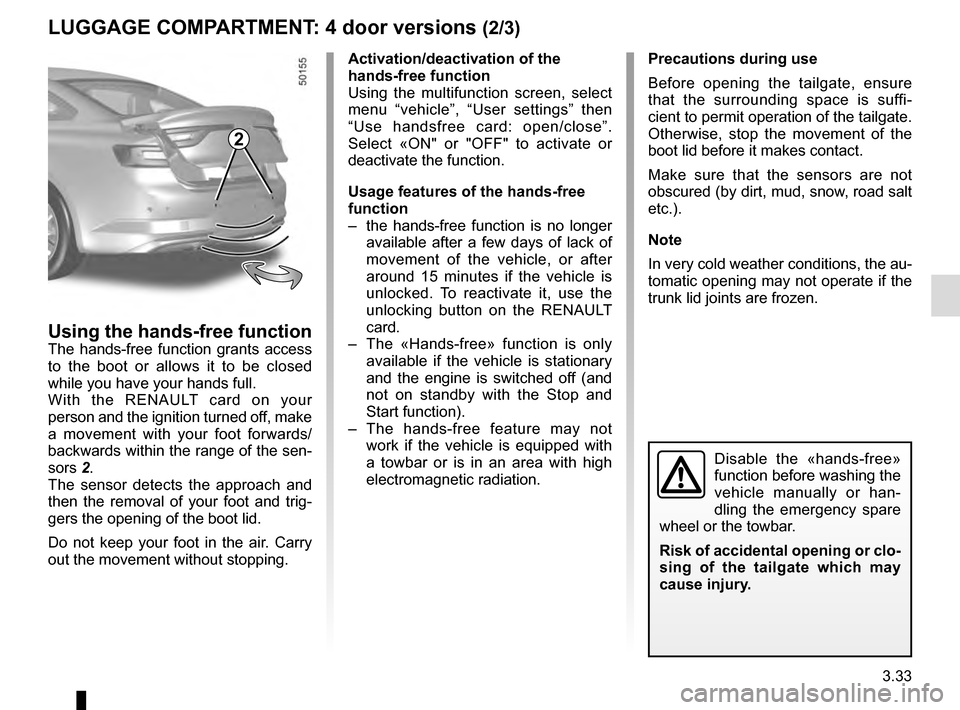
Using the hands-free functionThe hands-free function grants access
to the boot or allows it to be closed
while you have your hands full.
With the RENAULT card on your
person and the ignition turned off, make
a movement with your foot forwards/
backwards within the range of the sen-
sors 2.
The sensor detects the approach and
then the removal of your foot and trig-
gers the opening of the boot lid.
Do not keep your foot in the air. Carry
out the movement without stopping.
2
Activation/deactivation of the
hands-free function
Using the multifunction screen, select
menu “vehicle”, “User settings” then
“Use handsfree card: open/close”.
Select «ON" or "OFF" to activate or
deactivate the function.
Usage features of the hands-free
function
– the hands-free function is no longer available after a few days of lack of
movement of the vehicle, or after
around 15 minutes if the vehicle is
unlocked. To reactivate it, use the
unlocking button on the RENAULT
card.
– The «Hands-free» function is only available if the vehicle is stationary
and the engine is switched off (and
not on standby with the Stop and
Start function).
– The hands-free feature may not work if the vehicle is equipped with
a towbar or is in an area with high
electromagnetic radiation. Precautions during use
Before opening the tailgate, ensure
that the surrounding space is suffi-
cient to permit operation of the tailgate.
Otherwise, stop the movement of the
boot lid before it makes contact.
Make sure that the sensors are not
obscured (by dirt, mud, snow, road salt
etc.).
Note
In very cold weather conditions, the au-
tomatic opening may not operate if the
trunk lid joints are frozen.
Disable the «hands-free»
function before washing the
vehicle manually or han-
dling the emergency spare
wheel or the towbar.
Risk of accidental opening or clo-
sing of the tailgate which may
cause injury.
Page 263 of 328
5.3
TYRE INFLATION KIT (1/4)
The kit is only approved for
inflating the tyres of the ve-
hicle originally equipped
with the kit.
It must never be used to inflate
the tyres of another vehicle, or any
other inflatable object (rubber ring,
rubber boat, etc.).
Avoid spillage on skin when hand-
ling the repair liquid bottle. If drop-
lets do leak out, rinse them off with
plenty of water.
Keep the repair kit away from chil-
dren.
Do not dispose of the empty bottle
in the countryside. Return it to your
approved dealer or to a recycling or-
ganisation.
The bottle has a limited service
life which is indicated on its label.
Check the expiry date.
Contact an approved dealer to re-
place the inflation tube and repair
product bottle.
A
B
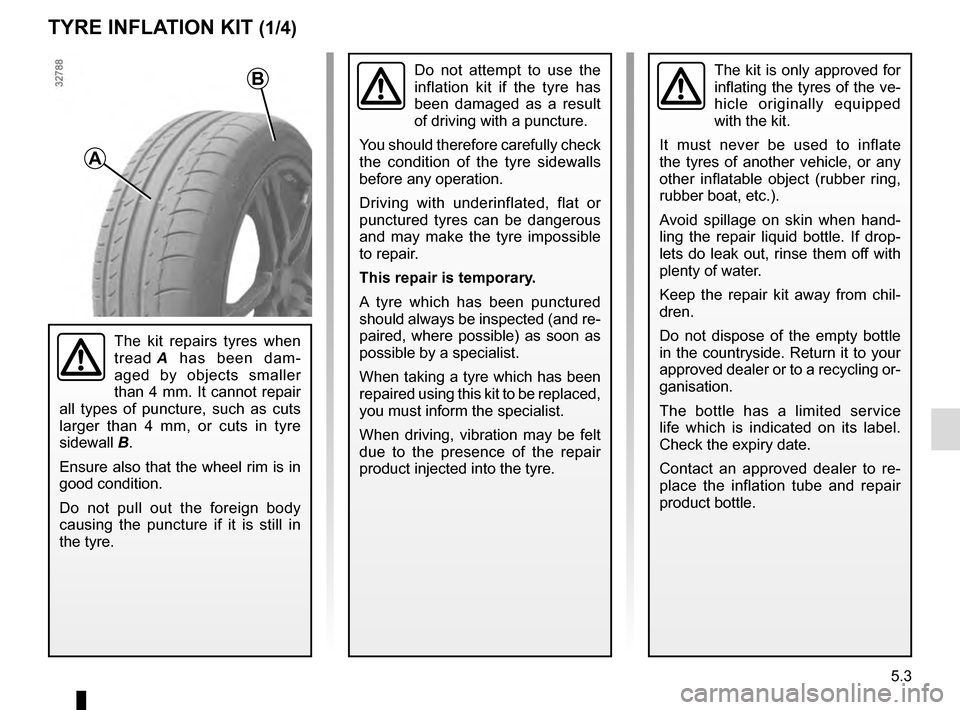
The kit repairs tyres when
tread A has been dam-
aged by objects smaller
than 4 mm. It cannot repair
all types of puncture, such as cuts
larger than 4 mm, or cuts in tyre
sidewall B.
Ensure also that the wheel rim is in
good condition.
Do not pull out the foreign body
causing the puncture if it is still in
the tyre.
Do not attempt to use the
inflation kit if the tyre has
been damaged as a result
of driving with a puncture.
You should therefore carefully check
the condition of the tyre sidewalls
before any operation.
Driving with underinflated, flat or
punctured tyres can be dangerous
and may make the tyre impossible
to repair.
This repair is temporary.
A tyre which has been punctured
should always be inspected (and re-
paired, where possible) as soon as
possible by a specialist.
When taking a tyre which has been
repaired using this kit to be replaced,
you must inform the specialist.
When driving, vibration may be felt
due to the presence of the repair
product injected into the tyre.
Page 308 of 328

6.8
Original parts are based on strict specifications and are subject to hig\
hly-specialised tests. Therefore, they are of at least the same
level of quality as the parts fitted originally.
If you always fit genuine replacement parts to your vehicle, you will en\
sure that it performs well. Furthermore, repairs carried out
within the manufacturer’s Network using original parts are guaranteed according to the condition\
s set out on the reverse of the
repair order.
REPLACEMENT PARTS AND REPAIRS
Page 321 of 328

A
ABS ....................................................................\
...2.28 → 2.39
accessories.............................................................\
....")
7.1
ALPHABETICAL INDEX (1/5)
A
ABS ....................................................................\
...2.28 → 2.39
accessories.............................................................\
........... 5.30
accessories socket ................................................... 3.28, 3.51
adaptive cruise control...........................................2.59 → 2.65
additional methods of restraint .....................1.31 → 1.34, 1.37
side protection ............................................................. 1.36
to the rear seat belts ........................................1.31 → 1.35
adjusting your driving position ........................................... 1.27
advice on antipollution ....................................................... 2.23
air bag.................................................................\
...1.31 → 1.37
activating the front passenger air bags ........................ 1.53
deactivating the front passenger air bags .................... 1.51
air conditioning ........................................................3.6 → 3.16
air vents ...................................................................... 3.4 – 3.5
anti-corrosion check ..............................................6.15 → 6.19
anti-corrosion protection .................................................... 4.14
anti-lock braking system: ABS ...............................2.28 → 2.39
antipollution advice .................................................................\
......... 2.23
armrest: front ..................................................................\
............ 3.26
ashtray ................................................................\
............... 3.28
assisted parking............................... 2.66 → 2.70, 2.74 → 2.77
automatic gearbox (use) ........................................2.79 → 2.81
automatic gearbox selector lever...........................2.79 → 2.81
automatic trunk lid .................................................3.37 → 3.41
B
battery.................................................................\
.... 4.10 – 4.11 troubleshooting ................................................. 5.26 – 5.27
blind spot warning signal .......................................2.43 → 2.46
blind spot: warning signal ......................................2.43 → 2.46
bonnet..................................................................\
....... 4.2 – 4.3
brake fluid ........................................................................\
.... 4.8 bulbs
changing ..........................................................5.14 \
→ 5.20
C
catalytic converter................................................... 2.12 – 2.13
central door locking ......................................1.12 → 1.14, 1.18
changing a bulb .....................................................5.14 → 5.20
changing a wheel...................................................... 5.9 – 5.10
changing gear ...............................................2.14, 2.79 → 2.81
child restraint/seat .............................1.38 – 1.39, 1.41 → 1.50
child safety..................1.5, 1.8, 1.38 – 1.39, 1.41 → 1.50, 3.17
child seats..........................................1.38 – 1.39, 1.4\
1 → 1.50
children .......................................................... 1.38 – 1.39, 1.39
children (safety) ................................................... 1.5, 1.8, 3.17
cigar lighter ........................................................................\
3.28
cleaning: inside the vehicle .............................................. 4.16 – 4.17
clock ..................................................................\
................ 1.78
closing the doors ...................................................1.12 → 1.17
control instruments ................................................. 1.66 – 1.67
controls ................................................................... 1.54 – 1.55
coolant ................................................................\
................. 4.7
courtesy light .....................................3.22 – 3.23, 5.21 → 5.23
courtesy mirrors ................................................................. 3.24
cruise control ................................... 2.49 → 2.51, 2.55 → 2.58
cruise control-speed limiter.............. 2.49 → 2.51, 2.55 → 2.58
customised vehicle settings ................................... 1.76 – 1.77
customising the vehicle settings ............................ 1.76 – 1.77
D
dashboard...............................................................\
1.54 – 1.55
daytime running lights..................................................\
...... 1.87
dimensions ................................................................. 6.4 – 6.5
display ..........................................................1.56 → 1.65, 3.50
doors...................................................................\
...1.15 → 1.18
doors/tailgate .........................................................\
.............. 1.4
Page 323 of 328

headrest................................................................\
............. 3.29
heated steering wheel .......................................................")
7.3
ALPHABETICAL INDEX (3/5)
headrest................................................................\
............. 3.29
heated steering wheel ....................................................... 1.79
heating and air conditioning system .................................. 3.16
heating system ........................................................3.6 → 3.15
Hill Start Assist..............................................2.28 → 2.39, 2.37
horn ...................................................................\
................ 1.84
horn: flash ..................................................................\
........... 1.84
sounding the horn ........................................................ 1.84
hubcap tool ................................................................. 5.7 – 5.8
I
ignition switch ...................................................................... 2.3
indicators ....................................................... 1.84, 5.14 – 5.15
indicators: direction indicators .............................................. 1.84, 5.16
exterior temperature indicator ...................................... 1.78
instrument panel ..............................................1.56 → 1.67
instrument panel ...........................................1.56 → 1.75, 1.85
instrument panel messages...................................1.68 → 1.75
interior trim maintenance ..................................................... 4.16 – 4.17
Isofix .................................................................\
.....1.48 → 1.50
J
jack ........................................................................\
..... 5.7 – 5.8
K
keys ...................................................................\
........1.2 → 1.4
L
lane departure warning ..........................................2.40 → 2.42
levels: brake fluid ...................................................................... 4.8
coolant ................................................................\
........... 4.7
engine oil ....................................................................... 4.4 windscreen washer reservoir ......................................... 4.9
lifting the vehicle changing a wheel ................................................ 5.9 – 5.10
lighting: exterior ......................................................1.6, 1.85 → 1.90
instrument panel .......................................................... 1.85
interior ..........................................3.22 – 3.23, 5.21 → 5.23
lights adjustment .............................................................\
...... 1.90
changing bulbs .................................................. 5.14 – 5.15
front ................................................................... 5.14 – 5.15
lights: adjusting ..............................................................\
........ 1.90
brake lights .................................................................. 5.16
dipped beam headlights ........................... 1.85, 5.14 – 5.15
direction indicators ..................................1.84, 5.14 → 5.16
fog lights ............................................................. 1.89, 5.16
hazard warning ............................................................ 1.84
main beam headlights ................... 1.86 – 1.87, 5.14 – 5.15
number plate lights ...................................................... 5.20
reversing lights ............................................................. 5.16
side lights ............................................................ 1.85, 5.16
locking the doors ............................... 1.2 → 1.11, 1.15 → 1.18
luggage compartment cover .............................................. 3.42
luggage retaining net .............................................. 3.43 – 3.44
M
maintenance ............................................................\
.......... 2.23
maintenance: bodywork .......................................................... 4.14 – 4.15
interior trim ........................................................ 4.16 – 4.17
mechanical .........................................4.2 – 4.3, 6.9 → 6.14
map reading lights .................................................. 3.22 – 3.23
menu for customising the vehicle settings .............. 1.76 – 1.77
methods of restraint in addition to the seat belts ...1.35 → 1.37
mobile floor ........................................................................\
3.45