radio RENAULT TRAFIC 2015 X82 / 3.G User Guide
[x] Cancel search | Manufacturer: RENAULT, Model Year: 2015, Model line: TRAFIC, Model: RENAULT TRAFIC 2015 X82 / 3.GPages: 292, PDF Size: 6.66 MB
Page 129 of 292
2.5
STARTING, STOPPING THE ENGINE: vehicle with RENAULT CARD (2/3)
Operating faults
In certain cases, the hands-free
RENAULT card may not work:
– when the RENAULT card battery is drained, flat battery, etc.
– near to appliances operating on the same frequency as the card (moni-
tor, mobile phone, video game, etc.);
– vehicle located in a high electromag- netic radiation zone.
The message “PLEASE INSERT
KEYCARD” appears on the instrument
panel.
Insert the RENAULT card fully into card
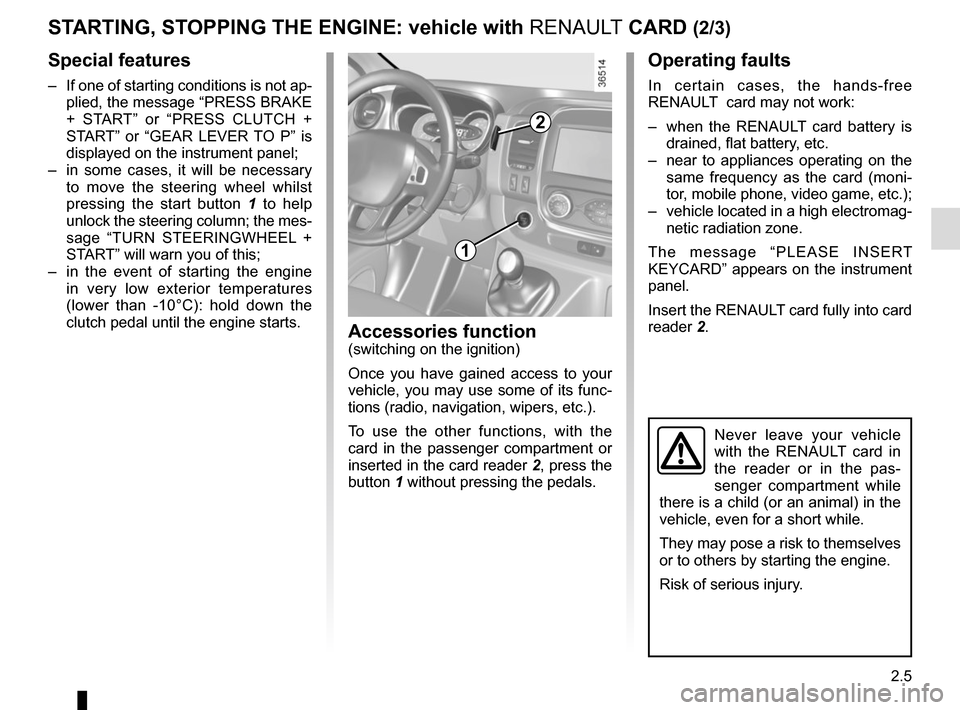
reader 2.
Accessories function(switching on the ignition)
Once you have gained access to your
vehicle, you may use some of its func-
tions (radio, navigation, wipers, etc.).
To use the other functions, with the
card in the passenger compartment or
inserted in the card reader 2, press the
button 1 without pressing the pedals.
Never leave your vehicle
with the RENAULT card in
the reader or in the pas-
senger compartment while
there is a child (or an animal) in the
vehicle, even for a short while.
They may pose a risk to themselves
or to others by starting the engine.
Risk of serious injury.
1
2
Special features
– If one of starting conditions is not ap- plied, the message “PRESS BRAKE
+ START” or “PRESS CLUTCH +
START” or “GEAR LEVER TO P” is
displayed on the instrument panel;
– in some cases, it will be necessary to move the steering wheel whilst
pressing the start button 1 to help
unlock the steering column; the mes-
sage “TURN STEERINGWHEEL +
START” will warn you of this;
– in the event of starting the engine in very low exterior temperatures
(lower than -10°C): hold down the
clutch pedal until the engine starts.
Page 130 of 292
2.6
When you leave your vehi-
cle, especially if you have
your RENAULT card with
you, check that the engine
is completely switched off.
If the card is no longer in the pas-
senger compartment when you try to
switch the engine off, the message “NO
KEYCARD PRESS AND HOLD” ap-
pears on the instrument panel: press
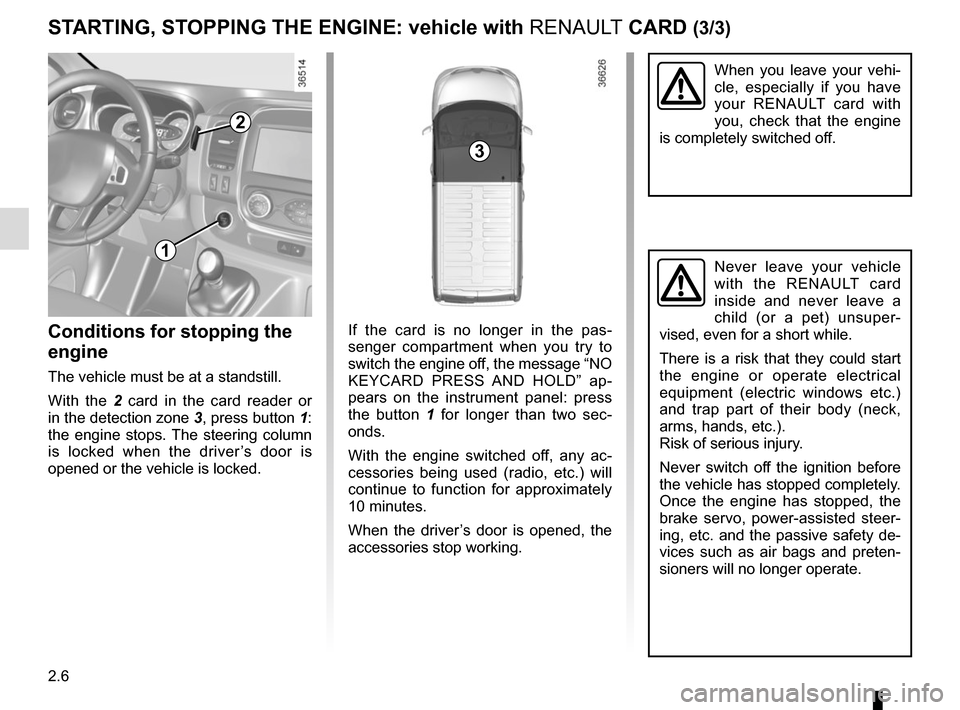
the button 1 for longer than two sec-
onds.
With the engine switched off, any ac-
cessories being used (radio, etc.) will
continue to function for approximately
10 minutes.
When the driver’s door is opened, the
accessories stop working.Conditions for stopping the
engine
The vehicle must be at a standstill.
With the 2 card in the card reader or
in the detection zone 3, press button 1:
the engine stops. The steering column
is locked when the driver’s door is
opened or the vehicle is locked.
STARTING, STOPPING THE ENGINE: vehicle with RENAULT CARD (3/3)
Never leave your vehicle
with the RENAULT card
inside and never leave a
child (or a pet) unsuper-
vised, even for a short while.
There is a risk that they could start
the engine or operate electrical
equipment (electric windows etc.)
and trap part of their body (neck,
arms, hands, etc.).
Risk of serious injury.
Never switch off the ignition before
the vehicle has stopped completely.
Once the engine has stopped, the
brake servo, power-assisted steer-
ing, etc. and the passive safety de-
vices such as air bags and preten-
sioners will no longer operate.
3
1
2
Page 218 of 292
4.14
Respect local regulations about wash-
ing vehicles (e.g. do not wash your ve-
hicle on a public highway).
Observe the vehicle stopping distances
when driving on gravelled surfaces to
prevent paint damage.
Repair, or have repaired quickly, areas
where the paint has been damaged, to
prevent corrosion spreading.
Remember to visit the body shop pe-
riodically in order to maintain your
anti-corrosion warranty. Refer to the
Maintenance Document.
If it is necessary to clean mechani-
cal components, hinges, etc., spray
them with products approved by our
Technical Department to protect them
after they have been cleaned.
BODYWORK MAINTENANCE (2/2)
We have selected special products
to care for your vehicle and you can
obtain these from the manufactur-
er’s accessory outlets.
Using a roller type car wash
Return the windscreen wiper stalk to
the Park position (refer to the informa-
tion on the “Windscreen washer, wiper”
in Section 1). Check the mounting of
external accessories, additional lights
and mirrors, and ensure that the wiper
blades are secured with adhesive tape.
Remove the radio aerial mast if your
vehicle is fitted with this equipment.
Remember to remove the tape and refit
the antenna after washing.
Cleaning the headlights
As the headlights are made of plastic
“glass”, use a soft cloth or cotton wool
to clean them. If this does not clean
them properly, moisten the cloth with
soapy water, then wipe clean with a soft
damp cloth or cotton wool.
Finally, carefully dry off with a soft dry
cloth.
Cleaning products containing alco-
hol must not be used.
Vehicles with a matte paint
finish
This type of paint requires certain pre-
cautions.
Do not do the following
– use wax-based products (polishing);
– rub hard;
– wash the vehicle in a roller-type car
wash;
– wash the vehicle using a high-pres-
sure device;
– attach stickers to the paintwork (risk
of leaving marks).
You should do the following
Wash the vehicle by hand using plenty
of water, using a soft cloth or a gentle
sponge.
Page 219 of 292
4.15
Glass instrument panel(e.g. instrument panel, clock, exterior
temperature display, radio display, etc.)
Use a soft cloth (or cotton wool).
If this does not clean it properly, use a
soft cloth (or cotton wool) slightly mois-
tened with soapy water and then wipe
clean with a soft damp cloth or cotton
wool.
Finally, carefully dry off with a soft dry
cloth.
Cleaning products containing alco-
hol must not be used under any cir-
cumstances.
Seat belts
These must be kept clean.
Use products selected by our Technical
Department (Approved outlets) or
warm, soapy water and a sponge and
wipe with a dry cloth.
Detergents or dyes must not be used
under any circumstances.
INTERIOR TRIM MAINTENANCE (1/2)
Textiles (seats, door trim, etc)
Vacuum-clean the textiles regularly.
Liquid stain
Use soapy water.
Dab lightly (never rub) with a soft cloth,
rinse and remove the excess.
Solid or pasty stain
Carefully remove the excess solid or
pasty material immediately with a
spatula (working from the edges to the
centre to avoid spreading the stain).
Clean as for a liquid stain.
Special instructions for sweets or
chewing gum
Put an ice cube on the stain to solidify
it, then proceed as for a solid stain.
A well-maintained vehicle will last
longer. It is therefore recommended to
maintain the interior of the vehicle regu-
larly.
A stain should always be dealt with
swiftly.
Whatever type of stain is on the trim,
use
cold (or warm) soapy water with
natural soap.
Detergents (washing-up liquid, pow-
dered products, alcohol-based prod-
ucts) should not be used.
Use a soft cloth.
Rinse and soak up the excess.
For further recommendations for
maintaining the interior, and/or for
any unsatisfactory results, please
see an authorised dealer.
Page 221 of 292

5.1
Section 5: Practical advice
Puncture, emergency spare wheel . . . . . . . . . . . . . . . . . . . . . . . . . . . . . . . . . . . .\
. . . . . . . . . . . . . . 5.2
Tyre inflation kit . . . . . . . . . . . . . . . . . . . . . . . . . . . \
. . . . . . . . . . . . . . . . . . . . . . . . . . . . . . . . . . . . . . 5.4
Tools . . . . . . . . . . . . . . . . . . . . . . . . . . . . . . . . . . . .\
. . . . . . . . . . . . . . . . . . . . . . . . . . . . . . . . . . . . . 5.7
Wheel trims . . . . . . . . . . . . . . . . . . . . . . . . . . . . . . \
. . . . . . . . . . . . . . . . . . . . . . . . . . . . . . . . . . . . . . 5.8
Changing a wheel . . . . . . . . . . . . . . . . . . . . . . . . . . . . . . . . . . . .\
. . . . . . . . . . . . . . . . . . . . . . . . . . . 5.9
Tyres (tyre and wheel safety, use in winter) . . . . . . . . . . . . . . . . . . . . . . . . . . . . . . . . . . . .\
. . . . . . . 5.11
Headlights (changing bulbs) . . . . . . . . . . . . . . . . . . . . . . . . . . . . . . . . . . . .\
. . . . . . . . . . . . . . . . . . . 5.14
Side lights . . . . . . . . . . . . . . . . . . . . . . . . . . . . . . . . . . . .\
. . . . . . . . . . . . . . . . . . . . . . . . . . . . . . . . . 5.15
Rear lights (changing bulbs) . . . . . . . . . . . . . . . . . . . . . . . . . . . . . . . . . . . .\
. . . . . . . . . . . . . . . . . . . 5.16
Indicator lights (changing bulbs) . . . . . . . . . . . . . . . . . . . . . . . . . . . . . . . . . . . .\
. . . . . . . . . . . . . . . . 5.19
Interior lighting (changing bulbs) . . . . . . . . . . . . . . . . . . . . . . . . . . . . . . . . . . . . \
. . . . . . . . . . . . . . . . 5.20
Key, radio frequency remote control: battery . . . . . . . . . . . . . . . . . . . . . . . . . . . . . . . . . . . . \
. . . . . . . 5.22
RENAULT card: battery . . . . . . . . . . . . . . . . . . . . . . . . . . . . . . . . . . . . \
. . . . . . . . . . . . . . . . . . . . . . . 5.23
Battery . . . . . . . . . . . . . . . . . . . . . . . . . . . . . . . . . . . . \
. . . . . . . . . . . . . . . . . . . . . . . . . . . . . . . . . . . . 5.24
Fitting a radio . . . . . . . . . . . . . . . . . . . . . . . . . . . . . . . . . . . . \
. . . . . . . . . . . . . . . . . . . . . . . . . . . . . . . 5.26
Fuses . . . . . . . . . . . . . . . . . . . . . . . . . . . . . . . . . . . . \
. . . . . . . . . . . . . . . . . . . . . . . . . . . . . . . . . . . . . 5.27
Accessories . . . . . . . . . . . . . . . . . . . . . . . . . . . . . . . . . . . . \
. . . . . . . . . . . . . . . . . . . . . . . . . . . . . . . . 5.30
Wipers (replacing blades) . . . . . . . . . . . . . . . . . . . . . . . . . . . . . . . . . . . .\
. . . . . . . . . . . . . . . . . . . . . 5.31
Towing . . . . . . . . . . . . . . . . . . . . . . . . . . . . . . . . . . . . \
. . . . . . . . . . . . . . . . . . . . . . . . . . . . . . . . . . . . 5.33
Operating faults . . . . . . . . . . . . . . . . . . . . . . . . . . . . . . . . . . . . \
. . . . . . . . . . . . . . . . . . . . . . . . . . . . . 5.35
Page 242 of 292
5.22
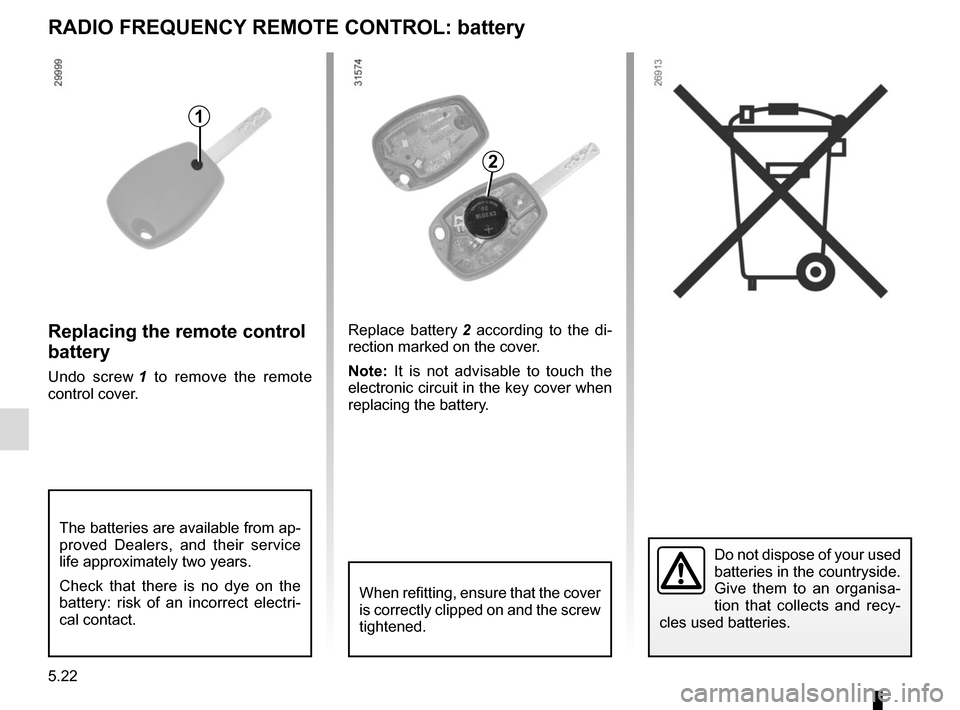
RADIO FREQUENCY REMOTE CONTROL: battery
Do not dispose of your used
batteries in the countryside.
Give them to an organisa-
tion that collects and recy-
cles used batteries.
1
Replacing the remote control
battery
Undo screw 1 to remove the remote
control cover. Replace battery
2 according to the di-
rection marked on the cover.
Note: It is not advisable to touch the
electronic circuit in the key cover when
replacing the battery.
When refitting, ensure that the cover
is correctly clipped on and the screw
tightened.
The batteries are available from ap-
proved Dealers, and their service
life approximately two years.
Check that there is no dye on the
battery: risk of an incorrect electri-
cal contact.
2
Page 246 of 292
5.26
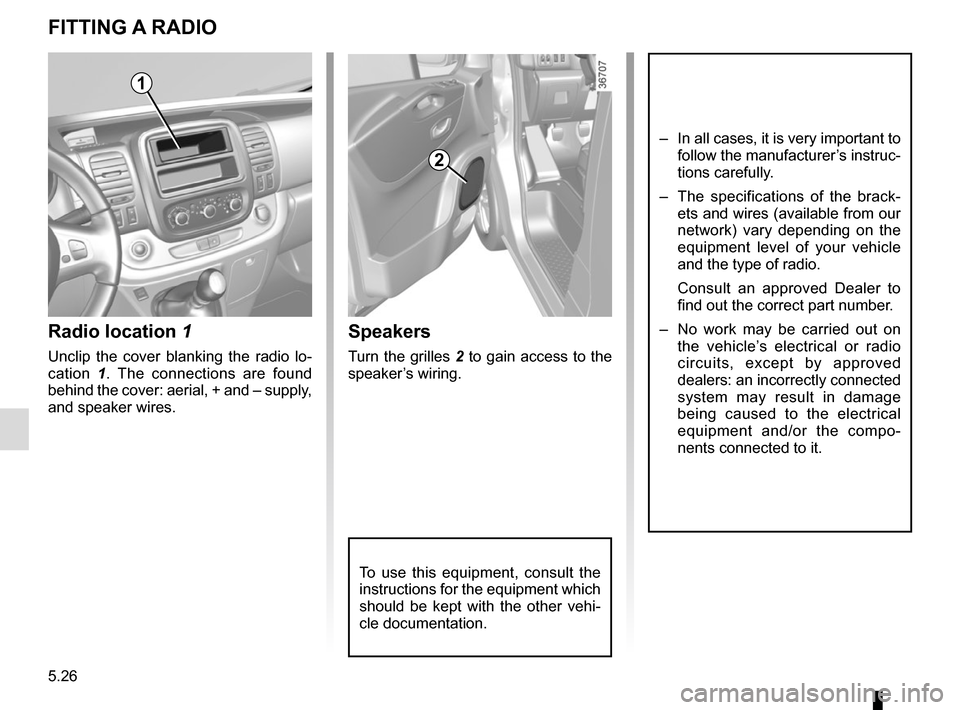
FITTING A RADIO
Radio location 1
Unclip the cover blanking the radio lo-
cation 1. The connections are found
behind the cover: aerial, + and – supply,
and speaker wires.
Speakers
Turn the grilles 2 to gain access to the
speaker’s wiring.
– In all cases, it is very important to follow the manufacturer’s instruc-
tions carefully.
– The specifications of the brack- ets and wires (available from our
network) vary depending on the
equipment level of your vehicle
and the type of radio.
Consult an approved Dealer to find out the correct part number.
– No work may be carried out on the vehicle’s electrical or radio
circuits, except by approved
dealers: an incorrectly connected
system may result in damage
being caused to the electrical
equipment and/or the compo-
nents connected to it.
2
To use this equipment, consult the
instructions for the equipment which
should be kept with the other vehi-
cle documentation.
1
Page 249 of 292
5.29
No.Allocation
1 + battery urea injection
2 + battery for vehicles with
RENAULT card
3 APC load for vehicle with
RENAULT card
4 Heater
5 Adjustment
6 Adjustment
7 Heater
8 Additional heating and air
conditioning
9 Supplementary passenger
compartment heating
10 Electric door mirrors,
supplementary central unit
adjustment
11 Heated door mirror
12 Radio, multimedia, rear-view
mirror, diagnostic socket
13 Pre-equipment, towbar socket
14 Timed battery, passenger
compartment unit
15 Passenger compartment
central unit, tyre pressure loss
notification, hands-free access
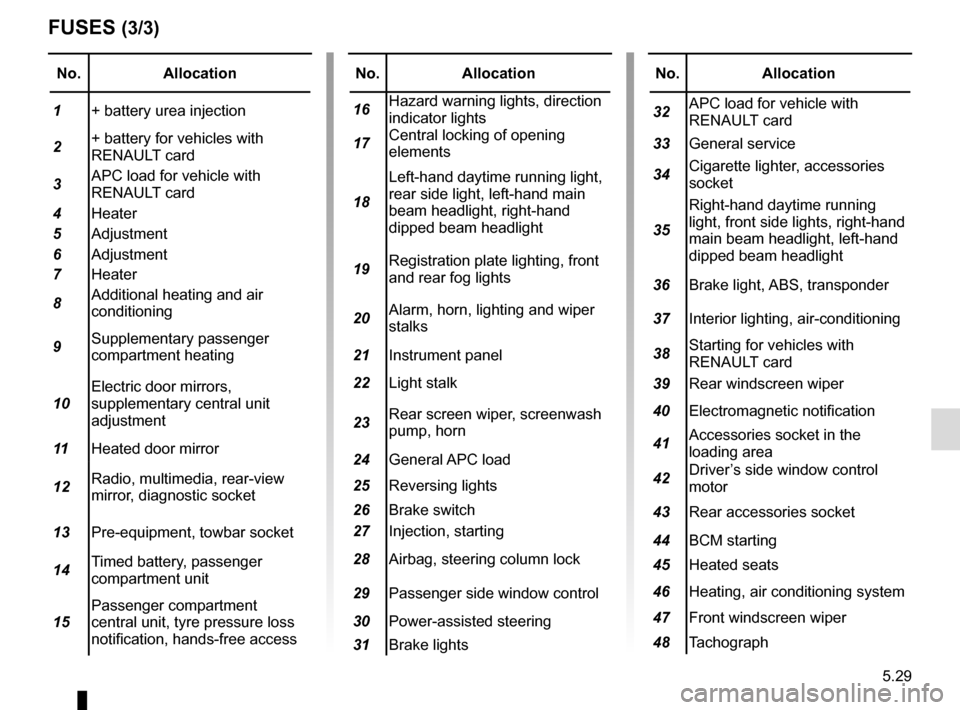
FUSES (3/3)
No.
Allocation
16 Hazard warning lights, direction
indicator lights
17 Central locking of opening
elements
18 Left-hand daytime running light,
rear side light, left-hand main
beam headlight, right-hand
dipped beam headlight
19 Registration plate lighting, front
and rear fog lights
20 Alarm, horn, lighting and wiper
stalks
21 Instrument panel
22 Light stalk
23 Rear screen wiper, screenwash
pump, horn
24 General APC load
25 Reversing lights
26 Brake switch
27 Injection, starting
28 Airbag, steering column lock
29 Passenger side window control
30 Power-assisted steering
31 Brake lightsNo. Allocation
32 APC load for vehicle with
RENAULT card
33 General service
34 Cigarette lighter, accessories
socket
35 Right-hand daytime running
light, front side lights, right-hand
main beam headlight, left-hand
dipped beam headlight
36 Brake light, ABS, transponder
37 Interior lighting, air-conditioning
38 Starting for vehicles with
RENAULT card
39 Rear windscreen wiper
40 Electromagnetic notification
41 Accessories socket in the
loading area
42 Driver’s side window control
motor
43 Rear accessories socket
44 BCM starting
45 Heated seats
46 Heating, air conditioning system
47 Front windscreen wiper
48 Tachograph
Page 250 of 292

5.30
ACCESSORIES
Electrical and electronic accessoriesBefore installing this type of accessory (particularly for transmitters\
/receivers: frequency bandwidth, power level, po-
sition of the aerial, etc.), make sure it is compatible with your vehic\
le. You can get advice from an authorised dealer.
Connect accessories with a maximum power of 120 watts only. Fire hazard.
No work may be carried out on the vehicle’s electrical or radio circuits, except by authorised dealers: an incorre\
ctly connecte d
system may result in damage being caused to the electrical equipment and\
/or the components connected to it.
If the vehicle is fitted with any aftermarket electrical equipment, make\
sure that the installation is correctly protected by a fuse.
Establish the rating and position of this fuse.
Use of transmission/receiving devices (telephones, CB equipment etc.).\
Telephones and CB equipment with integrated aerials may cause interferenc\
e to the electronic systems originally fitted to the
vehicle: it is advisable only to use equipment with an external aerial. \
Furthermore, we remind you of the need to conform
to the legislation in force concerning the use of such equipment.
Fitting after-market accessoriesIf you wish to install accessories on the vehicle: please contact an aut\
horised dealer. Also, to ensure the correct operation o f
your vehicle, and to avoid any risk to your safety, we recommend that you use only accessories specifically designed for y\
our
vehicle, which are the only accessories for which the manufacturer will \
provide a warranty.
If you are using an anti-theft device, only attach it to the brake pedal\
.
Obstructions to the driver
On the driver’s side, only use mats suitable for the vehicle, attached with the pre-fi\
tted components, and check the fitting re gu-
larly. Do not lay one mat on top of another. There is a risk of wedging the pedals
Page 286 of 292
7.2
ALPHABETICAL INDEX (2/5)
E
ECO driving ...........................................................2.12 → 2.15
ECO mode ................................................................ 2.13, 3.10
electric beam height adjustment ......................... 1.106 – 1.107
electric windows ..................................................... 3.14 – 3.15
electronic stability control: ESC .............................2.21 → 2.25
emergency brake assist.........................................2.21 → 2.25
emergency braking ................................................2.21 → 2.25
emergency key ........................................................... 1.7 – 1.8
emergency spare wheel ............................................. 5.2 – 5.3
engine technical specifications .................................................. 6.8
engine coolant ..................................................................... 4.7
engine oil ...................................................................4.4 → 4.6
engine oil capacity ...................................................... 4.5 – 4.6
engine oil level ...........................................................4.4 → 4.6
engine specifications .................................................... 6.3, 6.8
engine standby ..........................................................2.7 → 2.9
engine start/stop button .............................................2.3 → 2.6
environment ............................................................\
........... 2.17
ESC: electronic stability control ....................1.86, 2.21 → 2.25
external temperature ....................................................... 1.100
F
faults operating faults ................................................5.35 → 5.41
filter air filter ........................................................................\
... 4.9
oil filter .................................................................. 4.5 – 4.6
passenger compartment filter ........................................ 4.9
fitting a radio ...................................................................... 5.26
fittings ...............................................................\
.....3.19 → 3.27
front passenger air bag deactivation ................................. 1.77
front seat adjustment .............................................. 1.29 – 1.30
front seats adjustment ............................................... 1.28 – 1.30, 1.32 fuel
advice on fuel economy ...................................2.12 → 2.15
consumption ....................................................2.12 → 2.15
filling .................................................... 1.84, 1.112 → 1.114
grade ............................................................ 1.112 → 1.114
fuel consumption ...................................................2.12 → 2.15
fuel filler cap ...................................................... 1.112 → 1.114
fuel level ................................................................1.84 → 1.88
fuel tank capacity ...............................................................\
....... 1.112
fuel tank capacity ............................................... 1.112 → 1.114
fuses ..................................................................\
....5.27 → 5.29
G
gear lever..............................................................\
............. 2.11
grip control ........................................................................\
. 2.24
H
handbrake...............................................................\
........... 2.11
hazard warning lights signal ............................................ 1.108
headlight beam adjustment ................................ 1.106 – 1.107
headrest................................................................\
.... 1.28, 3.30
heated seats ...................................................................... 1.29
heated windscreen .................................................. 3.8 → 3.11
heating and air conditioning system ........................3.4 → 3.13
heating system ........................................................3.4 → 3.12
Hill Start Assist.......................................................2.21 → 2.25
horn ...................................................................\
.............. 1.108
horn: flash ..................................................................\
......... 1.108
hubcap tool ................................................................. 5.7 – 5.8
I
idle speed ........................................................................\
.. 2.34
ignition switch ...................................................................... 2.2
indicator lights........................................................\
............ 5.19