Eco system RENAULT TRAFIC 2017 X82 / 3.G Owner's Guide
[x] Cancel search | Manufacturer: RENAULT, Model Year: 2017, Model line: TRAFIC, Model: RENAULT TRAFIC 2017 X82 / 3.GPages: 294, PDF Size: 7.94 MB
Page 234 of 294
5.12
TYRES (2/3)
1
2
Maintaining the tyres
The tyres must be in good condition
and the tread form must have sufficient
depth; tyres approved by our Technical
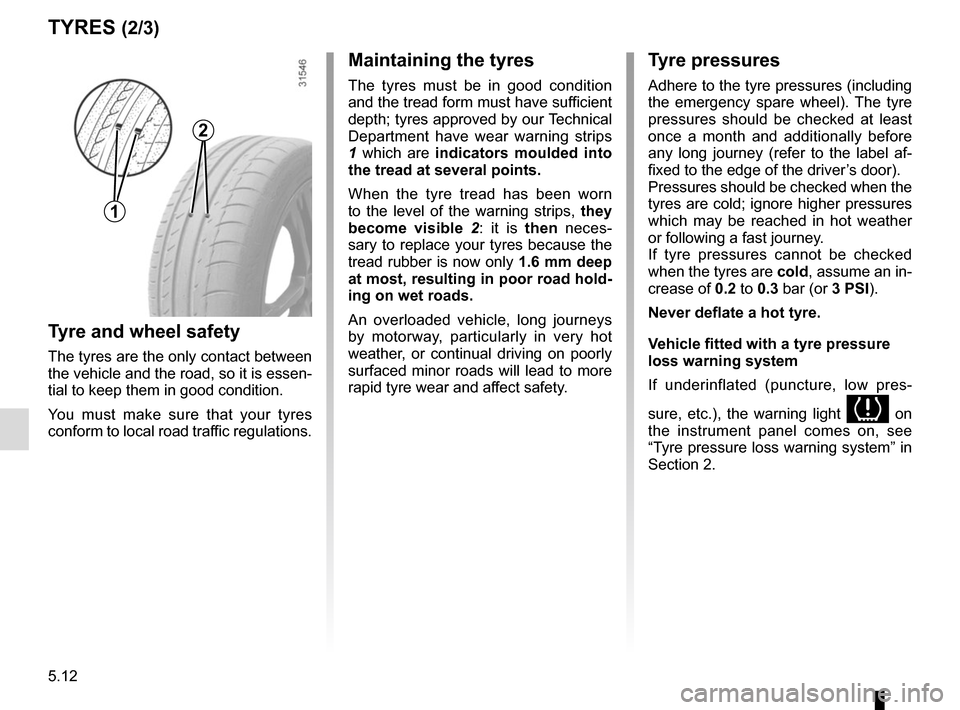
Department have wear warning strips
1 which are indicators moulded into
the tread at several points.
When the tyre tread has been worn
to the level of the warning strips, they
become visible 2: it is then neces-
sary to replace your tyres because the
tread rubber is now only 1.6 mm deep
at most, resulting in poor road hold-
ing on wet roads.
An overloaded vehicle, long journeys
by motorway, particularly in very hot
weather, or continual driving on poorly
surfaced minor roads will lead to more
rapid tyre wear and affect safety.
Tyre and wheel safety
The tyres are the only contact between
the vehicle and the road, so it is essen-
tial to keep them in good condition.
You must make sure that your tyres
conform to local road traffic regulations.
Tyre pressures
Adhere to the tyre pressures (including
the emergency spare wheel). The tyre
pressures should be checked at least
once a month and additionally before
any long journey (refer to the label af-
fixed to the edge of the driver’s door).
Pressures should be checked when the
tyres are cold; ignore higher pressures
which may be reached in hot weather
or following a fast journey.
If tyre pressures cannot be checked
when the tyres are cold, assume an in-
crease of 0.2 to 0.3 bar (or 3 PSI).
Never deflate a hot tyre.
Vehicle fitted with a tyre pressure
loss warning system
If underinflated (puncture, low pres-
sure, etc.), the warning light
on
the instrument panel comes on, see
“Tyre pressure loss warning system” in
Section 2.
Page 252 of 294

5.30
ACCESSORIES
Electrical and electronic accessories
Before installing this type of accessory (particularly for transmitters\
/receivers: frequency bandwidth, power level, po-
sition of the aerial, etc.), make sure it is compatible with your vehic\
le. You can get advice from an authorised dealer.
Connect accessories with a maximum power of 120 Watts only. Fire hazard. When several accessory sockets are
used at the same time, the total power of the connected accessories must\
not exceed 180 watts.
No work may be carried out on the vehicle’s electrical or radio circuits, except by authorised dealers: an incorre\
ctly connecte d
system may result in damage being caused to the electrical equipment and\
/or the components connected to it.
If the vehicle is fitted with any aftermarket electrical equipment, make\
sure that the installation is correctly protected by a fuse.
Establish the rating and position of this fuse.
Using the diagnostic socket
The use of electronic accessories on the diagnostic socket may cause ser\
ious disturbance to the vehicle’s electronic systems.
For your safety we recommend that you use only electronic accessories ap\
proved by the manufacturer, consult an Approved
Dealer. Serious accident risk.
Use of transmitting/receiving devices (telephones, CB equipment etc.).\
Telephones and CB equipment with integrated aerials may cause interferenc\
e to the electronic systems originally fitted to the
vehicle: it is advisable only to use equipment with an external aerial. \
Furthermore, we remind you of the need to conform
to the legislation in force concerning the use of such equipment.
Fitting aftermarket accessories
If you wish to install accessories on the vehicle: please contact an aut\
horised dealer. Also, to ensure the correct operation o f
your vehicle, and to avoid any risk to your safety, we recommend that you use only accessories specifically designed for y\
our
vehicle, which are the only accessories for which the manufacturer will \
provide a warranty.
If you are using an anti-theft device, only attach it to the brake pedal\
.
Obstructions to the driver
On the driver’s side, only use mats suitable for the vehicle, attached with the pre-fi\
tted components, and check the fitting re gu-
larly. Do not lay one mat on top of another. There is a risk of wedging the pedals.
Page 261 of 294
5.39
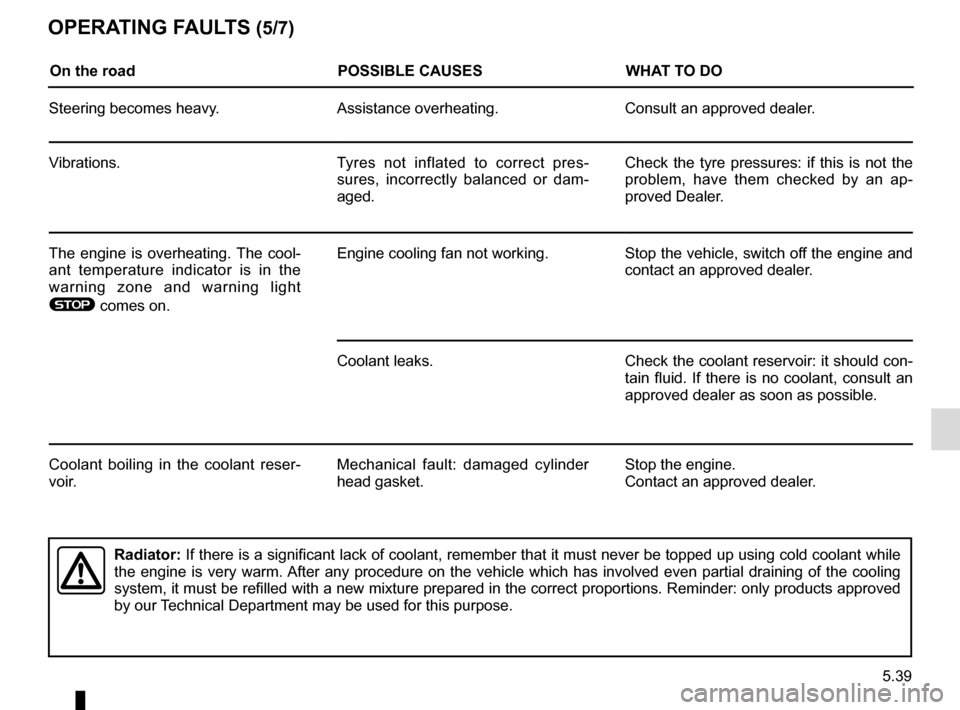
OPERATING FAULTS (5/7)
On the roadPOSSIBLE CAUSESWHAT TO DO
Steering becomes heavy. Assistance overheating. Consult an approved dealer.
Vibrations. Tyres not inflated to correct pres-
sures, incorrectly balanced or dam-
aged. Check the tyre pressures: if this is not the
problem, have them checked by an ap-
proved Dealer.
The engine is overheating. The cool-
ant temperature indicator is in the
warning zone and warning light
® comes on. Engine cooling fan not working. Stop the vehicle, switch off the engine and
contact an approved dealer.
Coolant leaks. Check the coolant reservoir: it should con- tain fluid. If there is no coolant, consult an
approved dealer as soon as possible.
Coolant boiling in the coolant reser-
voir. Mechanical fault: damaged cylinder
head gasket. Stop the engine.
Contact an approved dealer.
Radiator:
If there is a significant lack of coolant, remember that it must never b\
e topped up using cold coolant while
the engine is very warm. After any procedure on the vehicle which has involved even partial drain\
ing of the cooling
system, it must be refilled with a new mixture prepared in the correct p\
roportions. Reminder: only products approved
by our Technical Department may be used for this purpose.
Page 288 of 294
7.2
ALPHABETICAL INDEX (2/5)
driving positionsettings ............................................................1.32 → 1.36
driving recommendations ......................................2.12 → 2.15
E
ECO driving ...........................................................2.12 → 2.15
ECO mode ................................................................ 2.13, 3.10
electric beam height adjustment ......................... 1.107 – 1.108
electric windows ..................................................... 3.15 – 3.16
electronic stability control: ESC .............................2.21 → 2.25
emergency brake assist.........................................2.21 → 2.25
emergency braking ................................................2.21 → 2.25
emergency key ........................................................... 1.7 – 1.8
emergency spare wheel ............................................. 5.2 – 5.3
engine technical specifications .................................................. 6.8
engine coolant ..................................................................... 4.7
engine oil ...................................................................4.4 → 4.6
engine oil capacity ...................................................... 4.5 – 4.6
engine oil level ...........................................................4.4 → 4.6
engine specifications .................................................... 6.3, 6.8
engine standby ..........................................................2.7 → 2.9
engine start/stop button .............................................2.3 → 2.6
environment ............................................................\
........... 2.17
ESC: electronic stability control ....................1.86, 2.21 → 2.25
external temperature ....................................................... 1.100
F
faults operating faults ................................................5.35 → 5.41
filter air filter ........................................................................\
... 4.9
oil filter .................................................................. 4.5 – 4.6
passenger compartment filter ........................................ 4.9
fitting a radio ...................................................................... 5.26
fittings ...............................................................\
.....3.20 → 3.28front passenger air bag deactivation ................................. 1.77
front seat adjustment .............................................. 1.29 – 1.30
front seats adjustment ............................................... 1.28 – 1.30, 1.32
fuel advice on fuel economy ...................................2.12 → 2.15
consumption ....................................................2.12 → 2.15
filling .................................................... 1.84, 1.113 → 1.115
grade ............................................................ 1.113 → 1.115
fuel consumption ...................................................2.12 → 2.15
fuel filler cap ...................................................... 1.113 → 1.115
fuel level ................................................................1.84 → 1.88
fuel tank capacity ...............................................................\
....... 1.113
fuel tank capacity ............................................... 1.113 → 1.115
fuses ..................................................................\
....5.27 → 5.29
G
gear lever........................................................................\
... 2.11
grip control ........................................................................\
. 2.24
H
handbrake........................................................................\
.. 2.11
hazard warning lights signal ............................................ 1.109
headlight beam adjustment ................................ 1.107 – 1.108
headrest.................................................................... 1.28, 3.31
heated seats ...................................................................... 1.29
heated windscreen .................................................. 3.8 → 3.11
heating and air conditioning system ...............3.4 → 3.12, 3.14
heating system ........................................................3.4 → 3.13
Hill Start Assist.......................................................2.21 → 2.25
horn ...................................................................\
.............. 1.109
horn: flash ..................................................................\
......... 1.109
hubcap tool ................................................................. 5.7 – 5.8