brake light RENAULT TRAFIC 2018 User Guide
[x] Cancel search | Manufacturer: RENAULT, Model Year: 2018, Model line: TRAFIC, Model: RENAULT TRAFIC 2018Pages: 298, PDF Size: 8.05 MB
Page 207 of 298
3.43
TRANSPORTING OBJECTS towbar
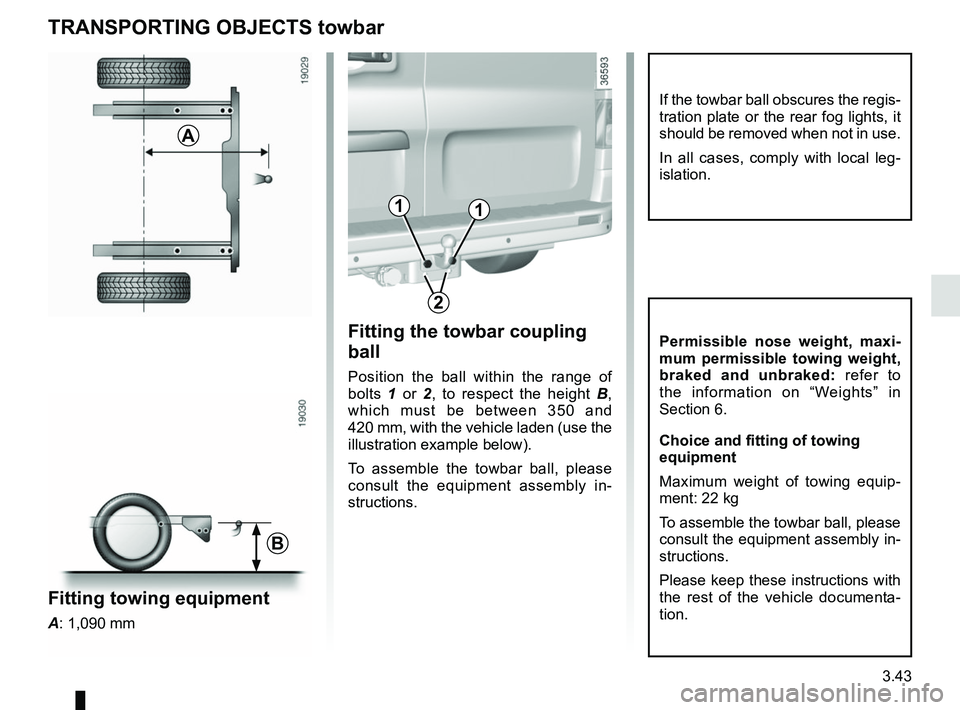
Fitting the towbar coupling
ball
Position the ball within the range of
bolts 1 or 2 , to respect the height B,
which must be between 350 and
420 mm, with the vehicle laden (use the
illustration example below).
To assemble the towbar ball, please
consult the equipment assembly in-
structions.
A
If the towbar ball obscures the regis-
tration plate or the rear fog lights, it
should be removed when not in use.
In all cases, comply with local leg-
islation.
Permissible nose weight, maxi-
mum permissible towing weight,
braked and unbraked: refer to
the information on “Weights” in
Section 6.
Choice and fitting of towing
equipment
Maximum weight of towing equip-
ment: 22 kg
To assemble the towbar ball, please
consult the equipment assembly in-
structions.
Please keep these instructions with
the rest of the vehicle documenta-
tion.
2
B
11
Fitting towing equipment
A: 1,090 mm
Page 216 of 298
4.8
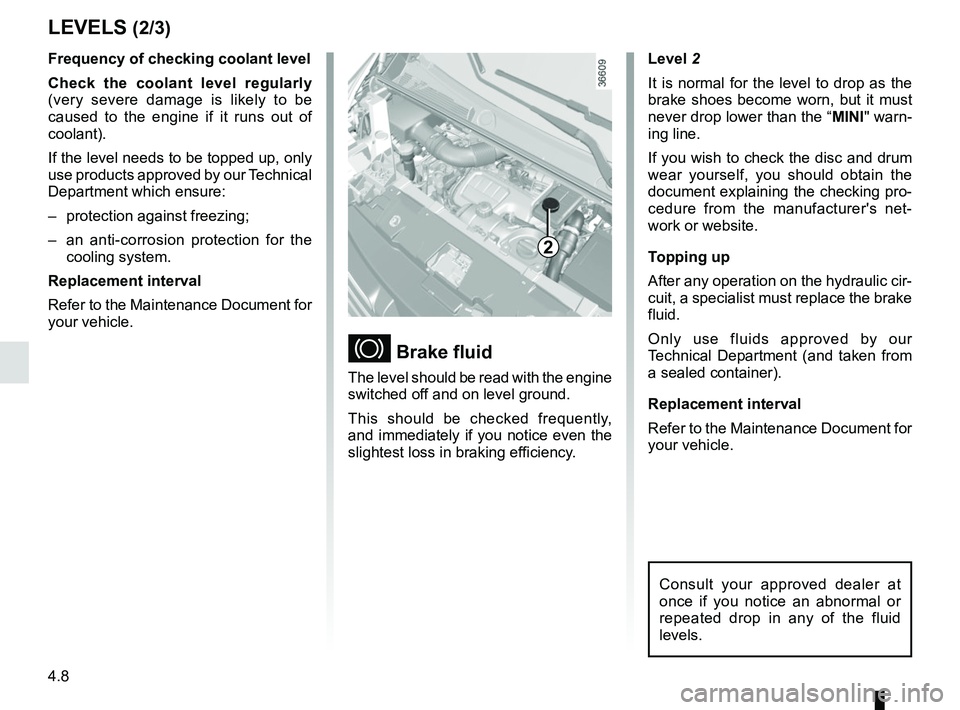
Level 2
It is normal for the level to drop as the
brake shoes become worn, but it must
never drop lower than the “MINI" warn-
ing line.
If you wish to check the disc and drum
wear yourself, you should obtain the
document explaining the checking pro-
cedure from the manufacturer's net-
work or website.
Topping up
After any operation on the hydraulic cir-
cuit, a specialist must replace the brake
fluid.
Only use fluids approved by our
Technical Department (and taken from
a sealed container).
Replacement interval
Refer to the Maintenance Document for
your vehicle.
Brake fluid
The level should be read with the engine
switched off and on level ground.
This should be checked frequently,
and immediately if you notice even the
slightest loss in braking efficiency.
LEVELS (2/3)
2
Consult your approved dealer at
once if you notice an abnormal or
repeated drop in any of the fluid
levels.
Frequency of checking coolant level
Check the coolant level regularly
(very severe damage is likely to be
caused to the engine if it runs out of
coolant).
If the level needs to be topped up, only
use products approved by our Technical
Department which ensure:
– protection against freezing;
– an anti-corrosion protection for the cooling system.
Replacement interval
Refer to the Maintenance Document for
your vehicle.
Page 231 of 298
5.5
TYRE PRESSURE KIT (2/3)
Before using this kit, park
the vehicle at a sufficient
distance from traffic, switch
on the hazard warning
lights, apply the handbrake, ask all
passengers to leave the vehicle and
keep them away from traffic.
Nothing should be placed
around the driver’s feet
as such objects may slide
under the pedals during
sudden braking manoeuvres and
obstruct their use.
Please be aware that a
poorly tightened or miss-
ing valve cap can make the
tyres less airtight and may
lead to pressure loss.
Always use valve caps identical to
those fitted originally and tighten
them fully.
If the vehicle is parked on
the hard shoulder, you must
warn other road users of
your vehicle’s presence
with a warning triangle or with other
devices as per the legislation apply-
ing to the country you are in.
Following repair with the kit,
do not travel further than
120 miles (200 km). In addi-
tion, reduce your speed and
under no circumstances exceed
48 mph (80 km/h). The sticker,
which you must affix in a prominent
position on the dashboard, reminds
you of this.
Depending on the country or local
legislation, a tyre repaired with the
inflation kit may need to be replaced.
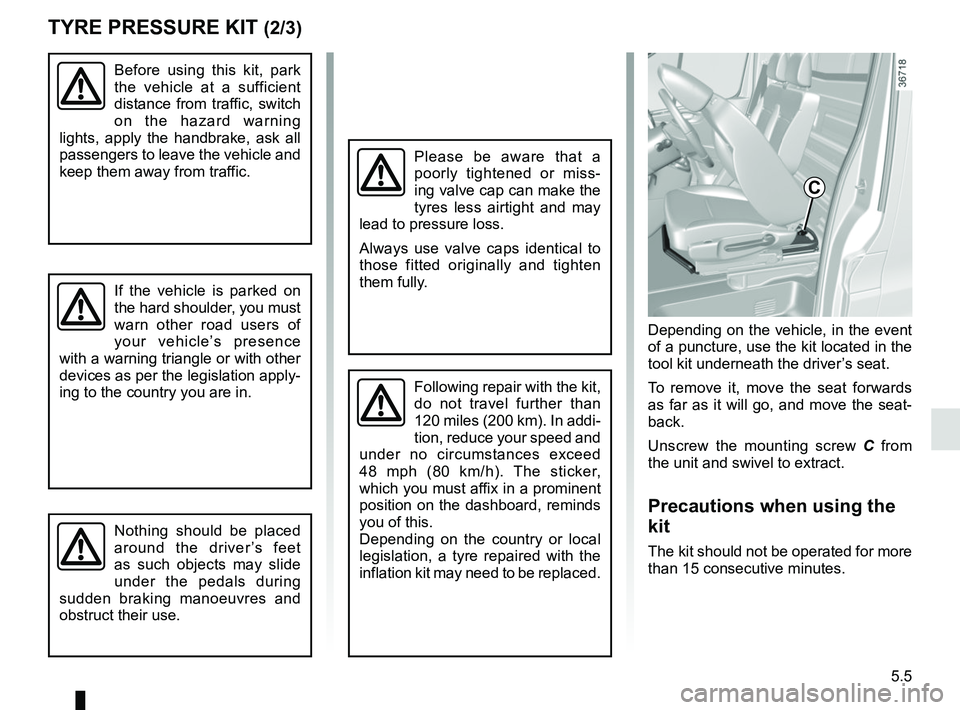
Depending on the vehicle, in the event
of a puncture, use the kit located in the
tool kit underneath the driver’s seat.
To remove it, move the seat forwards
as far as it will go, and move the seat-
back.
Unscrew the mounting screw C from
the unit and swivel to extract.
Precautions when using the
kit
The kit should not be operated for more
than 15 consecutive minutes.
C
Page 235 of 298
5.9
CHANGING A WHEEL (1/2)
Switch on the hazard warn-
ing lights.
Keep the vehicle away from
traffic and on a level surface
where it will not slip.
Apply the hand brake and engage a
gear (first or reverse, or P for auto-
matic transmissions).
Ask all the passengers to leave the
vehicle and keep them away from
traffic.
If the vehicle is parked on
the hard shoulder, you must
warn other road users of
your vehicle’s presence
with a warning triangle or with other
devices as per the legislation apply-
ing to the country you are in.
If you have a puncture, re-
place the wheel as soon as
possible.
A tyre which has been punc-
tured should always be inspected
(and repaired, where possible) by a
specialist.
Do not leave the tools un-
secured inside the vehicle
as they may come loose
under braking. After use,
check that all the tools are correctly
clipped into the tool kit, then position
it correctly in its housing: there is a
risk of injury.
The jack is designed for wheel
changing purposes only. Under no
circumstances should it be used for
carrying out repairs underneath the
vehicle or to gain access to the un-
derside of the vehicle.
Page 243 of 298
5.17
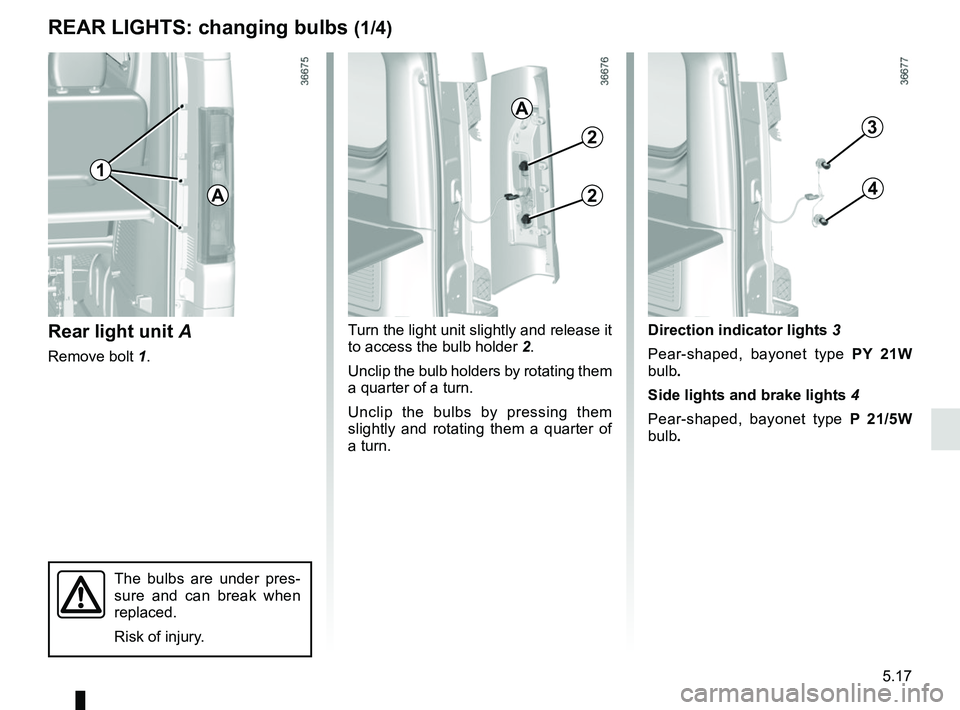
REAR LIGHTS: changing bulbs (1/4)
Rear light unit A
Remove bolt 1.
Turn the light unit slightly and release it
to access the bulb holder 2.
Unclip the bulb holders by rotating them
a quarter of a turn.
Unclip the bulbs by pressing them
slightly and rotating them a quarter of
a turn.
The bulbs are under pres-
sure and can break when
replaced.
Risk of injury.
A
A
2
2
1
3
4
Direction indicator lights 3
Pear-shaped, bayonet type PY 21W
bulb .
Side lights and brake lights 4
Pear-shaped, bayonet type P 21/5W
bulb .
Page 245 of 298
5.19
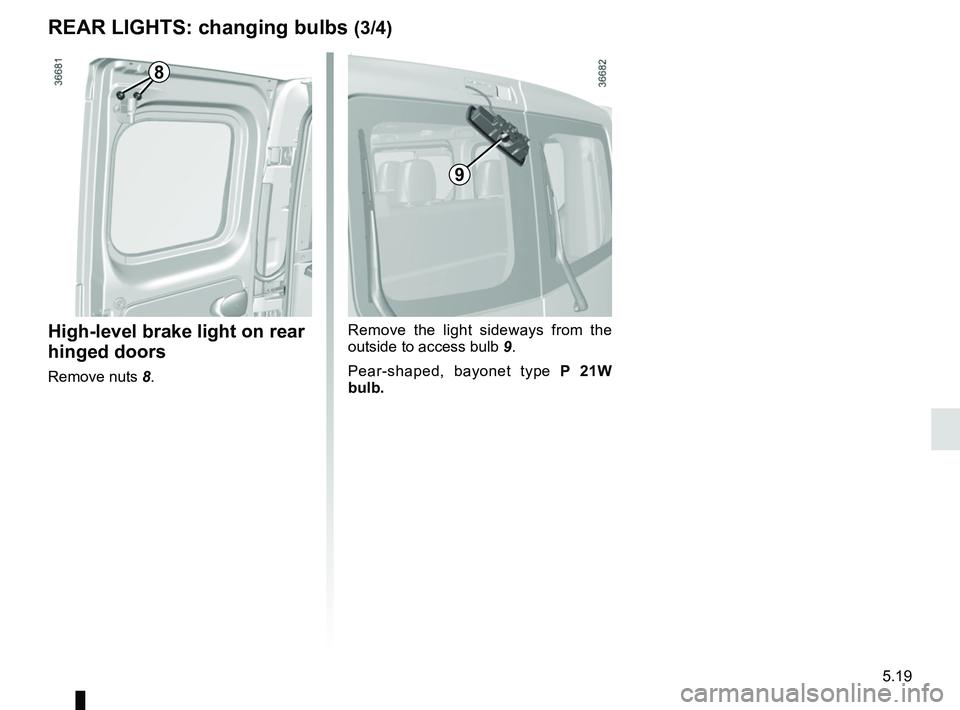
REAR LIGHTS: changing bulbs (3/4)
High-level brake light on rear
hinged doors
Remove nuts 8.Remove the light sideways from the
outside to access bulb
9.
Pear-shaped, bayonet type P 21W
bulb.
9
8
Page 246 of 298
5.20
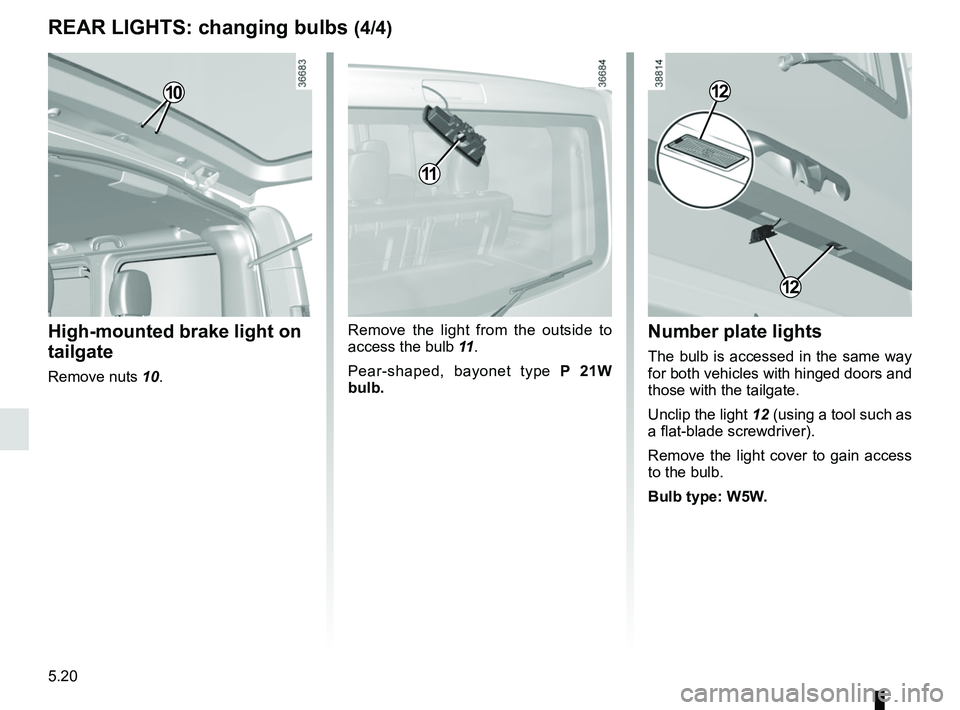
REAR LIGHTS: changing bulbs (4/4)
High-mounted brake light on
tailgate
Remove nuts 10.
Remove the light from the outside to
access the bulb 11.
Pear-shaped, bayonet type P 21W
bulb.Number plate lights
The bulb is accessed in the same way
for both vehicles with hinged doors and
those with the tailgate.
Unclip the light 12 (using a tool such as
a flat-blade screwdriver).
Remove the light cover to gain access
to the bulb.
Bulb type: W5W.
11
10
12
12
Page 255 of 298
5.29
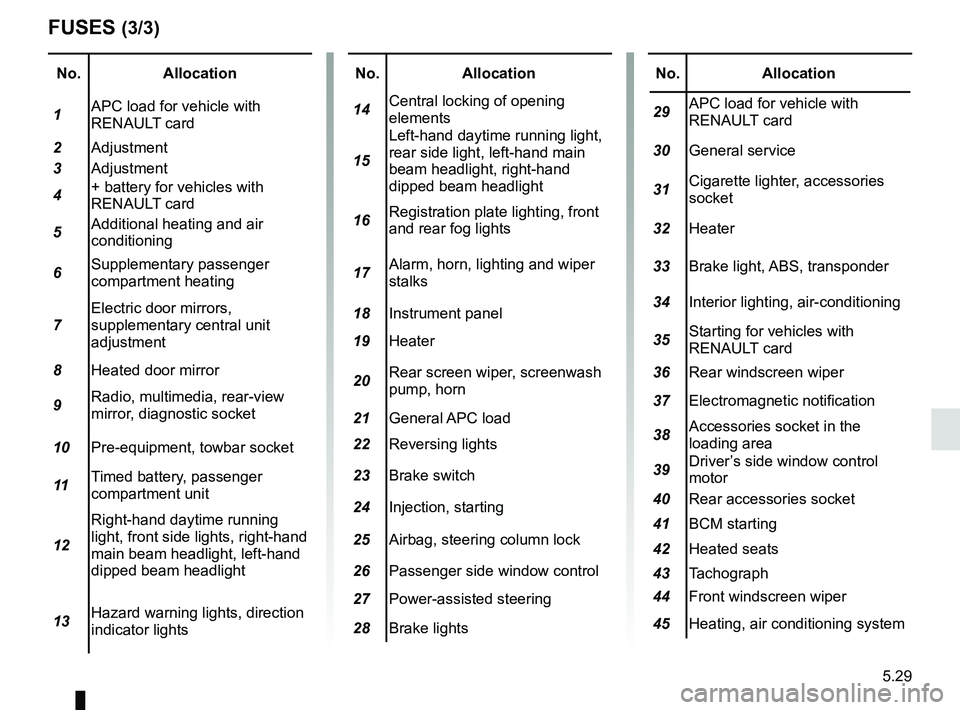
No.Allocation
1 APC load for vehicle with
RENAULT card
2 Adjustment
3 Adjustment
4 + battery for vehicles with
RENAULT card
5 Additional heating and air
conditioning
6 Supplementary passenger
compartment heating
7 Electric door mirrors,
supplementary central unit
adjustment
8 Heated door mirror
9 Radio, multimedia, rear-view
mirror, diagnostic socket
10 Pre-equipment, towbar socket
11 Timed battery, passenger
compartment unit
12 Right-hand daytime running
light, front side lights, right-hand
main beam headlight, left-hand
dipped beam headlight
13 Hazard warning lights, direction
indicator lights
FUSES (3/3)
No.
Allocation
14 Central locking of opening
elements
15 Left-hand daytime running light,
rear side light, left-hand main
beam headlight, right-hand
dipped beam headlight
16 Registration plate lighting, front
and rear fog lights
17 Alarm, horn, lighting and wiper
stalks
18 Instrument panel
19 Heater
20 Rear screen wiper, screenwash
pump, horn
21 General APC load
22 Reversing lights
23 Brake switch
24 Injection, starting
25 Airbag, steering column lock
26 Passenger side window control
27 Power-assisted steering
28 Brake lightsNo. Allocation
29 APC load for vehicle with
RENAULT card
30 General service
31 Cigarette lighter, accessories
socket
32 Heater
33 Brake light, ABS, transponder
34 Interior lighting, air-conditioning
35 Starting for vehicles with
RENAULT card
36 Rear windscreen wiper
37 Electromagnetic notification
38 Accessories socket in the
loading area
39 Driver’s side window control
motor
40 Rear accessories socket
41 BCM starting
42 Heated seats
43 Tachograph
44 Front windscreen wiper
45 Heating, air conditioning system
Page 259 of 298
5.33
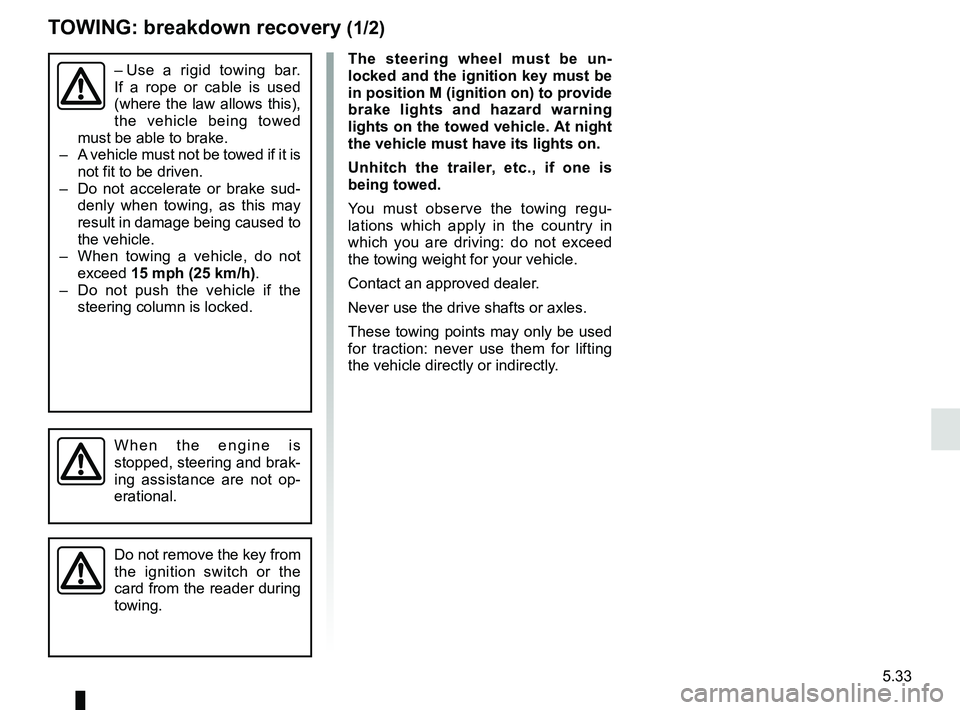
TOWING: breakdown recovery (1/2)
The steering wheel must be un-
locked and the ignition key must be
in position M (ignition on) to provide
brake lights and hazard warning
lights on the towed vehicle. At night
the vehicle must have its lights on.
Unhitch the trailer, etc., if one is
being towed.
You must observe the towing regu-
lations which apply in the country in
which you are driving: do not exceed
the towing weight for your vehicle.
Contact an approved dealer.
Never use the drive shafts or axles.
These towing points may only be used
for traction: never use them for lifting
the vehicle directly or indirectly.– Use a rigid towing bar.
If a rope or cable is used
(where the law allows this),
the vehicle being towed
must be able to brake.
– A vehicle must not be towed if it is
not fit to be driven.
– Do not accelerate or brake sud- denly when towing, as this may
result in damage being caused to
the vehicle.
– When towing a vehicle, do not exceed 15 mph (25 km/h).
– Do not push the vehicle if the steering column is locked.
When the engine is
stopped, steering and brak-
ing assistance are not op-
erational.
Do not remove the key from
the ignition switch or the
card from the reader during
towing.
Page 291 of 298
7.1
ALPHABETICAL INDEX (1/5)
A
ABS ..............................................................1.86, 2.21 → 2.25
accessories........................................................................\
5.30
accessories socket ................................................. 3.31 – 3.32
additional methods of restraint .......................................... 1.43 side protection ............................................................. 1.42
to the front seat belts .......................................1.37 → 1.40
to the rear seat belts .................................................... 1.41
additive (tank) .................................................... 1.116 → 1.119
additive tank ...................................................... 1.116 → 1.119
adjusting your driving position ..1.28 – 1.30, 1.32 → 1.36, 3.33
advice on antipollution ....................................................... 2.16
air bag.......................................1.37 → 1.40, 1.42 – 1.43, 1.84
activating the front passenger air bags ........................ 1.79
deactivating the front passenger air bags .................... 1.77
air conditioning ........................................................3.4 → 3.15
air vents ...................................................................... 3.2 – 3.3
anti-corrosion check ..............................................6.18 → 6.22
anti-corrosion protection .................................................... 4.14
anti-lock braking system: ABS ...............................2.21 → 2.25
antipollution advice .................................................................\
......... 2.16
armrest: front ..................................................................\
............ 3.26
ashtray .................................................................... 3.31 – 3.32
audible and visual signals................................................ 1.109
B
battery................................................. 4.12 – 4.13, 5.25 – 5.26 troubleshooting ................................................. 5.25 – 5.26
bonnet........................................................................\
. 4.2 – 4.3
brake fluid ........................................................................\
.... 4.8
bulbs changing ..........................................................5.14 → 5.22C
catalytic converter.............................................................. 2.10
central door locking 1.4 → 1.6, 1.13, 1.16 → 1.21, 1.23 → 1.27
changing a bulb .....................................................5.14 → 5.22
changing a wheel...................................................... 5.9 – 5.10
changing gear .................................................................... 2.11
child restraint/seat ....................1.44 – 1.45, 1.47 → 1.64, 1.77
child safety......1.15, 1.40, 1.44 – 1.45, 1.47 → 1.64, 1.77, 2.4,
3.16 – 3.17
child seats..........................................1.44 – 1.45, 1.47 → 1.64
children ................................. 1.2, 1.7, 1.44 – 1.45, 3.16 – 3.17
children (safety) ................................................... 1.2, 1.7, 1.15
cigar lighter ............................................................. 3.31 – 3.32
cleaning: inside the vehicle .............................................. 4.17 – 4.18
clock ..................................................................... 1.99 – 1.100
closing the doors ........................................... 1.14 – 1.15, 1.27
control instruments ..........................1.84 → 1.91, 1.99 – 1.100
controls ...............................................................\
...1.80 → 1.83
courtesy light ................................................3.19 → 3.21, 5.21
cruise control ................................................1.87, 2.29 → 2.32
cruise control-speed limiter....................................2.26 → 2.32
D
dashboard..............................................................1.80 → 1.83
deadlocking the doors ................................................ 1.6, 1.13
demisting rear screen ......................................................... 3.8 → 3.11
windscreen .................................................. 3.5, 3.8 → 3.11
dimensions .............................................................\
...6.4 → 6.7
dipstick................................................................\
................. 4.4
display ................................................................\
...1.84 → 1.89
doors......................................................................1.18 →
1.21
doors/tailgate .......................1.2 → 1.8, 1.13, 1.23 – 1.24, 1.27
driver
’s position .....................................................1.80 → 1.87
driving ............ 2.2 → 2.6, 2.10, 2.14, 2.18 → 2.33, 2.35 – 2.36