light RENAULT TRAFIC 2018 User Guide
[x] Cancel search | Manufacturer: RENAULT, Model Year: 2018, Model line: TRAFIC, Model: RENAULT TRAFIC 2018Pages: 298, PDF Size: 8.05 MB
Page 24 of 298
1.18
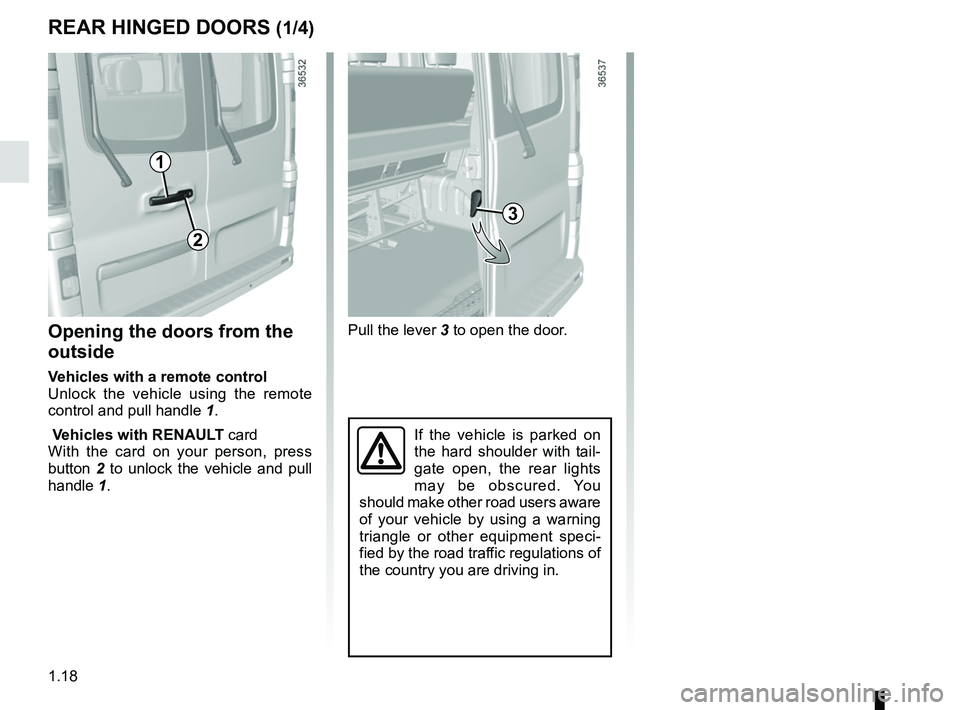
Pull the lever 3 to open the door.
If the vehicle is parked on
the hard shoulder with tail-
gate open, the rear lights
may be obscured. You
should make other road users aware
of your vehicle by using a warning
triangle or other equipment speci-
fied by the road traffic regulations of
the country you are driving in.
REAR HINGED DOORS (1/4)
Opening the doors from the
outside
Vehicles with a remote control
Unlock the vehicle using the remote
control and pull handle 1.
Vehicles with RENAULT card
With the card on your person, press
button 2 to unlock the vehicle and pull
handle 1.
1
3
2
1
Page 30 of 298
1.24
CENTRAL LOCKING, UNLOCKING OF OPENING ELEMENTS (2/2)
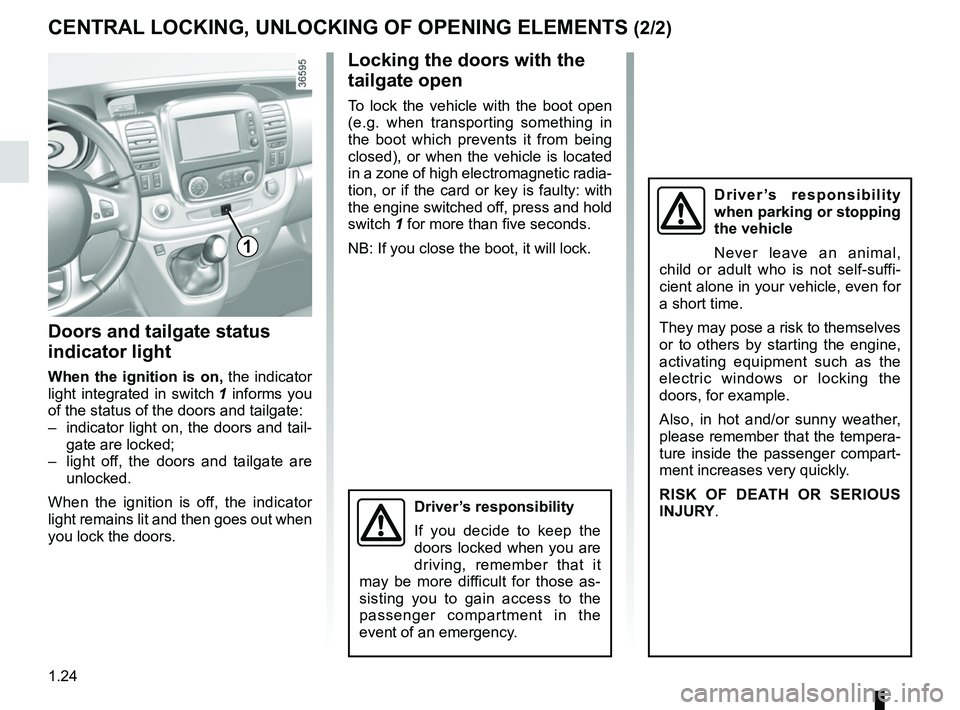
Locking the doors with the
tailgate open
To lock the vehicle with the boot open
(e.g. when transporting something in
the boot which prevents it from being
closed), or when the vehicle is located
in a zone of high electromagnetic radia-
tion, or if the card or key is faulty: with
the engine switched off, press and hold
switch 1 for more than five seconds.
NB: If you close the boot, it will lock.
Driver’s responsibility
If you decide to keep the
doors locked when you are
driving, remember that it
may be more difficult for those as-
sisting you to gain access to the
passenger compartment in the
event of an emergency.
Doors and tailgate status
indicator light
When the ignition is on, the indicator
light integrated in switch 1 informs you
of the status of the doors and tailgate:
– indicator light on, the doors and tail- gate are locked;
– light off, the doors and tailgate are unlocked.
When the ignition is off, the indicator
light remains lit and then goes out when
you lock the doors.
1
Driver’s responsibility
when parking or stopping
the vehicle
Never leave an animal,
child or adult who is not self-suffi-
cient alone in your vehicle, even for
a short time.
They may pose a risk to themselves
or to others by starting the engine,
activating equipment such as the
electric windows or locking the
doors, for example.
Also, in hot and/or sunny weather,
please remember that the tempera-
ture inside the passenger compart-
ment increases very quickly.
RISK OF DEATH OR SERIOUS
INJURY.
Page 38 of 298
1.32
Always wear your seat belt when trav-
elling in your vehicle. You must also
comply with the legislation of the par-
ticular country you are in.
SEAT BELTS (1/5)
1
2
Incorrectly adjusted or
twisted seat belts may
cause injuries in the event
of an accident.
Use one seat belt per person,
whether child or adult.
Even pregnant women should wear
a seat belt. In this case, ensure that
the lap belt is not exerting too much
pressure on the abdomen, but do
not allow any slack.
Before starting, first adjust your driv-
ing position, then ask all occupants
to adjust their seat belts to ensure
optimum protection.
Adjusting your driving
position
– Sit well back in your seat (having
first removed your coat or jacket).
This is essential to ensure your back
is positioned correctly;
– adjust the distance between the seat and the pedals. Your seat
should be as far back as possible
while still allowing you to depress
the clutch pedal fully. The seatback
should be adjusted so that your arms
are slightly bent when you hold the
steering wheel;
– adjust the position of your head- rest. For the maximum safety, your
head must be as close as possible to
the headrest;
– adjust the height of the seat. This
adjustment allows you to select the
seat position which offers you the
best possible view ;
– adjust the position of the steering
wheel.
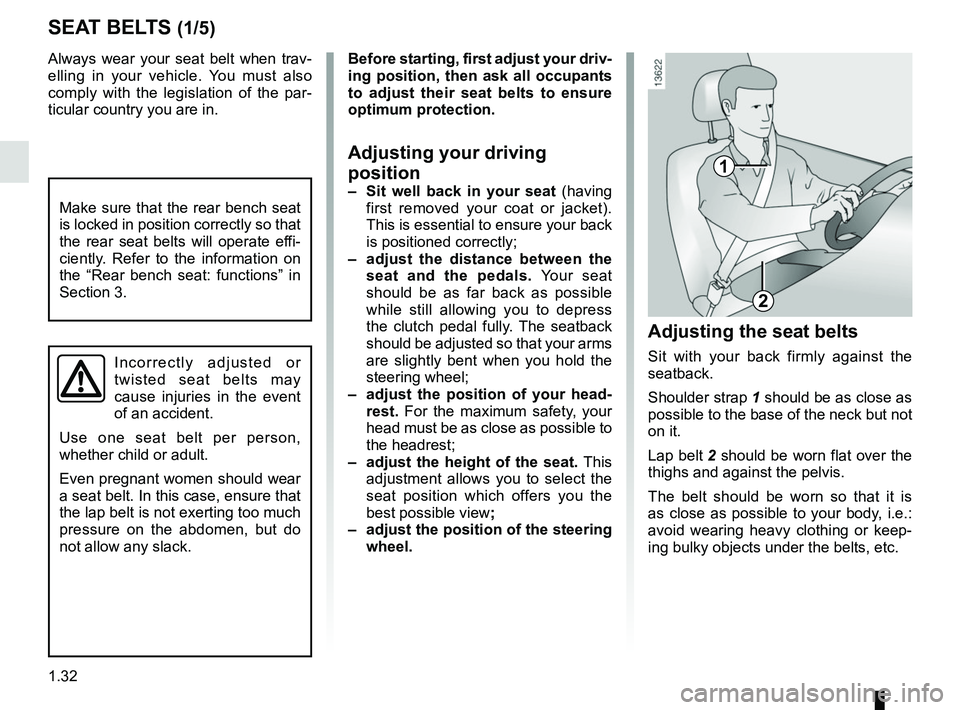
Adjusting the seat belts
Sit with your back firmly against the
seatback.
Shoulder strap 1 should be as close as
possible to the base of the neck but not
on it.
Lap belt 2 should be worn flat over the
thighs and against the pelvis.
The belt should be worn so that it is
as close as possible to your body, i.e.:
avoid wearing heavy clothing or keep-
ing bulky objects under the belts, etc.
Make sure that the rear bench seat
is locked in position correctly so that
the rear seat belts will operate effi-
ciently. Refer to the information on
the “Rear bench seat: functions” in
Section 3.
Page 39 of 298
1.33
SEAT BELTS (2/5)
ßFront seat belt reminder
warning light
It lights up on the central display when
the engine is started and, if the driv-
er’s seat belt is not fastened, the light
flashes and a beep sounds for about
2 minutes when the vehicle reaches a
speed of about 9.92 mph (16 km/h).
Depending on the vehicle, this flashes if
the front passenger seat belt is not fas-
tened.
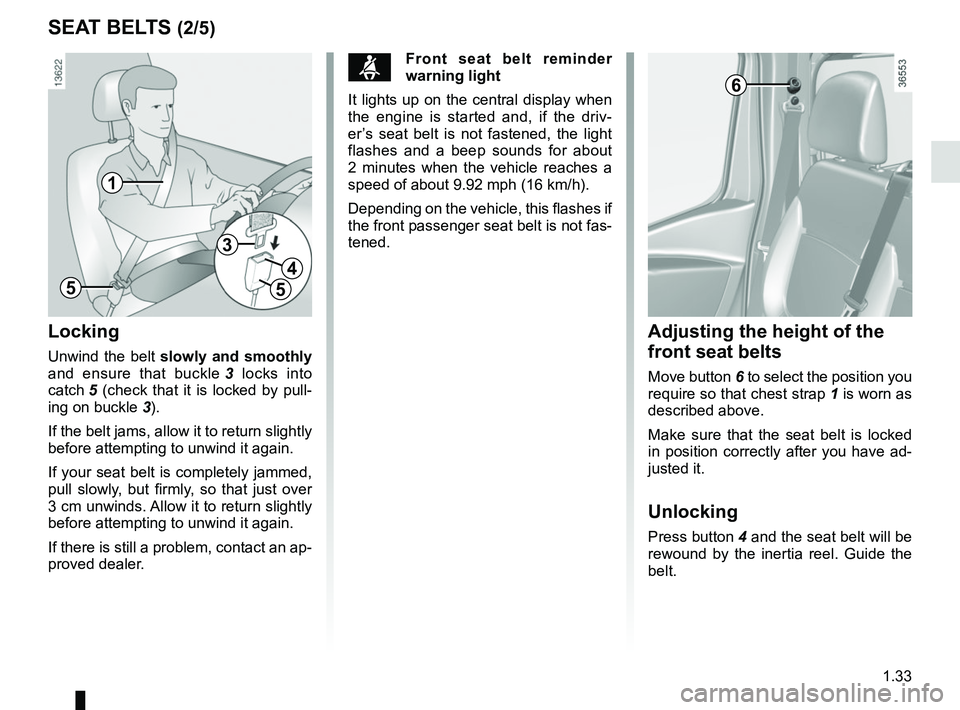
Adjusting the height of the
front seat belts
Move button 6 to select the position you
require so that chest strap 1 is worn as
described above.
Make sure that the seat belt is locked
in position correctly after you have ad-
justed it.
Unlocking
Press button 4 and the seat belt will be
rewound by the inertia reel. Guide the
belt.
6
Locking
Unwind the belt slowly and smoothly
and ensure that buckle 3 locks into
catch 5 (check that it is locked by pull- ing on buckle 3).
If the belt jams, allow it to return slightly
before attempting to unwind it again.
If your seat belt is completely jammed,
pull slowly, but firmly, so that just over
3 cm unwinds. Allow it to return slightly
before attempting to unwind it again.
If there is still a problem, contact an ap-
proved dealer.
1
5
3
4
5
Page 44 of 298
1.38
Load limiter
Above a certain severity of impact, this
mechanism is used to limit the force of
the belt against the body so that it is at
an acceptable level.
Airbags driver and passenger
front
Fitted to the driver and passenger
sides.
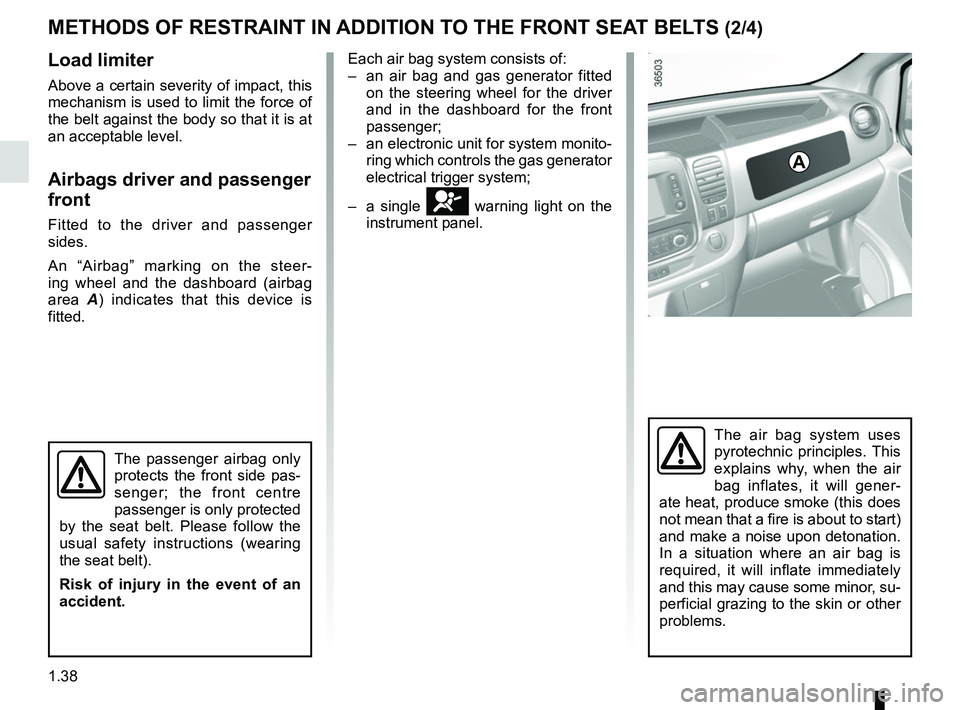
An “Airbag” marking on the steer-
ing wheel and the dashboard (airbag
area A) indicates that this device is
fitted.
Each air bag system consists of:
– an air bag and gas generator fitted on the steering wheel for the driver
and in the dashboard for the front
passenger;
– an electronic unit for system monito- ring which controls the gas generator
electrical trigger system;
– a single
å warning light on the
instrument panel.
METHODS OF RESTRAINT IN ADDITION TO THE FRONT SEAT BELTS (2/4)
The air bag system uses
pyrotechnic principles. This
explains why, when the air
bag inflates, it will gener-
ate heat, produce smoke (this does
not mean that a fire is about to start)
and make a noise upon detonation.
In a situation where an air bag is
required, it will inflate immediately
and this may cause some minor, su-
perficial grazing to the skin or other
problems.
A
The passenger airbag only
protects the front side pas-
senger; the front centre
passenger is only protected
by the seat belt. Please follow the
usual safety instructions (wearing
the seat belt).
Risk of injury in the event of an
accident.
Page 45 of 298
1.39
METHODS OF RESTRAINT IN ADDITION TO THE FRONT SEAT BELTS (3/4)
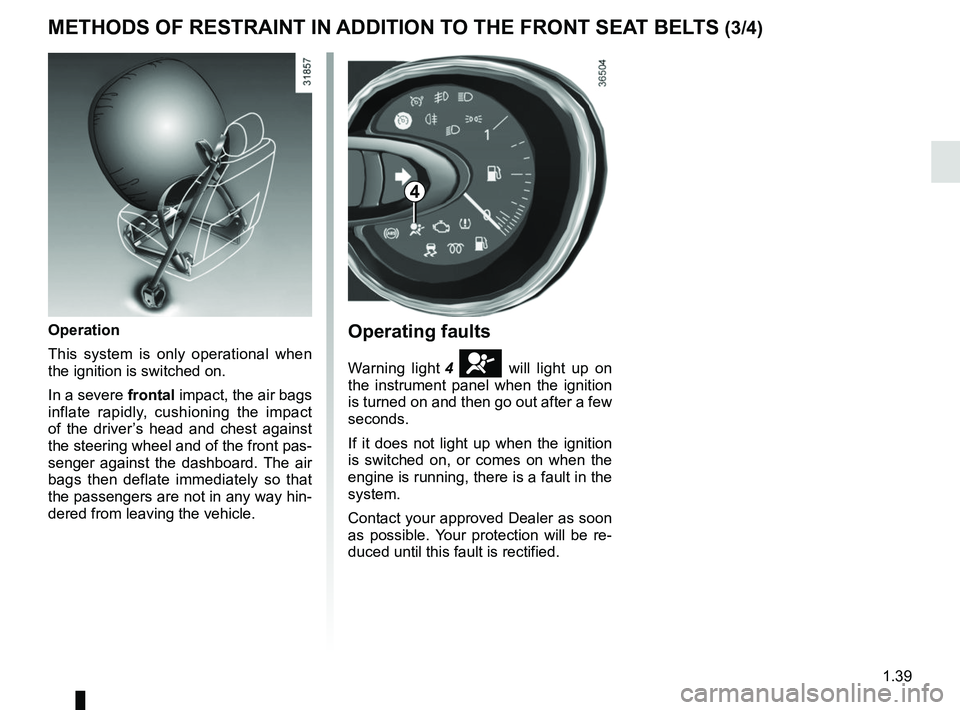
Operating faults
Warning light 4 å will light up on
the instrument panel when the ignition
is turned on and then go out after a few
seconds.
If it does not light up when the ignition
is switched on, or comes on when the
engine is running, there is a fault in the
system.
Contact your approved Dealer as soon
as possible. Your protection will be re-
duced until this fault is rectified.
4
Operation
This system is only operational when
the ignition is switched on.
In a severe frontal impact, the air bags
inflate rapidly, cushioning the impact
of the driver’s head and chest against
the steering wheel and of the front pas-
senger against the dashboard. The air
bags then deflate immediately so that
the passengers are not in any way hin-
dered from leaving the vehicle.
Page 46 of 298
1.40
METHODS OF RESTRAINT IN ADDITION TO THE FRONT SEAT BELTS (4/4)
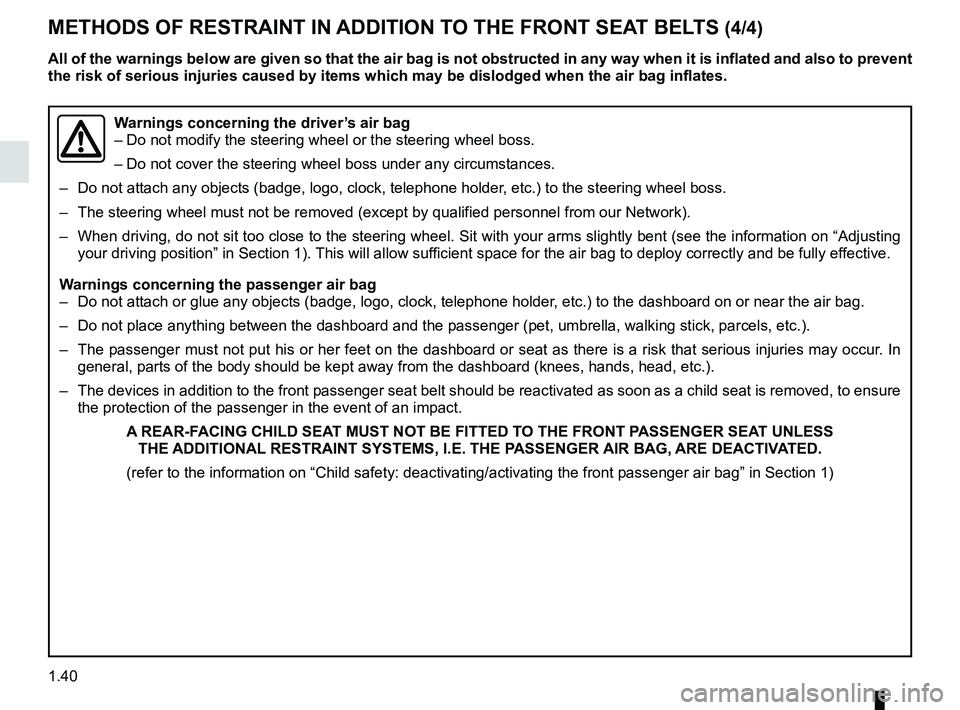
Warnings concerning the driver’s air bag
– Do not modify the steering wheel or the steering wheel boss.
– Do not cover the steering wheel boss under any circumstances.
– Do not attach any objects (badge, logo, clock, telephone holder, etc.) to the steering wheel boss.
– The steering wheel must not be removed (except by qualified personnel f\
rom our Network).
– When driving, do not sit too close to the steering wheel. Sit with your \
arms slightly bent (see the information on “Adjusting
your driving position” in Section 1). This will allow sufficient space for the air bag to deploy correctly and be fully effective.
Warnings concerning the passenger air bag
– Do not attach or glue any objects (badge, logo, clock, telephone holder\
, etc.) to the dashboard on or near the air bag.
– Do not place anything between the dashboard and the passenger (pet, umb\
rella, walking stick, parcels, etc.).
– The passenger must not put his or her feet on the dashboard or seat as t\
here is a risk that serious injuries may occur. In general, parts of the body should be kept away from the dashboard (knee\
s, hands, head, etc.).
– The devices in addition to the front passenger seat belt should be react\
ivated as soon as a child seat is removed, to ensure the protection of the passenger in the event of an impact.
A REAR-FACING CHILD SEAT MUST NOT BE FITTED TO THE FRONT PASSENGER SEAT UNLESS THE ADDITIONAL RESTRAINT SYSTEMS, I.E. THE PASSENGER AIR BAG, ARE DEACTIVATED.
(refer to the information on “Child safety: deactivating/activating \
the front passenger air bag” in Section 1)
All of the warnings below are given so that the air bag is not obstructe\
d in any way when it is inflated and also to prevent
the risk of serious injuries caused by items which may be dislodged when\
the air bag inflates.
Page 58 of 298
1.52
CHILD SEATS: attachment by seat belt (2/14)
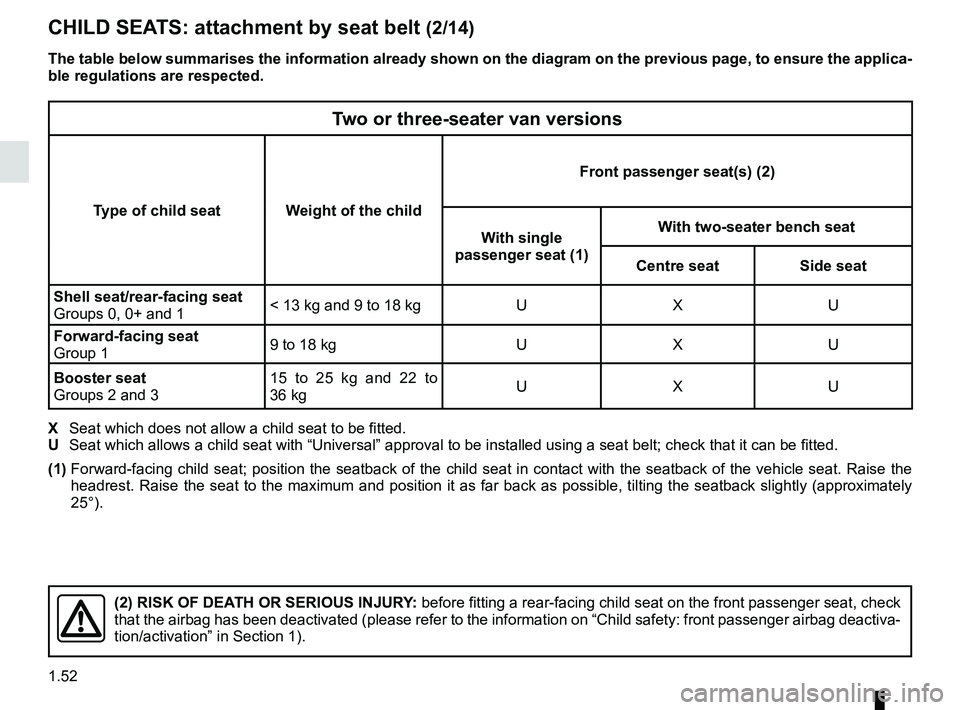
Two or three-seater van versions
Type of child seat Weight of the childFront passenger seat(s) (2)
With single
passenger seat (1) With two-seater bench seat
Centre seat Side seat
Shell seat/rear-facing seat
Groups 0, 0+ and 1 < 13 kg and 9 to 18 kg U X U
Forward-facing seat
Group 1 9 to 18 kg U X U
Booster seat
Groups 2 and 3 15 to 25 kg and 22 to
36 kg
UXU
X Seat which does not allow a child seat to be fitted.
U Seat which allows a child seat with “Universal” approval to be ins\
talled using a seat belt; check that it can be fitted.
(1) Forward-facing child seat; position the seatback of the child seat in co\
ntact with the seatback of the vehicle seat. Raise the
headrest. Raise the seat to the maximum and position it as far back as p\
ossible, tilting the seatback slightly (approximately
25°).
(2) RISK OF DEATH OR SERIOUS INJURY: before fitting a rear-facing child seat on the front passenger seat, ch\
eck
that the airbag has been deactivated (please refer to the information o\
n “Child safety: front passenger airbag deactiva-
tion/activation” in Section 1).
The table below summarises the information already shown on the diagram \
on the previous page, to ensure the applica-
ble regulations are respected.
Page 61 of 298

X = Seat not suitable for fitting child seats of this type.
U = Seat which allows a child seat with “Universal” approval to be ins\
talled using")
1.55
CHILD SEATS: attachment by seat belt (5/14)
X = Seat not suitable for fitting child seats of this type.
U = Seat which allows a child seat with “Universal” approval to be ins\
talled using a seat belt; check that it can be fitted.
(2) Raise the seat to the maximum and position it as far back as possible, \
tilting the seatback slightly (approximately 25°).
(3) A carrycot can be installed across the vehicle and will take up at least \
two seats. Position the child with his or her feet nea rest
the door.
(4) Move the front seat as far forward as possible to install a rear-facing \
child seat, then move back the seat in front as far as it will
go, although without allowing it to come into contact with the child sea\
t.
(5) Forward-facing child seat; position the seatback of the child seat in co\
ntact with the seatback of the vehicle seat. In all sit ua-
tions, remove the rear headrest of the seat on which the child seat is p\
ositioned. This must be done before fitting the child s eat
(please refer to the section entitled “Rear headrests” in Section\
3). Do not push the seat in front of the child more than half way
back on its runners and do not recline the seatback more than 25°.
Page 67 of 298

X = Seat not suitable for fitting child seats of this type.
U = Seat which allows a child seat with “Universal” approval to be ins\
talled using")
1.61
CHILD SEATS: attachment by seat belt (11/14)
X = Seat not suitable for fitting child seats of this type.
U = Seat which allows a child seat with “Universal” approval to be ins\
talled using a seat belt; check that it can be fitted.
(2) Raise the seat to the maximum and position it as far back as possible, \
tilting the seatback slightly (approximately 25°).
(3) A carrycot can be installed across the vehicle and will take up at least \
two seats. Position the child with his or her feet nea rest
the door.
(4) Move the front seat as far forward as possible to install a rear-facing \
child seat, then move back the seat in front as far as it will
go, although without allowing it to come into contact with the child sea\
t.
(5) Forward-facing child seat; position the seatback of the child seat in co\
ntact with the seatback of the vehicle seat. In all sit ua-
tions, remove the rear headrest of the seat on which the child seat is p\
ositioned. This must be done before fitting the child s eat
(please refer to the section entitled “Rear headrests” in Section\
3). Do not push the seat in front of the child more than half way
back on its runners and do not recline the seatback more than 25°.