weight RENAULT TRAFIC 2018 User Guide
[x] Cancel search | Manufacturer: RENAULT, Model Year: 2018, Model line: TRAFIC, Model: RENAULT TRAFIC 2018Pages: 298, PDF Size: 8.05 MB
Page 177 of 298
3.13
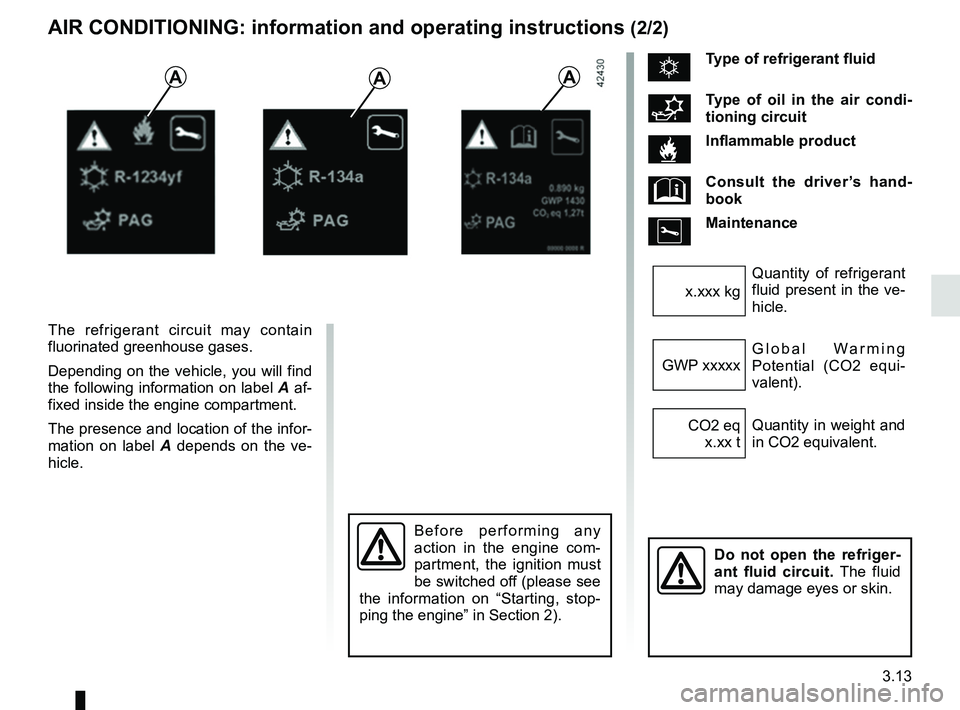
The refrigerant circuit may contain
fluorinated greenhouse gases.
Depending on the vehicle, you will find
the following information on label A af-
fixed inside the engine compartment.
The presence and location of the infor-
mation on label A depends on the ve-
hicle.
AAA
Before performing any
action in the engine com-
partment, the ignition must
be switched off (please see
the information on “Starting, stop-
ping the engine” in Section 2).
AIR CONDITIONING: information and operating instructions (2/2)
ÑType of refrigerant fluid
Type of oil in the air condi-
tioning circuit
Inflammable product
Consult the driver’s hand-
book
Maintenance
Quantity of refrigerant
fluid present in the ve-
hicle.
x.xxx kg
Global Warming
Potential (CO2 equi-
valent).
GWP xxxxx
Quantity in weight and
in CO2 equivalent.
CO2 eq
x.xx t
Do not open the refriger-
ant fluid circuit. The fluid
may damage eyes or skin.
Page 193 of 298
3.29
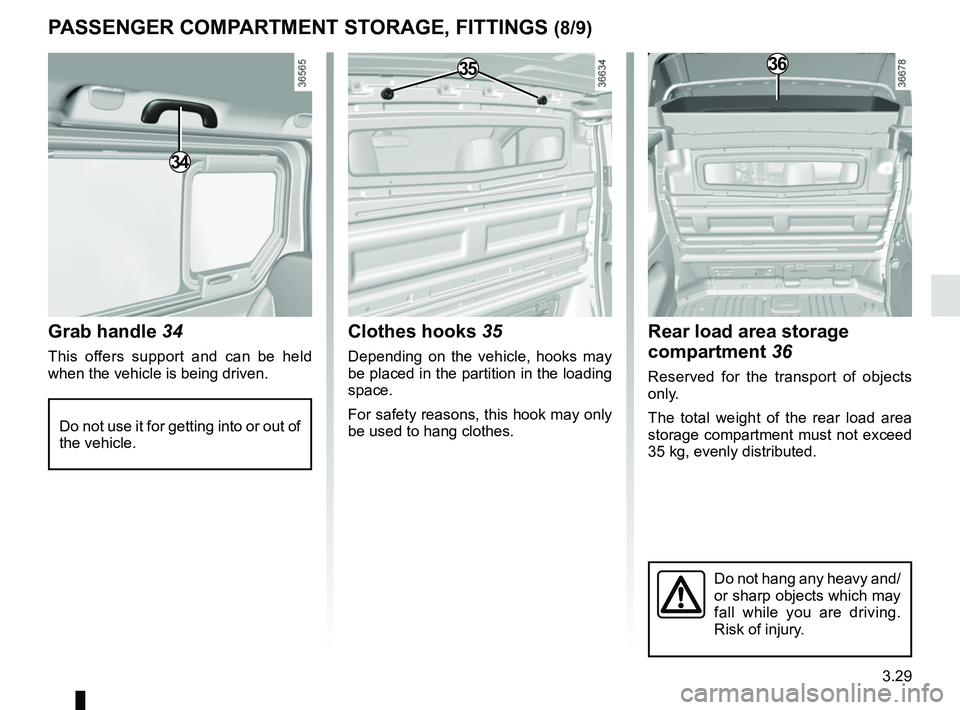
Grab handle 34
This offers support and can be held
when the vehicle is being driven.
PASSENGER COMPARTMENT STORAGE, FITTINGS (8/9)
Do not use it for getting into or out of
the vehicle.
34
Clothes hooks 35
Depending on the vehicle, hooks may
be placed in the partition in the loading
space.
For safety reasons, this hook may only
be used to hang clothes.
3536
Rear load area storage
compartment 36
Reserved for the transport of objects
only.
The total weight of the rear load area
storage compartment must not exceed
35 kg, evenly distributed.
Do not hang any heavy and/
or sharp objects which may
fall while you are driving.
Risk of injury.
Page 207 of 298
3.43
TRANSPORTING OBJECTS towbar
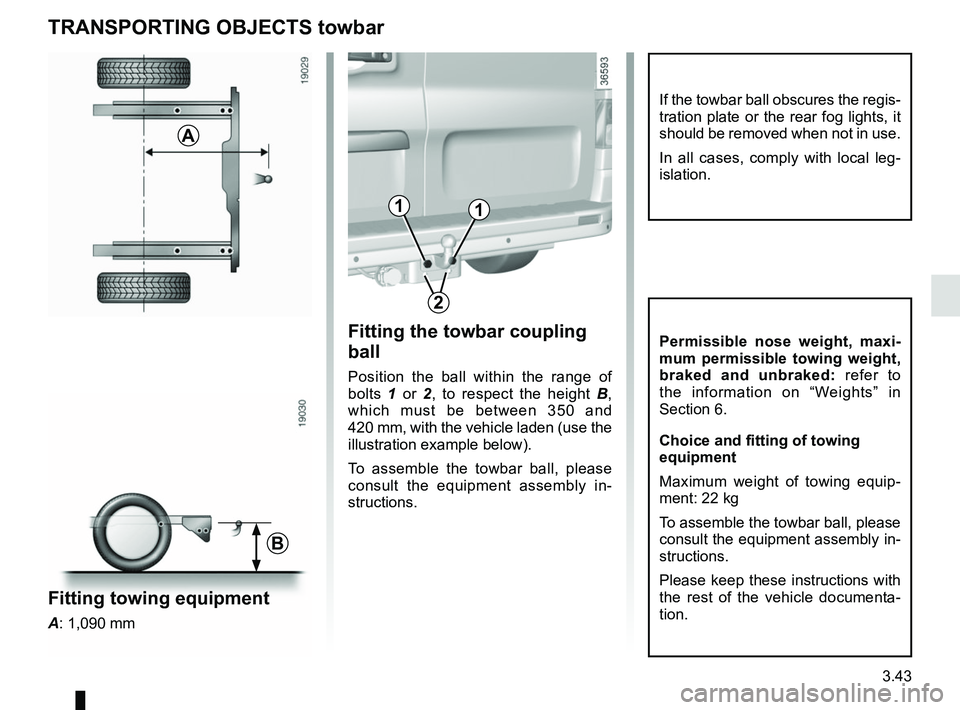
Fitting the towbar coupling
ball
Position the ball within the range of
bolts 1 or 2 , to respect the height B,
which must be between 350 and
420 mm, with the vehicle laden (use the
illustration example below).
To assemble the towbar ball, please
consult the equipment assembly in-
structions.
A
If the towbar ball obscures the regis-
tration plate or the rear fog lights, it
should be removed when not in use.
In all cases, comply with local leg-
islation.
Permissible nose weight, maxi-
mum permissible towing weight,
braked and unbraked: refer to
the information on “Weights” in
Section 6.
Choice and fitting of towing
equipment
Maximum weight of towing equip-
ment: 22 kg
To assemble the towbar ball, please
consult the equipment assembly in-
structions.
Please keep these instructions with
the rest of the vehicle documenta-
tion.
2
B
11
Fitting towing equipment
A: 1,090 mm
Page 211 of 298
4.3
Closing the bonnet
Check that nothing has been left in the
engine compartment.
To close the bonnet again, hold the
bonnet in the middle and lower it to
30 cm above the closed position, then
release it. It will latch automatically
under its own weight.
BONNET (2/2)
2
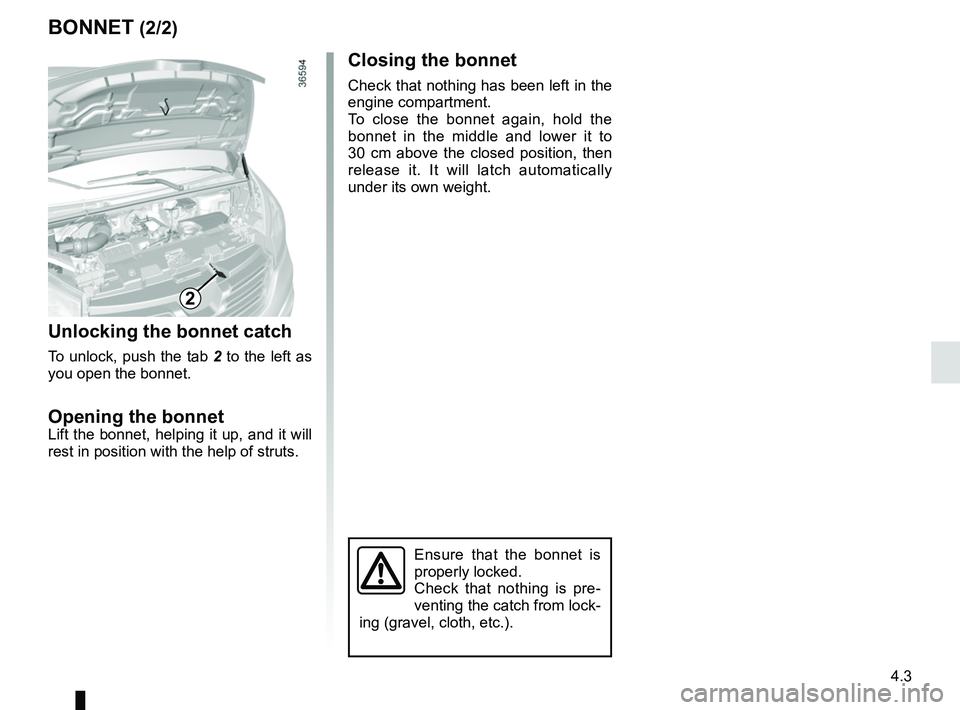
Unlocking the bonnet catch
To unlock, push the tab 2 to the left as
you open the bonnet.
Opening the bonnetLift the bonnet, helping it up, and it will
rest in position with the help of struts.
Ensure that the bonnet is
properly locked.
Check that nothing is pre-
venting the catch from lock-
ing (gravel, cloth, etc.).
Page 219 of 298
4.11
TYRE PRESSURE (2/2)
C
DE
B
A
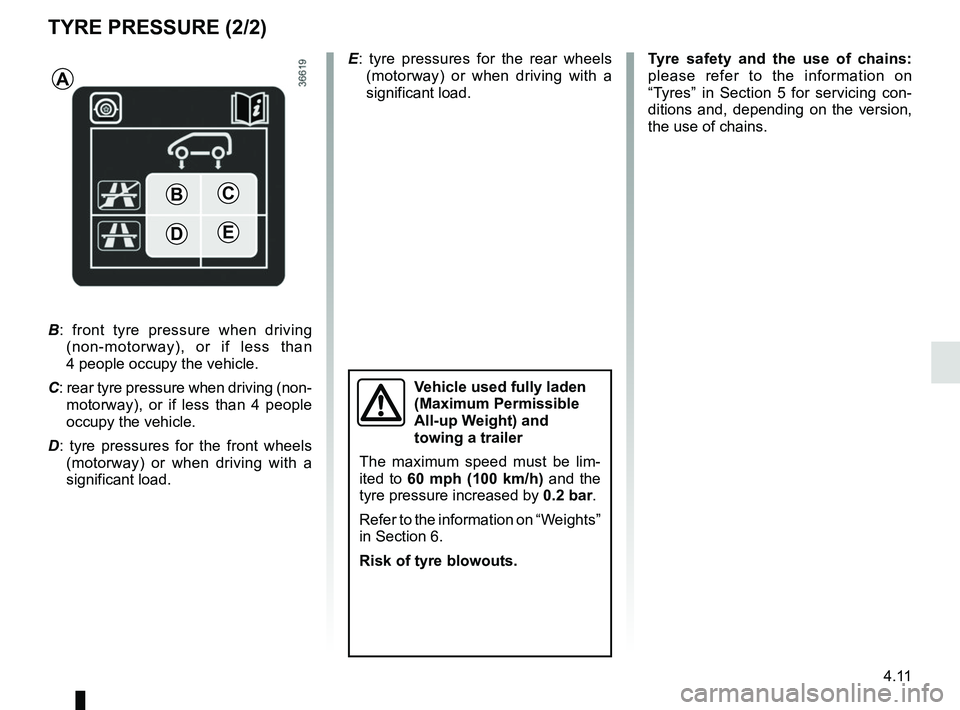
B: front tyre pressure when driving
(non-motorway), or if less than
4 people occupy the vehicle.
C: rear tyre pressure when driving (non- motorway), or if less than 4 people
occupy the vehicle.
D : tyre pressures for the front wheels
(motorway) or when driving with a
significant load. E
: tyre pressures for the rear wheels
(motorway) or when driving with a
significant load.
Vehicle used fully laden
(Maximum Permissible
All-up Weight) and
towing a trailer
The maximum speed must be lim-
ited to 60 mph (100 km/h) and the
tyre pressure increased by 0.2 bar.
Refer to the information on “Weights”
in Section 6.
Risk of tyre blowouts.
Tyre safety and the use of chains:
please refer to the information on
“Tyres” in Section 5 for servicing con-
ditions and, depending on the version,
the use of chains.
Page 259 of 298
5.33
TOWING: breakdown recovery (1/2)
The steering wheel must be un-
locked and the ignition key must be
in position M (ignition on) to provide
brake lights and hazard warning
lights on the towed vehicle. At night
the vehicle must have its lights on.
Unhitch the trailer, etc., if one is
being towed.
You must observe the towing regu-
lations which apply in the country in
which you are driving: do not exceed
the towing weight for your vehicle.
Contact an approved dealer.
Never use the drive shafts or axles.
These towing points may only be used
for traction: never use them for lifting
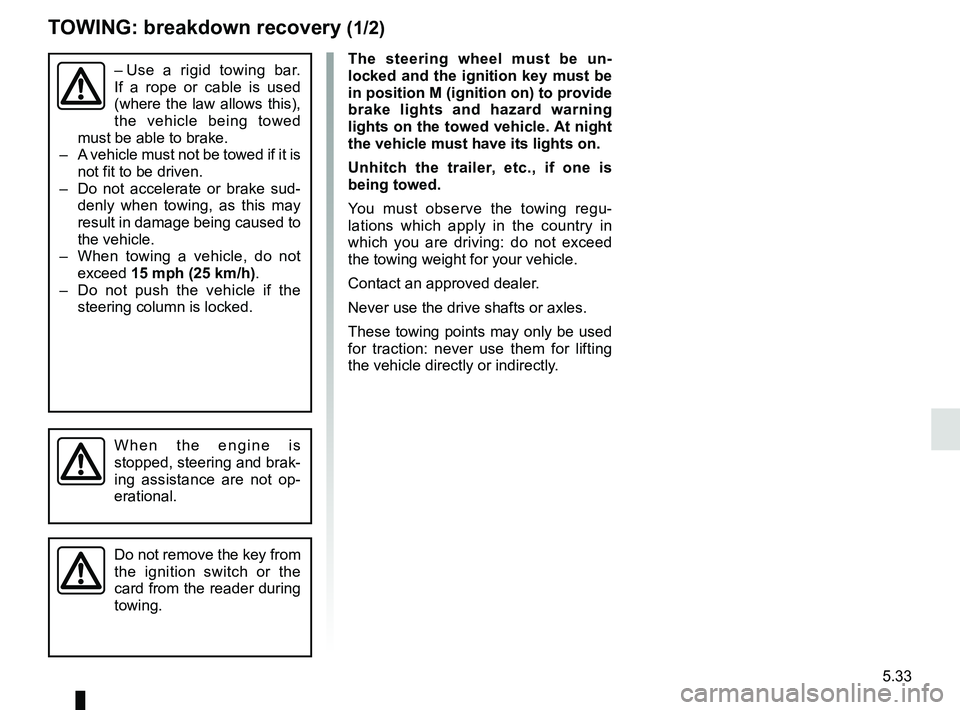
the vehicle directly or indirectly.– Use a rigid towing bar.
If a rope or cable is used
(where the law allows this),
the vehicle being towed
must be able to brake.
– A vehicle must not be towed if it is
not fit to be driven.
– Do not accelerate or brake sud- denly when towing, as this may
result in damage being caused to
the vehicle.
– When towing a vehicle, do not exceed 15 mph (25 km/h).
– Do not push the vehicle if the steering column is locked.
When the engine is
stopped, steering and brak-
ing assistance are not op-
erational.
Do not remove the key from
the ignition switch or the
card from the reader during
towing.
Page 269 of 298

6.1
Section 6: Technical specifications
Vehicle identification plate . . . . . . . . . . . . . . . . . . . . . . . . . . . . . . . . . . . . \
. . . . . . . . . . . . . . . . . . . . . 6.2
Engine identification plate . . . . . . . . . . . . . . . . . . . . . . . . . . . . . . . . . . . .\
. . . . . . . . . . . . . . . . . . . . . 6.3
Dimensions . . . . . . . . . . . . . . . . . . . . . . . . . . . . . . . . . . . .\
. . . . . . . . . . . . . . . . . . . . . . . . . . . . . . . . 6.4
Engine specifications . . . . . . . . . . . . . . . . . . . . . . . . . . . . . . . . . . . . \
. . . . . . . . . . . . . . . . . . . . . . . . . 6.8
Towing weights . . . . . . . . . . . . . . . . . . . . . . . . . . . . . . . . . . . .\
. . . . . . . . . . . . . . . . . . . . . . . . . . . . . 6.9
Weights . . . . . . . . . . . . . . . . . . . . . . . . . . . . . . . . . . . .\
. . . . . . . . . . . . . . . . . . . . . . . . . . . . . . . . . . . 6.9
Replacement parts and repairs . . . . . . . . . . . . . . . . . . . . . . . . . . . . . . . . . . . . \
. . . . . . . . . . . . . . . . . 6.11
Service sheets . . . . . . . . . . . . . . . . . . . . . . . . . . . . . . . . . . . . \
. . . . . . . . . . . . . . . . . . . . . . . . . . . . . . 6.12
Anticorrosion check . . . . . . . . . . . . . . . . . . . . . . . . . . . . . . . . . . . . \
. . . . . . . . . . . . . . . . . . . . . . . . . . 6.18
Page 270 of 298
6.2
VEHICLE IDENTIFICATION PLATES
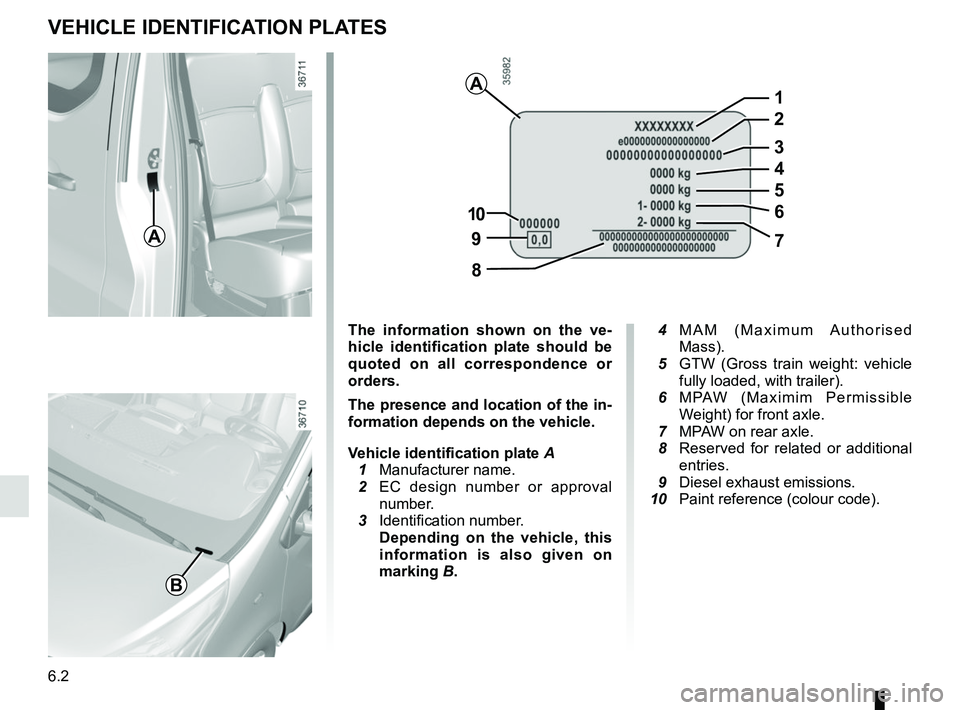
The information shown on the ve-
hicle identification plate should be
quoted on all correspondence or
orders.
The presence and location of the in-
formation depends on the vehicle.
Vehicle identification plate A
1 Manufacturer name.
2 EC design number or approval
number.
3 Identification number.
Depending on the vehicle, this
information is also given on
marking B.
4 MAM (Maximum Authorised
Mass).
5 GTW (Gross train weight: vehicle
fully loaded, with trailer).
6 MPAW (Maximim Permissible
Weight) for front axle.
7 MPAW on rear axle.
8 Reserved for related or additional
entries.
9 Diesel exhaust emissions.
10 Paint reference (colour code).
A
97
8
10
5
1
2
3
4
6
B
A
Page 277 of 298
6.9
WEIGHTS (in kg) (1/2)
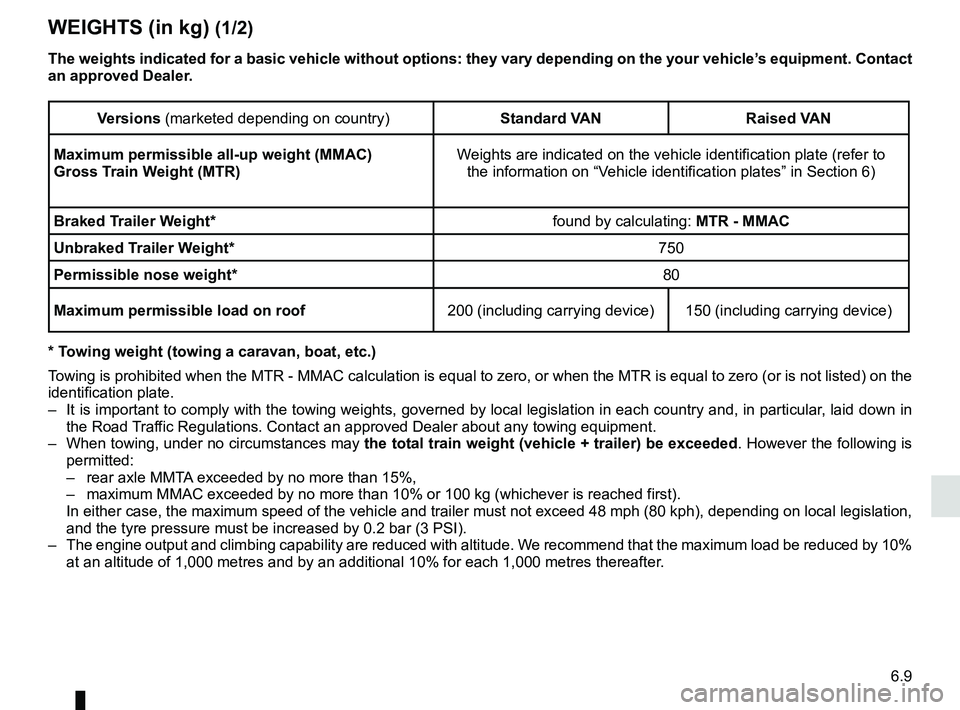
Versions (marketed depending on country)Standard VAN Raised VAN
Maximum permissible all-up weight (MMAC)
Gross Train Weight (MTR) Weights are indicated on the vehicle identification plate (refer to
the information on “Vehicle identification plates” in Section 6)
Braked Trailer Weight* found by calculating: MTR - MMAC
Unbraked Trailer Weight* 750
Permissible nose weight* 80
Maximum permissible load on roof 200 (including carrying device) 150 (including carrying device)
* Towing weight (towing a caravan, boat, etc.)
Towing is prohibited when the MTR - MMAC calculation is equal to zero, or\
when the MTR is equal to zero (or is not listed) on t he
identification plate.
– It is important to comply with the towing weights, governed by local leg\
islation in each country and, in particular, laid down in the Road Traffic Regulations. Contact an approved Dealer about any towing equipment.
– When towing, under no circumstances may the total train weight (vehicle + trailer) be exceeded . However the following is
permitted:
– rear axle MMTA exceeded by no more than 15%,
– maximum MMAC exceeded by no more than 10% or 100 kg (whichever is reach\
ed first).
In either case, the maximum speed of the vehicle and trailer must not ex\
ceed 48 mph (80 kph), depending on local legislation, and the tyre pressure must be increased by 0.2 bar (3 PSI).
– The engine output and climbing capability are reduced with altitude. We recommend that the maximum load be reduced by 10% at an altitude of 1,000 metres and by an additional 10% for each 1,000 m\
etres thereafter.
The weights indicated for a basic vehicle without options: they vary dep\
ending on the your vehicle’s equipment. Contact
an approved Dealer.
Page 278 of 298
 (2/2)
The weights indicated for a basic vehicle without options: they vary dep\
ending on the your vehicle’s equipment. Contact
an approved Dealer.
COMBI Versions (versions mar")
6.10
WEIGHTS (in kg) (2/2)
The weights indicated for a basic vehicle without options: they vary dep\
ending on the your vehicle’s equipment. Contact
an approved Dealer.
COMBI Versions (versions marketed depend on country)
Maximum permissible all-up weight (MMAC)
Gross Train Weight (MTR) Weights are indicated on the vehicle identification plate (refer to
the information on “Vehicle identification plates” in Section 6)
Braked Trailer Weight* found by calculating: MTR - MMAC
Unbraked Trailer Weight* 750
Permissible nose weight* 80
Maximum permissible load on roof 200 (including carrying device)
* Towing weight (towing a caravan, boat, etc.)
Towing is prohibited when the MTR - MMAC calculation is equal to zero, or\
when the MTR is equal to zero (or is not listed) on t he
identification plate.
– It is important to comply with the towing weights, governed by local leg\
islation in each country and, in particular, laid down in the Road Traffic Regulations. Contact an approved Dealer about any towing equipment.
– When towing, under no circumstances may the total train weight (vehicle + trailer) be exceeded . However the following is
permitted:
– rear MMTA exceeded by no more than 15%;
– MMAC exceeded by no more than 10% or 100 kg (whichever is reached first\
).
In both cases, the maximum speed of the vehicle and trailer must not exc\
eed 60 mph (100 km/h), depending on local legisla- tion, and the tyre pressure must be increased by 0.2 bar (3 PSI).
– The engine output and climbing capability are reduced with altitude. We recommend that the maximum load be reduced by 10% at an altitude of 1,000 metres and by an additional 10% for each 1,000 m\
etres thereafter.