seats RENAULT TRAFIC 2018 Service Manual
[x] Cancel search | Manufacturer: RENAULT, Model Year: 2018, Model line: TRAFIC, Model: RENAULT TRAFIC 2018Pages: 298, PDF Size: 8.05 MB
Page 198 of 298
3.34
REAR BENCH SEATS: functions (1/4)
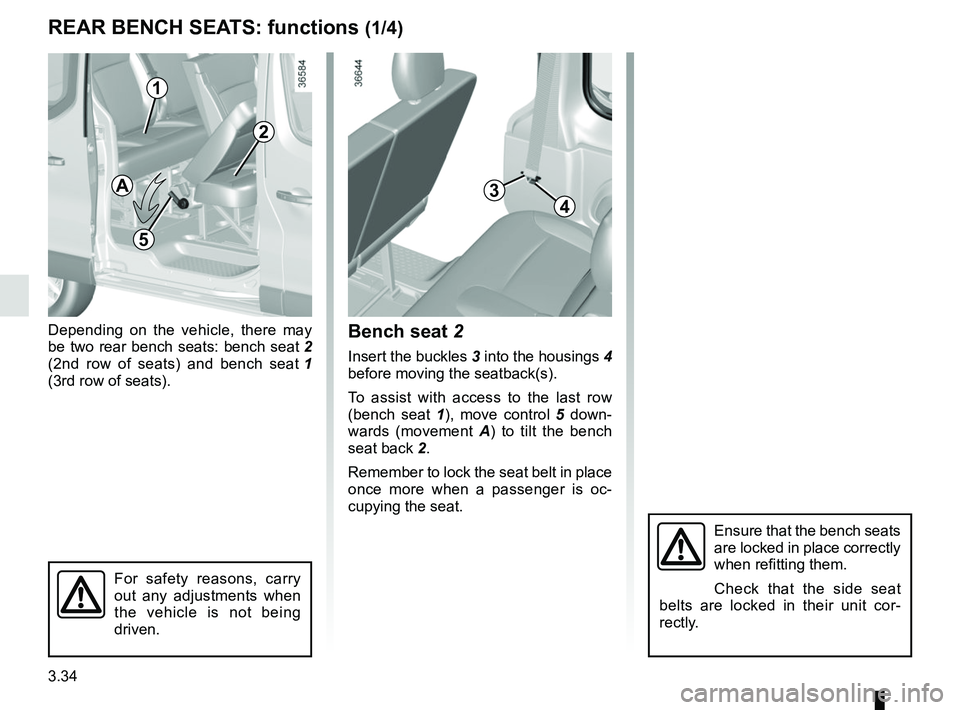
Depending on the vehicle, there may
be two rear bench seats: bench seat 2
(2nd row of seats) and bench seat 1
(3rd row of seats).Bench seat 2
Insert the buckles 3 into the housings 4
before moving the seatback(s).
To assist with access to the last row
(bench seat 1 ), move control 5 down-
wards (movement A) to tilt the bench
seat back 2.
Remember to lock the seat belt in place
once more when a passenger is oc-
cupying the seat.
Ensure that the bench seats
are locked in place correctly
when refitting them.
Check that the side seat
belts are locked in their unit cor-
rectly.
2
1
4
5
A
For safety reasons, carry
out any adjustments when
the vehicle is not being
driven.
3
Page 199 of 298
3.35
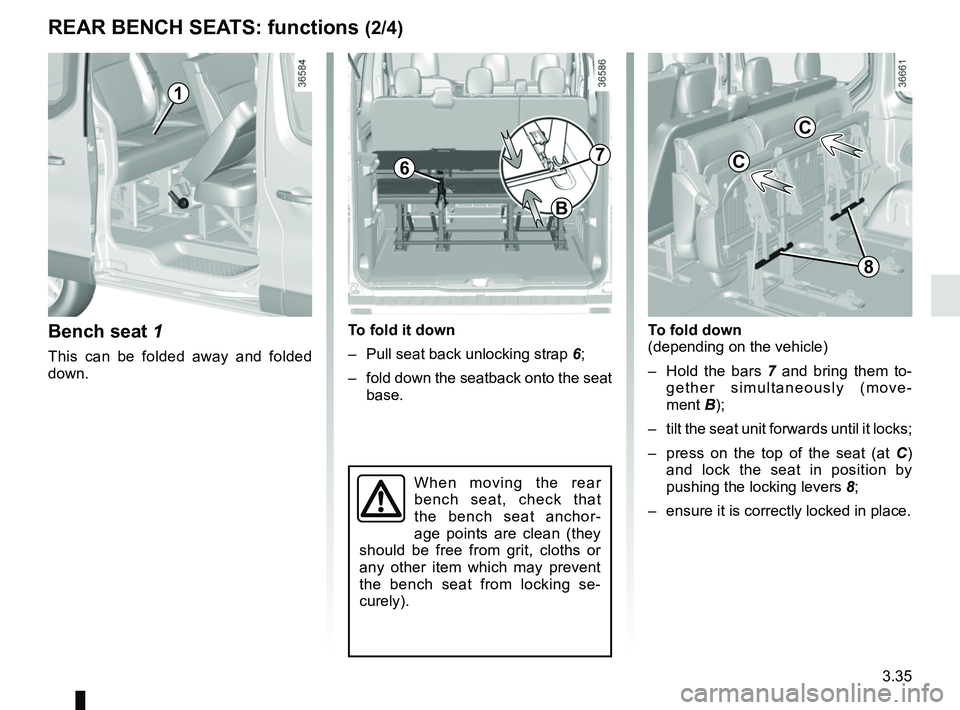
Bench seat 1
This can be folded away and folded
down.
To fold it down
– Pull seat back unlocking strap 6;
– fold down the seatback onto the seat base.
1
7
B
To fold down
(depending on the vehicle)
– Hold the bars 7 and bring them to-
gether simultaneously (move-
ment B);
– tilt the seat unit forwards until it locks;
– press on the top of the seat (at C)
and lock the seat in position by
pushing the locking levers 8;
– ensure it is correctly locked in place.
When moving the rear
bench seat, check that
the bench seat anchor-
age points are clean (they
should be free from grit, cloths or
any other item which may prevent
the bench seat from locking se-
curely).
REAR BENCH SEATS: functions (2/4)
6
8
C
C
Page 200 of 298
3.36
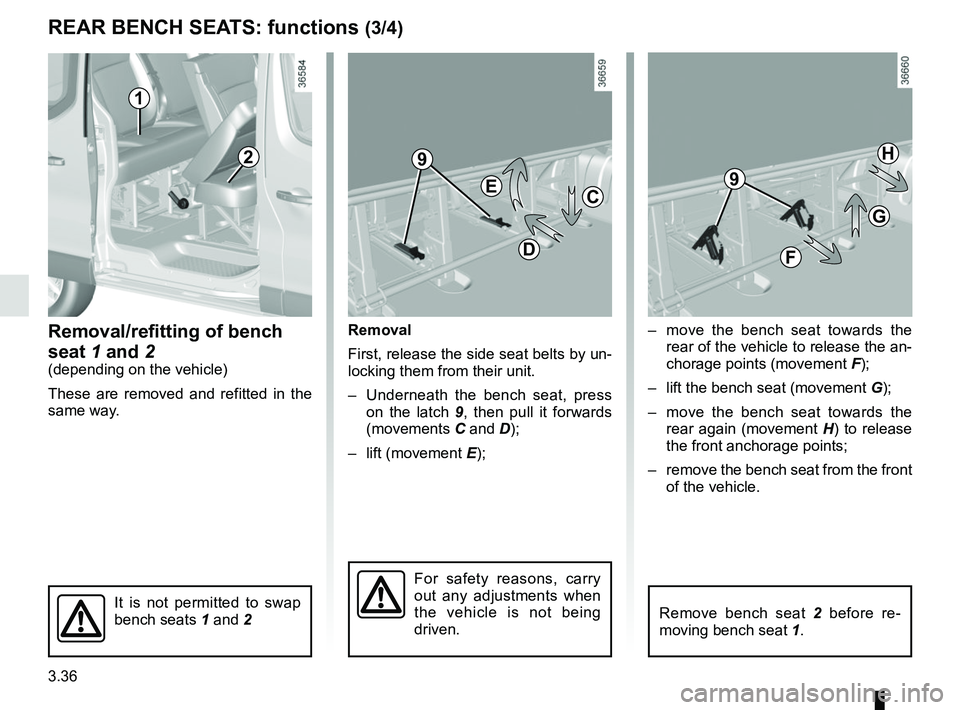
– move the bench seat towards the rear of the vehicle to release the an-
chorage points (movement F);
– lift the bench seat (movement G);
– move the bench seat towards the rear again (movement H) to release
the front anchorage points;
– remove the bench seat from the front of the vehicle.
REAR BENCH SEATS: functions (3/4)
Removal/refitting of bench
seat 1 and 2
(depending on the vehicle)
These are removed and refitted in the
same way. Removal
First, release the side seat belts by un-
locking them from their unit.
– Underneath the bench seat, press
on the latch 9, then pull it forwards
(movements C and D);
– lift (movement E);
It is not permitted to swap
bench seats 1 and 2
1
2
C
D
E
F
G
H
For safety reasons, carry
out any adjustments when
the vehicle is not being
driven.
Remove bench seat 2 before re-
moving bench seat 1.
9
9
Page 201 of 298
3.37
REAR BENCH SEATS: functions (4/4)
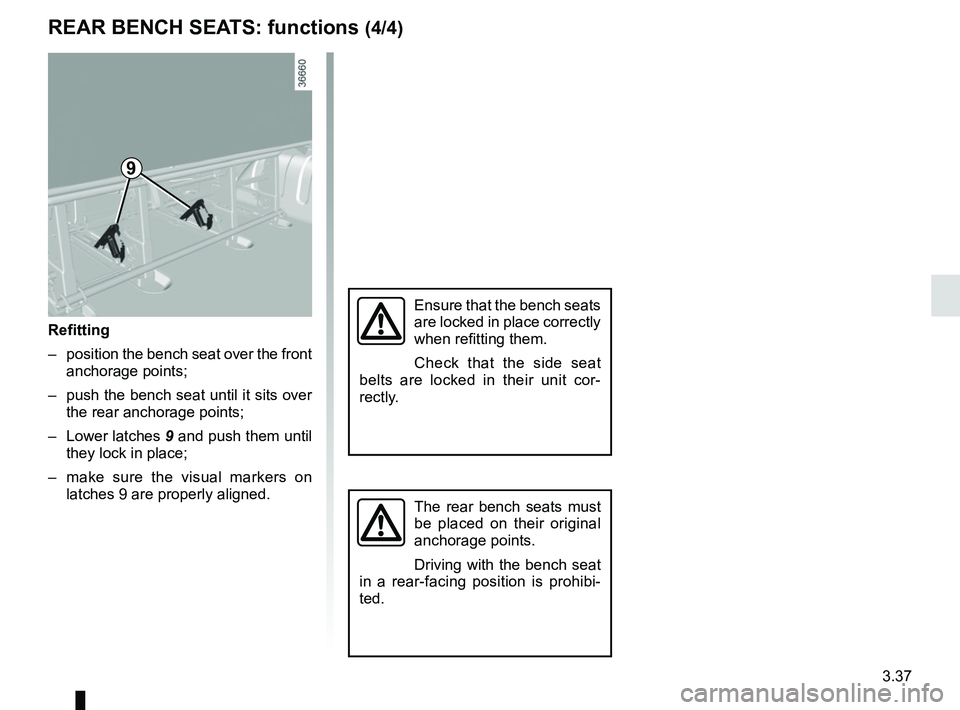
Refitting
– position the bench seat over the front anchorage points;
– push the bench seat until it sits over the rear anchorage points;
– Lower latches 9 and push them until
they lock in place;
– make sure the visual markers on latches 9 are properly aligned.
Ensure that the bench seats
are locked in place correctly
when refitting them.
Check that the side seat
belts are locked in their unit cor-
rectly.
The rear bench seats must
be placed on their original
anchorage points.
Driving with the bench seat
in a rear-facing position is prohibi-
ted.
9
Page 203 of 298
3.39
LUGGAGE NET (1/2)
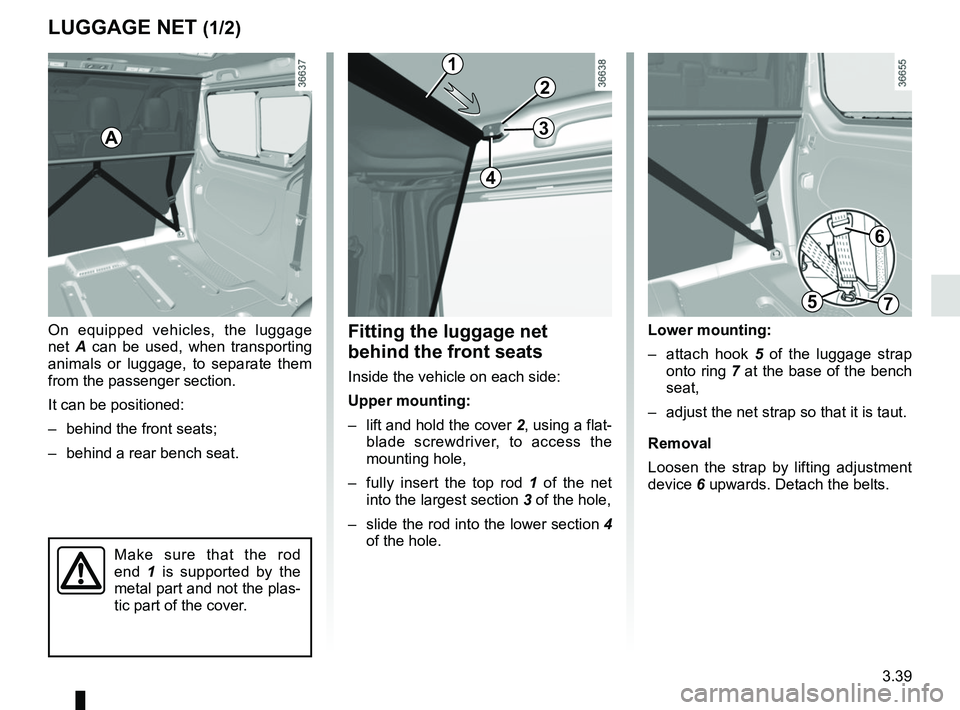
On equipped vehicles, the luggage
net A can be used, when transporting
animals or luggage, to separate them
from the passenger section.
It can be positioned:
– behind the front seats;
– behind a rear bench seat.Fitting the luggage net
behind the front seats
Inside the vehicle on each side:
Upper mounting:
– lift and hold the cover 2, using a flat-
blade screwdriver, to access the
mounting hole,
– fully insert the top rod 1 of the net
into the largest section 3 of the hole,
– slide the rod into the lower section 4
of the hole.
Lower mounting:
– attach hook 5 of the luggage strap
onto ring 7 at the base of the bench
seat,
– adjust the net strap so that it is taut.
Removal
Loosen the strap by lifting adjustment
device 6 upwards. Detach the belts.
Make sure that the rod
end 1 is supported by the
metal part and not the plas-
tic part of the cover.
A
1
2
3
4
6
75
Page 204 of 298
3.40
LUGGAGE NET (2/2)
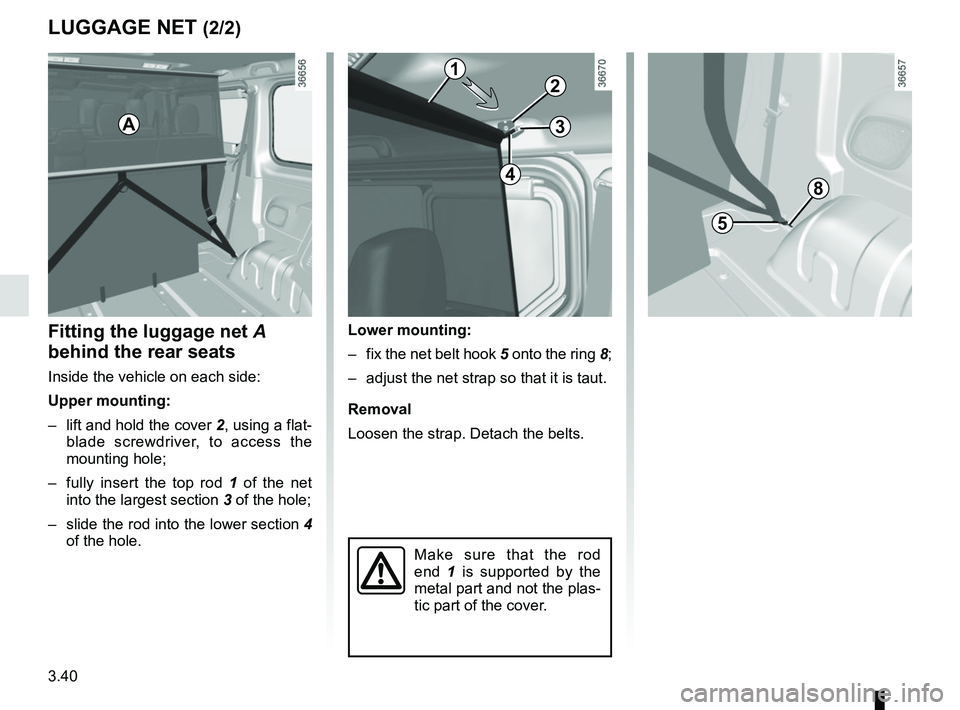
Fitting the luggage net A
behind the rear seats
Inside the vehicle on each side:
Upper mounting:
– lift and hold the cover 2, using a flat-
blade screwdriver, to access the
mounting hole;
– fully insert the top rod 1 of the net
into the largest section 3 of the hole;
– slide the rod into the lower section 4
of the hole. Lower mounting:
– fix the net belt hook 5 onto the ring 8;
– adjust the net strap so that it is taut.
Removal
Loosen the strap. Detach the belts.
Make sure that the rod
end
1 is supported by the
metal part and not the plas-
tic part of the cover.
1
2
3
4
5
8
A
Page 205 of 298
3.41
TRANSPORTING OBJECTS (1/2)
Always position the heavi-
est items directly on the
floor. Use the lashing points
on the luggage compart-
ment floor, if these are fitted to the
vehicle. The load should be loaded
in such a way that no items will be
thrown forward and strike the occu-
pants if the driver has to brake sud-
denly or while driving on a steep
gradient. Fasten the rear seat belts,
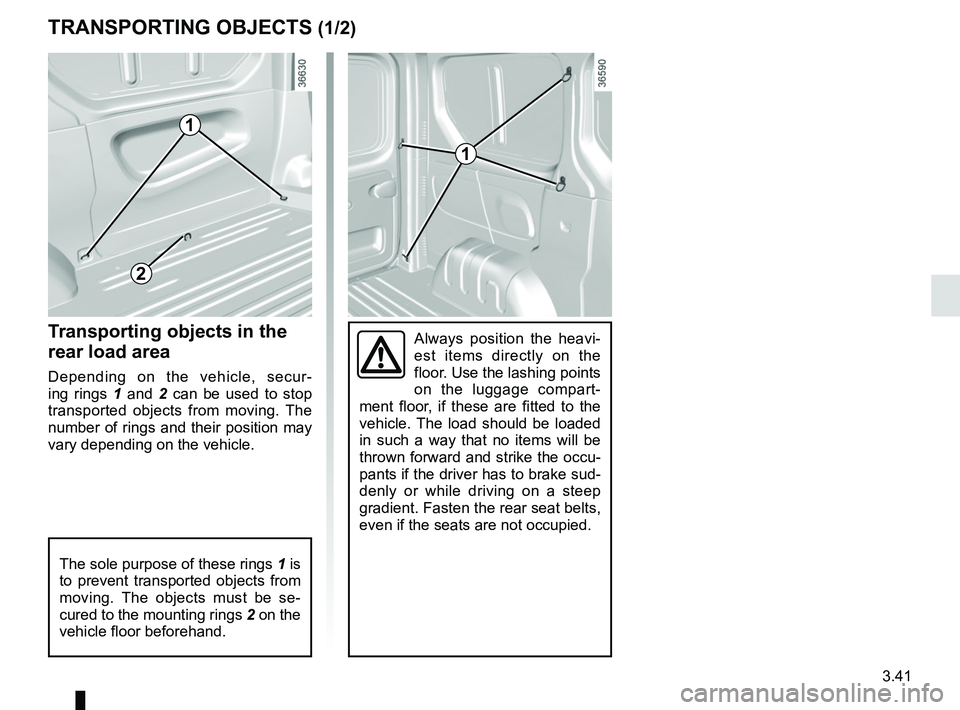
even if the seats are not occupied.Transporting objects in the
rear load area
Depending on the vehicle, secur-
ing rings 1 and 2 can be used to stop
transported objects from moving. The
number of rings and their position may
vary depending on the vehicle.
The sole purpose of these rings 1 is
to prevent transported objects from
moving. The objects must be se-
cured to the mounting rings 2 on the
vehicle floor beforehand.
1
1
2
Page 225 of 298
4.17
Glass instrument panel(e.g. instrument panel, clock, exterior
temperature display, radio display, etc.)
Use a soft cloth (or cotton wool).
If this does not clean them properly,
use a soft cloth (or cotton wool) slightly
moistened with soapy water and then
wipe clean with another soft damp cloth
or cotton wool.
Finally, carefully dry off with a soft dry
cloth.
Do not use products containing alco-
hol and/or spray fluids on the area.
Seat belts
These must be kept clean.
Use products selected by our Technical
Department (Approved outlets) or
warm, soapy water and a sponge and
wipe with a dry cloth.
Detergents or dyes must not be used
under any circumstances.
INTERIOR TRIM MAINTENANCE (1/2)
Textiles (seats, door trim, etc)
Vacuum-clean the textiles regularly.
Liquid stain
Use soapy water.
Dab lightly (never rub) with a soft cloth,
rinse and remove the excess.
Solid or pasty stain
Carefully remove the excess solid or
pasty material immediately with a
spatula (working from the edges to the
centre to avoid spreading the stain).
Clean as for a liquid stain.
Special instructions for sweets or
chewing gum
Put an ice cube on the stain to solidify
it, then proceed as for a solid stain.
A well-maintained vehicle will last
longer. It is therefore recommended to
maintain the interior of the vehicle regu-
larly.
A stain should always be dealt with
swiftly.
Whatever type of stain is on the trim,
use
cold (or warm) soapy water with
natural soap.
Detergents (washing-up liquid, pow-
dered products, alcohol-based prod-
ucts) should not be used.
Use a soft cloth.
Rinse and soak up the excess.
For further recommendations for
maintaining the interior, and/or for
any unsatisfactory results, please
see an authorised dealer.
Page 233 of 298
5.7
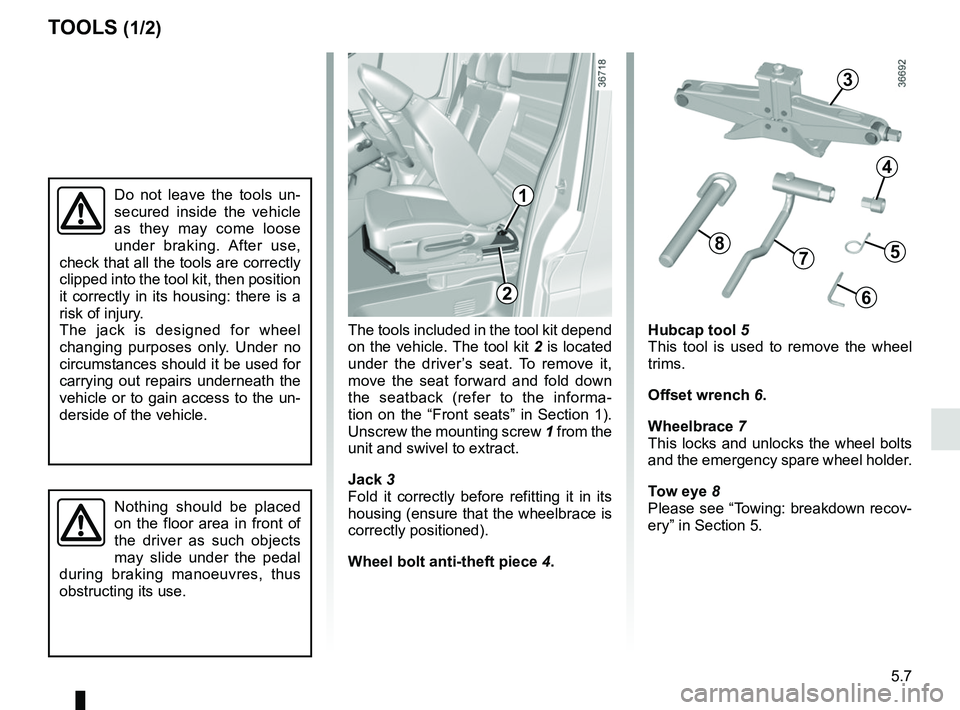
The tools included in the tool kit depend
on the vehicle. The tool kit 2 is located
under the driver’s seat. To remove it,
move the seat forward and fold down
the seatback (refer to the informa-
tion on the “Front seats” in Section 1).
Unscrew the mounting screw 1 from the
unit and swivel to extract.
Jack 3
Fold it correctly before refitting it in its
housing (ensure that the wheelbrace is
correctly positioned).
Wheel bolt anti-theft piece 4.
TOOLS (1/2)
Hubcap tool 5
This tool is used to remove the wheel
trims.
Offset wrench 6.
Wheelbrace 7
This locks and unlocks the wheel bolts
and the emergency spare wheel holder.
Tow eye 8
Please see “Towing: breakdown recov-
ery” in Section 5.
3
4
Do not leave the tools un-
secured inside the vehicle
as they may come loose
under braking. After use,
check that all the tools are correctly
clipped into the tool kit, then position
it correctly in its housing: there is a
risk of injury.
The jack is designed for wheel
changing purposes only. Under no
circumstances should it be used for
carrying out repairs underneath the
vehicle or to gain access to the un-
derside of the vehicle.
Nothing should be placed
on the floor area in front of
the driver as such objects
may slide under the pedal
during braking manoeuvres, thus
obstructing its use.
2
5
6
78
1
Page 255 of 298
5.29
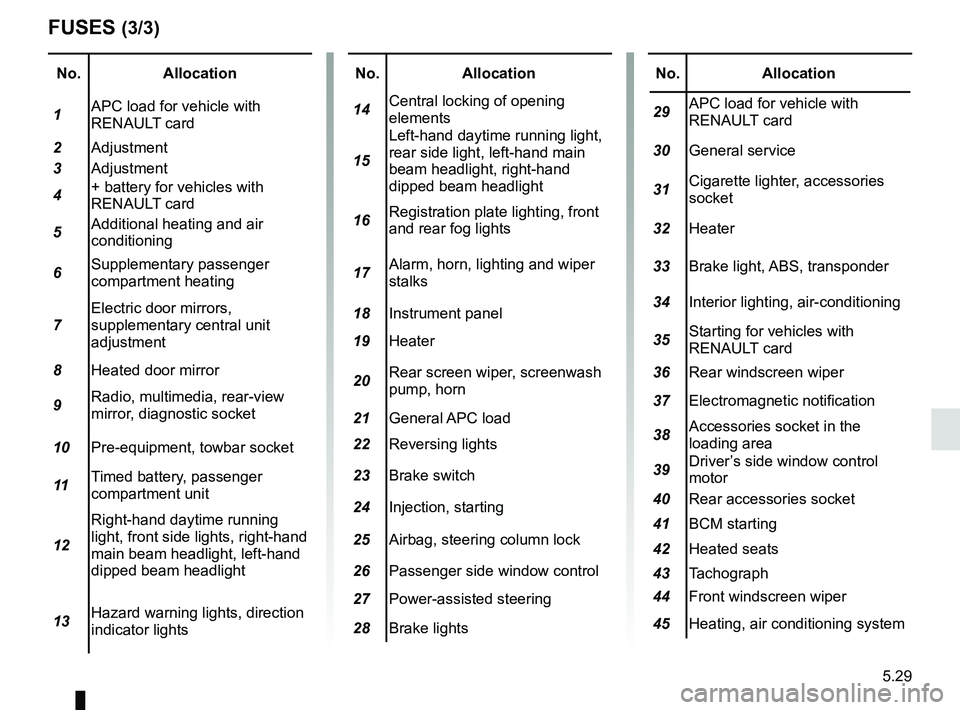
No.Allocation
1 APC load for vehicle with
RENAULT card
2 Adjustment
3 Adjustment
4 + battery for vehicles with
RENAULT card
5 Additional heating and air
conditioning
6 Supplementary passenger
compartment heating
7 Electric door mirrors,
supplementary central unit
adjustment
8 Heated door mirror
9 Radio, multimedia, rear-view
mirror, diagnostic socket
10 Pre-equipment, towbar socket
11 Timed battery, passenger
compartment unit
12 Right-hand daytime running
light, front side lights, right-hand
main beam headlight, left-hand
dipped beam headlight
13 Hazard warning lights, direction
indicator lights
FUSES (3/3)
No.
Allocation
14 Central locking of opening
elements
15 Left-hand daytime running light,
rear side light, left-hand main
beam headlight, right-hand
dipped beam headlight
16 Registration plate lighting, front
and rear fog lights
17 Alarm, horn, lighting and wiper
stalks
18 Instrument panel
19 Heater
20 Rear screen wiper, screenwash
pump, horn
21 General APC load
22 Reversing lights
23 Brake switch
24 Injection, starting
25 Airbag, steering column lock
26 Passenger side window control
27 Power-assisted steering
28 Brake lightsNo. Allocation
29 APC load for vehicle with
RENAULT card
30 General service
31 Cigarette lighter, accessories
socket
32 Heater
33 Brake light, ABS, transponder
34 Interior lighting, air-conditioning
35 Starting for vehicles with
RENAULT card
36 Rear windscreen wiper
37 Electromagnetic notification
38 Accessories socket in the
loading area
39 Driver’s side window control
motor
40 Rear accessories socket
41 BCM starting
42 Heated seats
43 Tachograph
44 Front windscreen wiper
45 Heating, air conditioning system