door lock RENAULT TWINGO 2012 2.G User Guide
[x] Cancel search | Manufacturer: RENAULT, Model Year: 2012, Model line: TWINGO, Model: RENAULT TWINGO 2012 2.GPages: 220, PDF Size: 6.73 MB
Page 32 of 220
child safety............................................ (up to the end of the DU)
child restraint/seat ................................ (up to the end of the DU)
child restraint/seat ................................ (up to the end of the DU)
child restraint/seat ................................ (up to the end of the DU)
child seats ............................................. (up to the end of the DU)
transporting children ............................. (up to the end of the DU)
children ................................................. (up to the end of the DU)
1.26
ENG_UD20118_2
Sécurité enfants : généralités (X44 - Renault)
ENG_NU_952-4_X44_Renault_1
Jaune NoirNoir texte
Carrying children
Children, and adults, must be correctly
seated and strapped in for all journeys.
The children being carried in your vehi-
cle are your responsibility.
A child is not a miniature adult. Children
are at risk of specific injuries as their
muscles and bones have not yet fin -
ished growing. The seat belt alone
would not provide suitable protection.
Use an approved child seat and ensure
you use it correctly.
Child safety: General information
ChILD sAFETY : General information (1/2)
To prevent the doors being
opened, use the “Child
safety” device (refer to the
information on “Opening
and closing the doors” in Section 1).
A collision at 30 mph (50
km/h) is the same as fall -
ing a distance of 10 metres.
Transporting a child without
a restraint is the equivalent of allow-
ing him or her to play on a fourth -
floor balcony without railings.
Never travel with a child held in your
arms. In the event of an accident,
you will not be able to keep hold of
the child, even if you yourself are
wearing a seat belt.
If your vehicle has been involved in
a road accident, replace the child
seat and have the seat belts and
ISOFIX anchorage points checked.
D r i v e r ’s r e s p o n s i b i l i t y
when parking or stopping
the vehicle
Never leave an animal,
child or adult who is not self-suffi -
cient alone on your vehicle, even for
a short time.
They may pose a risk to themselves
or to others by starting the engine,
activating equipment such as the
electric windows or by locking the
doors.
Also, in hot and/or sunny weather,
please remember that the tempera-
ture inside the passenger compart-
ment increases very quickly.
RI sK OF DEAT h OR sERIOU s
INJURY.
Page 47 of 220
JauneNoirNoir texte
1.41
ENG_UD24711_5
Poste de conduite direction à gauche (X44 - Renault)
ENG_NU_952-4_X44_Renault_1
DRIVING pOsITION, LEFT-hAND DRIVE (2/2)
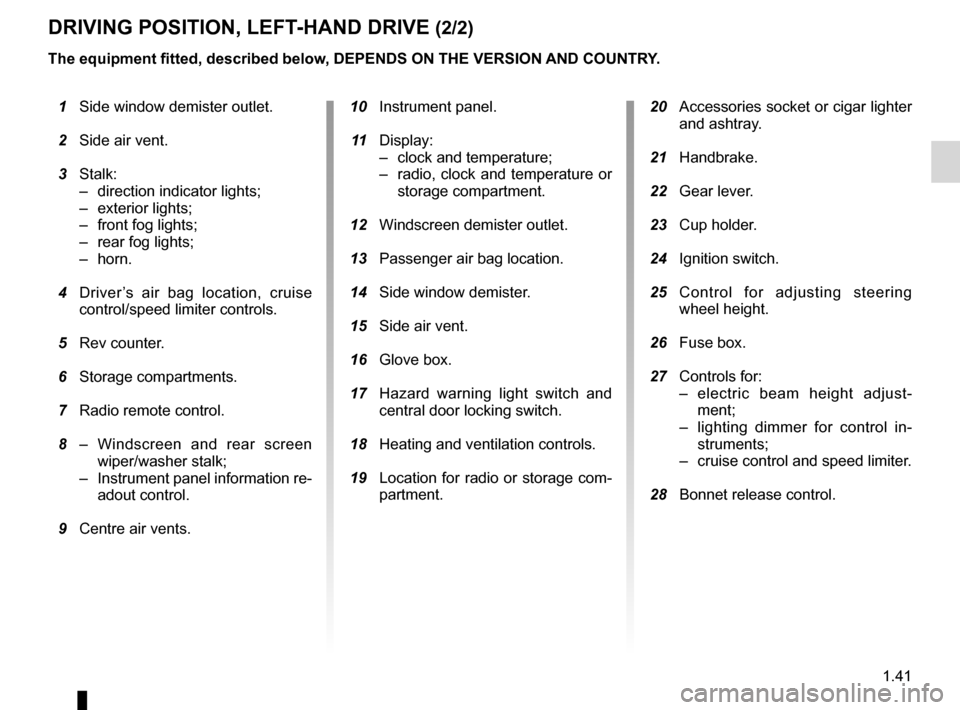
1 Side window demister outlet.
2 Side air vent.
3 Stalk:
– direction indicator lights;
– exterior lights;
– front fog lights;
– rear fog lights;
– horn.
4 Driver ’s air bag location, cruise
control/speed limiter controls.
5 Rev counter.
6 Storage compartments.
7 Radio remote control.
8 – Windscreen and rear screen
wiper/washer stalk;
– Instrument panel information re-
adout control.
9 Centre air vents.
10 Instrument panel.
11 Display:
– clock and temperature;
– radio, clock and temperature or
storage compartment.
12 Windscreen demister outlet.
13 Passenger air bag location.
14 Side window demister.
15 Side air vent.
16 Glove box.
17 Hazard warning light switch and
central door locking switch.
18 Heating and ventilation controls.
19 Location for radio or storage com-
partment.
20 Accessories socket or cigar lighter
and ashtray.
21 Handbrake.
22 Gear lever.
23 Cup holder.
24 Ignition switch.
25 Control for adjusting steering
wheel height.
26 Fuse box.
27 Controls for:
– electric beam height adjust -
ment;
– lighting dimmer for control in -
struments;
– cruise control and speed limiter.
28 Bonnet release control.
The equipment fitted, described below, DEpENDs ON ThE VERsION AND COUNTRY.
Page 49 of 220
JauneNoirNoir texte
1.43
ENG_UD24749_3
Poste de conduite direction à droite (X44 - Renault)
ENG_NU_952-4_X44_Renault_1
DRIVING pOsITION, RIGhT-hAND DRIVE (2/2)
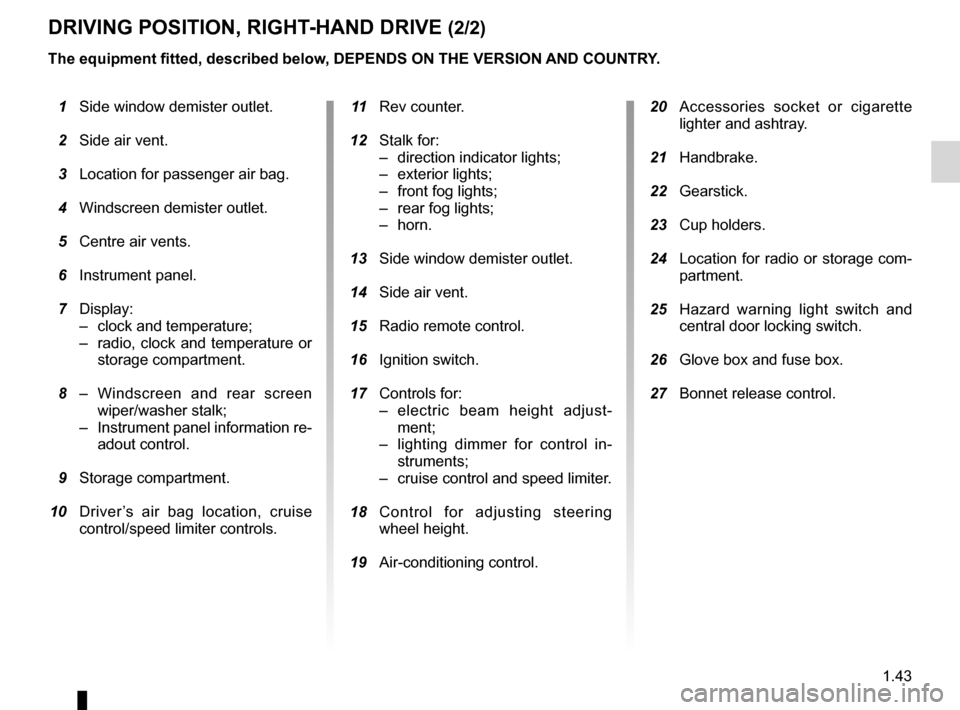
1 Side window demister outlet.
2 Side air vent.
3 Location for passenger air bag.
4 Windscreen demister outlet.
5 Centre air vents.
6 Instrument panel.
7 Display:
– clock and temperature;
– radio, clock and temperature or
storage compartment.
8 – Windscreen and rear screen
wiper/washer stalk;
– Instrument panel information re-
adout control.
9 Storage compartment.
10 Driver ’s air bag location, cruise
control/speed limiter controls.
11 Rev counter.
12 Stalk for:
– direction indicator lights;
– exterior lights;
– front fog lights;
– rear fog lights;
– horn.
13 Side window demister outlet.
14 Side air vent.
15 Radio remote control.
16 Ignition switch.
17 Controls for:
– electric beam height adjust -
ment;
– lighting dimmer for control in -
struments;
– cruise control and speed limiter.
18 Control for adjusting steering
wheel height.
19 Air-conditioning control. 20 Accessories socket or cigarette
lighter and ashtray.
21 Handbrake.
22 Gearstick.
23 Cup holders.
24 Location for radio or storage com-
partment.
25 Hazard warning light switch and
central door locking switch.
26 Glove box and fuse box.
27 Bonnet release control.
The equipment fitted, described below, DEpENDs ON ThE VERsION AND COUNTRY.
Page 75 of 220
starting the engine ................................ (up to the end of the DU)
starting the engine ................................ (up to the end of the DU)
stopping the engine ............................................... (current page)
2.3
ENG_UD28739_4
Démarrage / Arrêt du moteur (X44 - Renault)
ENG_NU_952-4_X44_Renault_2
Starting, Stopping the engine
St ARtING/StoPPING the eNGINe
Starting the engine
In very cold conditions (temperatures
below –20°C): so that it is easier to
start the engine, switch on the ignition
for several seconds before starting the
engine.
Feature when starting the engine, if the
outdoor temperature is very low (below
- 10 ° C): hold down the clutch pedal
until the engine starts.
– Petrol injection
engine warm or cold:
– activate the starter without ac-
celerating;
– release the key as soon as the
engine starts.ÉDiesel injection indicator
light
Turn the ignition key to the “Ignition
on” position and hold this position
until the preheating indicator light
goes out.
Turn the key to the “Start” position
without depressing the accelera -
tor pedal. Release the key as soon
as the engine starts.
Stopping the engine
With the engine idling, turn the key
back to the “Stop” position.
Driver’s responsibility
Never leave your vehicle
with the key inside the vehi-
cle and never leave a child
(or a pet) unsupervised, even for a
short while.
There is a risk that they could start
the engine or operate electrical
equipment (electric windows etc.)
and trap part of their body (neck,
arms, hands, etc.).
Risk of serious injury.
Never switch off the ignition
before the vehicle has stopped
completely . Once the engine has
stopped, the brake servo, pow -
erassisted steering, etc., and the
passive safety devices such as
air bags and pretensioners will no
longer operate.
The steering is locked when the key
is removed.
Page 117 of 220
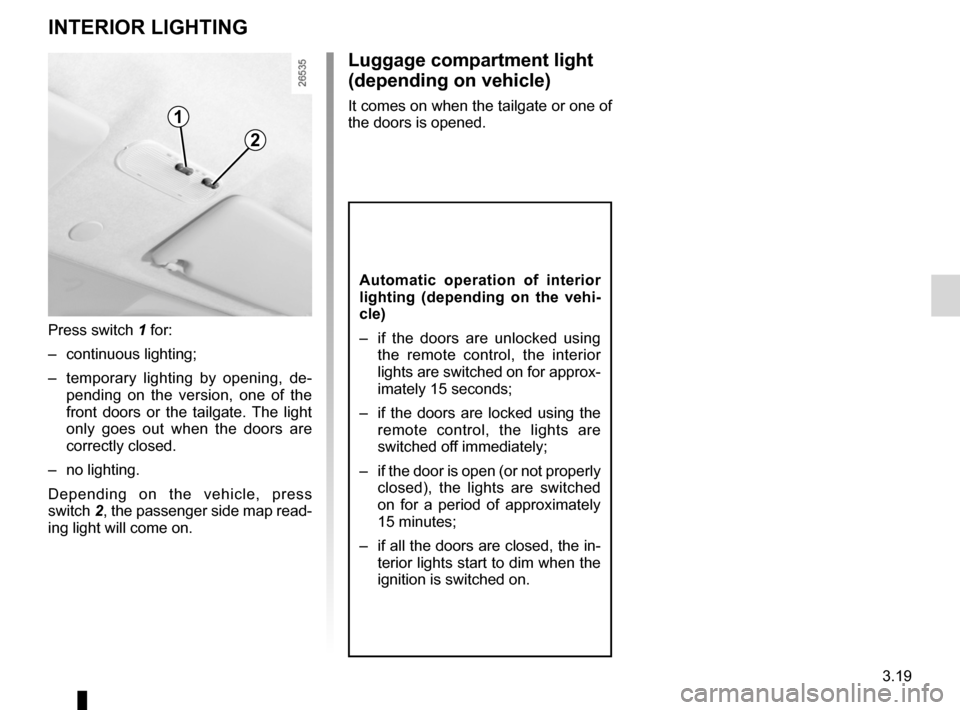
lighting:interior ............................................. (up to the end of the DU)
3.19
ENG_UD24750_2
Eclairage intérieur (X44 - Renault)
ENG_NU_952-4_X44_Renault_3
luggage compartment light
(depending on vehicle)
It comes on when the tailgate or one of
the doors is opened.
Interior lighting
INTERIoR lIghTINg
Press switch 1 for:
– continuous lighting;
– temporary lighting by opening, de -
pending on the version, one of the
front doors or the tailgate. The light
only goes out when the doors are
correctly closed.
– no lighting.
Depending on the vehicle, press
switch 2, the passenger side map read-
ing light will come on.
Automatic operation of interior
lighting (depending on the vehi -
cle)
– if the doors are unlocked using
the remote control, the interior
lights are switched on for approx -
imately 15 seconds;
– if the doors are locked using the
remote control, the lights are
switched off immediately;
– if the door is open (or not properly
closed), the lights are switched
on for a period of approximately
15 minutes;
– if all the doors are closed, the in-
terior lights start to dim when the
ignition is switched on.
1
2
Page 131 of 220
tailgate .................................................. (up to the end of the DU)
tailgate .................................................. (up to the end of the DU)
3.33
ENG_UD24694_3
Coffre à bagages (X44 - Renault)
ENG_NU_952-4_X44_Renault_3
Boot
luggAgE CoMPARTMENT
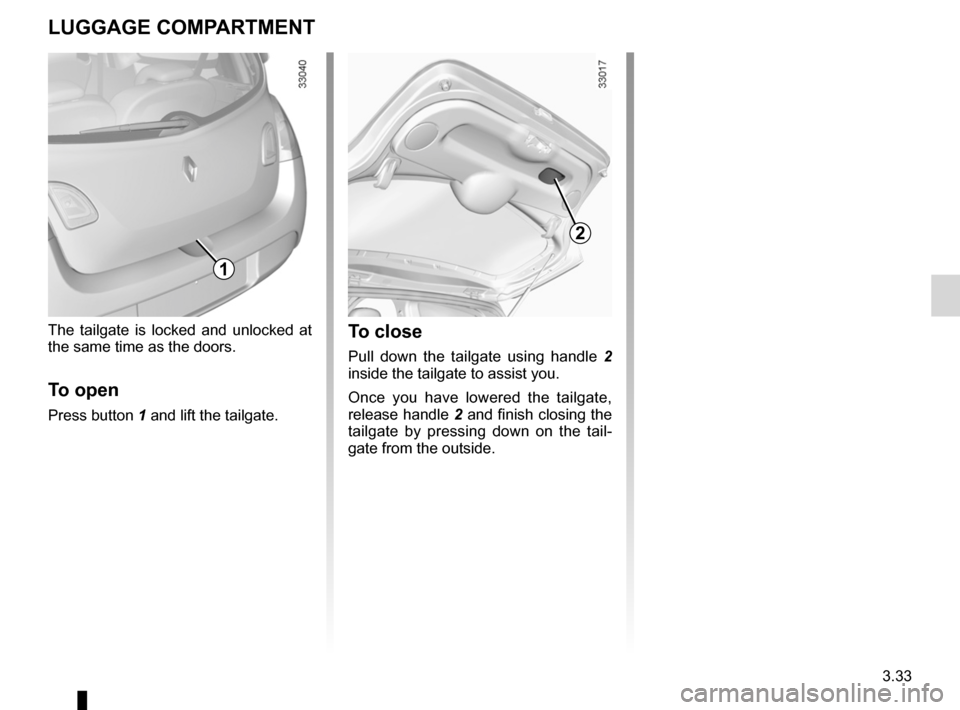
The tailgate is locked and unlocked at
the same time as the doors.
To open
Press button 1 and lift the tailgate.
To close
Pull down the tailgate using handle 2
inside the tailgate to assist you.
Once you have lowered the tailgate,
release handle 2 and finish closing the
tailgate by pressing down on the tail -
gate from the outside.
1
2
Page 153 of 220
maintenance:interior trim ....................................................... (current page)
4.15
ENG_UD22508_5
Entretien des garnitures intérieures (X44 - Renault)
ENG_NU_952-4_X44_Renault_4
Interior trim maintenance
INTERIOR TRIM MAINTENANCE (1/2)
A well-maintained vehicle will have a
longer service life. It is therefore ad -
visable to maintain the vehicle interior
regularly.
Stains should always be dealt with
quickly. Whatever type of stain is on
the trim, use soapy water (if possible,
warm water) containing:
Do not use detergents (washing up
liquid, powdered products, alcohol -
based products, etc.).
Use a soft cloth.
Glass instrument panel(e.g.: instrument panel, clock, exterior
temperature display, radio display).
Use a soft cloth or cotton wool.
If this does not clean it properly, use a
soft cloth (or cotton wool) slightly mois-
tened with soapy water and then wipe
clean with a soft damp cloth or cotton
wool.
Finally, carefully dry off with a soft dry
cloth.
Cleaning products containing alco -
hol must not be used under any cir-
cumstances.
Seat belts
These must be kept clean.
Use products selected by our Technical
Department (Approved outlets) or
warm, soapy water and a sponge and
wipe with a dry cloth.
Detergents or dyes must not be used
under any circumstances.
Fabrics (seats, door trim,
etc.)
Dust fabrics regularly.
Liquid stains
Use soapy water. Absorb or dab lightly
(never rub) using a soft cloth, then rinse
and absorb the excess water.
Solid or thick stains
Remove any excess solid or thick ma-
terial immediately and carefully using
a spatula (from the edge inwards to
avoid spreading the stain).
Clean using the procedure for a liquid
stain.
Special instructions for sweets or
chewing gum
Put an ice cube on the stain to solidify
it, then proceed as for a solid stain.
For advice on interior maintenance
and/or on unsatisfactory results,
contact an approved dealer.
Page 180 of 220
remote control electric door lockingbatteries ........................................................... (current page)
battery (remote control) ......................................... (current page)
5.26
ENG_UD14469_2
Télécommande à radiofréquence : piles (X44 - E33 - X33 - Re\
nault)
ENG_NU_952-4_X44_Renault_5
Radio frequency remote control: batteries
rADIO FreQuencY reMOte cOntrOL: BAtterIeS
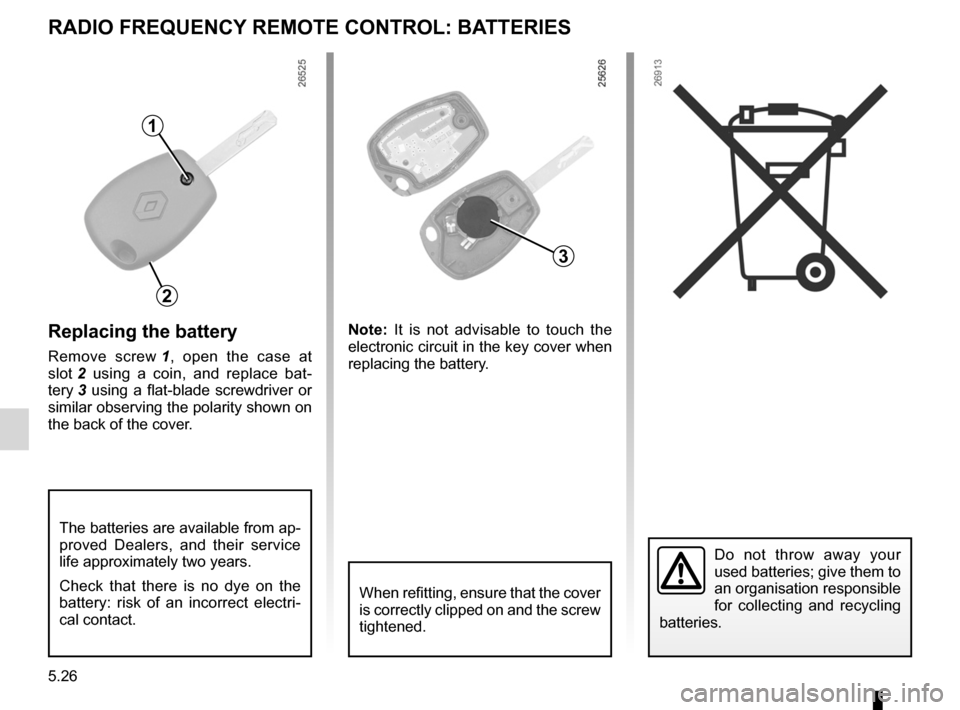
replacing the battery
Remove screw 1 , open the case at
slot 2 using a coin, and replace bat -
tery 3 using a flat-blade screwdriver or
similar observing the polarity shown on
the back of the cover. n
ote: It is not advisable to touch the
electronic circuit in the key cover when
replacing the battery.
Do not throw away your
used batteries; give them to
an organisation responsible
for collecting and recycling
batteries.
1
3
2
When refitting, ensure that the cover
is correctly clipped on and the screw
tightened.
The batteries are available from ap-
proved Dealers, and their service
life approximately two years.
Check that there is no dye on the
battery: risk of an incorrect electri -
cal contact.
Page 182 of 220
5.28
ENG_UD24741_10
Fusibles (X44 - Renault)
ENG_NU_952-4_X44_Renault_5
Jaune NoirNoir texte
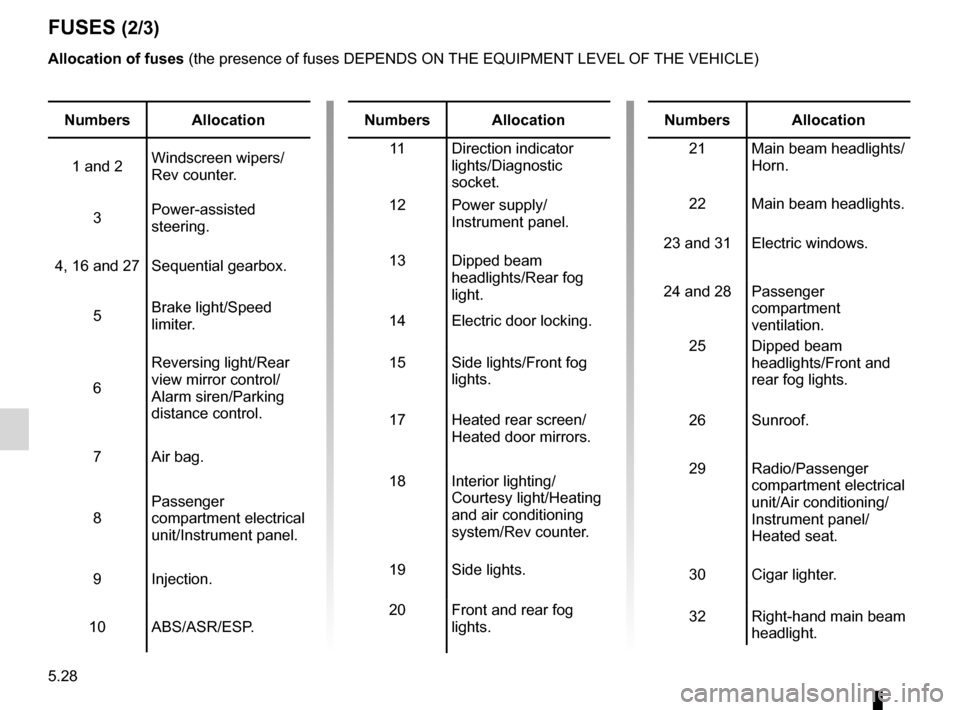
FuSeS (2/3)
numbers Allocation
1 and 2 Windscreen wipers/
Rev counter.
3 Power-assisted
steering.
4, 16 and 27 Sequential gearbox.
5 Brake light/Speed
limiter.
6 Reversing light/Rear
view mirror control/
Alarm siren/Parking
distance control.
7 Air bag.
8 Passenger
compartment electrical
unit/Instrument panel.
9 Injection.
10 ABS/ASR/ESP.numbers Allocation
11 Direction indicator
lights/Diagnostic
socket.
12 Power supply/
Instrument panel.
13 Dipped beam
headlights/Rear fog
light.
14 Electric door locking.
15 Side lights/Front fog
lights.
17 Heated rear screen/
Heated door mirrors.
18 Interior lighting/
Courtesy light/Heating
and air conditioning
system/Rev counter.
19 Side lights.
20 Front and rear fog
lights.numbers Allocation
21 Main beam headlights/
Horn.
22 Main beam headlights.
23 and 31 Electric windows.
24 and 28 Passenger
compartment
ventilation.
25 Dipped beam
headlights/Front and
rear fog lights.
26 Sunroof.
29 Radio/Passenger
compartment electrical
unit/Air conditioning/
Instrument panel/
Heated seat.
30 Cigar lighter.
32 Right-hand main beam
headlight.
Allocation of fuses
(the presence of fuses DEPENDS ON THE EQUIPMENT LEVEL OF THE VEHICLE)
Page 213 of 220
7.1
FRA_UD30806_17
Index (X44 - Renault)
ENG_NU_952-4_X44_Renault_7
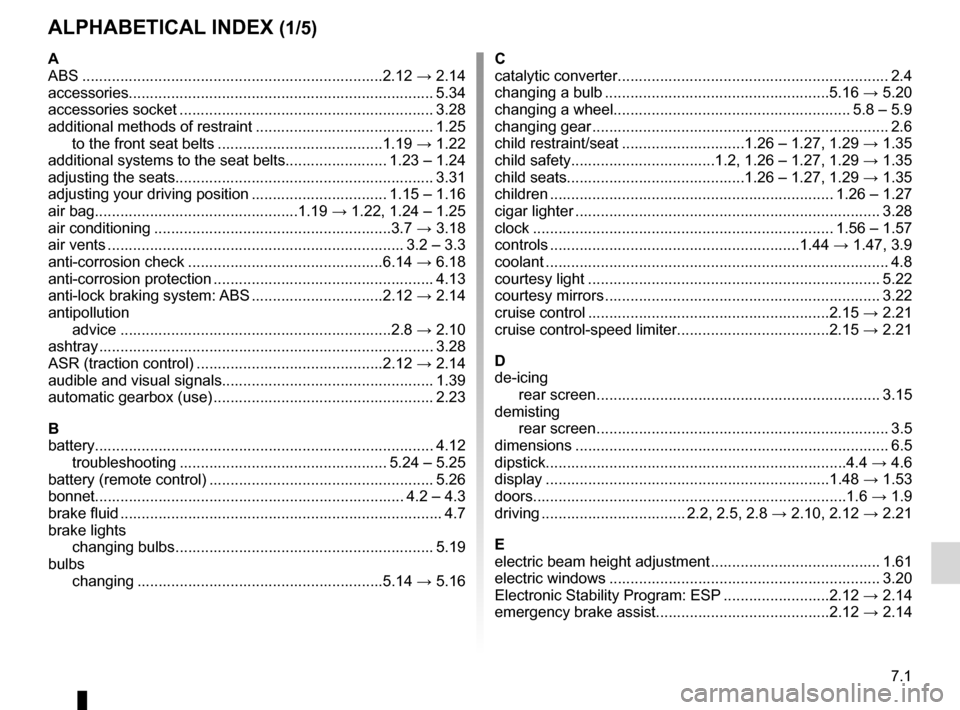
AlphAbeticAl index (1/5)
A
ABS ....................................................................... 2.12 → 2.14
accessories........................................................................ 5.34
accessories socket ............................................................ 3.28
additional methods of restraint .......................................... 1.25
to the front seat belts ....................................... 1.19 → 1.22
additional systems to the seat belts ........................1.23 – 1.24
adjusting the seats ............................................................. 3.31
adjusting your driving position ................................ 1.15 – 1.16
air bag ................................................ 1.19 → 1.22, 1.24 – 1.25
air conditioning ........................................................ 3.7 → 3.18
air vents ...................................................................... 3.2 – 3.3
anti-corrosion check .............................................. 6.14 → 6.18
anti-corrosion protection .................................................... 4.13
anti-lock braking system: ABS ...............................2.12 → 2.14
antipollution advice ................................................................ 2.8 → 2.10
ashtray ............................................................................... 3.28
ASR (traction control) ............................................ 2.12 → 2.14
audible and visual signals .................................................. 1.39
automatic gearbox (use) .................................................... 2.23
b
battery ................................................................................ 4.12
troubleshooting ................................................. 5.24 – 5.25
battery (remote control) ..................................................... 5.26
bonnet ......................................................................... 4.2 – 4.3
brake fluid ............................................................................ 4.7
brake lights changing bulbs ............................................................. 5.19
bulbs changing .......................................................... 5.14 → 5.16c
catalytic converter
................................................................ 2.4
changing a bulb ..................................................... 5.16 → 5.20
changing a wheel ........................................................ 5.8 – 5.9
changing gear ...................................................................... 2.6
child restraint/seat ............................. 1.26 – 1.27, 1.29 → 1.35
child safety .................................. 1.2, 1.26 – 1.27, 1.29 → 1.35
child seats .......................................... 1.26 – 1.27, 1.29 → 1.35
children ................................................................... 1.26 – 1.27
cigar lighter ........................................................................ 3.28
clock ....................................................................... 1.56 – 1.57
controls ........................................................... 1.44 → 1.47, 3.9
coolant ................................................................................. 4.8
courtesy light ..................................................................... 5.22
courtesy mirrors ................................................................. 3.22
cruise control ......................................................... 2.15 → 2.21
cruise control-speed limiter.................................... 2.15 → 2.21
d
de-icing rear screen ................................................................... 3.15
demisting rear screen ..................................................................... 3.5
dimensions .......................................................................... 6.5
dipstick....................................................................... 4.4 → 4.6
display ................................................................... 1.48 → 1.53
doors .......................................................................... 1.6 → 1.9
driving .................................. 2.2, 2.5, 2.8 → 2.10, 2.12 → 2.21
e
electric beam height adjustment ........................................ 1.61
electric windows ................................................................ 3.20
Electronic Stability Program: ESP .........................2.12 → 2.14
emergency brake assist ......................................... 2.12 → 2.14