heating RENAULT TWINGO 2012 2.G User Guide
[x] Cancel search | Manufacturer: RENAULT, Model Year: 2012, Model line: TWINGO, Model: RENAULT TWINGO 2012 2.GPages: 220, PDF Size: 6.73 MB
Page 102 of 220
heating system ..................................... (up to the end of the DU)
ventilation ............................................. (up to the end of the DU)
3.4
ENG_UD20165_4
Chauffage - Ventilation avec isolation de l habitacle (X44 - Renault)
ENG_NU_952-4_X44_Renault_3
Jaune NoirNoir texte
Manual air conditioning
MANuAl AIR CoNDITIoNINg (1/3)
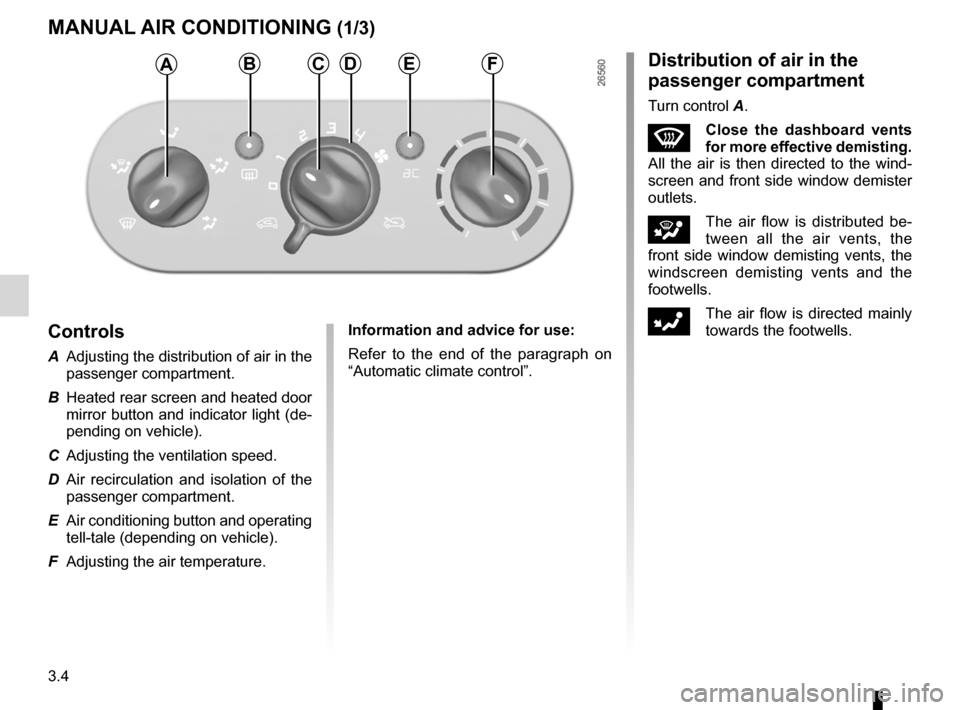
Controls
A Adjusting the distribution of air in the
passenger compartment.
B Heated rear screen and heated door
mirror button and indicator light (de-
pending on vehicle).
C Adjusting the ventilation speed.
D Air recirculation and isolation of the
passenger compartment.
E Air conditioning button and operating
tell-tale (depending on vehicle).
F Adjusting the air temperature.
Information and advice for use:
Refer to the end of the paragraph on
“Automatic climate control”.
Distribution of air in the
passenger compartment
Turn control A.
WClose the dashboard vents
for more effective demisting.
All the air is then directed to the wind -
screen and front side window demister
outlets.
iThe air flow is distributed be -
tween all the air vents, the
front side window demisting vents, the
windscreen demisting vents and the
footwells.
FThe air flow is directed mainly
towards the footwells.
ABCEFD
Page 105 of 220
heating system ..................................... (up to the end of the DU)
ventilation ............................................. (up to the end of the DU)
air conditioning ..................................... (up to the end of the DU)
air conditioning ..................................... (up to the end of the DU)
heating and air conditioning system ..... (up to the end of the DU)
temperature regulation ......................... (up to the end of the DU)
3.7
ENG_UD20167_4
Chauffage / air conditionné (X44 - Renault)
ENG_NU_952-4_X44_Renault_3
Heating – air conditioning
hEATINg – AIR CoNDITIoNINg (1/2)
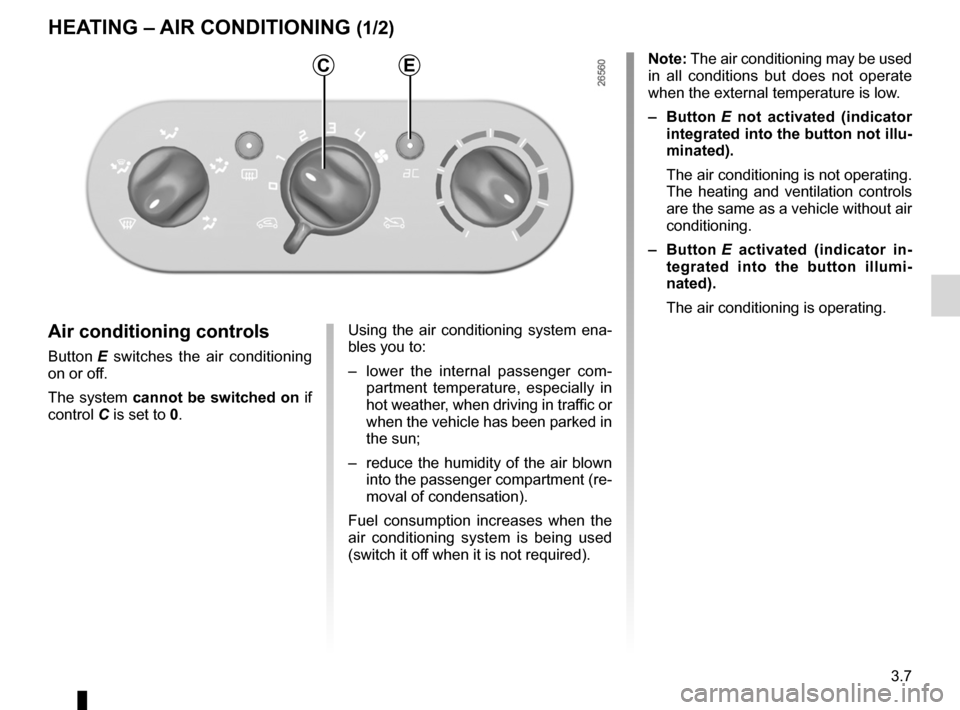
Air conditioning controls
Button E switches the air conditioning
on or off.
The system cannot be switched on if
control C is set to 0.
Using the air conditioning system ena-
bles you to:
– lower the internal passenger com -
partment temperature, especially in
hot weather, when driving in traffic or
when the vehicle has been parked in
the sun;
– reduce the humidity of the air blown
into the passenger compartment (re-
moval of condensation).
Fuel consumption increases when the
air conditioning system is being used
(switch it off when it is not required). Note: The air conditioning may be used
in all conditions but does not operate
when the external temperature is low.
–
Button E not activated (indicator
integrated into the button not illu -
minated).
The air conditioning is not operating.
The heating and ventilation controls
are the same as a vehicle without air
conditioning.
– Button E activated (indicator in -
tegrated into the button illumi -
nated).
The air conditioning is operating.
CE
Page 106 of 220
3.8
ENG_UD20167_4
Chauffage / air conditionné (X44 - Renault)
ENG_NU_952-4_X44_Renault_3
hEATINg – AIR CoNDITIoNINg (2/2)
In very hot weather or when the vehicle
has been parked in the sun, open the
doors for a few moments to let the hot
air escape before starting the engine.
Use the passenger compartment isola -
tion function to lower the temperature
as quickly as possible to the required
comfort level. Switch off the air recircu-
lation function once a comfortable level
has been reached. When the air conditioning system is op-
erating, all windows must be closed for
maximum efficiency.
If there is an operating fault, contact an
approved dealer.
If no cold air is produced
Check that the controls are set correctly
and that the fuses are sound. If they are
not, switch off the heating and air con-
ditioning system (indicator integrated
into button E) and contact an approved
dealer.
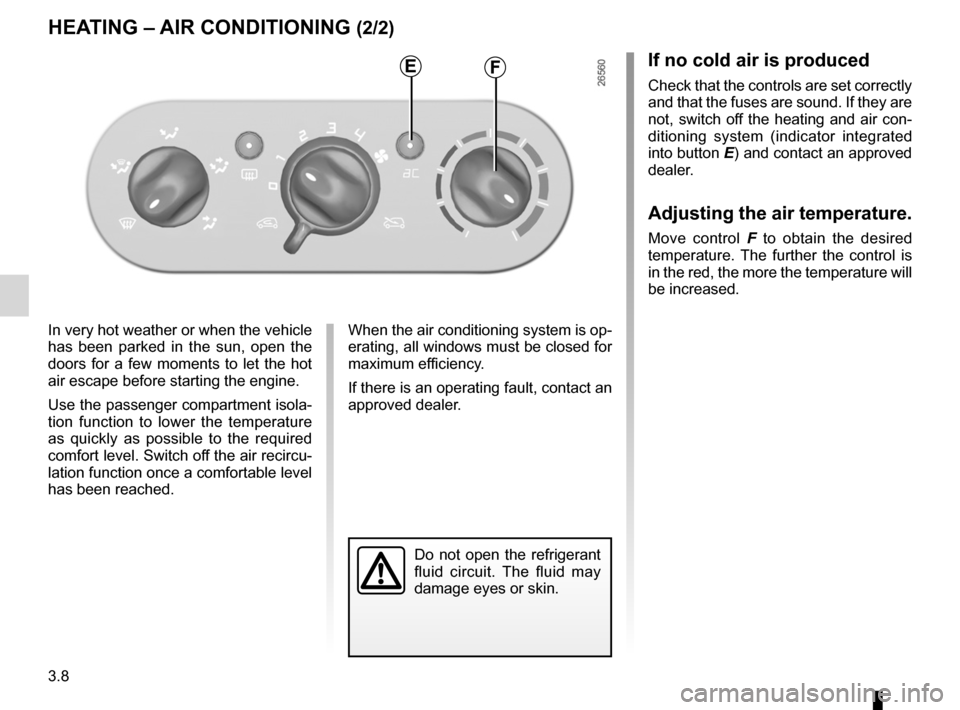
Adjusting the air temperature.
Move control
F to obtain the desired
temperature. The further the control is
in the red, the more the temperature will
be increased.
Do not open the refrigerant
fluid circuit. The fluid may
damage eyes or skin.
FE
Page 107 of 220
heating system ..................................... (up to the end of the DU)
air conditioning ..................................... (up to the end of the DU)
ventilation ............................................. (up to the end of the DU)
controls .................................................................. (current page)
air conditioning ..................................... (up to the end of the DU)
temperature regulation ......................... (up to the end of the DU)
heating and air conditioning system ..... (up to the end of the DU)
3.9
ENG_UD24164_1
Air conditionné automatique (X44 - Renault)
ENG_NU_952-4_X44_Renault_3
Automatic climate control
AuT oMATIC ClIMATE CoNTRol (1/9)
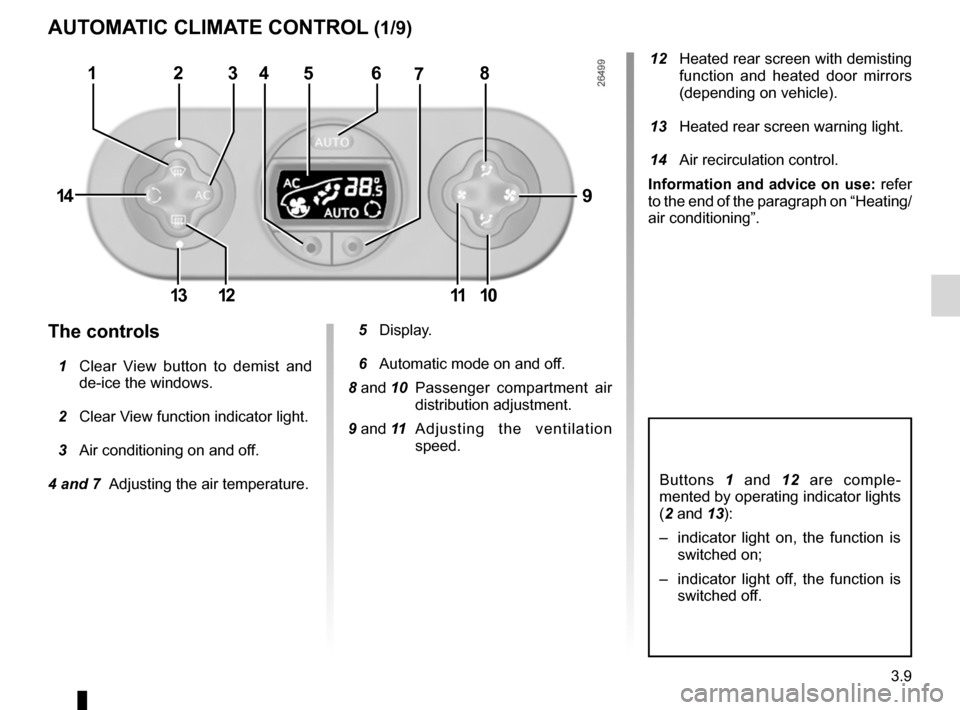
The controls
1 Clear View button to demist and
de-ice the windows.
2 Clear View function indicator light.
3 Air conditioning on and off.
4 and 7 Adjusting the air temperature.
5 Display.
6 Automatic mode on and off.
8 and 10 Passenger compartment air
distribution adjustment.
9 and 11 A d j u s t i n g t h e v e n t i l a t i o n
speed.
12 Heated rear screen with demisting
function and heated door mirrors
(depending on vehicle).
13 Heated rear screen warning light.
14 Air recirculation control.
Information and advice on use: refer
to the end of the paragraph on “Heating/
air conditioning”.
Buttons 1 and 12 are comple -
mented by operating indicator lights
(2 and 13):
– indicator light on, the function is
switched on;
– indicator light off, the function is
switched off.
12345678
9
10111213
14
Page 108 of 220
3.10
ENG_UD24164_1
Air conditionné automatique (X44 - Renault)
ENG_NU_952-4_X44_Renault_3
Jaune NoirNoir texte
AuToMATIC ClIMATE CoNTRol (2/9)
Ambient temperature:
automatic mode
Automatic mode
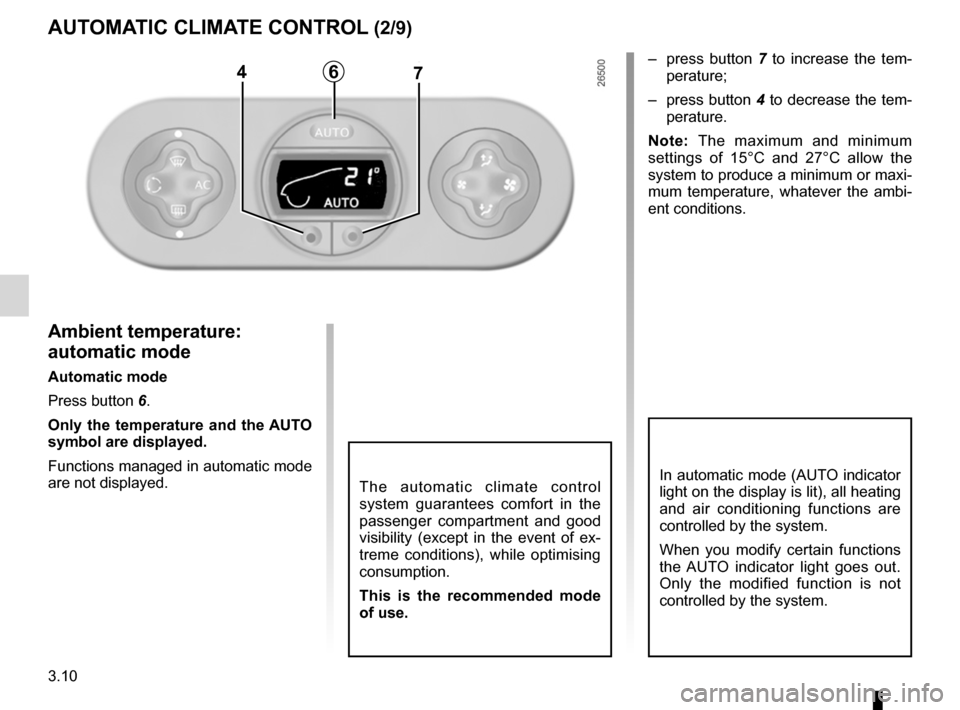
Press button 6.
only the temperature and the AuT o
symbol are displayed.
Functions managed in automatic mode
are not displayed. –
press button 7 to increase the tem -
perature;
– press button 4 to decrease the tem-
perature.
Note: The maximum and minimum
settings of 15°C and 27°C allow the
system to produce a minimum or maxi-
mum temperature, whatever the ambi-
ent conditions.
In automatic mode (AUTO indicator
light on the display is lit), all heating
and air conditioning functions are
controlled by the system.
When you modify certain functions
the AUTO indicator light goes out.
Only the modified function is not
controlled by the system.
47
The automatic climate control
system guarantees comfort in the
passenger compartment and good
visibility (except in the event of ex -
treme conditions), while optimising
consumption.
This is the recommended mode
of use.
6
Page 110 of 220
3.12
ENG_UD24164_1
Air conditionné automatique (X44 - Renault)
ENG_NU_952-4_X44_Renault_3
Jaune NoirNoir texte
AuToMATIC ClIMATE CoNTRol (4/9)
Adjusting automatic mode
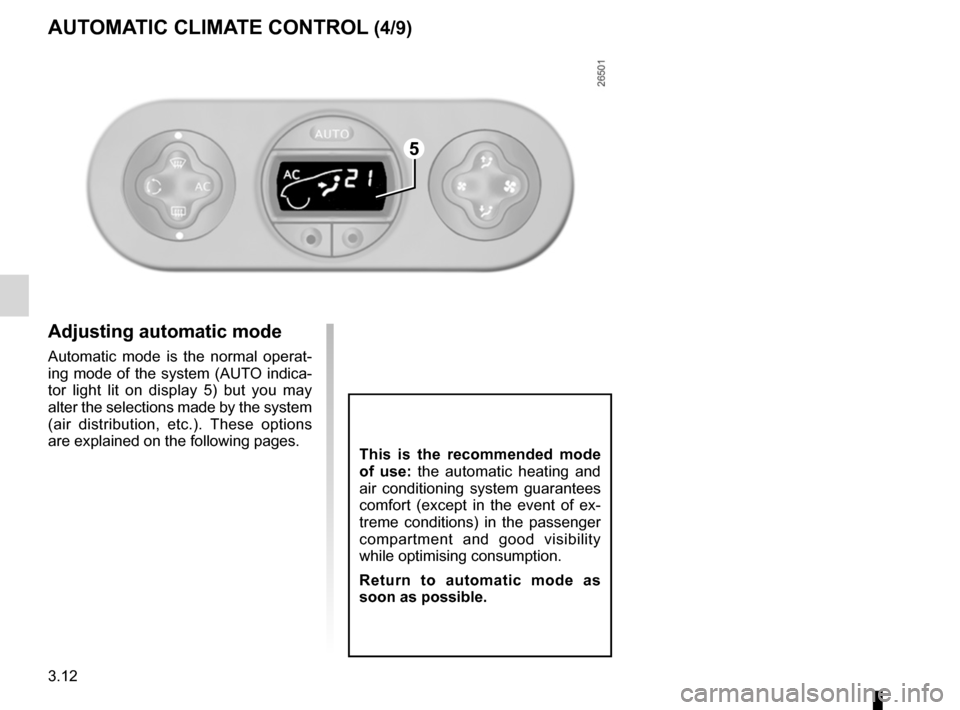
Automatic mode is the normal operat -
ing mode of the system (AUTO indica -
tor light lit on display 5) but you may
alter the selections made by the system
(air distribution, etc.). These options
are explained on the following pages.
This is the recommended mode
of use: the automatic heating and
air conditioning system guarantees
comfort (except in the event of ex -
treme conditions) in the passenger
compartment and good visibility
while optimising consumption.
Return to automatic mode as
soon as possible.
5
Page 114 of 220
windscreen de-icing/demisting .............................. (current page)
3.16
ENG_UD24164_1
Air conditionné automatique (X44 - Renault)
ENG_NU_952-4_X44_Renault_3
Jaune NoirNoir texte
AuToMATIC ClIMATE CoNTRol (8/9)
Clear View function
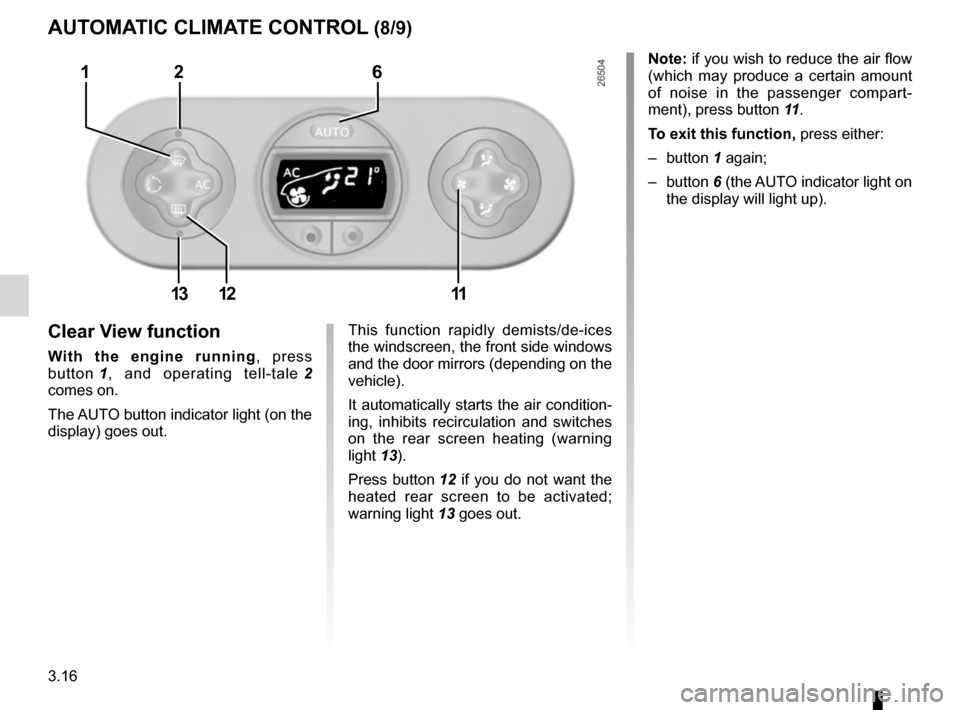
With the engine running , press
button 1 , and operating tell-tale 2
comes on.
The AUTO button indicator light (on the
display) goes out. This function rapidly demists/de-ices
the windscreen, the front side windows
and the door mirrors (depending on the
vehicle).
It automatically starts the air condition
-
ing, inhibits recirculation and switches
on the rear screen heating (warning
light 13).
Press button 12 if you do not want the
heated rear screen to be activated;
warning light 13 goes out.
Note: if you wish to reduce the air flow
(which may produce a certain amount
of noise in the passenger compart -
ment), press button 11.
To exit this function, press either:
– button 1 again;
– button 6 (the AUTO indicator light on
the display will light up).126
111213
Page 116 of 220
heating system ..................................... (up to the end of the DU)
air conditioning ..................................... (up to the end of the DU)
ventilation ............................................. (up to the end of the DU)
3.18
ENG_UD11090_2
Air conditionné : informations et conseils utilisation (X44 - Renaul\
t)
ENG_NU_952-4_X44_Renault_3
Air conditioning: information and advice on use
AIR CoNDITIoNINg: information and advice on use
Fuel consumption
It is normal to notice an increase
in fuel consumption (especially in
towns) when the air conditioning is
operating. For vehicles fitted with
manual air conditioning, switch off
the system when it is not required.
In order to minimise consump -
tion and help to protect the en -
vironment, it is recommended to
drive with the air vents open and the
windows closed.
If the vehicle has been parked in
the sun, open the doors for a few
moments to let the hot air escape
before starting the engine.
Maintenance
Refer to the Maintenance Document
for your vehicle for the inspection
frequency.
operating faults
As a general rule, contact your ap-
proved Dealer in the event of an op-
erating fault:
– reduction in de-icing, demist -
ing or air conditioning per -
formance. This may be caused
by the passenger compartment
filter cartridge becoming clogged;
– no cold air is being produced.
Check that the controls are set
correctly and that the fuses are
sound. Otherwise, switch off the
system.
Note
Presence of water under the ve -
hicle. After prolonged use of the air
conditioning system, it is normal for
water to be present under the vehi-
cle. This is caused by condensation.
Do not open the refriger -
ant fluid circuit. The fluid
may damage eyes or skin.
Page 167 of 220
wiper blades ......................................... (up to the end of the DU)
5.13
ENG_UD24735_3
Balais d essuie-vitres (X44 - Renault)
ENG_NU_952-4_X44_Renault_5
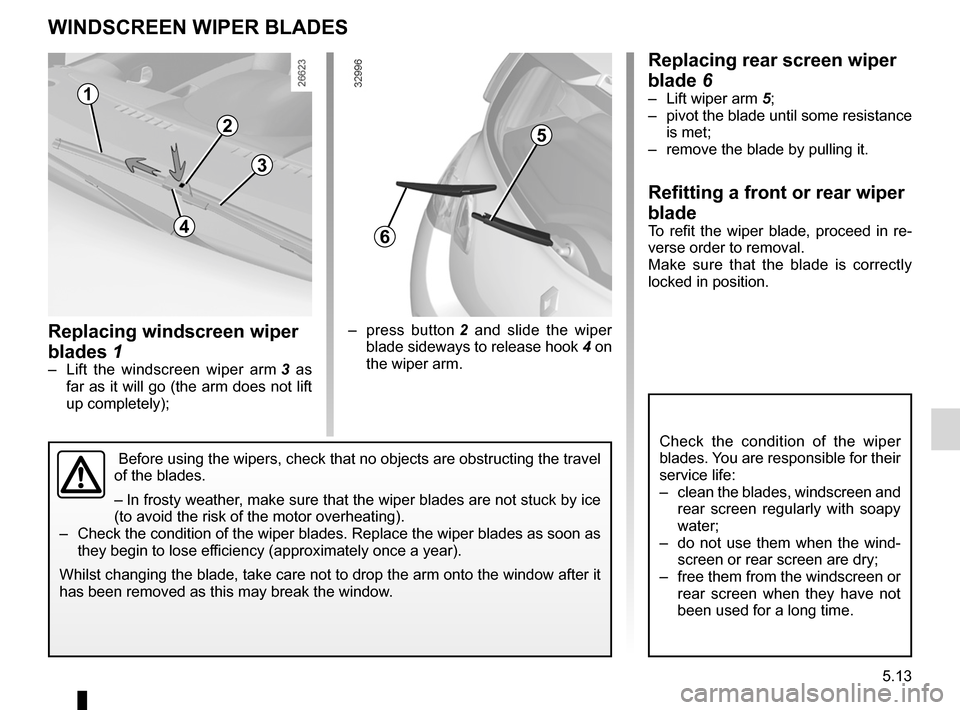
replacing windscreen wiper
blades 1
– Lift the windscreen wiper arm 3 as
far as it will go (the arm does not lift
up completely);
Wiper blades
WInDScreen WIPer BLADeS
replacing rear screen wiper
blade 6
– Lift wiper arm 5;
– pivot the blade until some resistance
is met;
– remove the blade by pulling it.
refitting a front or rear wiper
blade
To refit the wiper blade, proceed in re-
verse order to removal.
Make sure that the blade is correctly
locked in position.
– press button 2 and slide the wiper
blade sideways to release hook 4 on
the wiper arm.
Before using the wipers, check that no objects are obstructing the travel
of the blades.
– In frosty weather, make sure that the wiper blades are not stuck by ice
(to avoid the risk of the motor overheating).
– Check the condition of the wiper blades. Replace the wiper blades as soon as
they begin to lose efficiency (approximately once a year).
Whilst changing the blade, take care not to drop the arm onto the window after it
has been removed as this may break the window.
3
1
2
4
5
6
Check the condition of the wiper
blades. You are responsible for their
service life:
– clean the blades, windscreen and
rear screen regularly with soapy
water;
– do not use them when the wind-
screen or rear screen are dry;
– free them from the windscreen or
rear screen when they have not
been used for a long time.
Page 182 of 220
5.28
ENG_UD24741_10
Fusibles (X44 - Renault)
ENG_NU_952-4_X44_Renault_5
Jaune NoirNoir texte
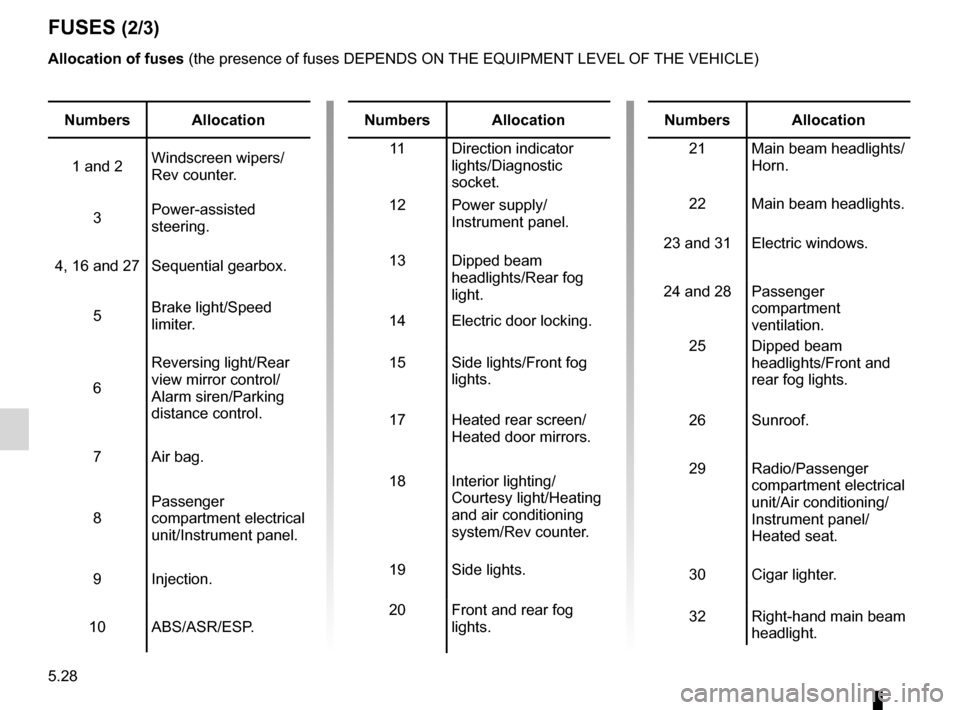
FuSeS (2/3)
numbers Allocation
1 and 2 Windscreen wipers/
Rev counter.
3 Power-assisted
steering.
4, 16 and 27 Sequential gearbox.
5 Brake light/Speed
limiter.
6 Reversing light/Rear
view mirror control/
Alarm siren/Parking
distance control.
7 Air bag.
8 Passenger
compartment electrical
unit/Instrument panel.
9 Injection.
10 ABS/ASR/ESP.numbers Allocation
11 Direction indicator
lights/Diagnostic
socket.
12 Power supply/
Instrument panel.
13 Dipped beam
headlights/Rear fog
light.
14 Electric door locking.
15 Side lights/Front fog
lights.
17 Heated rear screen/
Heated door mirrors.
18 Interior lighting/
Courtesy light/Heating
and air conditioning
system/Rev counter.
19 Side lights.
20 Front and rear fog
lights.numbers Allocation
21 Main beam headlights/
Horn.
22 Main beam headlights.
23 and 31 Electric windows.
24 and 28 Passenger
compartment
ventilation.
25 Dipped beam
headlights/Front and
rear fog lights.
26 Sunroof.
29 Radio/Passenger
compartment electrical
unit/Air conditioning/
Instrument panel/
Heated seat.
30 Cigar lighter.
32 Right-hand main beam
headlight.
Allocation of fuses
(the presence of fuses DEPENDS ON THE EQUIPMENT LEVEL OF THE VEHICLE)