radio RENAULT TWINGO 2012 2.G User Guide
[x] Cancel search | Manufacturer: RENAULT, Model Year: 2012, Model line: TWINGO, Model: RENAULT TWINGO 2012 2.GPages: 220, PDF Size: 6.73 MB
Page 153 of 220
maintenance:interior trim ....................................................... (current page)
4.15
ENG_UD22508_5
Entretien des garnitures intérieures (X44 - Renault)
ENG_NU_952-4_X44_Renault_4
Interior trim maintenance
INTERIOR TRIM MAINTENANCE (1/2)
A well-maintained vehicle will have a
longer service life. It is therefore ad -
visable to maintain the vehicle interior
regularly.
Stains should always be dealt with
quickly. Whatever type of stain is on
the trim, use soapy water (if possible,
warm water) containing:
Do not use detergents (washing up
liquid, powdered products, alcohol -
based products, etc.).
Use a soft cloth.
Glass instrument panel(e.g.: instrument panel, clock, exterior
temperature display, radio display).
Use a soft cloth or cotton wool.
If this does not clean it properly, use a
soft cloth (or cotton wool) slightly mois-
tened with soapy water and then wipe
clean with a soft damp cloth or cotton
wool.
Finally, carefully dry off with a soft dry
cloth.
Cleaning products containing alco -
hol must not be used under any cir-
cumstances.
Seat belts
These must be kept clean.
Use products selected by our Technical
Department (Approved outlets) or
warm, soapy water and a sponge and
wipe with a dry cloth.
Detergents or dyes must not be used
under any circumstances.
Fabrics (seats, door trim,
etc.)
Dust fabrics regularly.
Liquid stains
Use soapy water. Absorb or dab lightly
(never rub) using a soft cloth, then rinse
and absorb the excess water.
Solid or thick stains
Remove any excess solid or thick ma-
terial immediately and carefully using
a spatula (from the edge inwards to
avoid spreading the stain).
Clean using the procedure for a liquid
stain.
Special instructions for sweets or
chewing gum
Put an ice cube on the stain to solidify
it, then proceed as for a solid stain.
For advice on interior maintenance
and/or on unsatisfactory results,
contact an approved dealer.
Page 155 of 220
5.1
ENG_UD30797_17
Sommaire 5 (X44 - Renault)
ENG_NU_952-4_X44_Renault_5
Section 5: Practical advice
Puncture . . . . . . . . . . . . . . . . . . . . . . . . . . . . . . . . . . . . . . . . . . . . . . . . . . . . . . . . . . . . . . . . . . . . . . 5.2
Tyre inflation kit . . . . . . . . . . . . . . . . . . . . . . . . . . . . . . . . . . . . . . . . . . . . . . . . . . . . . . . . . . . . . . . . . 5.3
Tool kit . . . . . . . . . . . . . . . . . . . . . . . . . . . . . . . . . . . . . . . . . . . . . . . . . . . . . . . . . . . . . . . . . . . . . . . . 5.6
Wheel trim – Wheel rims . . . . . . . . . . . . . . . . . . . . . . . . . . . . . . . . . . . . . . . . . . . . . . . . . . . . . . . . . . 5.7
Changing a wheel . . . . . . . . . . . . . . . . . . . . . . . . . . . . . . . . . . . . . . . . . . . . . . . . . . . . . . . . . . . . . . . 5.8
Tyres (tyre and wheel safety, use in winter) . . . . . . . . . . . . . . . . . . . . . . . . . . . . . . . . . . . . . . . . . . . 5.10
Wiper blades . . . . . . . . . . . . . . . . . . . . . . . . . . . . . . . . . . . . . . . . . . . . . . . . . . . . . . . . . . . . . . . . . . . 5.13
Fog lights, front side lights . . . . . . . . . . . . . . . . . . . . . . . . . . . . . . . . . . . . . . . . . . . . . . . . . . . 5.16
Rear lights . . . . . . . . . . . . . . . . . . . . . . . . . . . . . . . . . . . . . . . . . . . . . . . . . . . . . . . . . . . . . . . 5.17
Side indicator lights . . . . . . . . . . . . . . . . . . . . . . . . . . . . . . . . . . . . . . . . . . . . . . . . . . . . . . . . 5.21
Interior lighting . . . . . . . . . . . . . . . . . . . . . . . . . . . . . . . . . . . . . . . . . . . . . . . . . . . . . . . . . . . . 5.22
Battery: breakdowns . . . . . . . . . . . . . . . . . . . . . . . . . . . . . . . . . . . . . . . . . . . . . . . . . . . . . . . . . . . . . 5.24
Radio frequency remote control unit: batteries . . . . . . . . . . . . . . . . . . . . . . . . . . . . . . . . . . . . . . . . . 5.26
Fuses . . . . . . . . . . . . . . . . . . . . . . . . . . . . . . . . . . . . . . . . . . . . . . . . . . . . . . . . . . . . . . . . . . . . . . . . . 5.27
Towing (breakdown – attachments) . . . . . . . . . . . . . . . . . . . . . . . . . . . . . . . . . . . . . . . . . . . . . . . . . . 5.30
Fitting a radio/accessories . . . . . . . . . . . . . . . . . . . . . . . . . . . . . . . . . . . . . . . . . . . . . . . . . . . . . . . . . 5.32
Accessories . . . . . . . . . . . . . . . . . . . . . . . . . . . . . . . . . . . . . . . . . . . . . . . . . . . . . . . . . . . . . . . . . . . . 5.34
Operating faults . . . . . . . . . . . . . . . . . . . . . . . . . . . . . . . . . . . . . . . . . . . . . . . . . . . . . . . . . . . . . . . . . 5.35
Page 178 of 220
batterytroubleshooting ............................... (up to the end of the DU)
5.24
ENG_UD24705_3
Batterie : dépannage (X44 - Renault)
ENG_NU_952-4_X44_Renault_5
Jaune NoirNoir texte
Battery: troubleshooting
BAtter Y: troubleshooting
to avoid all risk of sparks:
– Ensure that any consumers are
switched off before disconnecting or
reconnecting the battery;
– When charging, stop the charger
before connecting or disconnecting
the battery.
– Do not place metal objects on the
battery to avoid creating a short cir-
cuit between the terminals.
connecting a battery charger
the battery charger should be com-
patible with a battery with nominal
voltage of 12 Volts.
With the engine off, it is essential to dis-
connect the leads connected to both
battery terminals , starting with the
negative terminal.
Do not disconnect the battery when the
engine is running. Follow the instruc-
tions given by the manufacturer of
the battery charger you are using. Only a fully charged and well
-main -
tained battery will have a long and
useful service life and enable you to
start the vehicle’s engine normally.
The battery must be kept clean and dry.
Have the battery’s charge status
checked regularly:
– especially if you use your vehicle for
short journeys or for frequent driving
in town;
– when the exterior temperature drops
(in winter), the charge decreases .
In winter, only use the electrical
equipment that is really necessary;
– finally, you should understand that
the charge decreases naturally as a
result of certain permanent electrical
consumers such as the clock, after-
sales accessories, etc.
When many accessories are fitted to
the vehicle, have them connected to
the + after ignition feed. In this case,
it is advisable to have your vehicle
fitted with a battery which has an in -
creased nominal capacity. Contact an
approved Dealer. If your vehicle is to
be left stationary for a relatively long
time, disconnect the battery or have it
recharged regularly, particularly during
cold weather. The equipment with a
memory, radio, etc. will then have to
be reprogrammed. The battery must
be stored in a cool dry place, protected
from frost.
Special procedures may be
required to charge some
batteries. Contact an ap -
proved Dealer.
Avoid all risk of sparks which may
cause an immediate explosion, and
charge the battery in a well-venti -
lated area. Risk of serious injury.
Page 180 of 220
remote control electric door lockingbatteries ........................................................... (current page)
battery (remote control) ......................................... (current page)
5.26
ENG_UD14469_2
Télécommande à radiofréquence : piles (X44 - E33 - X33 - Re\
nault)
ENG_NU_952-4_X44_Renault_5
Radio frequency remote control: batteries
rADIO FreQuencY reMOte cOntrOL: BAtterIeS
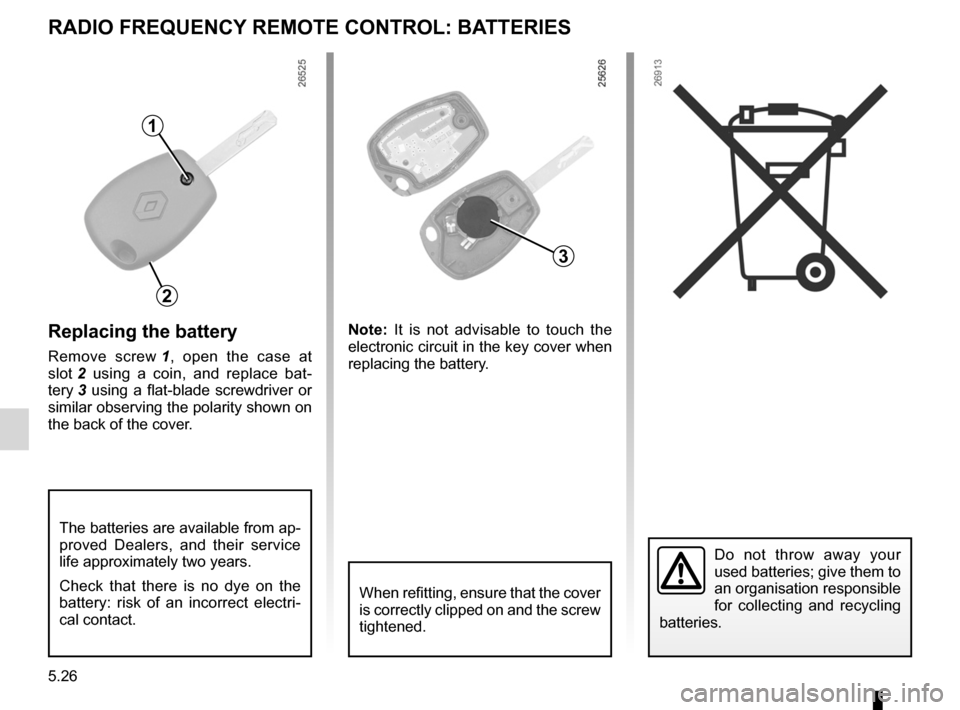
replacing the battery
Remove screw 1 , open the case at
slot 2 using a coin, and replace bat -
tery 3 using a flat-blade screwdriver or
similar observing the polarity shown on
the back of the cover. n
ote: It is not advisable to touch the
electronic circuit in the key cover when
replacing the battery.
Do not throw away your
used batteries; give them to
an organisation responsible
for collecting and recycling
batteries.
1
3
2
When refitting, ensure that the cover
is correctly clipped on and the screw
tightened.
The batteries are available from ap-
proved Dealers, and their service
life approximately two years.
Check that there is no dye on the
battery: risk of an incorrect electri -
cal contact.
Page 182 of 220
5.28
ENG_UD24741_10
Fusibles (X44 - Renault)
ENG_NU_952-4_X44_Renault_5
Jaune NoirNoir texte
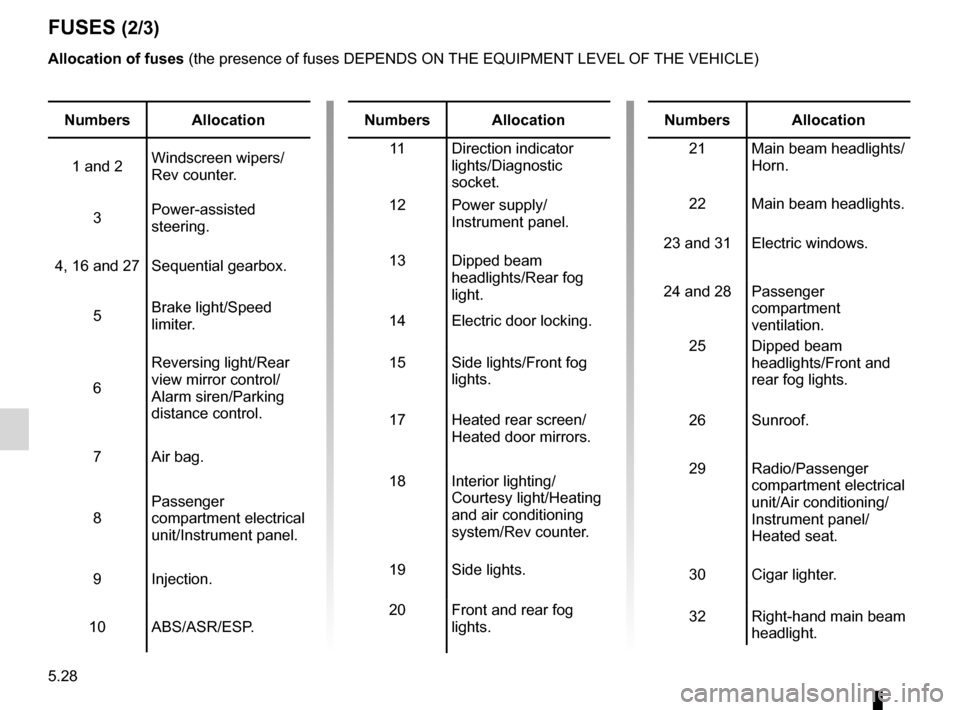
FuSeS (2/3)
numbers Allocation
1 and 2 Windscreen wipers/
Rev counter.
3 Power-assisted
steering.
4, 16 and 27 Sequential gearbox.
5 Brake light/Speed
limiter.
6 Reversing light/Rear
view mirror control/
Alarm siren/Parking
distance control.
7 Air bag.
8 Passenger
compartment electrical
unit/Instrument panel.
9 Injection.
10 ABS/ASR/ESP.numbers Allocation
11 Direction indicator
lights/Diagnostic
socket.
12 Power supply/
Instrument panel.
13 Dipped beam
headlights/Rear fog
light.
14 Electric door locking.
15 Side lights/Front fog
lights.
17 Heated rear screen/
Heated door mirrors.
18 Interior lighting/
Courtesy light/Heating
and air conditioning
system/Rev counter.
19 Side lights.
20 Front and rear fog
lights.numbers Allocation
21 Main beam headlights/
Horn.
22 Main beam headlights.
23 and 31 Electric windows.
24 and 28 Passenger
compartment
ventilation.
25 Dipped beam
headlights/Front and
rear fog lights.
26 Sunroof.
29 Radio/Passenger
compartment electrical
unit/Air conditioning/
Instrument panel/
Heated seat.
30 Cigar lighter.
32 Right-hand main beam
headlight.
Allocation of fuses
(the presence of fuses DEPENDS ON THE EQUIPMENT LEVEL OF THE VEHICLE)
Page 183 of 220
JauneNoirNoir texte
5.29
ENG_UD24741_10
Fusibles (X44 - Renault)
ENG_NU_952-4_X44_Renault_5
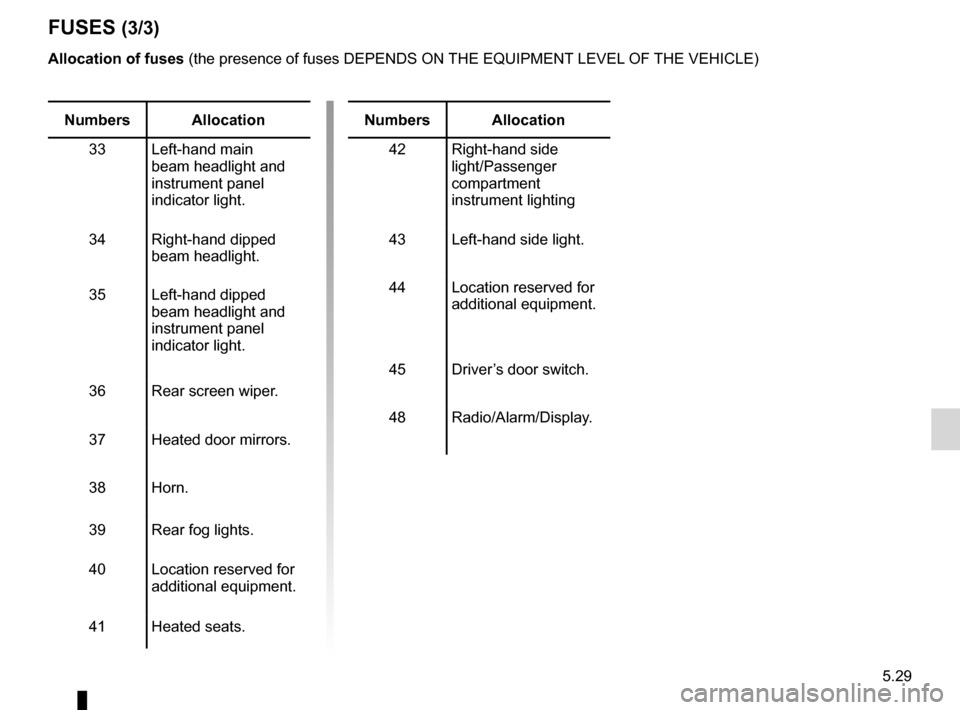
FuSeS (3/3)
numbers Allocation
33 Left-hand main
beam headlight and
instrument panel
indicator light.
34 Right-hand dipped
beam headlight.
35 Left-hand dipped
beam headlight and
instrument panel
indicator light.
36 Rear screen wiper.
37 Heated door mirrors.
38 Horn.
39 Rear fog lights.
40 Location reserved for
additional equipment.
41 Heated seats.numbers Allocation
42 Right-hand side
light/Passenger
compartment
instrument lighting
43 Left-hand side light.
44 Location reserved for
additional equipment.
45 Driver’s door switch.
48 Radio/Alarm/Display.
Allocation of fuses
(the presence of fuses DEPENDS ON THE EQUIPMENT LEVEL OF THE VEHICLE)
Page 186 of 220
fitting a radio ......................................... (up to the end of the DU)
speakers location ........................................... (up to the end of the DU)
radio...................................................... (up to the end of the DU)
fitting a radio ......................................... (up to the end of the DU)
radio fitting a radio ................................... (up to the end of the DU)
5.32
ENG_UD24740_3
Prééquipement radio (X44 - Renault)
ENG_NU_952-4_X44_Renault_5
Jaune NoirNoir texte
Fitting a radio/accessories
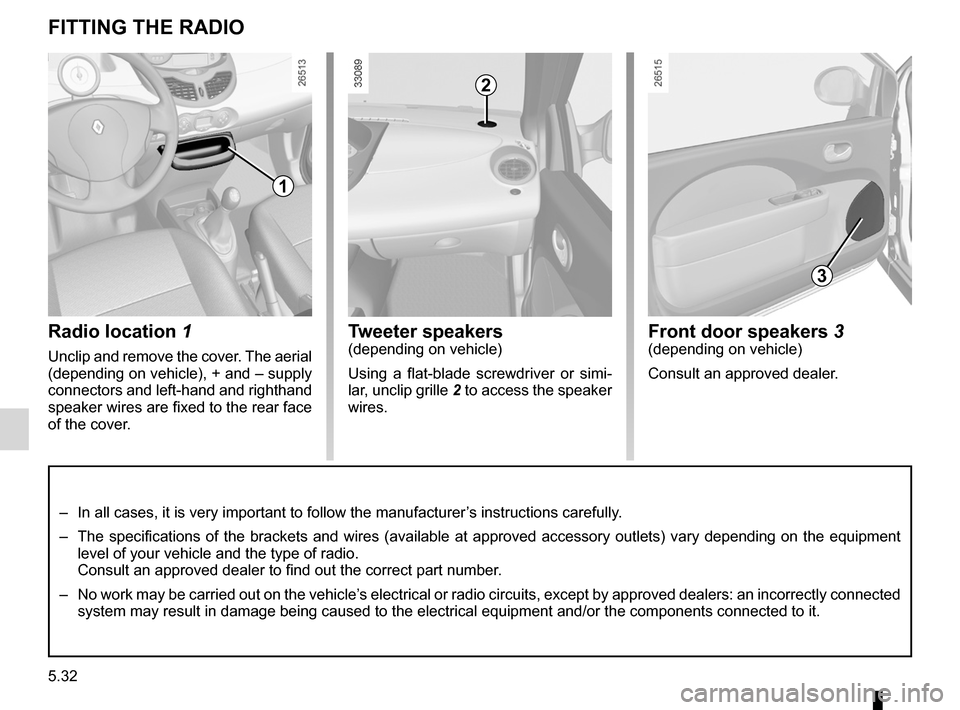
FIttIng tHe rADIO
radio location 1
Unclip and remove the cover. The aerial
(depending on vehicle), + and – supply
connectors and left-hand and righthand
speaker wires are fixed to the rear face
of the cover.
tweeter speakers(depending on vehicle)
Using a flat-blade screwdriver or simi -
lar, unclip grille 2 to access the speaker
wires.Front door speakers 3(depending on vehicle)
Consult an approved dealer.
– In all cases, it is very important to follow the manufacturer’s instructions carefully.
– The specifications of the brackets and wires (available at approved accessory outlets) vary depending on the equipment
level of your vehicle and the type of radio.
Consult an approved dealer to find out the correct part number.
– No work may be carried out on the vehicle’s electrical or radio circuits, except by approved dealers: an incorrectly connected
system may result in damage being caused to the electrical equipment and\
/or the components connected to it.
1
2
3
Page 187 of 220
JauneNoirNoir texte
5.33
ENG_UD24740_3
Prééquipement radio (X44 - Renault)
ENG_NU_952-4_X44_Renault_5
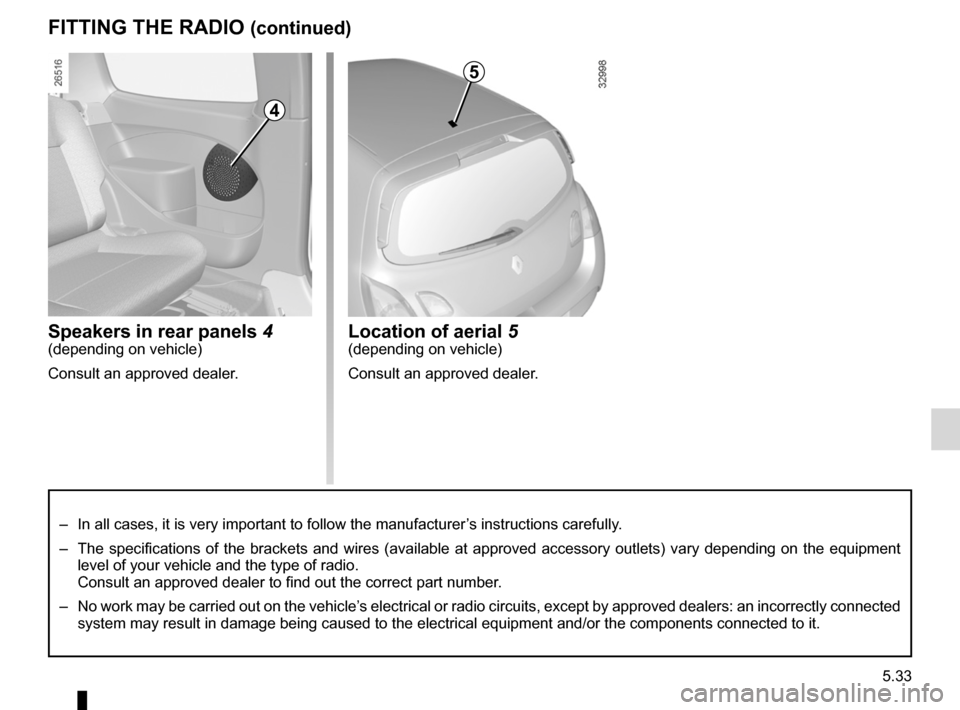
Speakers in rear panels 4(depending on vehicle)
Consult an approved dealer.
FIttIng tHe rADIO (continued)
4
Location of aerial 5(depending on vehicle)
Consult an approved dealer.
5
– In all cases, it is very important to follow the manufacturer’s instructions carefully.
– The specifications of the brackets and wires (available at approved accessory outlets) vary depending on the equipment
level of your vehicle and the type of radio.
Consult an approved dealer to find out the correct part number.
– No work may be carried out on the vehicle’s electrical or radio circuits, except by approved dealers: an incorrectly connected
system may result in damage being caused to the electrical equipment and\
/or the components connected to it.
Page 188 of 220

5.34
ENG_UD27824_1
Accessoires VT (X06 - X35 - X44 - X45 - X77 - X81 - X85 - X90 - X91 - X70 - X76 - X83\
- X61 - TEST")
accessories...........................................(up to the end of the DU)
5.34
ENG_UD27824_1
Accessoires VT (X06 - X35 - X44 - X45 - X77 - X81 - X85 - X90 - X91 - X70 - X76 - X83\
- X61 - TEST - X95 - X33 - X47 - X43 - X38 - H79 - X62 - X32 - X09 - X67 - X92 -
ENG_NU_952-4_X44_Renault_5
Accessories
AcceSSOrIeS
electrical and electronic accessoriesBefore installing this type of accessory, make sure it is compatible with your vehicle. You can get advice from an au-
thorised dealer.
Connect accessories with a maximum power of 120 watts only. Fire hazard.
No work may be carried out on the vehicle’s electrical or radio circuits, except by authorised dealers: an incorrectly connected
system may result in damage being caused to the electrical equipment and\
/or the components connected to it.
If the vehicle is fitted with any aftermarket electrical equipment, make sure that the installation is correctly protected by a fuse.
Establish the rating and position of this fuse.
use of transmission/receiving devices (telephones, cB equipment etc.).
Telephones and CB equipment with integrated aerials may cause interference to the electronic systems originally fitted to the
vehicle: it is advisable only to use equipment with an external aerial. Furthermore, we remind you of the need to conform
to the legislation in force concerning the use of such equipment.
Fitting after-market accessoriesIf you wish to install accessories on the vehicle: please contact an authorised dealer. Also, to ensure the correct operation of
your vehicle, and to avoid any risk to your safety, we recommend that you use only accessories specifically designed for your
vehicle, which are the only accessories for which the manufacturer will \
provide a warranty.
If you are using an anti-theft device, only attach it to the brake pedal\
.
Obstructions to the driver
On the driver’s side, only use mats suitable for the vehicle, attached with the pre-fitted components, and check the fitting regu-
larly. Do not lay one mat on top of another. there is a risk of wedging the pedals
Page 214 of 220
7.2
FRA_UD30806_17
Index (X44 - Renault)
ENG_NU_952-4_X44_Renault_7
Jaune NoirNoir texte
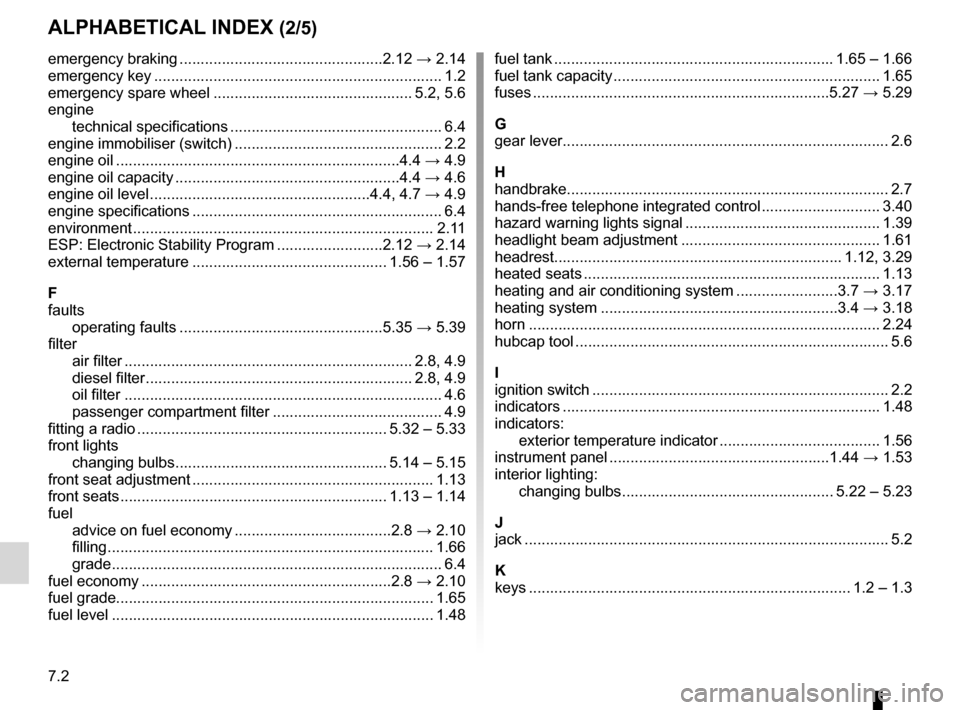
AlphAbeticAl index (2/5)
emergency braking ................................................ 2.12 → 2.14
emergency key .................................................................... 1.2
emergency spare wheel ............................................... 5.2, 5.6
engine technical specifications .................................................. 6.4
engine immobiliser (switch) ................................................. 2.2
engine oil ................................................................... 4.4 → 4.9
engine oil capacity ..................................................... 4.4 → 4.6
engine oil level .................................................... 4.4, 4.7 → 4.9
engine specifications ........................................................... 6.4
environment ....................................................................... 2.11
ESP: Electronic Stability Program .........................2.12 → 2.14
external temperature .............................................. 1.56 – 1.57
F
faults operating faults ................................................ 5.35 → 5.39
filter air filter .................................................................... 2.8, 4.9
diesel filter ............................................................... 2.8, 4.9
oil filter ........................................................................... 4.6
passenger compartment filter ........................................ 4.9
fitting a radio ........................................................... 5.32 – 5.33
front lights changing bulbs .................................................. 5.14 – 5.15
front seat adjustment ......................................................... 1.13
front seats ............................................................... 1.13 – 1.14
fuel advice on fuel economy ..................................... 2.8 → 2.10
filling ............................................................................. 1.66
grade .............................................................................. 6.4
fuel economy ........................................................... 2.8 → 2.10
fuel grade ........................................................................... 1.65
fuel level ............................................................................ 1.48fuel tank
.................................................................. 1.65 – 1.66
fuel tank capacity ............................................................... 1.65
fuses ...................................................................... 5.27 → 5.29
G
gear lever ............................................................................. 2.6
h
handbrake ............................................................................ 2.7
hands-free telephone integrated control ............................ 3.40
hazard warning lights signal .............................................. 1.39
headlight beam adjustment ............................................... 1.61
headrest .................................................................... 1.12, 3.29
heated seats ...................................................................... 1.13
heating and air conditioning system ........................ 3.7 → 3.17
heating system ........................................................ 3.4 → 3.18
horn ................................................................................... 2.24
hubcap tool .......................................................................... 5.6
i
ignition switch ...................................................................... 2.2
indicators ........................................................................... 1.48
indicators: exterior temperature indicator ...................................... 1.56
instrument panel .................................................... 1.44 → 1.53
interior lighting: changing bulbs .................................................. 5.22 – 5.23
J
jack ...................................................................................... 5.2
K
keys ............................................................................ 1.2 – 1.3