steering wheel RENAULT TWINGO 2012 2.G User Guide
[x] Cancel search | Manufacturer: RENAULT, Model Year: 2012, Model line: TWINGO, Model: RENAULT TWINGO 2012 2.GPages: 220, PDF Size: 6.73 MB
Page 85 of 220
JauneNoirNoir texte
2.13
ENG_UD25058_2
Dispositifs de correction de conduite (X44 - Renault)
ENG_NU_952-4_X44_Renault_2
DRIvING coRRectIoN DevIce (continued)
electronic stability program
(eSP) with understeer control
and traction control (ASR)
Warning light on the instrument
panel flashes when the function starts
operating. electronic Stability Program (eSP)
This system helps you to keep control
of the vehicle in critical driving condi
-
tions (avoiding an obstacle, loss of grip
on a bend, etc.).
operating principle
A sensor in the steering wheel detects
the direction selected by the driver.
Other sensors throughout the vehicle
measure the actual direction.
The system compares the direction se-
lected by the driver and the actual di -
rection of the vehicle and corrects this
as necessary by applying the brakes
selectively and/or acting on the engine
power.
Understeer control
This system optimises the action of the
ESP in the case of pronounced unders-
teering (loss of front axle road holding). t
raction control (ASR)
This system helps to limit wheelspin of
the drive wheels and to control the ve-
hicle when pulling away accelerating or
decelerating.
operating principle
Using the wheel sensors, the system
measures and compares the speed of
the drive wheels at all times and slows
down their over-rotation. If a wheel is
starting to slip, the system brakes au -
tomatically until the drive supplied be -
comes compatible with the level of grip
under the wheel again.
The system also adjusts the engine
speed to the grip available under the
wheels, independently of the pressure
exerted on the accelerator pedal.
Page 165 of 220
JauneNoirNoir texte
5.11
ENG_UD19374_3
Pneumatiques (X44 - Renault)
ENG_NU_952-4_X44_Renault_5
tYreS (2/3)
t yre pressures
Tyre pressures must be adhered to (in-
cluding the emergency spare wheel).
Pressures must be checked at least
once a month and always before a
long journey (refer to the information on
“Tyre pressures”). Pressures should be checked when the
tyres are cold; ignore higher pressures
which may be reached in hot weather
or following a fast journey.
If tyre pressures cannot be checked
when the tyres are
cold, the normal
pressures must be increased by 0.2 to
0.3 bar (or 3 PSI).
never deflate a hot tyre.
note: a label (depending on country or
model) fixed to the edge or frame of the
driver’s door gives the recommended
tyre pressures.
Fitting new tyres
changing wheels around
This practice is not recommended.
emergency spare wheel
Refer to the information on the
“Emergency spare wheel” and in -
structions on “Changing a wheel” in
Section 5.
For safety reasons, this op-
eration must be carried out
by a specialist.
Fitting different tyres may
change your vehicle as follows:
– it may mean that your vehicle no
longer conforms to current regu-
lations;
– it may change the way it handles
when cornering;
– it may cause the steering to be
heavy;
– it may affect the use of snow
chains.
Please be aware that a
missing valve cap can
make the tyres less airtight
and lead to pressure loss.
Always use valve caps identical to
those fitted originally and tighten
them fully.
Incorrect tyre pressures
lead to abnormal tyre wear
and unusually hot running.
These are factors which
may seriously affect safety and lead
to:
– poor road holding;
– the risk of blow-outs or of throw-
ing a tread.
Tyre pressures depend on the load
and the driving speed. Adjust the
pressures according to the condi -
tions of use. (Refer to the informa -
tion on “Tyre pressures”).
Page 181 of 220
fuses ..................................................... (up to the end of the DU)
5.27
ENG_UD24741_10
Fusibles (X44 - Renault)
ENG_NU_952-4_X44_Renault_5
Fuses
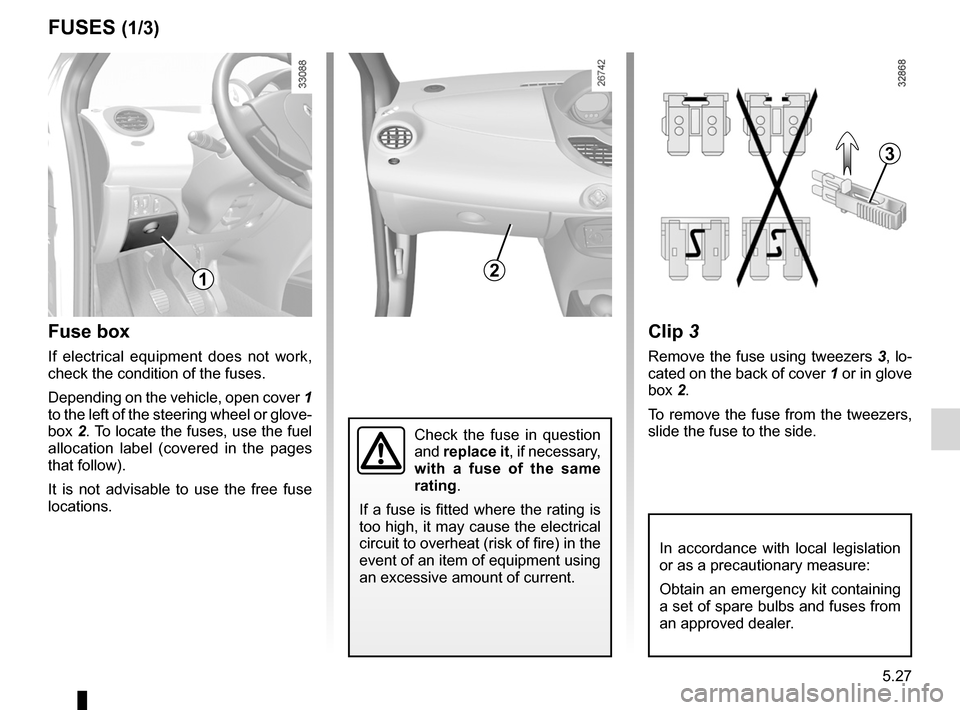
Fuse box
If electrical equipment does not work,
check the condition of the fuses.
Depending on the vehicle, open cover 1
to the left of the steering wheel or glove -
box 2. To locate the fuses, use the fuel
allocation label (covered in the pages
that follow).
It is not advisable to use the free fuse
locations.
FuSeS (1/3)
In accordance with local legislation
or as a precautionary measure:
Obtain an emergency kit containing
a set of spare bulbs and fuses from
an approved dealer.
clip 3
Remove the fuse using tweezers 3, lo-
cated on the back of cover 1 or in glove
box 2.
To remove the fuse from the tweezers,
slide the fuse to the side.
2
3
1
Check the fuse in question
and replace it, if necessary,
with a fuse of the same
rating.
If a fuse is fitted where the rating is
too high, it may cause the electrical
circuit to overheat (risk of fire) in the
event of an item of equipment using
an excessive amount of current.
Page 184 of 220
towingbreakdown ...................................... (up to the end of the DU)
towing towing equipment ............................ (up to the end of the DU)
towing hitch ........................................... (up to the end of the DU)
towing a caravan .................................. (up to the end of the DU)
5.30
ENG_UD24739_3
Remorquage : dépannage (X44 - Renault)
ENG_NU_952-4_X44_Renault_5
Jaune NoirNoir texte
Towing (breakdown – attachments)
tOWIng: breakdown
the steering wheel must be un -
locked and the ignition key must be
in the “Ignition on” position to pro -
vide signals (brake lights and direc-
tion indicators) on the towed vehi -
cle. At night the vehicle must have
its lights on.
You must observe the towing regu -
lations which apply in the country in
which you are driving: do not exceed
the towing weight for your vehicle.
Contact your RENAULT Dealer. u
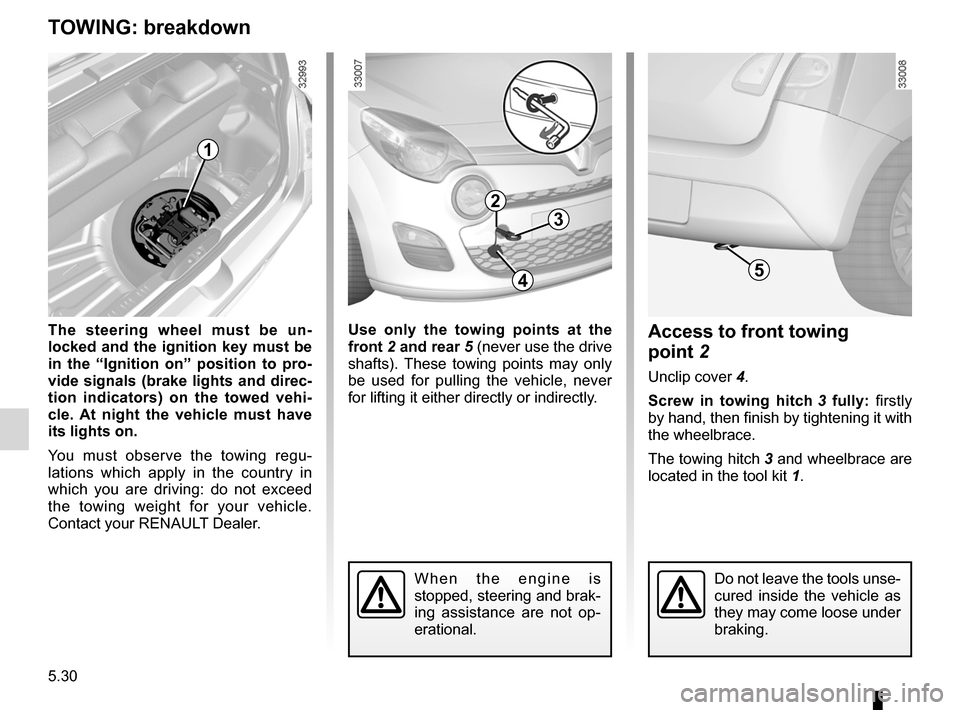
se only the towing points at the
front 2 and rear 5 (never use the drive
shafts). These towing points may only
be used for pulling the vehicle, never
for lifting it either directly or indirectly.Access to front towing
point 2
Unclip cover 4.
Screw in towing hitch 3 fully: firstly
by hand, then finish by tightening it with
the wheelbrace.
The towing hitch 3 and wheelbrace are
located in the tool kit 1.
W h e n t h e e n g i n e i s
stopped, steering and brak-
ing assistance are not op -
erational.
1
Do not leave the tools unse-
cured inside the vehicle as
they may come loose under
braking.
3
2
45
Page 189 of 220
operating faults ..................................... (up to the end of the DU)
faults operating faults ............................... (up to the end of the DU)
5.35
ENG_UD18961_2
Anomalies de fonctionnement (X44 - Renault)
ENG_NU_952-4_X44_Renault_5
Operating faults
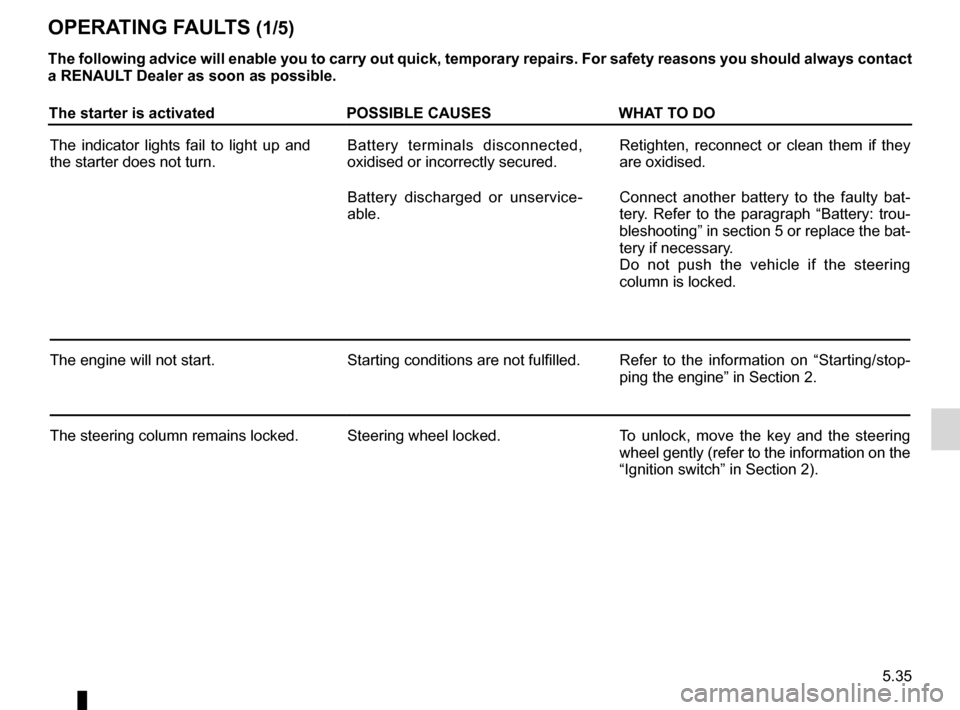
OPerA tIng FAuL tS (1/5)
the following advice will enable you to carry out quick, temporary repairs. For safety reasons you should always contact
a renAuLt Dealer as soon as possible.
the starter is activated POSSIBLe cAuSeSWHAt tO DO
The indicator lights fail to light up and
the starter does not turn. Battery terminals disconnected,
oxidised or incorrectly secured.Retighten, reconnect or clean them if they
are oxidised.
Battery discharged or unservice -
able. Connect another battery to the faulty bat
-
tery. Refer to the paragraph “Battery: trou-
bleshooting” in section 5 or replace the bat-
tery if necessary.
Do not push the vehicle if the steering
column is locked.
The engine will not start. Starting conditions are not fulfilled.Refer to the information on “Starting/stop -
ping the engine” in Section 2.
The steering column remains locked. Steering wheel locked.To unlock, move the key and the steering
wheel gently (refer to the information on the
“Ignition switch” in Section 2).
Page 216 of 220
7.4
FRA_UD30806_17
Index (X44 - Renault)
ENG_NU_952-4_X44_Renault_7
Jaune NoirNoir texte
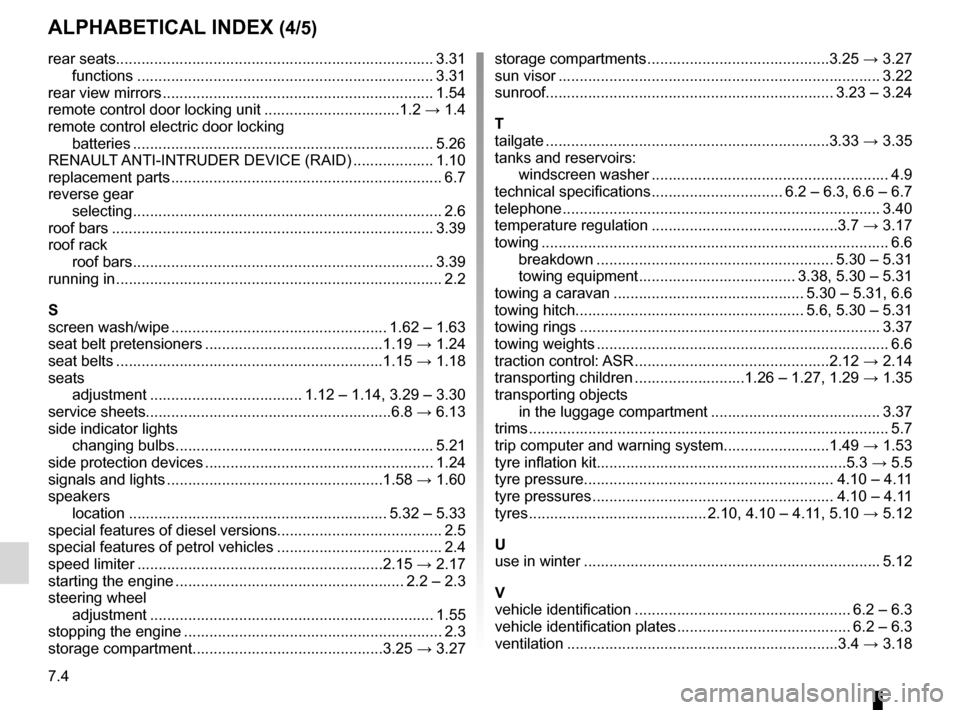
AlphAbeticAl index (4/5)
rear seats ........................................................................... 3.31
functions ...................................................................... 3.31
rear view mirrors ................................................................ 1.54
remote control door locking unit ................................1.2 → 1.4
remote control electric door locking batteries ....................................................................... 5.26
RENAULT ANTI-INTRUDER DEVICE (RAID) ...................1.10
replacement parts ................................................................ 6.7
reverse gear selecting ......................................................................... 2.6
roof bars ............................................................................ 3.39
roof rack roof bars ....................................................................... 3.39
running in ............................................................................. 2.2
S
screen wash/wipe ................................................... 1.62 – 1.63
seat belt pretensioners .......................................... 1.19 → 1.24
seat belts ............................................................... 1.15 → 1.18
seats adjustment .................................... 1.12 – 1.14, 3.29 – 3.30
service sheets .......................................................... 6.8 → 6.13
side indicator lights changing bulbs ............................................................. 5.21
side protection devices ...................................................... 1.24
signals and lights ................................................... 1.58 → 1.60
speakers location ............................................................. 5.32 – 5.33
special features of diesel versions .......................................2.5
special features of petrol vehicles ....................................... 2.4
speed limiter .......................................................... 2.15 → 2.17
starting the engine ...................................................... 2.2 – 2.3
steering wheel adjustment ................................................................... 1.55
stopping the engine ............................................................. 2.3
storage compartment ............................................. 3.25 → 3.27storage compartments
........................................... 3.25 → 3.27
sun visor ............................................................................ 3.22
sunroof .................................................................... 3.23 – 3.24
t
tailgate ................................................................... 3.33 → 3.35
tanks and reservoirs: windscreen washer ........................................................ 4.9
technical specifications ............................... 6.2 – 6.3, 6.6 – 6.7
telephone ........................................................................... 3.40
temperature regulation ............................................ 3.7 → 3.17
towing .................................................................................. 6.6
breakdown ........................................................ 5.30 – 5.31
towing equipment ..................................... 3.38, 5.30 – 5.31
towing a caravan ............................................. 5.30 – 5.31, 6.6
towing hitch ...................................................... 5.6, 5.30 – 5.31
towing rings ....................................................................... 3.37
towing weights ..................................................................... 6.6
traction control: ASR .............................................. 2.12 → 2.14
transporting children .......................... 1.26 – 1.27, 1.29 → 1.35
transporting objects in the luggage compartment ........................................ 3.37
trims ..................................................................................... 5.7
trip computer and warning system .........................1.49 → 1.53
tyre inflation kit ........................................................... 5.3 → 5.5
tyre pressure ........................................................... 4.10 – 4.11
tyre pressures ......................................................... 4.10 – 4.11
tyres .......................................... 2.10, 4.10 – 4.11, 5.10 → 5.12
U
use in winter ...................................................................... 5.12
V
vehicle identification ................................................... 6.2 – 6.3
vehicle identification plates ......................................... 6.2 – 6.3
ventilation ................................................................ 3.4 → 3.18