brake RENAULT TWINGO 2015 3.G Owner's Manual
[x] Cancel search | Manufacturer: RENAULT, Model Year: 2015, Model line: TWINGO, Model: RENAULT TWINGO 2015 3.GPages: 216, PDF Size: 5.06 MB
Page 149 of 216
4.9
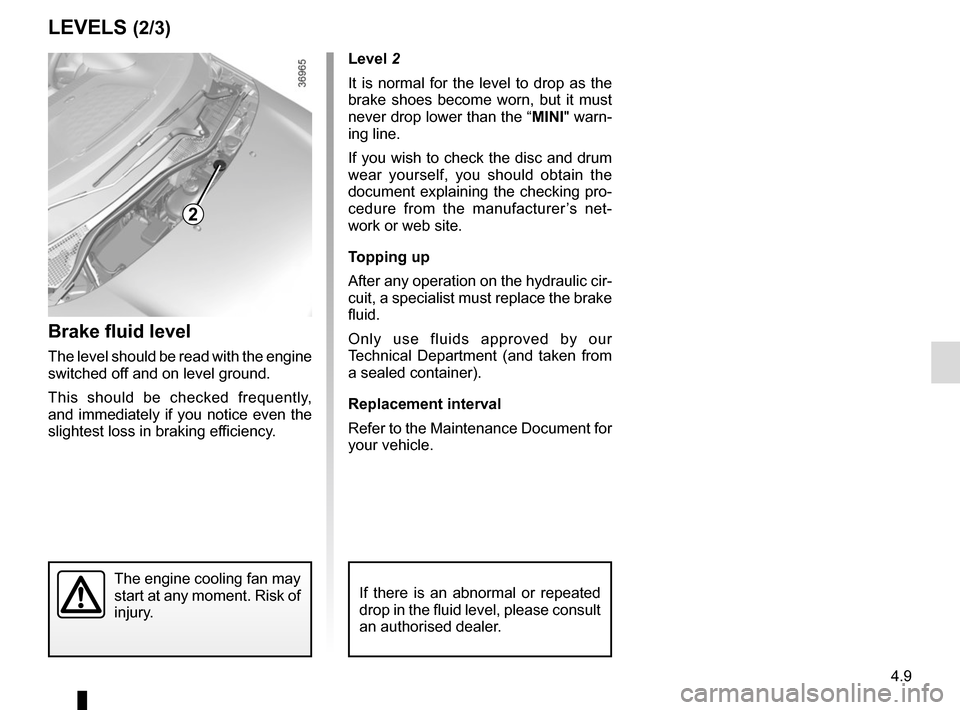
Level 2
It is normal for the level to drop as the
brake shoes become worn, but it must
never drop lower than the “MINI" warn-
ing line.
If you wish to check the disc and drum
wear yourself, you should obtain the
document explaining the checking pro-
cedure from the manufacturer’s net-
work or web site.
Topping up
After any operation on the hydraulic cir-
cuit, a specialist must replace the brake
fluid.
Only use fluids approved by our
Technical Department (and taken from
a sealed container).
Replacement interval
Refer to the Maintenance Document for
your vehicle.
Brake fluid level
The level should be read with the engine
switched off and on level ground.
This should be checked frequently,
and immediately if you notice even the
slightest loss in braking efficiency.
LEVELS (2/3)
2
The engine cooling fan may
start at any moment. Risk of
injury.If there is an abnormal or repeated
drop in the fluid level, please consult
an authorised dealer.
Page 161 of 216
5.3
TYRE INFLATION KIT (2/4)
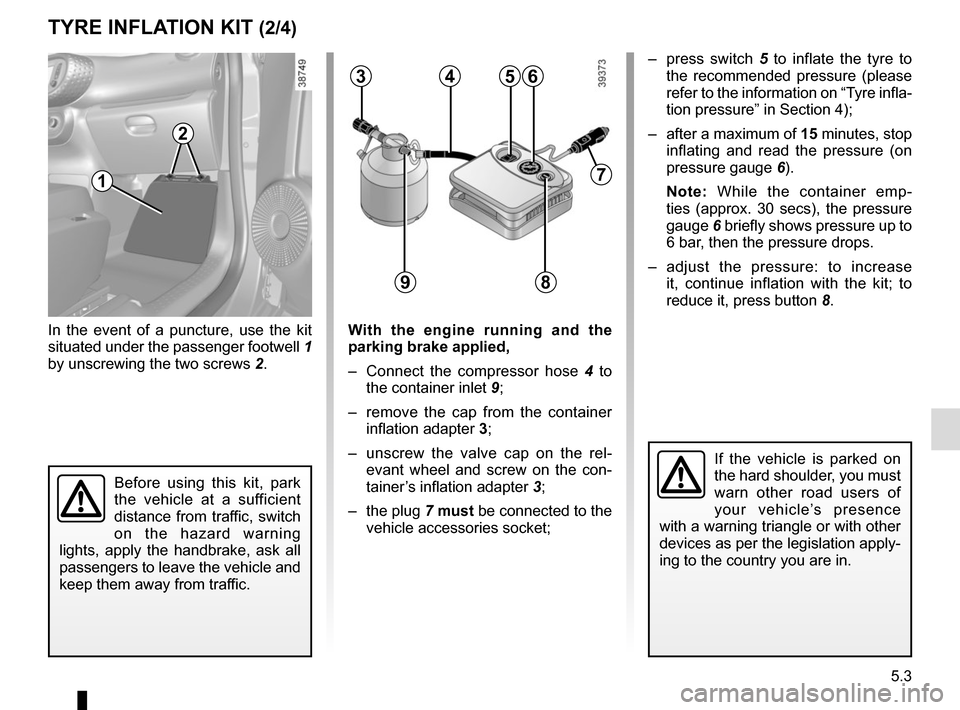
In the event of a puncture, use the kit
situated under the passenger footwell 1
by unscrewing the two screws 2.With the engine running and the
parking brake applied,
– Connect the compressor hose 4 to
the container inlet 9;
– remove the cap from the container inflation adapter 3;
– unscrew the valve cap on the rel- evant wheel and screw on the con-
tainer’s inflation adapter 3;
– the plug 7 must be connected to the
vehicle accessories socket;
563
Before using this kit, park
the vehicle at a sufficient
distance from traffic, switch
on the hazard warning
lights, apply the handbrake, ask all
passengers to leave the vehicle and
keep them away from traffic.
9
If the vehicle is parked on
the hard shoulder, you must
warn other road users of
your vehicle’s presence
with a warning triangle or with other
devices as per the legislation apply-
ing to the country you are in.
– press switch 5 to inflate the tyre to
the recommended pressure (please
refer to the information on “Tyre infla-
tion pressure” in Section 4);
– after a maximum of 15 minutes, stop inflating and read the pressure (on
pressure gauge 6).
Note: While the container emp-
ties (approx. 30 secs), the pressure
gauge 6 briefly shows pressure up to
6 bar, then the pressure drops.
– adjust the pressure: to increase it, continue inflation with the kit; to
reduce it, press button 8.
7
4
8
1
2
Page 169 of 216
5.11
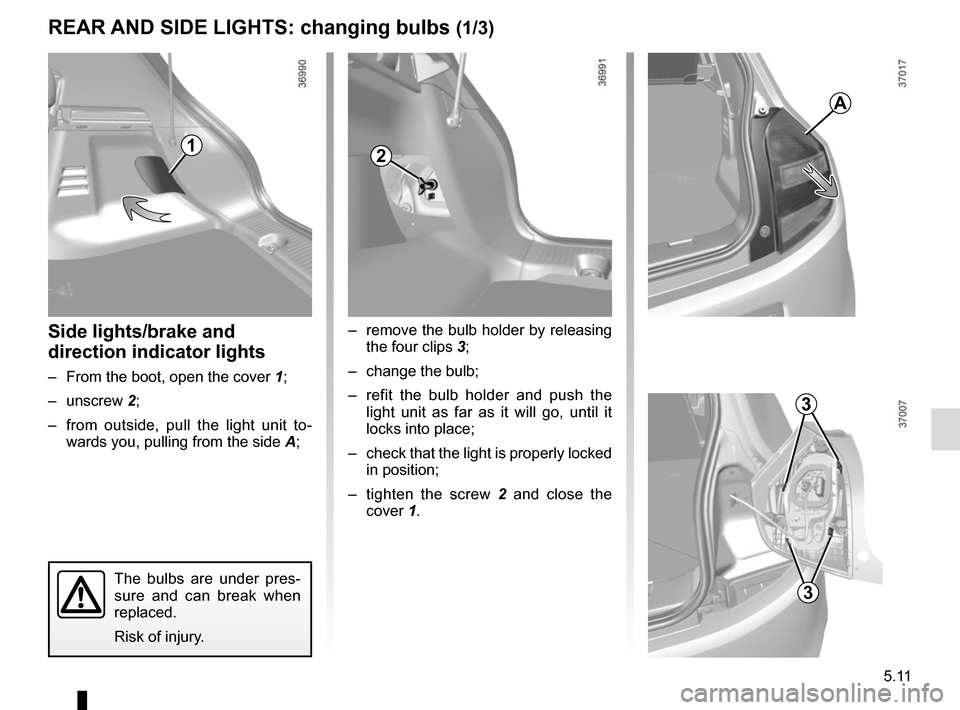
Side lights/brake and
direction indicator lights
– From the boot, open the cover 1;
– unscrew 2;
– from outside, pull the light unit to- wards you, pulling from the side A;
REAR AND SIDE LIGHTS: changing bulbs (1/3)
– remove the bulb holder by releasing
the four clips 3;
– change the bulb;
– refit the bulb holder and push the light unit as far as it will go, until it
locks into place;
– check that the light is properly locked in position;
– tighten the screw 2 and close the
cover 1.
3
3
12
A
The bulbs are under pres-
sure and can break when
replaced.
Risk of injury.
Page 170 of 216
5.12
REAR AND SIDE LIGHTS: changing bulbs (2/3)
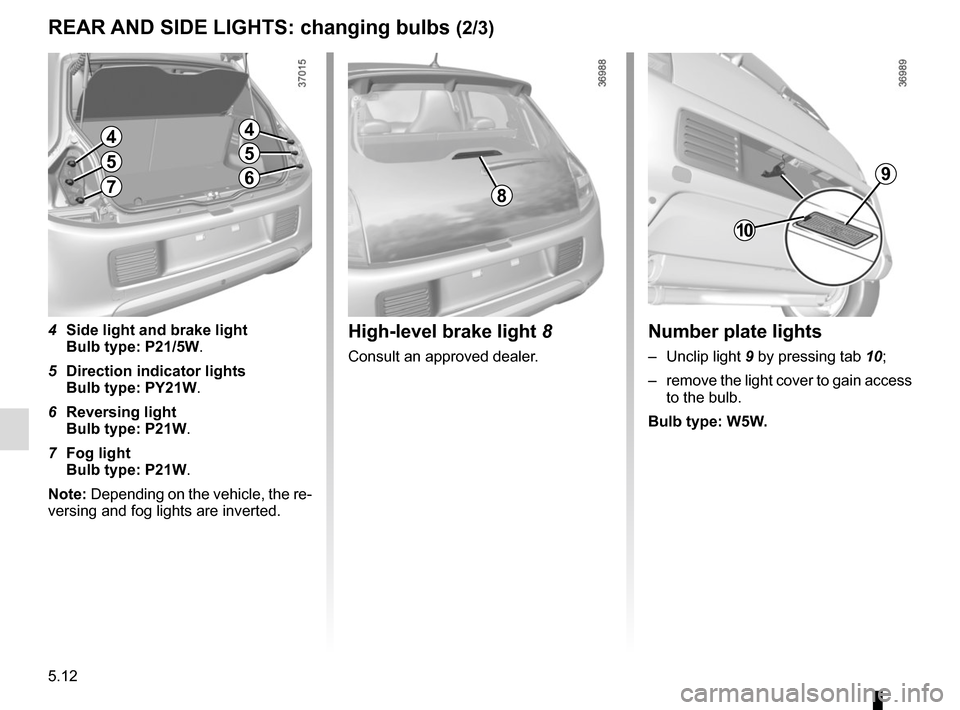
Number plate lights
– Unclip light 9 by pressing tab 10;
– remove the light cover to gain access to the bulb.
Bulb type: W5W.
10
9
High-level brake light 8
Consult an approved dealer.
8
44
4 Side light and brake light
Bulb type: P21/5W.
5 Direction indicator lights
Bulb type: PY21W.
6 Reversing light
Bulb type: P21W.
7 Fog light
Bulb type: P21W.
Note: Depending on the vehicle, the re-
versing and fog lights are inverted.
55
67
Page 175 of 216
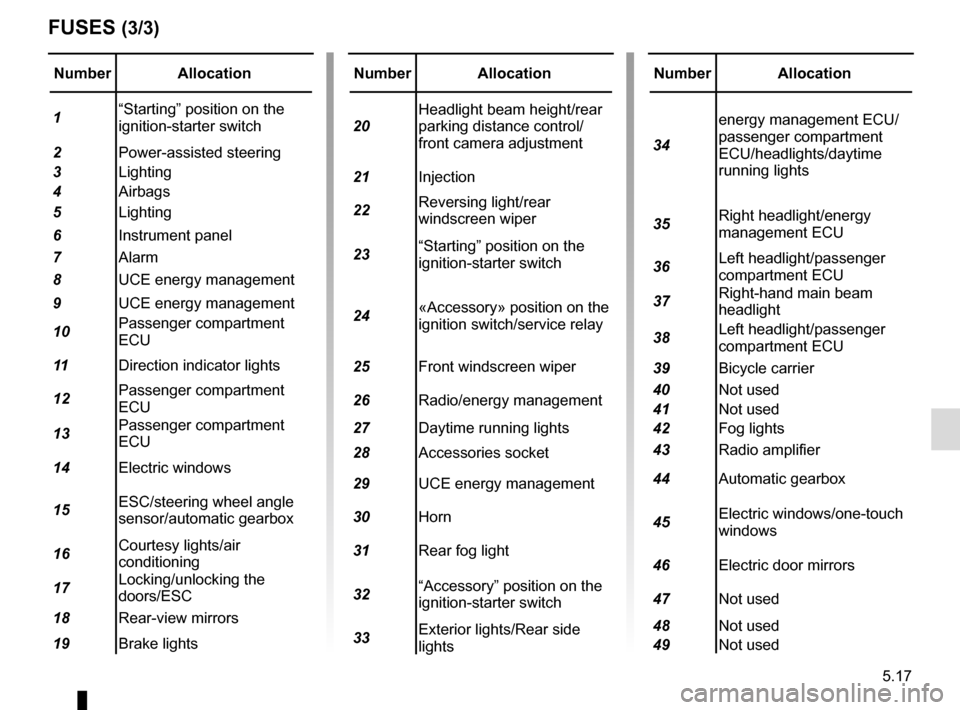
5.17
Number Allocation
1 “Starting” position on the
ignition-starter switch
2 Power-assisted steering
3 Lighting
4 Airbags
5 Lighting
6 Instrument panel
7 Alarm
8 UCE energy management
9 UCE energy management
10 Passenger compartment
ECU
11 Direction indicator lights
12 Passenger compartment
ECU
13 Passenger compartment
ECU
14 Electric windows
15 ESC/steering wheel angle
sensor/automatic gearbox
16 Courtesy lights/air
conditioning
17 Locking/unlocking the
doors/ESC
18 Rear-view mirrors
19 Brake lights
FUSES (3/3)
Number Allocation
20 Headlight beam height/rear
parking distance control/
front camera adjustment
21 Injection
22 Reversing light/rear
windscreen wiper
23 “Starting” position on the
ignition-starter switch
24 «Accessory» position on the
ignition switch/service relay
25 Front windscreen wiper
26 Radio/energy management
27 Daytime running lights
28 Accessories socket
29 UCE energy management
30 Horn
31 Rear fog light
32 “Accessory” position on the
ignition-starter switch
33 Exterior lights/Rear side
lightsNumber Allocation
34 energy management ECU/
passenger compartment
ECU/headlights/daytime
running lights
35 Right headlight/energy
management ECU
36 Left headlight/passenger
compartment ECU
37 Right-hand main beam
headlight
38 Left headlight/passenger
compartment ECU
39 Bicycle carrier
40 Not used
41 Not used
42 Fog lights
43 Radio amplifier
44 Automatic gearbox
45 Electric windows/one-touch
windows
46 Electric door mirrors
47 Not used
48 Not used
49 Not used
Page 180 of 216

5.22
ACCESSORIES
Electrical and electronic accessoriesBefore installing this type of accessory (particularly for transmitters\
/receivers: frequency bandwidth, power level, po-
sition of the aerial, etc.), make sure it is compatible with your vehic\
le. You can get advice from an authorised dealer.
Connect accessories with a maximum power of 120 watts only. Fire hazard.
No work may be carried out on the vehicle’s electrical or radio circuits, except by authorised dealers: an incorre\
ctly connecte d
system may result in damage being caused to the electrical equipment and\
/or the components connected to it.
If the vehicle is fitted with any aftermarket electrical equipment, make\
sure that the installation is correctly protected by a fuse.
Establish the rating and position of this fuse.
Use of transmission/receiving devices (telephones, CB equipment etc.).\
Telephones and CB equipment with integrated aerials may cause interferenc\
e to the electronic systems originally fitted to the
vehicle: it is advisable only to use equipment with an external aerial. \
Furthermore, we remind you of the need to conform
to the legislation in force concerning the use of such equipment.
Fitting after-market accessoriesIf you wish to install accessories on the vehicle: please contact an aut\
horised dealer. Also, to ensure the correct operation o f
your vehicle, and to avoid any risk to your safety, we recommend that you use only accessories specifically designed for y\
our
vehicle, which are the only accessories for which the manufacturer will \
provide a warranty.
If you are using an anti-theft device, only attach it to the brake pedal\
.
Obstructions to the driver
On the driver’s side, only use mats suitable for the vehicle, attached with the pre-fi\
tted components, and check the fitting re gu-
larly. Do not lay one mat on top of another. There is a risk of wedging the pedals
Page 183 of 216
5.25
TOWING: breakdown recovery (1/2)
Towing a vehicle with an
automatic gearbox
With the engine switched off, the trans-
mission is no longer lubricated. It is
preferable to tow this type of vehicle on
a trailer or tow it with the rear wheels off
the ground.
Under exceptional circumstances, you
may tow the vehicle with all four wheels
on the ground, only going forward, with
the gear lever in the neutral N position,
and for a distance not exceeding
30 miles (50 km).
If the gear lever cannot be put into the
N position, please consult an autho-
rised dealer.
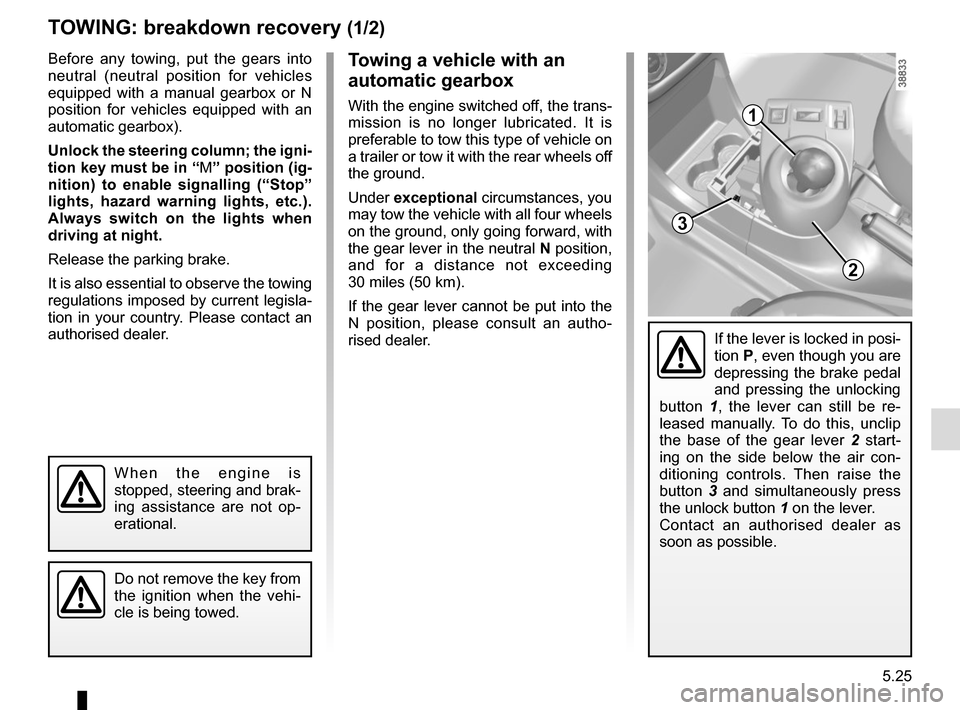
If the lever is locked in posi-
tion P, even though you are
depressing the brake pedal
and pressing the unlocking
button 1, the lever can still be re-
leased manually. To do this, unclip
the base of the gear lever 2 start-
ing on the side below the air con-
ditioning controls. Then raise the
button 3 and simultaneously press
the unlock button 1 on the lever.
Contact an authorised dealer as
soon as possible.
1
2
Before any towing, put the gears into
neutral (neutral position for vehicles
equipped with a manual gearbox or N
position for vehicles equipped with an
automatic gearbox).
Unlock the steering column; the igni-
tion key must be in “ M” position (ig-
nition) to enable signalling (“Stop”
lights, hazard warning lights, etc.).
Always switch on the lights when
driving at night.
Release the parking brake.
It is also essential to observe the towing
regulations imposed by current legisla-
tion in your country. Please contact an
authorised dealer.
When the engine is
stopped, steering and brak-
ing assistance are not op-
erational.
Do not remove the key from
the ignition when the vehi-
cle is being towed.
3
Page 184 of 216
5.26
TOWING: breakdown recovery (2/2)
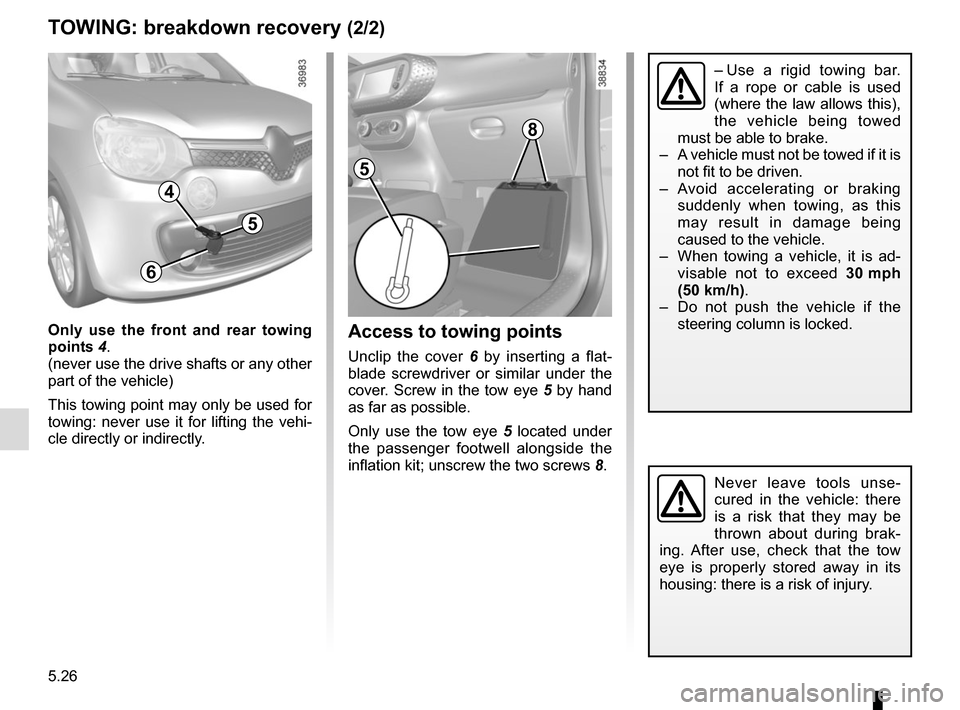
Only use the front and rear towing
points 4.
(never use the drive shafts or any other
part of the vehicle)
This towing point may only be used for
towing: never use it for lifting the vehi-
cle directly or indirectly.Access to towing points
Unclip the cover 6 by inserting a flat-
blade screwdriver or similar under the
cover. Screw in the tow eye 5 by hand
as far as possible.
Only use the tow eye 5 located under
the passenger footwell alongside the
inflation kit; unscrew the two screws 8.
6
5
4
Never leave tools unse-
cured in the vehicle: there
is a risk that they may be
thrown about during brak-
ing. After use, check that the tow
eye is properly stored away in its
housing: there is a risk of injury.
5
8
– Use a rigid towing bar.
If a rope or cable is used
(where the law allows this),
the vehicle being towed
must be able to brake.
– A vehicle must not be towed if it is
not fit to be driven.
– Avoid accelerating or braking suddenly when towing, as this
may result in damage being
caused to the vehicle.
– When towing a vehicle, it is ad- visable not to exceed 30 mph
(50 km/h).
– Do not push the vehicle if the steering column is locked.
Page 196 of 216

The weights indicated for a basic vehicle without options: they vary dep\
ending on the your vehicle’s equipment. Consult
your approved Dealer.Maximum permissible all-up weight")
6.6
WEIGHTS (in kg)
The weights indicated for a basic vehicle without options: they vary dep\
ending on the your vehicle’s equipment. Consult
your approved Dealer.Maximum permissible all-up weight (MMAC)
Maximum permissible all-up weight (MMTA)
Gross Train Weight (MTR) Weights are indicated on the vehicle identification plate (refer to
the information on “Vehicle identification plates” in Section 6)
Braked Trailer Weight* Prohibited
Unbraked Trailer Weight* Prohibited
Permissible nose weight* Prohibited
Maximum permissible load on roof 60 kg (including the carrying device)
Page 209 of 216

A
ABS ..............................................................1.46, \
2.18 → 2.21
accessories.............................................................\
......")
7.1
ALPHABETICAL INDEX (1/5)
A
ABS ..............................................................1.46, \
2.18 → 2.21
accessories.............................................................\
........... 5.22
accessories socket ............................................................ 3.20
additional methods of restraint .......................................... 1.21 side protection ............................................................. 1.20
to the front seat belts .......................................1.15 → 1.18
to the rear seat belts .................................................... 1.19
adjusting your driving position ...................... 1.11 → 1.14, 3.21
advice on antipollution ....................................................... 2.13
air bag...........................................................1.15 → 1.21, 1.44
activating the front passenger air bags ........................ 1.38
deactivating the front passenger air bags .................... 1.36
air conditioning ........................................................ 3.4 → 3.11
air vents ...................................................................... 3.2 – 3.3
anti-corrosion check ..............................................6.14 → 6.18
anti-corrosion protection .................................................... 4.14
anti-lock braking system: ABS ...............................2.18 → 2.21
antipollution advice .................................................................\
......... 2.13
ashtray ................................................................\
............... 3.20
audible and visual signals.................................................. 1.61
automatic gearbox (use) ........................................2.35 → 2.37
automatic gearbox selector lever...........................2.35 → 2.37
B
battery............................................................ 4.11, 5.19 – 5.20 troubleshooting ................................................. 5.19 – 5.20
battery (remote control) ..................................................... 5.18
brake fluid ........................................................................\
.... 4.9
bulbs changing ............................................................5.9 → 5.14
C
catalytic converter.....................................................\
........... 2.7
central door locking .................................1.2 – 1.3, 1.8 → 1.10changing a bulb .......................................................5.9
→ 5.14
changing gear .................................................2.8, 2.35 → 2.37
child restraint/seat .............................1.23 – 1.24, 1.26 → 1.36
child safety.........................1.7, 1.18, 1.23 – 1.24, 1.26 → 1.36
child seats..........................................1.23 – 1.24, 1.2\
6 → 1.35
children .......................................................... 1.23 – 1.24, 1.24
children (safety) ................................................................... 1.7
cigar lighter ........................................................................\
3.20
cleaning: inside the vehicle .............................................. 4.16 – 4.17
clock ....................................................................... 1.56 – 1.57
closing the doors .....................................................1.6 → 1.10
control instruments ............................1.44 → 1.51, 1.56 – 1.57
controls ...............................................................\
...1.40 → 1.43
courtesy light ............................................................ 3.15, 5.14
cruise control ................................................1.47, 2.27 → 2.30
crosswind assist ................................................................ 2.19
cruise control-speed limiter....................................2.24 → 2.30
crosswind assist function ................................................... 2.19
D
dashboard..............................................................1\
.40 → 1.43
demisting rear screen ..................................................3.4, 3.7 → 3.10
windscreen ..................................................3.5, 3.7 → 3.10
dimensions .............................................................\
............. 6.4
dipstick................................................................\
................. 4.3
display ................................................................\
...1.44 → 1.49
doors/tailgate ....................................................1.4, \
1.6 → 1.10
driver assistance....................................................2.1\
8 → 2.34
driver’s position .....................................................1.40 → 1.48
driving ........... 2.3, 2.7, 2.9 → 2.12, 2.18 → 2.21, 2.24 → 2.32,
2.35 → 2.37
driving aids ............................................................2.18 → 2.34
driving position settings ............................................................1.1\
2 →
1.14