light RENAULT TWINGO 2015 3.G Manual Online
[x] Cancel search | Manufacturer: RENAULT, Model Year: 2015, Model line: TWINGO, Model: RENAULT TWINGO 2015 3.GPages: 216, PDF Size: 5.06 MB
Page 172 of 216
5.14
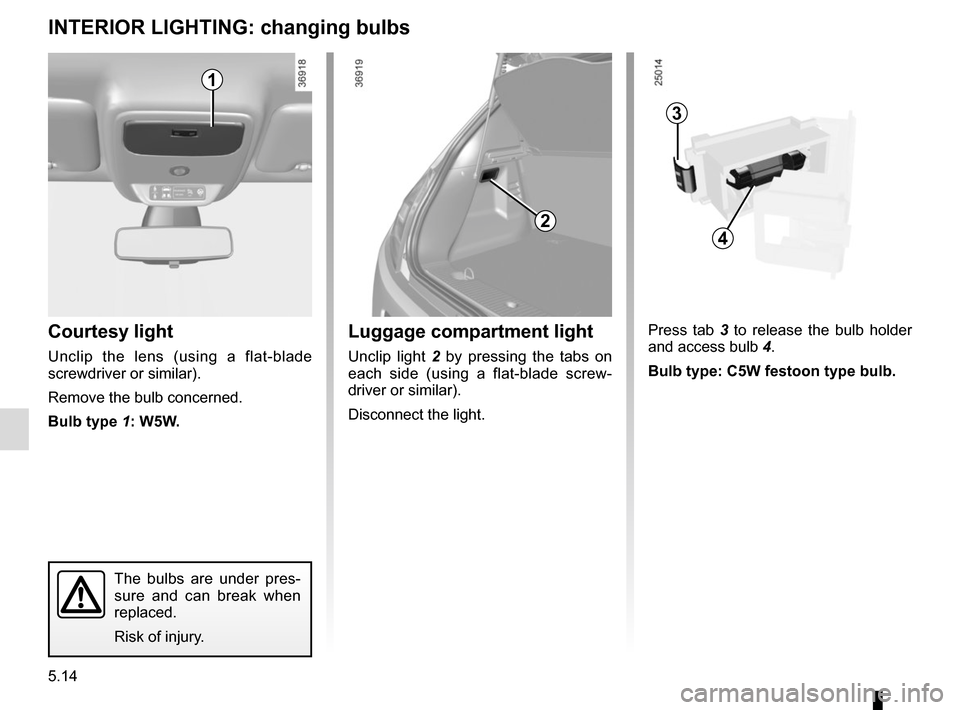
Courtesy light
Unclip the lens (using a flat-blade
screwdriver or similar).
Remove the bulb concerned.
Bulb type 1: W5W.
INTERIOR LIGHTING: changing bulbs
The bulbs are under pres-
sure and can break when
replaced.
Risk of injury.
Press tab 3 to release the bulb holder
and access bulb 4.
Bulb type: C5W festoon type bulb.Luggage compartment light
Unclip light 2 by pressing the tabs on
each side (using a flat-blade screw-
driver or similar).
Disconnect the light.
2
3
4
1
Page 175 of 216
5.17
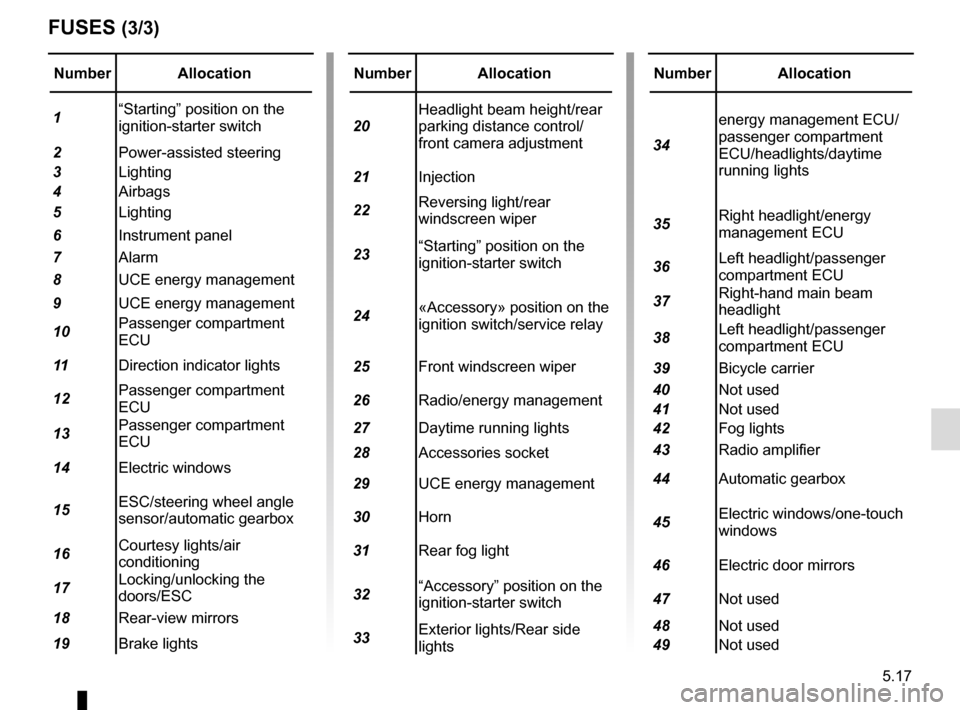
Number Allocation
1 “Starting” position on the
ignition-starter switch
2 Power-assisted steering
3 Lighting
4 Airbags
5 Lighting
6 Instrument panel
7 Alarm
8 UCE energy management
9 UCE energy management
10 Passenger compartment
ECU
11 Direction indicator lights
12 Passenger compartment
ECU
13 Passenger compartment
ECU
14 Electric windows
15 ESC/steering wheel angle
sensor/automatic gearbox
16 Courtesy lights/air
conditioning
17 Locking/unlocking the
doors/ESC
18 Rear-view mirrors
19 Brake lights
FUSES (3/3)
Number Allocation
20 Headlight beam height/rear
parking distance control/
front camera adjustment
21 Injection
22 Reversing light/rear
windscreen wiper
23 “Starting” position on the
ignition-starter switch
24 «Accessory» position on the
ignition switch/service relay
25 Front windscreen wiper
26 Radio/energy management
27 Daytime running lights
28 Accessories socket
29 UCE energy management
30 Horn
31 Rear fog light
32 “Accessory” position on the
ignition-starter switch
33 Exterior lights/Rear side
lightsNumber Allocation
34 energy management ECU/
passenger compartment
ECU/headlights/daytime
running lights
35 Right headlight/energy
management ECU
36 Left headlight/passenger
compartment ECU
37 Right-hand main beam
headlight
38 Left headlight/passenger
compartment ECU
39 Bicycle carrier
40 Not used
41 Not used
42 Fog lights
43 Radio amplifier
44 Automatic gearbox
45 Electric windows/one-touch
windows
46 Electric door mirrors
47 Not used
48 Not used
49 Not used
Page 177 of 216
5.19
BATTERY: breakdown recovery (1/2)
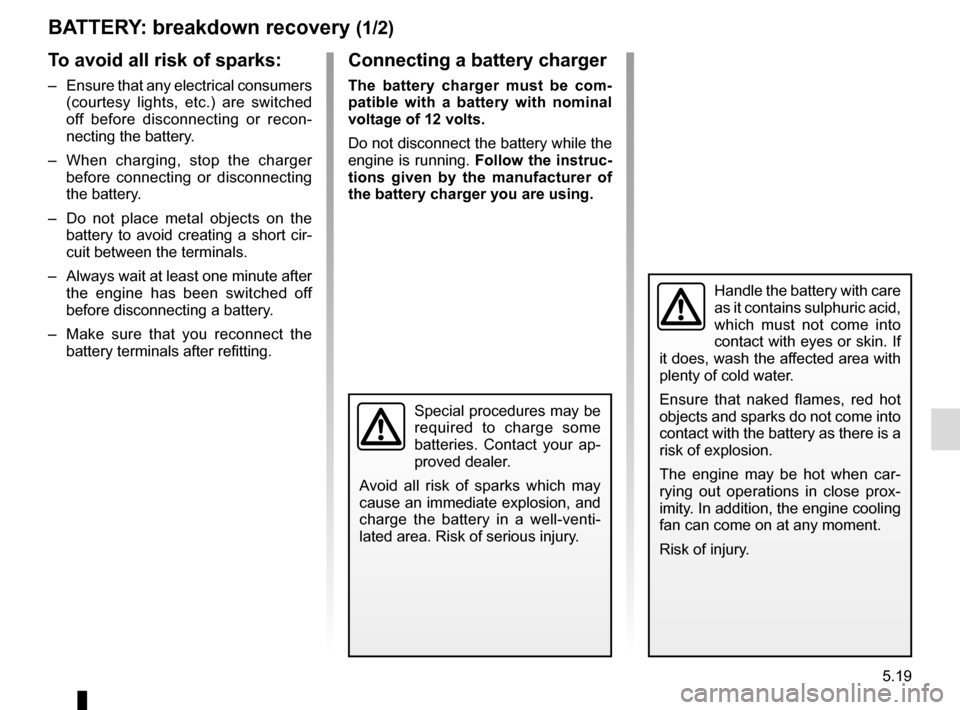
To avoid all risk of sparks:
– Ensure that any electrical consumers (courtesy lights, etc.) are switched
off before disconnecting or recon-
necting the battery.
– When charging, stop the charger before connecting or disconnecting
the battery.
– Do not place metal objects on the battery to avoid creating a short cir-
cuit between the terminals.
– Always wait at least one minute after the engine has been switched off
before disconnecting a battery.
– Make sure that you reconnect the battery terminals after refitting.
Connecting a battery charger
The battery charger must be com-
patible with a battery with nominal
voltage of 12 volts.
Do not disconnect the battery while the
engine is running. Follow the instruc-
tions given by the manufacturer of
the battery charger you are using.
Special procedures may be
required to charge some
batteries. Contact your ap-
proved dealer.
Avoid all risk of sparks which may
cause an immediate explosion, and
charge the battery in a well-venti-
lated area. Risk of serious injury.
Handle the battery with care
as it contains sulphuric acid,
which must not come into
contact with eyes or skin. If
it does, wash the affected area with
plenty of cold water.
Ensure that naked flames, red hot
objects and sparks do not come into
contact with the battery as there is a
risk of explosion.
The engine may be hot when car-
rying out operations in close prox-
imity. In addition, the engine cooling
fan can come on at any moment.
Risk of injury.
Page 183 of 216
5.25
TOWING: breakdown recovery (1/2)
Towing a vehicle with an
automatic gearbox
With the engine switched off, the trans-
mission is no longer lubricated. It is
preferable to tow this type of vehicle on
a trailer or tow it with the rear wheels off
the ground.
Under exceptional circumstances, you
may tow the vehicle with all four wheels
on the ground, only going forward, with
the gear lever in the neutral N position,
and for a distance not exceeding
30 miles (50 km).
If the gear lever cannot be put into the
N position, please consult an autho-
rised dealer.
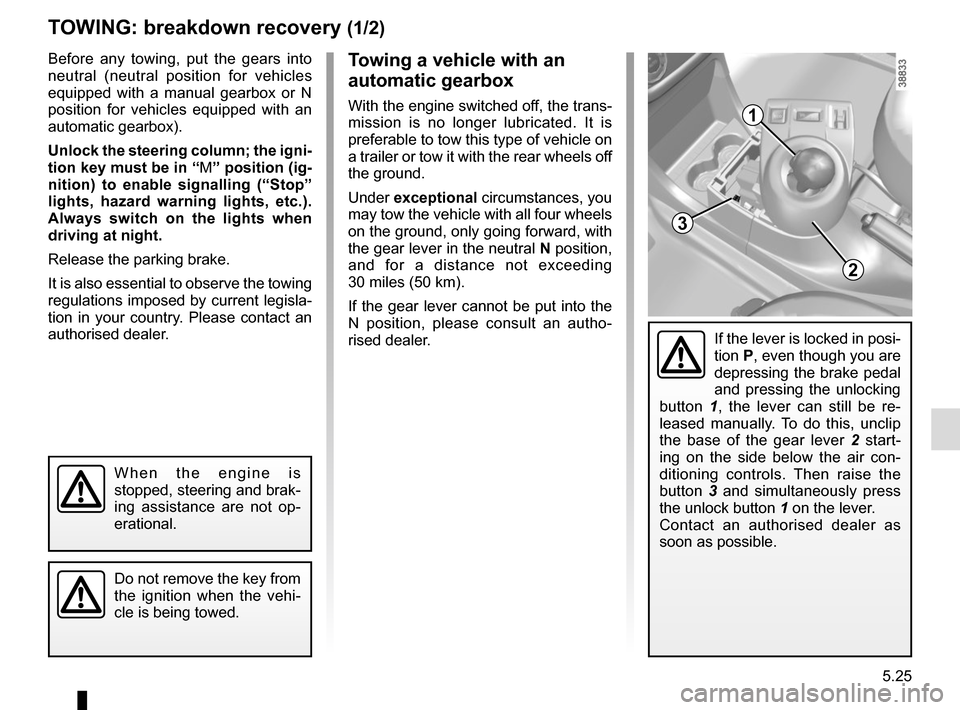
If the lever is locked in posi-
tion P, even though you are
depressing the brake pedal
and pressing the unlocking
button 1, the lever can still be re-
leased manually. To do this, unclip
the base of the gear lever 2 start-
ing on the side below the air con-
ditioning controls. Then raise the
button 3 and simultaneously press
the unlock button 1 on the lever.
Contact an authorised dealer as
soon as possible.
1
2
Before any towing, put the gears into
neutral (neutral position for vehicles
equipped with a manual gearbox or N
position for vehicles equipped with an
automatic gearbox).
Unlock the steering column; the igni-
tion key must be in “ M” position (ig-
nition) to enable signalling (“Stop”
lights, hazard warning lights, etc.).
Always switch on the lights when
driving at night.
Release the parking brake.
It is also essential to observe the towing
regulations imposed by current legisla-
tion in your country. Please contact an
authorised dealer.
When the engine is
stopped, steering and brak-
ing assistance are not op-
erational.
Do not remove the key from
the ignition when the vehi-
cle is being towed.
3
Page 186 of 216
5.28
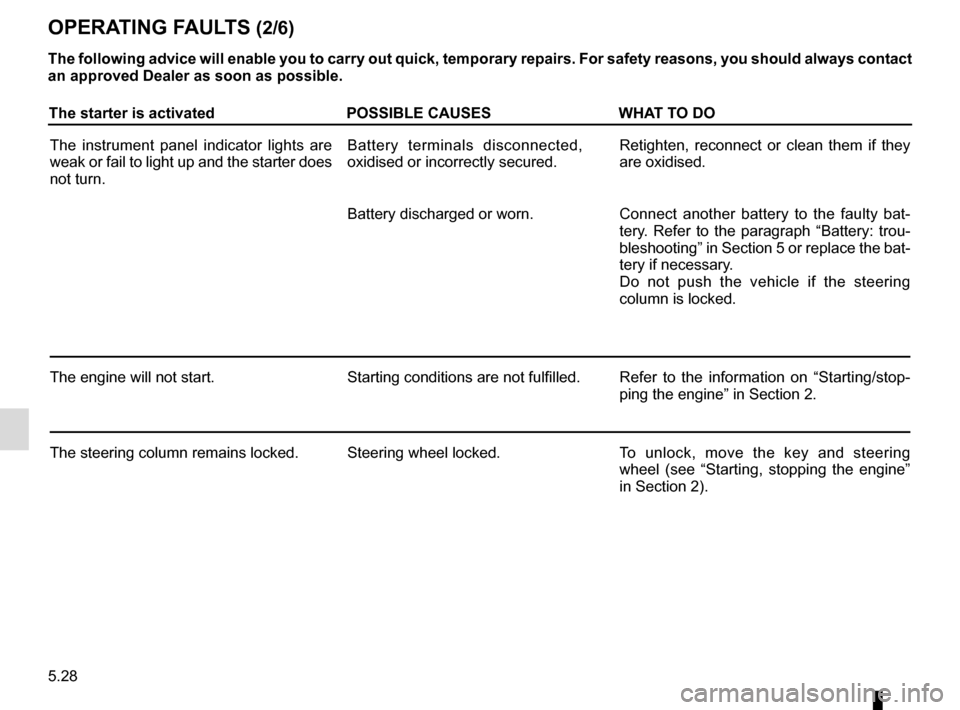
The starter is activatedPOSSIBLE CAUSESWHAT TO DO
The instrument panel indicator lights are
weak or fail to light up and the starter does
not turn. Battery terminals disconnected,
oxidised or incorrectly secured.
Retighten, reconnect or clean them if they
are oxidised.
Battery discharged or worn. Connect another battery to the faulty bat-
tery. Refer to the paragraph “Battery: trou-
bleshooting” in Section 5 or replace the bat-
tery if necessary.
Do not push the vehicle if the steering
column is locked.
The engine will not start. Starting conditions are not fulfilled.Refer to the information on “Starting/stop-
ping the engine” in Section 2.
The steering column remains locked. Steering wheel locked. To unlock, move the key and steering
wheel (see “Starting, stopping the engine”
in Section 2).
OPERATING FAULTS (2/6)
The following advice will enable you to carry out quick, temporary repai\
rs. For safety reasons, you should always contact
an approved Dealer as soon as possible.
Page 187 of 216
5.29
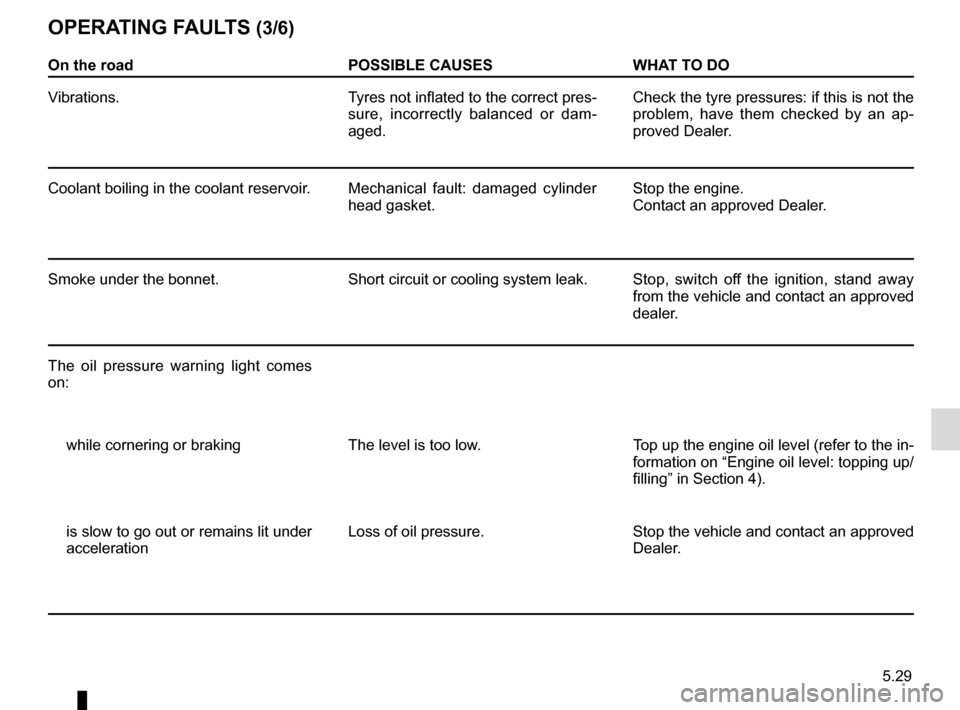
On the roadPOSSIBLE CAUSESWHAT TO DO
Vibrations. Tyres not inflated to the correct pres-
sure, incorrectly balanced or dam-
aged. Check the tyre pressures: if this is not the
problem, have them checked by an ap-
proved Dealer.
Coolant boiling in the coolant reservoir . Mechanical fault: damaged cylinder
head gasket. Stop the engine.
Contact an approved Dealer.
Smoke under the bonnet. Short circuit or cooling system leak.Stop, switch off the ignition, stand away
from the vehicle and contact an approved
dealer.
The oil pressure warning light comes
on:
while cornering or braking The level is too low. Top up the engine oil level (refer to the in-
formation on “Engine oil level: topping up/
filling” in Section 4).
is slow to go out or remains lit under
acceleration Loss of oil pressure.
Stop the vehicle and contact an approved
Dealer.
OPERATING FAULTS (3/6)
Page 188 of 216
5.30
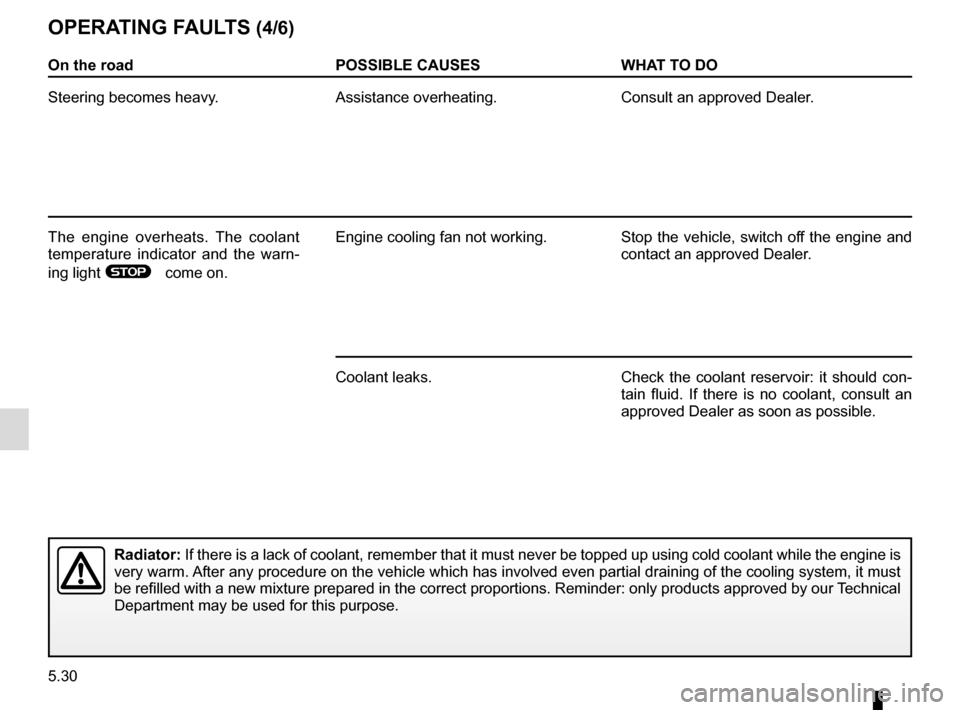
On the roadPOSSIBLE CAUSESWHAT TO DO
Steering becomes heavy. Assistance overheating.Consult an approved Dealer.
The engine overheats. The coolant
temperature indicator and the warn-
ing light
® come on. Engine cooling fan not working. Stop the vehicle, switch off the engine and
contact an approved Dealer.
Coolant leaks. Check the coolant reservoir: it should con- tain fluid. If there is no coolant, consult an
approved Dealer as soon as possible.
OPERATING FAULTS (4/6)
Radiator: If there is a lack of coolant, remember that it must never be topped up \
using cold coolant while the engine is
very warm. After any procedure on the vehicle which has involved even partial drain\
ing of the cooling system, it must
be refilled with a new mixture prepared in the correct proportions. Remi\
nder: only products approved by our Technical
Department may be used for this purpose.
Page 189 of 216
5.31
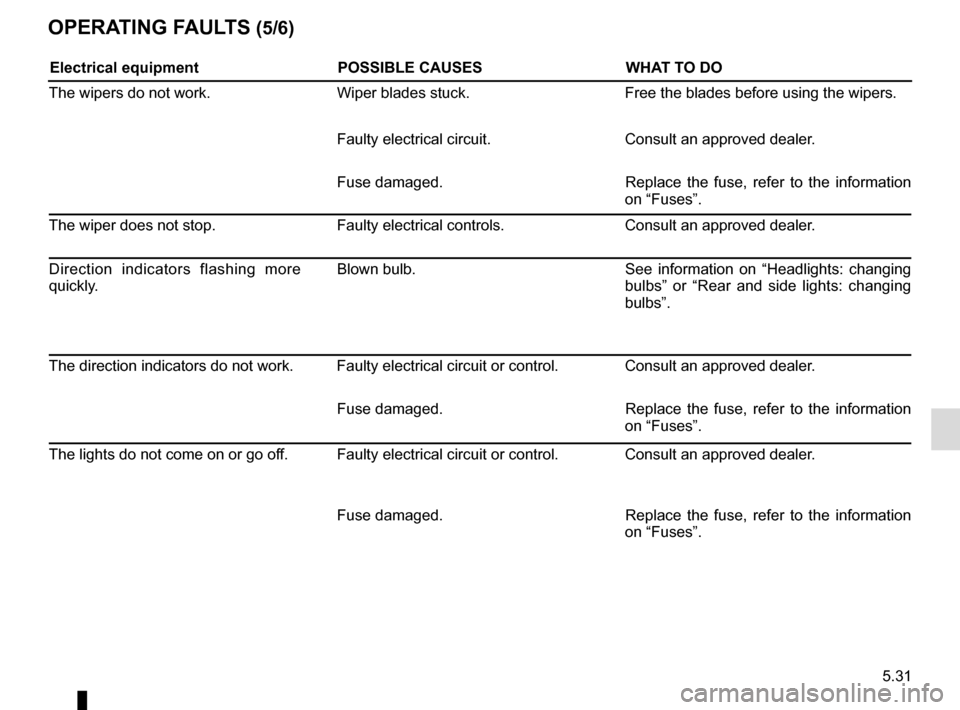
OPERATING FAULTS (5/6)
Electrical equipmentPOSSIBLE CAUSESWHAT TO DO
The wipers do not work. Wiper blades stuck. Free the blades before using the wipers.
Faulty electrical circuit. Consult an approved dealer.
Fuse damaged. Replace the fuse, refer to the information
on “Fuses”.
The wiper does not stop. Faulty electrical controls.Consult an approved dealer.
Direction indicators flashing more
quickly. Blown bulb.
See information on “Headlights: changing
bulbs” or “Rear and side lights: changing
bulbs”.
The direction indicators do not work. Faulty electrical circuit or control. Consult an approved dealer. Fuse damaged. Replace the fuse, refer to the information
on “Fuses”.
The lights do not come on or go off. Faulty electrical circuit or control. Consult an approved dealer.
Fuse damaged. Replace the fuse, refer to the information
on “Fuses”.
Page 190 of 216
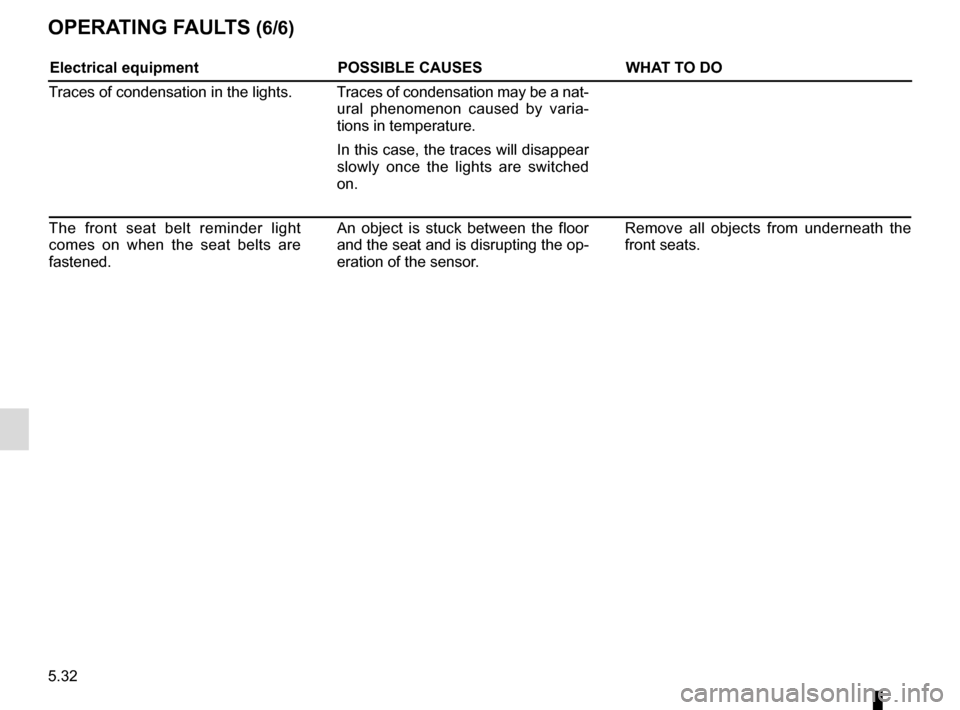
5.32
Electrical equipmentPOSSIBLE CAUSESWHAT TO DO
Traces of condensation in the lights. Traces of condensation may be a nat- ural phenomenon caused by varia-
tions in temperature.
In this case, the traces will disappear
slowly once the lights are switched
on.
The front seat belt reminder light
comes on when the seat belts are
fastened. An object is stuck between the floor
and the seat and is disrupting the op-
eration of the sensor. Remove all objects from underneath the
front seats.
OPERATING FAULTS (6/6)
Page 209 of 216

A
ABS ..............................................................1.46, \
2.18 → 2.21
accessories.............................................................\
......")
7.1
ALPHABETICAL INDEX (1/5)
A
ABS ..............................................................1.46, \
2.18 → 2.21
accessories.............................................................\
........... 5.22
accessories socket ............................................................ 3.20
additional methods of restraint .......................................... 1.21 side protection ............................................................. 1.20
to the front seat belts .......................................1.15 → 1.18
to the rear seat belts .................................................... 1.19
adjusting your driving position ...................... 1.11 → 1.14, 3.21
advice on antipollution ....................................................... 2.13
air bag...........................................................1.15 → 1.21, 1.44
activating the front passenger air bags ........................ 1.38
deactivating the front passenger air bags .................... 1.36
air conditioning ........................................................ 3.4 → 3.11
air vents ...................................................................... 3.2 – 3.3
anti-corrosion check ..............................................6.14 → 6.18
anti-corrosion protection .................................................... 4.14
anti-lock braking system: ABS ...............................2.18 → 2.21
antipollution advice .................................................................\
......... 2.13
ashtray ................................................................\
............... 3.20
audible and visual signals.................................................. 1.61
automatic gearbox (use) ........................................2.35 → 2.37
automatic gearbox selector lever...........................2.35 → 2.37
B
battery............................................................ 4.11, 5.19 – 5.20 troubleshooting ................................................. 5.19 – 5.20
battery (remote control) ..................................................... 5.18
brake fluid ........................................................................\
.... 4.9
bulbs changing ............................................................5.9 → 5.14
C
catalytic converter.....................................................\
........... 2.7
central door locking .................................1.2 – 1.3, 1.8 → 1.10changing a bulb .......................................................5.9
→ 5.14
changing gear .................................................2.8, 2.35 → 2.37
child restraint/seat .............................1.23 – 1.24, 1.26 → 1.36
child safety.........................1.7, 1.18, 1.23 – 1.24, 1.26 → 1.36
child seats..........................................1.23 – 1.24, 1.2\
6 → 1.35
children .......................................................... 1.23 – 1.24, 1.24
children (safety) ................................................................... 1.7
cigar lighter ........................................................................\
3.20
cleaning: inside the vehicle .............................................. 4.16 – 4.17
clock ....................................................................... 1.56 – 1.57
closing the doors .....................................................1.6 → 1.10
control instruments ............................1.44 → 1.51, 1.56 – 1.57
controls ...............................................................\
...1.40 → 1.43
courtesy light ............................................................ 3.15, 5.14
cruise control ................................................1.47, 2.27 → 2.30
crosswind assist ................................................................ 2.19
cruise control-speed limiter....................................2.24 → 2.30
crosswind assist function ................................................... 2.19
D
dashboard..............................................................1\
.40 → 1.43
demisting rear screen ..................................................3.4, 3.7 → 3.10
windscreen ..................................................3.5, 3.7 → 3.10
dimensions .............................................................\
............. 6.4
dipstick................................................................\
................. 4.3
display ................................................................\
...1.44 → 1.49
doors/tailgate ....................................................1.4, \
1.6 → 1.10
driver assistance....................................................2.1\
8 → 2.34
driver’s position .....................................................1.40 → 1.48
driving ........... 2.3, 2.7, 2.9 → 2.12, 2.18 → 2.21, 2.24 → 2.32,
2.35 → 2.37
driving aids ............................................................2.18 → 2.34
driving position settings ............................................................1.1\
2 →
1.14