ignition RENAULT TWINGO 2018 Owner's Guide
[x] Cancel search | Manufacturer: RENAULT, Model Year: 2018, Model line: TWINGO, Model: RENAULT TWINGO 2018Pages: 232, PDF Size: 6.88 MB
Page 95 of 232

2.19
TYRE PRESSURE LOSS WARNING (3/9)
SYSTEM A (cntd.)
Resetting the standard level for the
tyre pressures
This should be done:
– after each reinflation or readjustment of the pressure of one of the tyres;
– when the standard tyre pressure needs to be changed to adapt to
usage conditions (empty, carrying a
load, motorway driving, etc.);
– after changing a wheel;
– after using the tyre inflation kit;
– after swapping a wheel (however, this practice is not recommended).
It should always be done after checking
the tyre pressure of all four tyres when
cold.
Tyre pressures must correspond to the
current usage of the vehicle (empty,
carrying a load, motorway driving, etc.).
2
3
Resetting procedure
With the ignition on, depending on the
vehicle:
– repeatedly press button 2 or 3 to
select the “SET
” warning light
on the display B;
– press and hold (around 3 seconds) button 2 or 3 to start initialisation.
When the “SET
” warning light
flashes for around five seconds, this
indicates that the reset request for
the tyre pressure reference value
has been taken into account. Or
– repeatedly press the button 2
to
select the “SET
” warning light
on the display B;
– press and hold (around 3 seconds) the button 2 to start initialisation. The
flashing, lasting around five seconds,
followed by a constant display of the
“SET
” indicates that the reset
request for the tyre pressure refer-
ence value has been taken into ac-
count.
Reinitialisation is carried out after a few
minutes’ driving.
B
Page 99 of 232

2.23
TYRE PRESSURE LOSS WARNING (7/9)
SYSTEM B (cntd.)
Resetting procedure
With the ignition on, depending on the vehicle:
– repeatedly press button 2 or 3 to
select the “SET
” warning light
on the display B;
– press and hold (around 3 seconds) button 2 or 3 to start initialisation. When the “SET” warning light flashes
for around five seconds, this indicates
that the reset request for the tyre pres-
sure reference value has been taken
into account.
Reinitialisation is carried out after a few
minutes’ driving.
Note: the standard tyre pressure
cannot be less than that recommended
and indicated on the door frame.
Or
– repeatedly press the button 2
to
select the “SET
” warning light
on the display B;
– press and hold (around 3 seconds) the button 2 to start initialisation. The
flashing, lasting around five seconds,
followed by a constant display of the
“SET
” indicates that the reset
request for the tyre pressure refer-
ence value has been taken into ac-
count.
2
3
B
Reinitialisation is carried out after a few
minutes’ driving.
Page 122 of 232

2.46
Breakdown of a vehicle with an
automatic gearbox
Please refer to the information on
“Towing” in Section 5.
When setting off, if the lever is locked
in position P, even though you are de-
pressing the brake pedal and pressing
the unlocking button 2, the lever can
still be released manually.
AUTOMATIC TRANSMISSION (4/4)
Operating faults
When three horizontal bars on the dis-
play 3 come on accompanied by the
warning light
© or ®, this in-
dicates a gearbox fault. Contact an au-
thorised dealer as soon as possible. To do this, unclip the base of the gear
lever
5 starting on the side below the
air conditioning controls. Then raise the
button 6 and simultaneously press the
unlock button 2 on the lever.
For safety reasons, do not
switch off the ignition before
the vehicle has come to a
complete standstill.
5
2
3
6
6
3
Warning light ® re-
quires you to stop immedi-
ately, for your own safety,
as soon as traffic conditions
allow.
Page 134 of 232
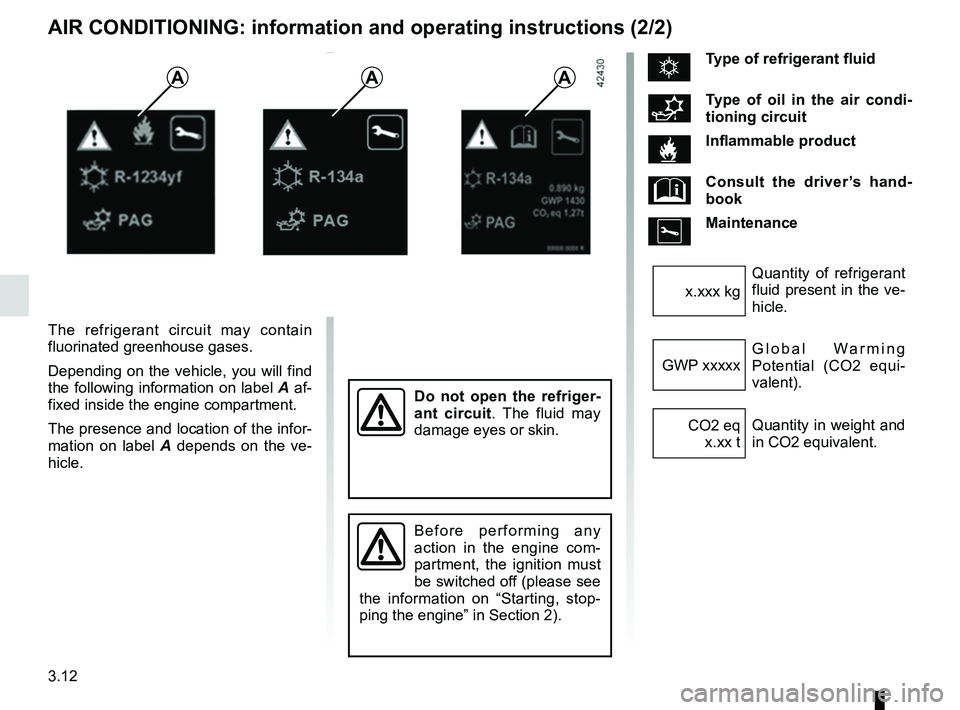
3.12
AIR CONDITIONING: information and operating instructions (2/2)
The refrigerant circuit may contain
fluorinated greenhouse gases.
Depending on the vehicle, you will find
the following information on label A af-
fixed inside the engine compartment.
The presence and location of the infor-
mation on label A depends on the ve-
hicle.
Do not open the refriger-
ant circuit . The fluid may
damage eyes or skin.
Before performing any
action in the engine com-
partment, the ignition must
be switched off (please see
the information on “Starting, stop-
ping the engine” in Section 2).
ÑType of refrigerant fluid
Type of oil in the air condi-
tioning circuit
Inflammable product
Consult the driver’s hand-
book
Maintenance
Quantity of refrigerant
fluid present in the ve-
hicle.
x.xxx kg
Global Warming
Potential (CO2 equi-
valent).
GWP xxxxx
Quantity in weight and
in CO2 equivalent.
CO2 eq
x.xx t
AAA
Page 137 of 232

3.15
SUNROOF
1
– Partial opening: press the switch 1
on side
\ until the desired
amount of opening.
– Full opening: press the switch 1 on
side
\ for around 6 seconds.
– To close: press the switch 1 on side
[ for around 6 seconds.
Precautions during use
– check that the sunroof is properly
closed before leaving your vehicle;
– clean the seal every three months using products recommended by our
Technical Department;
– Do not open the sunroof immedi-
ately after it has rained or immedi-
ately after washing the vehicle.
– vehicle with roof bars: Generally, it is not advisable to oper-
ate the sunroof.
Before using the sunroof, check the
objects and/or accessories (bike
racks, roof boxes, etc.) attached to
the roof bars: they should be prop-
erly arranged and secured and
should not interfere with the opera-
tion of the sunroof.
Contact an authorised dealer for de-
tails of possible conversions.
Operating faults
If the roof will not close, please consult
an authorised dealer.
Driver’s responsibility
Never leave your vehicle
with the key in the ignition
and leaving a child, an adult
who is not self-sufficient or a pet
inside, even for a short while.
The reason for this is that the child
may endanger himself or others by
starting the engine, activating equip-
ment such as the window winders
for example, or locking the doors.
If something gets caught, immedi-
ately reverse the direction of travel
by pressing the switch 1 on side
\.
Risk of serious injury.
Page 144 of 232

3.22
Accessories socket 2
It is provided for connecting accessories
approved by our Technical Department.
Ashtray A
It can be housed in either position 1
or 3.
Cigarette lighter 2
With the ignition on, push in the ciga-
rette lighter 2. It will spring back with a click when it is ready. Pull it out to use.
After use, replace it without pushing it
all the way in.
ASHTRAY, CIGARETTE LIGHTER, ACCESSORIES SOCKET
1
If your vehicle is not fitted with a
cigar lighter and an ashtray, these
can be obtained from an approved
Dealer.
3
2A
Connect accessories with
a maximum power of
120 watts (12 V) only.
When several accessory
sockets are used at the same time,
the total power of the connected
accessories must not exceed
180 watts.
Fire hazard.
Page 160 of 232

4.8
Frequency of checking coolant level
Check the coolant level regularly
(very severe damage is likely to be
caused to the engine if it runs out of
coolant).
If the level needs to be topped up, only
use products approved by our Technical
Department which ensure:
– protection against freezing;
– an anti-corrosion protection for the cooling system.
No operations should be
carried out on the cooling
circuit when the engine is
hot.
Risk of burns.
Replacement interval
Refer to the Maintenance Document for
your vehicle.
Coolant level
With the engine switched off and on
level ground, the level when cold must
be between the MINI and MAXI marks
on reservoir 1.
Top this level up when cold before it
reaches the MINI mark.
LEVELS (1/3)
1
When working in the engine
compartment, ensure that
the windscreen wiper stalk
is in the park position.
Risk of injury.For your safety, do not
remove the bonnet holding
straps.
Risk of the bonnet falling
on the road surface.
Before performing any
action in the engine com-
partment, the ignition must
be switched off (please see
the information on “Starting, stop-
ping the engine” in Section 2).
Page 162 of 232

4.10
Filters
The filter elements (air filter, passenger
compartment filter, etc.) should be re-
placed during the maintenance opera-
tions carried out on your vehicle.
Replacement intervals for filter el-
ements: refer to the Maintenance
Document for your vehicle.
Windscreen washer reservoir
Topping up
Engine switched off:
– open the cap 3;
– pull the extending funnel upwards as far as it will go;
– fill until you can see the fluid;
– push the funnel by pressing on it and replace the cap.
Liquid
Screen wash product (product with
antifreeze in winter).
LEVELS (3/3)/FILTERS
3
When working in the engine
compartment, ensure that
the windscreen wiper stalk
is in the park position.
Risk of injury.
No operations should be
carried out on the cooling
circuit when the engine is
hot.
Risk of burns.
If there is an abnormal or repeated
drop in the fluid level, please consult
an authorised dealer.
For your safety, do not
remove the bonnet holding
straps.
Risk of the bonnet falling
on the road surface.
Please note when work-
ing close to the engine that
it may be hot. The engine
cooling fan may also start
at any moment. The
warning
light in the engine compartment re-
minds you of this.
Risk of injury.
Before performing any
action in the engine com-
partment, the ignition must
be switched off (please see
the information on “Starting, stop-
ping the engine” in Section 2).
Page 189 of 232

5.19
Number Allocation
1 “Starting” position on the
ignition-starter switch
2 Power-assisted steering
3 Lighting
4 Airbags
5 Lighting
6 Instrument panel
7 Alarm
8 UCE energy management
9 UCE energy management
10 Passenger compartment
ECU
11 Direction indicator lights
12 Passenger compartment
ECU
13 Passenger compartment
ECU
14 Electric windows
15 ESC/steering wheel angle
sensor/automatic gearbox
16 Courtesy lights/air
conditioning
17 Locking/unlocking the
doors/ESC
18 Rear-view mirrors
19 Brake lights
FUSES (3/3)
Number Allocation
20 Headlight beam height/rear
parking distance control/
front camera adjustment
21 Injection
22 Reversing light/rear
windscreen wiper
23 “Starting” position on the
ignition-starter switch
24 «Accessory» position on the
ignition switch/service relay
25 Front windscreen wiper
26 Radio/energy management
27 Daytime running lights
28 Accessories socket
29 UCE energy management
30 Horn
31 Rear fog light
32 “Accessory” position on the
ignition-starter switch
33 Exterior lights/Rear side
lightsNumber Allocation
34 energy management ECU/
passenger compartment
ECU/headlights/daytime
running lights
35 Right headlight/energy
management ECU
36 Left headlight/passenger
compartment ECU
37 Right-hand main beam
headlight
38 Left headlight/passenger
compartment ECU
39 Bicycle carrier
40 Not used
41 Not used
42 Fog lights
43 Radio amplifier
44 Automatic gearbox
45 Electric windows/one-touch
windows
46 Electric door mirrors
47 Not used
48 Not used
49 Not used
Page 193 of 232

5.23
34
BATTERY: troubleshooting (2/3)
Depending on the vehicle, unclip the
red protective cover to access termi-
nal 2 (+).
Connect the positive cable B to the ter-
minal 2 (+) then to the terminal 3 (+) of
the battery supplying the current.
Connect the negative cable A to the
terminal 4 (–) of the battery supplying
the current, then to the terminal 1 (–) of
the discharged battery.
Starting the vehicle using the
battery from another vehicle
If you have to use the battery from an-
other vehicle to start, obtain suitable
jump leads (with a large cross section)
from an approved dealer or, if you al-
ready have jump leads, ensure that
they are in perfect condition.
The two batteries must have an iden-
tical nominal voltage of 12 volts. The
battery supplying the current should
have a capacity (amp-hours, Ah) which
is at least the same as that of the dis-
charged battery.
Ensure that there is no risk of contact
between the two vehicles (risk of short
circuiting when the positive terminals
are connected) and that the discharged
battery is properly connected. Switch
off your vehicle ignition.
Start the engine of the vehicle supply-
ing the current and run it at an interme-
diate engine speed.
Check that there is no con-
tact between cables A
and B, and that the positive
cable B is not touching any
metal parts of the vehicle supplying
the current.
Risk of injury and/or damage to
the vehicle.
1
2
21
B
A
For your safety, do not remove the bonnet holding straps. Risk of the
bonnet falling on the road surface.