light RENAULT TWINGO 2018 Manual PDF
[x] Cancel search | Manufacturer: RENAULT, Model Year: 2018, Model line: TWINGO, Model: RENAULT TWINGO 2018Pages: 232, PDF Size: 6.88 MB
Page 132 of 232

3.10
AUTOMATIC CLIMATE CONTROL (4/4)
76
Air recirculation (isolation of
the passenger compartment)
K
This function is managed automatically
(operation is confirmed by a warning
light on button 7), but you can also acti-
vate it manually.
NB:
– during recirculation, air is taken from the passenger compartment and
is recycled, with no air being taken
from outside the vehicle;
– air recirculation allows the external atmosphere to be cut off (when driv-
ing in polluted areas, etc.);
– the recirculation of air makes it pos- sible to reach the desired passenger
compartment temperature quicker.
1
The demisting/de-icing will still take
priority over the air recirculation.
Manual use
Press button 7 – the integrated indica-
tor light comes on.
Prolonged use of this position may lead
to odours, caused by non-renewal of
air, and the formation of condensation
on the windows.
We therefore advise you to return to au-
tomatic mode as soon as air recircula-
tion is no longer needed, by pressing
button 7.
To exit this function, press button 7
again. Stopping the system
Turn the control 6 to “OFF” to stop the
system. To start it, turn the control
6
again, then adjust the fan speed or
press the button 1.
Page 138 of 232
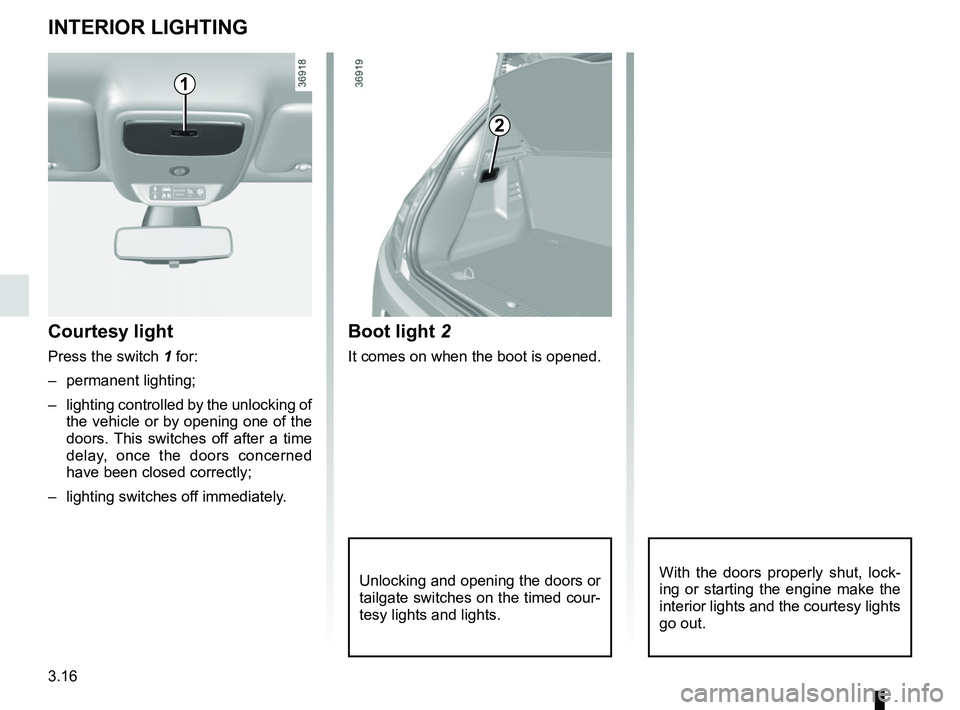
3.16
Unlocking and opening the doors or
tailgate switches on the timed cour-
tesy lights and lights.
Boot light 2
It comes on when the boot is opened.
Courtesy light
Press the switch 1 for:
– permanent lighting;
– lighting controlled by the unlocking of
the vehicle or by opening one of the
doors. This switches off after a time
delay, once the doors concerned
have been closed correctly;
– lighting switches off immediately.
INTERIOR LIGHTING
1
2
With the doors properly shut, lock-
ing or starting the engine make the
interior lights and the courtesy lights
go out.
Page 144 of 232

3.22
Accessories socket 2
It is provided for connecting accessories
approved by our Technical Department.
Ashtray A
It can be housed in either position 1
or 3.
Cigarette lighter 2
With the ignition on, push in the ciga-
rette lighter 2. It will spring back with a click when it is ready. Pull it out to use.
After use, replace it without pushing it
all the way in.
ASHTRAY, CIGARETTE LIGHTER, ACCESSORIES SOCKET
1
If your vehicle is not fitted with a
cigar lighter and an ashtray, these
can be obtained from an approved
Dealer.
3
2A
Connect accessories with
a maximum power of
120 watts (12 V) only.
When several accessory
sockets are used at the same time,
the total power of the connected
accessories must not exceed
180 watts.
Fire hazard.
Page 157 of 232

4.5
Engine oil gradeRefer to the Maintenance Service
Booklet for your vehicle.
ENGINE OIL LEVEL: topping up, filling (2/2) OIL CHANGE
Never run the engine in an
enclosed space as exhaust
gases are poisonous.
Engine oil change: if you
are changing the oil when
the engine is hot, be careful
not to scald yourself if the
oil overflows.
Filling: take care when
topping up the oil that
no oil drips onto engine
components - risk of fire.
Remember to refit the cap securely
as there is a risk of fire if oil splashes
onto hot engine components.Please note when work-
ing close to the engine that
it may be hot. The engine
cooling fan may also start
at any moment. The
warning
light in the engine compartment re-
minds you of this.
Risk of injury.
Consult your approved dealer at
once if you notice an abnormal or
repeated drop in any of the fluid
levels.
Deactivate the Stop and
Start function for any opera-
tion performed in the engine
compartment.
Oil changeService interval: refer to the
Maintenance Service Booklet for your
vehicle.
Oil change capacity
Please refer to the maintenance docu-
ment for your vehicle, or contact an au-
thorised dealer.
Always check the engine oil level using
the dipstick, as explained previously (it
should never fall below the minimum
level, or be over the maximum level on
the dipstick).
Page 158 of 232

4.6
Depending on the vehicle, insert the ve-
hicle key in the lock 4 and turn.
Pull the tabs 3 as far as they will go to
unlock the bonnet.Unlocking the bonnet catch
Unclip each cover 1 by holding side 2.
BONNET (1/2)
1
Opening the bonnet
– Pull the bonnet forwards (move-
ment A) as far as it will go;
– lift it by pulling it forwards (move- ment B).
Please note when working close to the engine that it may be hot. The
engine cooling fan may also start at any moment. The
warning
light in the engine compartment reminds you of this.
Risk of injury.
A
43
3
For your safety, do not
remove the bonnet holding
straps.
Risk of the bonnet falling
on the road surface.
1
2
2B
Page 159 of 232

4.7
BONNET (2/2)
Closing the bonnet
Slide the bonnet back until it closes
(movement C).
Ensure that the bonnet is
properly locked.
Check that nothing is pre-
venting the catch from lock-
ing (gravel, cloth, etc.).
In the event of even a slight
impact involving the radia-
tor grille or bonnet, have
the bonnet lock checked by
an approved dealer as soon as pos-
sible.
C
Locking the bonnet
– Push the tabs 3;
– depending on the vehicle, insert the vehicle key in the lock 4 and turn;
– replace the covers 1;
– clip them into their housing.
431
1
3
Page 161 of 232

4.9
Level 2
It is normal for the level to drop as the
brake shoes become worn, but it must
never drop lower than the “MINI" warn-
ing line.
If you wish to check the disc and drum
wear yourself, you should obtain the
document explaining the checking pro-
cedure from the manufacturer’s net-
work or web site.
Topping up
After any operation on the hydraulic cir-
cuit, a specialist must replace the brake
fluid.
Only use fluids approved by our
Technical Department (and taken from
a sealed container).
Replacement interval
Refer to the Maintenance Document for
your vehicle.
Brake fluid level
The level should be read with the engine
switched off and on level ground.
This should be checked frequently,
and immediately if you notice even the
slightest loss in braking efficiency.
LEVELS (2/3)
2
Please note when work-
ing close to the engine that
it may be hot. The engine
cooling fan may also start
at any moment. The
warning
light in the engine compartment re-
minds you of this.
Risk of injury.
If there is an abnormal or repeated
drop in the fluid level, please consult
an authorised dealer.
Page 162 of 232

4.10
Filters
The filter elements (air filter, passenger
compartment filter, etc.) should be re-
placed during the maintenance opera-
tions carried out on your vehicle.
Replacement intervals for filter el-
ements: refer to the Maintenance
Document for your vehicle.
Windscreen washer reservoir
Topping up
Engine switched off:
– open the cap 3;
– pull the extending funnel upwards as far as it will go;
– fill until you can see the fluid;
– push the funnel by pressing on it and replace the cap.
Liquid
Screen wash product (product with
antifreeze in winter).
LEVELS (3/3)/FILTERS
3
When working in the engine
compartment, ensure that
the windscreen wiper stalk
is in the park position.
Risk of injury.
No operations should be
carried out on the cooling
circuit when the engine is
hot.
Risk of burns.
If there is an abnormal or repeated
drop in the fluid level, please consult
an authorised dealer.
For your safety, do not
remove the bonnet holding
straps.
Risk of the bonnet falling
on the road surface.
Please note when work-
ing close to the engine that
it may be hot. The engine
cooling fan may also start
at any moment. The
warning
light in the engine compartment re-
minds you of this.
Risk of injury.
Before performing any
action in the engine com-
partment, the ignition must
be switched off (please see
the information on “Starting, stop-
ping the engine” in Section 2).
Page 163 of 232

4.11
Replacing the battery 1
As this operation is complex, we advise
you to contact an approved Dealer.
This is located under the bonnet and
does not need to be serviced. Yo u
should not open it or add any fluid. Label A
Observe the indications on the battery:
–
2 naked flames and smoking are for-
bidden;
– 3 eye protection required;
– 4 keep away from children;
– 5 explosive materials;
– 6 refer to the handbook;
– 7 corrosive materials.
BATTERY
2
Handle the battery with
care as it contains sulphuric
acid which must not come
into contact with the eyes
or skin. If it does, wash the affec-
ted area with plenty of cold water. If
necessary, consult a doctor. Ensure
that naked flames, red hot objects
and sparks do not come into contact
with the battery as there is a risk of
explosion.
The battery is a specific type, please ensure it is replaced with the same
type. Consult an approved dealer.
A234
567
Please note when work-
ing close to the engine that
it may be hot. The engine
cooling fan may also start
at any moment. The
warning
light in the engine compartment re-
minds you of this.
Risk of injury.
1
For your safety, do not
remove the bonnet holding
straps.
Risk of the bonnet falling
on the road surface.
Page 164 of 232

4.12
TYRE PRESSURE (1/2)
B: size of vehicle front tyres.
C: size of vehicle rear tyres.
D: recommended front pressure.
E: recommended rear pressure.
A
D
E
B
C
Label A
Open the driver’s door to read it.
Tyre pressures should be checked
when the tyres are cold.
If the tyre pressures cannot be checked
when the tyres are cold, increase the
pressures from 0.2 to 0.3 bar (or 3 PSI).
Never deflate a hot tyre.
A
Vehicle fitted with a tyre pressure
loss warning system
If under-inflated (puncture, low pressure
etc.), the warning light
on the in-
strument panel comes on. See “Tyre
pressure loss warning” in Section 2.
Vehicle used fully laden
(Maximum Permissible
All-up Weight) and
towing a trailer
The maximum speed must be lim-
ited to 60 mph (100 km/h) and the
tyre pressure increased by 0.2 bar.
Please refer to the information on
“Weights” in Section 6.
Risk of tyre blowouts.