Time RENAULT TWIZY 2017 1.G User Guide
[x] Cancel search | Manufacturer: RENAULT, Model Year: 2017, Model line: TWIZY, Model: RENAULT TWIZY 2017 1.GPages: 118, PDF Size: 2.48 MB
Page 46 of 118
1.40
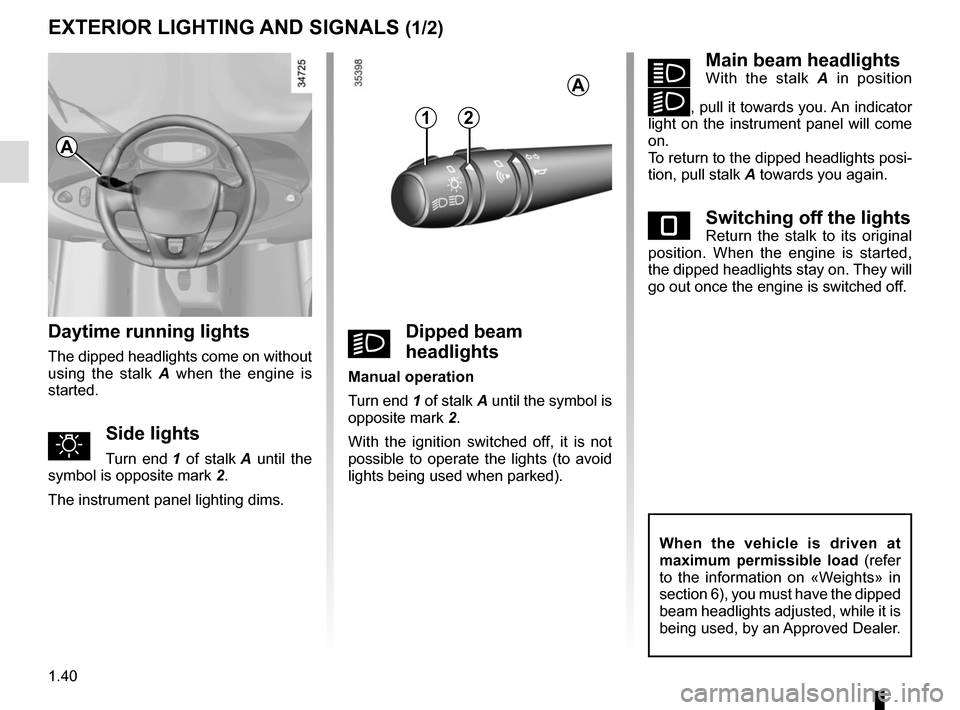
áMain beam headlightsWith the stalk A in position
k, pull it towards you. An indicator
light on the instrument panel will come
on.
To return to the dipped headlights posi-
tion, pull stalk A towards you again.
eSwitching off the lightsReturn the stalk to its original
position. When the engine is started,
the dipped headlights stay on. They will
go out once the engine is switched off.
EXTERIOR LIGHTING AND SIGNALS (1/2)
Daytime running lights
The dipped headlights come on without
using the stalk A when the engine is
started.
uSide lights
Turn end 1 of stalk A until the
symbol is opposite mark 2.
The instrument panel lighting dims.
A
kDipped beam
headlights
Manual operation
Turn end 1 of stalk A until the symbol is
opposite mark 2.
With the ignition switched off, it is not
possible to operate the lights (to avoid
lights being used when parked).
21
A
When the vehicle is driven at
maximum permissible load (refer
to the information on «Weights» in
section 6), you must have the dipped
beam headlights adjusted, while it is
being used, by an Approved Dealer.
Page 47 of 118
1.41
EXTERIOR LIGHTING AND SIGNALS (2/2)
Lights-on warning buzzerIf the stalk is not returned to its ini-
tial position
e after the ignition is
switched off, a warning beep sounds
four times to warn you.
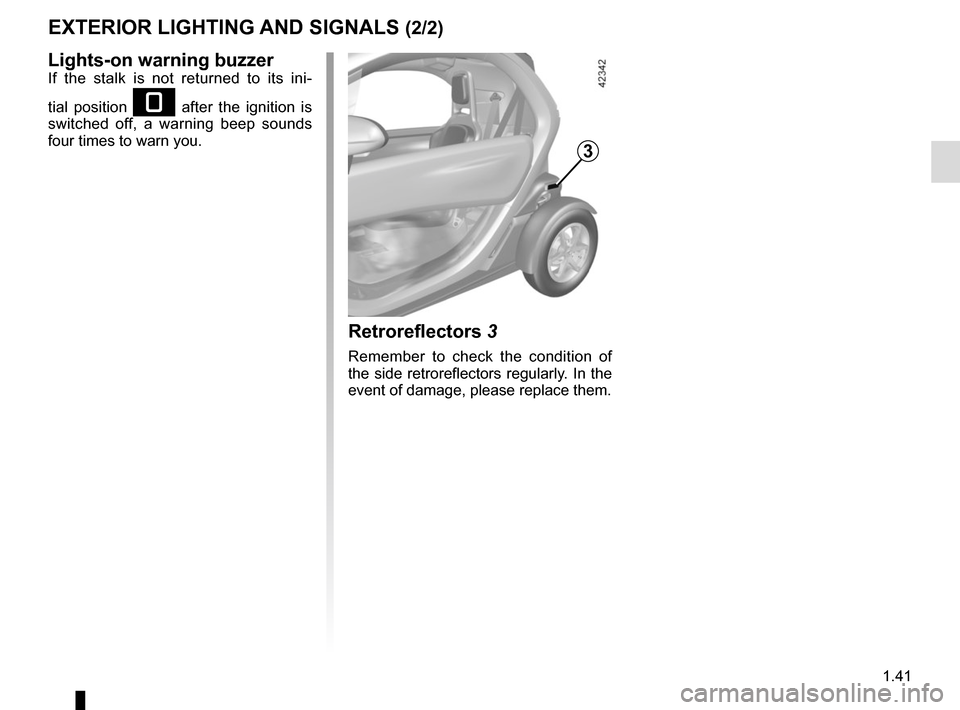
Retroreflectors 3
Remember to check the condition of
the side retroreflectors regularly. In the
event of damage, please replace them.
3
Page 48 of 118
1.42
SCREEN WASHER/WIPER
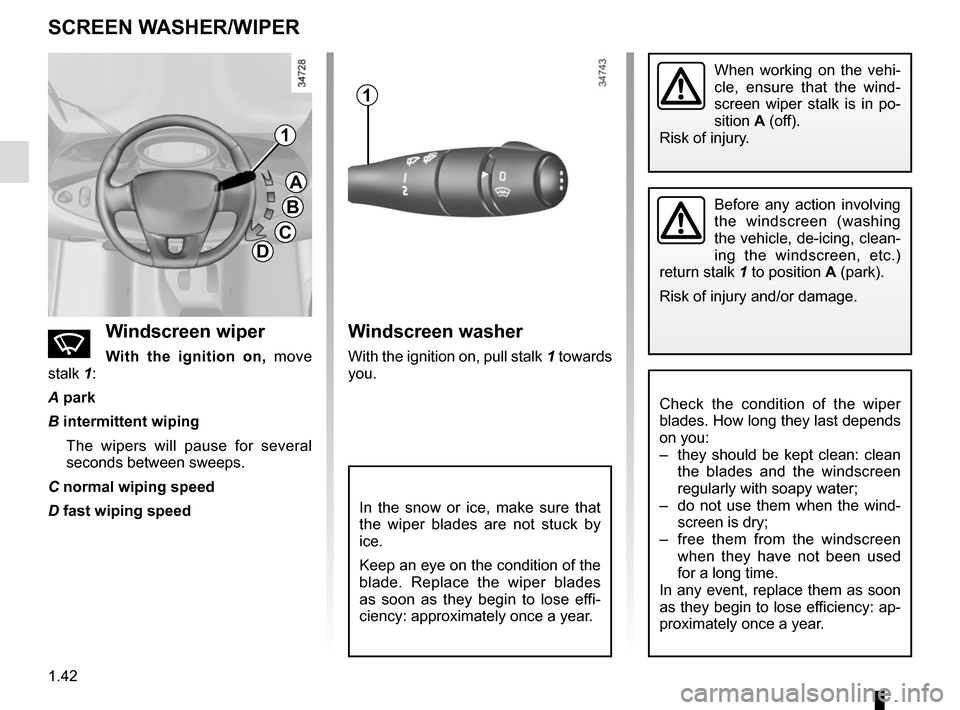
nWindscreen wiper
With the ignition on, move
stalk 1:
A park
B intermittent wiping The wipers will pause for several
seconds between sweeps.
C normal wiping speed
D fast wiping speed
A
B
C
D
1
1
Windscreen washer
With the ignition on, pull stalk 1 towards
you.
In the snow or ice, make sure that
the wiper blades are not stuck by
ice.
Keep an eye on the condition of the
blade. Replace the wiper blades
as soon as they begin to lose effi-
ciency: approximately once a year.
Check the condition of the wiper
blades. How long they last depends
on you:
– they should be kept clean: clean the blades and the windscreen
regularly with soapy water;
– do not use them when the wind- screen is dry;
– free them from the windscreen when they have not been used
for a long time.
In any event, replace them as soon
as they begin to lose efficiency: ap-
proximately once a year.
When working on the vehi-
cle, ensure that the wind-
screen wiper stalk is in po-
sition A (off).
Risk of injury.
Before any action involving
the windscreen (washing
the vehicle, de-icing, clean-
ing the windscreen, etc.)
return stalk 1 to position A (park).
Risk of injury and/or damage.
Page 50 of 118
2.2
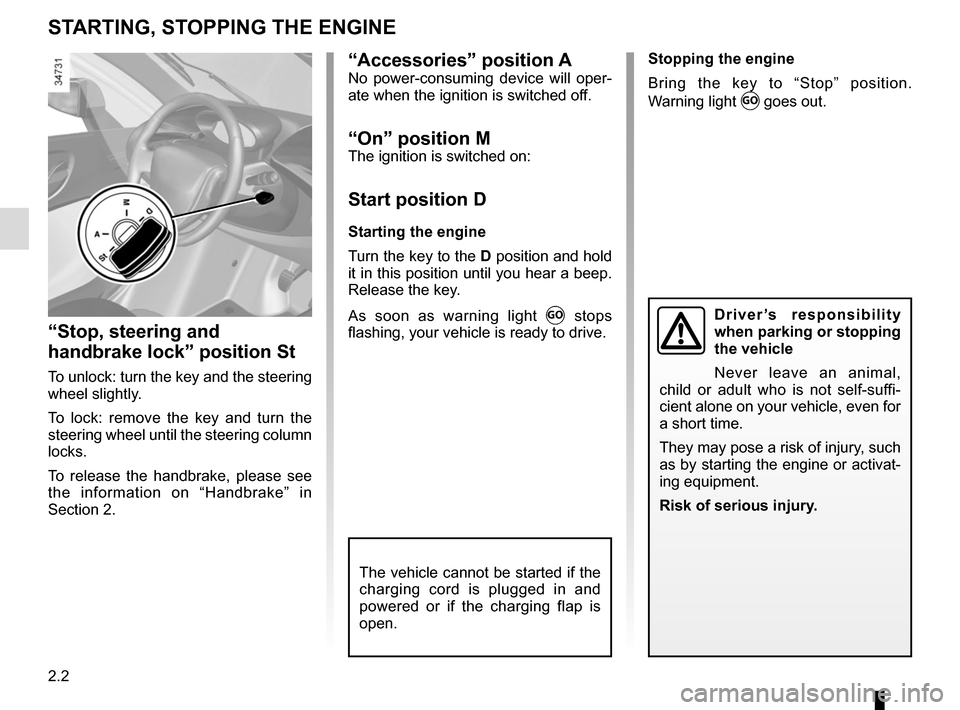
“Accessories” position ANo power-consuming device will oper-
ate when the ignition is switched off.
“On” position MThe ignition is switched on:
Start position D
Starting the engine
Turn the key to the D position and hold
it in this position until you hear a beep.
Release the key.
As soon as warning light
Ṑ stops
flashing, your vehicle is ready to drive.“Stop, steering and
handbrake lock” position St
To unlock: turn the key and the steering
wheel slightly.
To lock: remove the key and turn the
steering wheel until the steering column
locks.
To release the handbrake, please see
the information on “Handbrake” in
Section 2.
STARTING, STOPPING THE ENGINE
The vehicle cannot be started if the
charging cord is plugged in and
powered or if the charging flap is
open.
Stopping the engine
Bring the key to “Stop” position.
Warning light
Ṑ goes out.
Driver’s responsibility
when parking or stopping
the vehicle
Never leave an animal,
child or adult who is not self-suffi-
cient alone on your vehicle, even for
a short time.
They may pose a risk of injury, such
as by starting the engine or activat-
ing equipment.
Risk of serious injury.
Page 57 of 118
2.9
CHARGE METER/ECO-CONSUMPTION
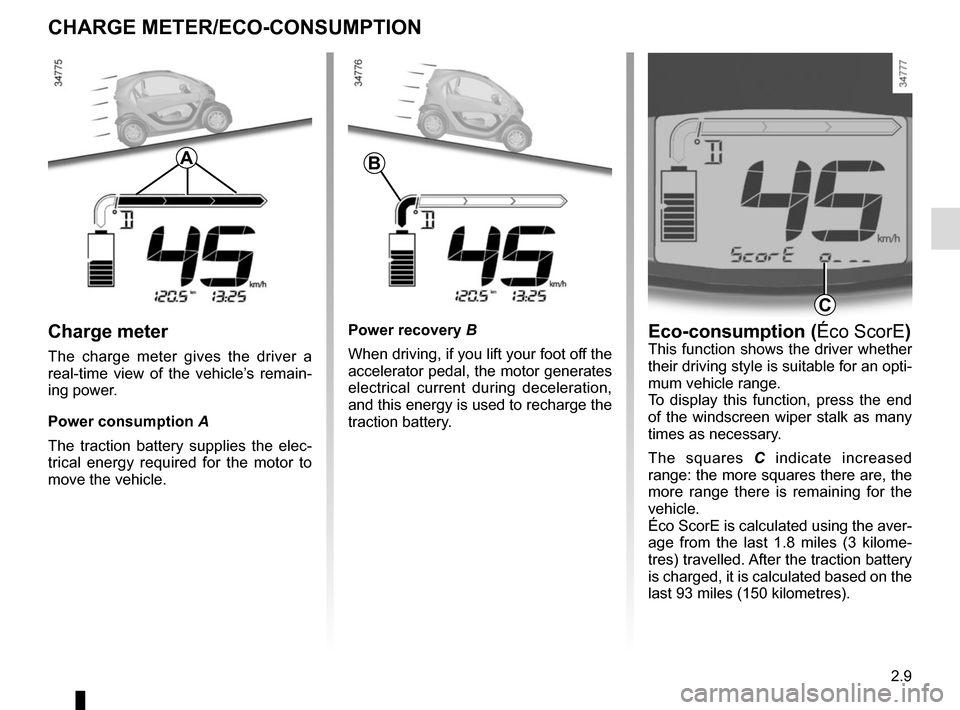
Eco-consumption (Éco ScorE)This function shows the driver whether
their driving style is suitable for an opti-
mum vehicle range.
To display this function, press the end
of the windscreen wiper stalk as many
times as necessary.
The squares C indicate increased
range: the more squares there are, the
more range there is remaining for the
vehicle.
Éco ScorE is calculated using the aver-
age from the last 1.8 miles (3 kilome-
tres) travelled. After the traction battery
is charged, it is calculated based on the
last 93 miles (150 kilometres).
Power recovery
B
When driving, if you lift your foot off the
accelerator pedal, the motor generates
electrical current during deceleration,
and this energy is used to recharge the
traction battery.Charge meter
The charge meter gives the driver a
real-time view of the vehicle’s remain-
ing power.
Power consumption A
The traction battery supplies the elec-
trical energy required for the motor to
move the vehicle.
BA
C
Page 69 of 118
4.5
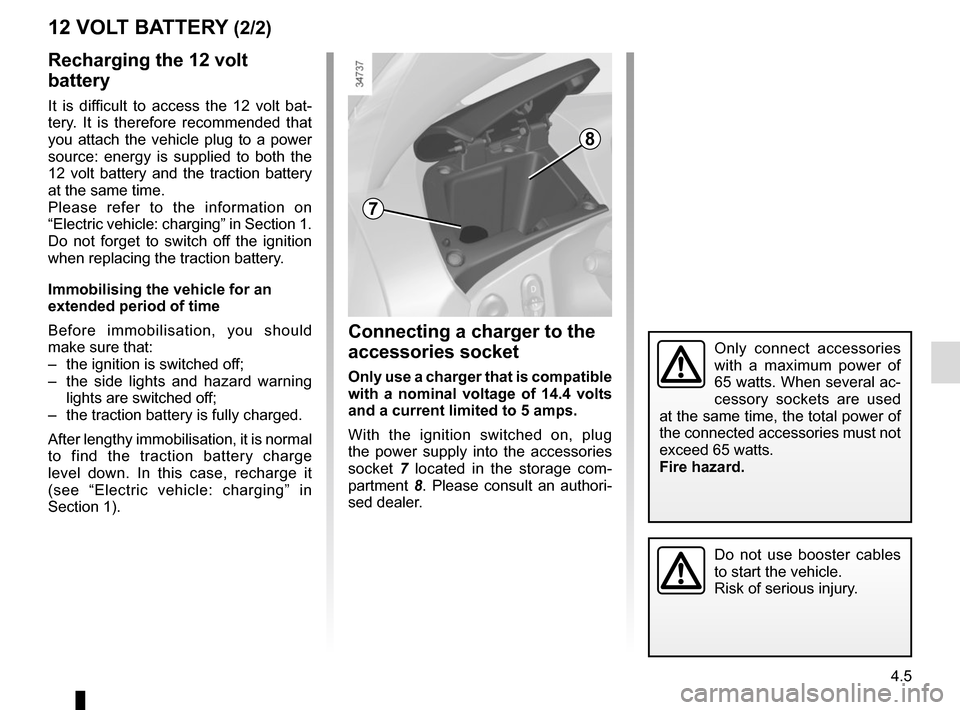
12 VOLT BATTERY (2/2)Connecting a charger to the
accessories socket
Only use a charger that is compatible
with a nominal voltage of 14.4 volts
and a current limited to 5 amps.
With the ignition switched on, plug
the power supply into the accessories
socket 7 located in the storage com-
partment 8. Please consult an authori-
sed dealer.
Recharging the 12 volt
battery
It is difficult to access the 12 volt bat-
tery. It is therefore recommended that
you attach the vehicle plug to a power
source: energy is supplied to both the
12 volt battery and the traction battery
at the same time.
Please refer to the information on
“Electric vehicle: charging” in Section 1.
Do not forget to switch off the ignition
when replacing the traction battery.
Immobilising the vehicle for an
extended period of time
Before immobilisation, you should
make sure that:
– the ignition is switched off;
– the side lights and hazard warning lights are switched off;
– the traction battery is fully charged.
After lengthy immobilisation, it is normal
to find the traction battery charge
level down. In this case, recharge it
(see “Electric vehicle: charging” in
Section 1).
Do not use booster cables
to start the vehicle.
Risk of serious injury.
8
7
Only connect accessories
with a maximum power of
65 watts. When several ac-
cessory sockets are used
at the same time, the total power of
the connected accessories must not
exceed 65 watts.
Fire hazard.
Page 70 of 118
4.6
BODYWORK MAINTENANCE (1/2)
– Scrape off mud or dirt without pre-wetting.
– Allow dirt to accumulate.
– Allow rust to form following minor im- pacts.
– Use solvents not approved by our Technical Department to remove
stains as this could damage the
paintwork.
– Drive frequently in snow or muddy conditions without washing the ve-
hicle, particularly under the wheel
arches and body.
– minor impacts
You should take a minimum number of
precautions in order to safeguard your
vehicle against such risks and not to
lose the benefit of your vehicle’s anti-
corrosion protection.
What you should not do
– Degrease or clean mechanical com-
ponents, underneath the body, parts
with hinges (e.g. inside the fuel tank
flap) and painted plastic external fit-
tings using high-pressure cleaning
equipment or by spraying on prod-
ucts not approved by our Technical
Department. If adequate precautions
are not taken, this could give rise to
corrosion, damage to paintwork or
operating faults.
– Wash the vehicle in bright sunlight or freezing temperatures.
A well-maintained vehicle will last
longer. It is therefore recommended to
maintain the exterior of the vehicle reg-
ularly.
Some parts may look different over time
(e.g.: bleaching, etc.)
Protection against the effects
of corrosive agents
Although your vehicle has been treated
with very effective anti-corrosion prod-
ucts, it nevertheless remains subject to
the effects of:
– corrosives in the atmosphere
– atmospheric pollution (built-up
and industrial areas),
– saline atmospheres (near the
sea, particularly in hot weather),
– seasonal and damp weather con-
ditions, (e.g. road salt in winter,
water from road cleaners, etc.).
– abrasives Wind-borne dust and sand, mud,
road grit thrown up by other vehi-
cles, etc.
Washing the vehicle
Never wash the vehicle with
a roller or a high-pressure
spray, and under no circum-
stances when charging.
This risks damaging the electrical
circuit.
Page 77 of 118
5.3
TYRES (2/4)
Tyre pressures
Respect the tyre pressures, checking
them at least once a month and before
any long journeys.
Pressures should be checked when the
tyres are cold; ignore higher pressures
which may be reached in hot weather
or following a fast journey. If tyre pressures cannot be checked
when the tyres are
cold, the normal
pressures must be increased by 0.2 to
0.3 bar (or 3 PSI).
Never deflate a hot tyre.
Use in winter
The use of snow or winter tyres signifi-
cantly reduces the vehicle range.
Incorrect tyre pressures
lead to abnormal tyre wear
and unusually hot running.
These are factors which
may seriously affect safety and lead
to:
– poor road holding,
– risk of bursting or tread separa- tion.
The pressure depends on the load
and the speed of use. Adjust the
pressure based on the user condi-
tions.
Please be aware that a
poorly tightened or miss-
ing valve cap can make the
tyres less airtight and lead
to pressure loss.
Always use valve caps identical to
those fitted originally and tighten
them fully.
Snow or Winter tyres
We would recommend that these be
fitted to all four wheels to ensure that
your vehicle retains maximum adhe-
sion.
Warning : These tyres sometimes have
a specific direction of rotation and a
maximum speed index which may be
lower than the maximum speed of your
vehicle.
You must use tyres made by the same
manufacturer, with the same dimen-
sions, type and structure.
Chains
In all cases, we would recommend
that you contact an approved dealer
who will be able to advise you on
the choice of equipment which is
most suitable for your vehicle.
For safety reasons, the use
of chains is strictly forbid-
den.
Page 86 of 118

5.12
ACCESSORIES
Electrical and electronic accessories
Before installing this type of accessory (particularly for transmitters\
/receivers: frequency bandwidth, power level, po-
sition of the aerial, etc.), make sure it is compatible with your vehic\
le. You can get advice from an authorised dealer.
Only connect accessories with a maximum power of 65 watts. Fire hazard. When several accessory sockets are used
at the same time, the total power of the connected accessories must not \
exceed 65 watts.
No work may be carried out on the vehicle’s electrical or radio circuits, except by approved Dealers: an incorrect\
ly connected
system may result in damage being caused to the electrical equipment and\
/or the components connected to it.
If the vehicle is fitted with any aftermarket electrical equipment, make\
sure that the installation is correctly protected by a fuse.
Establish the rating and position of this fuse.
Using the diagnostic socket
The use of electronic accessories on the diagnostic socket may cause ser\
ious disturbance to the vehicle’s electronic systems.
For your safety we recommend that you use only electronic accessories ap\
proved by the manufacturer, consult an Approved
Dealer. Serious accident risk.
Use of transmission/receiving devices (telephones, CB equipment etc.).\
Telephones and CB equipment with integrated aerials may cause interferenc\
e to the electronic systems originally fitted to the
vehicle: it is advisable only to use equipment with an external aerial. \
Furthermore, we remind you of the need to conform
to the legislation in force concerning the use of such equipment.
Fitting after-market accessories
If you wish to install accessories on the vehicle: please contact an aut\
horised dealer. Also, to ensure the correct operation o f
your vehicle, and to avoid any risk to your safety, we recommend that you use only accessories specifically designed for y\
our
vehicle, which are the only accessories for which the manufacturer will \
provide a warranty.
If you are using an anti-theft device, only attach it to the brake pedal\
.
Obstructions to the driver
Only use mats suitable for the vehicle, attached with the pre-fitted com\
ponents, and check the fitting regularly. Do not lay on e
mat on top of another. There is a risk of wedging the pedals.
Page 87 of 118
5.13
WIPER BLADE
Check the condition of the wiper
blades. How long they last depends
on you:
– clean the blades and the wind-screen regularly with soapy
water;
– do not use them when the wind- screen is dry;
– free them from the windscreen when they have not been used
for a long time.
– In freezing weather, make
sure that the wiper blades
are not stuck by ice (to
avoid the risk of the wiper
motor overheating).
– Keep an eye on the condition of
the blade.
Replace the wiper blades as soon
as they begin to lose efficiency:
approximately once a year.
When changing the blade, when it
has been removed, do not let the
wiper arm fall against the window:
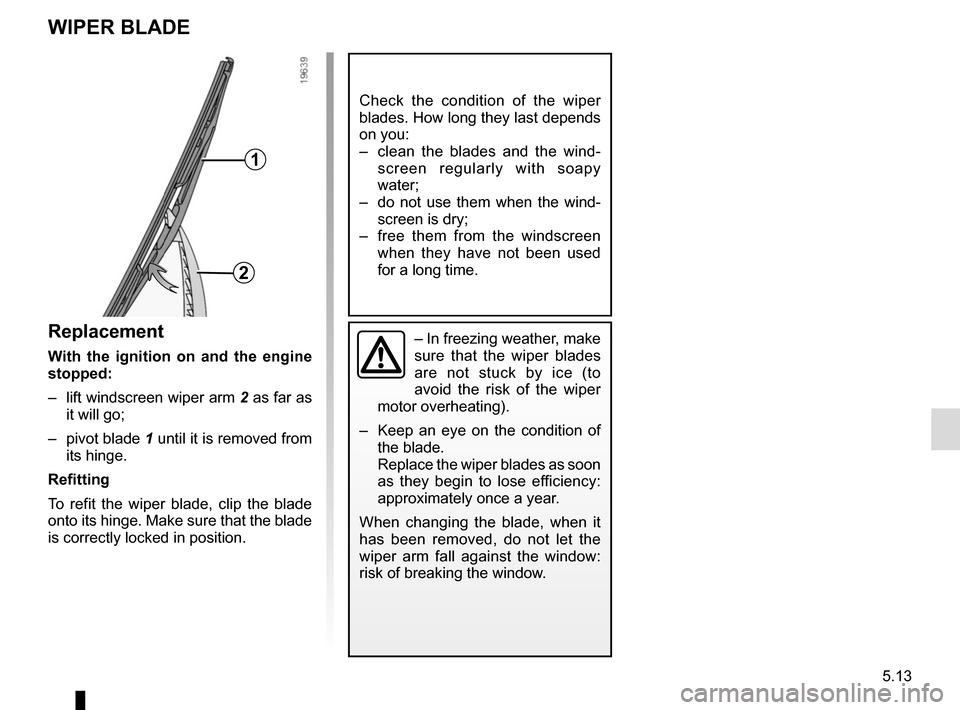
risk of breaking the window.Replacement
With the ignition on and the engine
stopped:
– lift windscreen wiper arm 2 as far as
it will go;
– pivot blade 1 until it is removed from
its hinge.
Refitting
To refit the wiper blade, clip the blade
onto its hinge. Make sure that the blade
is correctly locked in position.
1
2