side RENAULT TWIZY 2017 1.G User Guide
[x] Cancel search | Manufacturer: RENAULT, Model Year: 2017, Model line: TWIZY, Model: RENAULT TWIZY 2017 1.GPages: 118, PDF Size: 2.48 MB
Page 38 of 118
1.32
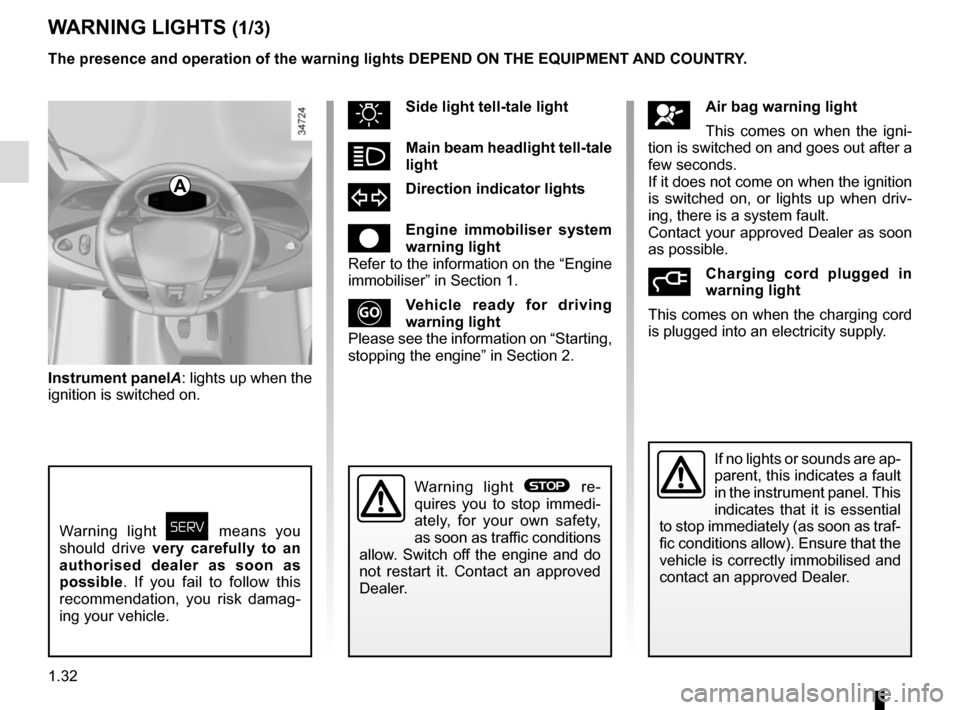
Instrument panelA: lights up when the
ignition is switched on.
WARNING LIGHTS (1/3)
Warning light ø means you
should drive very carefully to an
authorised dealer as soon as
possible. If you fail to follow this
recommendation, you risk damag-
ing your vehicle.
A
åAir bag warning light
This comes on when the igni-
tion is switched on and goes out after a
few seconds.
If it does not come on when the ignition
is switched on, or lights up when driv-
ing, there is a system fault.
Contact your approved Dealer as soon
as possible.
Charging cord plugged in
warning light
This comes on when the charging cord
is plugged into an electricity supply.
uSide light tell-tale light
áMain beam headlight tell-tale
light
dDirection indicator lights
êEngine immobiliser system
warning light
Refer to the information on the “Engine
immobiliser” in Section 1.
Vehicle ready for driving
warning light
Please see the information on “Starting,
stopping the engine” in Section 2.
If no lights or sounds are ap-
parent, this indicates a fault
in the instrument panel. This
indicates that it is essential
to stop immediately (as soon as traf-
fic conditions allow). Ensure that the
vehicle is correctly immobilised and
contact an approved Dealer.
Warning light ® re-
quires you to stop immedi-
ately, for your own safety,
as soon as traffic conditions
allow. Switch off the engine and do
not restart it. Contact an approved
Dealer.
The presence and operation of the warning lights DEPEND ON THE EQUIPMENT\
AND COUNTRY.
Page 46 of 118
1.40
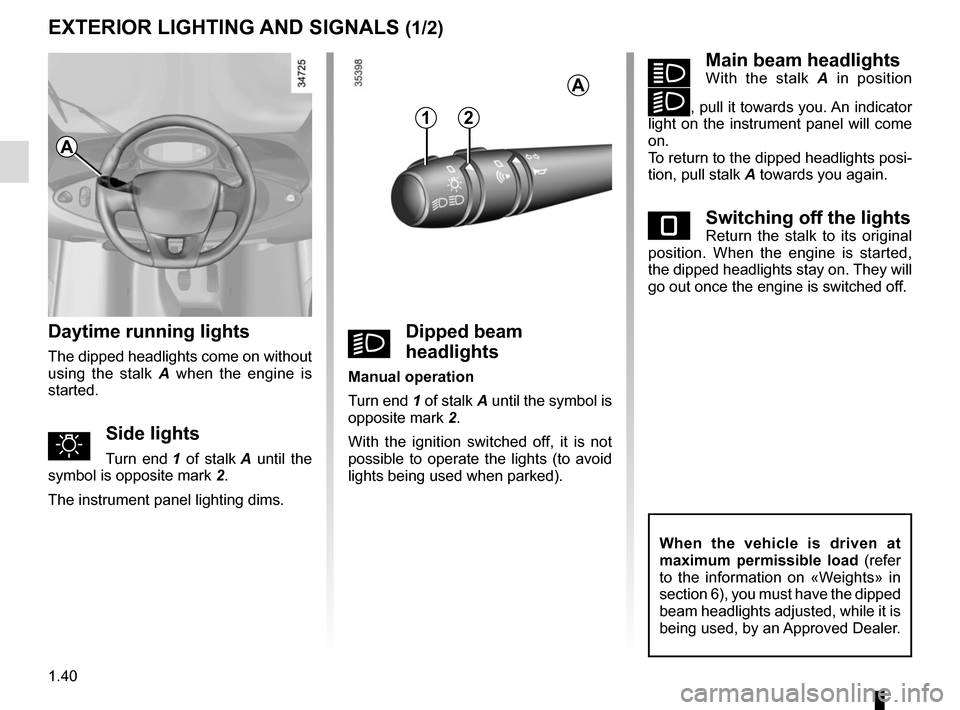
áMain beam headlightsWith the stalk A in position
k, pull it towards you. An indicator
light on the instrument panel will come
on.
To return to the dipped headlights posi-
tion, pull stalk A towards you again.
eSwitching off the lightsReturn the stalk to its original
position. When the engine is started,
the dipped headlights stay on. They will
go out once the engine is switched off.
EXTERIOR LIGHTING AND SIGNALS (1/2)
Daytime running lights
The dipped headlights come on without
using the stalk A when the engine is
started.
uSide lights
Turn end 1 of stalk A until the
symbol is opposite mark 2.
The instrument panel lighting dims.
A
kDipped beam
headlights
Manual operation
Turn end 1 of stalk A until the symbol is
opposite mark 2.
With the ignition switched off, it is not
possible to operate the lights (to avoid
lights being used when parked).
21
A
When the vehicle is driven at
maximum permissible load (refer
to the information on «Weights» in
section 6), you must have the dipped
beam headlights adjusted, while it is
being used, by an Approved Dealer.
Page 47 of 118
1.41
EXTERIOR LIGHTING AND SIGNALS (2/2)
Lights-on warning buzzerIf the stalk is not returned to its ini-
tial position
e after the ignition is
switched off, a warning beep sounds
four times to warn you.
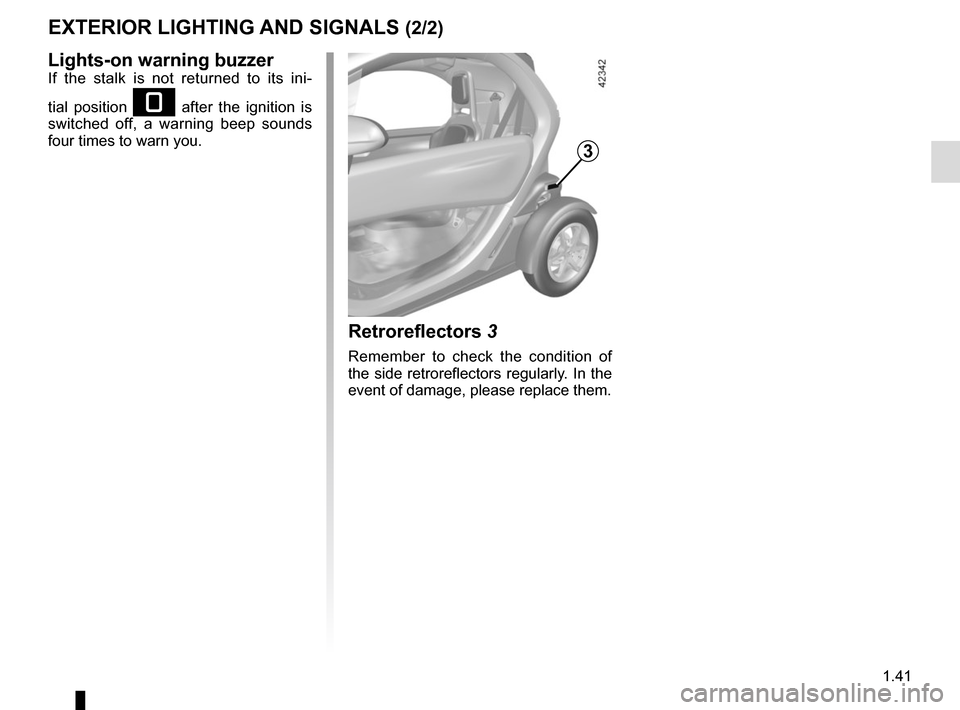
Retroreflectors 3
Remember to check the condition of
the side retroreflectors regularly. In the
event of damage, please replace them.
3
Page 52 of 118
2.4
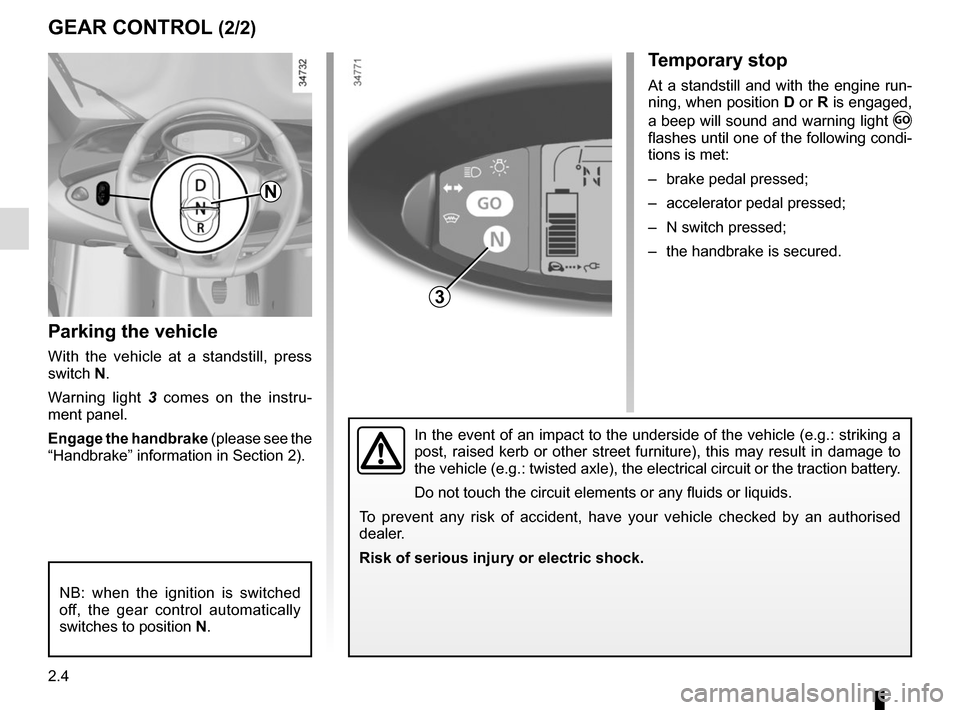
Parking the vehicle
With the vehicle at a standstill, press
switch N.
Warning light 3 comes on the instru-
ment panel.
Engage the handbrake (please see the
“Handbrake” information in Section 2).
GEAR CONTROL (2/2)
In the event of an impact to the underside of the vehicle (e.g.: striki\
ng a
post, raised kerb or other street furniture), this may result in damage\
to
the vehicle (e.g.: twisted axle), the electrical circuit or the tracti\
on battery.
Do not touch the circuit elements or any fluids or liquids.
To prevent any risk of accident, have your vehicle checked by an authoris\
ed
dealer.
Risk of serious injury or electric shock.
N
3
NB: when the ignition is switched
off, the gear control automatically
switches to position N.
Temporary stop
At a standstill and with the engine run-
ning, when position D or R is engaged,
a beep will sound and warning light
Ṑ
flashes until one of the following condi-
tions is met:
– brake pedal pressed;
– accelerator pedal pressed;
– N switch pressed;
– the handbrake is secured.
Page 54 of 118
2.6
VEHICLE RANGE: recommendations (1/2)
The vehicle range is approved for an
ECE-15 cycle.
In real usage, the range of an electric
vehicle may vary depending on several
factors over which you have partial con-
trol, which may make a considerable
difference to the vehicle range. These
factors are:
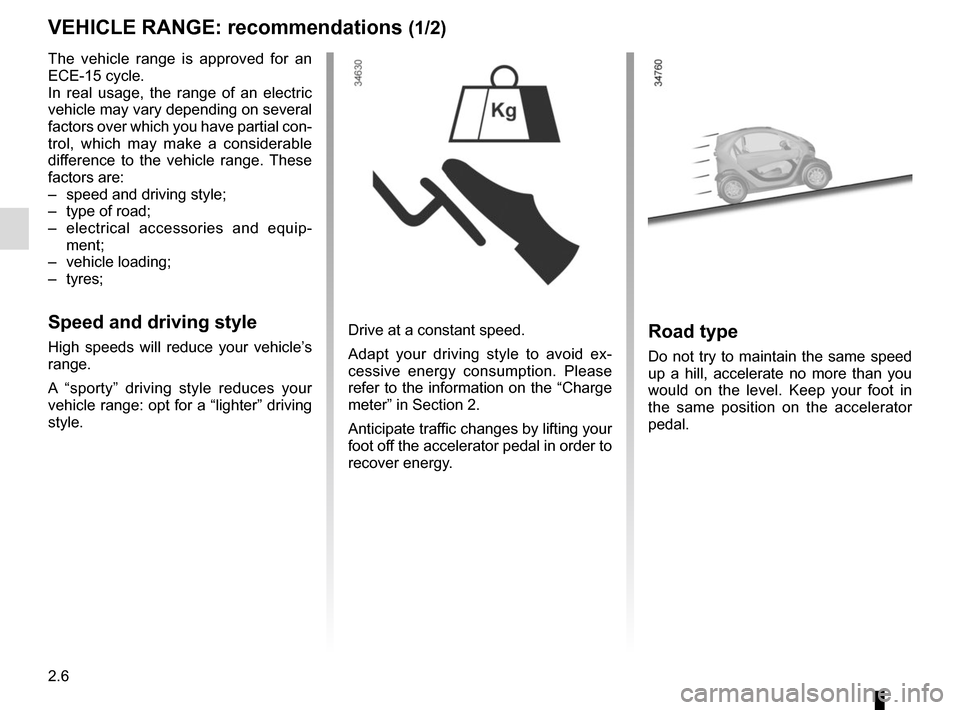
– speed and driving style;
– type of road;
– electrical accessories and equip-ment;
– vehicle loading;
– tyres;
Speed and driving style
High speeds will reduce your vehicle’s
range.
A “sporty” driving style reduces your
vehicle range: opt for a “lighter” driving
style.
Drive at a constant speed.
Adapt your driving style to avoid ex-
cessive energy consumption. Please
refer to the information on the “Charge
meter” in Section 2.
Anticipate traffic changes by lifting your
foot off the accelerator pedal in order to
recover energy.Road type
Do not try to maintain the same speed
up a hill, accelerate no more than you
would on the level. Keep your foot in
the same position on the accelerator
pedal.
Page 69 of 118
4.5
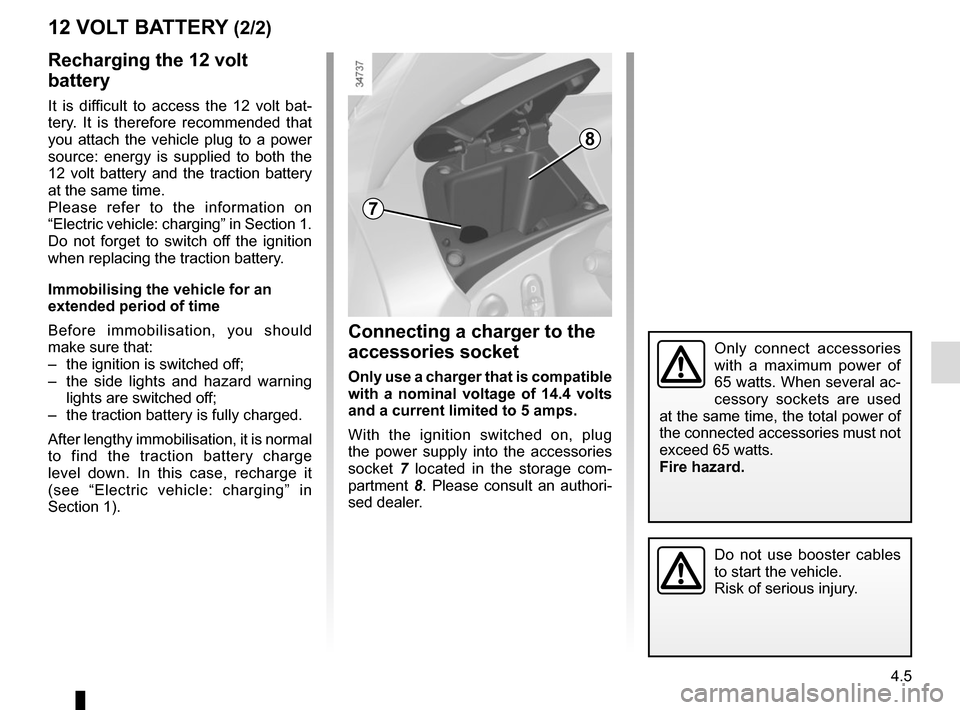
12 VOLT BATTERY (2/2)Connecting a charger to the
accessories socket
Only use a charger that is compatible
with a nominal voltage of 14.4 volts
and a current limited to 5 amps.
With the ignition switched on, plug
the power supply into the accessories
socket 7 located in the storage com-
partment 8. Please consult an authori-
sed dealer.
Recharging the 12 volt
battery
It is difficult to access the 12 volt bat-
tery. It is therefore recommended that
you attach the vehicle plug to a power
source: energy is supplied to both the
12 volt battery and the traction battery
at the same time.
Please refer to the information on
“Electric vehicle: charging” in Section 1.
Do not forget to switch off the ignition
when replacing the traction battery.
Immobilising the vehicle for an
extended period of time
Before immobilisation, you should
make sure that:
– the ignition is switched off;
– the side lights and hazard warning lights are switched off;
– the traction battery is fully charged.
After lengthy immobilisation, it is normal
to find the traction battery charge
level down. In this case, recharge it
(see “Electric vehicle: charging” in
Section 1).
Do not use booster cables
to start the vehicle.
Risk of serious injury.
8
7
Only connect accessories
with a maximum power of
65 watts. When several ac-
cessory sockets are used
at the same time, the total power of
the connected accessories must not
exceed 65 watts.
Fire hazard.
Page 70 of 118
4.6
BODYWORK MAINTENANCE (1/2)
– Scrape off mud or dirt without pre-wetting.
– Allow dirt to accumulate.
– Allow rust to form following minor im- pacts.
– Use solvents not approved by our Technical Department to remove
stains as this could damage the
paintwork.
– Drive frequently in snow or muddy conditions without washing the ve-
hicle, particularly under the wheel
arches and body.
– minor impacts
You should take a minimum number of
precautions in order to safeguard your
vehicle against such risks and not to
lose the benefit of your vehicle’s anti-
corrosion protection.
What you should not do
– Degrease or clean mechanical com-
ponents, underneath the body, parts
with hinges (e.g. inside the fuel tank
flap) and painted plastic external fit-
tings using high-pressure cleaning
equipment or by spraying on prod-
ucts not approved by our Technical
Department. If adequate precautions
are not taken, this could give rise to
corrosion, damage to paintwork or
operating faults.
– Wash the vehicle in bright sunlight or freezing temperatures.
A well-maintained vehicle will last
longer. It is therefore recommended to
maintain the exterior of the vehicle reg-
ularly.
Some parts may look different over time
(e.g.: bleaching, etc.)
Protection against the effects
of corrosive agents
Although your vehicle has been treated
with very effective anti-corrosion prod-
ucts, it nevertheless remains subject to
the effects of:
– corrosives in the atmosphere
– atmospheric pollution (built-up
and industrial areas),
– saline atmospheres (near the
sea, particularly in hot weather),
– seasonal and damp weather con-
ditions, (e.g. road salt in winter,
water from road cleaners, etc.).
– abrasives Wind-borne dust and sand, mud,
road grit thrown up by other vehi-
cles, etc.
Washing the vehicle
Never wash the vehicle with
a roller or a high-pressure
spray, and under no circum-
stances when charging.
This risks damaging the electrical
circuit.
Page 73 of 118
4.9
High-pressure equipment
and sprays may not be
used inside the passenger
compartment. This could
impair the correct functioning of the
electrical or electronic components
in the vehicle, or have other detri-
mental effects.
INTERIOR TRIM MAINTENANCE (2/2)
Removal/replacing removable
equipment originally fitted in
the vehicle
If you have to remove detachable
equipment to clean the passenger
compartment, make sure you reinstall
it properly and attach them using the
original parts.
With the vehicle stationary, ensure that
nothing will impede driving (anything
obstructing the pedals, etc.).
Washing with a water jet is permit-
ted if you do not wash higher than
the driver’s seat.
Page 80 of 118
5.6
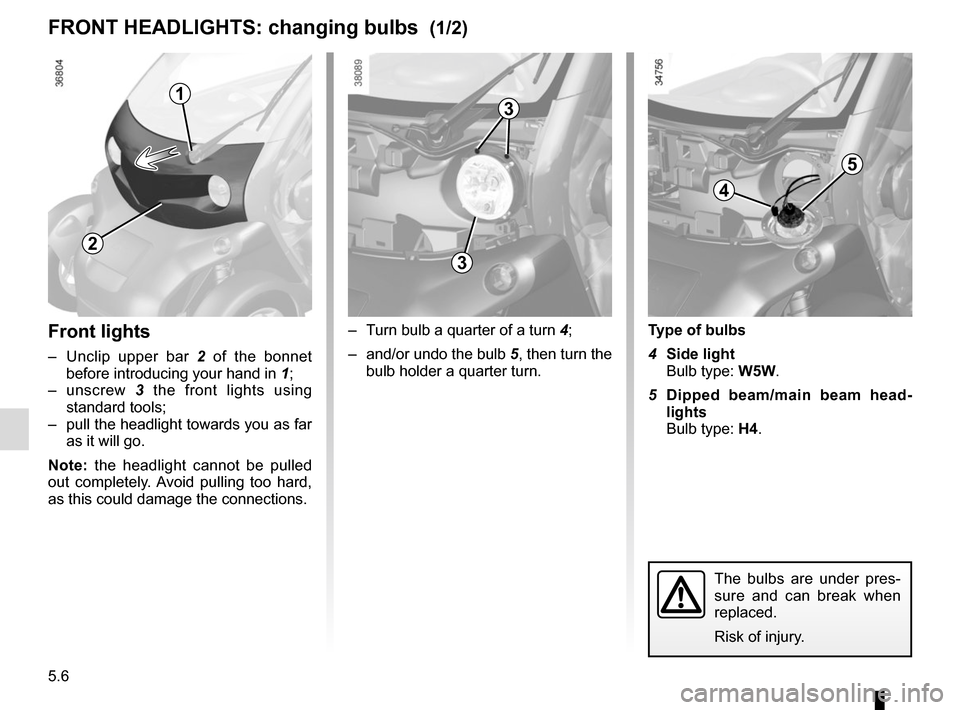
Front lights
– Unclip upper bar 2 of the bonnet
before introducing your hand in 1;
– unscrew 3 the front lights using
standard tools;
– pull the headlight towards you as far as it will go.
Note: the headlight cannot be pulled
out completely. Avoid pulling too hard,
as this could damage the connections.
FRONT HEADLIGHTS: changing bulbs (1/2)
– Turn bulb a quarter of a turn 4;
– and/or undo the bulb 5, then turn the
bulb holder a quarter turn.
2
13
3
5
4
Type of bulbs
4 Side light
Bulb type: W5W.
5 Dipped beam/main beam head-
lights
Bulb type: H4.
The bulbs are under pres-
sure and can break when
replaced.
Risk of injury.
Page 82 of 118
5.8
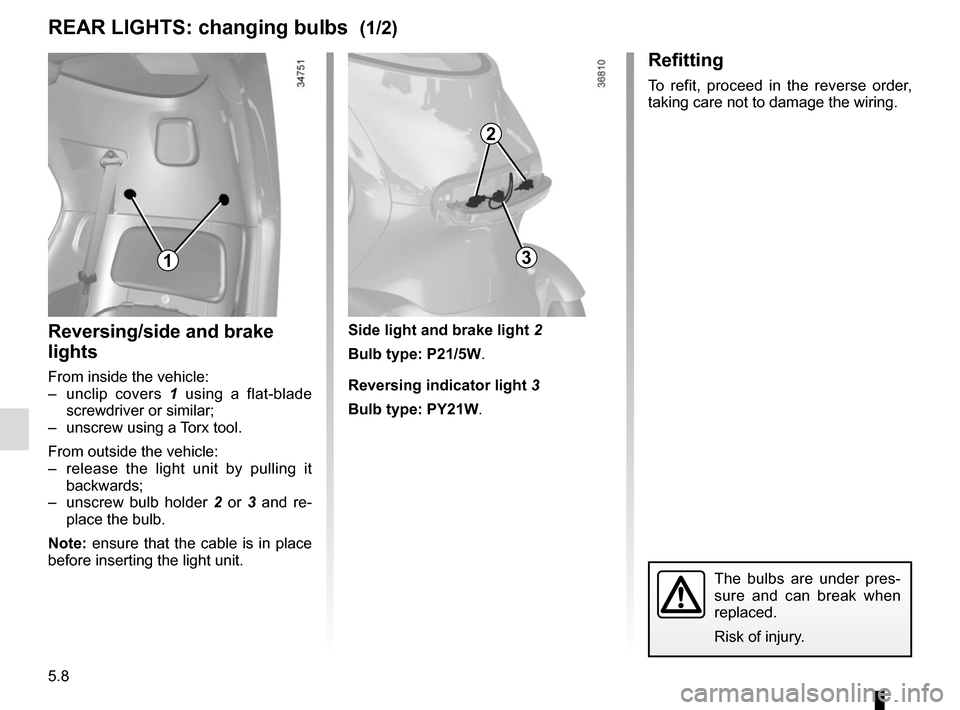
Side light and brake light 2
Bulb type: P21/5W.
Reversing indicator light 3
Bulb type: PY21W.Reversing/side and brake
lights
From inside the vehicle:
– unclip covers 1 using a flat-blade
screwdriver or similar;
– unscrew using a Torx tool.
From outside the vehicle:
– release the light unit by pulling it backwards;
– unscrew bulb holder 2 or 3 and re-
place the bulb.
Note: ensure that the cable is in place
before inserting the light unit.
REAR LIGHTS: changing bulbs (1/2)
Refitting
To refit, proceed in the reverse order,
taking care not to damage the wiring.
The bulbs are under pres-
sure and can break when
replaced.
Risk of injury.
1
2
3