charging RENAULT TWIZY 2018 User Guide
[x] Cancel search | Manufacturer: RENAULT, Model Year: 2018, Model line: TWIZY, Model: RENAULT TWIZY 2018Pages: 118, PDF Size: 2.51 MB
Page 39 of 118
1.33
WARNING LIGHTS (2/3)
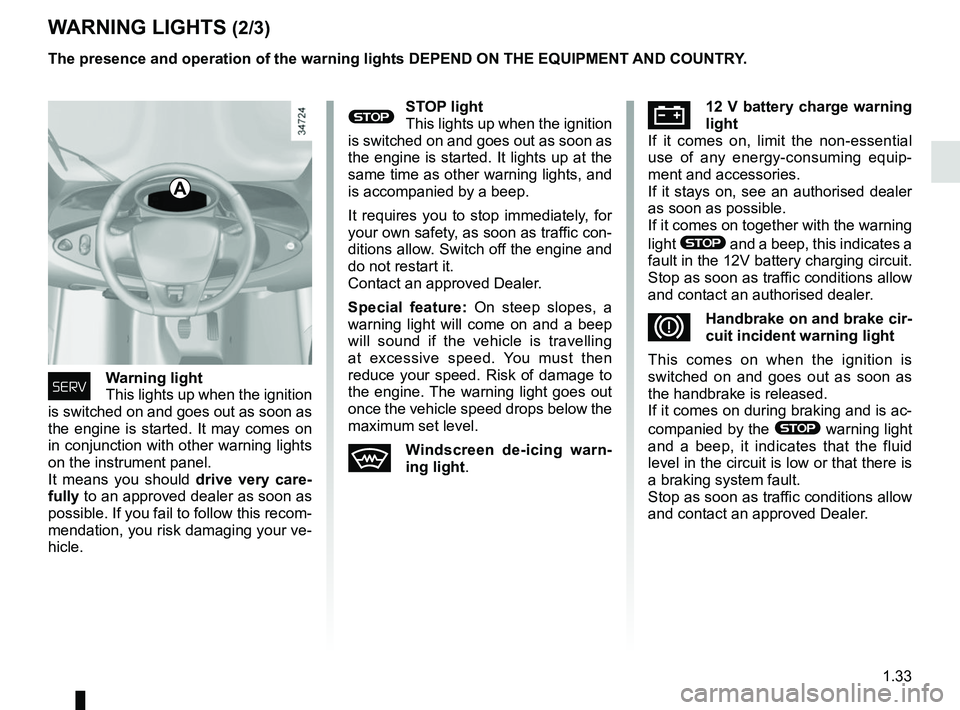
®STOP light
This lights up when the ignition
is switched on and goes out as soon as
the engine is started. It lights up at the
same time as other warning lights, and
is accompanied by a beep.
It requires you to stop immediately, for
your own safety, as soon as traffic con-
ditions allow. Switch off the engine and
do not restart it.
Contact an approved Dealer.
Special feature: On steep slopes, a
warning light will come on and a beep
will sound if the vehicle is travelling
at excessive speed. You must then
reduce your speed. Risk of damage to
the engine. The warning light goes out
once the vehicle speed drops below the
maximum set level.
Windscreen de-icing warn-
ing light .
Ú12 V battery charge warning
light
If it comes on, limit the non-essential
use of any energy-consuming equip-
ment and accessories.
If it stays on, see an authorised dealer
as soon as possible.
If it comes on together with the warning
light
® and a beep, this indicates a
fault in the 12V battery charging circuit.
Stop as soon as traffic conditions allow
and contact an authorised dealer.
DHandbrake on and brake cir-
cuit incident warning light
This comes on when the ignition is
switched on and goes out as soon as
the handbrake is released.
If it comes on during braking and is ac-
companied by the
® warning light
and a beep, it indicates that the fluid
level in the circuit is low or that there is
a braking system fault.
Stop as soon as traffic conditions allow
and contact an approved Dealer.
The presence and operation of the warning lights DEPEND ON THE EQUIPMENT\
AND COUNTRY.
A
øWarning light
This lights up when the ignition
is switched on and goes out as soon as
the engine is started. It may comes on
in conjunction with other warning lights
on the instrument panel.
It means you should drive very care-
fully to an approved dealer as soon as
possible. If you fail to follow this recom-
mendation, you risk damaging your ve-
hicle.
Page 40 of 118
1.34
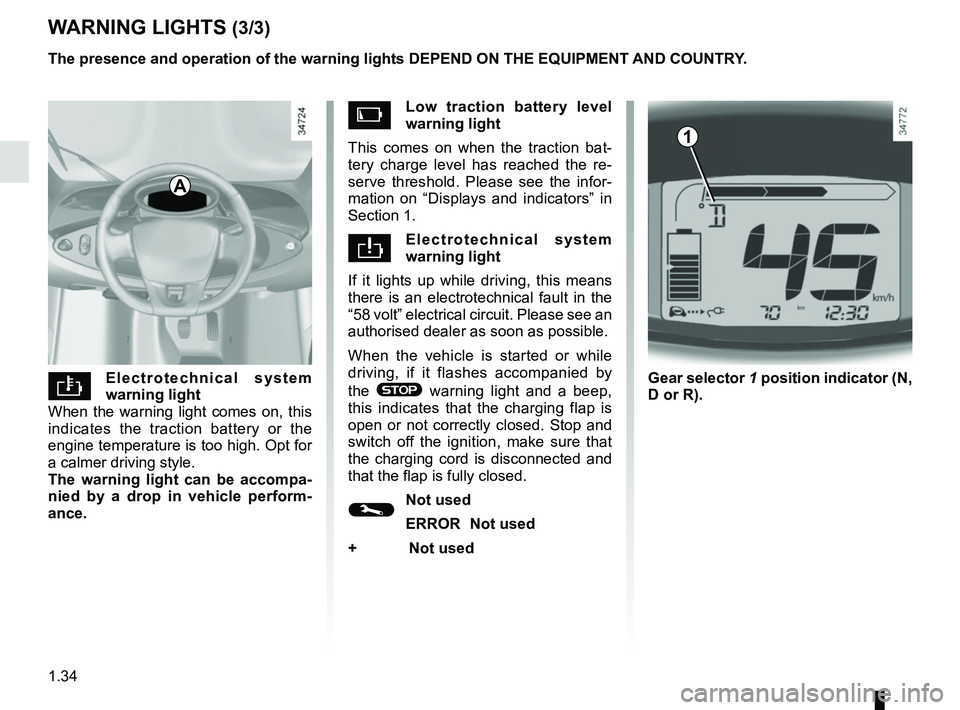
\bLow traction battery level
warning light
This comes on when the traction bat-
tery charge level has reached the re-
serve threshold. Please see the infor-
mation on “Displays and indicators” in
Section 1.
Electrotechnical system
warning light
If it lights up while driving, this means
there is an electrotechnical fault in the
“58 volt” electrical circuit. Please see an
authorised dealer as soon as possible.
When the vehicle is started or while
driving, if it flashes accompanied by
the
® warning light and a beep,
this indicates that the charging flap is
open or not correctly closed. Stop and
switch off the ignition, make sure that
the charging cord is disconnected and
that the flap is fully closed.
©Not used
ERROR Not used
+ Not used
WARNING LIGHTS (3/3)
Electrotechnical system
warning light
When the warning light comes on, this
indicates the traction battery or the
engine temperature is too high. Opt for
a calmer driving style.
The warning light can be accompa-
nied by a drop in vehicle perform-
ance. The presence and operation of the warning lights DEPEND ON THE EQUIPMENT\
AND COUNTRY.
A
Gear selector 1 position indicator (N,
D or R).
1
Page 42 of 118

1.36
Forecast range display features
– Sporty driving will strongly affect the forecast range value. Once you
return to a calmer driving style, you
will need to drive for several miles to
return to an estimate that is closer to
the real situation;
– the forecast range displayed after charging the traction battery is calcu-
lated based on the power consump-
tion over the last 93 miles (150 kilo-
metres) travelled.
Instrument panel in miles
It is possible to switch to km/h.
Press button 5 and switch on the igni-
tion.
The speed measurement unit indica-
tor flashes for approximately three sec-
onds, then the new unit flashes on the
display and is then lit up continuously:
release button 5.
To return to miles, proceed in the same
manner.Display 4
Press and hold button 5 to reset the trip
mileage recorder. The display must be
set to “Trip mileage recorder”. Zones
6 of the instrument panel dis-
play the information detailed below by
pressing button 5 repeatedly:
– estimated range;
– total mileage recorder;
– trip mileage recorder;
– Eco score;
– clock (CS : Clock setting).
Note: resetting is automatic when
the maximum capacity of any of the
memories is exceeded.
4
5
6
DISPLAYS AND INDICATORS (2/2)
Page 50 of 118

2.2
“Accessories” position ANo power-consuming device will oper-
ate when the ignition is switched off.
“On” position MThe ignition is switched on:
Start position D
Starting the engine
Turn the key to the D position and hold
it in this position until you hear a beep.
Release the key.
As soon as warning light
Ṑ stops
flashing, your vehicle is ready to drive.“Stop, steering and
handbrake lock” position St
To unlock: turn the key and the steering
wheel slightly.
To lock: remove the key and turn the
steering wheel until the steering column
locks.
To release the handbrake, please see
the information on “Handbrake” in
Section 2.
STARTING, STOPPING THE ENGINE
The vehicle cannot be started if the
charging cord is plugged in and
powered or if the charging flap is
open.
Stopping the engine
Bring the key to “Stop” position.
Warning light
Ṑ goes out.
Driver’s responsibility
when parking or stopping
the vehicle
Never leave an animal,
child or adult who is not self-suffi-
cient alone on your vehicle, even for
a short time.
They may pose a risk of injury, such
as by starting the engine or activat-
ing equipment.
Risk of serious injury.
Page 51 of 118
2.3
Driving
Press switch D, a beep will sound.
While driving, press the accelerator
pedal to achieve the desired speed.
Hill start
When setting off on a slope, release the
handbrake whilst pressing the brake
pedal before pressing the accelerator
pedal.
Reverse
Press switch R.
The reversing light will come on as
soon as reverse gear is selected (igni-
tion on).
A beep will sound.
GEAR CONTROL (1/2)
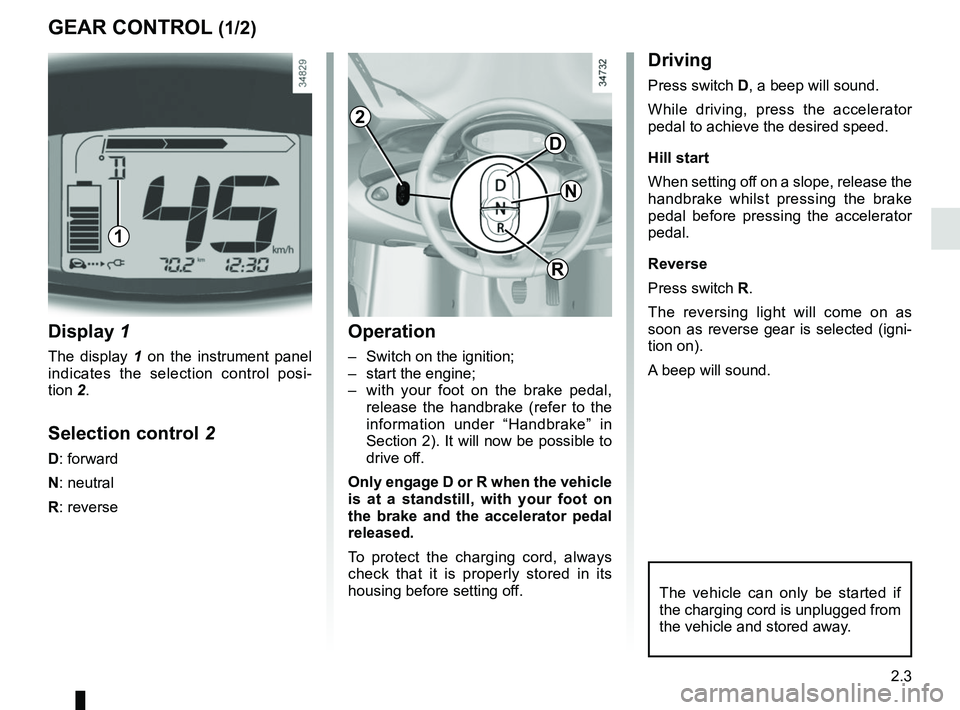
Display 1
The display 1 on the instrument panel
indicates the selection control posi-
tion 2.
Selection control 2
D: forward
N: neutral
R: reverse
Operation
– Switch on the ignition;
– start the engine;
– with your foot on the brake pedal,
release the handbrake (refer to the
information under “Handbrake” in
Section 2). It will now be possible to
drive off.
Only engage D or R when the vehicle
is at a standstill, with your foot on
the brake and the accelerator pedal
released.
To protect the charging cord, always
check that it is properly stored in its
housing before setting off.
The vehicle can only be started if
the charging cord is unplugged from
the vehicle and stored away.
1
D
N
R
2
Page 69 of 118
4.5
12 VOLT BATTERY (2/2)Connecting a charger to the
accessories socket
Only use a charger that is compatible
with a nominal voltage of 14.4 volts
and a current limited to 5 amps.
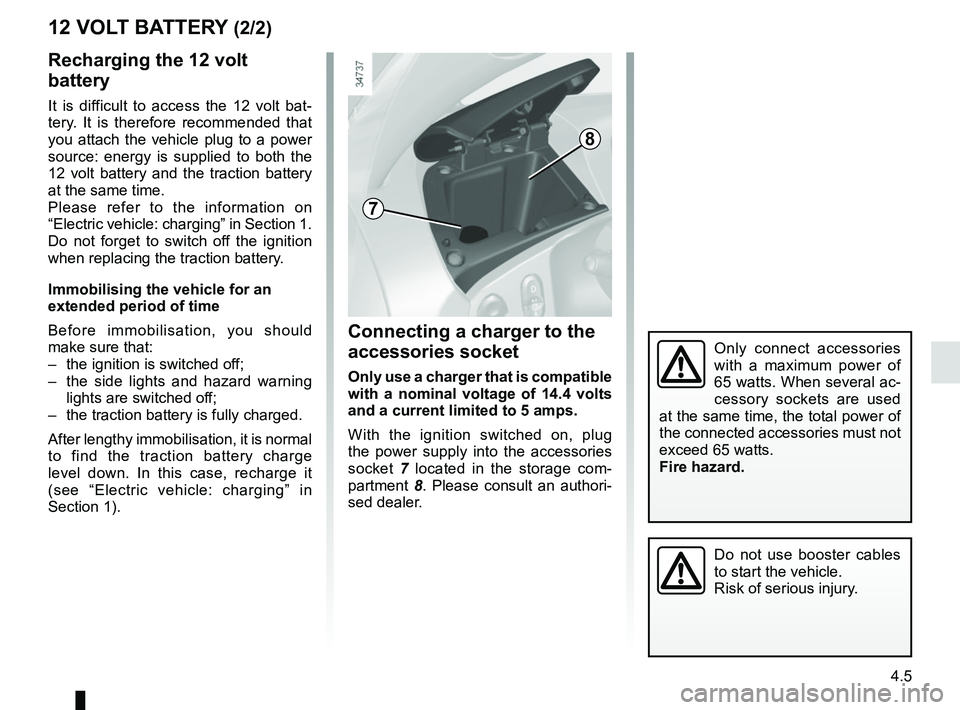
With the ignition switched on, plug
the power supply into the accessories
socket 7 located in the storage com-
partment 8. Please consult an authori-
sed dealer.
Recharging the 12 volt
battery
It is difficult to access the 12 volt bat-
tery. It is therefore recommended that
you attach the vehicle plug to a power
source: energy is supplied to both the
12 volt battery and the traction battery
at the same time.
Please refer to the information on
“Electric vehicle: charging” in Section 1.
Do not forget to switch off the ignition
when replacing the traction battery.
Immobilising the vehicle for an
extended period of time
Before immobilisation, you should
make sure that:
– the ignition is switched off;
– the side lights and hazard warning lights are switched off;
– the traction battery is fully charged.
After lengthy immobilisation, it is normal
to find the traction battery charge
level down. In this case, recharge it
(see “Electric vehicle: charging” in
Section 1).
Do not use booster cables
to start the vehicle.
Risk of serious injury.
8
7
Only connect accessories
with a maximum power of
65 watts. When several ac-
cessory sockets are used
at the same time, the total power of
the connected accessories must not
exceed 65 watts.
Fire hazard.
Page 91 of 118

The following advice will enable you to carry out quick, temporary repai\
rs. For safety reasons you should always contact
an approved dealer as soon as possible.
FAULTSPO")
5.17
OPERATING FAULTS (1/3)
The following advice will enable you to carry out quick, temporary repai\
rs. For safety reasons you should always contact
an approved dealer as soon as possible.
FAULTSPOSSIBLE CAUSES WHAT TO DO
Impossible to charge the
traction battery. No electrical current in domes-
tic sockets or poor connection of
cable to domestic socket. Check your installation (circuit breaker, programmer,
etc.).
Check the connections (power socket, etc.). Please
refer to the information on “Electric vehicle: charging”
in Section 1.
The outdoor temperature is ex-
tremely low. Recharge your vehicle in a more suitable environ-
ment. Please refer to the information on “Electric ve-
hicle: charging” in Section 1.
The cord is defective. Please see an authorised dealer to replace it.
The steering column remains
locked. Steering wheel locked.
Move the steering wheel while pressing the engine
start button (refer to Section 2 “Starting the engine”).
Vibrations. Tyres incorrectly inflated or dam-
aged. Check the tyre pressures. If this is not the problem,
have them checked by an approved Dealer.
The engine performance is
limited. The outdoor temperature is ex-
tremely high. Opt for a calmer driving style.
The traction battery reserve has
been reached. Recharge the traction battery as soon as possible.
Please refer to the information on “Electric vehicle:
charging” in Section 1.
The vehicle will not start. The charging flap is open or not
properly closed. Check that the charging flap is correctly locked. In
other cases, contact an authorised dealer as soon as
possible.
Page 113 of 118

A
accessories........................................................................\
5.12
additional methods of restraint ..............................1.20 → 1.23
to")
7.1
ALPHABETICAL INDEX (1/3)
A
accessories........................................................................\
5.12
additional methods of restraint ..............................1.20 → 1.23
to the front seat belts .......................................1.20 → 1.22
to the rear seat belts ........................................1.20 → 1.22
adjusting your driving position ........................................... 1.17
air bag....................................................................1.20 → 1.23
anti-corrosion check ..............................................6.13 → 6.18
anti-corrosion protection ...................................................... 4.6
audible and visual signals.................................................. 1.38
B
battery........................................................................\
........ 1.33
12 volt battery maintenance ......................................................... 4.4 – 4.5
12 volt battery ............................................................. 4.4 – 4.5
brake fluid ........................................................................\
.... 4.2
bulbs changing ............................................................... 5.8 – 5.9
C
changing a bulb .......................................................... 5.8 – 5.9
charge meter ....................................................................... 2.9
charging cord ...........................................................1.8 → 1.12
charging flap ........................................................................\
1.7
child booster seat ..............................1.24 – 1.25, 1.28 → 1.30
child restraint/seat .............................1.24 – 1.25, 1.27 → 1.30
child safety.........................................1.24 – 1.25, 1.27 → 1.30
child seats..........................................1.24 – 1.25, 1.27 → 1.30
children ............................................... 1.13 – 1.14, 1.24 – 1.25
cleaning: inside the vehicle .................................................. 4.8 – 4.9
clock ..................................................................\
................ 1.37
closing the doors ............................................................... 1.14
control instruments ................................................1.32 → 1.36
controls ...............................................................\
............... 1.31 D
dashboard........................................................................\
.. 1.31
de-icing windscreen .............................................................\
........ 3.2
demisting windscreen .............................................................\
........ 3.2
display ................................................................\
...1.32 → 1.36
doors........................................................................\
.......... 1.14
driver’s position .....................................................1.31 → 1.34
driving .................................................................. 2.2, 2.6 – 2.7
driving position settings ............................................................1.17 → 1.19
E
electric vehicle vehicle range ........................................................ 2.6 – 2.7
charge ................................................................1.8 → 1.12
driving ................................................................... 2.6 – 2.7
important recommendations ................................... 1.7, 1.9
electrical installation ............................................................ 1.9
energy recovery ...............................................................\
.......... 2.9
saving .................................................................\
........... 2.6
charge meter (function) .................................................. 2.9
consumption ............................................................\
...... 2.9
energy saving ............................................................. 2.6 – 2.7
energy consumption ............................... 1.35 – 1.36, 2.6 – 2.7
energy recovery ................................................................... 2.6
engine immobiliser............................................................. 1.15
engine specifications ........................................................... 6.3
environment ............................................................\
............. 2.8
F
faults operating faults ................................................5.17 → 5.19
fittings ...............................................................\
.........3.3 → 3.6