light RENAULT TWIZY 2018 Owner's Manual
[x] Cancel search | Manufacturer: RENAULT, Model Year: 2018, Model line: TWIZY, Model: RENAULT TWIZY 2018Pages: 118, PDF Size: 2.51 MB
Page 52 of 118
2.4
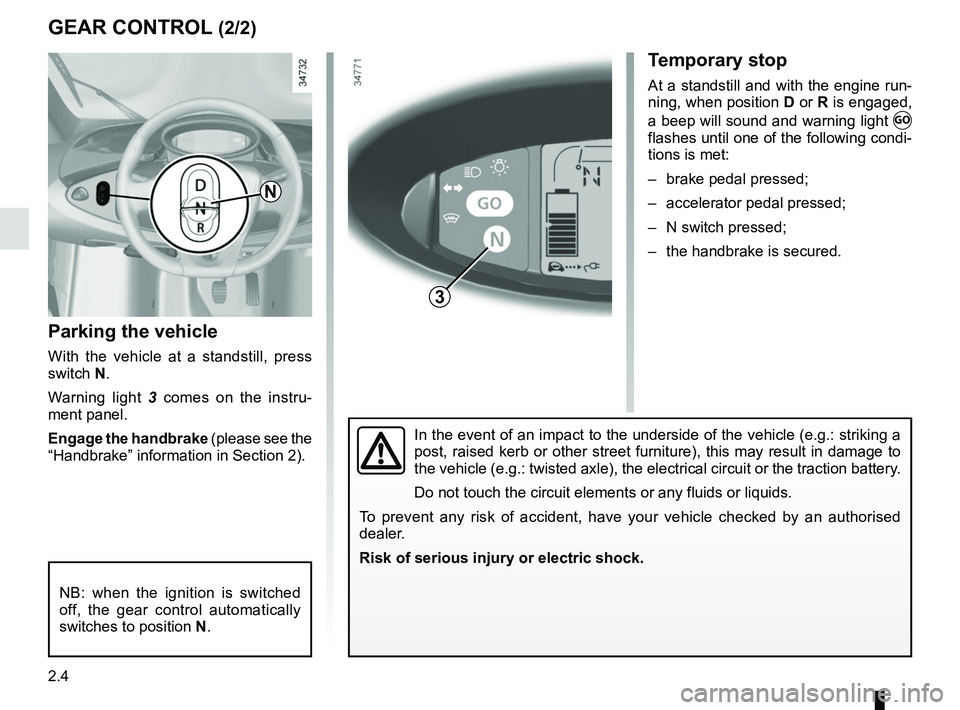
Parking the vehicle
With the vehicle at a standstill, press
switch N.
Warning light 3 comes on the instru-
ment panel.
Engage the handbrake (please see the
“Handbrake” information in Section 2).
GEAR CONTROL (2/2)
In the event of an impact to the underside of the vehicle (e.g.: striki\
ng a
post, raised kerb or other street furniture), this may result in damage\
to
the vehicle (e.g.: twisted axle), the electrical circuit or the tracti\
on battery.
Do not touch the circuit elements or any fluids or liquids.
To prevent any risk of accident, have your vehicle checked by an authoris\
ed
dealer.
Risk of serious injury or electric shock.
N
3
NB: when the ignition is switched
off, the gear control automatically
switches to position N.
Temporary stop
At a standstill and with the engine run-
ning, when position D or R is engaged,
a beep will sound and warning light
Ṑ
flashes until one of the following condi-
tions is met:
– brake pedal pressed;
– accelerator pedal pressed;
– N switch pressed;
– the handbrake is secured.
Page 53 of 118
2.5
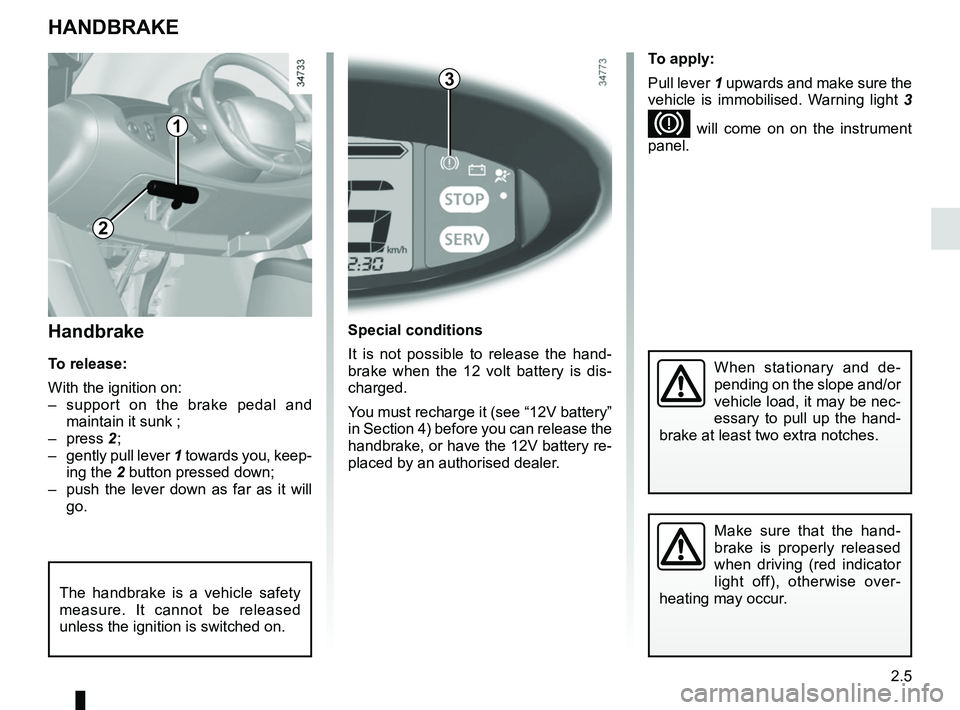
Handbrake
To release:
With the ignition on:
– support on the brake pedal and maintain it sunk ;
– press 2 ;
– gently pull lever 1 towards you, keep-
ing the 2 button pressed down;
– push the lever down as far as it will go.When stationary and de-
pending on the slope and/or
vehicle load, it may be nec-
essary to pull up the hand-
brake at least two extra notches.
Make sure that the hand-
brake is properly released
when driving (red indicator
light off), otherwise over-
heating may occur.
1
2
HANDBRAKE
To apply:
Pull lever 1 upwards and make sure the
vehicle is immobilised. Warning light 3
D will come on on the instrument
panel.
3
Special conditions
It is not possible to release the hand-
brake when the 12 volt battery is dis-
charged.
You must recharge it (see “12V battery”
in Section 4) before you can release the
handbrake, or have the 12V battery re-
placed by an authorised dealer.
The handbrake is a vehicle safety
measure. It cannot be released
unless the ignition is switched on.
Page 54 of 118
2.6
VEHICLE RANGE: recommendations (1/2)
The vehicle range is approved for an
ECE-15 cycle.
In real usage, the range of an electric
vehicle may vary depending on several
factors over which you have partial con-
trol, which may make a considerable
difference to the vehicle range. These
factors are:
– speed and driving style;
– type of road;
– electrical accessories and equip-ment;
– vehicle loading;
– tyres;
Speed and driving style
High speeds will reduce your vehicle’s
range.
A “sporty” driving style reduces your
vehicle range: opt for a “lighter” driving
style.
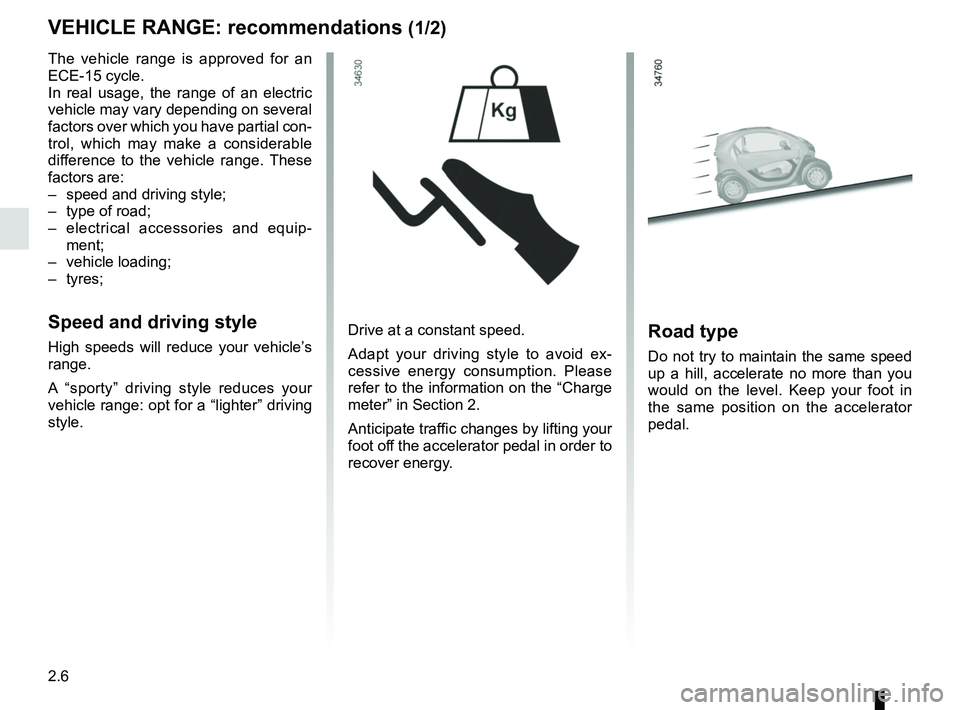
Drive at a constant speed.
Adapt your driving style to avoid ex-
cessive energy consumption. Please
refer to the information on the “Charge
meter” in Section 2.
Anticipate traffic changes by lifting your
foot off the accelerator pedal in order to
recover energy.Road type
Do not try to maintain the same speed
up a hill, accelerate no more than you
would on the level. Keep your foot in
the same position on the accelerator
pedal.
Page 60 of 118
3.2
WINDSCREEN DE-ICING, DEMISTING
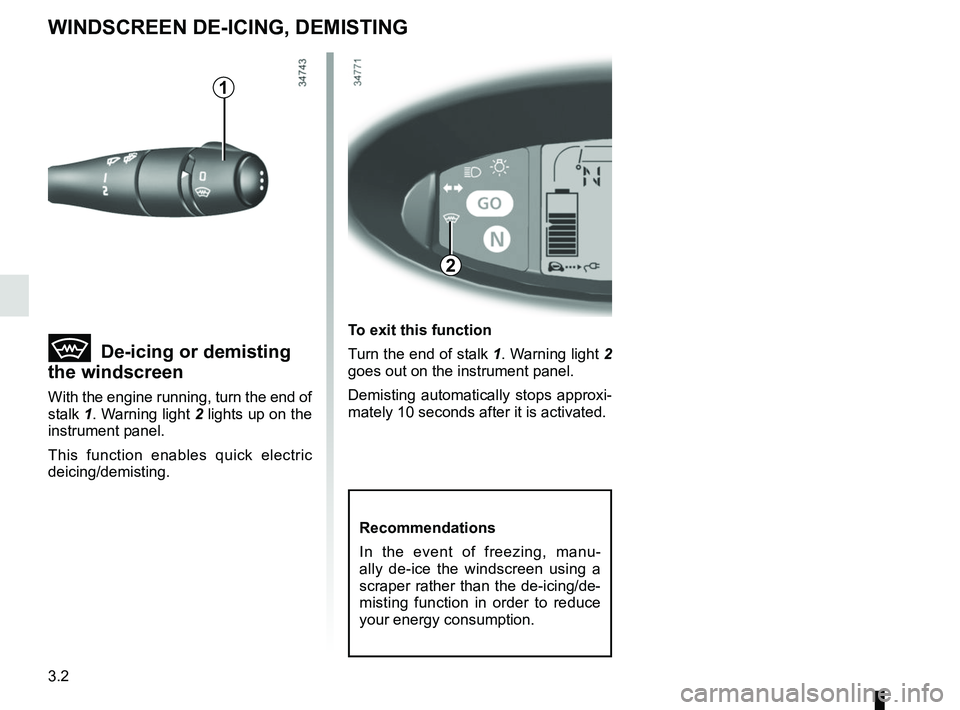
1
De-icing or demisting
the windscreen
With the engine running, turn the end of
stalk 1. Warning light 2 lights up on the
instrument panel.
This function enables quick electric
deicing/demisting.
To exit this function
Turn the end of stalk 1. Warning light 2
goes out on the instrument panel.
Demisting automatically stops approxi-
mately 10 seconds after it is activated.
2
Recommendations
In the event of freezing, manu-
ally de-ice the windscreen using a
scraper rather than the de-icing/de-
misting function in order to reduce
your energy consumption.
Page 66 of 118
4.2
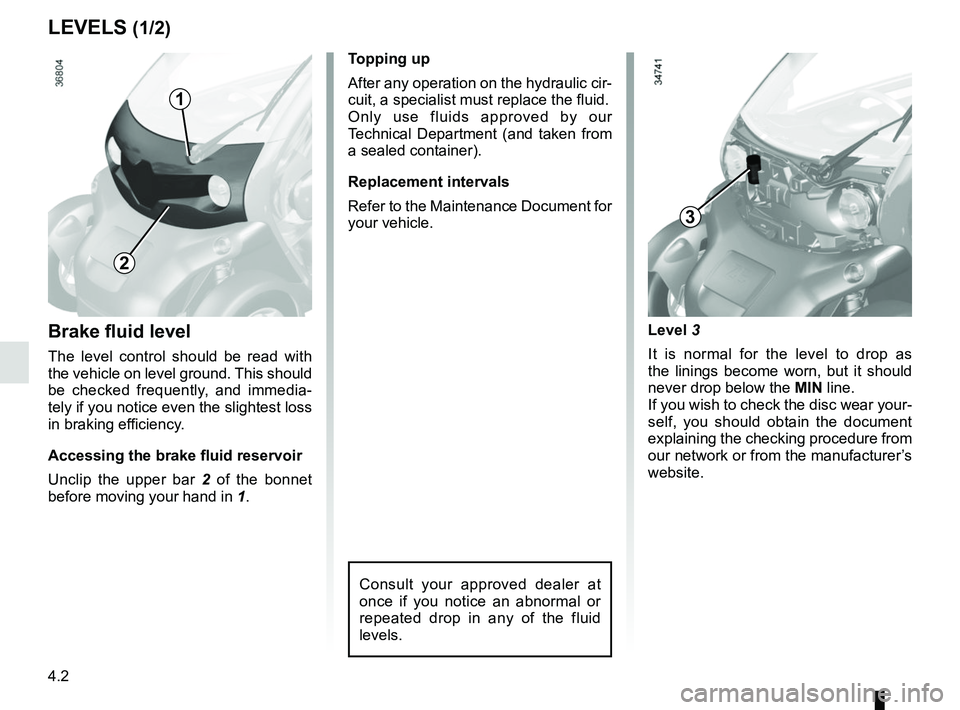
Brake fluid level
The level control should be read with
the vehicle on level ground. This should
be checked frequently, and immedia-
tely if you notice even the slightest loss
in braking efficiency.
Accessing the brake fluid reservoir
Unclip the upper bar 2 of the bonnet
before moving your hand in 1.Topping up
After any operation on the hydraulic cir-
cuit, a specialist must replace the fluid.
Only use fluids approved by our
Technical Department (and taken from
a sealed container).
Replacement intervals
Refer to the Maintenance Document for
your vehicle.
Consult your approved dealer at
once if you notice an abnormal or
repeated drop in any of the fluid
levels.
LEVELS (1/2)
Level 3
It is normal for the level to drop as
the linings become worn, but it should
never drop below the
MIN line.
If you wish to check the disc wear your-
self, you should obtain the document
explaining the checking procedure from
our network or from the manufacturer’s
website.
1
2
3
Page 68 of 118
4.4
12V BATTERY (1/2)
The secondary battery is a 12 V battery:
this supplies the energy required to op-
erate vehicle equipment (lights, wind-
screen wipers, audio system, etc) and
certain safety systems, such as ABS.
For your safety and the
proper operation of the
vehicle’s electrical equip-
ment (lights, windscreen
wipers, etc.), any work on the se-
condary 12V battery (removal, dis-
connection, etc.) must be carried
out by a specialist.
Risk of serious burns or electric
shocks.
Respect categorically the replace-
ment intervals (without exceeding
them) as stated in the maintenance
document.
The battery is a specific type.
Please ensure it is replaced with the
same type.
Contact an Authorised Dealer.
A123
456
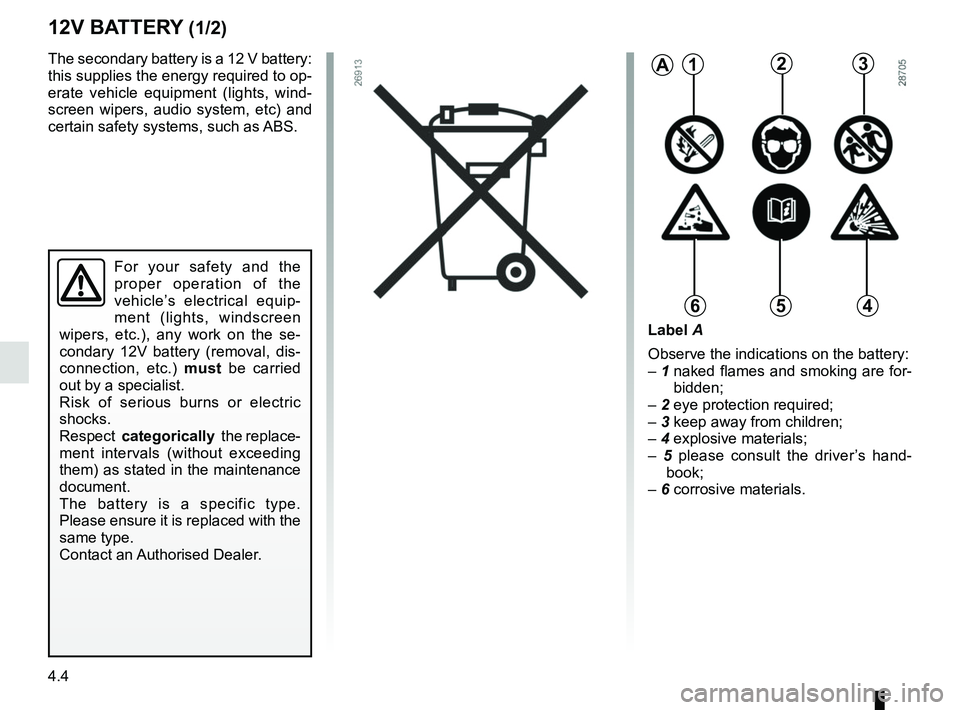
Label A
Observe the indications on the battery:
– 1 naked flames and smoking are for-
bidden;
– 2 eye protection required;
– 3 keep away from children;
– 4 explosive materials;
– 5 please consult the driver’s hand-
book;
– 6 corrosive materials.
Page 69 of 118
4.5
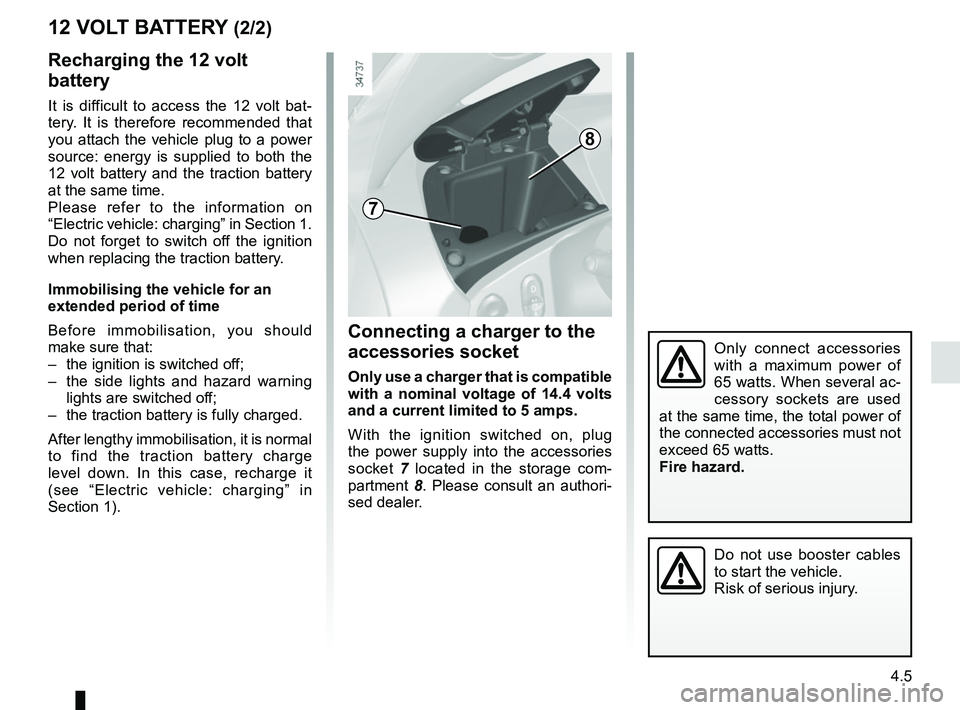
12 VOLT BATTERY (2/2)Connecting a charger to the
accessories socket
Only use a charger that is compatible
with a nominal voltage of 14.4 volts
and a current limited to 5 amps.
With the ignition switched on, plug
the power supply into the accessories
socket 7 located in the storage com-
partment 8. Please consult an authori-
sed dealer.
Recharging the 12 volt
battery
It is difficult to access the 12 volt bat-
tery. It is therefore recommended that
you attach the vehicle plug to a power
source: energy is supplied to both the
12 volt battery and the traction battery
at the same time.
Please refer to the information on
“Electric vehicle: charging” in Section 1.
Do not forget to switch off the ignition
when replacing the traction battery.
Immobilising the vehicle for an
extended period of time
Before immobilisation, you should
make sure that:
– the ignition is switched off;
– the side lights and hazard warning lights are switched off;
– the traction battery is fully charged.
After lengthy immobilisation, it is normal
to find the traction battery charge
level down. In this case, recharge it
(see “Electric vehicle: charging” in
Section 1).
Do not use booster cables
to start the vehicle.
Risk of serious injury.
8
7
Only connect accessories
with a maximum power of
65 watts. When several ac-
cessory sockets are used
at the same time, the total power of
the connected accessories must not
exceed 65 watts.
Fire hazard.
Page 71 of 118
4.7
BODYWORK MAINTENANCE (2/2)
Cleaning the roof
Use a soft cloth or cotton wool.
Soak it lightly with a protective agent
recommended by our Technical
Department.
Spread the protective agent carefully
in circular movements using a soft or a
cotton cloth.
What you should not do
Wash the vehicle in bright sunlight or
freezing temperatures.
Do not scrape off mud or dirt without
pre-wetting.
Allow dirt to accumulate on the exterior.
Allow rust to form following minor im-
pacts.
Do not use solvents not approved by
our Technical Department to remove
stains as this could damage the paint-
work.
Do not drive in snow or muddy condi-
tions without washing the vehicle, par-
ticularly under the wheel arches and
body.Degrease or clean using
high-pressure cleaning
equipment or by spray-
ing on products not ap-
proved by our Technical
Department:
– mechanical components (e.g.:
engine compartment);
– underbody;
– parts with hinges (e.g.: inside the
doors);
– painted plastic external fittings (e.g.:
bumpers).
Doing this could give rise to corrosion
or operational faults.
Page 72 of 118
4.8
Instrument panel glass and
door deflector
(e.g.: instrument panel, clock, etc.)
Use a soft cloth (or cotton wool).
If this does not clean them properly,
use a soft cloth (or cotton wool) slightly
moistened with soapy water and then
wipe clean with another soft damp cloth
or cotton wool.
Finally, carefully dry off with a soft dry
cloth.
Do not use products containing alco-
hol and/or spray fluids on the area.
INTERIOR TRIM MAINTENANCE (1/2)
Seat belts
These must be kept clean.
Use products selected by our Technical
Department (Approved outlets) or
warm, soapy water and a sponge and
wipe with a dry cloth.
Detergents or dyes must not be used
under any circumstances.
A well-maintained vehicle will last
longer. It is therefore recommended to
maintain the interior of the vehicle regu-
larly.
A stain should always be dealt with
swiftly.
Whatever type of stain is on the trim,
use
cold (or warm) soapy water with
natural soap.
Detergents (washing-up liquid, pow-
dered products, alcohol-based prod-
ucts) should not be used.
Use a soft cloth.
Rinse and wipe up excess water.
For further recommendations for
maintaining the interior, and/or for
any unsatisfactory results, please
see an authorised dealer.
Page 75 of 118
 . . . . . . . . . . . . . . . . . . . . . . . . . . . . . . . . . . . .\
. . . . . . . 5.2
Headlights (changing bulbs)")
5.1
Section 5: Practical advice
Tyres (tyre and wheel safety, use in winter) . . . . . . . . . . . . . . . . . . . . . . . . . . . . . . . . . . . .\
. . . . . . . 5.2
Headlights (changing bulbs) . . . . . . . . . . . . . . . . . . . . . . . . . . . . . . . . . . . .\
. . . . . . . . . . . . . . . . . . . 5.6
Rear lights (changing bulbs) . . . . . . . . . . . . . . . . . . . . . . . . . . . . . . . . . . . .\
. . . . . . . . . . . . . . . . . . . 5.8
Fuses . . . . . . . . . . . . . . . . . . . . . . . . . . . . . . . . . . . . \
. . . . . . . . . . . . . . . . . . . . . . . . . . . . . . . . . . . . . 5.10
Accessories . . . . . . . . . . . . . . . . . . . . . . . . . . . . . . . . . . . . \
. . . . . . . . . . . . . . . . . . . . . . . . . . . . . . . . 5.12
Wipers (replacing blades) . . . . . . . . . . . . . . . . . . . . . . . . . . . . . . . . . . . .\
. . . . . . . . . . . . . . . . . . . . . 5.13
Towing/breakdown . . . . . . . . . . . . . . . . . . . . . . . . . . . . . . . . . . . . \
. . . . . . . . . . . . . . . . . . . . . . . . . . . 5.14
Operating faults . . . . . . . . . . . . . . . . . . . . . . . . . . . . . . . . . . . . \
. . . . . . . . . . . . . . . . . . . . . . . . . . . . . 5.17