fuel RENAULT WIND 2012 1.G User Guide
[x] Cancel search | Manufacturer: RENAULT, Model Year: 2012, Model line: WIND, Model: RENAULT WIND 2012 1.GPages: 185, PDF Size: 5.52 MB
Page 65 of 185
2.1
ENG_UD29994_7
Sommaire 2 (E33 - X33 - Renault)
ENG_NU_865-6_E33_Renault_2
Section 2: Driving
(Advice on use relating to fuel economy and the environment)
Running in . . . . . . . . . . . . . . . . . . . . . . . . . . . . . . . . . . . . . . . . . . . . . . . . . . . . . . . . . . . . . . . . . . . . . 2.2
Ignition switch . . . . . . . . . . . . . . . . . . . . . . . . . . . . . . . . . . . . . . . . . . . . . . . . . . . . . . . . . . . . . . . . . . 2.2
Starting, stopping the engine . . . . . . . . . . . . . . . . . . . . . . . . . . . . . . . . . . . . . . . . . . . . . . . . . . . . . . . 2.3
Special features of petrol versions . . . . . . . . . . . . . . . . . . . . . . . . . . . . . . . . . . . . . . . . . . . . . . . . . . 2.4
Gear lever . . . . . . . . . . . . . . . . . . . . . . . . . . . . . . . . . . . . . . . . . . . . . . . . . . . . . . . . . . . . . . . . . . . . . 2.5
Handbrake . . . . . . . . . . . . . . . . . . . . . . . . . . . . . . . . . . . . . . . . . . . . . . . . . . . . . . . . . . . . . . . . . . . . . 2.5
Advice on emission control and fuel economy . . . . . . . . . . . . . . . . . . . . . . . . . . . . . . . . . . . . . . . . . 2.6
Environment . . . . . . . . . . . . . . . . . . . . . . . . . . . . . . . . . . . . . . . . . . . . . . . . . . . . . . . . . . . . . . . . . . . 2.9
Driver correction devices and aids . . . . . . . . . . . . . . . . . . . . . . . . . . . . . . . . . . . . . . . . . . . . . . . . . . 2.10
Speed limiter . . . . . . . . . . . . . . . . . . . . . . . . . . . . . . . . . . . . . . . . . . . . . . . . . . . . . . . . . . . . . . . . . . . 2.13
Cruise control . . . . . . . . . . . . . . . . . . . . . . . . . . . . . . . . . . . . . . . . . . . . . . . . . . . . . . . . . . . . . . . . . . 2.16
Page 68 of 185
special features of petrol vehicles ........ (up to the end of the DU)
catalytic converter ................................. (up to the end of the DU)
driving ................................................... (up to the end of the DU)
catalytic converter ................................. (up to the end of the DU)
2.4
ENG_UD10553_1
Particularités des versions essence (X85 - B85 - C85 - S85 - K85 - R\
enault)
ENG_NU_865-6_E33_Renault_2
Special features of petrol versions
SPEcIAL FEA tURES oF PEtRoL VERSIoNS
The following operating conditions:
– driving for long periods when the low
fuel level warning light is lit;
– using leaded petrol;
– using fuel or lubrication additives
which are not approved.
Or operating faults such as:
– faulty ignition system, running out of
fuel or disconnected spark plugs re-
sulting in the engine misfiring or cut-
ting out when driving;
– loss of power,
as they may cause the catalytic con -
verter to overheat and thus reduce its
efficiency, or damage it irreparably
and cause heat damage to the vehi-
cle. If you notice any of the above operating
faults, have the necessary repairs car-
ried out as soon as possible by an ap-
proved Dealer.
These faults may be avoided by regu
-
larly taking your vehicle to an approved
Dealer at the intervals specified in the
Maintenance Service Booklet.
Starting problems
To avoid damaging the catalytic con -
verter, do not keep trying to start the
engine (using the start button, or by
pushing or towing the vehicle) without
having identified and corrected the
starting fault.
If the fault cannot be identified, do not
keep trying to start the engine, but con-
tact an approved Dealer.
Do not park the vehicle or
run the engine in locations
where combustible sub -
stances or materials such
as grass or leaves can come into
contact with the hot exhaust system.
Page 70 of 185
fueladvice on fuel economy .................. (up to the end of the DU)
practical advice ..................................... (up to the end of the DU)
fuel economy ........................................ (up to the end of the DU)
filter air filter ............................................................. (current page)
filter diesel filter ........................................................ (current page)
driving ................................................... (up to the end of the DU)
maintenance .......................................................... (current page)
antipollution advice ............................................. (up to the end of the DU)
2.6
ENG_UD20551_2
CONSEILS : antipollution, économies de carburant, conduite (E33 - X3\
3 - Renault)
ENG_NU_865-6_E33_Renault_2
Jaune NoirNoir texte
Advice on antipollution and fuel economy
ADVIcE: antipollution, fuel economy and driving (1/3)
By virtue of its design, moderate fuel
consumption and initial settings, your
vehicle conforms to current antipol-
lution regulations. The manufacturer
is actively striving to reduce pollutant
exhaust gas emissions and to save
energy. But the fuel consumption of
your vehicle and the level of pollutant
exhaust gas emissions are also your
responsibility. Ensure that it is main -
tained and used correctly.Maintenance
It is important to remember that failure to
respect antipollution regulations could
lead to legal action being taken against
the vehicle owner. In addition, replacing
engine, fuel supply system and exhaust
components with parts other than those
originally recommended by the manu -
facturer may alter your vehicle so that
it no longer complies with antipollution
regulations.
Have your vehicle adjusted and
checked by an approved Dealer, in ac-
cordance with the instructions given in
your maintenance schedule: they will
have all the equipment necessary for
ensuring that your vehicle is maintained
to its original standard.
Engine adjustments
– ignition: this does not require ad -
justment.
– spark plugs: for optimum fuel econ-
omy, efficiency and performance
the specifications laid down by our
Design Department must be strictly
applied.
If the spark plugs have to be
changed, use the make, type and
gap specified for your vehicle’s
engine. Contact an approved dealer
for this.
– idle: this does not require adjust -
ment.
– air filter: a choked element will
reduce efficiency. It must be re -
placed.
Page 71 of 185

ENG_NU_865-6_E33_Renault_2
ADVIcE: antipollution, fuel economy and driving (2")
JauneNoirNoir texte
2.7
ENG_UD20551_2
CONSEILS : antipollution, économies de carburant, conduite (E33 - X3\
3 - Renault)
ENG_NU_865-6_E33_Renault_2
ADVIcE: antipollution, fuel economy and driving (2/3)
Driving
– Drive carefully for the first few miles
until the engine reaches its normal
operating temperature, rather than
let it warm up while the vehicle is sta-
tionary.
– Speed is expensive.
– Sporty driving uses a lot of fuel: drive
with a light right foot.
– Do not overrev the engine in the in-
termediate gears.
Always use the highest gear possi -
ble without labouring the engine.
Exhaust gas monitoring
system
The exhaust gas monitoring system will
detect any operating faults in the vehi-
cle’s antipollution system.
If this system malfunctions, toxic sub -
stances may be released into the at -
mosphere or damage may occur.
ÄThis warning light on the in -
strument panel will indicate if
there are any faults in the system:
This lights up when the ignition is
switched on and goes out when the
engine is started.
– If it lights up continuously, consult
your approved dealer as soon as
possible;
– if it flashes, reduce the engine speed
until the light stops flashing. Contact
your approved dealer as soon as
possible. –
Avoid sudden acceleration.
– Brake as little as possible. If you an-
ticipate an obstacle or bend in ad -
vance, you may then simply release
the accelerator pedal.
– Do not try to maintain the same
speed up a hill, accelerate no more
than you would on the level. Keep
your foot in the same position on the
accelerator pedal.
– Double declutching and accelerating
before switching off are unnecessary
in modern vehicles.
– Bad weather, flooded roads:
Do not drive through floods
if the depth of water is
above the lower edge of the
wheel rims.
obstructions to the driver
On the driver ’s side, only
use mats adapted to the ve-
hicle that attach to the pre-
installed parts, and regularly check
their mounting. Do not place several
mats on top of each other.
Risk of pedals jamming
Page 72 of 185

2.8
ENG_UD20551_2
CONSEILS : antipollution, économies de carburant, conduite (E33 - X3\
3 - Renault)
ENG_N")
tyres ....................................................................... (current page)
2.8
ENG_UD20551_2
CONSEILS : antipollution, économies de carburant, conduite (E33 - X3\
3 - Renault)
ENG_NU_865-6_E33_Renault_2
ADVIcE: antipollution, fuel economy and driving (3/3)
Advice on use
– Electricity is fuel; switch off all the
electrical components which are
not really needed. however (safety
first), keep your lights on when the
visibility is bad (“see and be seen”).
– Use the air vents. Driving with the
windows open at 60 mph (100 km/h)
will increase fuel con -sumption by
4%.
– For vehicles fitted with air condi -
tioning , it is normal to observe an
increase in fuel consumption (es -
pecially in city conditions) when
it is used. For vehicles fitted with
manual air conditioning, switch off
the system when it is not required.
Advice for reducing consumption
and therefore helping to preserve
the environment:
Drive with the air vents open and the
windows closed.
If the vehicle has been parked in the
sun, open the doors for a few mo -
ments to let the hot air escape before
starting the engine.
– Never fill the fuel tank right to the
brim to avoid overflow.
– Avoid using the vehicle for door -
to-door calls (short journeys with
long waits in between) because the
engine never reaches its normal op-
erating temperature.
t yres
– An under-inflated tyre increases fuel
consumption.
– The use of non-recommended tyres
can increase fuel consumption.
Page 73 of 185

2.9
ENG_UD25716_1
Environnement (sans marque) (X44 - X45 - X77 - X81 - X85 - X90 - X91 \
- X83 - X61 - TEST - X95 - J95")
environment .......................................... (up to the end of the DU)
2.9
ENG_UD25716_1
Environnement (sans marque) (X44 - X45 - X77 - X81 - X85 - X90 - X91 \
- X83 - X61 - TEST - X95 - J95 - R95 - F90 Ph2 - X33 - X47 - X43 - X38 - H79 - X62 - X32 -\
X09 -
ENG_NU_865-6_E33_Renault_2
Environment
ENVIRoNMENt
Emissions
Your vehicle has been designed to
emit fewer greenhouse gases (CO2)
while in use, and therefore to consume
less fuel (eg. 140 g/km, equivalent to
5.3 l/100 km for a diesel vehicle).
Our vehicles are also equipped with a
particle filter system including a cata -
lytic converter, an oxygen sensor and
an active carbon filter (the latter pre -
vents vapour from the fuel tank being
released into the open air).
For certain diesel vehicles, this system
also has a particle filter to reduce the
volume of soot particles emitted.
Please make your own
contribution towards
protecting the environment
too
– Worn parts replaced in the course of
routine vehicle maintenance (vehi -
cle battery, oil filter, air filter, batter -
ies, etc.) and oil containers (empty or
filled with used oil) must be disposed
of through specialist organisations. –
At the end of the vehicle’s service
life, it should be sent to approved
centres to ensure that it is recycled.
– In all cases, comply with local legis -
lation.
Recycling
Your vehicle is 85% recyclable and
95% recoverable.
To achieve these objectives, many of
the vehicle components have been de-
signed to enable them to be recycled.
The materials and structures have
been carefully designed to allow these
components to be easily removed and
reprocessed by specialist companies.
In order to preserve raw material re -
sources, this vehicle incorporates nu -
merous parts made from recycled plas-
tics or renewable materials (vegetable
or animal-derived materials such as
cotton or wool).
Your vehicle has been designed with
respect for the
environment in mind for
its entire service life: during production,
use and at the end of its life.
This commitment is illustrated by the of
the manufacturer eco² signature.Manufacture
Your vehicle has been manufactured at
a factory which complies with a policy
to reduce the environmental impact
on the surrounding areas (reduction of
water and energy consumption, visual
and noise pollution, atmospheric emis-
sions and waste water; sorting and re-
using waste).
Page 97 of 185
JauneNoirNoir texte
3.13
ENG_UD11200_1
Air conditionné automatique (E33 - X33 - Renault)
ENG_NU_865-6_E33_Renault_3
autoMatiC CliMate ContRol (2/6)
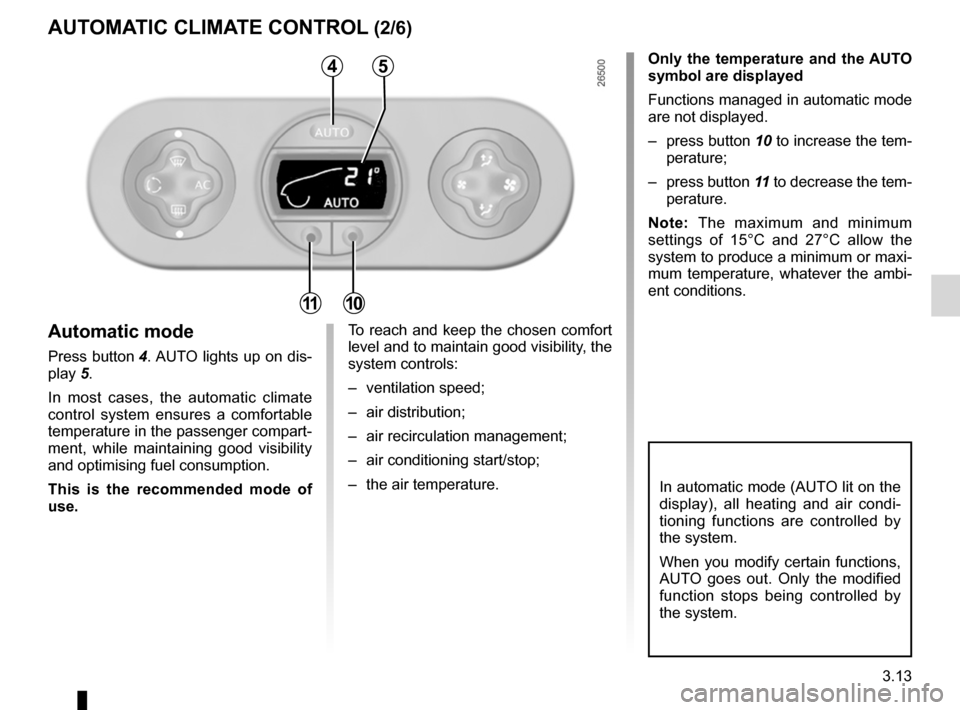
only the temperature and the auto
symbol are displayed
Functions managed in automatic mode
are not displayed.
– press button 10 to increase the tem-
perature;
– press button 11 to decrease the tem-
perature.
n ote: The maximum and minimum
settings of 15°C and 27°C allow the
system to produce a minimum or maxi-
mum temperature, whatever the ambi-
ent conditions.
In automatic mode (AUTO lit on the
display), all heating and air condi -
tioning functions are controlled by
the system.
When you modify certain functions,
AUTO goes out. Only the modified
function stops being controlled by
the system.
To reach and keep the chosen comfort
level and to maintain good visibility, the
system controls:
– ventilation speed;
– air distribution;
– air recirculation management;
– air conditioning start/stop;
– the air temperature.automatic mode
Press button 4. AUTO lights up on dis-
play 5.
In most cases, the automatic climate
control system ensures a comfortable
temperature in the passenger compart-
ment, while maintaining good visibility
and optimising fuel consumption.
this is the recommended mode of
use.
45
1011
Page 98 of 185
3.14
ENG_UD11200_1
Air conditionné automatique (E33 - X33 - Renault)
ENG_NU_865-6_E33_Renault_3
Jaune NoirNoir texte
autoMatiC CliMate ContRol (3/6)
adjusting automatic mode
The system normally operates in auto-
matic mode but you can alter the stand-
ard settings used by the system (air
distribution, etc.). These options are
explained on the following pages.
automatic mode is the recom -
mended mode of use
In most cases, the automatic cli -
mate control system ensures a com-
fortable temperature in the passen -
ger compartment, while maintaining
good visibility and optimising fuel
consumption.
The types of adjustments that can
be made are described in the follow -
ing pages.
Return to automatic mode as soon
as possible.
The displayed temperature values
show a comfort level.
When starting the engine, increas -
ing or decreasing the value dis -
played will not allow the com -
fort level to be reached any more
quickly. The system will always op-
timise the temperature increase or
decrease (the ventilation system
does not start instantly at maximum
speed: it gradually increases). This
may take several minutes.
Generally speaking, unless there is
a particular reason not to, the dash-
board air vents should remain open.
Page 102 of 185
air conditioning ..................................... (up to the end of the DU)
heating system ..................................... (up to the end of the DU)
air conditioning ..................................... (up to the end of the DU)
temperature regulation ......................... (up to the end of the DU)
ventilation ............................................. (up to the end of the DU)
heating and air conditioning system ...................... (current page)
3.18
ENG_UD11524_2
Air conditionné : informations et conseils d’utilisation (X77 ph2\
- Renault)
ENG_NU_865-6_E33_Renault_3
aiR ConDitioning: information and advice on use
Fuel consumption
You will normally notice an increase
in fuel consumption (especially
when driving in town) when the air
conditioning is operating. For vehi -
cles fitted with manual air condition -
ing, switch off the system when it is
not required.
advice for reducing consumption
and therefore helping to preserve
the environment:
Drive with the air vents open and
the windows closed.
If the vehicle has been parked in
the sun, open the doors for a few
moments to let the hot air escape
before starting the engine.
Maintenance
Refer to the Maintenance Document
for your vehicle for the inspection
frequency.
Do not open the refriger -
ant fluid circuit. The fluid
may damage eyes or skin.
note
Presence of water under the ve -
hicle. After prolonged use of the air
conditioning system, it is normal for
water to be present under the vehi-
cle. This is caused by condensation.
operating faults
As a general rule, contact your ap-
proved Dealer in the event of an op-
erating fault.
– Reduction in de-icing, demist -
ing or air conditioning per -
formance . This may be caused
by the passenger compartment
filter cartridge becoming clogged.
– no cold air is being produced.
Check that the controls are set
correctly and that the fuses are
sound. Otherwise, switch off the
system.
Do not add anything to the
vehicle’s ventilation circuit
(for example, to remove
bad odours).
t here is a risk of damage or of
fire.
Page 120 of 185
tyre pressure......................................... (up to the end of the DU)
tyre pressures ....................................... (up to the end of the DU)
tyres ...................................................... (up to the end of the DU)
4.10
ENG_UD29998_2
Pression de gonflage des pneumatiques (E33 - X33 - Renault)
ENG_NU_865-6_E33_Renault_4
Tyre pressure
tyRe pReSSURe
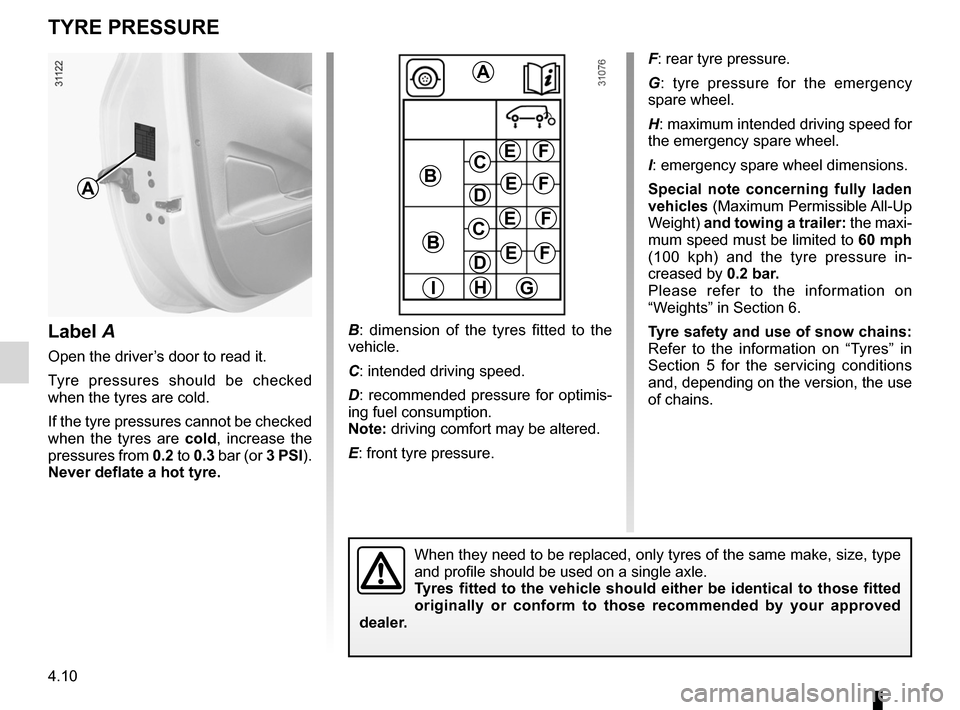
label A
Open the driver’s door to read it.
Tyre pressures should be checked
when the tyres are cold.
If the tyre pressures cannot be checked
when the tyres are cold, increase the
pressures from 0.2 to 0.3 bar (or 3 pSi).
never deflate a hot tyre. B
: dimension of the tyres fitted to the
vehicle.
C: intended driving speed.
D: recommended pressure for optimis-
ing fuel consumption.
note: driving comfort may be altered.
E: front tyre pressure.
A
A
B
B
i
e
e
e
eF
F
F
F
g
D
D
C
C
H
F: rear tyre pressure.
G : tyre pressure for the emergency
spare wheel.
H: maximum intended driving speed for
the emergency spare wheel.
I: emergency spare wheel dimensions.
Special note concerning fully laden
vehicles (Maximum Permissible All-Up
Weight) and towing a trailer: the maxi-
mum speed must be limited to 60 mph
(100 kph) and the tyre pressure in -
creased by 0.2 bar.
Please refer to the information on
“Weights” in Section 6.
t yre safety and use of snow chains:
Refer to the information on “Tyres” in
Section 5 for the servicing conditions
and, depending on the version, the use
of chains.
When they need to be replaced, only tyres of the same make, size, type
and profile should be used on a single axle.
t yres fitted to the vehicle should either be identical to those fitted
originally or conform to those recommended by your approved
dealer.