ECU RENAULT WIND ROADSTER 2012 User Guide
[x] Cancel search | Manufacturer: RENAULT, Model Year: 2012, Model line: WIND ROADSTER, Model: RENAULT WIND ROADSTER 2012Pages: 185, PDF Size: 5.52 MB
Page 32 of 185
1.26
ENG_UD20474_3
Sécurité enfants : installation du siège enfant (E33 - X33 - Renault)
ENG_NU_865-6_E33_Renault_1
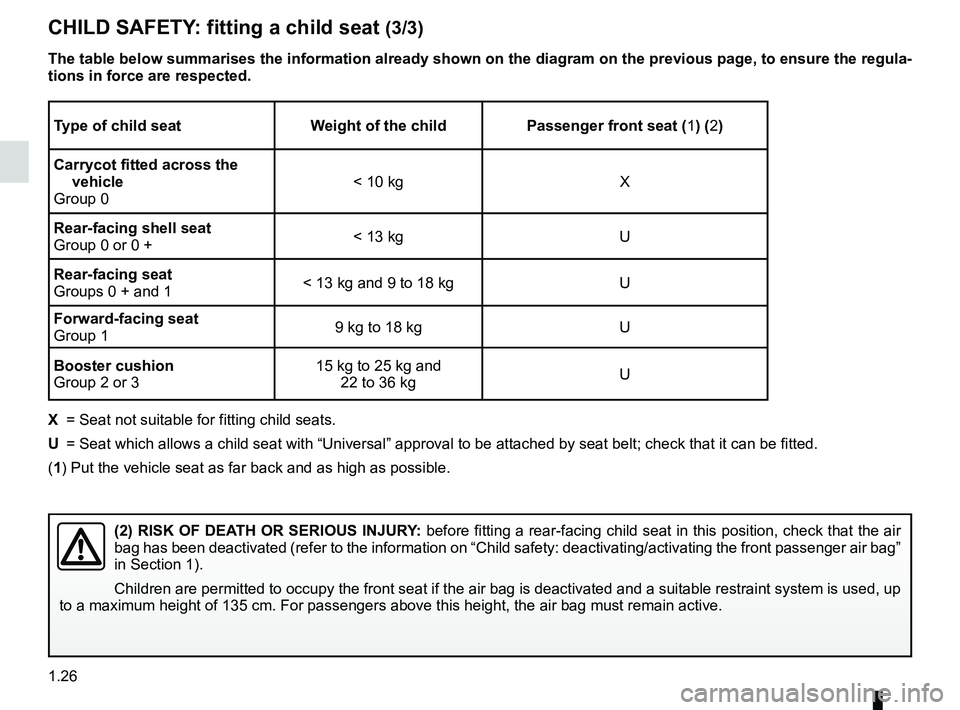
CHILD SAFETY : fitting a child seat (3/3)
Type of child seat Weight of the childpassenger front seat (1) (2)
Carrycot fitted across the vehicle
Group 0 < 10 kg
X
Rear-facing shell seat
Group 0 or 0 + < 13 kg
U
Rear-facing seat
Groups 0 + and 1 < 13 kg and 9 to 18 kg
U
Forward-facing seat
Group 1 9 kg to 18 kg
U
Booster cushion
Group 2 or 3 15 kg to 25 kg and
22 to 36 kg U
X = Seat not suitable for fitting child seats.
U = Seat which allows a child seat with “Universal” approval to be attached by seat belt; check that it can be fitted.
(1) Put the vehicle seat as far back and as high as possible.
(2) RISK OF DEATH OR SERIOUS INJURY: before fitting a rear-facing child seat in this position, check that the air
bag has been deactivated (refer to the information on “Child safety: deactivating/activating the front passenger air bag”
in Section 1).
Children are permitted to occupy the front seat if the air bag is deactivated and a suitable restraint system is used, up
to a maximum height of 135 cm. For passengers above this height, the air bag must remain active.
The table below summarises the information already shown on the diagram on the previous page, to ensure the regula-
tions in force are respected.
Page 33 of 185
1.27
ENG_UD21752_3
Sécurité enfants : désactivation/activation airbag passager avant (E33 - X33 - Renault)
ENG_NU_865-6_E33_Renault_1
deactivating/activating the front passenger air bag
The passenger air bag must
be activated or deactivated
with the ignition off .
If it is interfered with when
the vehicle is being driven, indicator
lights
å and © will come
on.
Switch the ignition off then on again
to reset the air bag in accordance
with the lock.
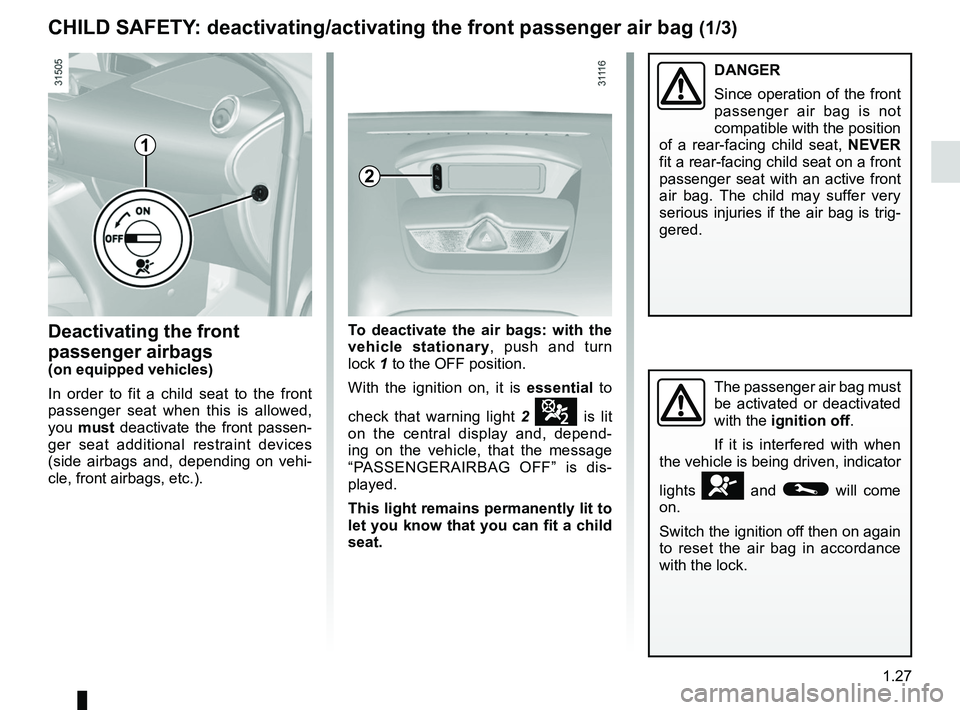
CHILD SAFETY : deactivating/activating the front passenger air bag (1/3)
Deactivating the front
passenger airbags
(on equipped vehicles)
In order to fit a child seat to the front
passenger seat when this is allowed,
you must deactivate the front passen-
ger seat additional restraint devices
(side airbags and, depending on vehi -
cle, front airbags, etc.).
2
To deactivate the air bags: with the
vehicle stationary , push and turn
lock 1 to the OFF position.
With the ignition on, it is essential to
check that warning light 2
¹ is lit
on the central display and, depend -
ing on the vehicle, that the message
“ PASSENGERAIRBAG OFF ” is dis-
played.
This light remains permanently lit to
let you know that you can fit a child
seat.
1
DANGER
Since operation of the front
passenger air bag is not
compatible with the position
of a rear-facing child seat, NEVER
fit a rear-facing child seat on a front
passenger seat with an active front
air bag. The child may suffer very
serious injuries if the air bag is trig-
gered.
Page 34 of 185
1.28
ENG_UD21752_3
Sécurité enfants : désactivation/activation airbag passager avant (E33 - X33 - Renault)
ENG_NU_865-6_E33_Renault_1
Jaune NoirNoir texte
CHILD SAFETY : deactivating/activating the front passenger air bag (2/3)
DANGER
Since operation of the front
passenger air bag is not
compatible with the position
of a rear-facing child seat, NEVER
fit a rear-facing child seat on a front
passenger seat with an active front
air bag. The child may suffer very
serious injuries if the air bag is trig-
gered.
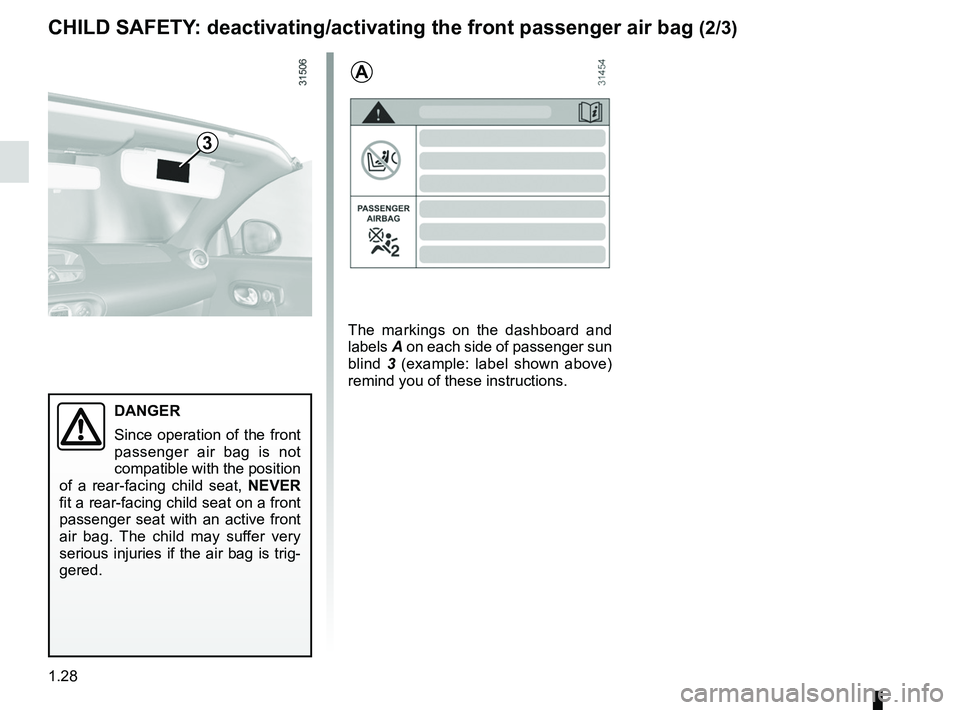
The markings on the dashboard and
labels A on each side of passenger sun
blind 3 (example: label shown above)
remind you of these instructions.
A
3
Page 35 of 185
JauneNoirNoir texte
1.29
ENG_UD21752_3
Sécurité enfants : désactivation/activation airbag passager avant (E33 - X33 - Renault)
ENG_NU_865-6_E33_Renault_1
CHILD SAFETY : deactivating/activating the front passenger air bag (3/3)
The passenger air bag must
be activated or deactivated
with the ignition off.
If it is interfered with when
the vehicle is being driven, indicator
lights
å and © will come
on.
Switch the ignition off then on again
to reset the air bag in accordance
with the lock.
Operating faults
It is forbidden to fit a rear-facing child
seat to the front passenger seat if the
air bag activation/deactivation system
is faulty.
Allowing any other passenger to sit in
that seat is not recommended.
Contact your approved dealer as soon
as possible.
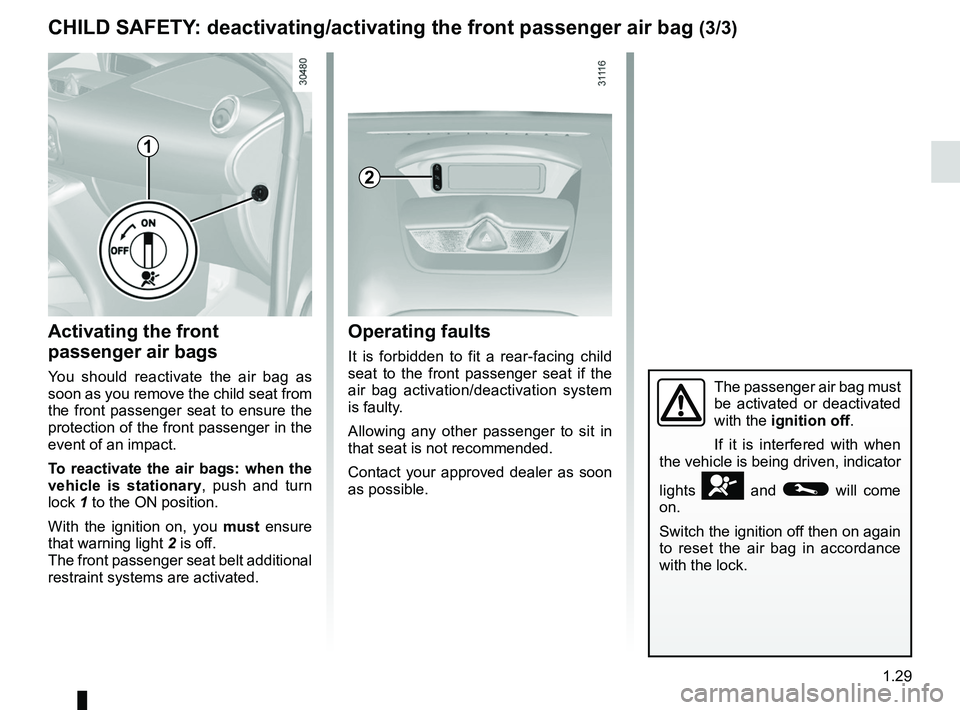
Activating the front
passenger air bags
You should reactivate the air bag as
soon as you remove the child seat from
the front passenger seat to ensure the
protection of the front passenger in the
event of an impact.
To reactivate the air bags: when the
vehicle is stationary , push and turn
lock 1 to the ON position.
With the ignition on, you must ensure
that warning light 2 is off.
The front passenger seat belt additional
restraint systems are activated.
2
1
Page 58 of 185
lighting:exterior ............................................ (up to the end of the DU)
instrument panel .................................................... (current page)
lights: side lights ......................................................... (current page)
lights: dipped beam headlights ................................... (current page)
hazard warning lights signal .................................. (current page)
signals and lights .................................. (up to the end of the DU)
lighting: instrument panel .............................................. (current page)
daytime running lights ............................................ (current page)
1.52
ENG_UD21753_2
Éclairages et signalisations extérieurs (E33 - X33 - Renault)
ENG_NU_865-6_E33_Renault_1
Jaune NoirNoir texte
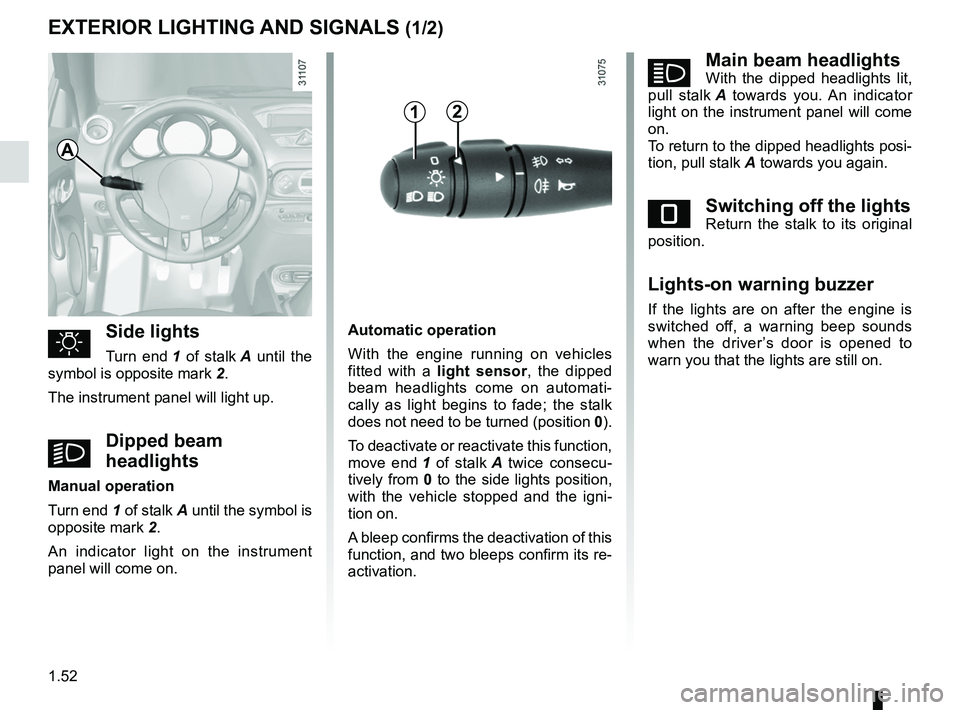
áMain beam headlightsWith the dipped headlights lit,
pull stalk A towards you. An indicator
light on the instrument panel will come
on.
To return to the dipped headlights posi-
tion, pull stalk A towards you again.
eSwitching off the lightsReturn the stalk to its original
position.
Lights-on warning buzzer
If the lights are on after the engine is
switched off, a warning beep sounds
when the driver ’s door is opened to
warn you that the lights are still on.
Exterior lighting and signals
EXTERIOR LIGHTING AND SIGNALS (1/2)
uSide lights
Turn end 1 of stalk A until the
symbol is opposite mark 2.
The instrument panel will light up.
kDipped beam
headlights
Manual operation
Turn end 1 of stalk A until the symbol is
opposite mark 2.
An indicator light on the instrument
panel will come on.
A
Automatic operation
With the engine running on vehicles
fitted with a light sensor , the dipped
beam headlights come on automati -
cally as light begins to fade; the stalk
does not need to be turned (position 0).
To deactivate or reactivate this function,
move end 1 of stalk A twice consecu -
tively from 0 to the side lights position,
with the vehicle stopped and the igni -
tion on.
A bleep confirms the deactivation of this
function, and two bleeps confirm its re-
activation.
21
Page 109 of 185
transporting objectsin the luggage compartment ........... (up to the end of the DU)
towing rings .......................................... (up to the end of the DU)
towing towing equipment ............................ (up to the end of the DU)
towing equipment fitting ............................................... (up to the end of the DU)
towing a caravan .................................. (up to the end of the DU)
3.25
ENG_UD22203_3
Transport d’objets dans le coffre (E33 - X33 - Renault)
ENG_NU_865-6_E33_Renault_3
Transporting objects in the luggage compartment
tRansPoRting oBjeCts in tHe luggage CoMP aRtMent
Always position the heavi-
est items directly on the
floor. Use the lashing points
on the luggage compart -
ment floor, if these are fitted to the
vehicle. The luggage should be
loaded in such a way that no items
will be thrown forward and strike the
occupants if the driver has to brake
suddenly.
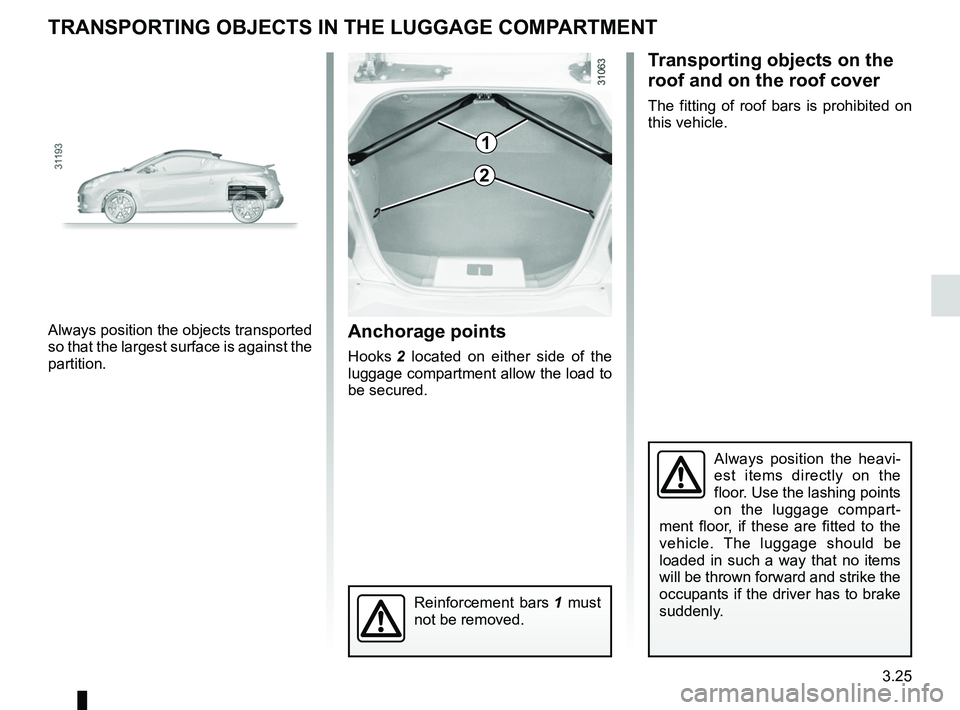
Always position the objects transported
so that the largest surface is against the
partition.anchorage points
Hooks 2 located on either side of the
luggage compartment allow the load to
be secured.
2
1
Reinforcement bars 1 must
not be removed.
t ransporting objects on the
roof and on the roof cover
The fitting of roof bars is prohibited on
this vehicle.
Page 116 of 185
filteroil filter ............................................ (up to the end of the DU)
4.6
ENG_UD20478_2
Niveau huile moteur : appoint/remplissage (E33 - X33 - Renault)
ENG_NU_865-6_E33_Renault_4
Engine oil change
engine oil level : topping up/filling (2/2)/oil CHAnge
oil change
S e r v i c e i n t e r v a l : r e f e r t o t h e
Maintenance Service Booklet for your
vehicle.
Average capacities for oil change (in-
cluding oil filter for information).
1.2 tCe engine: 4.2 litres
1.6 16v engine : 4.7 litres
engine oil grade
Refer to the Maintenance Service
Booklet for your vehicle.
The engine may be hot
when carrying out opera -
tions in close proximity. In
addition, the engine cooling
fan can come on at any moment.
Risk of injury.
e ngine oil change : if you
are changing the oil when
the engine is hot, be careful
not to scald yourself if the
oil overflows.
Filling: take care when
topping up the oil that
no oil drips onto engine
components - risk of fire.
Remember to refit the cap securely
as there is a risk of fire if oil splashes
onto hot engine components.
Never run the engine in an
enclosed space as exhaust
gases are poisonous.
Consult your approved Dealer at
once if you notice an abnormal or
repeated drop in any of the fluid
levels.
When working in the engine
compartment, ensure that
the windscreen wiper stalk
is in the park position.
Risk of injury.
Page 123 of 185
JauneNoirNoir texte
4.13
ENG_UD30003_4
Entretien de la carrosserie (E33 - X33 - Renault)
ENG_NU_865-6_E33_Renault_4
BoDyWoRk MAintenAnCe (2/2)
y ou should
Wash your car frequently, with the
engine off, with cleaning products rec-
ommended by the manufacturer (never
use abrasive products). Rinse thor -
oughly beforehand with a jet:
– spots of tree resin and industrial
grime;
– mud in the wheel arches and under -
neath the body which forms damp
patches;
– bird droppings , which cause a
chemical reaction with the paint that
rapidly discolours paintwork and
may even cause the paint to peel
off;
wash the vehicle immediately to
remove these marks since it is im -
possible to remove them by polish -
ing;
– salt, particularly in the wheel arches
and underneath the body after driv -
ing in areas where the roads have
been gritted.
Remove any plant matter (resin, leaves,
etc.) from the vehicle regularly.
Clean the roof cover using a soft cloth. Respect local regulations about wash
-
ing vehicles (e.g. do not wash your ve-
hicle on a public highway).
Observe the vehicle stopping distances
when driving on gravelled surfaces to
prevent paint damage.
Repair, or have repaired quickly, areas
where the paint has been damaged, to
prevent corrosion spreading.
Remember to visit the body shop pe -
riodically in order to maintain your
anti-corrosion warranty. Refer to the
Maintenance Document.
If it is necessary to clean mechani -
cal components, hinges, etc., spray
them with products approved by our
Technical Department to protect them
after they have been cleaned.
We have selected special products
to care for your vehicle and you can
obtain these from the manufactur -
er’s accessory outlets.
Using a roller type car wash
Return the windscreen wiper stalk to
the Park position (refer to the informa-
tion on the “Windscreen washer, wiper”
in Section 1). Check the mounting of
external accessories, additional lights
and mirrors, and ensure that the wiper
blades are secured with adhesive tape.
Remove the radio aerial mast if your
vehicle is fitted with this equipment.
Remember to remove the tape and refit
the antenna after washing.
Cleaning the headlights
As the headlights are made of plastic
“glass”, use a soft cloth or cotton wool
to clean them. If this does not clean
them properly, moisten the cloth with
soapy water, then wipe clean with a soft
damp cloth or cotton wool.
Finally, carefully dry off with a soft dry
cloth.
Cleaning products containing alco -
hol must not be used.
Page 131 of 185

ENG_NU_865-6_E33_Renault_5
ty")
JauneNoirNoir texte
5.5
ENG_UD28665_3
Kit de gonflage des pneumatiques (X77 - X85 - B85 - C85 - S85 - X77 ph2\
- K85 - X95 - E95 - X67 - X92 - X10 - X98 - X52 - Renault)
ENG_NU_865-6_E33_Renault_5
tyre Pressure KIt (3/3)
Once the tyre is correctly inflated,
remove the kit: slowly unscrew the in -
flation adapter 1 to prevent any repair
product from escaping and store the
container in plastic packaging to pre -
vent the product from escaping.
– Affix the driving recommendation
label to the dashboard where it can
easily be seen by the driver;
– Put the kit away.
– At the end of this initial inflation op-
eration, air will still escape from the
tyre. You must drive a short distance
in order to seal the hole.
– Start immediately and drive at be -
tween 12 and 40 mph (20 and
60 km/h) in order to distribute the
product evenly in the tyre and, after
driving for 2 miles (3 km), stop and
check the pressure.
– If the pressure is greater than 1.3 bar
but less than the recommended
pressure (refer to the label affixed to
the edge of the driver’s door), read-
just it. Otherwise, please contact an
authorised dealer: the tyre cannot be
repaired.Precautions when using the
kit
The kit should not be operated for more
than 15 consecutive minutes.
Nothing should be placed
around the driver ’s feet
as such objects may slide
under the pedals during
sudden braking manoeuvres and
obstruct their use.
1
Please be aware that a
poorly tightened or miss -
ing valve cap can make the
tyres less airtight and may
lead to pressure loss.
Always use valve caps identical to
those fitted originally and tighten
them fully.
Following repair with the kit,
do not travel further than
120 miles (200 km). In addi -
tion, reduce your speed and
under no circumstances exceed
48 mph (80 km/h). The sticker,
which you must affix in a prominent
position on the dashboard, reminds
you of this.
Depending on the country or local
legislation, a tyre repaired with the
inflation kit may need to be replaced.
Page 132 of 185
tool kit ................................................... (up to the end of the DU)
hubcap tool ........................................... (up to the end of the DU)
jack ....................................................... (up to the end of the DU)
puncture ................................................ (up to the end of the DU)
wheelbrace ........................................... (up to the end of the DU)
trims ...................................................... (up to the end of the DU)
emergency spare wheel ....................... (up to the end of the DU)
wheelbrace ............................................................ (current page)
5.6
ENG_UD20555_2
Bloc-outils (E33 - X33 - Renault)
ENG_NU_865-6_E33_Renault_5
Tool kit (jack, wheelbrace, etc.)
Hubcap
t OOL KIt/WHeeL trIm – WHeeL
The tool kit is located in the luggage
compartment: lift the luggage compart-
ment carpet then unscrew the central
mounting.
The tools included in the tool kit depend
on the vehicle.
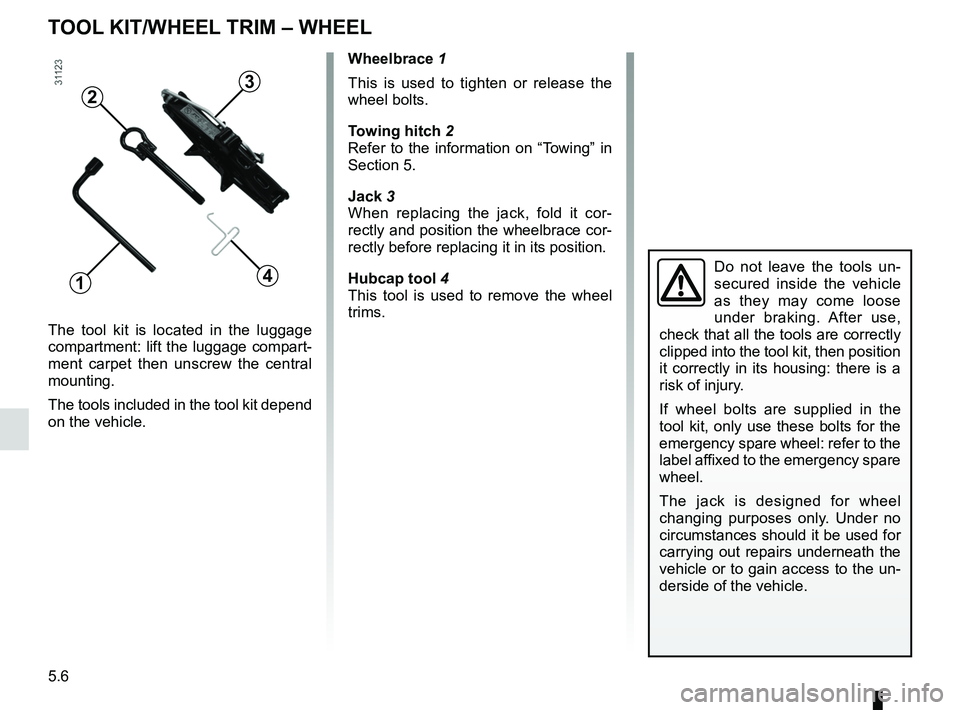
Wheelbrace 1
This is used to tighten or release the
wheel bolts.
towing hitch 2
Refer to the information on “Towing” in
Section 5.
Jack 3
When replacing the jack, fold it cor -
rectly and position the wheelbrace cor-
rectly before replacing it in its position.
Hubcap tool 4
This tool is used to remove the wheel
trims.
Do not leave the tools un -
secured inside the vehicle
as they may come loose
under braking. After use,
check that all the tools are correctly
clipped into the tool kit, then position
it correctly in its housing: there is a
risk of injury.
If wheel bolts are supplied in the
tool kit, only use these bolts for the
emergency spare wheel: refer to the
label affixed to the emergency spare
wheel.
The jack is designed for wheel
changing purposes only. Under no
circumstances should it be used for
carrying out repairs underneath the
vehicle or to gain access to the un-
derside of the vehicle.
1
23
4