ignition RENAULT WIND ROADSTER 2012 User Guide
[x] Cancel search | Manufacturer: RENAULT, Model Year: 2012, Model line: WIND ROADSTER, Model: RENAULT WIND ROADSTER 2012Pages: 185, PDF Size: 5.52 MB
Page 35 of 185
JauneNoirNoir texte
1.29
ENG_UD21752_3
Sécurité enfants : désactivation/activation airbag passager avant (E33 - X33 - Renault)
ENG_NU_865-6_E33_Renault_1
CHILD SAFETY : deactivating/activating the front passenger air bag (3/3)
The passenger air bag must
be activated or deactivated
with the ignition off.
If it is interfered with when
the vehicle is being driven, indicator
lights
å and © will come
on.
Switch the ignition off then on again
to reset the air bag in accordance
with the lock.
Operating faults
It is forbidden to fit a rear-facing child
seat to the front passenger seat if the
air bag activation/deactivation system
is faulty.
Allowing any other passenger to sit in
that seat is not recommended.
Contact your approved dealer as soon
as possible.
Activating the front
passenger air bags
You should reactivate the air bag as
soon as you remove the child seat from
the front passenger seat to ensure the
protection of the front passenger in the
event of an impact.
To reactivate the air bags: when the
vehicle is stationary , push and turn
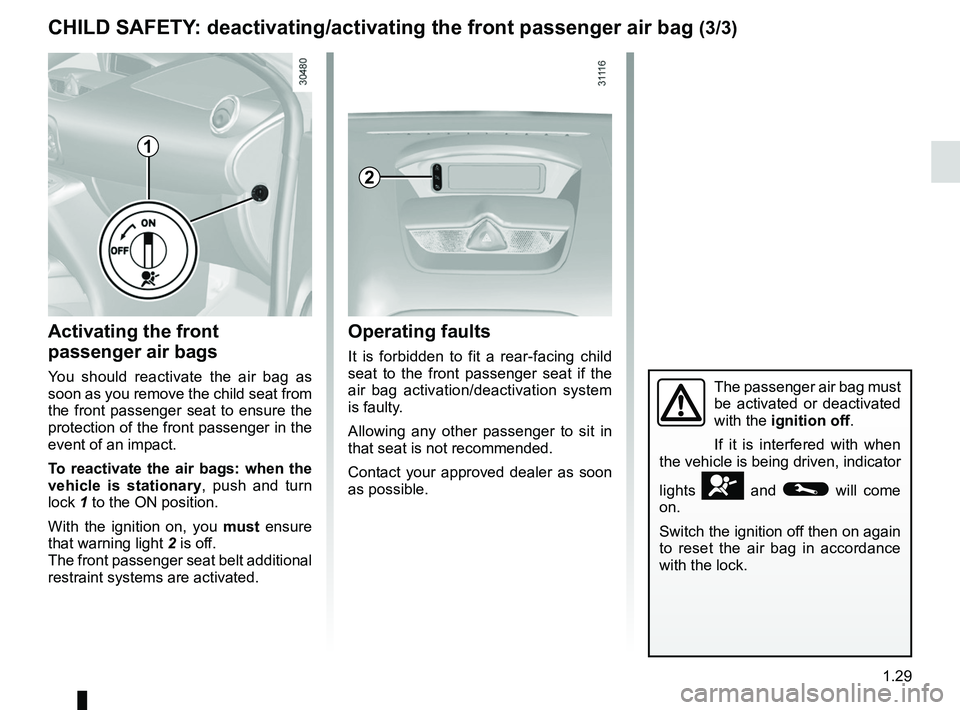
lock 1 to the ON position.
With the ignition on, you must ensure
that warning light 2 is off.
The front passenger seat belt additional
restraint systems are activated.
2
1
Page 40 of 185
instrument panel ................................... (up to the end of the DU)
warning lights ........................................ (up to the end of the DU)
driver’s position .................................... (up to the end of the DU)
trip computer and warning system ........(up to the end of the DU)
indicators: instrument panel ............................. (up to the end of the DU)
display .................................................. (up to the end of the DU)
operating faults ..................................... (up to the end of the DU)
control instruments ............................... (up to the end of the DU)
indicators ............................................................... (current page)
lights: fog lights .......................................................... (current page)
lights: dipped beam headlights ................................... (current page)
lights: direction indicators ........................................... (current page)
lights: main beam headlights ...................................... (current page)
handbrake .............................................................. (current page)
1.34
ENG_UD20502_3
Tableau de bord : témoins lumineux (E33 - X33 - Renault)
ENG_NU_865-6_E33_Renault_1
Jaune NoirNoir texte
Warning lights
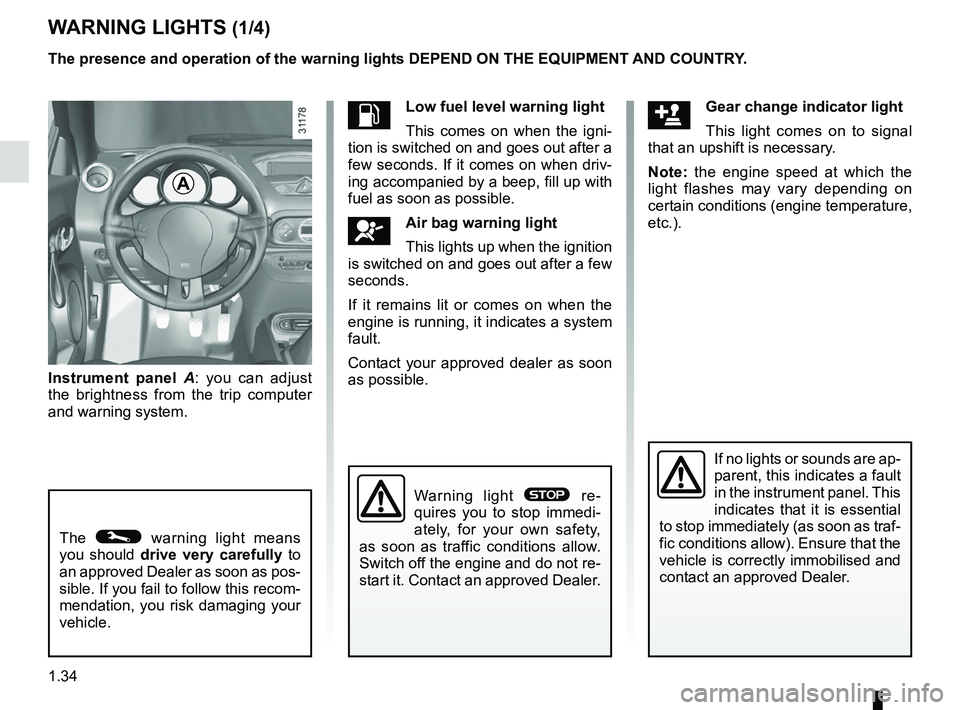
Instrument panel A: you can adjust
the brightness from the trip computer
and warning system.
W ARNING LIGHTS (1/4)
LLow fuel level warning light
This comes on when the igni -
tion is switched on and goes out after a
few seconds. If it comes on when driv-
ing accompanied by a beep, fill up with
fuel as soon as possible.
åAir bag warning light
This lights up when the ignition
is switched on and goes out after a few
seconds.
If it remains lit or comes on when the
engine is running, it indicates a system
fault.
Contact your approved dealer as soon
as possible.
?Gear change indicator light
This light comes on to signal
that an upshift is necessary.
Note: the engine speed at which the
light flashes may vary depending on
certain conditions (engine temperature,
etc.).
If no lights or sounds are ap-
parent, this indicates a fault
in the instrument panel. This
indicates that it is essential
to stop immediately (as soon as traf-
fic conditions allow). Ensure that the
vehicle is correctly immobilised and
contact an approved Dealer.
The © warning light means
you should drive very carefully to
an approved Dealer as soon as pos-
sible. If you fail to follow this recom-
mendation, you risk damaging your
vehicle.
Warning light ® re -
quires you to stop immedi -
ately, for your own safety,
as soon as traffic conditions allow.
Switch off the engine and do not re-
start it. Contact an approved Dealer.
The presence and operation of the warning lights DEpEND ON THE EQUIpMENT AND COUNTRY.
A
Page 41 of 185
ABS ....................................................................... (current page)
air bag .................................................................... (current page)
variable power-assisted steering ........................... (current page)
JauneNoirNoir texte
1.35
ENG_UD20502_3
Tableau de bord : témoins lumineux (E33 - X33 - Renault)
ENG_NU_865-6_E33_Renault_1
W ARNING LIGHTS (2/4)
kDipped beam headlight tell -
tale
áMain beam headlight tell-tale
light
gFront fog light tell-tale light
fRear fog light tell-tale light
cLeft-hand direction indicator
tell-tale light
bRight-hand direction indica -
tor tell-tale light
ÄWarning light for monitoring
exhaust gas
On equipped vehicles, the light comes
on when the ignition is switched on then
goes out.
– If it lights up continuously accompa -
nied by the
© indicator light, con-
sult an approved dealer as soon as
possible;
– If it flashes, reduce the engine speed
until the light stops flashing. Contact an
approved dealer as soon as possible.
Refer to “Emission control, fuel econ -
omy and driving advice” in section 2.
2
Door status warning light
It lights up when the ignition is
switched on and a door is open
or not properly closed.
ΔSpeed limiter and cruise
control indicator lights
See the information on the “Speed lim-
iter” and “Cruise control” in Section 2.
©Warning light
This lights up when the igni -
tion is switched on and goes out after a
few seconds. It may come on with other
warning lights on the instrument panel.
If it lights up when the vehicle is being
driven, it is advisable to stop at an ap-
proved dealer soon.
The presence and operation of the warning lights DEpEND ON THE EQUIpMENT AND COUNTRY.
Page 42 of 185
1.36
ENG_UD20502_3
Tableau de bord : témoins lumineux (E33 - X33 - Renault)
ENG_NU_865-6_E33_Renault_1
Jaune NoirNoir texte
\fAnti-lock braking warning
light
This lights up when the ignition is
switched on and goes out after a few
seconds.
If it does not go out after the ignition is
switched on, or lights up when driving,
there is a fault with the ABS. Braking
will then be as normal, without the ABS
system.
Contact an approved dealer as soon as
possible.
DHandbrake “on” warning
light and brake circuit inci -
dent warning light
If it comes on during braking and is ac-
companied by the
® warning light
and a beep, it indicates that the fluid
level in the circuit is low or that there is
a braking system fault. Stop as soon as
traffic conditions allow and contact an
approved dealer.
ÀOil pressure warning light
This lights up when the ignition is
switched on and goes out after a few
seconds.
If it comes on when you are driving ac-
companied by the
® warning light
and a beep, it is essential to stop and
switch off the ignition.
Check the oil level. If the level is normal,
the indicator light is being lit by some-
thing else.
Consult an approved dealer.
W ARNING LIGHTS (3/4)
The presence and operation of the warning lights DEpEND ON THE EQUIpMENT AND COUNTRY.
A
®STOp light
It switches off a few seconds
after the ignition is switched on, if it
does not light up, consult an approved
dealer. It may light up at the same time
as other warning lights, together with
a beep. It indicates that it is essential
to stop immediately (as soon as traffic
conditions allow). Contact an approved
dealer.
ÚBattery charge warning light
This comes on when the igni -
tion is switched on and goes out after
a few seconds. If it comes on together
with the
® warning light and a
beep, it indicates that the electrical cir-
cuit is overcharged or undercharged.
If it flashes on its own, this indicates
that the battery is low. Stop as soon as
traffic conditions allow and contact an
approved dealer.
Page 55 of 185
clock ..................................................... (up to the end of the DU)
clock ..................................................... (up to the end of the DU)
external temperature ............................ (up to the end of the DU)
indicators: exterior temperature indicator .......................... (current page)
1.49
ENG_UD11174_1
Heure et température extérieure (E33 - X33 - Renault)
ENG_NU_865-6_E33_Renault_1
Clock and exterior temperature
External temperature
indicator
As ice formation is related
to climatic exposure, local
air humidity and temperature, the
external temperature alone is not
sufficient to detect ice.
CLOCK AND EXTERIOR TEMpERATURE
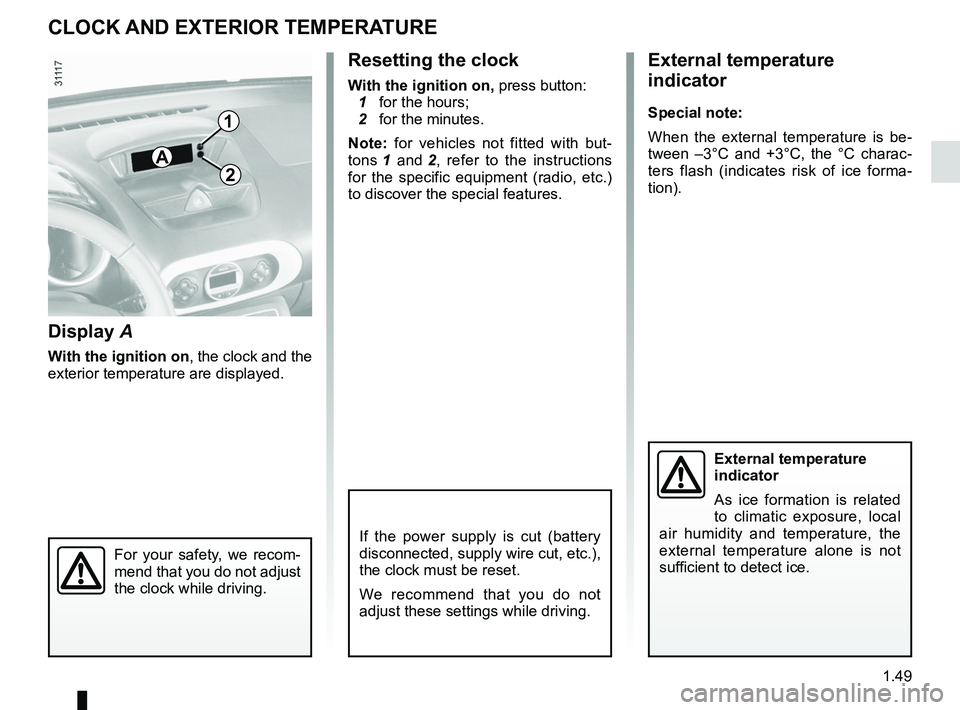
Display A
With the ignition on, the clock and the
exterior temperature are displayed.
For your safety, we recom -
mend that you do not adjust
the clock while driving.
A
1
2
If the power supply is cut (battery
disconnected, supply wire cut, etc.),
the clock must be reset.
We recommend that you do not
adjust these settings while driving.
External temperature
indicator
Special note:
When the external temperature is be -
tween –3°C and +3°C, the °C charac -
ters flash (indicates risk of ice forma -
tion).
Resetting the clock
With the ignition on, press button:
1 for the hours;
2 for the minutes.
Note: for vehicles not fitted with but -
tons 1 and 2 , refer to the instructions
for the specific equipment (radio, etc.)
to discover the special features.
Page 56 of 185
rear view mirrors ................................... (up to the end of the DU)
1.50
ENG_UD11175_1
Rétroviseurs (E33 - X33 - Renault)
ENG_NU_865-6_E33_Renault_1
Door mirrors
REAR VIEW MIRRORS
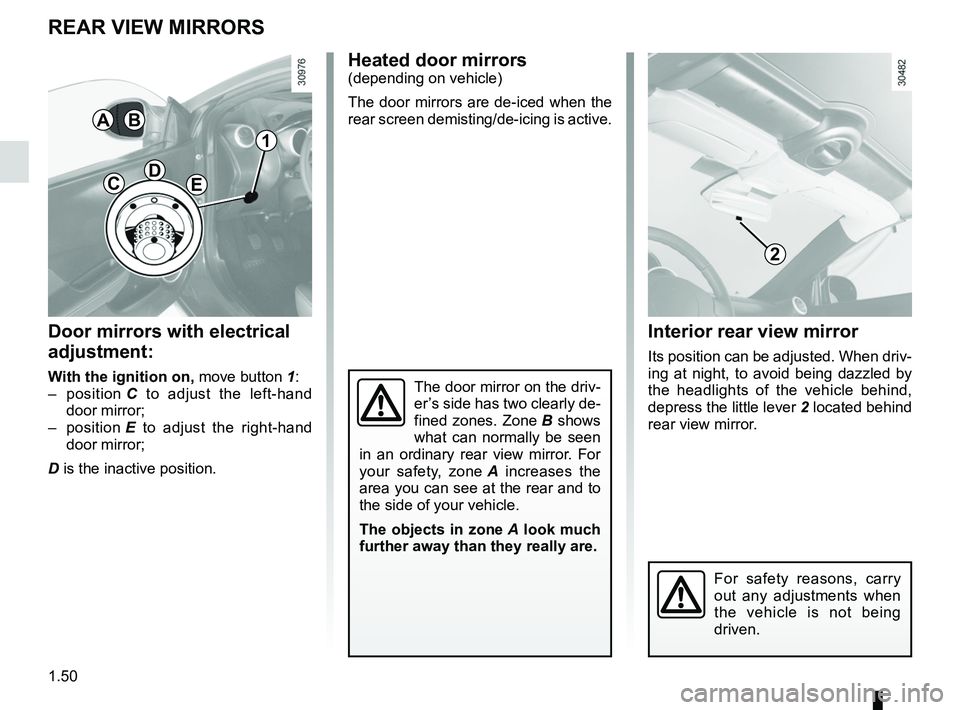
Door mirrors with electrical
adjustment:
With the ignition on, move button 1:
– position C to adjust the left-hand
door mirror;
– position E to adjust the right-hand
door mirror;
D is the inactive position.
Heated door mirrors(depending on vehicle)
The door mirrors are de-iced when the
rear screen demisting/de-icing is active.
The door mirror on the driv-
er’s side has two clearly de-
fined zones. Zone B shows
what can normally be seen
in an ordinary rear view mirror. For
your safety, zone A increases the
area you can see at the rear and to
the side of your vehicle.
The objects in zone A look much
further away than they really are.
Interior rear view mirror
Its position can be adjusted. When driv-
ing at night, to avoid being dazzled by
the headlights of the vehicle behind,
depress the little lever 2 located behind
rear view mirror.
For safety reasons, carry
out any adjustments when
the vehicle is not being
driven.
2
CDE
AB
1
Page 60 of 185
wipers ................................................... (up to the end of the DU)
windscreen washer/wiper ..................... (up to the end of the DU)
windscreen washer ............................... (up to the end of the DU)
1.54
ENG_UD25520_2
Essuie-vitre / lave-vitre avant (E33 - X33 - Renault)
ENG_NU_865-6_E33_Renault_1
Jaune NoirNoir texte
Windscreen washers/wipers
SCREEN WASHER/WIpER (1/2)
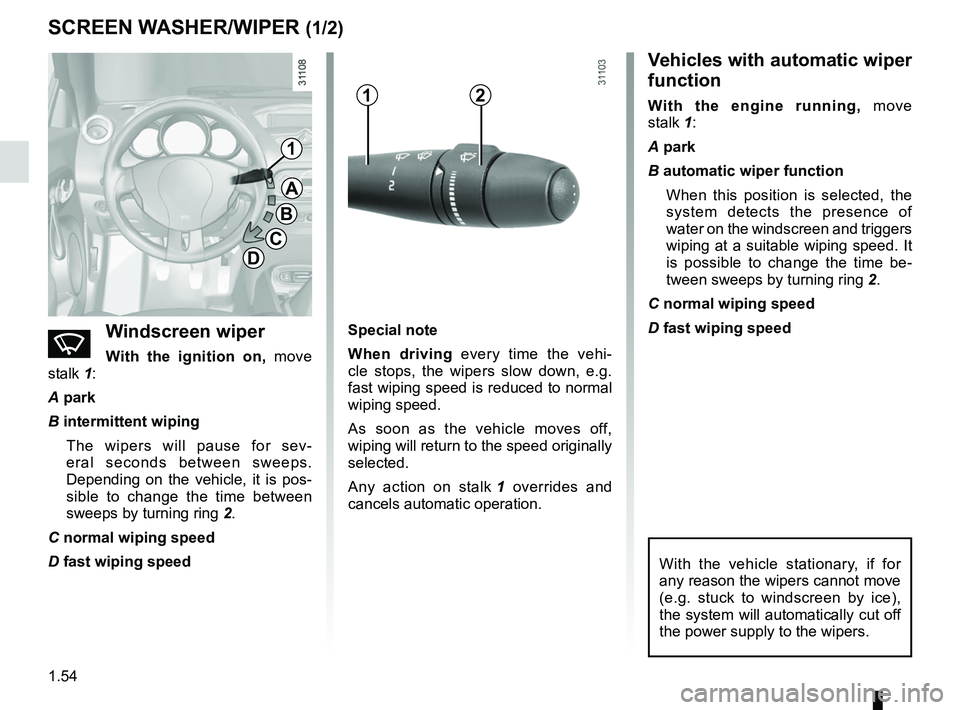
nWindscreen wiper
With the ignition on, move
stalk 1:
A park
B intermittent wiping
The wipers will pause for sev -
eral seconds between sweeps.
Depending on the vehicle, it is pos-
sible to change the time between
sweeps by turning ring 2.
C normal wiping speed
D fast wiping speed
Special note
When driving every time the vehi -
cle stops, the wipers slow down, e.g.
fast wiping speed is reduced to normal
wiping speed.
As soon as the vehicle moves off,
wiping will return to the speed originally
selected.
Any action on stalk 1 overrides and
cancels automatic operation.
Vehicles with automatic wiper
function
With the engine running, move
stalk 1:
A park
B automatic wiper function
When this position is selected, the
system detects the presence of
water on the windscreen and triggers
wiping at a suitable wiping speed. It
is possible to change the time be -
tween sweeps by turning ring 2.
C normal wiping speed
D fast wiping speed
With the vehicle stationary, if for
any reason the wipers cannot move
(e.g. stuck to windscreen by ice),
the system will automatically cut off
the power supply to the wipers.
2
A
B
C
D
1
1
Page 61 of 185
JauneNoirNoir texte
1.55
ENG_UD25520_2
Essuie-vitre / lave-vitre avant (E33 - X33 - Renault)
ENG_NU_865-6_E33_Renault_1
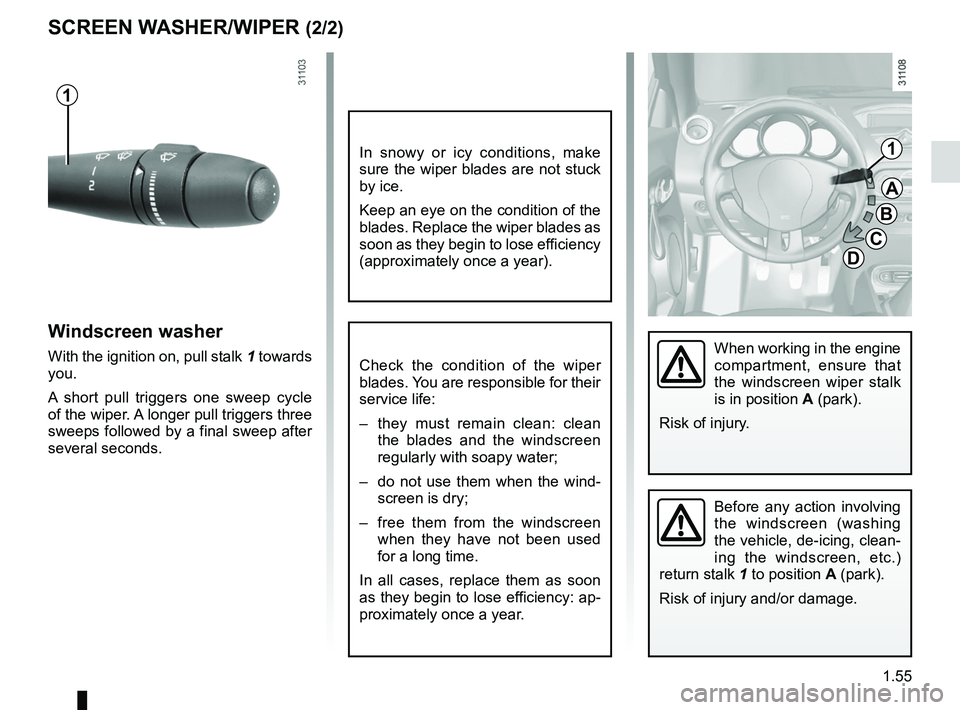
Before any action involving
the windscreen (washing
the vehicle, de-icing, clean -
ing the windscreen, etc.)
return stalk 1 to position A (park).
Risk of injury and/or damage.
SCREEN WASHER/WIpER (2/2)
When working in the engine
compartment, ensure that
the windscreen wiper stalk
is in position A (park).
Risk of injury.Windscreen washer
With the ignition on, pull stalk 1 towards
you.
A short pull triggers one sweep cycle
of the wiper. A longer pull triggers three
sweeps followed by a final sweep after
several seconds.
A
B
C
D
1
Check the condition of the wiper
blades. You are responsible for their
service life:
– they must remain clean: clean
the blades and the windscreen
regularly with soapy water;
– do not use them when the wind-
screen is dry;
– free them from the windscreen
when they have not been used
for a long time.
In all cases, replace them as soon
as they begin to lose efficiency: ap-
proximately once a year.
In snowy or icy conditions, make
sure the wiper blades are not stuck
by ice.
Keep an eye on the condition of the
blades. Replace the wiper blades as
soon as they begin to lose efficiency
(approximately once a year).
1
Page 63 of 185
JauneNoirNoir texte
1.57
ENG_UD24355_2
Réservoir à carburant (E33 - X33 - Renault)
ENG_NU_865-6_E33_Renault_1
No modifications what -
soever are permitted on
any part of the fuel supply
system (computers, wiring,
fuel circuit, injector, protection
covers, etc.) as this may be danger-
ous (such work must be undertaken
by qualified Network personnel).
FUEL TANK (2/2)
persistent smell of
fuel
If you notice a persistent
smell of fuel you should:
– stop the vehicle as soon as traf-
fic conditions allow and switch off
the ignition;
– switch on the hazard warning
lights and ask your passengers
to leave the vehicle and to keep
away from the traffic;
– contact an approved dealer.
Do not mix even small
amounts of petrol (un -
leaded or E85) with diesel.
Do not use ethanol-based
fuel if your vehicle is not compatible
with this fuel.
Do not add additive to the fuel –
otherwise you risk damaging the
engine.
Page 65 of 185
2.1
ENG_UD29994_7
Sommaire 2 (E33 - X33 - Renault)
ENG_NU_865-6_E33_Renault_2
Section 2: Driving
(Advice on use relating to fuel economy and the environment)
Running in . . . . . . . . . . . . . . . . . . . . . . . . . . . . . . . . . . . . . . . . . . . . . . . . . . . . . . . . . . . . . . . . . . . . . 2.2
Ignition switch . . . . . . . . . . . . . . . . . . . . . . . . . . . . . . . . . . . . . . . . . . . . . . . . . . . . . . . . . . . . . . . . . . 2.2
Starting, stopping the engine . . . . . . . . . . . . . . . . . . . . . . . . . . . . . . . . . . . . . . . . . . . . . . . . . . . . . . . 2.3
Special features of petrol versions . . . . . . . . . . . . . . . . . . . . . . . . . . . . . . . . . . . . . . . . . . . . . . . . . . 2.4
Gear lever . . . . . . . . . . . . . . . . . . . . . . . . . . . . . . . . . . . . . . . . . . . . . . . . . . . . . . . . . . . . . . . . . . . . . 2.5
Handbrake . . . . . . . . . . . . . . . . . . . . . . . . . . . . . . . . . . . . . . . . . . . . . . . . . . . . . . . . . . . . . . . . . . . . . 2.5
Advice on emission control and fuel economy . . . . . . . . . . . . . . . . . . . . . . . . . . . . . . . . . . . . . . . . . 2.6
Environment . . . . . . . . . . . . . . . . . . . . . . . . . . . . . . . . . . . . . . . . . . . . . . . . . . . . . . . . . . . . . . . . . . . 2.9
Driver correction devices and aids . . . . . . . . . . . . . . . . . . . . . . . . . . . . . . . . . . . . . . . . . . . . . . . . . . 2.10
Speed limiter . . . . . . . . . . . . . . . . . . . . . . . . . . . . . . . . . . . . . . . . . . . . . . . . . . . . . . . . . . . . . . . . . . . 2.13
Cruise control . . . . . . . . . . . . . . . . . . . . . . . . . . . . . . . . . . . . . . . . . . . . . . . . . . . . . . . . . . . . . . . . . . 2.16