tow RENAULT WIND ROADSTER 2012 User Guide
[x] Cancel search | Manufacturer: RENAULT, Model Year: 2012, Model line: WIND ROADSTER, Model: RENAULT WIND ROADSTER 2012Pages: 185, PDF Size: 5.52 MB
Page 92 of 185
heating system ..................................... (up to the end of the DU)
ventilation ............................................. (up to the end of the DU)
air conditioning ..................................... (up to the end of the DU)
air conditioning ..................................... (up to the end of the DU)
3.8
ENG_UD13546_1
Chauffage - ventilation avec isolation de l’habitacle (E33 - X33 - Renaul\
t)
ENG_NU_865-6_E33_Renault_3
Jaune NoirNoir texte
Manual air conditioning/heating system
Manual aiR ConDitioning/Heating systeM (1/4)
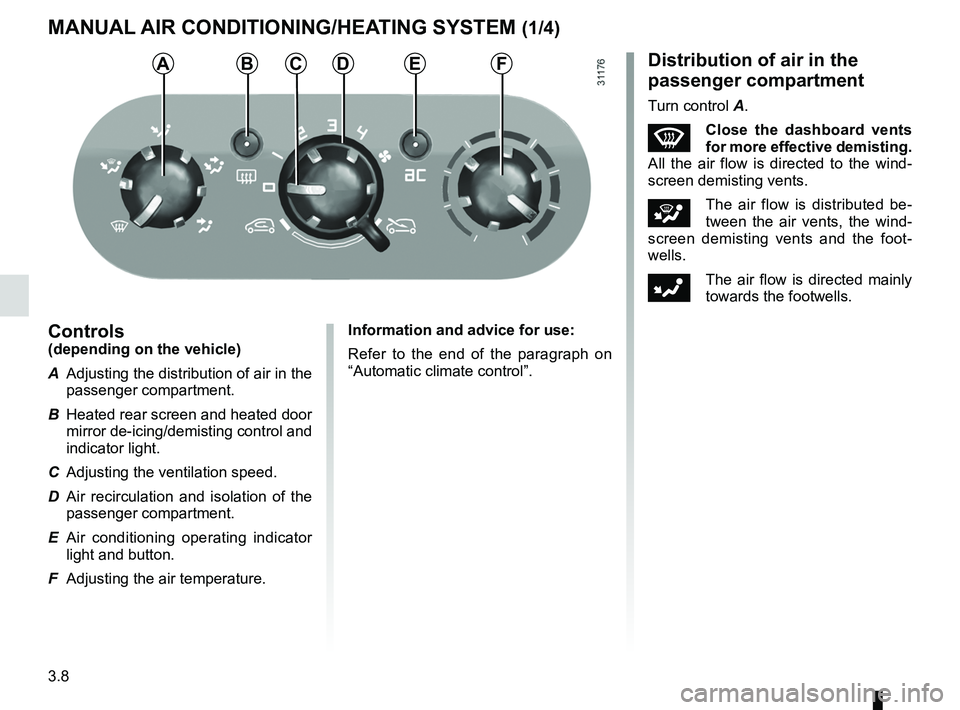
Controls(depending on the vehicle)
A Adjusting the distribution of air in the
passenger compartment.
B Heated rear screen and heated door
mirror de-icing/demisting control and
indicator light.
C Adjusting the ventilation speed.
D Air recirculation and isolation of the
passenger compartment.
E Air conditioning operating indicator
light and button.
F Adjusting the air temperature.
information and advice for use:
Refer to the end of the paragraph on
“Automatic climate control”.
Distribution of air in the
passenger compartment
Turn control A.
WClose the dashboard vents
for more effective demisting.
All the air flow is directed to the wind -
screen demisting vents.
iThe air flow is distributed be -
tween the air vents, the wind -
screen demisting vents and the foot -
wells.
FThe air flow is directed mainly
towards the footwells.
aBCDeF
Page 93 of 185
demistingrear screen ....................................................... (current page)
rear screen demisting ......................................................... (current page)
JauneNoirNoir texte
3.9
ENG_UD13546_1
Chauffage - ventilation avec isolation de l’habitacle (E33 - X33 - Renaul\
t)
ENG_NU_865-6_E33_Renault_3
GThe air flow is directed towards
the dashboard vents and the
footwells.
JAll the air flow is directed to the
dashboard vents.
This selection is not appropriate if all
the air vents are closed.
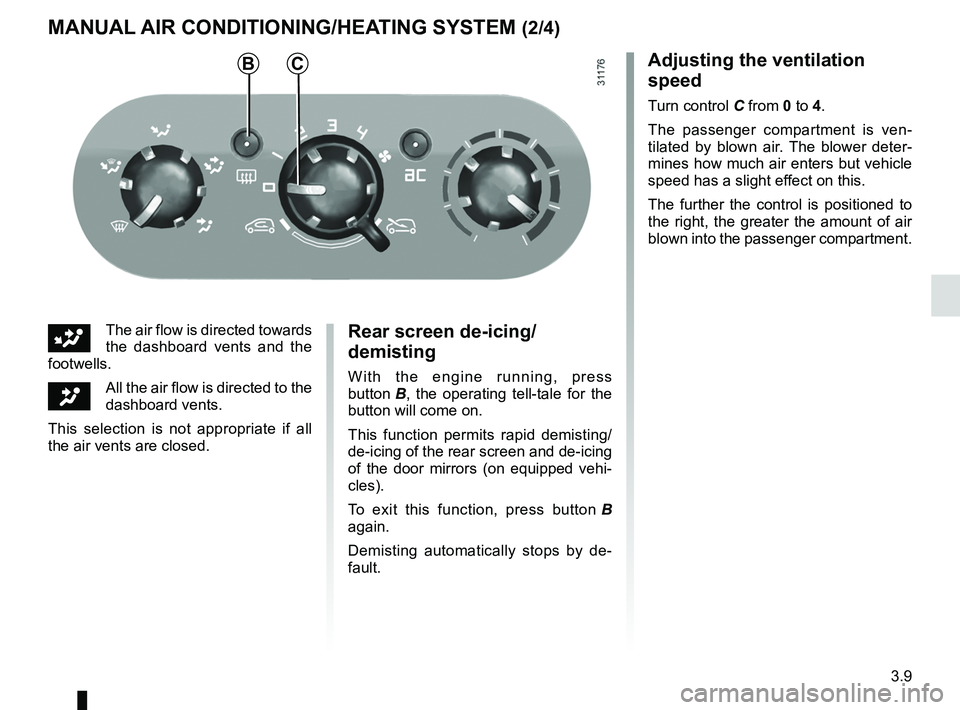
Rear screen de-icing/
demisting
W i t h t h e e n g i n e r u n n i n g , p r e s s
button B , the operating tell-tale for the
button will come on.
This function permits rapid demisting/
de-icing of the rear screen and de-icing
of the door mirrors (on equipped vehi -
cles).
To exit this function, press button B
again.
Demisting automatically stops by de -
fault.
adjusting the ventilation
speed
Turn control C from 0 to 4.
The passenger compartment is ven -
tilated by blown air. The blower deter -
mines how much air enters but vehicle
speed has a slight effect on this.
The further the control is positioned to
the right, the greater the amount of air
blown into the passenger compartment.
Manual aiR ConDitioning/Heating systeM (2/4)
BC
Page 94 of 185

ENG_NU_865-6_E33_Renault_3
Jaune NoirNoir texte
air recirculation operation
(isolation of the passen")
3.10
ENG_UD13546_1
Chauffage - ventilation avec isolation de l’habitacle (E33 - X33 - Renaul\
t)
ENG_NU_865-6_E33_Renault_3
Jaune NoirNoir texte
air recirculation operation
(isolation of the passenger
compartment)
Turn control D towards air recirculation
symbol
â.
In these conditions air is taken from the
passenger compartment and is recircu-
lated, with no air being taken from out-
side the vehicle. air recirculation is for:
–
isolating the vehicle from the exter -
nal atmosphere (driving in polluted
areas, etc.);
– bringing the passenger compartment
to the desired temperature as quickly
as possible.
Prolonged use of this position (iso -
lation mode) may mist up the win -
dows slightly or cause odours due
to the air not being renewed.
It is therefore advisable to return to
normal operation (external air) by
pressing control D when you have
passed through the polluted area.
Manual aiR ConDitioning/Heating systeM (3/4)
D
Page 99 of 185
rear screen de-icing/demisting .............................. (current page)
windscreen de-icing/demisting .............................. (current page)
JauneNoirNoir texte
3.15
ENG_UD11200_1
Air conditionné automatique (E33 - X33 - Renault)
ENG_NU_865-6_E33_Renault_3
autoMatiC CliMate ContRol (4/6)
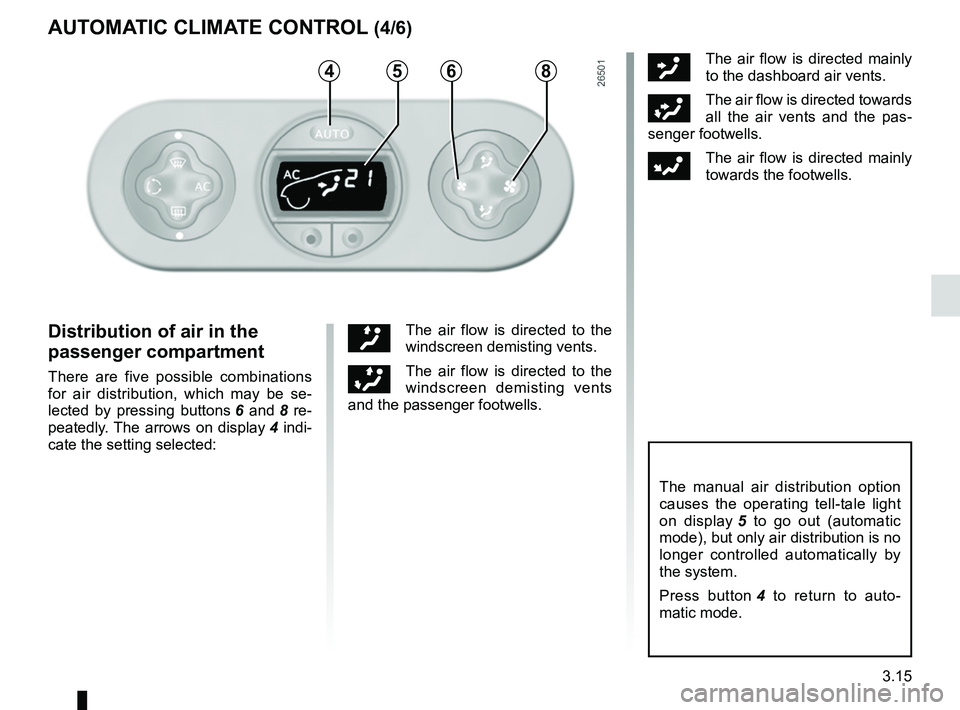
ôThe air flow is directed mainly
to the dashboard air vents.
öThe air flow is directed towards
all the air vents and the pas-
senger footwells.
FThe air flow is directed mainly
towards the footwells.
The manual air distribution option
causes the operating tell-tale light
on display 5 to go out (automatic
mode), but only air distribution is no
longer controlled automatically by
the system.
Press button 4 to return to auto -
matic mode.
Distribution of air in the
passenger compartment
There are five possible combinations
for air distribution, which may be se -
lected by pressing buttons 6 and 8 re -
peatedly. The arrows on display 4 indi-
cate the setting selected:
õThe air flow is directed to the
windscreen demisting vents.
÷The air flow is directed to the
windscreen demisting vents
and the passenger footwells.
6845
Page 102 of 185
air conditioning ..................................... (up to the end of the DU)
heating system ..................................... (up to the end of the DU)
air conditioning ..................................... (up to the end of the DU)
temperature regulation ......................... (up to the end of the DU)
ventilation ............................................. (up to the end of the DU)
heating and air conditioning system ...................... (current page)
3.18
ENG_UD11524_2
Air conditionné : informations et conseils d’utilisation (X77 ph2\
- Renault)
ENG_NU_865-6_E33_Renault_3
aiR ConDitioning: information and advice on use
Fuel consumption
You will normally notice an increase
in fuel consumption (especially
when driving in town) when the air
conditioning is operating. For vehi -
cles fitted with manual air condition -
ing, switch off the system when it is
not required.
advice for reducing consumption
and therefore helping to preserve
the environment:
Drive with the air vents open and
the windows closed.
If the vehicle has been parked in
the sun, open the doors for a few
moments to let the hot air escape
before starting the engine.
Maintenance
Refer to the Maintenance Document
for your vehicle for the inspection
frequency.
Do not open the refriger -
ant fluid circuit. The fluid
may damage eyes or skin.
note
Presence of water under the ve -
hicle. After prolonged use of the air
conditioning system, it is normal for
water to be present under the vehi-
cle. This is caused by condensation.
operating faults
As a general rule, contact your ap-
proved Dealer in the event of an op-
erating fault.
– Reduction in de-icing, demist -
ing or air conditioning per -
formance . This may be caused
by the passenger compartment
filter cartridge becoming clogged.
– no cold air is being produced.
Check that the controls are set
correctly and that the fuses are
sound. Otherwise, switch off the
system.
Do not add anything to the
vehicle’s ventilation circuit
(for example, to remove
bad odours).
t here is a risk of damage or of
fire.
Page 109 of 185
transporting objectsin the luggage compartment ........... (up to the end of the DU)
towing rings .......................................... (up to the end of the DU)
towing towing equipment ............................ (up to the end of the DU)
towing equipment fitting ............................................... (up to the end of the DU)
towing a caravan .................................. (up to the end of the DU)
3.25
ENG_UD22203_3
Transport d’objets dans le coffre (E33 - X33 - Renault)
ENG_NU_865-6_E33_Renault_3
Transporting objects in the luggage compartment
tRansPoRting oBjeCts in tHe luggage CoMP aRtMent
Always position the heavi-
est items directly on the
floor. Use the lashing points
on the luggage compart -
ment floor, if these are fitted to the
vehicle. The luggage should be
loaded in such a way that no items
will be thrown forward and strike the
occupants if the driver has to brake
suddenly.
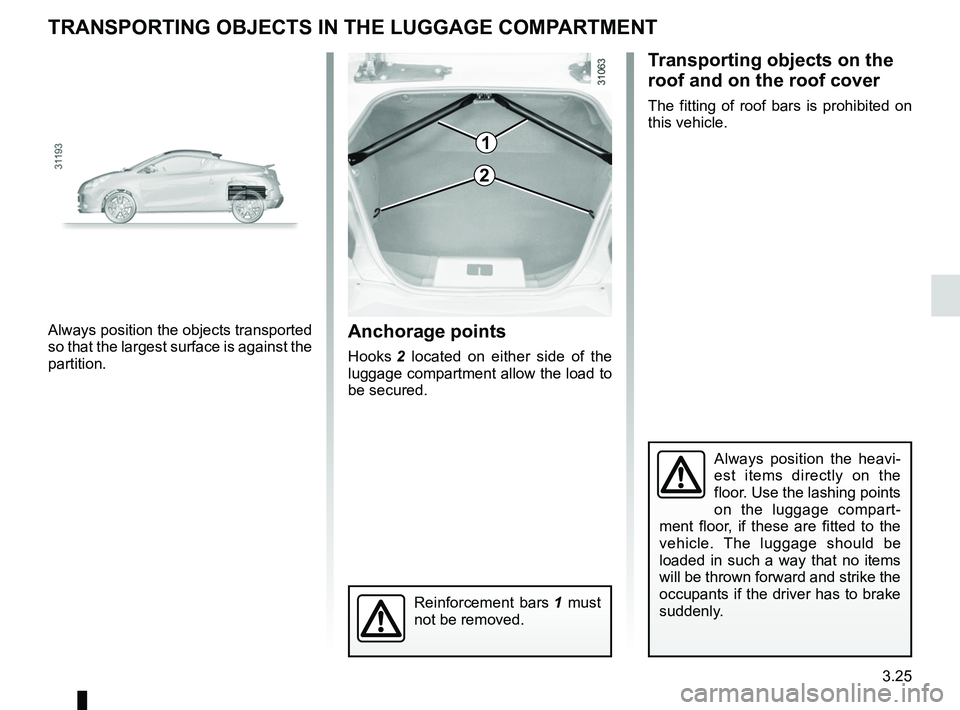
Always position the objects transported
so that the largest surface is against the
partition.anchorage points
Hooks 2 located on either side of the
luggage compartment allow the load to
be secured.
2
1
Reinforcement bars 1 must
not be removed.
t ransporting objects on the
roof and on the roof cover
The fitting of roof bars is prohibited on
this vehicle.
Page 120 of 185
tyre pressure......................................... (up to the end of the DU)
tyre pressures ....................................... (up to the end of the DU)
tyres ...................................................... (up to the end of the DU)
4.10
ENG_UD29998_2
Pression de gonflage des pneumatiques (E33 - X33 - Renault)
ENG_NU_865-6_E33_Renault_4
Tyre pressure
tyRe pReSSURe
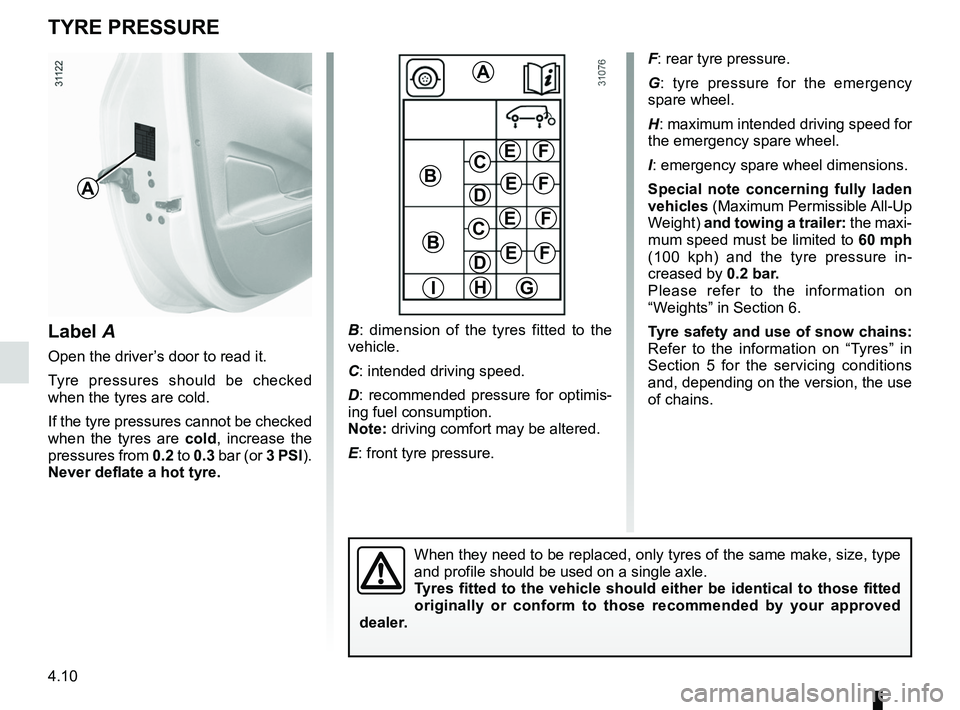
label A
Open the driver’s door to read it.
Tyre pressures should be checked
when the tyres are cold.
If the tyre pressures cannot be checked
when the tyres are cold, increase the
pressures from 0.2 to 0.3 bar (or 3 pSi).
never deflate a hot tyre. B
: dimension of the tyres fitted to the
vehicle.
C: intended driving speed.
D: recommended pressure for optimis-
ing fuel consumption.
note: driving comfort may be altered.
E: front tyre pressure.
A
A
B
B
i
e
e
e
eF
F
F
F
g
D
D
C
C
H
F: rear tyre pressure.
G : tyre pressure for the emergency
spare wheel.
H: maximum intended driving speed for
the emergency spare wheel.
I: emergency spare wheel dimensions.
Special note concerning fully laden
vehicles (Maximum Permissible All-Up
Weight) and towing a trailer: the maxi-
mum speed must be limited to 60 mph
(100 kph) and the tyre pressure in -
creased by 0.2 bar.
Please refer to the information on
“Weights” in Section 6.
t yre safety and use of snow chains:
Refer to the information on “Tyres” in
Section 5 for the servicing conditions
and, depending on the version, the use
of chains.
When they need to be replaced, only tyres of the same make, size, type
and profile should be used on a single axle.
t yres fitted to the vehicle should either be identical to those fitted
originally or conform to those recommended by your approved
dealer.
Page 121 of 185
battery................................................... (up to the end of the DU)
4.11
ENG_UD11219_1
Batterie (E33 - X33 - Renault)
ENG_NU_865-6_E33_Renault_4
Battery
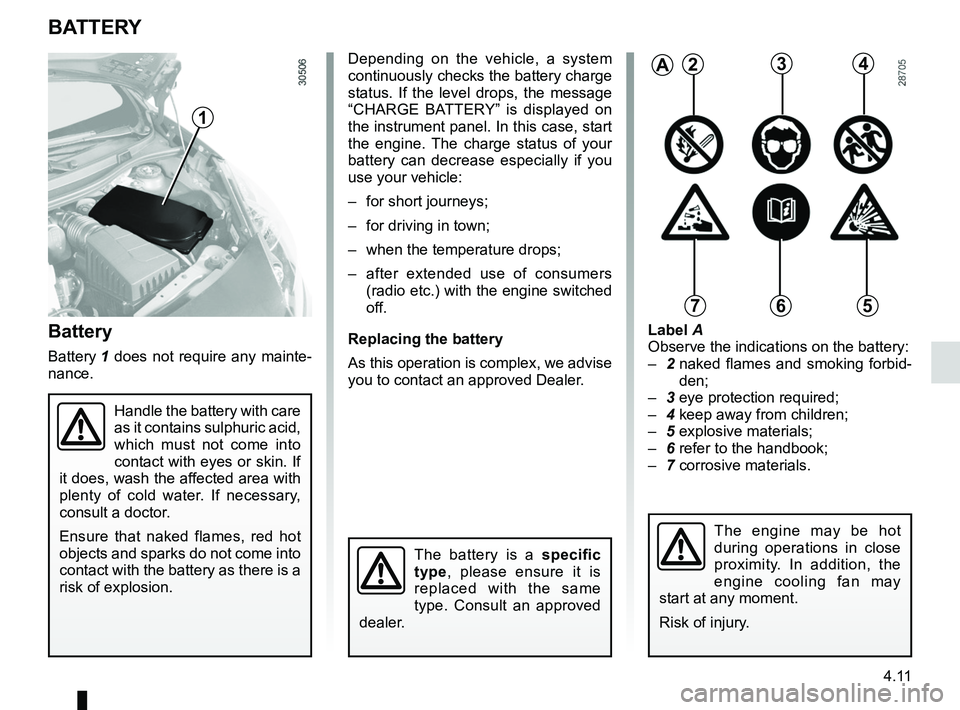
Battery 1 does not require any mainte-
nance.
Battery
Handle the battery with care
as it contains sulphuric acid,
which must not come into
contact with eyes or skin. If
it does, wash the affected area with
plenty of cold water. If necessary,
consult a doctor.
Ensure that naked flames, red hot
objects and sparks do not come into
contact with the battery as there is a
risk of explosion.
BA tteR y
Depending on the vehicle, a system
continuously checks the battery charge
status. If the level drops, the message
“CHARGE BATTERY ” is displayed on
the instrument panel. In this case, start
the engine. The charge status of your
battery can decrease especially if you
use your vehicle:
– for short journeys;
– for driving in town;
– when the temperature drops;
– after extended use of consumers
(radio etc.) with the engine switched
off.
Replacing the battery
As this operation is complex, we advise
you to contact an approved Dealer.
The engine may be hot
during operations in close
proximity. In addition, the
engine cooling fan may
start at any moment.
Risk of injury.
A234
567
The battery is a specific
type , please ensure it is
replaced with the same
type. Consult an approved
dealer.
1
label A
Observe the indications on the battery:
– 2 naked flames and smoking forbid-
den;
– 3 eye protection required;
– 4 keep away from children;
– 5 explosive materials;
– 6 refer to the handbook;
– 7 corrosive materials.
Page 127 of 185
5.1
ENG_UD29999_7
Sommaire 5 (E33 - X33 - Renault)
ENG_NU_865-6_E33_Renault_5
Section 5: Practical advice
Puncture . . . . . . . . . . . . . . . . . . . . . . . . . . . . . . . . . . . . . . . . . . . . . . . . . . . . . . . . . . . . . . . . . . . . . . 5.2
Emergency spare wheel . . . . . . . . . . . . . . . . . . . . . . . . . . . . . . . . . . . . . . . . . . . . . . . . . . . . . . . . . . 5.2
Tyre inflation kit . . . . . . . . . . . . . . . . . . . . . . . . . . . . . . . . . . . . . . . . . . . . . . . . . . . . . . . . . . . . . . . . . 5.3
Tool kit (jack, wheelbrace, etc.) . . . . . . . . . . . . . . . . . . . . . . . . . . . . . . . . . . . . . . . . . . . . . . . . . . . . . 5.6
Wheel trim . . . . . . . . . . . . . . . . . . . . . . . . . . . . . . . . . . . . . . . . . . . . . . . . . . . . . . . . . . . . . . . . . . . . . 5.6
Changing a wheel . . . . . . . . . . . . . . . . . . . . . . . . . . . . . . . . . . . . . . . . . . . . . . . . . . . . . . . . . . . . . . . 5.7
Tyres (tyre and wheel safety, use in winter) . . . . . . . . . . . . . . . . . . . . . . . . . . . . . . . . . . . . . . . . . . . 5.9
Rear lights (changing bulbs) . . . . . . . . . . . . . . . . . . . . . . . . . . . . . . . . . . . . . . . . . . . . . . . . . . . . . . . 5.14
Indicator lights (changing bulbs) . . . . . . . . . . . . . . . . . . . . . . . . . . . . . . . . . . . . . . . . . . . . . . . . . . . . 5.15
Interior lights (changing bulbs) . . . . . . . . . . . . . . . . . . . . . . . . . . . . . . . . . . . . . . . . . . . . . . . . . . . . . 5.17
Fuses . . . . . . . . . . . . . . . . . . . . . . . . . . . . . . . . . . . . . . . . . . . . . . . . . . . . . . . . . . . . . . . . . . . . . . . . . 5.19
Battery . . . . . . . . . . . . . . . . . . . . . . . . . . . . . . . . . . . . . . . . . . . . . . . . . . . . . . . . . . . . . . . . . . . . . . . . 5.22
Key, radio frequency remote control: battery . . . . . . . . . . . . . . . . . . . . . . . . . . . . . . . . . . . . . . . . . . . 5.24
Accessories . . . . . . . . . . . . . . . . . . . . . . . . . . . . . . . . . . . . . . . . . . . . . . . . . . . . . . . . . . . . . . . . . . . . 5.25
Wipers (replacing blades) . . . . . . . . . . . . . . . . . . . . . . . . . . . . . . . . . . . . . . . . . . . . . . . . . . . . . . . . . 5.26
Towing . . . . . . . . . . . . . . . . . . . . . . . . . . . . . . . . . . . . . . . . . . . . . . . . . . . . . . . . . . . . . . . . . . . . . . . . 5.27
Operating faults . . . . . . . . . . . . . . . . . . . . . . . . . . . . . . . . . . . . . . . . . . . . . . . . . . . . . . . . . . . . . . . . . 5.28
Page 132 of 185
tool kit ................................................... (up to the end of the DU)
hubcap tool ........................................... (up to the end of the DU)
jack ....................................................... (up to the end of the DU)
puncture ................................................ (up to the end of the DU)
wheelbrace ........................................... (up to the end of the DU)
trims ...................................................... (up to the end of the DU)
emergency spare wheel ....................... (up to the end of the DU)
wheelbrace ............................................................ (current page)
5.6
ENG_UD20555_2
Bloc-outils (E33 - X33 - Renault)
ENG_NU_865-6_E33_Renault_5
Tool kit (jack, wheelbrace, etc.)
Hubcap
t OOL KIt/WHeeL trIm – WHeeL
The tool kit is located in the luggage
compartment: lift the luggage compart-
ment carpet then unscrew the central
mounting.
The tools included in the tool kit depend
on the vehicle.
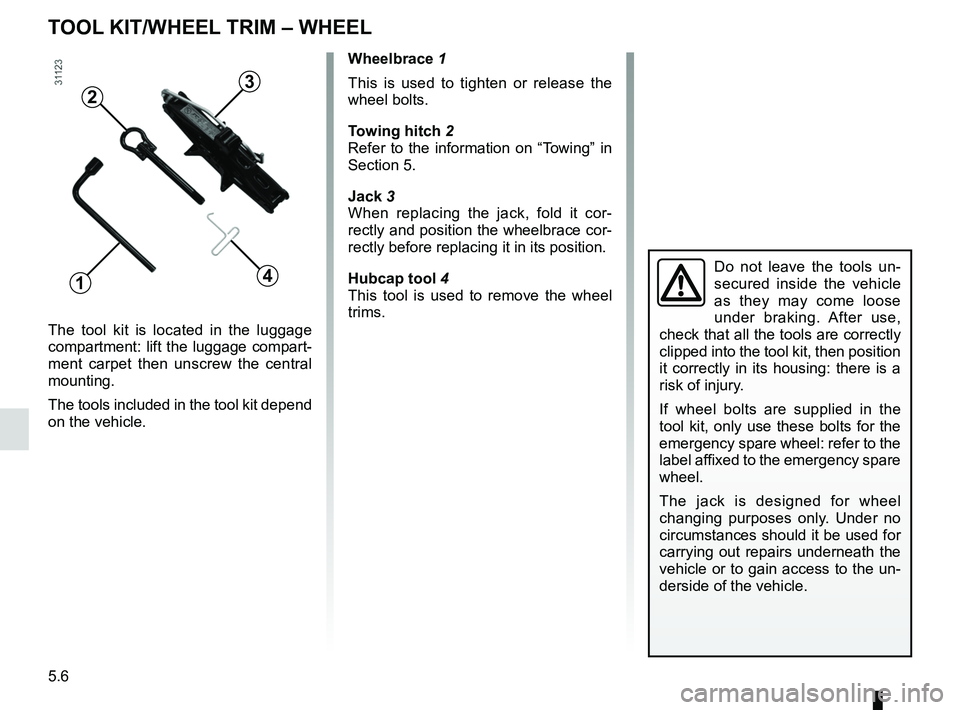
Wheelbrace 1
This is used to tighten or release the
wheel bolts.
towing hitch 2
Refer to the information on “Towing” in
Section 5.
Jack 3
When replacing the jack, fold it cor -
rectly and position the wheelbrace cor-
rectly before replacing it in its position.
Hubcap tool 4
This tool is used to remove the wheel
trims.
Do not leave the tools un -
secured inside the vehicle
as they may come loose
under braking. After use,
check that all the tools are correctly
clipped into the tool kit, then position
it correctly in its housing: there is a
risk of injury.
If wheel bolts are supplied in the
tool kit, only use these bolts for the
emergency spare wheel: refer to the
label affixed to the emergency spare
wheel.
The jack is designed for wheel
changing purposes only. Under no
circumstances should it be used for
carrying out repairs underneath the
vehicle or to gain access to the un-
derside of the vehicle.
1
23
4