lights RENAULT WIND ROADSTER 2012 Owner's Manual
[x] Cancel search | Manufacturer: RENAULT, Model Year: 2012, Model line: WIND ROADSTER, Model: RENAULT WIND ROADSTER 2012Pages: 185, PDF Size: 5.52 MB
Page 59 of 185
lights:main beam headlights ...................................... (current page)
warning buzzer ...................................................... (current page)
see-me-home lighting ............................................ (current page)
lights mobile directional ............................................. (current page)
JauneNoirNoir texte
1.53
ENG_UD21753_2
Éclairages et signalisations extérieurs (E33 - X33 - Renault)
ENG_NU_865-6_E33_Renault_1
Turning off the fog lights
Turn ring 3 again until mark 4 is oppo -
site the symbol for the fog light that you
wish to switch off. The corresponding
indicator light on the instrument panel
goes out.
The front and rear fog lights switch off
when the exterior lights are switched
off.
Special case
The front and rear fog lights do not op-
erate in automatic mode.
They only come on when the end of
ring 4 is in position
u or k.
EXTERIOR LIGHTING AND SIGNALS (2/2)
gFront fog lights
Turn centre ring 3 on stalk A
until the symbol faces mark 4, then re-
lease it.
Operation of the fog lights depends on
the exterior lighting position selected,
and an indicator light will light up on the
instrument panel.
Before driving at night:
check that the electrical
equipment is in good con -
dition. As a general precau -
tion, check that the lights are not
obscured (by dirt, mud, snow or ob-
jects which could cover them).
1A3
4
fRear fog lights
Turn centre ring 3 on stalk A
until the symbol faces mark 4, then re-
lease it.
Operation of the fog lights depends on
the exterior lighting selected, and an in-
dicator light will light up on the instru -
ment panel.
To avoid inconveniencing other road
users, remember to switch off the rear
fog light when it is no longer needed.
When driving in fog or snow, or
when transporting objects which are
higher than the roof, the headlights
do not come on automatically.
Switching on the fog lights remains
the responsibility of the driver: the
indicator lights on the instrument
panel inform you whether the fog
lights are lit (indicator light on) or not
(indicator light not on).
Page 63 of 185
JauneNoirNoir texte
1.57
ENG_UD24355_2
Réservoir à carburant (E33 - X33 - Renault)
ENG_NU_865-6_E33_Renault_1
No modifications what -
soever are permitted on
any part of the fuel supply
system (computers, wiring,
fuel circuit, injector, protection
covers, etc.) as this may be danger-
ous (such work must be undertaken
by qualified Network personnel).
FUEL TANK (2/2)
persistent smell of
fuel
If you notice a persistent
smell of fuel you should:
– stop the vehicle as soon as traf-
fic conditions allow and switch off
the ignition;
– switch on the hazard warning
lights and ask your passengers
to leave the vehicle and to keep
away from the traffic;
– contact an approved dealer.
Do not mix even small
amounts of petrol (un -
leaded or E85) with diesel.
Do not use ethanol-based
fuel if your vehicle is not compatible
with this fuel.
Do not add additive to the fuel –
otherwise you risk damaging the
engine.
Page 69 of 185
gear lever............................................................... (current page)
changing gear ....................................... (up to the end of the DU)
reverse gear selecting .......................................... (up to the end of the DU)
driving ................................................... (up to the end of the DU)
handbrake ............................................. (up to the end of the DU)
2.5
ENG_UD24356_2
Levier de vitesses (E33 - X33 - Renault)
ENG_NU_865-6_E33_Renault_2
Gearstick
Handbrake
GEAR LEVER/hANDbRAkE
Gear lever
Selecting reverse gear
With the vehicle stationary, move the
gear lever into neutral then into reverse.
Follow the grid shown on knob 1.
The reversing lights will come on as
soon as reverse gear is selected (with
the ignition on).
1
handbrake
t o release:
Pull lever 2 up slightly, press button 3
and then lower the lever to the floor.
t o apply:
Pull the lever 2 upwards and make sure
the vehicle is immobilised.
Depending on the gradient
and/or vehicle load, it may
be necessary when station-
ary to apply the brake by
at least a further two notches and
engage a gear (1
st or reverse gear).
Make sure that the hand -
brake is properly released
when driving (red indicator
light off), otherwise over -
heating may occur.
An impact to the underside
of the vehicle when revers-
ing (e.g. striking a raised
kerb) may result in damage
to the vehicle (eg. deformation of
the rear axle).
To avoid any risk of accident, have
your vehicle checked by an ap -
proved Dealer.
3
2
1
Page 71 of 185

ENG_NU_865-6_E33_Renault_2
ADVIcE: antipollution, fuel economy and driving (2")
JauneNoirNoir texte
2.7
ENG_UD20551_2
CONSEILS : antipollution, économies de carburant, conduite (E33 - X3\
3 - Renault)
ENG_NU_865-6_E33_Renault_2
ADVIcE: antipollution, fuel economy and driving (2/3)
Driving
– Drive carefully for the first few miles
until the engine reaches its normal
operating temperature, rather than
let it warm up while the vehicle is sta-
tionary.
– Speed is expensive.
– Sporty driving uses a lot of fuel: drive
with a light right foot.
– Do not overrev the engine in the in-
termediate gears.
Always use the highest gear possi -
ble without labouring the engine.
Exhaust gas monitoring
system
The exhaust gas monitoring system will
detect any operating faults in the vehi-
cle’s antipollution system.
If this system malfunctions, toxic sub -
stances may be released into the at -
mosphere or damage may occur.
ÄThis warning light on the in -
strument panel will indicate if
there are any faults in the system:
This lights up when the ignition is
switched on and goes out when the
engine is started.
– If it lights up continuously, consult
your approved dealer as soon as
possible;
– if it flashes, reduce the engine speed
until the light stops flashing. Contact
your approved dealer as soon as
possible. –
Avoid sudden acceleration.
– Brake as little as possible. If you an-
ticipate an obstacle or bend in ad -
vance, you may then simply release
the accelerator pedal.
– Do not try to maintain the same
speed up a hill, accelerate no more
than you would on the level. Keep
your foot in the same position on the
accelerator pedal.
– Double declutching and accelerating
before switching off are unnecessary
in modern vehicles.
– Bad weather, flooded roads:
Do not drive through floods
if the depth of water is
above the lower edge of the
wheel rims.
obstructions to the driver
On the driver ’s side, only
use mats adapted to the ve-
hicle that attach to the pre-
installed parts, and regularly check
their mounting. Do not place several
mats on top of each other.
Risk of pedals jamming
Page 72 of 185

2.8
ENG_UD20551_2
CONSEILS : antipollution, économies de carburant, conduite (E33 - X3\
3 - Renault)
ENG_N")
tyres ....................................................................... (current page)
2.8
ENG_UD20551_2
CONSEILS : antipollution, économies de carburant, conduite (E33 - X3\
3 - Renault)
ENG_NU_865-6_E33_Renault_2
ADVIcE: antipollution, fuel economy and driving (3/3)
Advice on use
– Electricity is fuel; switch off all the
electrical components which are
not really needed. however (safety
first), keep your lights on when the
visibility is bad (“see and be seen”).
– Use the air vents. Driving with the
windows open at 60 mph (100 km/h)
will increase fuel con -sumption by
4%.
– For vehicles fitted with air condi -
tioning , it is normal to observe an
increase in fuel consumption (es -
pecially in city conditions) when
it is used. For vehicles fitted with
manual air conditioning, switch off
the system when it is not required.
Advice for reducing consumption
and therefore helping to preserve
the environment:
Drive with the air vents open and the
windows closed.
If the vehicle has been parked in the
sun, open the doors for a few mo -
ments to let the hot air escape before
starting the engine.
– Never fill the fuel tank right to the
brim to avoid overflow.
– Avoid using the vehicle for door -
to-door calls (short journeys with
long waits in between) because the
engine never reaches its normal op-
erating temperature.
t yres
– An under-inflated tyre increases fuel
consumption.
– The use of non-recommended tyres
can increase fuel consumption.
Page 74 of 185
ABS ...................................................... (up to the end of the DU)
anti-lock braking system: ABS ..............(up to the end of the DU)
ESP: Electronic Stability Program ........ (up to the end of the DU)
ASR (traction control) ........................... (up to the end of the DU)
traction control: ASR .............................(up to the end of the DU)
Electronic Stability Program: ESP ........ (up to the end of the DU)
emergency brake assist ........................(up to the end of the DU)
emergency braking ............................... (up to the end of the DU)
traction control: ASR .............................................. (current page)
driving ................................................... (up to the end of the DU)
2.10
ENG_UD11192_1
Dispositifs de correction de conduite (E33 - X33 - Renault)
ENG_NU_865-6_E33_Renault_2
Jaune NoirNoir texte
Driver correction devices/aids
DRIVER coRREctIoN DEVIcES/AIDS (1/3)
In an emergency, apply firm and
continuous pressure to the brake
pedal. There is no need to pump
it repeatedly. The ABS will modu -
late the force applied in the braking
system.
These functions are an ad-
ditional aid in the event of
critical driving conditions,
enabling the vehicle behav -
iour to be adapted to suit the driving
conditions.
However, the functions do not take
the place of the driver. they do
not increase the vehicle’s limits
and should not encourage you
to drive more quickly. Therefore,
they can under no circumstances
replace the vigilance or responsibil -
ity of the driver when manoeuvring
the vehicle (the driver must always
be ready for sudden incidents which
may occur when driving).
Yo u r b r a k i n g s y s t e m s
are partially operational.
However, it is dangerous
to brake suddenly and
it is essential to stop immediately,
as soon as traffic conditions allow.
Contact an approved dealer.
Depending on the vehicle, this is com-
posed of:
– the (A bS) (anti-lock braking
system);
– the electronic stability program
(ESP) with understeer control and
traction control (ASR);
– emergency brake assist. operating faults:
–
If the
x and © indicator
lights on the instrument panel come
on, braking is still operational but
without AbS;
– If the
x, ®, © and
D indicator lights on the instru -
ment panel come on when driving,
this indicates a fault with the braking
and AbS systems.
In both cases, consult an approved
Dealer.
AbS (anti-lock braking
system)
Under heavy braking, the ABS prevents
the wheels from locking, allowing the
stopping distance to be managed and
keeping control of the vehicle.
Under these circumstances, the vehi -
cle can be steered to avoid an obstacle
whilst braking. In addition, this system
can increase stopping distances, par -
ticularly on roads with low surface grip
(wet ground etc.).
You will feel a pulsation through the
brake pedal each time the system is
activated. The ABS does not in any way
improve the vehicle's physical perform-
ance relating to the road surface and
roadholding. It is still essential to follow
the rules of good driving practice (such
as driving at a safe distance from the
vehicle in front etc.).
Page 76 of 185
2.12
ENG_UD11192_1
Dispositifs de correction de conduite (E33 - X33 - Renault)
ENG_NU_865-6_E33_Renault_2
DRIVER coRREctIoN DEVIcES/AIDS (3/3)
Disabling the function
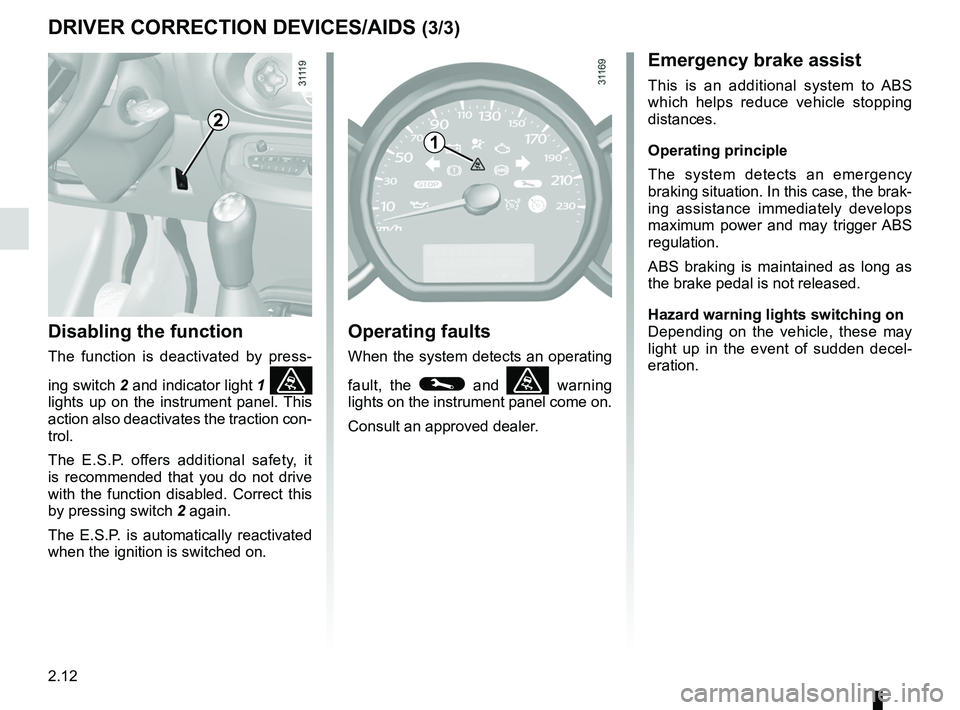
The function is deactivated by press -
ing switch 2 and indicator light 1
ù
lights up on the instrument panel. This
action also deactivates the traction con-
trol.
The E.S.P. offers additional safety, it
is recommended that you do not drive
with the function disabled. Correct this
by pressing switch 2 again.
The E.S.P. is automatically reactivated
when the ignition is switched on.
operating faults
When the system detects an operating
fault, the
© and ù warning
lights on the instrument panel come on.
Consult an approved dealer.
Emergency brake assist
This is an additional system to ABS
which helps reduce vehicle stopping
distances.
operating principle
The system detects an emergency
braking situation. In this case, the brak-
ing assistance immediately develops
maximum power and may trigger ABS
regulation.
ABS braking is maintained as long as
the brake pedal is not released.
hazard warning lights switching on
Depending on the vehicle, these may
light up in the event of sudden decel -
eration.
2
1
Page 81 of 185

ENG_NU_865-6_E33_Renault_2
cRUISE coNtRoL - SPEED LIMItER: cruise control functi")
JauneNoirNoir texte
2.17
ENG_UD11194_1
Régulateur-limiteur de vitesse : fonction régulateur (E33 - X33 -\
Renault)
ENG_NU_865-6_E33_Renault_2
cRUISE coNtRoL - SPEED LIMItER: cruise control function (2/4)
Activating cruise controlAt a steady speed (above 20 mph
( 3 0 k m / h ) a p p r o x i m a t e l y ) p r e s s
switch 2 (+) or 3 (-): the function is ac -
tivated and the current speed is memo-
rised.
Cruise control activation is confirmed
when indicator light 7 lights up in addi -
tion to indicator light 6.Driving
Once a cruising speed is stored and
the cruise control function is active,
you may lift your foot off the accelera -
tor pedal.
Important: you are never -
theless advised to keep
your feet close to the pedals
in order to react if neces -
sary.
1
Switching on
Press switch 1 on the side showing .
Warning light 6 comes on, lit green, and
the message “CRUISE CONTROL” ap-
pears on instrument panel, accom -
panied by dashes to indicate that the
cruise control function is activated and
waiting to memorise a cruising speed.
67
23
Page 83 of 185

ENG_NU_865-6_E33_Renault_2
cRUISE coNtRoL - SPEED LIMItER: cruise control functi")
JauneNoirNoir texte
2.19
ENG_UD11194_1
Régulateur-limiteur de vitesse : fonction régulateur (E33 - X33 -\
Renault)
ENG_NU_865-6_E33_Renault_2
cRUISE coNtRoL - SPEED LIMItER: cruise control function (4/4)
1
2345
Switching off the function
The cruise control function is deacti -
vated if you press switch 1: in this case
a speed is no longer memorised.
The
and indicator lights on the
instrument panel go out, confirming that
the function is deactivated.
Recalling the cruising speed
If a speed is stored, it can be recalled,
once you are sure that the road condi -
tions are suitable (traffic, road surface,
weather conditions, etc.).
With a vehicle speed above 20 mph (30
km/h), press switch 5 (R).
Note: if the speed previously stored is
much higher than the current speed,
the vehicle will accelerate more rapidly
to reach this threshold.
When the cruise control is set to
standby, pressing switch 2 (+) re -
activates the cruise control func -
tion without taking into account
the stored speed: it is the speed at
which the vehicle is moving that is
taken into account.Putting the cruise control
on standby or switching it
off does not cause a rapid
reduction in speed: you
must brake by depressing the brake
pedal.
Putting the function on
standby
The function is suspended when you:
– button 4 (O);
– depress the brake pedal;
– the clutch pedal or shift into neutral
if the vehicle has an automatic gear-
box.
In all three cases, the cruising speed
remains memorised and the message
“SPEED MEMORY” appears on the in-
strument panel.
Standby is confirmed when the green
indicator light goes out.
Page 96 of 185
air conditioning ..................................... (up to the end of the DU)
heating system ..................................... (up to the end of the DU)
temperature regulation ......................... (up to the end of the DU)
ventilation ............................................. (up to the end of the DU)
air conditioning ..................................... (up to the end of the DU)
3.12
ENG_UD11200_1
Air conditionné automatique (E33 - X33 - Renault)
ENG_NU_865-6_E33_Renault_3
Jaune NoirNoir texte
Automatic climate control
autoMatiC CliMate ContRol (1/6)
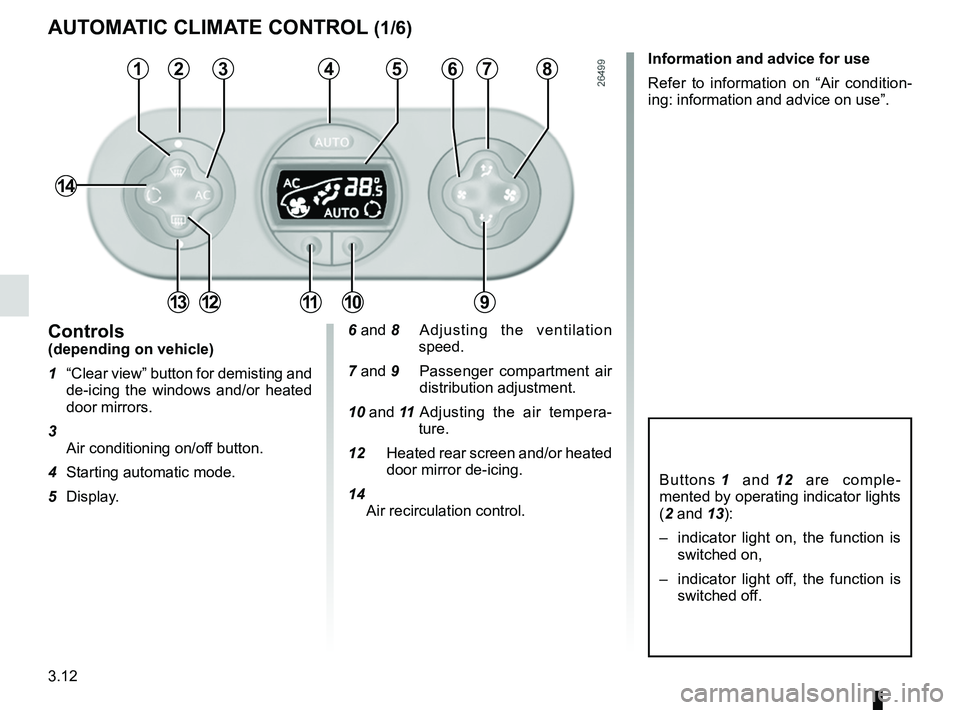
Controls(depending on vehicle)
1 “Clear view” button for demisting and
de-icing the windows and/or heated
door mirrors.
3 Air conditioning on/off button.
4 Starting automatic mode.
5 Display. 6 and 8
Adjusting the ventilation
speed.
7 and 9 Passenger compartment air
distribution adjustment.
10 and 11 Adjusting the air tempera -
ture.
12 Heated rear screen and/or heated
door mirror de-icing.
14 Air recirculation control.
4568
101113
13
Buttons 1 and 12 are comple -
mented by operating indicator lights
(2 and 13):
– indicator light on, the function is
switched on,
– indicator light off, the function is
switched off.
information and advice for use
Refer to information on “Air condition -
ing: information and advice on use”.27
9
14
12