warning lights RENAULT ZOE 2017 1.G Owner's Manual
[x] Cancel search | Manufacturer: RENAULT, Model Year: 2017, Model line: ZOE, Model: RENAULT ZOE 2017 1.GPages: 220, PDF Size: 4.07 MB
Page 133 of 220
3.7
Depending on the vehicle, the system
determines whether or not air recircula-
tion is used, based on the quality of the
outside air.
The air quality is confirmed by the ap-
pearance of one of the following warn-
ing lights on the multimedia display (for
the cleanest and the least clean air re-
spectively):
.
AUTOMATIC AIR-CONDITIONING (4/4)
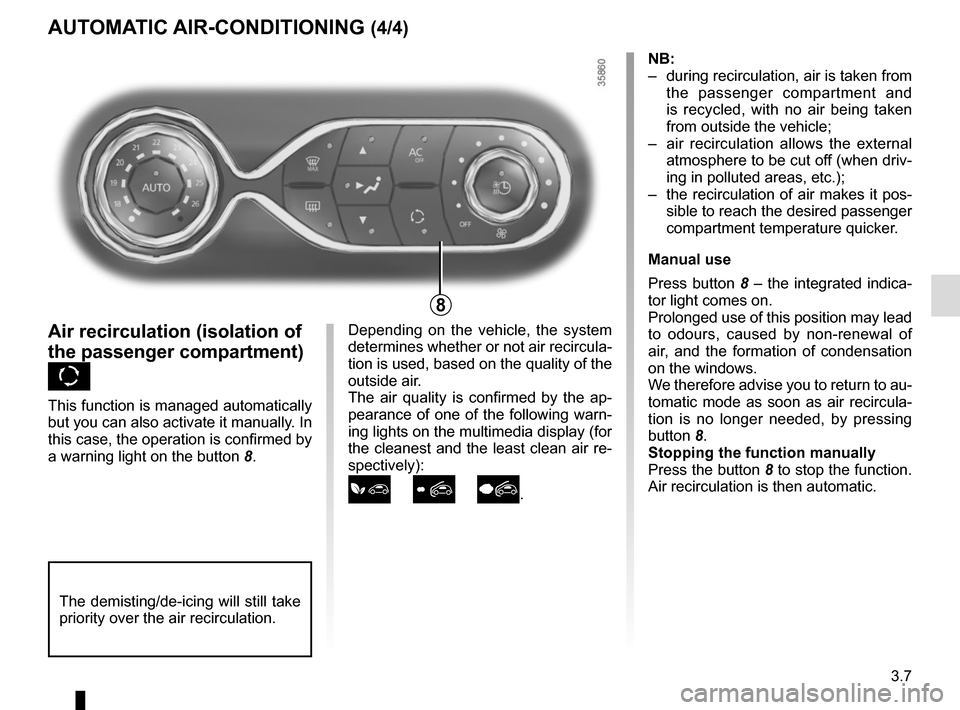
Air recirculation (isolation of
the passenger compartment)
K
This function is managed automatically
but you can also activate it manually. In
this case, the operation is confirmed by
a warning light on the button 8. NB:
– during recirculation, air is taken from
the passenger compartment and
is recycled, with no air being taken
from outside the vehicle;
– air recirculation allows the external atmosphere to be cut off (when driv-
ing in polluted areas, etc.);
– the recirculation of air makes it pos- sible to reach the desired passenger
compartment temperature quicker.
Manual use
Press button 8 – the integrated indica-
tor light comes on.
Prolonged use of this position may lead
to odours, caused by non-renewal of
air, and the formation of condensation
on the windows.
We therefore advise you to return to au-
tomatic mode as soon as air recircula-
tion is no longer needed, by pressing
button 8.
Stopping the function manually
Press the button 8 to stop the function.
Air recirculation is then automatic.
8
The demisting/de-icing will still take
priority over the air recirculation.
Page 134 of 220
3.8
AIR CONDITIONING: remote activation
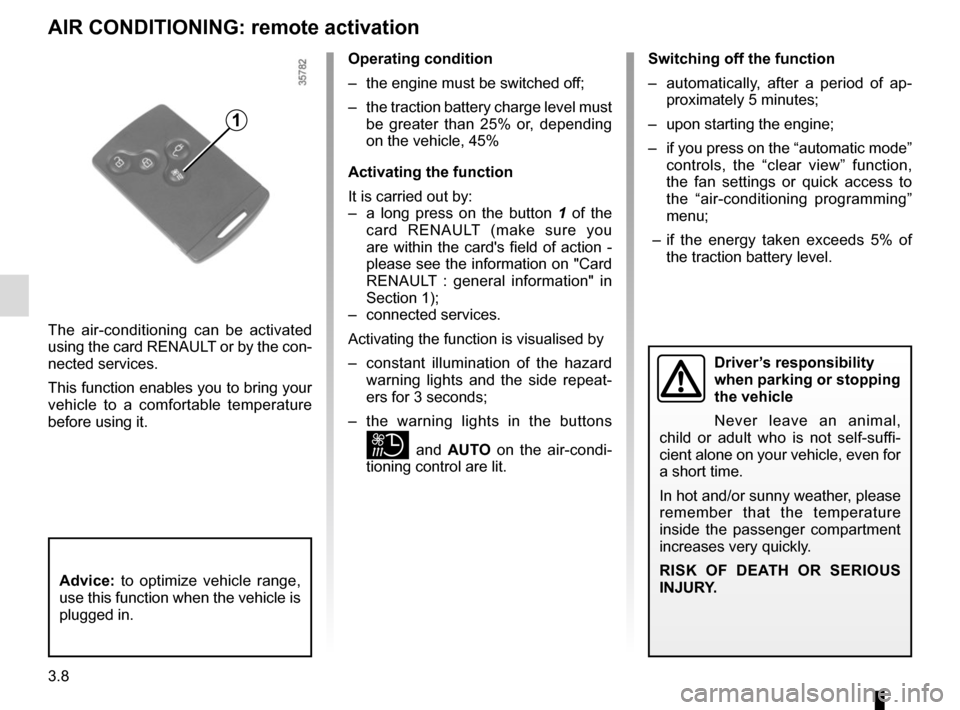
The air-conditioning can be activated
using the card RENAULT or by the con-
nected services.
This function enables you to bring your
vehicle to a comfortable temperature
before using it.
1
Operating condition
– the engine must be switched off;
– the traction battery charge level must be greater than 25% or, depending
on the vehicle, 45%
Activating the function
It is carried out by:
– a long press on the button 1 of the
card RENAULT (make sure you
are within the card's field of action -
please see the information on "Card
RENAULT : general information" in
Section 1);
– connected services.
Activating the function is visualised by
– constant illumination of the hazard warning lights and the side repeat-
ers for 3 seconds;
– the warning lights in the buttons
and AUTO on the air-condi-
tioning control are lit. Switching off the function
– automatically, after a period of ap-
proximately 5 minutes;
– upon starting the engine;
– if you press on the “automatic mode” controls, the “clear view” function,
the fan settings or quick access to
the “air-conditioning programming”
menu;
– if the energy taken exceeds 5% of the traction battery level.
Driver’s responsibility
when parking or stopping
the vehicle
Never leave an animal,
child or adult who is not self-suffi-
cient alone on your vehicle, even for
a short time.
In hot and/or sunny weather, please
remember that the temperature
inside the passenger compartment
increases very quickly.
RISK OF DEATH OR SERIOUS
INJURY.
Advice: to optimize vehicle range,
use this function when the vehicle is
plugged in.
Page 136 of 220
3.10
AIR CONDITIONING: programming (2/4)
The two programmed times cannot
be activated simultaneously.
A
12
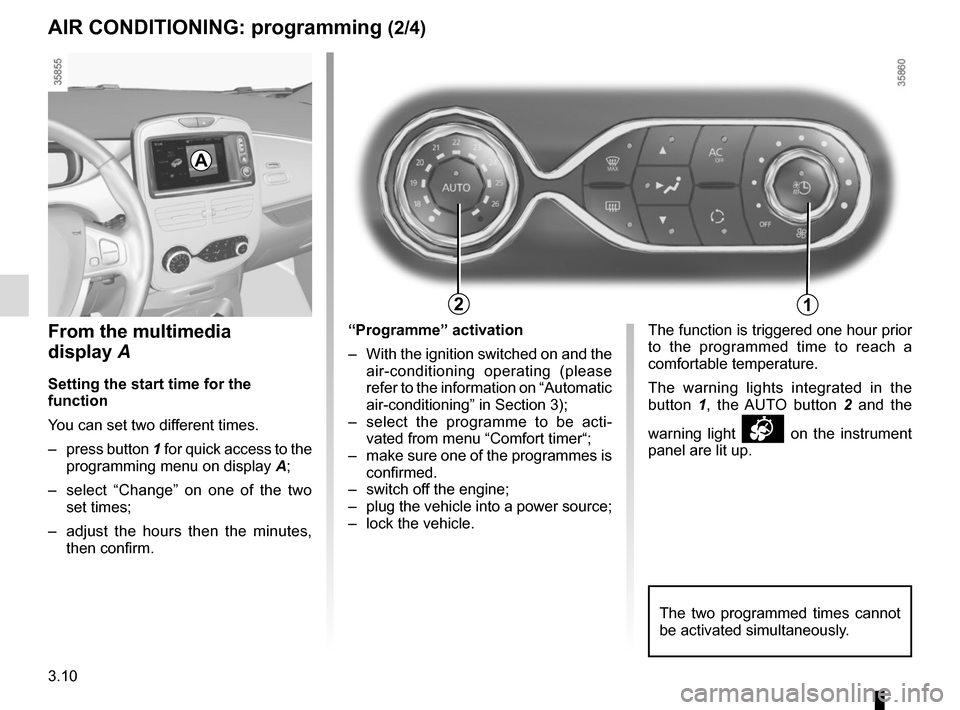
From the multimedia
display A
Setting the start time for the
function
You can set two different times.
– press button 1 for quick access to the
programming menu on display A;
– select “Change” on one of the two set times;
– adjust the hours then the minutes, then confirm. The function is triggered one hour prior
to the programmed time to reach a
comfortable temperature.
The warning lights integrated in the
button
1, the AUTO button 2 and the
warning light
on the instrument
panel are lit up.
“Programme” activation
– With the ignition switched on and the
air-conditioning operating (please
refer to the information on “Automatic
air-conditioning” in Section 3);
– select the programme to be acti- vated from menu “Comfort timer“;
– make sure one of the programmes is confirmed.
– switch off the engine;
– plug the vehicle into a power source;
– lock the vehicle.
Page 138 of 220

3.12
Stopping the programmed air
conditioning
The air conditioning stops automati-
cally around ten minutes after the set
end time.
However, the function can be deacti-
vated if:
– the charging socket is disconnected;
– the “Remote Activation” function is activated – please see the informa-
tion on “Air conditioning: remote acti-
vation” in Section 2;
– the traction battery charging level is lower than 15% or, depending on the
vehicle, 30%Driver’s responsibility
when parking or stopping
the vehicle
Never leave an animal,
child or adult who is not self-suffi-
cient alone on your vehicle, even for
a short time.
In hot and/or sunny weather, please
remember that the temperature
inside the passenger compartment
increases very quickly.
RISK OF DEATH OR SERIOUS
INJURY.
AIR CONDITIONING: programming (4/4)
Connected services
The air conditioning can also be acti-
vated using the connected services.
For more information regarding the op-
erating conditions, please contact an
authorised dealer.
“Programme” activation
– With the ignition switched on and the air-conditioning operating (please
refer to the information on “Automatic
air-conditioning” in Section 3);
– press the button 1.
The function is triggered one hour prior
to the programmed time to reach a
comfortable temperature.
The warning lights integrated in the
button 1, the AUTO button 2 and the
warning light
on the instrument
panel are lit up.
12
Page 172 of 220
5.4
TYRE PRESSURE KIT (2/3)
Depending on the vehicle, in the event
of a puncture, use the kit located in the
boot or underneath the luggage com-
partment carpet.
Vehicle fitted with a tyre pressure
loss warning system
If under-inflated (puncture, low pres-
sure, etc.), the warning light
lights up on the instrument panel. See
“Tyre pressure loss warning” in
Section 2.
With the engine running and the
parking brake applied,
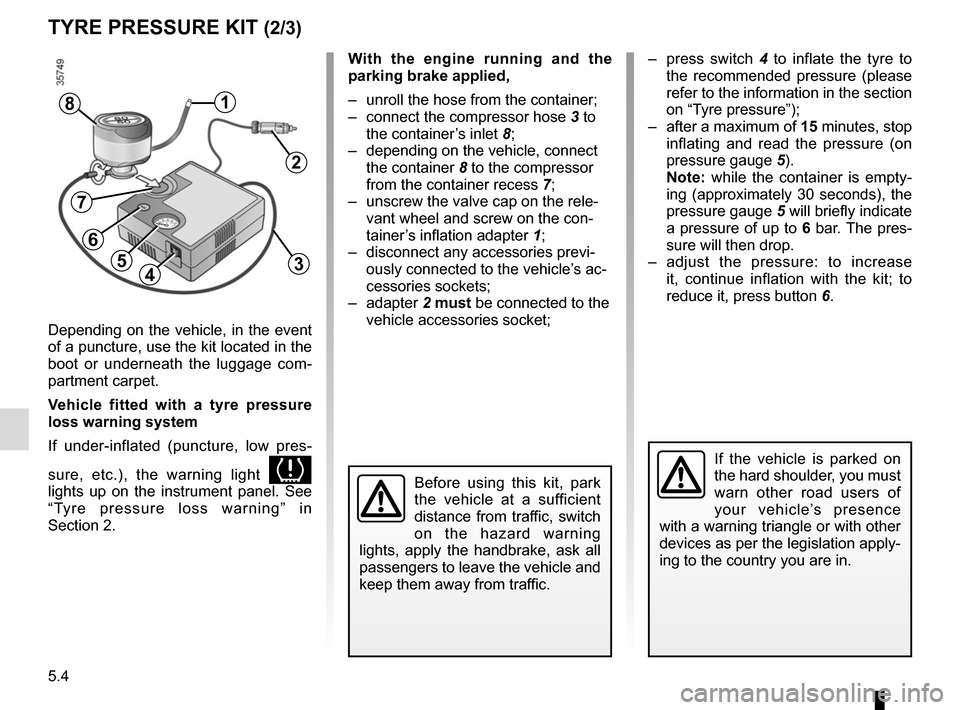
– unroll the hose from the container;
– connect the compressor hose 3 to
the container’s inlet 8;
– depending on the vehicle, connect the container 8 to the compressor
from the container recess 7;
– unscrew the valve cap on the rele- vant wheel and screw on the con-
tainer’s inflation adapter 1;
– disconnect any accessories previ- ously connected to the vehicle’s ac-
cessories sockets;
– adapter 2 must be connected to the
vehicle accessories socket;
45
1
Before using this kit, park
the vehicle at a sufficient
distance from traffic, switch
on the hazard warning
lights, apply the handbrake, ask all
passengers to leave the vehicle and
keep them away from traffic.
8
If the vehicle is parked on
the hard shoulder, you must
warn other road users of
your vehicle’s presence
with a warning triangle or with other
devices as per the legislation apply-
ing to the country you are in.
– press switch 4 to inflate the tyre to
the recommended pressure (please
refer to the information in the section
on “Tyre pressure”);
– after a maximum of 15 minutes, stop inflating and read the pressure (on
pressure gauge 5).
Note: while the container is empty-
ing (approximately 30 seconds), the
pressure gauge 5 will briefly indicate
a pressure of up to 6 bar. The pres-
sure will then drop.
– adjust the pressure: to increase it, continue inflation with the kit; to
reduce it, press button 6.
2
3
7
6
Page 188 of 220
5.20
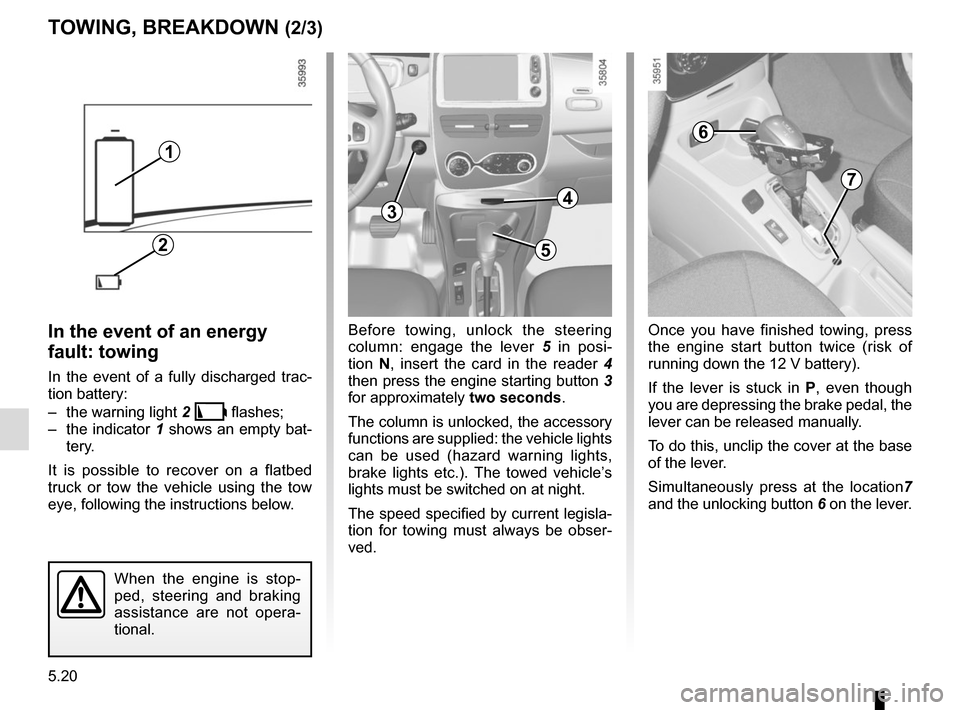
Once you have finished towing, press
the engine start button twice (risk of
running down the 12 V battery).
If the lever is stuck in P, even though
you are depressing the brake pedal, the
lever can be released manually.
To do this, unclip the cover at the base
of the lever.
Simultaneously press at the location 7
and the unlocking button 6 on the lever.
TOWING, BREAKDOWN (2/3)
6
7
In the event of an energy
fault: towing
In the event of a fully discharged trac-
tion battery:
– the warning light 2
Ṏ flashes;
– the indicator 1 shows an empty bat-
tery.
It is possible to recover on a flatbed
truck or tow the vehicle using the tow
eye, following the instructions below.
When the engine is stop-
ped, steering and braking
assistance are not opera-
tional.
Before towing, unlock the steering
column: engage the lever 5 in posi-
tion N, insert the card in the reader 4
then press the engine starting button 3
for approximately two seconds.
The column is unlocked, the accessory
functions are supplied: the vehicle lights
can be used (hazard warning lights,
brake lights etc.). The towed vehicle’s
lights must be switched on at night.
The speed specified by current legisla-
tion for towing must always be obser-
ved.
3
5
4
1
2
Page 214 of 220
7.2
ALPHABETICAL INDEX (2/5)
E
»ECO» mode function ......................................................... 2.9
ECO driving ...............................................................2.7 → 2.9
ECO mode ........................................................................\
... 2.9
electric beam height adjustment ........................................ 1.84
»400 volt» electrical circuit ........................................1.2 → 1.6
electric vehicle vehicle range .................................................... 2.10 – 2.11
noise ..................................................................\
............ 1.6
charge ................................................................1.8 → 1.15
driving ........................................................ 1.6, 2.10 – 2.11
presentation .........................................................1.2 → 1.6
important recommendations .......................................... 1.7
electric windows ..................................................... 3.16 – 3.17
Electronic Stability Program: ESP .........................2.16 → 2.20
emergency brake assist.........................................2.16 → 2.20
emergency braking ................................................2.16 → 2.20
emergency key ....................................................... 1.18 – 1.19
energy »ECO» mode ................................................................. 2.9
saving .................................................................\
......... 2.10
charge meter (function) .................................................. 2.7
range ..................................................................\
..2.7 → 2.9
energy saving .......................................................... 2.7 → 2.11
energy consumption ........................... 1.65 – 1.66, 2.10 – 2.11
energy recovery ................................................................. 2.10
engine specifications ........................................................... 6.3
environment ............................................................\
........... 2.12
ESP: Electronic Stability Program .........................2.16 → 2.20
external temperature .............................................. 1.75 – 1.76
F
faults operating faults ................................................5.22 → 5.25
fitting a radio ...................................................................... 5.16
fittings ...............................................................\
.....3.19 → 3.21fragrance diffuser ............................................................... 3.13
fragrance ..............................................................\
............. 3.13
front passenger air bag deactivation ................................. 1.55
front seat adjustment ......................................................... 1.32
front seats adjustment .......................................................1.32 → 1.36
with manual controls .................................................... 1.32
fuses ....................................................................... 5.13 – 5.14
G
gear lever.................................................................... 2.5 – 2.6
glove box ........................................................................\
... 3.21
H
handbrake........................................................................\
.... 2.6
hands-free telephone integrated control ............................ 3.29
hazard warning lights signal ..................................... 1.79, 1.81
headlight beam adjustment ............................................... 1.84
headlight flashers .............................................................. 1.79
headlight washer ............................................................... 1.86
headrest........................................................................\
..... 3.23
heating and air conditioning system .................................. 3.15
heating, air conditioning: programming .......... 2.11, 3.9 → 3.12
heating system ...................................... 3.4 → 3.7, 3.9 → 3.12
heating/air conditioning programming .....................3.9 → 3.12
horn ...................................................................\
................ 1.79
horn: flash ..................................................................\
........... 1.79
sounding the horn ........................................................ 1.79
hubcap tool ........................................................................\
.. 5.2
I
indicators .............................................................\
....... 1.79, 5.9
indicators: direction indicators ................................................ 1.79, 5.9
exterior temperature indicator ...................................... 1.75
Page 215 of 220
7.3
ALPHABETICAL INDEX (3/5)
instrument panel ..............................................1.62 → 1.68
instrument panel ...........................................1.62 → 1.74, 1.81
instrument panel messages...................................1.67 → 1.74
interior trim maintenance ..................................................... 4.11 – 4.12
ionizer ................................................................\
................ 3.14
L
levels: brake fluid ...................................................................... 4.5
coolant ................................................................\
........... 4.4
windscreen washer reservoir ......................................... 4.5
lighting: exterior .............................................................1.81 → 1.83
instrument panel .......................................................... 1.81
interior ...............................................................\
.. 3.18, 5.12
lights adjustment .............................................................\
...... 1.84
lights: adjusting ..............................................................\
........ 1.84
brake lights ....................................................... 5.10 – 5.11
dipped beam headlights ............................... 1.62, 1.81, 5.9
direction indicators ............................ 1.62, 1.79, 5.9 – 5.10
fog lights .................................................... 1.62, 1.83, 5.11
hazard warning ............................................................ 1.79
indicator lights .............................................................. 5.11
main beam headlights .................................. 1.62, 1.82, 5.9
number plate lights ...................................................... 5.11
reversing lights ............................................................. 5.11
side lights ............................................................ 1.81, 5.10
locking the doors ..........................................1.18 → 1.28, 1.31
M
maintenance: bodywork ............................................................ 4.9 – 4.10
interior trim ........................................................ 4.11 – 4.12 mechanical .........................................4.2 – 4.3, 6.7
→ 6.12
map reading lights ............................................................. 3.18
methods of restraint in addition to the seat belts ...1.37 → 1.43
multimedia (equipment) ..................................................... 3.29
multimedia equipment .............................................. 3.29, 5.16
N
navigation .............................................................\
............. 3.29
navigation system .............................................................. 3.29
O
opening the doors ..................................................1.27 → 1.30
operating faults .............................................1.73, 5.22 → 5.25
P
paintwork maintenance ....................................................... 4.9 – 4.10
parking distance control.........................................2.28 → 2.31
pedestrian warning system ................................................ 1.80
power-assisted steering..................................................... 1.77
practical advice ....................................................... 2.10 – 2.11
presentation of the electric vehicle important recommendations .......................................... 1.7
pretensioners .........................................................1.37 → 1.40
R
radio........................................................................\
........... 3.29
range of the traction battery.......................................2.7 → 2.9
rear bench seat.................................................................. 3.24
rear parcel shelf ................................................................. 3.25
rear seats functions ..............................................................\
........ 3.24
rear view camera .................................................... 2.30 – 2.31
rear view mirrors ................................................................ 1.78
RENAULT ANTI-INTRUDER DEVICE (RAID) ................... 1.31
Page 216 of 220

RENAULT cardbattery ................................................................\
.......... 5.15
use ............................................................1.18")
7.4
ALPHABETICAL INDEX (4/5)
RENAULT cardbattery ................................................................\
.......... 5.15
use ............................................................1.18 → 1.26, 3.8
RENAULT card battery ...................................................... 5.15
replacement parts ................................................................ 6.6
reverse gear selecting ................................................................ 2.5 – 2.6
reversing sensor ..................................................... 2.28 – 2.29
S
screen wash/wipe .............................................................. 1.87
seat belt pretensioners ..........................................1.37 → 1.40
front seat belt ...................................................1.37 → 1.40
seat belts ..................................1.33 → 1.40, 1.42 – 1.43, 1.63
see-me-home lighting ............................................... 1.82, 1.84
service sheets..........................................................6.7 → 6.12
side protection devices ...................................................... 1.42
signals and lights ...................................................1.81 → 1.84
speakers location ...............................................................\
......... 5.16
speed control .............................................................. 2.5 – 2.6
speed limiter .................................................1.63, 2.21 → 2.23
spoiler ................................................................\
................ 3.27
starting ...............................................................\
........2.2 → 2.4
starting the engine .....................................................2.2 → 2.4
steering wheel adjustment .............................................................\
...... 1.77
stopping the engine ............................................................. 2.4
storage compartment.............................................3.19 → 3.21
storage compartments ...........................................3.19 → 3.21
sun visor ........................................................................\
.... 3.18
T
tailgate ...............................................................\
................ 3.27
tanks and reservoirs brake fluid ...................................................................... 4.5 coolant ................................................................\
........... 4.4
tanks and reservoirs: windscreen washer ........................................................ 4.5
technical specifications ........................................................ 6.6
telephone ..............................................................\
............. 3.29
temperature regulation ..............................................3.4 → 3.7
tool kit ........................................................................\
.......... 5.2
towing in the event of energy failure ...........................5.19 → 5.21
breakdown .......................................................5.19 → 5.21
towing hitch...................................................... 5.2, 5.20 – 5.21
towing rings ................................................... 1.47 – 1.48, 3.28
traction battery ...........................................................1.2 → 1.6
traction battery charge .............................................1.8 → 1.15
traction control .......................................................2.16 → 2.20
transporting children ..........................1.44 – 1.45, 1.47 → 1.57
transporting objects in the luggage compartment ............................. 3.27 – 3.28
trip computer and warning system.........................1.67 → 1.74
tyre inflation kit...........................................................5.3 → 5.5
tyre pressure............................................2.13 → 2.15, 4.8, 5.7
tyre pressure loss warning.....................................2.13 → 2.15
tyre pressures ...................................................................... 4.8
tyres .............................................. 2.13 → 2.15, 4.8, 5.6 → 5.8
U
unlocking the doors ................................................ 1.29 – 1.30
V
vehicle range ........................................................... 2.7 → 2.11
ventilation ............................................................\
......3.4 → 3.7
W
warning buzzer ..................................... 1.27 – 1.28, 1.79, 1.82
warning lights.....................................1.62 →
1.64, 1.67 – 1.68
washing .................................................................... 4.9 – 4.10