brake light RENAULT ZOE 2018 User Guide
[x] Cancel search | Manufacturer: RENAULT, Model Year: 2018, Model line: ZOE, Model: RENAULT ZOE 2018Pages: 226, PDF Size: 5.51 MB
Page 121 of 226
2.27
CRUISE CONTROL (4/4)
When the cruise control function is
put on standby, pressing switch 2
(+) reactivates the cruise control
function without taking into account
the stored speed: it is the speed at
which the vehicle is moving that is
taken into account.Putting the cruise control
on standby or switching it
off does not cause a rapid
reduction in speed: you
must brake by depressing the brake
pedal.
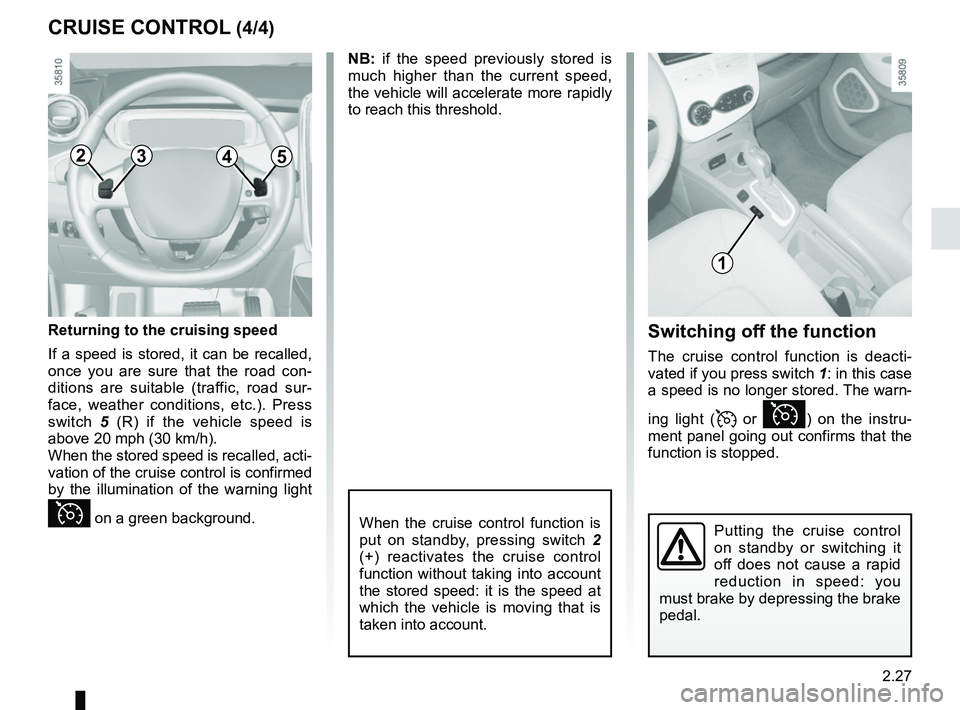
NB: if the speed previously stored is
much higher than the current speed,
the vehicle will accelerate more rapidly
to reach this threshold.
Switching off the function
The cruise control function is deacti-
vated if you press switch 1: in this case
a speed is no longer stored. The warn-
ing light (
or Ï) on the instru-
ment panel going out confirms that the
function is stopped.
2354
1
Returning to the cruising speed
If a speed is stored, it can be recalled,
once you are sure that the road con-
ditions are suitable (traffic, road sur-
face, weather conditions, etc.). Press
switch 5 (R) if the vehicle speed is
above 20 mph (30 km/h).
When the stored speed is recalled, acti-
vation of the cruise control is confirmed
by the illumination of the warning light
Ï on a green background.
Page 156 of 226
3.30
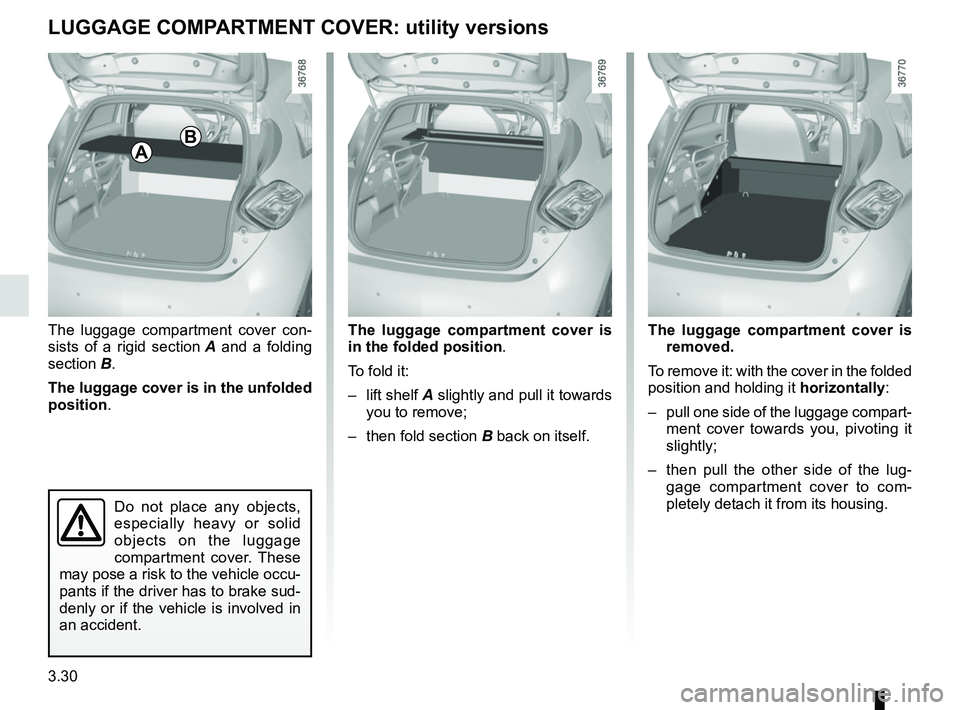
The luggage compartment cover con-
sists of a rigid section A and a folding
section B.
The luggage cover is in the unfolded
position . The luggage compartment cover is
removed.
To remove it: with the cover in the folded
position and holding it horizontally:
– pull one side of the luggage compart- ment cover towards you, pivoting it
slightly;
– then pull the other side of the lug- gage compartment cover to com-
pletely detach it from its housing.
LUGGAGE COMPARTMENT COVER: utility versions
Do not place any objects,
especially heavy or solid
objects on the luggage
compartment cover. These
may pose a risk to the vehicle occu-
pants if the driver has to brake sud-
denly or if the vehicle is involved in
an accident.
The luggage compartment cover is
in the folded position .
To fold it:
– lift shelf A slightly and pull it towards
you to remove;
– then fold section B back on itself.
AB
Page 165 of 226
4.5
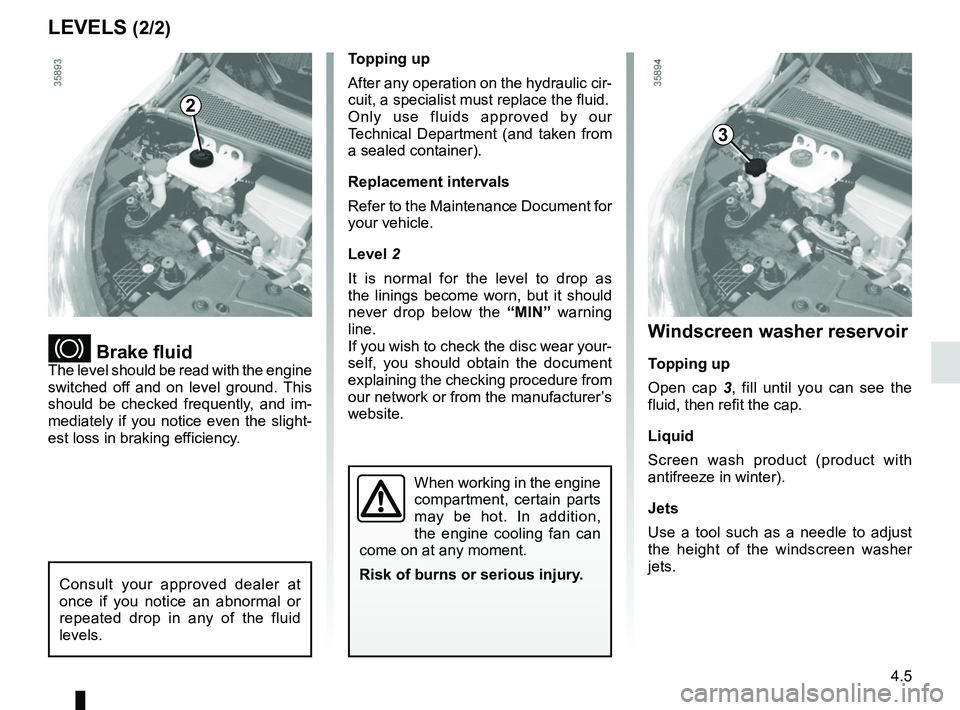
Windscreen washer reservoir
Topping up
Open cap 3, fill until you can see the
fluid, then refit the cap.
Liquid
Screen wash product (product with
antifreeze in winter).
Jets
Use a tool such as a needle to adjust
the height of the windscreen washer
jets.
3
2
Brake fluidThe level should be read with the engine
switched off and on level ground. This
should be checked frequently, and im-
mediately if you notice even the slight-
est loss in braking efficiency. Topping up
After any operation on the hydraulic cir-
cuit, a specialist must replace the fluid.
Only use fluids approved by our
Technical Department (and taken from
a sealed container).
Replacement intervals
Refer to the Maintenance Document for
your vehicle.
Level 2
It is normal for the level to drop as
the linings become worn, but it should
never drop below the
“MIN” warning
line.
If you wish to check the disc wear your-
self, you should obtain the document
explaining the checking procedure from
our network or from the manufacturer’s
website.
Consult your approved dealer at
once if you notice an abnormal or
repeated drop in any of the fluid
levels.
LEVELS (2/2)
When working in the engine
compartment, certain parts
may be hot. In addition,
the engine cooling fan can
come on at any moment.
Risk of burns or serious injury.
Page 178 of 226
5.4
TYRE PRESSURE KIT (2/3)
Depending on the vehicle, in the event
of a puncture, use the kit located in the
boot or underneath the luggage com-
partment carpet.
Vehicle fitted with a tyre pressure
loss warning system
If under-inflated (puncture, low pres-
sure, etc.), the warning light
lights up on the instrument panel. See
“Tyre pressure loss warning” in
Section 2.
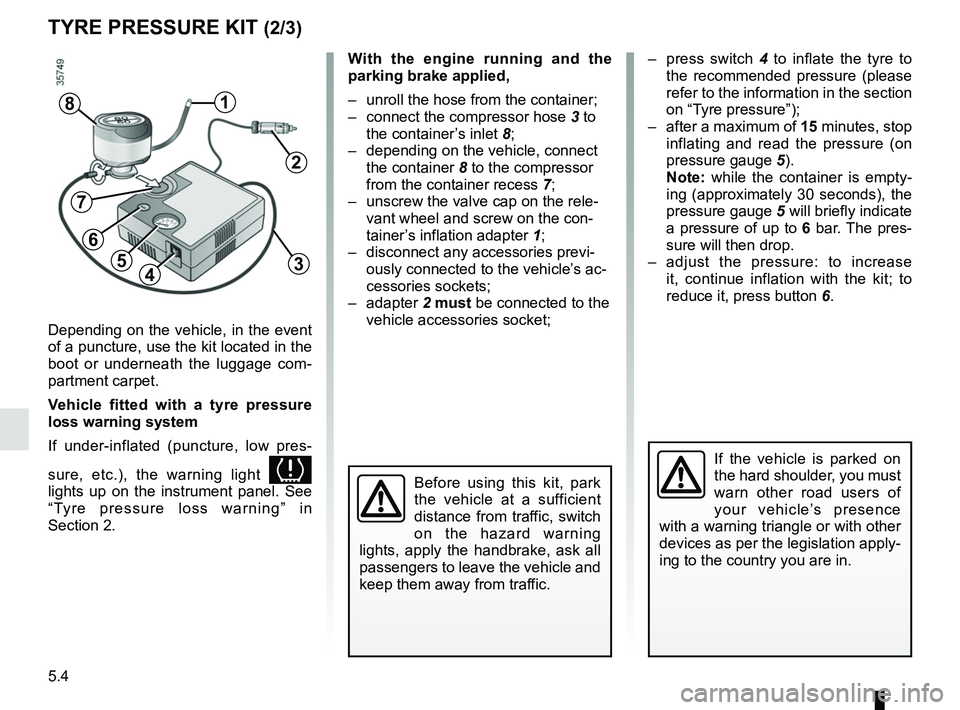
With the engine running and the
parking brake applied,
– unroll the hose from the container;
– connect the compressor hose 3 to
the container’s inlet 8;
– depending on the vehicle, connect the container 8 to the compressor
from the container recess 7;
– unscrew the valve cap on the rele- vant wheel and screw on the con-
tainer’s inflation adapter 1;
– disconnect any accessories previ- ously connected to the vehicle’s ac-
cessories sockets;
– adapter 2 must be connected to the
vehicle accessories socket;
45
1
Before using this kit, park
the vehicle at a sufficient
distance from traffic, switch
on the hazard warning
lights, apply the handbrake, ask all
passengers to leave the vehicle and
keep them away from traffic.
8
If the vehicle is parked on
the hard shoulder, you must
warn other road users of
your vehicle’s presence
with a warning triangle or with other
devices as per the legislation apply-
ing to the country you are in.
– press switch 4 to inflate the tyre to
the recommended pressure (please
refer to the information in the section
on “Tyre pressure”);
– after a maximum of 15 minutes, stop inflating and read the pressure (on
pressure gauge 5).
Note: while the container is empty-
ing (approximately 30 seconds), the
pressure gauge 5 will briefly indicate
a pressure of up to 6 bar. The pres-
sure will then drop.
– adjust the pressure: to increase it, continue inflation with the kit; to
reduce it, press button 6.
2
3
7
6
Page 184 of 226
5.10
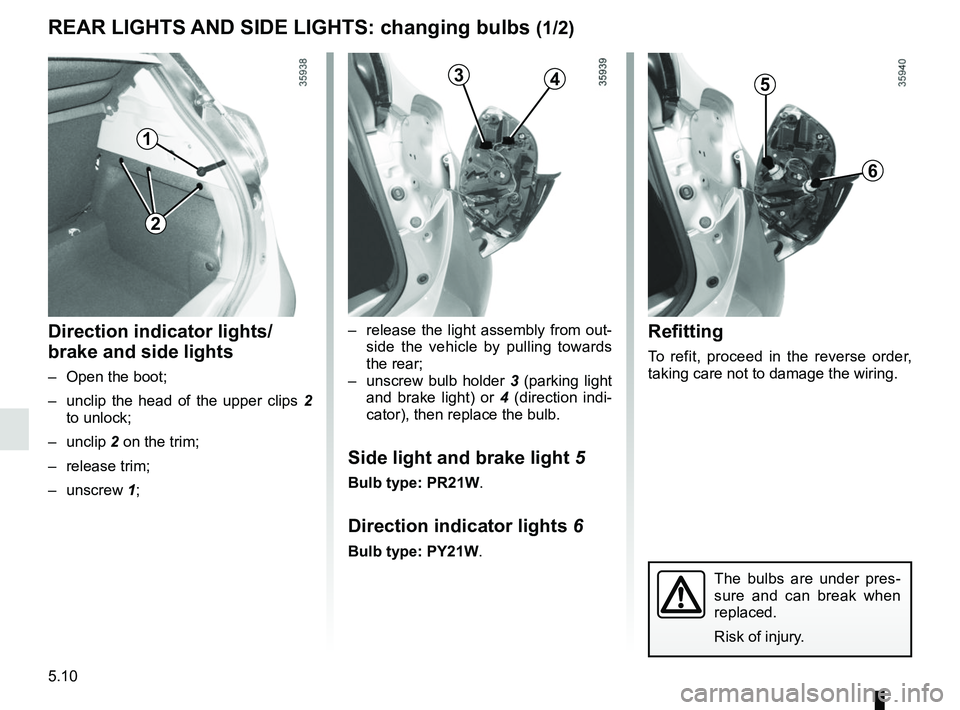
– release the light assembly from out-side the vehicle by pulling towards
the rear;
– unscrew bulb holder 3 (parking light
and brake light) or 4 (direction indi-
cator), then replace the bulb.
Side light and brake light 5
Bulb type: PR21W.
Direction indicator lights 6
Bulb type: PY21W.
Direction indicator lights/
brake and side lights
– Open the boot;
– unclip the head of the upper clips 2
to unlock;
– unclip 2 on the trim;
– release trim;
– unscrew 1;
REAR LIGHTS AND SIDE LIGHTS: changing bulbs (1/2)
5
6
Refitting
To refit, proceed in the reverse order,
taking care not to damage the wiring.
The bulbs are under pres-
sure and can break when
replaced.
Risk of injury.
34
1
2
Page 185 of 226
5.11
The bulbs are under pres-
sure and can break when
replaced.
Risk of injury.
REAR AND SIDE LIGHTS: changing bulbs (2/2)
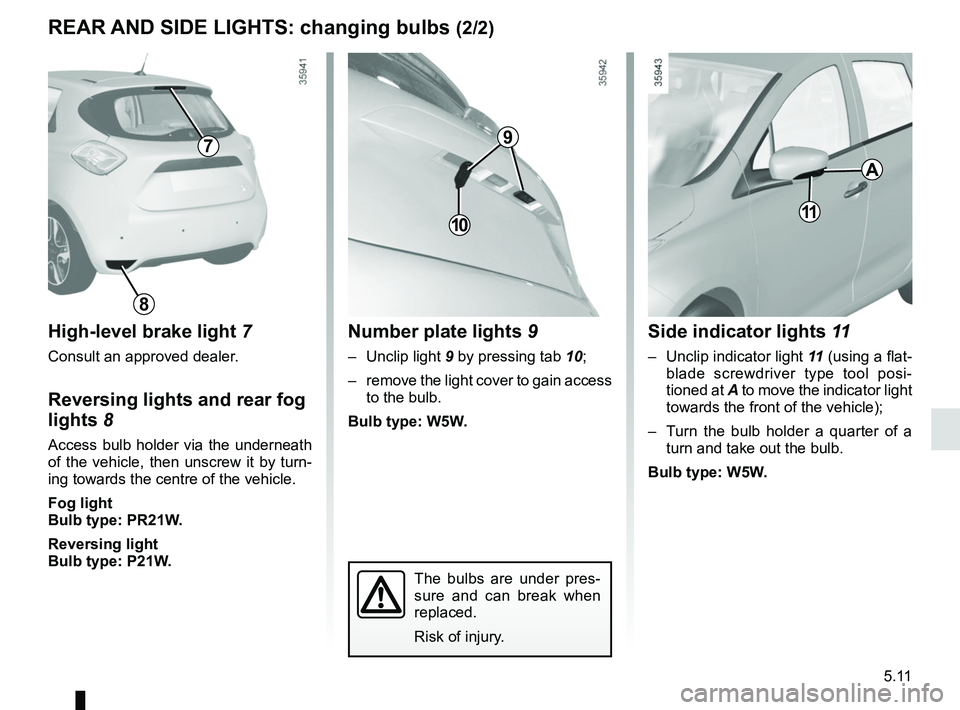
High-level brake light 7
Consult an approved dealer.
Reversing lights and rear fog
lights 8
Access bulb holder via the underneath
of the vehicle, then unscrew it by turn-
ing towards the centre of the vehicle.
Fog light
Bulb type: PR21W.
Reversing light
Bulb type: P21W.
Side indicator lights 11
– Unclip indicator light 11 (using a flat-
blade screwdriver type tool posi-
tioned at A to move the indicator light
towards the front of the vehicle);
– Turn the bulb holder a quarter of a turn and take out the bulb.
Bulb type: W5W.
11
A
Number plate lights 9
– Unclip light 9 by pressing tab 10;
– remove the light cover to gain access to the bulb.
Bulb type: W5W.
10
8
79
Page 188 of 226
5.14
FUSES (2/2)
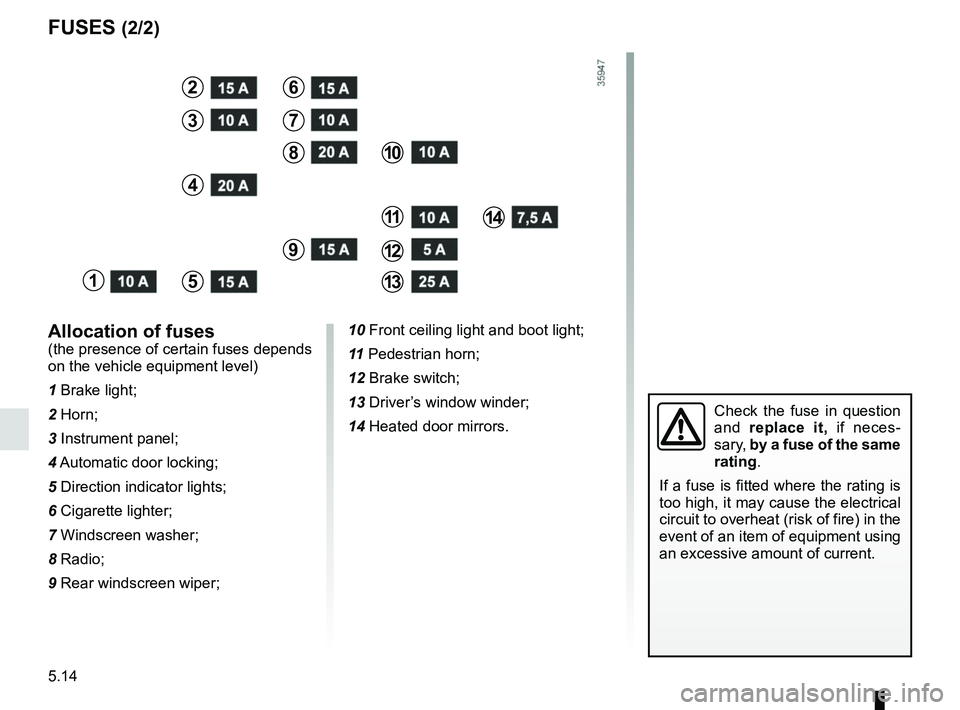
Allocation of fuses
(the presence of certain fuses depends
on the vehicle equipment level)
1 Brake light;
2 Horn;
3 Instrument panel;
4 Automatic door locking;
5 Direction indicator lights;
6 Cigarette lighter;
7 Windscreen washer;
8 Radio;
9 Rear windscreen wiper;
1
2
3
4
5
6
7
8
9
10
11
12
13
14
10 Front ceiling light and boot light;
11 Pedestrian horn;
12 Brake switch;
13 Driver’s window winder;
14 Heated door mirrors.
Check the fuse in question
and replace it, if neces-
sary, by a fuse of the same
rating.
If a fuse is fitted where the rating is
too high, it may cause the electrical
circuit to overheat (risk of fire) in the
event of an item of equipment using
an excessive amount of current.
Page 194 of 226

5.20
Once you have finished towing, press
the engine start button twice (risk of
running down the 12 V battery).
If the lever is stuck in P, even though
you are depressing the brake pedal, the
lever can be released manually.
To do this, unclip the cover at the base
of the lever.
Simultaneously press at the location 7
and the unlocking button 6 on the lever.
TOWING, BREAKDOWN (2/3)
6
7
In the event of an energy
fault: towing
In the event of a fully discharged trac-
tion battery:
– the warning light 2
Ṏ flashes;
– the indicator 1 shows an empty bat-
tery.
It is possible to recover on a flatbed
truck or tow the vehicle using the tow
eye, following the instructions below.
When the engine is stop-
ped, steering and braking
assistance are not opera-
tional.
Before towing, unlock the steering
column: engage the lever 5 in posi-
tion N, insert the card in the reader 4
then press the engine starting button 3
for approximately two seconds.
The column is unlocked, the accessory
functions are supplied: the vehicle lights
can be used (hazard warning lights,
brake lights etc.). The towed vehicle’s
lights must be switched on at night.
The speed specified by current legisla-
tion for towing must always be obser-
ved.
3
5
4
1
2
Page 219 of 226

A
ABS ....................................................................\
...2.16 → 2.20
accessories...................................................................")
7.1
ALPHABETICAL INDEX (1/5)
A
ABS ....................................................................\
...2.16 → 2.20
accessories........................................................................\
5.17
accessories socket ............................................................ 3.26
additional methods of restraint .....................1.37 → 1.40, 1.43
side protection ............................................................. 1.42
to the front seat belts .......................................1.37 → 1.40
to the rear seat belts ........................................1.37 → 1.41
adjusting your driving position ........................................... 1.33
air bag....................................................................1.37 → 1.43
activating the front passenger air bags ........................ 1.57
deactivating the front passenger air bags .................... 1.55
air conditioning ................ 1.20 – 1.21, 3.4 → 3.11, 3.18 – 3.19
air vents ...................................................................... 3.2 – 3.3
anti-corrosion check ..............................................6.13 → 6.17
anti-corrosion protection ...................................................... 4.9
anti-lock braking system: ABS ...............................2.16 → 2.20
armrest: front ..................................................................\
............ 3.24
ashtray ................................................................\
............... 3.26
audible and visual signals.................................................. 1.79
B
battery........................................................................\
........ 1.63
12 volt battery maintenance ......................................................... 4.6 – 4.7
12 volt battery ............................................1.2 → 1.6, 4.6 – 4.7
bonnet........................................................................\
. 4.2 – 4.3
brake fluid ........................................................................\
.... 4.5
bulbs changing ........................................................... 5.10 – 5.11
C
central door locking ......................................1.26, 1.29 → 1.31
changing a bulb ...................................................... 5.10 – 5.11
changing gear ............................................................. 2.5 – 2.6 charge meter .............................................................. 1.66, 2.7
charging cord .......................................1.8
→ 1.15, 1.20 – 1.21
charging flap ............................................................1.8 → 1.15
charging socket ..................................... 1.2 → 1.6, 1.8 → 1.15
child restraint/seat .............................1.44 – 1.45, 1.47 → 1.57
child safety..1.18 – 1.19, 1.24, 1.28, 1.44 – 1.45, 1.47 → 1.57,
3.20 – 3.21
child seats..........................................1.44 – 1.45, 1.47 → 1.54
children ........................... 1.18 – 1.19, 1.27 – 1.28, 1.44 – 1.45
children (safety) ............................................. 1.24, 3.20 – 3.21
cleaning: inside the vehicle .............................................. 4.12 – 4.13
clock ....................................................................... 1.75 – 1.76
closing the doors ...................................................1.27 → 1.30
connected services .............................................................. 1.3
control instruments ................................................1.62 → 1.68
controls ...............................................................\
...1.58 → 1.61
coolant ................................................................\
................. 4.4
courtesy light ............................................................ 3.22, 5.12
courtesy mirrors ................................................................. 3.22
cruise control ................................................1.63, 2.21 → 2.27
cruise control-speed limiter....................................2.21 → 2.27
D
dashboard..............................................................1.58 → 1.61
daytime running lights................................................. 1.81, 5.9
deadlocking the doors ....................................................... 1.26
display .................................................1.58 → 1.66, 2.29, 3.33
doors.............................................................. 1.27 – 1.28, 1.31
doors/tailgate ................................................. 1.26 – 1.28, 1.31
driver’s position .....................................................1.58 → 1.64
driving .............................. 2.2 → 2.6, 2.10 – 2.11, 2.13 → 2.29
driving position settings ............................................................1.33 → 1.36
driving recommendations ........................................ 2.7 → 2.11
Page 220 of 226

7.2
ALPHABETICAL INDEX (2/5)
E
»ECO» mode function ......................................................... 2.9
ECO driving ...............................................................2.7 → 2.9
ECO mode ........................................................................\
... 2.9
electric beam height adjustment ........................................ 1.84
»400 volt» electrical circuit ........................................1.2 → 1.6
electric vehicle vehicle range .................................................... 2.10 – 2.11
noise ..................................................................\
............ 1.6
charge ................................................................1.8 → 1.15
driving ........................................................ 1.6, 2.10 – 2.11
presentation .........................................................1.2 → 1.6
important recommendations .......................................... 1.7
electric windows ..................................................... 3.20 – 3.21
Electronic Stability Program: ESP .........................2.16 → 2.20
emergency brake assist.........................................2.16 → 2.20
emergency braking ................................................2.16 → 2.20
emergency key ....................................................... 1.18 – 1.19
energy »ECO» mode ................................................................. 2.9
saving .................................................................\
......... 2.10
charge meter (function) .................................................. 2.7
range ..................................................................\
..2.7 → 2.9
energy saving .......................................................... 2.7 → 2.11
energy consumption ........................... 1.65 – 1.66, 2.10 – 2.11
energy recovery ................................................................. 2.10
engine specifications ........................................................... 6.3
environment ............................................................\
........... 2.12
ESP: Electronic Stability Program .........................2.16 → 2.20
external temperature .............................................. 1.75 – 1.76
F
faults operating faults ................................................5.22 → 5.25
fitting a radio ...................................................................... 5.16
fittings ...............................................................\
.....3.23 → 3.25fragrance diffuser ............................................................... 3.16
fragrance ..............................................................\
............. 3.16
front passenger air bag deactivation ................................. 1.55
front seat adjustment ......................................................... 1.32
front seats adjustment .......................................................1.32 → 1.36
with manual controls .................................................... 1.32
fuses ....................................................................... 5.13 – 5.14
G
gear lever.................................................................... 2.5 – 2.6
glove box ........................................................................\
... 3.25
H
handbrake........................................................................\
.... 2.6
hands-free telephone integrated control ............................ 3.33
hazard warning lights signal ..................................... 1.79, 1.81
headlight beam adjustment ............................................... 1.84
headlight flashers .............................................................. 1.79
headlight washer ............................................................... 1.86
headrest........................................................................\
..... 3.27
heating and air conditioning system .................................. 3.18
heating, air conditioning: programming ........ 2.11, 3.12 → 3.15
heating system .................................. 3.4 → 3.10, 3.12 → 3.15
heating/air conditioning programming ...................3.12 → 3.15
horn ...................................................................\
................ 1.79
horn: flash ..................................................................\
........... 1.79
sounding the horn ........................................................ 1.79
hubcap tool ........................................................................\
.. 5.2
I
indicators .............................................................\
....... 1.79, 5.9
indicators: direction indicators ................................................ 1.79, 5.9
exterior temperature indicator ...................................... 1.75