ESP RENAULT ZOE 2018 Owner's Guide
[x] Cancel search | Manufacturer: RENAULT, Model Year: 2018, Model line: ZOE, Model: RENAULT ZOE 2018Pages: 226, PDF Size: 5.51 MB
Page 169 of 226
4.9
BODYWORK MAINTENANCE (1/3)
A well-maintained vehicle will last
longer. It is therefore recommended to
maintain the exterior of the vehicle reg-
ularly.
Your vehicle has been treated with very
effective anti-corrosion products. It is
nevertheless subject to various outside
influences.
Corrosive agents in the atmosphere
– atmospheric pollution (built-up and
industrial areas),
– saline atmospheres (near the sea,
particularly in hot weather),
– seasonal and damp weather condi-
tions (e.g. road salt in winter, water
from road cleaners, etc.).
Minor impacts
Abrasive action
Dust and sand in the air, mud, road grit
thrown up by other vehicles, etc.
You should take a number of minor pre-
cautions in order to safeguard your ve-
hicle against such risks.You should
Wash your car frequently, with the
engine off , with cleaning products rec-
ommended by the manufacturer (never
use abrasive products). Rinse thor-
oughly beforehand with a jet:
– spots of tree resin and industrial
grime;
– mud in the wheel arches and under-
neath the body which forms damp
patches;
– bird droppings , which cause a
chemical reaction with the paint that
rapidly discolours paintwork and
may even cause the paint to peel
off;
wash the vehicle immediately to
remove these marks since it is im-
possible to remove them by polish-
ing;
– salt, particularly in the wheel arches
and underneath the body after driv-
ing in areas where the roads have
been gritted.
Withdraw the vegetable falls (resin, film
etc.) from the vehicle regularly. Observe the vehicle stopping distances
when driving on gravelled surfaces to
prevent paint damage.
Repair, or have repaired quickly, areas
where the paint has been damaged, to
prevent corrosion spreading.
Remember to visit the body shop pe-
riodically in order to maintain your
anti-corrosion warranty. Refer to the
Maintenance Document.
Respect local regulations about wash-
ing vehicles (e.g. do not wash your ve-
hicle on a public highway).
If it is necessary to clean mechani-
cal components, hinges, etc., spray
them with products approved by our
Technical Department to protect them
after they have been cleaned.
We have selected special products
to care for your vehicle and you can
obtain these from the manufactur-
er’s accessory outlets.
Page 182 of 226
5.8
Studded tyres
This type of equipment may only be
used for a limited period and as laid
down by local legislation. It is neces-
sary to observe the speed specified by
current legislation.
These tyres must, at a minimum, be
fitted to the two front wheels.
NB:
The use of snow tyres, winter tyres or
studded tyres significantly reduces the
vehicle range.
TYRES (3/3)
Changing wheels around
This practice is not recommended.
Fitting new tyres Use in winter
Chains
For safety reasons, fitting snow
chains to the rear axle is strictly for-
bidden.
Chains cannot be fitted
to tyres which
are larger than those originally fitted to
the vehicle.
Snow or Winter tyres
We would recommend that these be
fitted to all four wheels to ensure that
your vehicle retains maximum adhe-
sion.
Warning : These tyres sometimes have
a specific direction of rotation and a
maximum speed index which may be
lower than the maximum speed of your
vehicle.
In all cases, we would recommend
that you contact an approved Dealer
who will be able to advise you on
the choice of equipment which is
most suitable for your vehicle.
Chains may only be fitted to tyres of the same size as those originally
fitted to your vehicle.
Chains may be fitted, provided that they are specific chains. We would
advise you to consult an approved dealer.
For your safety, please re-
spect the speed limit.
When they need to be re-
placed, only tyres of the
same make, size, type and profile
should be used on a single axle.
They must: either have a load ca-
pacity and a speed capacity at
least equal to the original tyres,
or correspond to those recom-
mended by your authorised
dealer.
Failure to heed these instructions
could endanger your safety and
affect your vehicle’s roadworthi-
ness.
Risk of loss of control of the ve-
hicle.
Page 189 of 226
5.15
Operating faultsIf the battery is too weak to ensure cor-
rect operation, you can still start (insert
the RENAULT card in the card reader)
and lock/unlock the vehicle (refer to the
information on "Locking/unlocking the
doors" in Section 1).
RENAULT CARD: battery
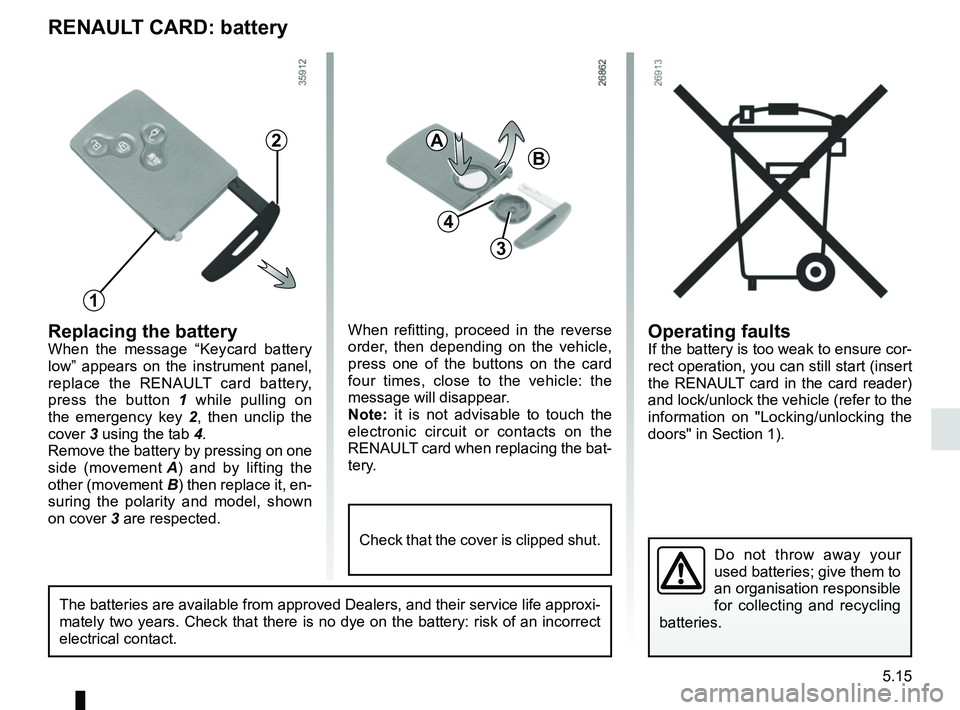
Replacing the batteryWhen the message “Keycard battery
low” appears on the instrument panel,
replace the RENAULT card battery,
press the button 1 while pulling on
the emergency key 2 , then unclip the
cover 3 using the tab 4.
Remove the battery by pressing on one
side (movement A) and by lifting the
other (movement B) then replace it, en-
suring the polarity and model, shown
on cover 3 are respected.
Do not throw away your
used batteries; give them to
an organisation responsible
for collecting and recycling
batteries.
1
2
When refitting, proceed in the reverse
order, then depending on the vehicle,
press one of the buttons on the card
four times, close to the vehicle: the
message will disappear.
Note: it is not advisable to touch the
electronic circuit or contacts on the
RENAULT card when replacing the bat-
tery.
A
B
3
The batteries are available from approved Dealers, and their service lif\
e approxi-
mately two years. Check that there is no dye on the battery: risk of an \
incorrect
electrical contact.
4
Check that the cover is clipped shut.
Page 202 of 226
6.2
VEHICLE IDENTIFICATION PLATES
A
B
A
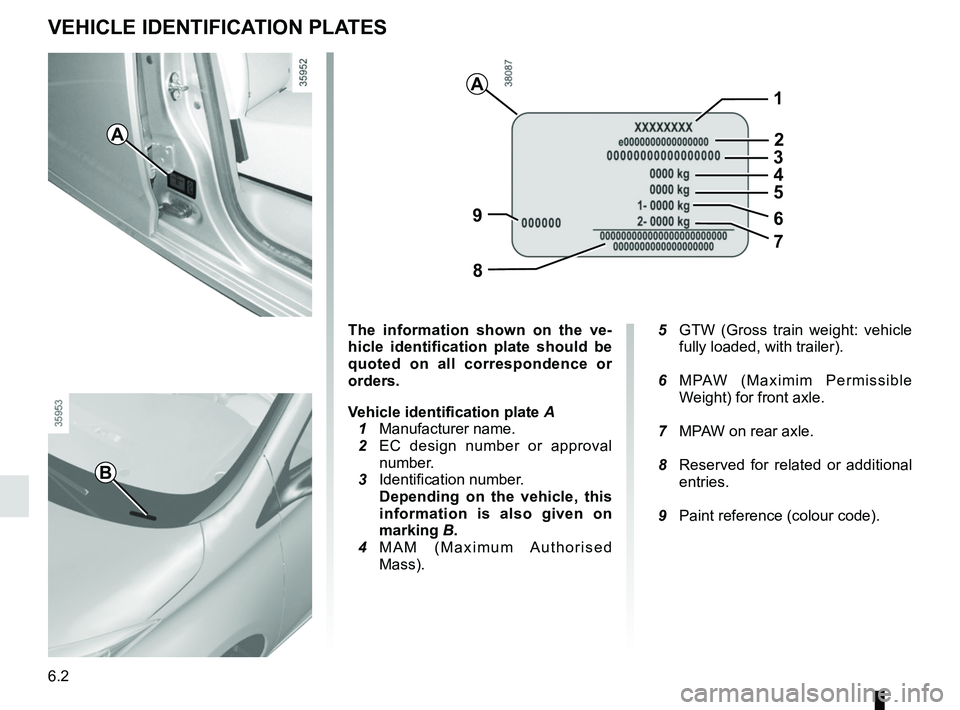
The information shown on the ve-
hicle identification plate should be
quoted on all correspondence or
orders.
Vehicle identification plate A
1 Manufacturer name.
2 EC design number or approval
number.
3 Identification number.
Depending on the vehicle, this
information is also given on
marking B.
4 MAM (Maximum Authorised
Mass).
5 GTW (Gross train weight: vehicle
fully loaded, with trailer).
6 MPAW (Maximim Permissible
Weight) for front axle.
7 MPAW on rear axle.
8 Reserved for related or additional
entries.
9 Paint reference (colour code).
7
8
96
5
4
3
2
1
Page 220 of 226

7.2
ALPHABETICAL INDEX (2/5)
E
»ECO» mode function ......................................................... 2.9
ECO driving ...............................................................2.7 → 2.9
ECO mode ........................................................................\
... 2.9
electric beam height adjustment ........................................ 1.84
»400 volt» electrical circuit ........................................1.2 → 1.6
electric vehicle vehicle range .................................................... 2.10 – 2.11
noise ..................................................................\
............ 1.6
charge ................................................................1.8 → 1.15
driving ........................................................ 1.6, 2.10 – 2.11
presentation .........................................................1.2 → 1.6
important recommendations .......................................... 1.7
electric windows ..................................................... 3.20 – 3.21
Electronic Stability Program: ESP .........................2.16 → 2.20
emergency brake assist.........................................2.16 → 2.20
emergency braking ................................................2.16 → 2.20
emergency key ....................................................... 1.18 – 1.19
energy »ECO» mode ................................................................. 2.9
saving .................................................................\
......... 2.10
charge meter (function) .................................................. 2.7
range ..................................................................\
..2.7 → 2.9
energy saving .......................................................... 2.7 → 2.11
energy consumption ........................... 1.65 – 1.66, 2.10 – 2.11
energy recovery ................................................................. 2.10
engine specifications ........................................................... 6.3
environment ............................................................\
........... 2.12
ESP: Electronic Stability Program .........................2.16 → 2.20
external temperature .............................................. 1.75 – 1.76
F
faults operating faults ................................................5.22 → 5.25
fitting a radio ...................................................................... 5.16
fittings ...............................................................\
.....3.23 → 3.25fragrance diffuser ............................................................... 3.16
fragrance ..............................................................\
............. 3.16
front passenger air bag deactivation ................................. 1.55
front seat adjustment ......................................................... 1.32
front seats adjustment .......................................................1.32 → 1.36
with manual controls .................................................... 1.32
fuses ....................................................................... 5.13 – 5.14
G
gear lever.................................................................... 2.5 – 2.6
glove box ........................................................................\
... 3.25
H
handbrake........................................................................\
.... 2.6
hands-free telephone integrated control ............................ 3.33
hazard warning lights signal ..................................... 1.79, 1.81
headlight beam adjustment ............................................... 1.84
headlight flashers .............................................................. 1.79
headlight washer ............................................................... 1.86
headrest........................................................................\
..... 3.27
heating and air conditioning system .................................. 3.18
heating, air conditioning: programming ........ 2.11, 3.12 → 3.15
heating system .................................. 3.4 → 3.10, 3.12 → 3.15
heating/air conditioning programming ...................3.12 → 3.15
horn ...................................................................\
................ 1.79
horn: flash ..................................................................\
........... 1.79
sounding the horn ........................................................ 1.79
hubcap tool ........................................................................\
.. 5.2
I
indicators .............................................................\
....... 1.79, 5.9
indicators: direction indicators ................................................ 1.79, 5.9
exterior temperature indicator ...................................... 1.75