ABS SAAB 9-3 2000 User Guide
[x] Cancel search | Manufacturer: SAAB, Model Year: 2000, Model line: 9-3, Model: SAAB 9-3 2000Pages: 236, PDF Size: 10.85 MB
Page 176 of 236
176 Car careBrake- clutch fluid and
brake pads
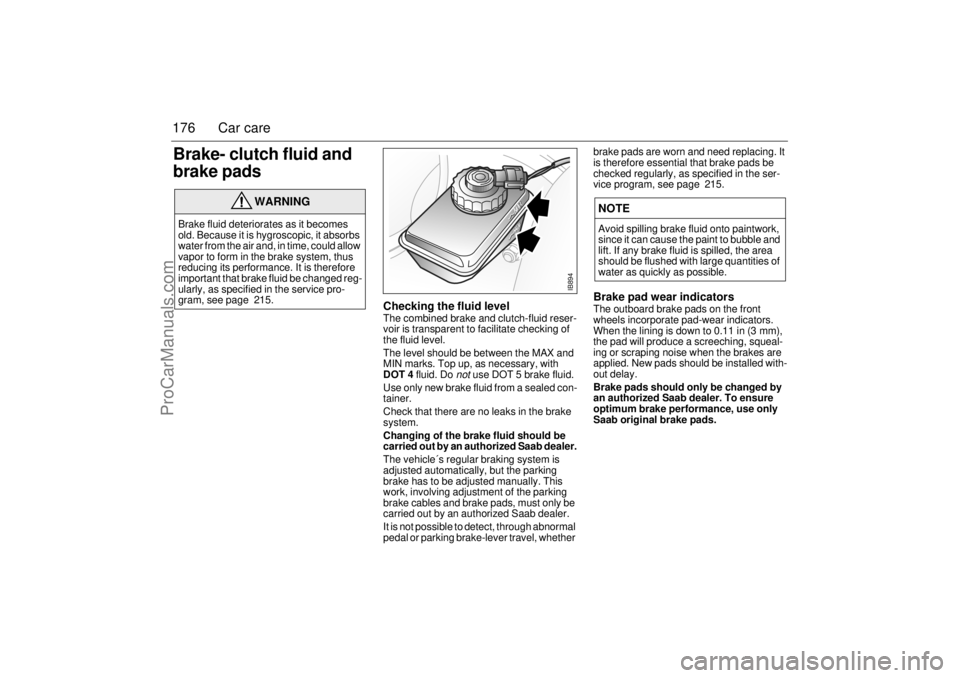
Checking the fluid level The combined brake and clutch-fluid reser-
voir is transparent to facilitate checking of
the fluid level.
The level should be between the MAX and
MIN marks. Top up, as necessary, with
DOT 4 fluid. Do
not
use DOT 5 brake fluid.
Use only new brake fluid from a sealed con-
tainer.
Check that there are no leaks in the brake
system.
Changing of the brake fluid should be
carried out by an authorized Saab dealer.
The vehicle´s regular braking system is
adjusted automatically, but the parking
brake has to be adjusted manually. This
work, involving adjustment of the parking
brake cables and brake pads, must only be
carried out by an authorized Saab dealer.
It is not possible to detect, through abnormal
pedal or parking brake-lever travel, whether brake pads are worn and need replacing. It
is therefore essential that brake pads be
checked regularly, as specified in the ser-
vice program, see page 215.
Brake pad wear indicators The outboard brake pads on the front
wheels incorporate pad-wear indicators.
When the lining is down to 0.11 in (3 mm),
the pad will produce a screeching, squeal-
ing or scraping noise when the brakes are
applied. New pads should be installed with-
out delay.
Brake pads should only be changed by
an authorized Saab dealer. To ensure
optimum brake performance, use only
Saab original brake pads.
WARNING
Brake fluid deteriorates as it becomes
old. Because it is hygroscopic, it absorbs
water from the air and, in time, could allow
vapor to form in the brake system, thus
reducing its performance. It is therefore
important that brake fluid be changed reg-
ularly, as specified in the service pro-
gram, see page 215.
NOTEAvoid spilling brake fluid onto paintwork,
since it can cause the paint to bubble and
lift. If any brake fluid is spilled, the area
should be flushed with large quantities of
water as quickly as possible.
IB894
ProCarManuals.com
Page 182 of 236
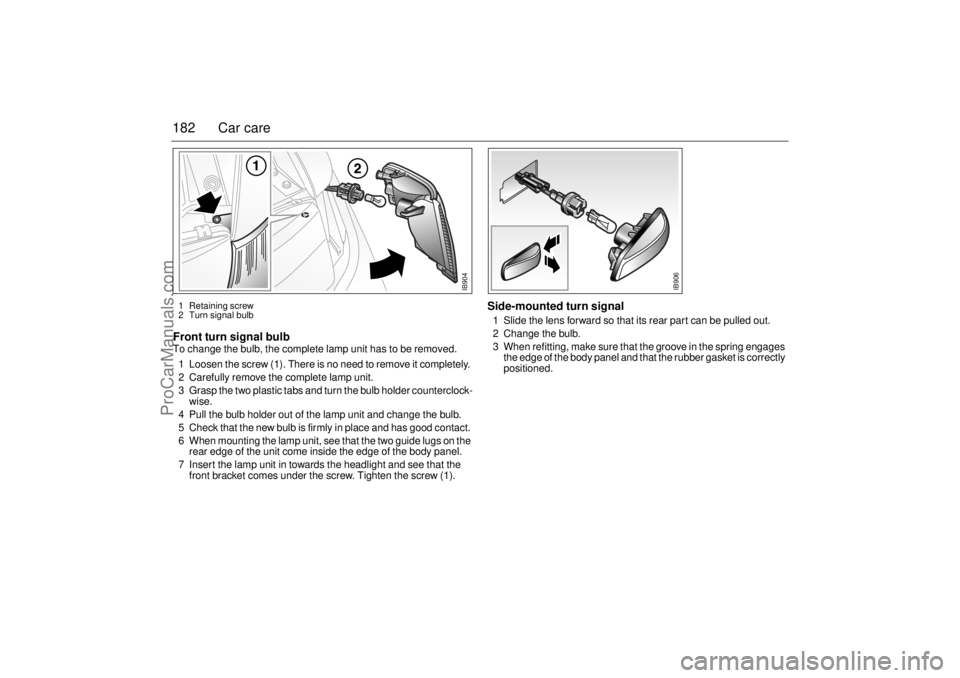
182 Car careFront turn signal bulb To change the bulb, the complete lamp unit has to be removed.
1 Loosen the screw (1). There is no need to remove it completely.
2 Carefully remove the complete lamp unit.
3 Grasp the two plastic tabs and turn the bulb holder counterclock-
wise.
4 Pull the bulb holder out of the lamp unit and change the bulb.
5 Check that the new bulb is firmly in place and has good contact.
6 When mounting the lamp unit, see that the two guide lugs on the
rear edge of the unit come inside the edge of the body panel.
7 Insert the lamp unit in towards the headlight and see that the
front bracket comes under the screw. Tighten the screw (1).
Side-mounted turn signal1 Slide the lens forward so that its rear part can be pulled out.
2 Change the bulb.
3 When refitting, make sure that the groove in the spring engages
the edge of the body panel and that the rubber gasket is correctly
positioned.
IB904
1 Retaining screw
2 Turn signal bulb
IB906
ProCarManuals.com
Page 189 of 236
189 Car care
FusesNo. Amp Function
A––
B 10 Stop lights, trailer
C 30 Cabin fan, ACC
1 30 Electrically heated rear window and rear-view mir-
rors
220Direction indicators
330Cabin fan, A/C
4 15 Trunk light; switch illumination; electrically powered
radio antenna
5 30 Electrically operated front seat, right
6 30 Cigarette lighter
6A 7.5 Automatic transmission
7 30 Rear window operators, rear-view mirrors, sunroof
8 15 Rear wiper
9 7.5 ACC panel
10 – –
11 7.5 DICE / TWICE
12 20 Stop lights; front fog lights
13 15 Diagnostics; radio
14 30 Front window motors
15 20 Daytime running lights
16 30 Electrically operated front seat, left
16B 30 Control module, engine management system
17 15 DICE/TWICE; instruments; memory for
electrically operated driver’s seat
18 10 Airbag
19 10 ABS; A/C; rear fog light
20 20 Electric heating, front seats
30 10 20
30 30 15
15 15
10 10 10
10
10
10 30
30 10 20
15
15
15
10 10
20
10 20 20
20 20 15
15
30 15
15 10 15
15
IB918
1 C B A23456
7 6A 8 9 10 11 12 13 14 15 16
17 16B 18 19 20 21 22 23 2425 26 27 28 29 30 3132 33 34 35 3637 38 39
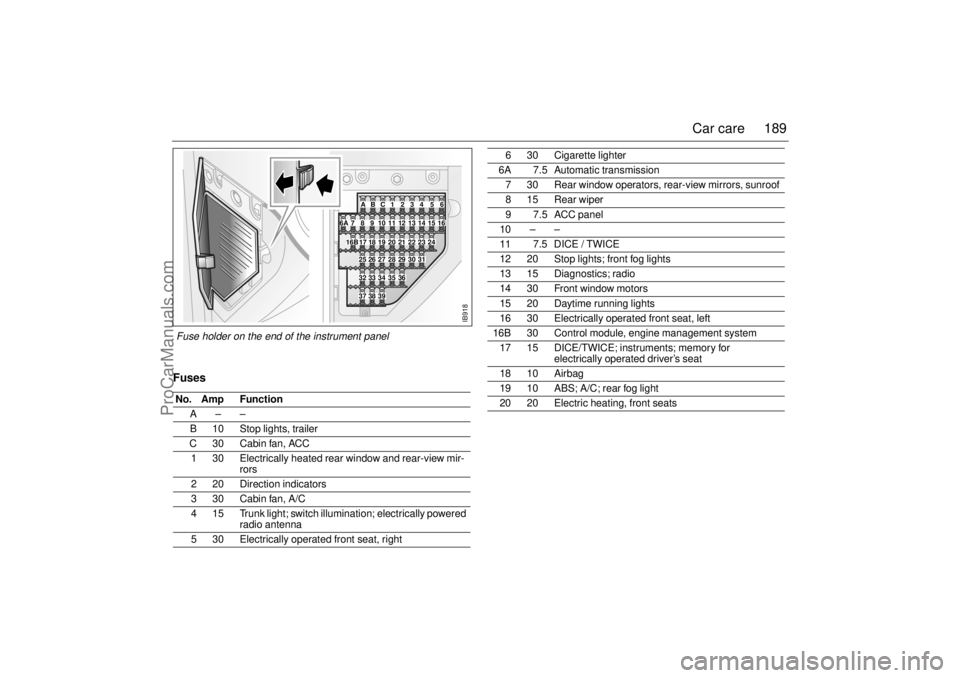
Fuse holder on the end of the instrument panel
ProCarManuals.com
Page 191 of 236
191 Car care
Fuses and relays Fuse panel in engine bay
No. Amp Function
110Horn
2 15 Front fog lights
3 40 Radiator fan, low speed
4 10 Vacuum pump
5 15 A/C-compressor
610Left low beam
7 10 Right low beam
8 10 Left high beam
9 10 Right high beam
10 7.5 Headlight wipers
11 – –
12 – Extra lights
13 7.5 APC
14 10 Extra heater; water pump (Europe)
15 15 Extra heater (Europe)
MAXI 1 30 Radiator fan, high speed
MAXI 2 50 ABS
Item Amp Function
A Low beam
B High beam
C1 Extra heater (Europe)
C2 Vacuum pump (Turbo aut.)
D Radiator fan, low speed
E Lamp check (filament monitor, front)
F1 – –
F2 – –
G1 Horn
G2 Front fog lights
H–
I Radiator fan, high speed
J A/C-compressor
IB919
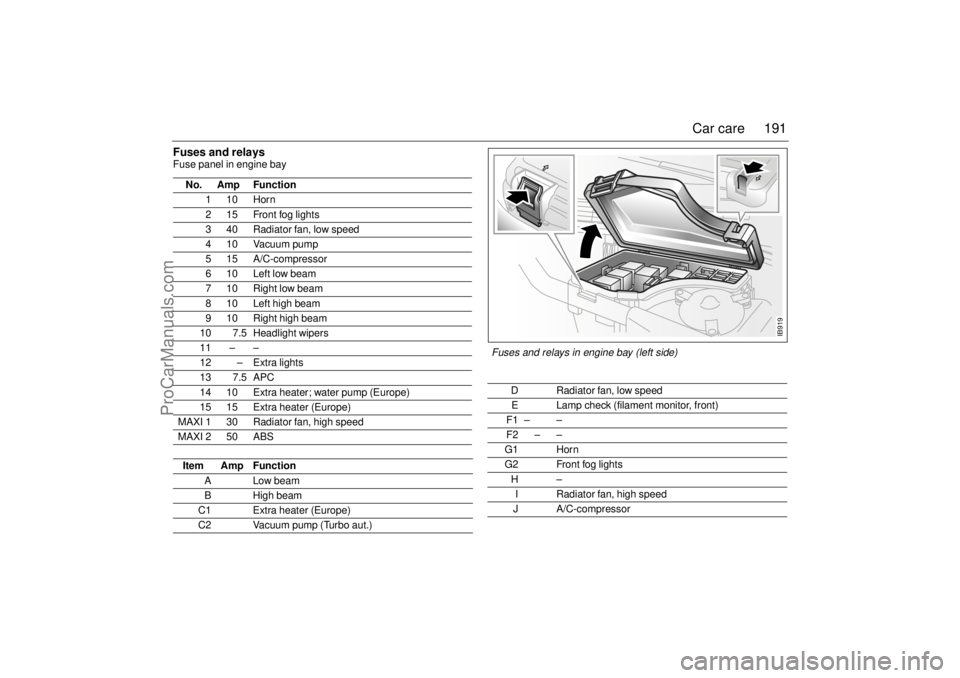
Fuses and relays in engine bay (left side)
ProCarManuals.com
Page 192 of 236

192 Car careWheelsAlternative wheels and tiresIf you wish to fit other tires or wheels than
those supplied with the car, consult your
Saab dealer first as to the possibilities avail-
able.
Wheels/tires combinations that are not
approved by Saab can negatively affect the
car´s directional stability, steering and brak-
ing in both wet and dry conditions.
Do not assume that a wheel/tire combina-
tion will function properly just because it will
bolt on.
The wheels and tires have been carefully
matched to the characteristics of the car and
play a key role in its outstanding roadhold-
ing and handling.
Tire pressureTires need to be inflated to suit the load car-
ried and the maximum speed the car will be
driven (see the recommended tire pres-
sures on the back cover). Note that all
values apply to cold tires. For tires with an
aspect ratio less than /60, increase the tire
pressure by 3 psi (20 kPa) for rough roads
with potholes to minimize the risk of rim
damage.
Never reduce the pressure of a hot tire. If the
tires are hot when you check them, only
increase the pressure, if necessary.
Soft tires will cause faster wear than
over-pressurized tires. They also increase
fuel consumption.
If a valve is leaking, simply unscrew it and fit
a new one.
Important! Remember to adjust the tire
pressures if you change the load in the car
or intend to cruise at a substantially higher
or lower speed than normal.
NOTEFor wide wheels and/or low-profile tires,
bear in mind the following:
Tires and wheels can be damaged in
potholes etc.
Springs and shock absorbers can be
overloaded.
The wheels can come into contact with
chassis and body components.
The speed and load limits for the tires
must not be exceeded; see page 193.
Wheels larger than 16” must not be
fitted on the Saab 9-3. For Viggen
models the wheel should not be larger
than 17”. The maximum permissible
offset for the 9-3 is 49 mm and for the
Viggen 42 mm.
When fitting wheels on a 9-3, please
note that a 15” wheel should be used
on 9-3 Coupé and 5-door models, and
nothing smaller than 16” wheel should
be used for Viggen models. Fitting a
smaller size wheel on a Viggen is not
possible due to the size of the brake
discs.
NOTECheck the tire pressures at least once
per month.
Underinflation is the main cause of:
Tires wearing out prematurely.
Damage to the sidewalls.
Damage to the wheels.
ProCarManuals.com
Page 200 of 236

200 Car careUpholstery and trimTo remove fluff or hairs from the seat uphol-
stery or headlining, use a moist, lint-free
cloth or a special lint remover (brush or
roller). Remove any dirty marks using a
cloth moistened with lukewarm soapy
water.
When using a stain remover, always work
from the outside towards the center to avoid
leaving a ring. If a soiled ring or spot should
remain, it can usually be removed using
lukewarm soapy water or water alone.
Wet patches left by spilled soft drinks or thin
oil must be wiped off immediately using an
absorbent material, such as paper toweling,
and treated with stain remover.
Isopropyl alcohol is recommended for
removing grease or oil stains, and a
semi-stiff brush may also be used.
Cleaning and caring for leather
upholsteryThe principal reason for treating leather
upholstery is to maintain its elegant appear-
ance and to provide it with a protective film.
Discoloration caused by dust and wear
mainly affects the lighter shades, although
this is not detrimental to the leather –
indeed, the patina resulting from use is often
considered desirable in leather. But if the
leather is allowed to become too grubby, it
can start to look shabby.
It is a good idea to clean and recondition the
leather twice a year – in conjunction with a
general spring-cleaning of the car – after the
winter and in the autumn, for instance. In
hot, dry climates, the leather will need to be
treated more frequently.
Moisten a soft cloth in a mild soap solution.
Carefully apply this damp (not wet) cloth to
the leather, working in light, circular move-
ments until the leather is clean. Repeat the
procedure using clean water and then leave
the leather to dry thoroughly. Finally, treat
the leather with a conditioner.Apply the leather conditioner using a soft
cloth and the same circular movements as
described above. After it has dried, polish
the leather with a soft, dry cloth. Follow the
directions given above. Do not use hot
water, unknown abrasive polishes, sol-
vents, sprays or soaps that might scratch
the leather. Look after the leather as
described and it will stay clean and attrac-
tive for many years.
Textile carpetingVacuum clean the carpeting regularly. Car-
pets can also be cleaned using a brush, or
carpet shampoo applied with a sponge. Do
not use vacuum cleaners outdoors unless
they are properly grounded.
ProCarManuals.com
Page 206 of 236
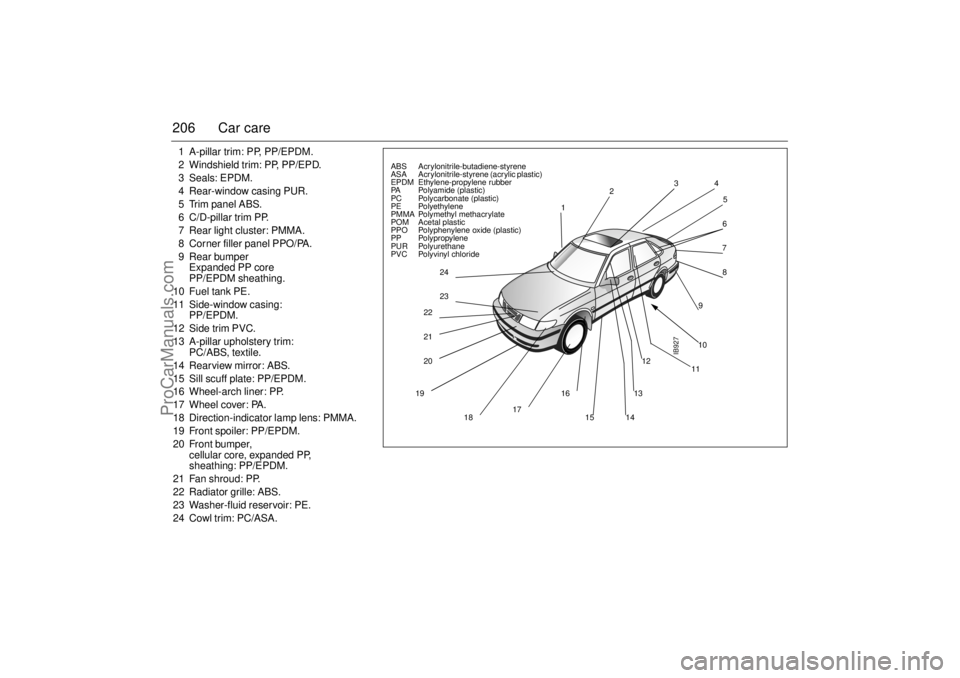
206 Car care1 A-pillar trim: PP, PP/EPDM.
2 Windshield trim: PP, PP/EPD.
3 Seals: EPDM.
4 Rear-window casing PUR.
5 Trim panel ABS.
6 C/D-pillar trim PP.
7 Rear light cluster: PMMA.
8 Corner filler panel PPO/PA.
9 Rear bumper
Expanded PP core
PP/EPDM sheathing.
10 Fuel tank PE.
11 Side-window casing:
PP/EPDM.
12 Side trim PVC.
13 A-pillar upholstery trim:
PC/ABS, textile.
14 Rearview mirror: ABS.
15 Sill scuff plate: PP/EPDM.
16 Wheel-arch liner: PP.
17 Wheel cover: PA.
18 Direction-indicator lamp lens: PMMA.
19 Front spoiler: PP/EPDM.
20 Front bumper,
cellular core, expanded PP,
sheathing: PP/EPDM.
21 Fan shroud: PP.
22 Radiator grille: ABS.
23 Washer-fluid reservoir: PE.
24 Cowl trim: PC/ASA.
IB927
19 20 21 22 23 24 1 2 3 4
18 1716
15 14 13 12
11 7
10 98 6 5 ABS Acr ylonitrile-butadiene-styrene
ASA Acrylonitrile-styrene (acrylic plastic)
EPDM Ethylene-propylene rubber
PA Polyamide (plastic)
PC Polycarbonate (plastic)
PE Polyethylene
PMMA Polymethyl methacrylate
POM Acetal plastic
PPO Polyphenylene oxide (plastic)
PP Polypropylene
PUR Polyurethane
PVC Polyvinyl chloride
ProCarManuals.com
Page 217 of 236

217 Maintenance and owner assistance
(c.) Check wheel alignment if irregular or premature tire wear is apparent.
(d.) Check and clean rear pads and rear calipers in areas with heavy road salt use.
Service Intervals **
Miles = U.S. Cars
Kilometers = Canadian Cars
1,000
(1,600 km)
10,000
(16,000 km)
20,000
(32,000 km)
30,000
(48,000 km)
40,000
(64,000 km)
50,000
(80,000 km)
60,000
(96,000 km)
70,000
(112,000 km)
80,000
(128,000 km)
90,000
(144,000 km)
100,000
(160,000 km)
Service #
1234567891011
Chassis
R Ball joint clearance, outer and inner steering joints and
rubber boots""""""""""
R Front suspension, rear axle mountings; retighten"
R Shock absorbers and bushes; tightness and condition"""
R Tire pressure, tread depth and wear (c.)"""""""""""
R Rotate tires, front to rear""""""""""
R Brake pads and discs; wear and condition (d.)""""""""""
R Brake lines and hoses"""""""""""
R Brake fluid level & renewal (max. 2-year intervals)""" ! "" ! "" ! "
R Check parking brake function"""""""""""
R Power steering fluid level"""""""""""
ProCarManuals.com
Page 226 of 236

226 Technical dataManual transmission
Automatic transmissionSuspension
SteeringType _____________________________ 5-speed, fully
synchronized with
final-drive gear and
differential
Oil type (for topping-up) ______________ Saab synthetic man-
ual gearbox oil
Oil capacity ________________________ 1.8 qts. (1.8 l)
Speed (mph/km/h) at 1000 rpm in 5th gear 26/42
Type _____________________________ Electronically con-
trolled 4-speed with
torque converter
and differential
Gear selector positions ______________ P R N D 3 2 1
Oil quantity, total ____________________ 7.4 qts. (7.2 litres)
Oil volume (on changing) _____________ 3.4 qts. (3.25 litres)
Oil type ___________________________ Texaco Texamatic
Dexron III, mineral
oil based
Clutch type ________________________ Hydraulically-oper-
ated plate clutches,
brake bands and
one-way clutches
Speed (mph/km/h) at 1000 rpm in 4th gear 25/40Spring type, front and rear ____________ Coil springs
Maximum deflection of springs:
front, Coupé/5-door/Convertible _______ 6.4" (163 mm)
front, Viggen ______________________ 6.5” (165 mm)
rear, Coupé/5-door/Convertible _______ 8.3" (212 mm)
rear, Viggen ______________________ 7.9” (200 mm)
Dampers, front and rear ______________ Gas-filled tele-
scopic shock
absorbers
Steering __________________________ Power-assisted
steering gear of
rack-and-pinion
type with tele-
scopic, universal
joint steering- col-
umn shaft
Number of turns, lock to lock __________ 3.0
Oil type ___________________________ Power Steering
Fluid CHF 11S
ProCarManuals.com
Page 227 of 236

227 Technical data
Brake system Rims and tires Footbrake (ABS) ___________________ Hydraulic disc
brakes with vacuum
servo, diagonally
split circuits
Parking brake ______________________ Acts on rear wheels
Brake fluid ________________________ DOT 4
Do not use DOT 5
Disc diameter:
front, Coupé/5-door/Convertible _______ 11.4" (288 mm)
front, Viggen ______________________ 12.0” (306 mm)
rear ____________________________ 11.3" (286 mm)
Total friction area of brake pads:
front, Coupé/5-door/Convertible _______ 34.4 in² (224 cm²)
front, Viggen ______________________ 35.9 in² (234 cm²)
rear ____________________________ 14.2 in² (92 cm²)Rim size:
Coupé/5-door/Convertible ___________ 6.5 x 15 or 6.5 x 16
Viggen __________________________ 7.5 x 17
Viggen must use 6.5 x 16 or 7 x 17
Tire sizes (summer tires):
6.5 x 15 (not Viggen) _______________ 195/60 R15
6.5 x 16__________________________ 205/50 R16
7.5 x 17 Viggen only ________________ 215/45 R17
Tire sizes (winter tires):
6 x 15 (not Viggen) _________________ 185/65 R15 M+S
195/60 R15 M+S
6.5 x 16 _________________________ 205/50 R16 M+S
Recommended rims for snow chains:
Coupé/5-door/Convertible ___________ 6 x 15
Viggen __________________________ 6.5 x 16
Spare wheel:
Tire:
Coupé/5-door/Convertible ___________ T115/70 R15
Viggen __________________________ T115/70 R16
Rim:
Coupé/5-door/Convertible ___________ 4.0 x 15
Viggen __________________________ 4.0 x 16
Maximum life _____________________ 2000 miles
(3500 km)
Maximum speed __________________ 50 mph (80 km/h)
ProCarManuals.com