check oil SAAB 9-3 2000 User Guide
[x] Cancel search | Manufacturer: SAAB, Model Year: 2000, Model line: 9-3, Model: SAAB 9-3 2000Pages: 236, PDF Size: 10.85 MB
Page 175 of 236
175 Car care
Changing the coolant(Usually carried out as part of the Saab
original service by an authorized Saab
dealer)
1 If the engine is hot, loosen the expan-
sion-tank filler cap a little to release the
pressure. Leave the cap in place.
2 Fit a suitable piece of hose onto the
nipple of the drain cock. Let the hose dis-
charge into a receptacle under the radi-
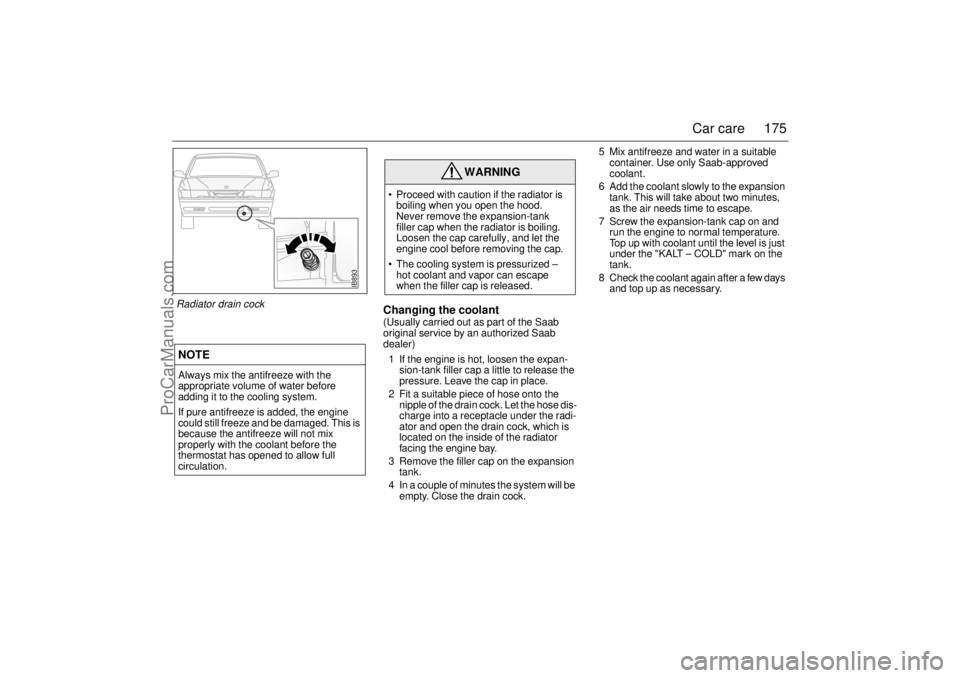
ator and open the drain cock, which is
located on the inside of the radiator
facing the engine bay.
3 Remove the filler cap on the expansion
tank.
4 In a couple of minutes the system will be
empty. Close the drain cock. 5 Mix antifreeze and water in a suitable
container. Use only Saab-approved
coolant.
6 Add the coolant slowly to the expansion
tank. This will take about two minutes,
as the air needs time to escape.
7 Screw the expansion-tank cap on and
run the engine to normal temperature.
Top up with coolant until the level is just
under the "KALT – COLD" mark on the
tank.
8 Check the coolant again after a few days
and top up as necessary.
NOTEAlways mix the antifreeze with the
appropriate volume of water before
adding it to the cooling system.
If pure antifreeze is added, the engine
could still freeze and be damaged. This is
because the antifreeze will not mix
properly with the coolant before the
thermostat has opened to allow full
circulation.
WARNING
Proceed with caution if the radiator is
boiling when you open the hood.
Never remove the expansion-tank
filler cap when the radiator is boiling.
Loosen the cap carefully, and let the
engine cool before removing the cap.
The cooling system is pressurized –
hot coolant and vapor can escape
when the filler cap is released.
IB893
Radiator drain cock
ProCarManuals.com
Page 177 of 236
177 Car care
Power steeringCheck the level of the power-steering fluid
in the reservoir regularly, in accordance with
the service program.
The wheels should point forward during the
check.
Clean around the cap before it is
unscrewed.
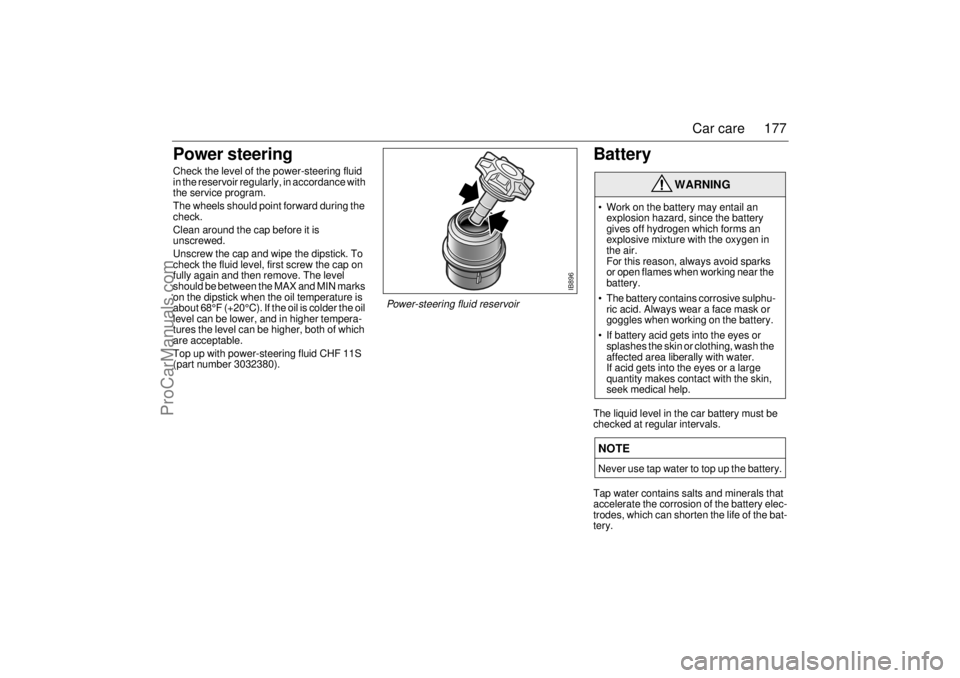
Unscrew the cap and wipe the dipstick. To
check the fluid level, first screw the cap on
fully again and then remove. The level
should be between the MAX and MIN marks
on the dipstick when the oil temperature is
about 68°F (+20°C). If the oil is colder the oil
level can be lower, and in higher tempera-
tures the level can be higher, both of which
are acceptable.
Top up with power-steering fluid CHF 11S
(part number 3032380).
BatteryThe liquid level in the car battery must be
checked at regular intervals.
Tap water contains salts and minerals that
accelerate the corrosion of the battery elec-
trodes, which can shorten the life of the bat-
tery.
WARNING
Work on the battery may entail an
explosion hazard, since the battery
gives off hydrogen which forms an
explosive mixture with the oxygen in
the air.
For this reason, always avoid sparks
or open flames when working near the
battery.
The battery contains corrosive sulphu-
ric acid. Always wear a face mask or
goggles when working on the battery.
If battery acid gets into the eyes or
splashes the skin or clothing, wash the
affected area liberally with water.
If acid gets into the eyes or a large
quantity makes contact with the skin,
seek medical help. NOTENever use tap water to top up the battery.
IB896
Power-steering fluid reservoir
ProCarManuals.com
Page 199 of 236
199 Car care
Flat spottingAll tires get hot, especially on long journeys
or when the car is driven hard. After the car
has been parked with hot tires and the tires
have cooled down, a flat spot can form in the
tire, where it is in contact with the ground.
The same can occur if the car has not been
moved for a long time.
Flat spots can cause vibration that can be
felt through the steering wheel, similar to
that experienced when the wheels need bal-
ancing. Flat spots of this type disappear
once the tires get hot again, usually after
10–15 miles (20–25 km) of driving at cruis-
ing speed.
Safety beltsA check should be made periodically to
ensure that the safety belts are working
properly.
Hold the diagonal strap and pull it sharply.
The seat belt should lock and it should not
be possible to withdraw it further.
A sharp tug on the belt should cause the
inertia reel to lock. Check the floor anchor-
age points for corrosion damage. If a belt is
worn or has any fraying edges, it should be
replaced.
Safety belts must not come into contact with
substances such as polishes, oil or chemi-
cals. If the belts get dirty, wash them with
warm water and a detergent or have them
replaced.
WARNING
Safety belts and belt pretensioners that
were in use in a serious collision must be
replaced even if they are not visibly
damaged.
No attempt must be made to repair, or
modify the function of, safety belts.
IB923
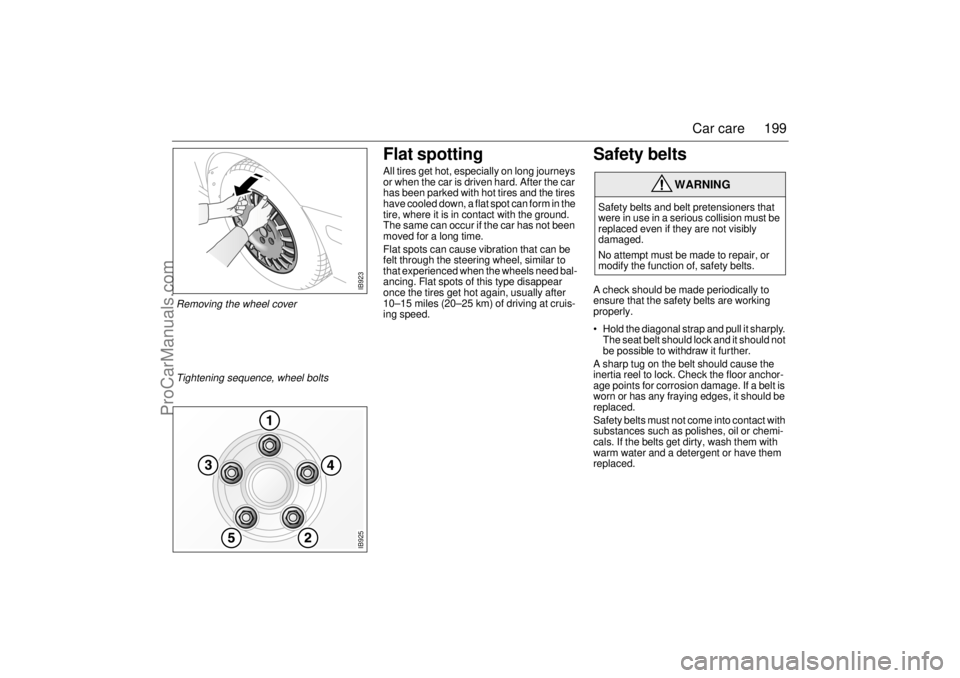
Removing the wheel cover
IB925
Tightening sequence, wheel bolts
ProCarManuals.com
Page 213 of 236

213 Maintenance and owner assistance
Service record retentionService instruction coupons and record
stubs are provided in the Saab Warranties
and Service Record Booklet which accom-
panies this Owner’s Manual. The coupons
are arranged in the order that normal ser-
vice should be performed. The edge of each
coupon is shaded to correspond to the type
of service point:
Striped - "First Service".
Blue - Oil change/inspection service.
Black - Major service.
Note that in Canada a combined service
and warranty book is used, but not service
coupons.
When scheduled services are performed,
your dealer will tear out the applicable
coupon and use it to check off the opera-
tions performed and enter it into the service
file at the dealership. The servicing dealer’s
stamp, along with the date and mileage at
which the service was done, should be
entered on the corresponding stub which
remains in your booklet. The booklet is your
permanent record of the services per-
formed. It also includes a log sheet for
unscheduled repairs.
It is advisable to retain receipts and, if pos-
sible, copies of shop work orders for all ser-
vice and repair work, wherever performed.
Service costsDealer pricing practices and labor for ser-
vice work vary. Saab’s recommended ser-
vice times for each service point do not
include the labor required to replace wear
items, such as wiper blades, brake pads or
tires. Nor is labor to perform other service or
repairs found to be necessary as a result of
the inspections included in these times.
Additional labor and parts will be charged
for such work when necessary, except as
covered under an applicable Saab warranty
or any optional extended service contract.
Transmission fluid changes or suspension
alignment, when necessary, are also addi-
tional.
Dealer charges for general shop material,
regulated hazardous waste removal, recy-
cling expenses or other operation costs may
also be applied to service and repair
invoices and are apt to vary by dealer and
location.
Owner assistanceWarranties and service problem
assistanceFor complete information about all applica-
ble warranties, including the New Car War-
ranty, Perforation Warranty, Vehicle Emis-
sion Warranty and Emission Perforation
Warranty, consult the Warranties and Ser-
vice Record Booklet which accompanies
this Owner’s Manual. It also contains owner
assistance information including Saab
Roadside Assistance. If the booklet is lost or
misplaced, a new one may be ordered
through a Saab dealer or by contacting
Saab.
In the U.S. there is a national Customer
Assistance Center at Saab Cars USA, Inc.
The toll-free number to call from all 50 states
is 1-800-955-9007.
In Canada, please call the Saab Customer
Assistance Centre at 1-800-263-1999.
A list of authorized Saab sales and service
dealers is available for those planning to
travel in the United States and Canada.
Canadian or U.S. travelers may call the
Customer Assistance Center in the country
in which they are traveling.
ProCarManuals.com
Page 215 of 236

215 Maintenance and owner assistance
Saab Original Service Program M2000 USA, Canada, (9-3 Models)* These are the minimum required Emission Control System maintenance steps. Saab urges that all recommended maintenance procedures be performed
according to this program.
(a.) Engine oil and filter should be changed at least once a year. Intermediate oil and filter changes (halfway between indicated intervals) suggested for
cars primarily used for driving in dense city traffic or for repeated short trip operation without sufficient warm up.
** Service intervals:
Refer to the Warranties & Service Record Book for service intervals beyond 100,000 miles (160,000 km).Service Intervals **
Miles = U.S. Cars
Kilometers = Canadian Cars
1,000
(1,600 km)
10,000
(16,000 km)
20,000
(32,000 km)
30,000
(48,000 km)
40,000
(64,000 km)
50,000
(80,000 km)
60,000
(96,000 km)
70,000
(112,000 km)
80,000
(128,000 km)
90,000
(144,000 km)
100,000
(160,000 km)
Service #
1234567891011
Engine and engine compartment
E Engine oil and filter (a.)!!!!!!!!!!!
R Engine coolant freezing point and level""" "" "" "
R Engine coolant flush and replace (max. 3-year intervals)!!!
R Engine cooling system, hoses and cap""""""""""
R Drive belt; condition""""" ! """"
E Spark plugs!
*
!*
!*
E Crankcase ventilation and vacuum lines""
Application/type of service (col. 1) Service Procedure
E = emission service"= Check - top up, adjust or replace if necessary
R = regular maintenance!= Replace
#= Lubricate
ProCarManuals.com
Page 233 of 236

233 Index
Index
AA/C system, fault diagnosis
_______ 207
A/C system, maintenance
_________ 207
ACC
__________________________ 80
ACC, useful tips
_________________ 88
Adjustment, steering wheel
________ 118
Air conditioning (A/C),
fault diagnosis and maintenance
__ 207
Airbag
_________________________ 22
Alarm _________________________ 35
Alarm functions
__________________ 38
Alarm signals
___________________ 38
Anticorrosion treatment
___________ 203
Anti-theft safety, alarm ____________ 35
Ashtray
_______________________ 123
Audio System
___________________ 90
Automatic climate control (ACC)
_____ 80
Automatic transmission
___________ 141
BBattery
_______________________ 177
Boost starting from donor battery
___ 162
Brake fluid, check
_______________ 176
Brake fluid, grade _______________ 227
Brake pad wear indicators
________ 176
Brakes
________________________ 149Braking
_______________________ 149
Bulb table _____________________ 186
CCD changer
____________________ 101
CD player
______________________ 99
CHECK messages
____________ 63
, 68
CHECKING
__________________ 63
, 68
Cabin lighting
__________________ 121
Calibration, ACC _________________ 86
Car alarm
______________________ 35
Car phone, installation
___________ 109
Cassette player
__________________ 96
Center console compartment
______ 123
Central locking
__________________ 30
Change of address notification
_____ 214
Changing a wheel
_______________ 196
Changing bulbs
_________________ 181
Changing the coolant
____________ 175
Changing the engine oil __________ 173
Changing wiper blades
___________ 179
Chassis number
________________ 229
Child car seats
__________________ 18
Child safety
_____________________ 18
Child safety locks, rear doors
_______ 33
Child seats
_____________________ 18
Cigar lighter ____________________ 123
Cleaning the soft top
______________ 51
Climate-control system, manual
_____ 76
Clock
__________________________ 69Condensation water, A/C
__________ 78
Condensation water, ACC __________ 81
Convertible
_____________________ 42
Coolant
_______________________ 174
Courtesy Headlight Feature
________ 72
Cruise Control
__________________ 148
Cup holder
_____________________ 122
DDICE/TWICE
___________________ 188
Date code, tires _________________ 195
Dim low beam
___________________ 71
Dimmer
________________________ 74
Direction indicators
_______________ 72
Direction-indicator stalk
____________ 72
Dome lighting
__________________ 121
Door mirrors
___________________ 124
Drive belt
______________________ 179
Driving in deep water
_____________ 166
Driving in hot weather ____________ 156
Driving technique
________________ 153
Driving with a compact spare wheel
_ 165
Driving with a roof load
___________ 158
Driving with the trunk lid open
______ 166
EEconomical motoring
_____________ 153
Electrical system, technical data
____ 225
ProCarManuals.com
Page 234 of 236

234 IndexElectrical window
_______________ 119
Electrically adjustable seats
_______ 116
Electrically heated front seats ______ 118
Electrically heated rear seat
_______ 118
Electrically heated rear window _____ 79
Electronic starting interlock
_________ 31
Emergency opening, fuel filler door
_ 131
Emergency operation of the soft top,
Convertible
____________________ 46
Emergency operation of the sunroof
_ 120
Emission control systems
_________ 170
Engine bay, cleaning
____________ 201
Engine bay, gasoline engine
_______ 169
Engine break-in period
_______ 140
, 153
Engine number
_________________ 229
Engine oil, change ______________ 173
Engine oil, checking _____________ 172
Engine oil, grade
________________ 223
Engine oil, volume ______________ 223
Engine variants
_________________ 225
Engine, description ______________ 168
Engine, technical data ___________ 223
FFault codes, Audio System
________ 110
Flat spot
______________________ 199
Folding the soft top
_______________ 43
Fuel filler door, emergency opening
_ 131
Fuel gauge
_____________________ 61
Fuel grade _____________________ 224Fueling
_______________________ 138
Fuse table _____________________ 189
Fuses
________________________ 187
GGearbox number
________________ 229
Gearbox oil, checking and changing
_173
Gearbox oil, grade
______________ 226
General safety instructions,
Convertible
____________________ 42
Glove compartment
______________ 123
HHazard warning lights
_____________ 72
Head restraint
__________________ 114
Headlight flasher _________________ 71
Hood
_________________________ 168
Horn signal
____________________ 118
IIf the car does not start
___________ 135
Ignition switch
__________________ 134
Immobilizer
_____________________ 31
Important considerations concerning
cars with catalytic converters
_____ 137Important considerations for driving,
turbo models
__________________ 136
Instrument lighting
________________ 74
Integrated child car seat
___________ 20
Interior lighting
__________________ 121
Interior lighting, Convertible
_________ 52
Interior rearview mirror
___________ 124
KKey
___________________________ 30
Key, removing
__________________ 134
LLabels and plates
_______________ 229
Leather upholstery, care of
________ 200
Load eyes
_____________________ 129
Locks
__________________________ 30
Lowering rear seat
_______________ 125
Luggage compartment
___________ 125
Luggage compartment, Convertible
__ 50
Luggage-compartment lighting
_____ 129
MMain beam
______________________ 71
Main instrument panel
_____________ 54
Maintenance schedule ___________ 212
ProCarManuals.com
Page 235 of 236

235 Index
Manual climate-control system
______ 76
Manual raising of the soft top,
Convertible
____________________ 46
Manually opening the fuel filler door,
Convertible ____________________ 52
Manually opening the fuel filler door,
Coupé and 5-door
______________ 131
Maxi fuses
_____________________ 188
Memory, driver’s seat
____________ 117
Motoring abroad
________________ 165
NNight Panel
_____________________ 69
OOdometer
______________________ 59
Oil specification
_________________ 223
OnStar
_______________________ 109
Opening handle
_________________ 30
Owner assistance _______________ 213
PPaint touch-up
__________________ 202
Parcel shelf
____________________ 128
Parking
_______________________ 151
Parking brake
__________________ 151Parking lights
___________________ 71
Plates and labels ________________ 229
Power-steering fluid, check
________ 177
Pressure gauge
__________________ 60
Programmable driver’s seat
_______ 117
Programming, ACC
_______________ 86
RRadio
__________________________ 94
Raising the soft top, Convertible
_____ 45
Rear fog light
____________________ 73
Rear seat
_____________________ 125
Rear seat, tipping
_______________ 125
Rear window wiper _______________ 75
Rearview mirrors
________________ 124
Rear-window wiper _______________ 75
Recirculation
____________________ 78
Recycling
_____________________ 205
Refuelling _____________________ 138
Relay table ____________________ 190
Remote control __________________ 30
Remote control battery, changing
____ 32
Reporting safety defects
__________ 214
Rev counter
_____________________ 59
Reversing lights
_________________ 73
Rotating the tires ________________ 193
Running-in
_____________________ 140
SSAHR, head restraint
____________ 114
SID (Side instrument display)
_______ 62
SRS (airbag)
____________________ 22
Safety belts
_____________________ 12
Safety belts, care of
______________ 199
Seat-belt pretensioners
____________ 13
Seats
_________________________ 112
Securing a load
__________________ 33
Service costs
___________________ 213
Service information
______________ 214
Service intervals
________________ 212
Service record retention
__________ 213
Side airbag
_____________________ 27
Side airbags ____________________ 27
Ski hatch
______________________ 128
Snow tires _____________________ 227
Soft-top storage, Convertible
________ 50
Spare wheel
___________________ 130
Speedometer ____________________ 59
Starting the engine
______________ 135
Steering pump oil, grade
__________ 226
Steering-wheel adjustment ________ 118
Sunroof
_______________________ 120
TTachometer
_____________________ 59
Tailgate, opening
_________________ 33
Technical data
__________________ 220
ProCarManuals.com