child lock SAAB 9-3 2000 User Guide
[x] Cancel search | Manufacturer: SAAB, Model Year: 2000, Model line: 9-3, Model: SAAB 9-3 2000Pages: 236, PDF Size: 10.85 MB
Page 33 of 236
33 Security
Battery type: Panasonic CR 2032, 3V lith-
ium. Avoid putting fingerprints on the flat
sides of the battery.
Dispose of the old battery properly when
you buy a new one. These batteries contain
substances that are environmentally
hazardous.
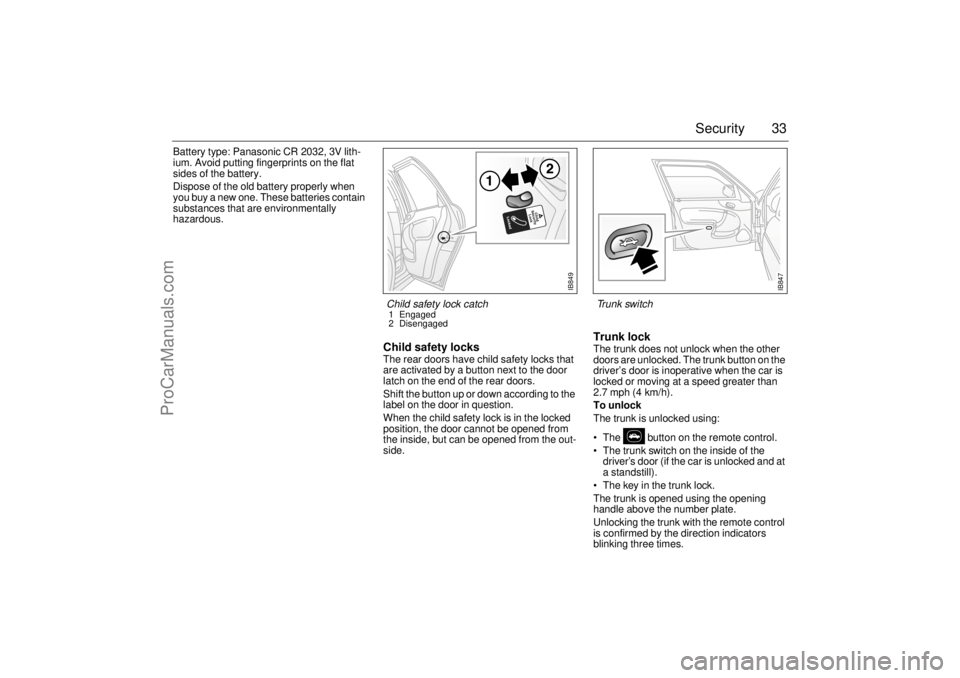
Child safety locksThe rear doors have child safety locks that
are activated by a button next to the door
latch on the end of the rear doors.
Shift the button up or down according to the
label on the door in question.
When the child safety lock is in the locked
position, the door cannot be opened from
the inside, but can be opened from the out-
side.
Trunk lockThe trunk does not unlock when the other
doors are unlocked. The trunk button on the
driver’s door is inoperative when the car is
locked or moving at a speed greater than
2.7 mph (4 km/h).
To unlock
The trunk is unlocked using:
The button on the remote control.
The trunk switch on the inside of the
driver’s door (if the car is unlocked and at
a standstill).
The key in the trunk lock.
The trunk is opened using the opening
handle above the number plate.
Unlocking the trunk with the remote control
is confirmed by the direction indicators
blinking three times.
IB849
Child safety lock catch 1 Engaged
2 Disengaged
IB847
Trunk switch
ProCarManuals.com
Page 35 of 236
35 Security
Car alarmThe car alarm (anti-theft system) is acti-
vated/deactivated when the car is
locked/unlocked by the remote control or by
the key.
All the doors plus trunk lid and hood are
monitored by microswitches, and win-
dow-glass sensors will trigger the alarm if
any glass is broken.
Electronic starting interlock (immobilizer),
see page 36.
The car alarm is armed 10 seconds after the
car has been locked by the remote control.
During this ten-second delay period, the
doors, trunk lid and hood may still be
opened without the alarm being triggered.
The LED indicator on the dash will be on
continuously during this period, at the end of
which it will start to flash (once every third
second) when the alarm arms. If a door or the trunk lid or hood has been left
open when the car is locked, the LED on the
dash will flash (three times per second) for
ten seconds to indicate that something is
wrong.
Check to ensure that all the doors, plus
trunk lid and hood, are closed properly.
If the fault persists (LED flashing when
renewed attempt made to activate the car
alarm by remote control), lock the car using
the key instead. The car alarm may not have
been activated and you should get in touch
with an authorized Saab dealer.
Be sure everyone using the car is familiar
with how both the car alarm and the locking
system work. This will avoid the alarm being
triggered inadvertently.
WARNING
Leaving children or pets unattended in a
locked car is dangerous. It is also danger-
ous to leave children in a vehicle with the
ignition key. A child or others could be
badly injured or even killed.
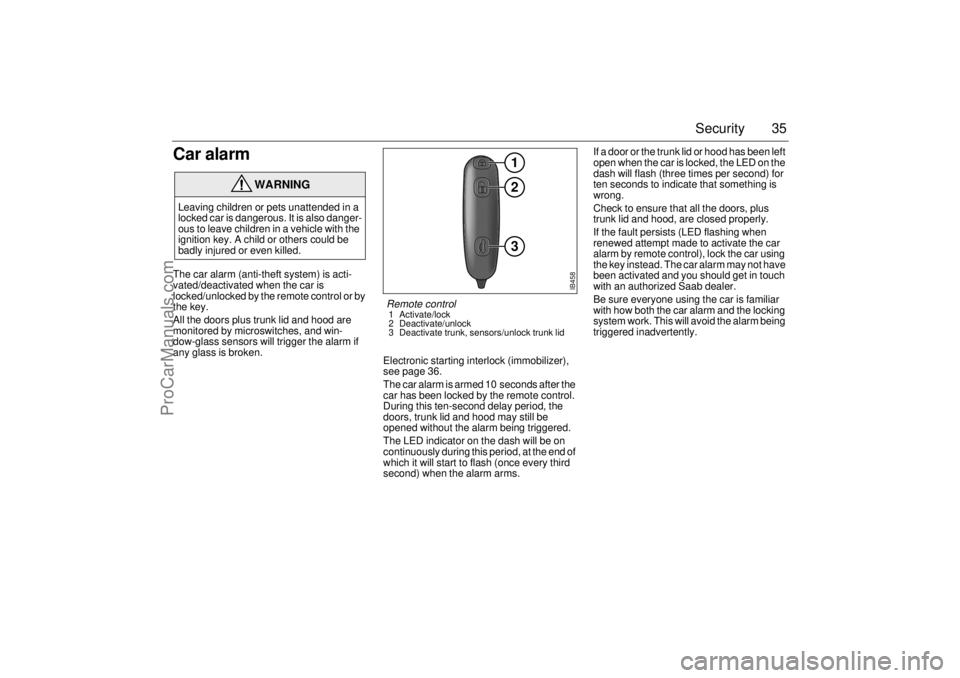
IB458
123
Remote control 1 Activate/lock
2 Deactivate/unlock
3 Deactivate trunk, sensors/unlock trunk lid
ProCarManuals.com
Page 36 of 236

36 SecurityActivating the car alarmThe car alarm (anti-theft system) is
activated/deactivated when the car is
locked/unlocked by the remote control or by
the key.
The car alarm cannot be activated if the
driver’s door is open or if the ignition switch
is in position ON.
If, on the other hand, one of the other doors
or the trunk or hood is open or opened and
not closed again during the 10-seconds
delay period, it will be excluded from the
alarm function.
If it is then closed, a new delay period of ten
seconds will start, and the door (or trunk or
hood) will once again be secured by the
alarm system.
As usual, the LED will be on continuously
during the new delay period and will start to
flash every three seconds after the 10-sec-
onds period has elapsed.
Window glass sensorThe car-alarm (anti-theft system) incorpo-
rates a sensor that monitors the window
glass for the sound of breakage. The sensor
is fitted inside the rear dome light (on Con-
vertibles: in the front interior light).
To avoid false alarms, such as the alarm
being triggered by children or pets left inside
the car, the sensor can be temporarily dis-
abled.
To disable the sensor
To disable the sensor, first turn off the igni-
tion and remove the key from the switch.
Next, press and hold the NIGHT PANEL
button until ”DOOR ALARM ONLY” appears
on the SID and a chime sounds. The car
alarm must now be activated within three
minutes, or the glass sensor will become
active again.
The glass sensor will be enabled again
automatically the next time the car is
unlocked. The sensor can also be enabled
again by repeating the procedure for dis-
abling it. When the sensor has been
enabled, ”FULL THEFT ALARM” will
appear on the SID.
If a fault is detected in the glass sensor,
”SERVICE THEFT ALARM” will appear on
the SID.
9-3 Convertible: when the car is parked
with the soft top down, the glass sensor will
be automatically disabled.
Electronic starting interlock
(immobilizer)When the key is inserted in the ignition, a
signal is sent to the receiver. If the signal is
verified, the engine can be started.
Each time the key is removed from the igni-
tion, the electronic immobilizer is activated.
If a fault is detected (e.g. in the transmitter)
”KEY NOT ACCEPTED” will appear on the
SID.
In this case, you can still start the car if you
turn the ignition key to ON and press one of
the buttons on the remote control.
Take the car to an authorized Saab dealer to
have the system checked.
The LED on the top of the dash dou-
ble-flashes when the car is immobilized.
ProCarManuals.com
Page 42 of 236

42 ConvertibleConvertibleGeneral safety instructions• Never touch the hinges and struts of the
soft top nor the upper beam of the wind-
shield while operating the soft top.
After raising the soft top, always check
that it is properly secured to the top beam
of the windshield with the soft top locking
device before driving the car away.
After folding it down you should check that
the tonneau cover latches have engaged
properly. Otherwise it may come loose
while you are driving and cause injury.
Do not operate the soft top with passen-
gers in the rear seat or bystanders right
next to the car. There is a risk of head inju-
ries while the soft top is in motion.
Remove child car seats and children
before operating the soft top.
Don’t operate the soft top in temperatures
below 23°F (-5°C). Note that certain automatic carwashes
can do damage to fabric soft tops. This
applies to carwashes that use mechanical
feelers bearing against the body. We
advise against washing a Saab 9-3 Con-
vertible in automatic carwashes.
Note that certain automatic car washes
can cause water to leak in places that nor-
mally would not leak. Do not direct high
pressure streams of water at the seals for
the conver tible top.
Roof racks and ski holders must not be
mounted on the soft top.
Under no circumstances should anything
be put into the storage space for the soft
top (under the tonneau cover) since this
could cause obstruction when the soft top
is being folded away.
See that no luggage is resting against the
soft top stowage space since this could
interfere with the rasing and folding of the
soft top. When the soft top is being operated, low-
ering or raising should be completed. Do
not leave the soft top partially raised or
lowered: after 20 seconds it will quickly
"settle down" when the hydraulic pres-
sure is automatically released.
It is important that the telescopic locking
handle is completely pushed in when the
soft top is closed.
Fold down any auxilliary mounted
antenna before raising the top to avoid
possible antenna or top damage (e.g.,
OnStar cellular antenna on windshield of
Conver tible)
ProCarManuals.com
Page 50 of 236
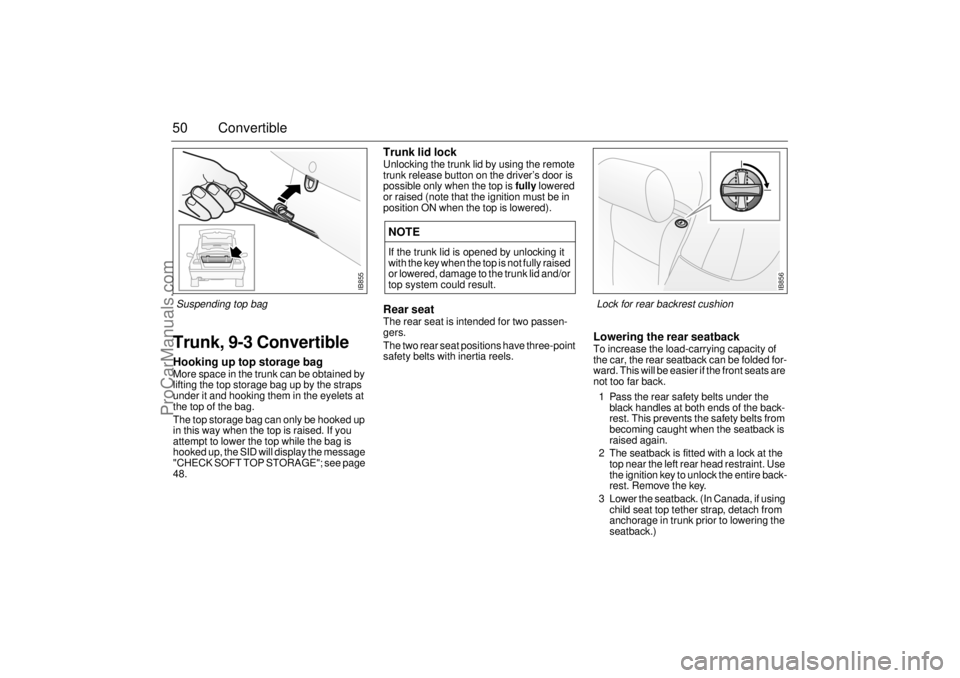
50 ConvertibleTrunk, 9-3 ConvertibleHooking up top storage bagMore space in the trunk can be obtained by
lifting the top storage bag up by the straps
under it and hooking them in the eyelets at
the top of the bag.
The top storage bag can only be hooked up
in this way when the top is raised. If you
attempt to lower the top while the bag is
hooked up, the SID will display the message
"CHECK SOFT TOP STORAGE"; see page
48.
Trunk lid lockUnlocking the trunk lid by using the remote
trunk release button on the driver’s door is
possible only when the top is fully lowered
or raised (note that the ignition must be in
position ON when the top is lowered).Rear seatThe rear seat is intended for two passen-
gers.
The two rear seat positions have three-point
safety belts with inertia reels.
Lowering the rear seatbackTo increase the load-carrying capacity of
the car, the rear seatback can be folded for-
ward. This will be easier if the front seats are
not too far back.
1 Pass the rear safety belts under the
black handles at both ends of the back-
rest. This prevents the safety belts from
becoming caught when the seatback is
raised again.
2 The seatback is fitted with a lock at the
top near the left rear head restraint. Use
the ignition key to unlock the entire back-
rest. Remove the key.
3 Lower the seatback. (In Canada, if using
child seat top tether strap, detach from
anchorage in trunk prior to lowering the
seatback.)
NOTEIf the trunk lid is opened by unlocking it
with the key when the top is not fully raised
or lowered, damage to the trunk lid and/or
top system could result.
IB855
Suspending top bag
IB856
Lock for rear backrest cushion
ProCarManuals.com
Page 120 of 236
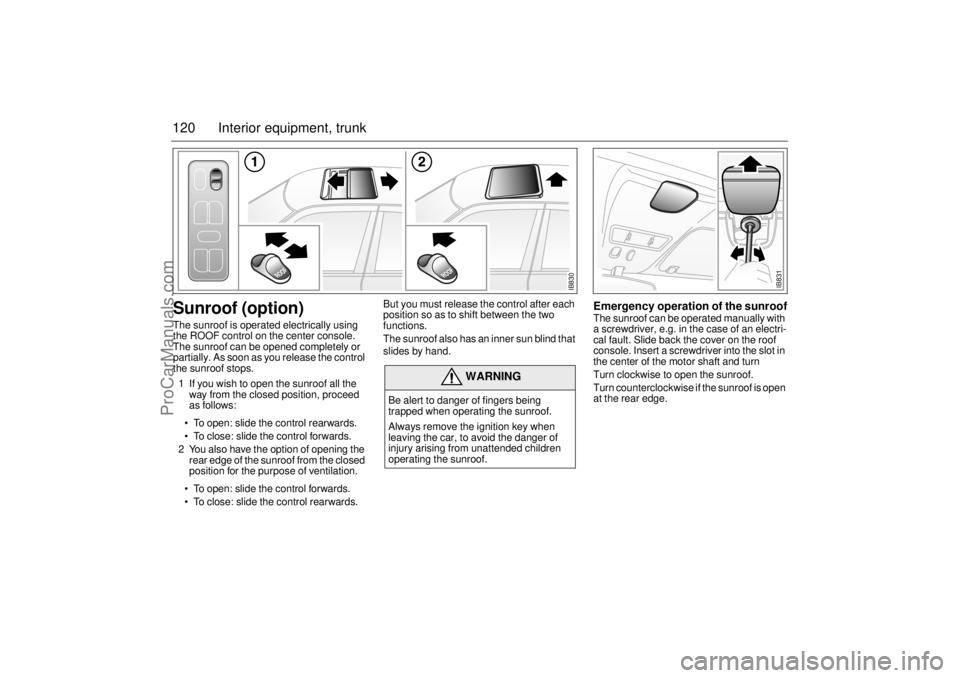
120 Interior equipment, trunkSunroof (option)The sunroof is operated electrically using
the ROOF control on the center console.
The sunroof can be opened completely or
partially. As soon as you release the control
the sunroof stops.
1 If you wish to open the sunroof all the
way from the closed position, proceed
as follows:
To open: slide the control rearwards.
To close: slide the control forwards.
2 You also have the option of opening the
rear edge of the sunroof from the closed
position for the purpose of ventilation.
To open: slide the control forwards.
To close: slide the control rearwards. But you must release the control after each
position so as to shift between the two
functions.
The sunroof also has an inner sun blind that
slides by hand.
Emergency operation of the sunroofThe sunroof can be operated manually with
a screwdriver, e.g. in the case of an electri-
cal fault. Slide back the cover on the roof
console. Insert a screwdriver into the slot in
the center of the motor shaft and turn
Turn clockwise to open the sunroof.
Turn counterclockwise if the sunroof is open
at the rear edge.
WARNING
Be alert to danger of fingers being
trapped when operating the sunroof.
Always remove the ignition key when
leaving the car, to avoid the danger of
injury arising from unattended children
operating the sunroof.
IB830
IB831
ProCarManuals.com
Page 126 of 236
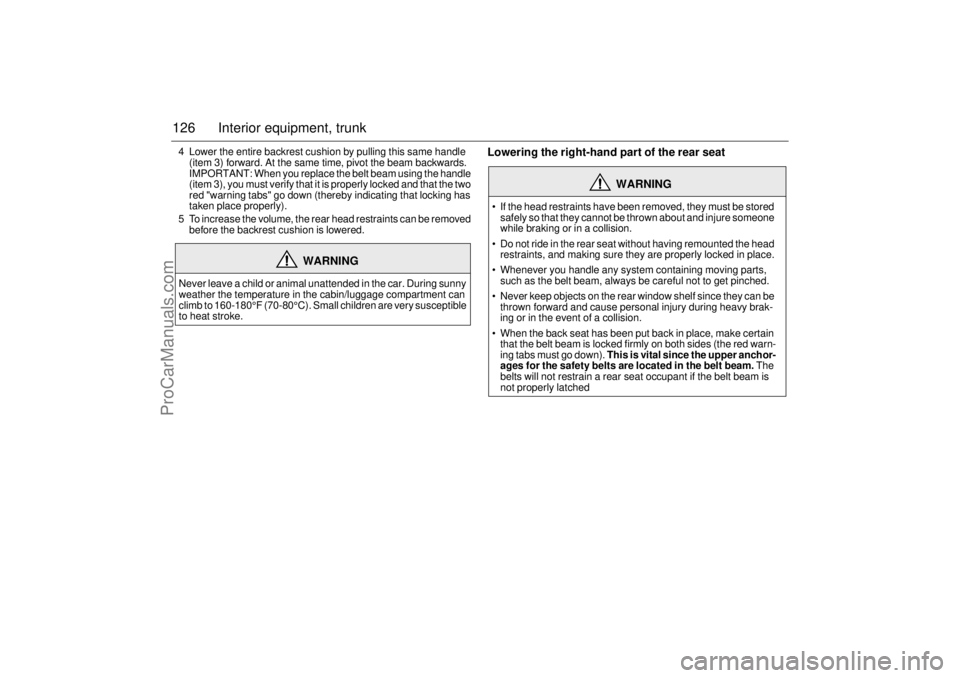
126 Interior equipment, trunk4 Lower the entire backrest cushion by pulling this same handle
(item 3) forward. At the same time, pivot the beam backwards.
IMPORTANT: When you replace the belt beam using the handle
(item 3), you must verify that it is properly locked and that the two
red "warning tabs" go down (thereby indicating that locking has
taken place properly).
5 To increase the volume, the rear head restraints can be removed
before the backrest cushion is lowered.
Lowering the right-hand part of the rear seat
WARNING
Never leave a child or animal unattended in the car. During sunny
weather the temperature in the cabin/luggage compartment can
climb to 160-180°F (70-80°C). Small children are very susceptible
to heat stroke.
WARNING
If the head restraints have been removed, they must be stored
safely so that they cannot be thrown about and injure someone
while braking or in a collision.
Do not ride in the rear seat without having remounted the head
restraints, and making sure they are properly locked in place.
Whenever you handle any system containing moving parts,
such as the belt beam, always be careful not to get pinched.
Never keep objects on the rear window shelf since they can be
thrown forward and cause personal injury during heavy brak-
ing or in the event of a collision.
When the back seat has been put back in place, make certain
that the belt beam is locked firmly on both sides (the red warn-
ing tabs must go down). This is vital since the upper anchor-
ages for the safety belts are located in the belt beam.
The
belts will not restrain a rear seat occupant if the belt beam is
not properly latched
ProCarManuals.com
Page 151 of 236
151 Starting and driving
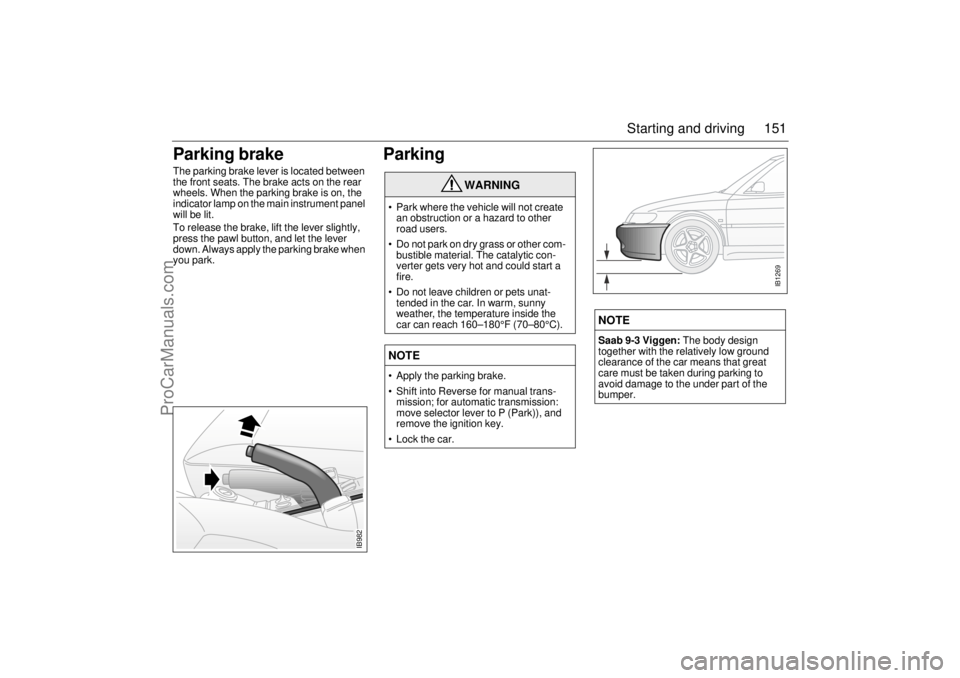
Parking brakeThe parking brake lever is located between
the front seats. The brake acts on the rear
wheels. When the parking brake is on, the
indicator lamp on the main instrument panel
will be lit.
To release the brake, lift the lever slightly,
press the pawl button, and let the lever
down. Always apply the parking brake when
you park.
Parking
WARNING
Park where the vehicle will not create
an obstruction or a hazard to other
road users.
Do not park on dry grass or other com-
bustible material. The catalytic con-
verter gets very hot and could start a
fire.
Do not leave children or pets unat-
tended in the car. In warm, sunny
weather, the temperature inside the
car can reach 160–180°F (70–80°C). NOTE Apply the parking brake.
Shift into Reverse for manual trans-
mission; for automatic transmission:
move selector lever to P (Park)), and
remove the ignition key.
Lock the car.
NOTESaab 9-3 Viggen: The body design
together with the relatively low ground
clearance of the car means that great
care must be taken during parking to
avoid damage to the under part of the
bumper.
IB1269
IB982
ProCarManuals.com
Page 233 of 236

233 Index
Index
AA/C system, fault diagnosis
_______ 207
A/C system, maintenance
_________ 207
ACC
__________________________ 80
ACC, useful tips
_________________ 88
Adjustment, steering wheel
________ 118
Air conditioning (A/C),
fault diagnosis and maintenance
__ 207
Airbag
_________________________ 22
Alarm _________________________ 35
Alarm functions
__________________ 38
Alarm signals
___________________ 38
Anticorrosion treatment
___________ 203
Anti-theft safety, alarm ____________ 35
Ashtray
_______________________ 123
Audio System
___________________ 90
Automatic climate control (ACC)
_____ 80
Automatic transmission
___________ 141
BBattery
_______________________ 177
Boost starting from donor battery
___ 162
Brake fluid, check
_______________ 176
Brake fluid, grade _______________ 227
Brake pad wear indicators
________ 176
Brakes
________________________ 149Braking
_______________________ 149
Bulb table _____________________ 186
CCD changer
____________________ 101
CD player
______________________ 99
CHECK messages
____________ 63
, 68
CHECKING
__________________ 63
, 68
Cabin lighting
__________________ 121
Calibration, ACC _________________ 86
Car alarm
______________________ 35
Car phone, installation
___________ 109
Cassette player
__________________ 96
Center console compartment
______ 123
Central locking
__________________ 30
Change of address notification
_____ 214
Changing a wheel
_______________ 196
Changing bulbs
_________________ 181
Changing the coolant
____________ 175
Changing the engine oil __________ 173
Changing wiper blades
___________ 179
Chassis number
________________ 229
Child car seats
__________________ 18
Child safety
_____________________ 18
Child safety locks, rear doors
_______ 33
Child seats
_____________________ 18
Cigar lighter ____________________ 123
Cleaning the soft top
______________ 51
Climate-control system, manual
_____ 76
Clock
__________________________ 69Condensation water, A/C
__________ 78
Condensation water, ACC __________ 81
Convertible
_____________________ 42
Coolant
_______________________ 174
Courtesy Headlight Feature
________ 72
Cruise Control
__________________ 148
Cup holder
_____________________ 122
DDICE/TWICE
___________________ 188
Date code, tires _________________ 195
Dim low beam
___________________ 71
Dimmer
________________________ 74
Direction indicators
_______________ 72
Direction-indicator stalk
____________ 72
Dome lighting
__________________ 121
Door mirrors
___________________ 124
Drive belt
______________________ 179
Driving in deep water
_____________ 166
Driving in hot weather ____________ 156
Driving technique
________________ 153
Driving with a compact spare wheel
_ 165
Driving with a roof load
___________ 158
Driving with the trunk lid open
______ 166
EEconomical motoring
_____________ 153
Electrical system, technical data
____ 225
ProCarManuals.com
Page 234 of 236

234 IndexElectrical window
_______________ 119
Electrically adjustable seats
_______ 116
Electrically heated front seats ______ 118
Electrically heated rear seat
_______ 118
Electrically heated rear window _____ 79
Electronic starting interlock
_________ 31
Emergency opening, fuel filler door
_ 131
Emergency operation of the soft top,
Convertible
____________________ 46
Emergency operation of the sunroof
_ 120
Emission control systems
_________ 170
Engine bay, cleaning
____________ 201
Engine bay, gasoline engine
_______ 169
Engine break-in period
_______ 140
, 153
Engine number
_________________ 229
Engine oil, change ______________ 173
Engine oil, checking _____________ 172
Engine oil, grade
________________ 223
Engine oil, volume ______________ 223
Engine variants
_________________ 225
Engine, description ______________ 168
Engine, technical data ___________ 223
FFault codes, Audio System
________ 110
Flat spot
______________________ 199
Folding the soft top
_______________ 43
Fuel filler door, emergency opening
_ 131
Fuel gauge
_____________________ 61
Fuel grade _____________________ 224Fueling
_______________________ 138
Fuse table _____________________ 189
Fuses
________________________ 187
GGearbox number
________________ 229
Gearbox oil, checking and changing
_173
Gearbox oil, grade
______________ 226
General safety instructions,
Convertible
____________________ 42
Glove compartment
______________ 123
HHazard warning lights
_____________ 72
Head restraint
__________________ 114
Headlight flasher _________________ 71
Hood
_________________________ 168
Horn signal
____________________ 118
IIf the car does not start
___________ 135
Ignition switch
__________________ 134
Immobilizer
_____________________ 31
Important considerations concerning
cars with catalytic converters
_____ 137Important considerations for driving,
turbo models
__________________ 136
Instrument lighting
________________ 74
Integrated child car seat
___________ 20
Interior lighting
__________________ 121
Interior lighting, Convertible
_________ 52
Interior rearview mirror
___________ 124
KKey
___________________________ 30
Key, removing
__________________ 134
LLabels and plates
_______________ 229
Leather upholstery, care of
________ 200
Load eyes
_____________________ 129
Locks
__________________________ 30
Lowering rear seat
_______________ 125
Luggage compartment
___________ 125
Luggage compartment, Convertible
__ 50
Luggage-compartment lighting
_____ 129
MMain beam
______________________ 71
Main instrument panel
_____________ 54
Maintenance schedule ___________ 212
ProCarManuals.com