heating SAAB 9-3 2000 User Guide
[x] Cancel search | Manufacturer: SAAB, Model Year: 2000, Model line: 9-3, Model: SAAB 9-3 2000Pages: 236, PDF Size: 10.85 MB
Page 88 of 236
88 Instruments and controlsUseful tips: If the ACC system is not functioning
satisfactorily the following should be tried
before you take the car to an authorized
Saab dealer.
If the indication AUTO does not light up
after starting (the ignition must have been
switched off for at least 10 minutes): See
Cancelling programming of ACC.
If you think that the ACC system is not
functioning satisfactorily you should:
1. Check that the cigarette lighter plug is
in its socket (since if the socket is empty
heated air can flow out and affect the
cabin sensor).
2. Recalibrate: See the section headed
Calibration.
If the battery has been disconnected or
has died, the ACC system should be reca-
librated: See Calibration.
Programmed settings are not deleted if the
battery has been disconnected. Extinguishing the lighting in ACC See section Night Panel, page 63.
ACC - 9-3 Convertible When the soft top is folded down the ACC
system goes over to manual temperature
setting.
Between HI and LO there are eleven (0-10)
fixed temperature steps.
The system adjusts itself as follows
AUTO is turned off.
Heating, air distribution and fan speed are
not affected.
Recirculation and electric rear window
are turned off.
A/C assumes the same setting (ON/OFF)
as it had when the soft top was last folded
down.
All manual selections are possible with the
exception of electric rear window.
Saab recommends leaving the ACC setting
on ECON when the soft top is folded down
to improve fuel economy and unnecessary
running of the A/C compressor.
When the soft top is raised the system
reverts to the AUTO mode and the previous
set temperature.
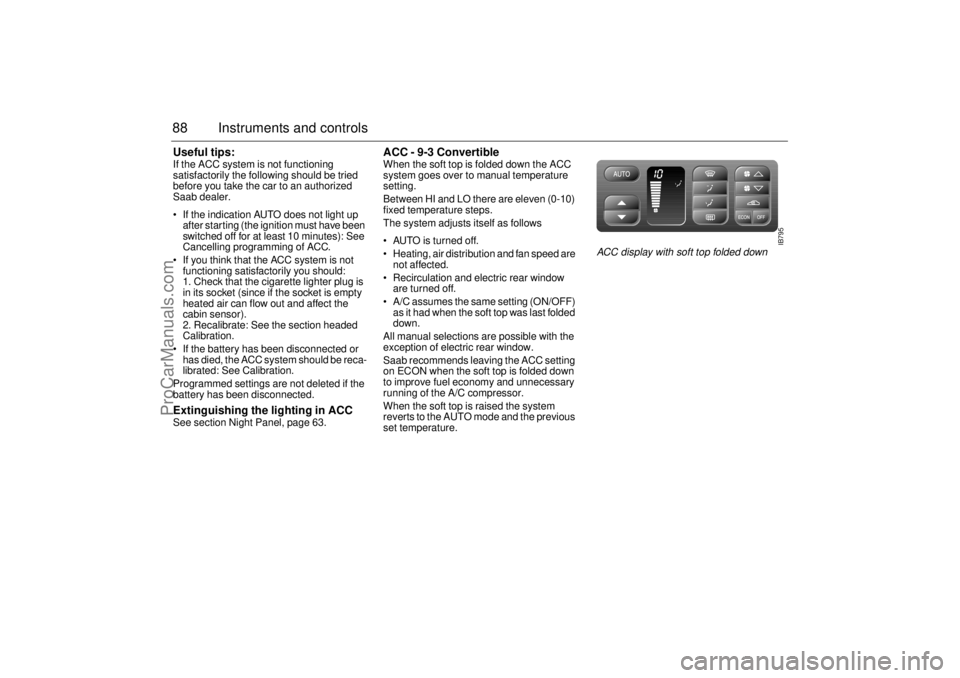
IB795
ACC display with soft top folded down
ProCarManuals.com
Page 118 of 236
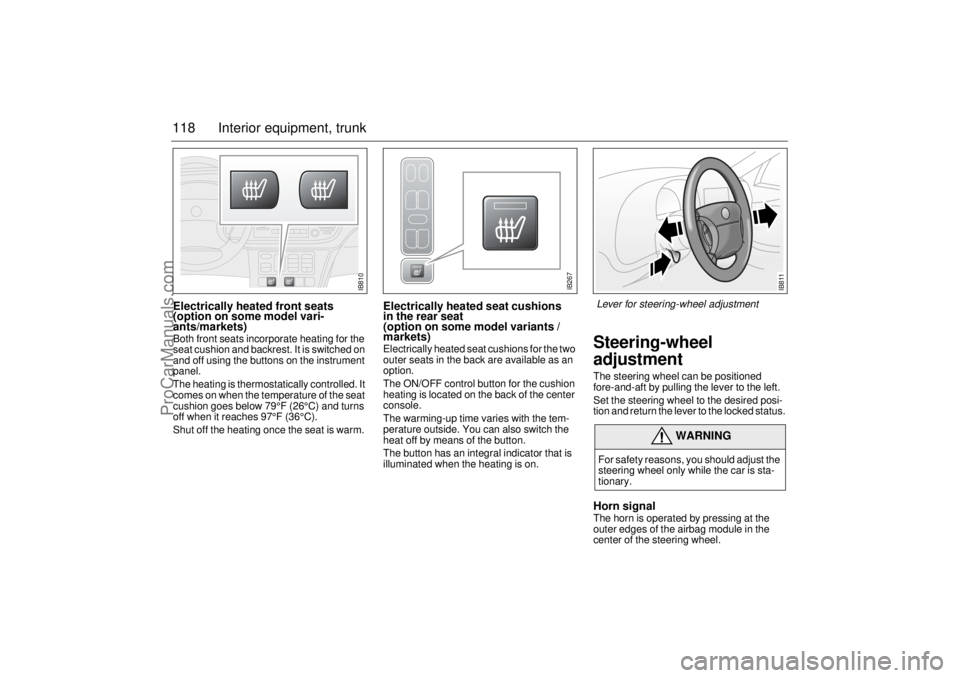
118 Interior equipment, trunkElectrically heated front seats
(option on some model vari-
ants/markets)Both front seats incorporate heating for the
seat cushion and backrest. It is switched on
and off using the buttons on the instrument
panel.
The heating is thermostatically controlled. It
comes on when the temperature of the seat
cushion goes below 79°F (26°C) and turns
off when it reaches 97°F (36°C).
Shut off the heating once the seat is warm.
Electrically heated seat cushions
in the rear seat
(option on some model variants /
markets) Electrically heated seat cushions for the two
outer seats in the back are available as an
option.
The ON/OFF control button for the cushion
heating is located on the back of the center
console.
The warming-up time varies with the tem-
perature outside. You can also switch the
heat off by means of the button.
The button has an integral indicator that is
illuminated when the heating is on.
Steering-wheel
adjustmentThe steering wheel can be positioned
fore-and-aft by pulling the lever to the left.
Set the steering wheel to the desired posi-
tion and return the lever to the locked status. Horn signalThe horn is operated by pressing at the
outer edges of the airbag module in the
center of the steering wheel.
WARNING
For safety reasons, you should adjust the
steering wheel only while the car is sta-
tionary.
IB810
IB267
IB811
Lever for steering-wheel adjustment
ProCarManuals.com
Page 124 of 236
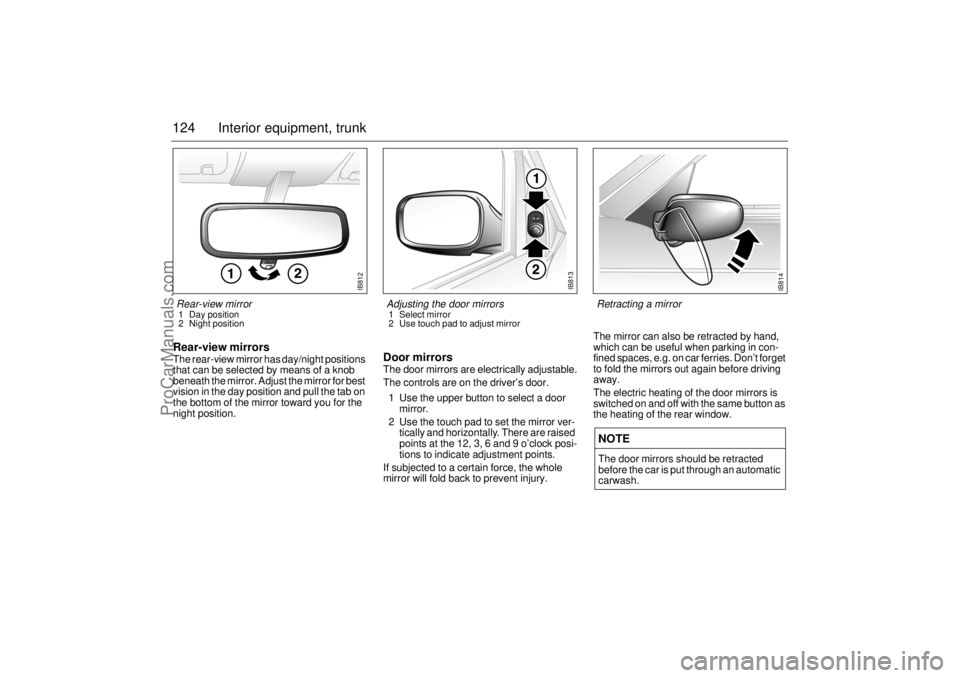
124 Interior equipment, trunkRear-view mirrorsThe rear-view mirror has day/night positions
that can be selected by means of a knob
beneath the mirror. Adjust the mirror for best
vision in the day position and pull the tab on
the bottom of the mirror toward you for the
night position.
Door mirrorsThe door mirrors are electrically adjustable.
The controls are on the driver’s door.
1 Use the upper button to select a door
mirror.
2 Use the touch pad to set the mirror ver-
tically and horizontally. There are raised
points at the 12, 3, 6 and 9 o’clock posi-
tions to indicate adjustment points.
If subjected to a certain force, the whole
mirror will fold back to prevent injury. The mirror can also be retracted by hand,
which can be useful when parking in con-
fined spaces, e.g. on car ferries. Don’t forget
to fold the mirrors out again before driving
away.
The electric heating of the door mirrors is
switched on and off with the same button as
the heating of the rear window.
NOTEThe door mirrors should be retracted
before the car is put through an automatic
carwash.
IB813
Adjusting the door mirrors 1 Select mirror
2 Use touch pad to adjust mirror
IB814
Retracting a mirror
IB812
Rear-view mirror1 Day position
2 Night position
ProCarManuals.com
Page 144 of 236
144 Starting and driving
Automatic transmission
fault indicator
If the symbol appears on the main instru-
ment panel, the system has detected a fault
in the automatic transmission or its control
module (see page 58).
This also means that the Limp-home mode
has been selected, to guard against further
damage being done to the transmission. In
this mode, the automatic transmission
starts in 4th gear, and gear changes (if nec-
essary) will have to be made manually.
It is not possible to select the SPORT or
WINTER mode when the Limp-home mode
is active.
You should have the automatic transmis-
sion checked as soon as possible by an
authorized Saab dealer.
The following gears will be engaged in the
respective selector positions when the auto-
matic transmission is in the Limp-home
mode:
Overheated transmission oilIf the transmission oil becomes overheated
while driving, the following message
appears on the SID: TRANSMISSION
OVERHEATING. In this event, stop the car
in a suitable place, switch off the engine,
open the hood and wait until the message
goes out. When driving subsequent to the
transmission oil overheating, select a
locked gear position in which the engine
speed is about 3,000 rpm.
The transmission oil can become very hot
when the car is driven with a heavy load; for
example, driving with a trailer on hilly roads
when the wrong gear has been selected,
resulting in many extra gear changes.
Select one of the positions 1, 2 or 3. A high
outside temperature or a defective oil cooler
can also cause the oil temperature to
increase. Contact an authorized Saab work-
shop, see also page 156.
Driving in hilly country with a heavy
loadOverheating of the automatic-transmission
fluid can occur when the car is towing a
heavy load, such as a trailer in hilly country,
with the wrong gear selected, resulting in
abnormally frequent gear changing. Try
selecting position 1, 2 or 3. High ambient
temperatures can also increase the temper-
ature of the transmission fluid or the oil
cooler may be faulty. As the transmission
fluid temperature increases, its useful ser-
vice life is reduced. Contact an authorized
Saab dealer (see also page 156).TowingTowing a car with automatic transmission,
see page 162. Position R D 3 2 1
Gear Reverse 4th 4th 3rd 3rd
NOTEIf the control module has actuated the
Limp-home function for the automatic
transmission, the car will remain in 4th
gear when D is selected, making it very
sluggish. To overcome this, move the
selector lever to position 2.
WARNING
Remember to use engine-braking (selec-
tor position 1, 2, or 3) to spare the brakes
when you are driving on a long or steep
downhill slope. Select the same gear as
you would on the corresponding uphill
slope.
Brake failure can result from overheated
brakes!
ProCarManuals.com
Page 146 of 236

146 Starting and drivingIf the gear selector lever is moved from position D to 1, a
change-down to 3rd gear will occur at about 110 mph (180 km/h).
A change-down to 2nd gear will occur at about 75 mph (120 km/h)
and to 1st gear at about 40 mph (65 km/h).
When position 1 is selected, all the other gears will be locked out.
Manual gear-changing is not recommended on slippery roads.
2.0 Turbo 185 hp and 205 hp: If one of the drive wheels spins
excessively, the engine torque will be reduced to avoid damaging
the transmissionKick-downWhen the accelerator is pressed down hard, a downshift to the next
lower gear will occur to provide maximum acceleration, e.g. for over-
taking.
The change-up to the next gear again will take place either when the
accelerator is released or when maximum engine speed for that
gear is reached.
Adaptive gear-change patternsAdaptive gear-change patterns are selected automatically depend-
ing on the engine load. This function applies in the Normal and Sport
modes.
The change occurs at a higher rotation speed and the gear remains
engaged for a longer period, if the control module senses that the
load does not drop. These change patterns avoid unnecessary gear
changes when, for example, driving on long inclines with a trailer,
and to prevent overheating of the transmission oil. This function cuts
in automatically if the oil becomes too hot, to protect the transmis-
sion from serious damage, and lower the oil temperature.
The adaptive change pattern function is not activated at speeds over
93 mph (150 km/h). If a pattern is in operation when this speed is
exceeded, it will be maintained until the control module senses that
a more suitable one can be activated.
The adaptive gear-change pattern function is deselected when:
Winter mode is selected.
The engine is switched off.
The load is reduced by so much that this function is no longer
required.
“Automatic transmission fault indicator” appears on the
main instrument panel, see page 144. 1
Position 1 should be used when maximum
engine-braking is required on steep downhill
slopes and to avoid frequent gear-changing on
steep climbs.
Do not move the selector to position 1 at speeds
in excess of 30 mph (50 km/h).
ProCarManuals.com
Page 149 of 236
149 Starting and driving
Disengaging the system The system will be disengaged:
When the brake or clutch pedal is
depressed.
When the switch is moved to CANCEL.
When the switch is moved to OFF.
When the engine is switched off.
When the selector lever is moved to posi-
tion N (cars with automatic transmission).
BrakingTo avoid overheating the brakes, (e.g. when
negotiating long descents with a drop of
several hundred feet), select a low gear to
use the braking effect of the engine. If the
car has automatic transmission, move the
selector lever to position 1 or 2.
When driving fast, you can help to prolong
the life of the brakes by thinking ahead and
braking harder for short periods, rather than
braking more moderately over long
stretches. Brake pad wear indicatorsThe outboard brake pads on the front
wheels incorporate pad-wear indicators.
When the lining is down to 3 mm, the pad
will produce a screeching, squealing or
scraping noise when the brakes are applied.
New pads should be installed without delay.
Brake pads should only be replaced by
an authorized Saab dealer.
To ensure optimum brake performance,
it is recommended that you use only
Saab original brake pads.
WARNING
It is prudent to try your brakes from
time to time, especially when driving in
heavy rain, on roads with a lot of sur-
face water, or in snow or slush. In such
conditions, the brakes may take
longer than normal to take effect. To
rectify this, touch the brake pedal peri-
odically to dry the brakes out.
The same applies after the car has
been washed or when the weather is
very humid.
The brakes are power assisted and it
should be kept in mind that the servo
unit only provides the power assis-
tance when the engine is running.
The brake pressure required when the
engine is off,( e.g. when the car is
being towed) is roughly four times the
normal pedal force required. The
pedal also feels hard and unrespon-
sive.
ProCarManuals.com
Page 157 of 236
157 Starting and driving
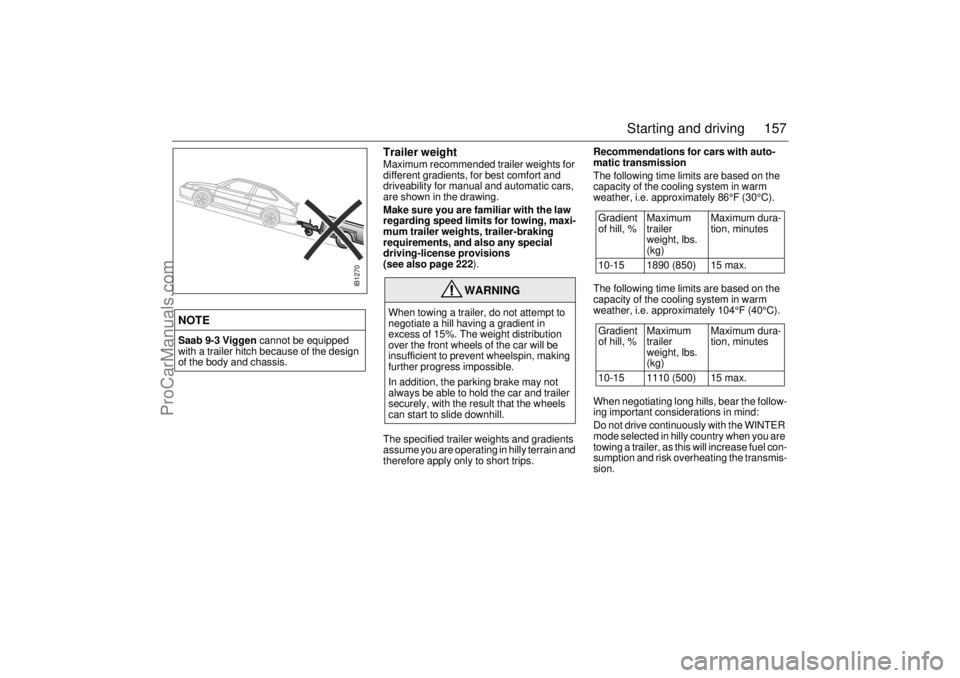
Trailer weightMaximum recommended trailer weights for
different gradients, for best comfort and
driveability for manual and automatic cars,
are shown in the drawing.
Make sure you are familiar with the law
regarding speed limits for towing, maxi-
mum trailer weights, trailer-braking
requirements, and also any special
driving-license provisions
(see also page 222).
The specified trailer weights and gradients
assume you are operating in hilly terrain and
therefore apply only to short trips.Recommendations for cars with auto-
matic transmission
The following time limits are based on the
capacity of the cooling system in warm
weather, i.e. approximately 86°F (30°C).
The following time limits are based on the
capacity of the cooling system in warm
weather, i.e. approximately 104°F (40°C).
When negotiating long hills, bear the follow-
ing important considerations in mind:
Do not drive continuously with the WINTER
mode selected in hilly country when you are
towing a trailer, as this will increase fuel con-
sumption and risk overheating the transmis-
sion.
NOTESaab 9-3 Viggen cannot be equipped
with a trailer hitch because of the design
of the body and chassis.
WARNING
When towing a trailer, do not attempt to
negotiate a hill having a gradient in
excess of 15%. The weight distribution
over the front wheels of the car will be
insufficient to prevent wheelspin, making
further progress impossible.
In addition, the parking brake may not
always be able to hold the car and trailer
securely, with the result that the wheels
can start to slide downhill.
Gradient
of hill, % Maximum
trailer
weight, lbs.
(kg)Maximum dura-
tion, minutes
10-15 1890 (850) 15 max.
Gradient
of hill, % Maximum
trailer
weight, lbs.
(kg)Maximum dura-
tion, minutes
10-15 1110 (500) 15 max.
IB1270
ProCarManuals.com
Page 188 of 236

188 Car careMAXI fusesThe MAXI fuses are housed in the fuse box
under the hood. These fuses can be
checked in the same way as the other fuses.
The MAXI fuses are designed to protect the
car’s electrical system from being dam-
aged. Each MAXI fuse protects a number of
electrical circuits and functions and there-
fore has a higher rating (amperage) than the
standard fuses. No spare MAXI fuses are
supplied with the car.
DICE / TWICEDICE = Dashboard Integrated Central Elec-
tronics
TWICE = Theft-Warning Central Electronics
DICE and TWICE are electronic control
modules.
DICE controls, among other things:
Front lights and interior lighting.
Instrument illumination.
Intermittent wiper operation.
Electric heating of rear window and door
mirrors.
TWICE controls, among other things:
Central locking.
Car alarm (Anti-theft system).
Engine immobilizer.
Auto checking of lights.
Electric heating of rear seat.
Safety belt reminder.
Electrically adjustable passenger seat.The DICE and TWICE control modules are
linked to a data bus, which is basically an
information carrier that allows information to
be exchanged between all the control mod-
ules and components connected to the bus.
If a fault occurs in any of these components,
diagnostic faults codes are set in the rele-
vant control module, which enhances fault
diagnosis at the Saab dealer.
The scan tool connector for fault diagnosis
is located under the instrument panel on the
drivers side.
NOTEIf a MAXI fuse blows, it means that there
is a major fault in the electrical system.
Have the car checked without delay by an
authorized Saab dealer.
IB920
MAXI fuse for soft-top system
(Convertible)
ProCarManuals.com
Page 189 of 236
189 Car care
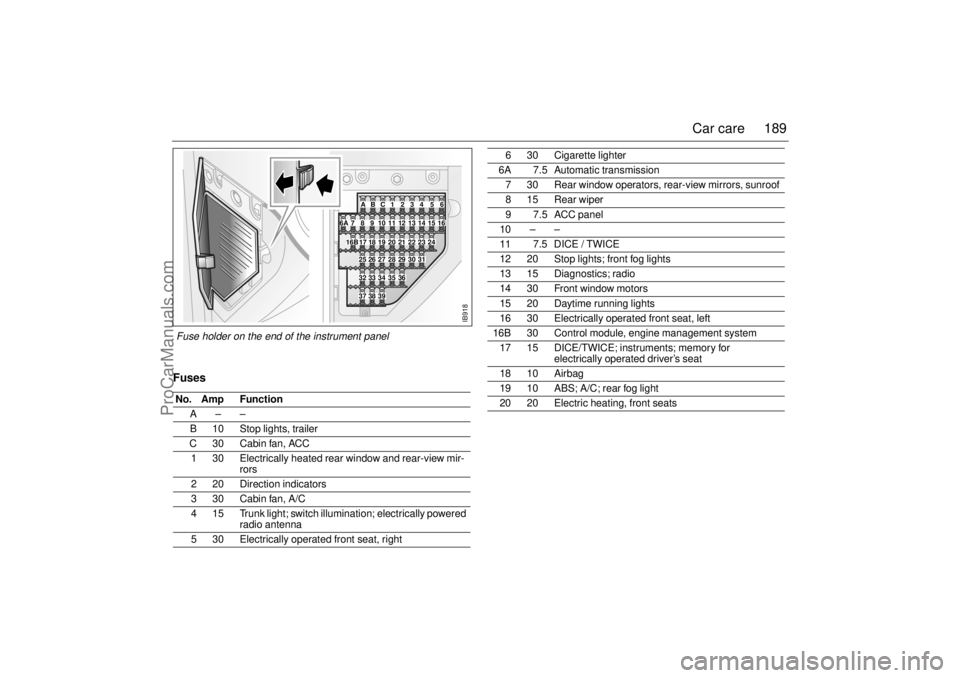
FusesNo. Amp Function
A––
B 10 Stop lights, trailer
C 30 Cabin fan, ACC
1 30 Electrically heated rear window and rear-view mir-
rors
220Direction indicators
330Cabin fan, A/C
4 15 Trunk light; switch illumination; electrically powered
radio antenna
5 30 Electrically operated front seat, right
6 30 Cigarette lighter
6A 7.5 Automatic transmission
7 30 Rear window operators, rear-view mirrors, sunroof
8 15 Rear wiper
9 7.5 ACC panel
10 – –
11 7.5 DICE / TWICE
12 20 Stop lights; front fog lights
13 15 Diagnostics; radio
14 30 Front window motors
15 20 Daytime running lights
16 30 Electrically operated front seat, left
16B 30 Control module, engine management system
17 15 DICE/TWICE; instruments; memory for
electrically operated driver’s seat
18 10 Airbag
19 10 ABS; A/C; rear fog light
20 20 Electric heating, front seats
30 10 20
30 30 15
15 15
10 10 10
10
10
10 30
30 10 20
15
15
15
10 10
20
10 20 20
20 20 15
15
30 15
15 10 15
15
IB918
1 C B A23456
7 6A 8 9 10 11 12 13 14 15 16
17 16B 18 19 20 21 22 23 2425 26 27 28 29 30 3132 33 34 35 3637 38 39
Fuse holder on the end of the instrument panel
ProCarManuals.com
Page 190 of 236

190 Car care
Relay holderUnder the instrument panel next to the steering wheel No. Amp Function
21 10 Manual A/C; soft top (Convertible)
22 15 Cruise Control; direction indicators
23 20 Soft top (Convertible); telephone
24 7.5 Radio
25 30 Central locking
26 30 Control module, engine management system; igni-
tion cassette
27 15 High beam flash; ACC
28 10 Engine management system
29 10 Right parking light; number-plate lighting
30 10 Left parking light
31 20 Reversing light; windshield wipers; headlight
beam-length adjustment
32 15 Fuel pump
33 15 Electric heating of rear seat
34 10 SID; control module; automatic transmission
35 15 DICE/TWICE; main instrument panel; interior light-
ing
36 10 Relay, starter
37 – –
38 25 Oxygen sensor (lambda probe)
39 – –Item Function
A Electric heating of rear seat
B Reversing light, cars with automatic transmission
C1 –
C2 Lock motor, trunk lid
D1 Rear wiper
D2 Rear-window washing
E Ignition switch
F–
G Windshield wipers (intermittent)
H Rear-window heating
IFuel pump
J–
KStart relay
L Main relay (injection system)
ProCarManuals.com